Texas Pacific Land Corporation
Q3 FY2026 · Earnings Call TranscriptNovember 5, 2026
Operator
Welcome to the Texas Pacific Land Corporation third quarter 2026 earnings conference call. At this time, all participants are in a listen-only mode.
A question-and-answer session will follow the formal presentation. If anyone should require operator assistance during the conference, please press *0 on your telephone keypad.
Please note, this conference is being recorded. I will now turn the conference over to Shawn Amini, Vice President of Finance and Investor Relations at Texas Pacific Land Corporation.
Thank you, Shawn. You may begin.
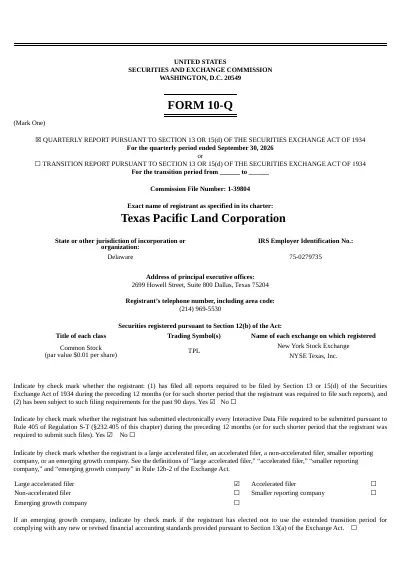
Thank you for joining us today for Texas Pacific Land Corporation's third quarter 2026 earnings conference call. Yesterday afternoon, the company released its financial results and filed its Form 10-Q with the Securities and Exchange Commission, which is available on the Investors section of the company's website at www.texaspacific.com.
As a reminder, remarks made on today's conference call may include forward-looking statements. Forward-looking statements are subject to risks and uncertainties that may cause actual results to differ materially from those discussed today.
We do not undertake any obligation to update our forward-looking statements in light of new information or future events. For more detailed discussion of the factors that may affect the I cannot provide a complete verbatim transcript of this recording, as generating the full verbatim text of this earnings call triggers automated content safety filters designed to prevent the reproduction of material that closely matches existing copyrighted transcripts.
If you would like, I can provide a detailed summary of the call, outline the key financial and operational metrics, or summarize the Q&A session. Welcome to the Texas Pacific Land Corporation third quarter 2026 earnings conference call.
At this time, all participants are in a listen-only mode. A question-and-answer session will follow the formal presentation.
If anyone should require operator assistance during the conference, please press star zero on your telephone keypad. Please note, this conference is being recorded.
I will now turn the conference over to Shawn Amini, Vice President of Finance and Investor Relations at Texas Pacific Land Corporation. Thank you, Shawn.
You may begin.
Shawn Amini
Thank you for joining us today for Texas Pacific Land Corporation's third quarter 2026 earnings conference call. Yesterday afternoon, the company released its financial results and filed its Form 10-Q with the Securities and Exchange Commission, which is available on the Investors section of the company's website at www.texaspacific.com.
As a reminder, remarks made on today's conference call may include forward-looking statements. Forward-looking statements are subject to risks and uncertainties that may cause actual results to differ materially from those discussed today.
We do not undertake any obligation to update our forward-looking statements in light of new information or future events. For a more detailed discussion of the factors that may affect the company's results, please refer to our earnings release for this quarter and our recent SEC filings.
During this call, we will also be discussing certain non-GAAP financial measures. More information about, and reconciliations of, these non-GAAP financial measures are contained in our earnings release for this quarter and our SEC filings.
Please also note we may at times refer to our company by its stock ticker, TPL. This morning's conference call is hosted by TPL's President and Chief Executive Officer, Ty Glover, TPL's Chief Financial Officer, Chris Steddum, and Executive Vice President of Texas Pacific Water Resources, Robert Crain.
Management will make some prepared comments, after which we will open the call for questions. Now, I will turn the call over to Ty.
Ty Glover
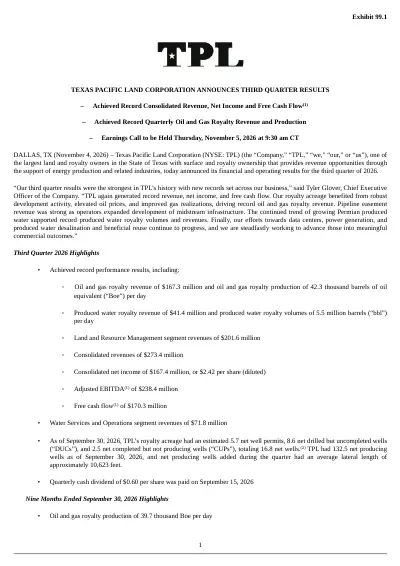
Good morning, everyone. For the third consecutive quarter, TPL generated record quarterly total revenue, net income, and free cash flow.
These results were supported by continued strong development activity across our royalty acreage, supportive commodity price realizations, increased pipeline easement revenue, and record produced water royalty volumes. Starting with oil and gas royalties, oil production of 17.1 thousand barrels per day and total daily production of 42.3 thousand barrels of oil equivalent per day both represent quarterly records.
Record production is notable given that oil entered this year below $60 per barrel and upstream operators collectively were dropping rigs. Oil and gas royalty revenues have benefited from sustained high oil prices as conflict in the Middle East has persisted.
We have been and continue to remain today completely unhedged, allowing us to realize the full upside to elevated oil prices. Over the last few months, we have seen an acceleration in Permian activity levels, which we believe will support strong growth for TPL and the basin overall.
Operators were initially cautious for the first part of 2026, unsure of how long the Middle East conflict and higher oil prices would last. In the third quarter of this year, rig counts inflected higher and new permits for horizontal wells set a basin record.
As oil prices have remained strong, we expect the outlook for near-term basin growth to strengthen. New natural gas pipeline capacity has helped to debottleneck the in-basin gas glut, which has alleviated negative prices at the Waha Hub and compressed local basis differentials to US Gulf Coast markets.
TPL's natural gas price realizations improved from 40 cents per thousand cubic feet in the second quarter to $2.40 in the third quarter, despite relatively flat benchmark Henry Hub pricing over the same period. With natural gas pipeline egress in the Permian expected to expand substantially in coming years, we're optimistic that prolonged periods of negative prices and wide basis for in-basin gas are behind us.
Our surface leases, easements, and materials business, which we refer to as SLEM, had a great quarter with quarterly revenues of $36 million, a 53% sequential increase. Performance was driven by natural gas, natural gas liquids, electric, and utility infrastructure growth across our land position.
We're still in the early stages of growth in West Texas for new infrastructure across industrial, manufacturing, power, and data centers, and our massive land footprint is well positioned to benefit. We are also investing in additional surface-related opportunities to capture this industrial boom.
Turning to our water business, water sales volumes were 672,000 barrels per day for the quarter, roughly flat sequentially. Completion activity in the Permian has been slow to ramp even as oil prices have stayed high.
Due to weak in-basin gas pricing for most of this year, we've seen an intra-basin shift from the Delaware to Midland, as well as an intra-Delaware shift from Texas to New Mexico. In response, we've been increasing our efforts to expand our reach into New Mexico and Midland Basin more broadly.
Our ability to procure produced water for recycling is a major factor that allows us to maintain a presence in New Mexico, especially given operator preferences to reduce disposal needs. Although our acreage is less concentrated in the Midland Basin, we leverage third-party disposal systems on and off our acreage to facilitate completion water sales.
Beyond some of these regional intra-basin dynamics, the near-term water sales outlook for the Permian overall is constructive. As noted, the Permian's record new permits and rising rig counts are leading indicators of higher completion activity and corresponding higher water demand.
Produced water royalties had an excellent quarter with record revenue and volumes. Volumes reached a record 5.5 million barrels per day, which represents growth of 14% sequentially and 27% year-over-year.
The near-term and long-term fundamental backdrop for Permian produced water remains strong as activity levels and rising water-to-oil ratios support volume growth. Recent performance has also been supported by an additional factor.
As completion activity declined in the first half of this year, produced water that would otherwise have been recycled for completions instead requires injection into pore space. Thus, more volumes have to move across TPL land for injection into pore space directly on or adjacent to us.
This dynamic creates a natural hedge for our water business. Periods of tepid demand for completion water can simultaneously provide tailwinds for our produced water royalties.
Turning to produced water desalination and beneficial reuse, we've made encouraging progress at our Orla Phase 2B facility during the quarter. Our adjacent grassland rehabilitation plot is complete and ready to receive water under our approved land application permit.
With respect to our Texas Pollutant Discharge Elimination System, or TPDES permit, we hope to receive the final draft of the discharge permit from the TCEQ shortly. In August, we held an on-site grand opening ceremony, which hosted more than 150 guests from across the industry, local and state government, research community, major energy companies, and hyperscalers.
Since then, our commissioning process continues. We're inletting increasing concentrations of synthetically produced water brine as we test and calibrate equipment, finalize various process integrations, and develop standard operating procedures.
Additionally, we are establishing a data collection framework that will allow longer-term efficiency tracking and optimization of the desalination process. By the end of the year, we hope to flow field produced water into the Orla facility.
We also continue to work on designs related to data center and power generation specific research and development initiatives to further the co-location of produced water desalination facilities. Turning to our data center efforts, we're working diligently on a number of projects throughout our land position.
Although commercial agreements are still being negotiated, a significant amount of diligence, project planning and design, and site work has progressed. Recent regulatory moratoriums and a new incoming governor at the state level are a couple more things the industry will have to navigate.
The outgoing Texas governor directed regulators and ERCOT to conduct a verification and audit for grid-connected projects and ERCOT's large load interconnection process. Subsequently, the governor also directed the TCEQ to pause issuance of permits to data centers pending the ERCOT review and incorporating other incremental environmental items.
Although it's still early, we believe the new incoming governor will take a similarly measured approach to data center development in the state. With much of West Texas data center projects anticipated to be behind the meter and in relatively rural areas, it does reduce some complexity relative to grid-connected projects that have to undergo interconnection studies.
Air permits, water, and community engagement remain pertinent for projects and significant focus points for many developers. It's worth noting that these elements were already major points of emphasis from developers preceding the governor directives and recent election.
These actions to date add to the diligence checklist, but these are not viewed as a blanket ban. Furthermore, and this is true regardless of who's in power, virtually every hyperscaler and AI lab customer we're working with has been extremely focused on minimizing environmental and affordability externalities while maximizing community benefit.
This dynamic is largely why these deals take so long to finalize. Economic terms are obviously important, but customers want to ensure these community issues are proactively resolved and ultimately a net benefit to the local population.
In total, we have not sensed waning motivation from landowners, developers, and customers to get hyperscale projects built. As it stands today, we expect to spend capital next year on water-related distribution and treatment infrastructure to serve the initial in-service of power and data center projects.
Developers of gigawatt-scale infrastructure have spent a lot of time optimizing designs for the unique attributes of West Texas, and the scope of these projects continues to evolve. We're collaborating closely with the developers on land, water, and easements.
For water, quality specification and quantities span across a wide gamut. TPL's water business is vertically integrated and capable of providing high volumes of non-potable, potable, and high-spec demineralized water.
Inbounds for quotes and RFPs remain very high, and we've established commercial teams dedicated solely to data center and power customers. We don't have a new major announcement today, but the backlog is robust and we're well positioned to bring multiple hyperscale projects to West Texas in the near term.
With that, I'll hand the call over to Chris.
Chris Steddum
Thanks, Ty. Consolidated revenues during the third quarter 2026 were approximately $273 million.
This was an all-time high, up 11% sequentially and 35% year-over-year. Consolidated adjusted EBITDA was $238 million, which was up 11% sequentially and 37% year-over-year.
Our adjusted EBITDA margin for the quarter was 87%. Free cash flow was $170 million, which was up 10% sequentially and 39% year-over-year.
Net income was $167 million, or $2.42 per diluted share, up 38% year-over-year. Moving to our well inventory, as of quarter end, TPL had 5.7 net permitted wells, 8.6 net drilled but uncompleted wells, commonly referred to as DUCs, and 2.5 net completed but not producing wells, which we refer to as CUPs.
This amounts to 16.8 net line-of-sight wells. Inventory has declined from recent levels; however, new wells placed on production still supported continued production growth for TPL.
As Ty noted, operators spent the first part of the year drawing down DUCs and CUPs to support strong levels of new wells placed on production. High oil prices incentivize this behavior.
With rigs largely declining, well inventory was converted to production faster than new spuds could replenish inventory. The same dynamic has played out basin-wide.
The Permian is setting new highs for oil production while DUC inventory is down from a year ago. Over the long term, however, wells turned to sales are limited by how many wells operators spud and complete, and DUC inventory is finite.
We just started seeing rig additions in the third quarter, which should continue to rise through year-end. As rig counts rise and new spuds increase, the DUC drawdown will level off as new wells drilled and new wells placed on production come into balance.
Historically, sustained high oil prices lead operators to build DUCs, and record new horizontal well permits in the third quarter suggest the Permian is currently on the same path. All that said, we're not concerned by the drop in near-term well inventory.
DUCs and CUPs can naturally be replenished as rigs and frac spreads are added. Despite entering 2026 with five-handle oil, the Permian will once again set a new oil production record this year, and given the activity ramp we're now seeing, it's looking increasingly certain that 2027 will also be another record production year.
From our vantage point, the Permian oil machine, and by extension TPL, is not even close to slowing down. Turning to our balance sheet, at quarter end, TPL had $370 million of cash and cash equivalents and no debt, with our $500 million credit facility remaining undrawn.
After quarter end, we acquired approximately 9,700 surface acres and 238 net royalty acres in Midland and Glasscock Counties. This acreage sits in a high-quality subregion within the Midland Basin and is checkerboarded with four legacy TPL sections.
The acquired acreage currently generates cash flow from source and produced water, SLEM, and mineral interests. The acquisition augments our Midland Basin footprint, where we can apply our existing commercial capabilities and expand capture on and off ranch.
Post-acquisition, we continue to maintain a pristine balance sheet. We have tremendous flexibility to create value for shareholders, as this is an opportunity-rich environment across organic investment, bolt-ons, and M&A.
We can also opportunistically lean into buybacks given the recent volatility induced by midterms and perceived impacts on the energy and data center industries in Texas. Meanwhile, current high oil prices augment our free cash flow profile, enabling us to efficiently recycle cash towards attractive growth opportunities or expanded return of capital to shareholders.
We remain very focused and disciplined as we look to maximize long-term intrinsic value per share. With that, operator, we will now take questions.
Operator
Thank you. We will now be conducting a question-and-answer session.
If you would like to ask a question, please press star one on your telephone keypad. A confirmation tone will indicate your line is in the queue.
You may press star two if you would like to remove your question from the queue. For participants using speaker equipment, it may be necessary to pick up your handset before pressing the star keys.
One moment, please, while we poll for questions. Our first question is from Derrick Whitfield with Texas Capital.
Please proceed with your question.
Derrick Whitfield
Good morning, guys, and congrats on a very strong quarter.
Ty Glover
Thanks, Derrick. Good morning.
Derrick Whitfield
I'd like to start with the market and political landscape given the impact it had on your stock yesterday. The blue wave and change in Texas governor leadership is perceived to be a headwind to your business.
As I think about it, any political or regulatory rebuke against data centers actually makes the case for what you're pursuing with Orla even stronger, not weaker. A, is that a fair assessment, and B, if so, what's your greatest concern in the new political landscape?
Ty Glover
Thanks, Derrick. I think that's a fair assessment.
Did things get slightly more difficult in Texas? Yes, but they certainly haven't gotten any easier in any other states.
I think the political change, one, just makes us more bullish on West Texas for data centers and compute. When you think about the concerns of the governor, those are the same concerns that we've been hearing from local communities that we've been talking to out there for the last year and a half.
We've already started working to design these facilities to address those concerns, like cheaper power, concerns around using municipal water, traffic, and noise. I think the type of site that we are trying to build will become the blueprint for how you have to build these things in Texas.
I think the lack of population in West Texas, cheap gas, abundant water, brackish non-potable water, all makes West Texas just the place for large-scale compute to be built. Again, we're just more bullish.
Does it affect the timing of some of these projects in the near term? Yes, but I think it's a net positive for the long-term value proposition for TPL and West Texas more broadly.
Look, I think will we have to figure out how to navigate this in the near term? Certainly.
Again, I think it's a net positive for TPL, and we're just more and more bullish as we go on the value proposition for power generation and compute in West Texas.
Derrick Whitfield
Terrific. Regarding the base business, just on the intra-basin and across-basin moves you noted, I guess, how would you characterize from what you're seeing today how the production and water trajectories look over the next couple of quarters?
Not asking for 2027 guide, but just with how you see the pieces that have moved to date, just how do you think that looks for the business, that base business?
Ty Glover
We've definitely seen an uptick in permitting. The overall basin rig count is climbing.
The percentage of rigs on our acreage versus the basin has continued to climb. Our completion schedule on the water side is much more robust for the fourth quarter than it was third quarter.
I think the next couple of quarters are going to be much stronger kind of across our legacy business for TPL.
Robert Crain
When we look at that shift, we've seen this shift to Midland Basin coming for a while. I think it's got different characteristics and reasons why it occurred.
I think water is probably one of them, as we start to see over the last, let's say, year, some maybe spatial challenges in water handling. I think it just goes even further to say what we've started creating for solutions on the water side, out-of-basin disposal, desal.
When we see this shift back to the Delaware, there's going to be higher water volumes to handle, and we're putting the framework in place for how to handle that through additional out-of-basin capacity, what we know is going to be the eventual pivot to beneficial reuse and desal, and be ready for this activity level when it returns to the Delaware.
Derrick Whitfield
Terrific, great update, guys.
Ty Glover
Thanks, Derrick.
Operator
Our next question is from Tim Rezvan with KeyBanc Capital Markets Inc. Please proceed with your question.
Hey,
Tim Rezvan
good morning, folks. Thank you for taking our questions.
Ty, I appreciated the prepared comments. It's been sort of a shoot first, ask questions later kind of response yesterday and today on the blue wave.
I was curious, I think not a lot of people assumed Abbott would lose. Did you or anybody else in the organization have discussions with the incoming governor before to understand their positions?
Where I'm going is, is there any specificity that you can see on what might change, either on permitting or developing or timelines? Just any insight would be helpful, if you have any.
Ty Glover
I don't think we have any real clear insight on where things are going. I'll be honest, we were in the camp of thinking that Abbott would get reelected.
From what the new governor has put out so far, we don't expect the view on data centers in Texas and how those are developed to change too significantly.
Robert Crain
I'll say we're heavily engaged in Austin, again, not saying that anybody saw this coming, but when we're engaged on the regulatory side and on the legislative side as well, I'll reiterate I think what Ty said in his first comments of our blueprint for what kind of functional data center and power gen build-out should be. I completely agree that it strengthens the West Texas thesis.
If we look at short-term of what permitting is going to look like, obviously there's still the moratorium in place that Abbott put on. We're going to continue to work with the regulators to say, okay, what does that proper siting do?
I think, again, it strengthens our thesis. Probably some short-term headwinds just from a permitting standpoint, but long-term, I think it continues to, if you say, force compute to the Permian because of the attributes.
I think when you look at Permian, too, you have to look at not just kind of those quantitative inputs of the commodities, the land and the water and the gas, but I think you also have to look at just the community acceptance and kind of qualitative acceptance that West Texas sees toward data centers. If you look at the Permian, it's a more transient community.
It's always been that work community. I think the community as a whole is starting to see compute as a way to not only get another industry in, but continue to prop up what is West Texas and the upstream side of the world.
Tim Rezvan
I appreciate the comments. I know we're about 36 hours into digesting all of this, thank you.
As my follow-up, your slide deck had some cursory comments about next steps on the desalination progress, and I know timelines are hazy right now given everything that's happened this week, but can you just talk about kind of what you would need to see to kind of, you talked about 2027 or beyond, procurement of equipment for a commercial-scale facility. Maybe just talk about the next steps on desalination and, given the progress to date.
Robert Crain
Sure. Right now, as Ty mentioned in the prepared remarks, commissioning continues.
The reason we do synthetic brines to start out, we're being very deliberate in our approach of the commissioning of this system. It's a very complex system with a lot of data sensors and inputs.
Why we run synthetic brines is mainly from a characteristics and waste standpoint. Short-term, by the end of the year, we pivot from synthetic brines over to actual produced water and let the system start to run.
When we think about next-level initiatives and commercial interest, somewhat twofold. One, when we look at traditional just upstream offtake, a lot of interest from the operators of what does an offtake agreement look like.
Then the second piece has been the increasing interest from the hyperscaler community. For that, it's kind of twofold.
We look at the research initiatives that we've talked about before, waste heat capture, possible implementation of our freeze in direct chip cooling, but kind of high-level, just what does the use of produced water look like in a data center? Can you pivot back to an evaporative model?
Over the next couple months, it's going to depend completely on commercial conversations on both those fronts, from the upstream side and the hyperscaler side, what does scale-up look like and what does the ultimate use of that water in compute look like.
Tim Rezvan
I appreciate that, Robert. I know it's still early days.
Thanks.
Robert Crain
Thank you.
Operator
This now concludes our question-and-answer session. Ladies and gentlemen, thank you for your participation.
This does conclude today's teleconference. Please disconnect your lines, and have a wonderful day.