TPG RE Finance Trust, Inc.
Q2 FY2026 · Earnings Call TranscriptJuly 29, 2026
Operator
Welcome to the TPG RE Finance Trust Second Quarter 2026 Earnings Conference Call. At this time, all participants will be in a listen-only mode.
A question-and-answer session will follow the formal presentation. If you would like to ask a question, please press *1 on your telephone keypad.
A confirmation tone will indicate your line is in the question queue. You may press *2 to remove yourself from the queue.
For participants using speaker equipment, it may be necessary to pick up the handset before pressing the star keys. Please note this conference is being recorded.
I will now turn the conference over to Ashwin Ashvin Rao. You may begin, thank you.
Ashvin Rao
Good morning, and welcome to the TPG RE Finance Trust earnings call for the second quarter of 2026. Today I am joined by Doug Bouquard, our Chief Executive Officer; Brandon Fox, our Interim Chief Financial Officer; and Ryan Roberto, our Head of Portfolio Management and Capital Markets.
Doug, Brandon, and Ryan will provide commentary regarding the company, its performance, and the general economy, and will answer questions from call participants. Yesterday afternoon, we filed our Form 10-Q, issued a press release, and shared an earnings supplemental, all of which are available on the company's website in the Investor Relations section.
This morning's call and webcast are being recorded. Information regarding the replay of this call is available in our earnings release and on the TRTX website.
Recordings are the property of TRTX, and any unauthorized broadcasts or reproduction in any form is strictly prohibited. This morning's call will include forward-looking statements, which are uncertain and outside of the company's control.
Actual results may differ materially from those set forth in or implied by these forward-looking statements. For a discussion of risks that could affect results, please see the Risk Factors section of the company's latest Form 10-K and Form 10-Q.
The company does not undertake any duty to update our forward-looking statements unless required to do so by law. We will refer during today's call to certain non-GAAP financial measures, which are reconciled to GAAP amounts in our Form 10-Q, our earnings release, and in our earnings supplemental, all of which are available in the Investor Relations section of our website.
Now, I'll turn the call over to Doug.
Doug Bouquard
Good morning, and thank you for joining the call. Over the past quarter, market activity was shaped by several competing forces, including heightened geopolitical tensions and continued debate around the path of inflation and interest rates.
Despite this uncertainty, both equity and credit markets have remained broadly resilient. In real estate, the environment has remained largely consistent with prior quarters.
Elevated interest rates and ongoing rate volatility continue to suppress transaction activity, while the gap between buyer and seller expectations remains wide. As a result, lending demand continues to be driven primarily by refinancing activity, particularly within the multifamily and industrial sectors, two of the most liquid areas of the real estate market.
Importantly, this activity continues to be supported by both bank balance sheets and CRE CLO bond buyers, where credit spreads tightened further during the quarter. Against this market backdrop, TRTX continues to differentiate itself through disciplined growth and prudent risk management.
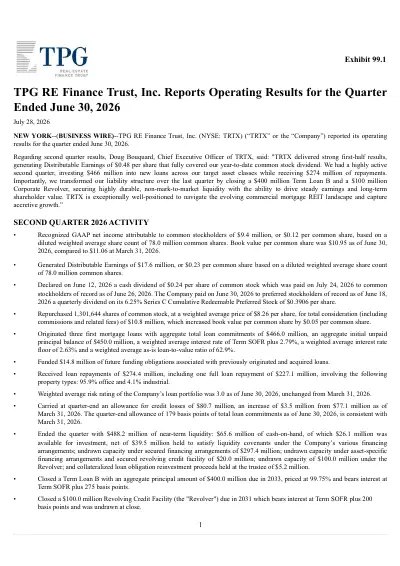
Over the past year, we have closed $1.7 billion of new loan investments, driving $551 million or 15% net asset growth. During the second quarter, we closed $466 million of new loan investments and an additional $72 million subsequent to quarter end, continuing the steady growth of our earning asset base.
Looking ahead, we have approximately $380 million of executed term sheets, providing good visibility into future deployment opportunities. We remain focused on prudently growing the portfolio while maintaining the disciplined underwriting and risk management approach that has differentiated TRTX throughout the cycle.
From a credit perspective, portfolio performance remains stable, with CECL reserves and risk ratings largely unchanged quarter-over-quarter. Meanwhile, the balance sheet transformation we have discussed over the past several years continues to advance.
As of June 30th, 69% of our portfolio is comprised of loans originated in 2023 or later. This continued reinvestment into newer vintage assets enhances the overall credit profile of the portfolio and further differentiates TRTX relative to many of our peers.
The second quarter also marked an important milestone in the continued evolution of our liability structure. During the quarter, we issued a $400 million Term Loan B with a seven-year maturity, added a new $100 million corporate revolving credit facility, upsized two existing secured financing arrangements by a combined $600 million, and entered into a new $500 million secured financing arrangement.
Importantly, these actions were effectively leverage- and cost-of-funds-neutral, allowing us to significantly strengthen and diversify our liability structure without sacrificing current earnings power. Beyond enhancing liquidity and financial flexibility, these transactions introduced a new source of long-duration covenant-light corporate capital and further broadened our funding base.
The expanding financing toolkit positions us to continue growing earning assets while maintaining our target leverage profile, particularly as we execute on our REO monetization strategy and recycle capital into new investment opportunities. Collectively, these transactions demonstrate the strength of the TRTX platform and our ability to access multiple forms of capital, including bank, syndicated loan, and public bond markets, representing another important step in TRTX's evolution as a corporate borrower.
Finally, we continue to view share repurchases as an attractive tool for creating shareholder value. During the quarter, we repurchased 1.3 million shares of common stock for a total consideration of $10.8 million at an average share price of $8.26 per share, which allows us to invest additional capital into our business at what we believe is a meaningful discount to intrinsic value.
As we enter the second half of 2026, we are operating from a position of strength. We have continued to grow the portfolio, maintained stable credit performance, enhanced our financing profile, and increased our financial flexibility.
At the same time, we continue to see attractive investment opportunities and believe our competitive position has never been stronger. While market conditions remain dynamic, our strategy remains clear and consistent: responsibly grow earning assets, maintain disciplined risk management, strengthen our balance sheet, and allocate capital in a manner that maximizes long-term shareholder value.
We continue to believe the market is not fully recognizing the earnings power of our platform, including the strength of our balance sheet, the breadth of TPG's integrated real estate debt and equity investment platform, and our unique ability to take advantage of the current opportunities set relative to competitors. We believe the foundation we have built and the strategy we have executed over the past several years leaves us well positioned for continued success over the long term.
With that, I will turn the call over to Brandon to discuss our financial results in more detail.
Brandon Fox
Thank you, Doug, and good morning. For the second quarter of 2026, TRTX reported GAAP net income of $9.4 million.
Distributable earnings for the quarter was $17.6 million or 23 cents per common share. For the full year 2026, distributable earnings was $37.1 million or 48 cents per common share, covering our common stock dividend of 48 cents per common share through June 30th.
As Doug mentioned, we repurchased 1.3 million shares of common stock during the quarter and have $9.3 million remaining on the company's share repurchase plan at June 30th. Book value per common share was $10.95 at quarter end.
During the second quarter, we originated three first mortgage loans with total commitments of $466 million at a weighted average credit spread of 2.79%, and received loan repayments of $274.4 million, including one full office loan repayment of $227.1 million, which reduced our office exposure to 4.3% of total loan commitments as of June 30th. Quarter-over-quarter, net assets increased $190.4 million or 5% to $4.3 billion.
Year-over-year, our net assets have grown 15% or $551.4 million. At quarter end, our loan portfolio was 100% performing.
During the quarter, we did not have any credit migration in our loan portfolio. Our weighted average risk rating for the loan portfolio is unchanged at 3.0.
Our CECL reserve was flat quarter-over-quarter at 179 basis points. In total, our CECL reserve increased $3.5 million to $80.7 million, primarily due to net asset growth quarter-over-quarter.
As of June 30th, 2026, our loan portfolio was 76.4% multifamily and industrial collateralized assets. Office now only makes up 4.3% of our loan portfolio at quarter end, down from 52.9% in June of 2021.
From a capital markets perspective, this was an active and transformational quarter. During the quarter, we closed: one, a $400 million Term Loan B due in 2033, priced at 99.75%, bearing a 2.75% credit spread; two, a $100 million corporate revolver due in 2031 with a 2.00% credit spread; three, an upsize of two existing secured financing arrangements by a total of $600 million; and four, a new $500 million secured financing arrangement.
As part of these capital markets transactions, we were able to amend and align our financial covenants across our capital structure to industry-leading terms, including maximum total debt to total assets ratio of 83.33% and an interest coverage ratio of not less than 1.3 times. We accomplished this capital structure transformation while remaining leverage- and cost-of-funds-neutral.
We ended the quarter with near-term liquidity of $488.2 million, consisting of $65.6 million of cash on hand, including amounts held to satisfy liquidity covenants, undrawn capacity under secured financing arrangements of $317.4 million, $100 million of undrawn capacity on the corporate revolver, and CRE CLO reinvestment proceeds of $5.2 million. Additionally, we held unencumbered loan investments with an unpaid principal balance of $186 million that are eligible to be pledged under our existing financing arrangements.
The company's liability structure is now 85.2% non-mark-to-market across 11 financing sources and carries a weighted average cost of funds of 1.83%. Total leverage increased to 3.32 times from 3.1 times at March 31st, 2026, as a result of our investment activity during the quarter.
At quarter end, we had $1.8 billion of financing capacity available to support loan investment activity and were in compliance with all of our financial covenants. With that, we welcome your questions.
Operator?
Operator
Thank you. We will now be conducting a question-and-answer session.
If you would like to ask a question, please press *1 on your telephone keypad. A confirmation tone will indicate your line is in the question queue.
You may press *2 to remove yourself from the queue. For participants using speaker equipment, it may be necessary to pick up the handset before pressing the star keys.
One moment while we poll for questions. Our first question today will come from Gabe Poggi with Raymond James.
Gabe Poggi
Hey, good morning, guys. Thanks for taking the question.
Can you talk about loan origination, repayment timing in the quarter? It looks like the large New York office loan was repaid early in the quarter, and you had a couple loans close very late.
Just help us kind of reconcile timing as it pertains to 1Q run rate to 2Q run rate, and how you think about that in the back half of the year. Thanks.
Doug Bouquard
Sure. I think, as always, Gabe, you're sort of spot on and from a timing perspective, it was pretty chunky group of repayments that all happened within the first three weeks of the month.
The largest of which was that New York City office deal that paid off. Then as we sort of saw that repayment coming, we began to sign deals up, but really about 70% of our new originations closed in the last three days of the quarter.
That really is the kind of short version for what drove that drop in sort of DE quarter-over-quarter is just largely due to timing, which, as we've said in the past, is just going to be the nature of the beast as we scale and grow our balance sheet. We're going to be making investments and risk decisions based on high-quality credits and aren't going to sort of push the envelopes.
For us, this is just sort of a unique moment where we had, again, a sort of chunky flow of repayments the first few weeks of the quarter, and then the loans that closed all closed, or largely all closed, at the end of the quarter. The only other thing I'll add to that is, with investment activity and kind of as we look through to the rest of the year, it's very clear to us, as we've mentioned in prior calls, that a lot of the activity in our market remains refinancings.
As those that have lived and breathed the lending business know, when it's a refinancing, sometimes the pressure for the borrower to close can be eased. What we've seen is just longer times from when we execute term sheets to closing, which can sometimes expose us to maybe a small amount of difference relative to our expected run rate.
I think when you kind of get to maybe your final question around the next few quarters, look, I think looking at our sort of aggregate net asset growth combined with our sort of aggregate debt-to-equity ratio is sort of a better sort of sign for where we're headed in terms of our expected DE. Again, we're going to be growing prudently and carefully, and there can be times where there are these sort of gaps between, again, when we receive repayments and when we make new investments.
Gabe Poggi
Thanks, Doug. That's helpful.
A follow-up to what you kind of just said is total leverage is 3.3x. Considering the macro, I know you guys have talked about 3.5 to 3.75, is that still the zone for kind of the here and now with rate vol and what you just talked about with the refinancing environment, etc.?
Are we still on target for that target leverage ratio?
Doug Bouquard
I'd say, I'd say the short answer is is is yes. Where we've been really consistent, and I would say that there's really no change at all to kind of how we're thinking about our strategy.
I would say that, first and foremost, our, sort of investment paradigm is centered on making great credit investments, and and that will continue to kind of drive both, the the the sort of growth in our balance sheet and also, the the timing of our DE growth over time.
Gabe Poggi
Thanks, guys. Appreciate it.
Doug Bouquard
Thanks, Gabe.
Operator
Next we'll hear from [Zhong Hong Zheng?] with J.P.
Morgan Chase & Co.
Zhong Hong Zheng
Hey. This is Hong on for Rick Shane.
I guess could you provide an update on your REO portfolio? I think last quarter you talked about potentially looking forward to selling a couple of assets by the end of the year.
I'm just wondering if that's still the expectation.
Ryan Roberto
Thanks. This is Ryan.
As we communicated last quarter, you are correct. We continue to make good progress on the REO front, and we still continue to expect to monetize, recycle a portion of that portfolio this year.
In the interim, operating fundamentals continue to improve. We hope to share an update in the coming months on that.
Zhong Hong Zheng
Got it. If I could sneak one other question in.
Your office loan exposure shrunk dramatically with the repayment. I guess looking forward, do you expect to just reduce your office exposure further, potentially zero, or are you okay with that level going forward?
Doug Bouquard
It's a great question. Look, I think the substantial reduction in office has been primarily or I would say exclusively really kind of driven by what I'll call kind of legacy office deals that we had originated many years ago.
When we think about new investments, although we do not have any office deals currently signed up, there are office deals in our pipeline more broadly that we are evaluating. I wouldn't say that we are a no to office.
I'd say that, simply put, we're just being very selective. Frankly, wouldn't surprise me if we did an office deal or two between now and year end, but, again, nothing signed up and just being very very selective in that sector.
Got it. Thanks.
Zhong Hong Zheng
Thank you.
Operator
Next we'll move to Tom Catherwood with BTIG.
Tom Catherwood
Thanks, and good morning, everybody. Maybe building on Gabe's first question, how did the balance sheet optimization, all the work you did there, impact 2Q results, and what else needs to happen to get the balance sheet to where you kind of are in a perfectly optimized state?
Ryan Roberto
Thanks. This is Ryan.
I'll answer the first part of this question, and maybe Doug or Brandon will have a add-on. This quarter, as you kind of noted, we opportunistically kind of accessed the corporate loan market at what we believe are historically attractive terms.
I think as to why now, why did we do it this quarter? It was a unique period of time where we could immediately deploy the $400 million that we raised without really creating any earnings drag or increasing our cost of capital.
What we were able to do is, on a leverage-neutral basis and really a cost-of-funds basis, deploy $400 million to retire a legacy liability structure that was just in an amortization mode and getting more expensive via each repayment. We think long term, there'll be a lot of accretion to the balance sheet over time.
That's kind of the rationale, and again, there wasn't much of an impact from a P&L standpoint.
Tom Catherwood
Got it. That accretion to—sorry, go ahead, Doug.
Doug Bouquard
Oh, sorry, go ahead. No, no.
Please go ahead.
Tom Catherwood
No, I was just going to ask if that accretion to the balance sheet was from the structure the way it is today or was that retiring that older CLO and then, kind of getting a new CLO out the door just to make the cost of capital more efficient? What drives that accretion?
Ryan Roberto
I think just having a piece of our liability structure that is long-dated, low-cost, non-mark-to-market, we know that over the next seven years spreads are going to move in probably both directions. Just having a very stable part of our liability structure that will allow us to be offensively oriented, I think it's a good thing to have long term.
We think just again, as we try to position the company for, earnings growth and kind of an all-weather balance sheet, we think it's just the right thing to do. That's at least how we thought about it.
Doug Bouquard
Look, I was going to add one other thing is huge credit to Ryan who leads our capital markets team and frankly our whole franchise on just what we were able to do on the liability side of our balance sheet. I think on page 12 of our supplemental, there's a sort of updated pretty thoughtful summary, but when you look at sort of all corners of it in terms of the really high percentage of non-mark-to-market, the long duration of the liability set, and we really have built, I'd say, a sort of fortress liability structure, and I think a lot of that is a credit to the sort of de-risked balance sheet that we have relative to competitors, but then also I think it was great to get the acknowledgment from the corporate loan market that, in fact, we've got a clear strategy, we have a very low-risk balance sheet, and again, I think we've been kind of rewarded by what I'll call the sort of debt side of our balance sheet very very resoundingly.
Big credit to Ryan and the team.
Tom Catherwood
Got it. Appreciate that color.
Then last one for me, maybe Doug, a bit of a broader question on rates and the impact on CRE. You mentioned that almost 70% of your portfolio is newer vintage post-2023 loans, but as the 10-year stays 4.6% and above, how does that increase the potential for some of those legacy loans to just not be able to refinance?
There's no equity left, and we end up getting more watch list migration. Or on the flip side, are you seeing kind of new origination opportunities where buyers would normally be going to agency financing, and they're choosing bridge loans just because the rates are more attractive than what they would be getting a longer-term fixed rate?
How is it impacting both sides of the equation right now?
Doug Bouquard
Sure. I'll say first, again, I guess we'll find out later today exactly the sort of path of the Fed.
It'll be interesting. First and foremost, I think the current rate complex is definitely driving two very clear trends in our market.
I think one is both marginally elevated rates, but more particularly actually rate volatility, tends to reduce transaction activity. I think that reduced transaction activity has led to two things.
One is, I'd say we are on the margin seeing slower repayments. Then, two, I think what you're seeing is just frankly a new origination market where we're still seeing primarily refinancings.
Those are kind of the two first-order effects. When I think about our balance sheet versus the market, probably where we're different is if we had a portfolio of let's just say 100% loans that were originated let's say pre-Fed hike, I think a move higher in rates could really kind of exacerbate the sort of breaking of those capital structures and potentially some further credit stress, whereas our balance sheet is generally different from the rest of the market in that close to about 70% of it is originated post-Fed hike.
In some ways we view a higher rate complex as on the margin a positive for us, because ultimately, I think it's on page 14 of the supplemental, you can look at sort of moves in the index rate and how that affects our earnings. Simply put, as SOFR goes higher, that's going to be a net positive for our platform.
Again, we're somewhat unique in that I think because we have newer vintage collateral, we've done $1.7 billion of new loans over the past year, we're going to have, I think, probably a more positive earnings outcome if rates do either stay or frankly rise from here.
Tom Catherwood
Got it. That's it for me.
Thanks, everyone.
Doug Bouquard
Appreciate it. Thanks, Tom.
Operator
Next we'll hear from Chris Muller with Citizens Capital Markets.
Chris Muller
Hey, guys. Thanks for taking the question, and congrats on all the progress on the balance sheet.
I guess following up on a prior question on the new financings, I hear you guys on the cost of funds and leverage-neutral, but were there fees or any drag on earnings that hit in the quarter? I'm just trying to think through the earnings run rate and if there was an impact from that in the quarter or not.
Brandon Fox
No. That's a very good question, and obviously there were fees associated with the transaction.
The transaction closed mid-quarter, middle of May, and you will have some amortization of the fees in the quarter for the quarter. Within our debt footnote, you can see the components of it.
There were about $8 million or so of fees that got partially amortized in, and it's over the life of the instrument itself, between five and seven years given the Term Loan and the corporate revolver maturity dates.
Chris Muller
Got it. That's helpful.
Then, I guess changing gears a little bit to repayments. Repayments, excluding the large office loan, were pretty low.
I guess what are you guys expecting in terms of repayments in the back half of the year? Is the slower pace of repayments just due to a slower lending pace you guys did back in '23 and '24?
Doug Bouquard
I think there's a few things. I think one does dovetail with what I'd mentioned earlier as it relates to Tom's question.
From a balance sheet perspective, because we have, again, largely kind of post-Fed hike collateral, what we're seeing is that those loans are more recently originated and in many cases have call protections, we're just going to see just from an organic perspective, I think a lower level of repayments versus competitors that probably have more pre-Fed hike exposure. That's one.
Then, two, look, I think that it can be idiosyncratic, as I've shared. Even that New York City office deal that I'd mentioned paid off earlier in the quarter, the sort of timing on that was definitely moving around.
We sort of knew it was going to happen, but at the same time, sometimes kind of getting a buyer and a seller and a new lender all in the same room to close in the same day can be challenging, and that's kind of what we're seeing. I think it's that dynamic.
I think combined with, look, I think that conviction level across our borrower base is not incredibly high right now. We're obviously both a debt and equity platform, we're seeing kind of both sides of the coin.
I think that if you're on the real estate equity side of the coin right now, it's a tricky market to really want to deploy capital just purely in the face of a lot of different kind of trends that are happening. I think those are the two factors that I'd probably highlight as it relates to repayments.
I think again the last thing I'll add perhaps is when we look at our repayments going forward, again, I think that we have also primarily multifamily and industrial collateral, and the business plans there are relatively straightforward and sort of allow for us to have perhaps a better window into what that repayment profile is going to look like over the next coming quarters.
Chris Muller
Got it. That's all very helpful.
Appreciate you guys taking the questions today.
Doug Bouquard
No problem. Thanks a lot.
Operator
There are no further questions at this time. I would like to turn the floor back to management for closing remarks.
Doug Bouquard
This is Doug Bouquard, and again just wanted to thank everyone for taking the time this morning on the call, and we look forward to updating you on further progress. Thank you very much.
Operator
Thank you. This does conclude today's teleconference.
We thank you for your participation. You may disconnect your lines at this time.