Toray Industries, Inc.
Q2 FY2027 · Earnings Call TranscriptNovember 10, 2026
Thank you very much for joining us today despite your busy schedule. On behalf of Toray Group, I'd like to take this opportunity to extend my gratitude towards your continued understanding and your interest in our management and business activities.
Now, I'd like to report Toray's business results for the second quarter ended September 30th, 2026, and the business forecast for the fiscal year ending March 2027. Now, I'd like to follow the table of contents shown on Page 1.
This is the summary of the business performance and forecast. In the first half of the fiscal year, under Ignition 2028, our medium-term management program launched in April this year, we focused on expanding our core growth businesses and restoring profitability in low-profit businesses, while promoting price pass-through and cost reductions in response to higher raw material and fuel costs resulting from the situation in the Middle East.
As a result, core operating income for the first six months of FY 2026 increased significantly by 46% year-on-year to 99.4 billion yen, marking a record high for a six-month period. In terms of the consolidated business forecast for the fiscal year ending March 2027, Toray has revised upward the initial forecast announced on May 13th, 2026, based on the six-month results.
Furthermore, the company resolved to conduct a buyback up to 70 billion yen at the Board of Directors meeting on November 10th, 2026. Under Ignition 2028, our medium-term management program announced in March 2026, the company intends to conduct share buybacks flexibly.
The size of this share buyback was determined based on the scale of asset sales. I will explain the details starting from the next page.
I would like to begin with summary of business results for the second quarter ended September 30th, 2026. Please turn to Page 4.
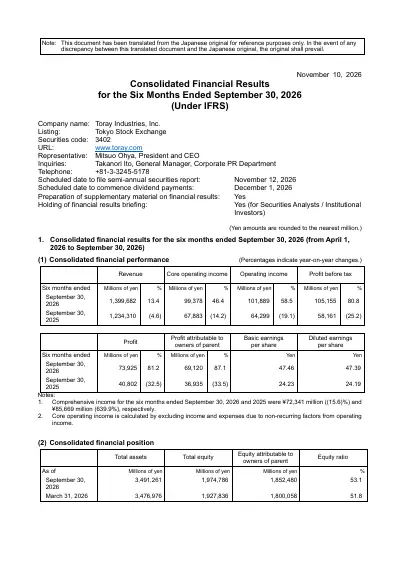
Consolidated revenue for the first six months increased by 13.4% compared with the same period a year earlier to 1 trillion 399.7 billion yen. Core operating income increased by 46.4% to 99.4 billion yen, and profit increased by 87.1% to 69.1 billion yen.
Special items for the first six months improved by 6.1 billion yen to positive 2.5 billion yen. Page 5 is about assets, liabilities, equity, and free cash flow.
As for financial condition at the end of September 2026, the total assets stood at 3 trillion 491.3 billion yen, up 14.3 billion yen from the end of the previous fiscal year, due primarily to increases in inventories, despite decreases in property, plant, and equipment, and retirement benefit assets. Total liabilities decreased by 32.7 billion yen from the end of the previous fiscal year to 1,516.5 billion yen, owing mainly to decreases in borrowings.
Total equity increased by 47 billion yen compared with the end of the previous fiscal year to 1,974.8 billion yen, mainly owing to increases in retained earnings. Owners' equity was 1,852.5 billion yen, interest-bearing liabilities were 848 billion yen, and D/E ratio was 0.46.
Free cash flow was positive at 96.2 billion yen. Page 6 explains about capital expenditures, depreciation and amortization, and R&D expenditures.
Capital expenditures for the six months decreased by 3 billion yen to 64.1 billion yen on a year-to-year comparison. Meanwhile, depreciation and amortization increased by 3.2 billion yen to 69.4 billion yen.
R&D expenditures increased by 0.6 billion yen to 36.5 billion yen compared with the same period of the previous fiscal year. The table on Page 7 describes revenue and core operating income by segment.
The graph on this page shows the factor analysis of 31.5 billion yen increase in core operating income for the six months on a year-to-year comparison. Recovery or expansion trends were seen mainly in the automotive applications of the Fibers & Textiles and Performance Chemicals, as well as the aircraft applications of the Carbon Fiber Composite Materials.
Increase in demand related to AI and data center also contributed to the business performance. Furthermore, efforts were made to achieve price pass-through and reduce costs despite the impact of higher raw material and fuel prices amid tensions in the Middle East.
As a result of capturing strong demand and promoting structural reforms and strategic pricing, core operating income increased by 46% year-on-year, while core operating margin improved by 1.6 percentage points. From Page 8 onward, I'd like to explain the results of each segment.
First, the Fibers & Textiles. Revenue of the overall segments increased by 9% to 549.5 billion yen compared with the same period a year earlier, and core operating income increased by 15% to 40.3 billion yen.
In the apparel applications, the group focused on capturing demand despite intensified competition from overseas products. The industrial applications showed a gradual recovery in demand, primarily in the automotive applications.
Page 9 is the Performance Chemicals segment. Revenue increased by 13% to 501.4 billion yen compared with the same period a year earlier.
Core operating income increased by 46% to 41.9 billion yen. The resins and chemicals businesses were affected by rising raw material prices resulting from the worsening situation in the Middle East.
However, sales remained steady as efforts were made to achieve price pass-through. The films business, sales for the electronic component applications, including MLCCs, remained strong, owing primarily to increase demand related to AI and data center.
In the electronic and information materials business, sales of products for the power inductor applications expanded, although OLED-related materials were affected by the slow demand for display panels and intensified competition in China. Page 10 is the Carbon Fiber Composite Materials segment.
Revenue increased by 35% to 183 billion yen compared with the same period a year earlier, and this segment posted core operating income of 16.5 billion yen, a 75% increase from the same period a year earlier. In the aircraft applications, sales to major customers continued to grow steadily, while sales for the space and defense applications also increased.
In the sports applications, although inventory adjustment of the general-purpose products continued, sales of the high-end products for outdoor leisure was steady. The industrial applications showed a recovery trend primarily in the pressure vessel and wind turbine blade applications.
Page 11 explains the Water Treatment and Healthcare segment. Revenue increased by 4% to 80.2 billion yen compared with the same period a year earlier, and core operating income increased by 33% to 7.5 billion yen.
In the water treatment business, shipments of reverse osmosis or RO membranes for large-scale projects in the Middle East and sales in the Americas, one of its key markets, remained strong. In the pharmaceuticals and medical products business, sales of pharmaceutical products stagnated, but efforts were made to shift toward higher value-added hemodialysis dialyzers and to reduce costs.
Page 12 shows the business results of major subsidiaries and regions. In Japan, at Toray Engineering, shipments of electronics-related equipment were strong.
At our subsidiaries in Southeast Asia, in the fibers and textiles businesses, demand for the automotive applications was steady. At our subsidiaries in China, sales for the apparel applications in the fibers and textiles business were robust.
As for our subsidiaries in the Republic of Korea, in the performance chemicals business, sales for the power inductor applications in the electronic and information materials business grew. At our subsidiaries in the U.S., Europe, and others, in the performance chemicals business, sales of high value-added products in the U.S.
film business expanded. In addition, in the carbon fiber composite materials business, sales for the aircraft, space, and defense applications increased.
Next, I would like to explain the consolidated business forecast for the fiscal year ending March 2027. Please turn to Page 14.
The global economy is expected to continue its gradual expansion as AI-related demand grows and the downward pressure from heightened tensions in the Middle East eases. The Japanese economy is also expected to continue with its gradual recovery.
However, downside risks remain, including increases in fuel and raw material prices and supply constraints resulting from renewed escalation or prolonged tensions in the Middle East, as well as a slowdown in the global economy. Further, the future economic conditions will be affected by the trends in AI-related demand and the slowdown in the Chinese economy, while the direction of the U.S.
trade and foreign policies and the rise in protectionism in various countries may significantly affect supply chains and trade structures in the medium to long term. Given its business performance for the six months of the fiscal year and the changes of the business environment, Toray revised its full-year consolidated forecasts.
The company now expects revenue of 2 trillion 850 billion yen, core operating income of 180 billion yen, and profit of 110 billion yen. Full-year forecast for ROIC is about 5%, and ROE is 6%.
Assumed exchange rate from October onward is 155 yen per U.S. dollar.
Page 15 shows the biannual consolidated business forecast for the fiscal year ending March 2027 by segment. Revenue and core operating income of all segments are expected to increase, owing to sales expansion in each segment, especially in the Performance Chemicals, in addition to the positive effects from strategic pricing and profitability improvement projects.
Page 16 shows the comparison between the initial forecast and the new forecast for the fiscal year ending March 2027 and variance factors by segment. Next, I would like to explain about topics of this fiscal year.
Page 18 outlines initiatives for structural reforms of low-growth, low-profitability businesses. Under Ignition 2028, in addition to the initiatives under Darwin Project, the company is advancing structural reforms of low-growth, low-profitability businesses through measures such as establishing an efficient production structure for the battery separator film business in line with order volumes, and reviewing the production structure of the TC woven fabric business to restore profitability.
The withdrawals and downsizing implemented in the first half are shown here. In addition to the above initiatives, the company is deliberating and implementing other structural reforms.
Page 19 shows the status of initiatives under Darwin Project and the outlook for FY 2026. For FY 2026, Toray had expected an improvement of around half of the 25 billion yen targeted over the three-year period.
However, due to a slight shortfall mainly in the fibers and textiles business, the company now expects an improvement of about 10 billion yen compared with FY 2025. Page 20, I'd like to explain Toray's shareholders' return and share buybacks.
Under the medium-term management program, Ignition 2028, announced in March 2026, the company aims for DOE 3% or higher and intends to flexibly conduct share buybacks. In FY 2025 and FY 2026, as part of our portfolio reform, Toray has divested some businesses and assets, including our shares in Soda Aromatic.
At the meeting on November 10th, 2026, the Board of Directors resolved to repurchase 70 billion yen of the company's shares, funded by cash generated from the asset sales. For FY 2026, the company plans to pay an annual dividend of 26 yen per share, up 6 yen year-on-year, including a 100th anniversary commemorative dividend of 3 yen as part of the interim dividend.
This concludes my presentation. Thank you very much.