Kioxia Holdings Corporation
Q2 FY2027 · Earnings Call TranscriptOctober 30, 2026
Moderator
Thank you very much for joining us today. If you have joined the meeting using your nickname or something similar, we kindly ask that you please enter your company name as well as full name before continuing to view.
Please log out, go to the Zoom webinar registration screen, populate your company name and full name in the field, reregister, and then rejoin the session. Thank you for your continued patience.
Thank you all very much for your patience. We will now begin Kioxia Holding Corporation's financial results briefing for the second quarter of the fiscal year ending March 2027.
I am Nishida from the Investor Relations Division of the Corporate Communications Department and will be serving as the moderator. Thank you.
First, I would like to introduce the speakers: Executive Vice President and Chief Financial Officer, Yoshihiko Kawamura; Executive Officer and General Manager of the Corporate Communications Department, Toshiaki Fujikawa. These will be the two speakers.
I will now go over the agenda for today's briefing. After noting some disclaimers, Fujikawa will discuss the NAND market overview as well as enhancement of production capability to support growing demand in the AI era.
Following, Kawamura will be presenting the results for the second quarter of the fiscal year ending March 2027, as well as guidance for the third quarter and surrounding all of the initiatives for enhancing our corporate value. After that, we will move to the Q&A, and the event is scheduled to conclude at 8:15 p.m.
This is going to be recorded for on-demand distribution in the future, please do be understanding. Allow me to go over the disclaimers.
Yoshihiko Kawamura
Please be aware that the forward-looking statements and explanations contained in today's materials and presentations are based on assumptions and beliefs formed by the company based on information available to us at this time. Actual results may differ due to various risks as well as uncertainties.
Furthermore, the company assumes no obligation to update the forward-looking statements contained in today's materials as well as presentations. For more deep disclaimers, please refer to the information displayed on the screen.
Now, over to Fujikawa. Allow me to begin with an overview of the NAND market.
At a high level, we expect NAND supply-demand dynamics to remain tight, supported by AI-driven demand in data centers. First, on the left, is data center enterprise.
AI-related demand remains exceptionally strong, driven by the growing adoption of agentic AI applications, while demand for KV cache continues to grow. In addition, the explosive increase in AI-generated data is supporting the adoption of high-capacity QLC SSDs.
Next, in the center, are smartphones and PCs. For smartphones, unit shipments of low-price models are moderating at a faster pace, while premium models remain resilient.
We therefore expect no significant changes in NAND demand through calendar year 2027. For PCs, unit shipments are declining due to higher BOM costs, and NAND demand is also expected to decline through calendar year 2027.
On the right is our NAND market outlook. Data center enterprise demand is expected to offset softer smartphone PC demand, with robust demand growth continuing in CY28 as well.
We expect bit growth in the high teens percentage range in CY26 and the low 20% range in CY27. Kioxia's bit shipment growth is also expected to be in line with the market outlook.
Next, I will explain how we are enhancing our production capability to support growing demand in the AI era. To address growing AI demand, ramp up production of cutting-edge products, and ensure a stable supply, we have begun site preparation for Fab 3, or K3, at the Kitakami plant.
K3 is planned to produce advanced-node BiCS FLASH, with operations scheduled to begin in fiscal year 2029. As we expand production capacity, we will first fully utilize available space at the existing Y7 Fab in Yokkaichi and K2 Fab in Kitakami.
We will then expand K3 in phases, calibrated to market demand growth. The photo on the right provides an overview of the Kitakami plant, including the planned K3 construction site together with the existing K1 and K2 Fabs.
In addition, the absorption-type merger of Kioxia Iwate Corporation into Kioxia Corporation announced today is intended to achieve sustainable growth by strengthening manufacturing scale for cutting-edge flash memory products, as well as by improving management efficiency and reinforcing our business through the integrated deployment of management resources, including personnel and technologies, and the optimization of our business structure. As such, alongside the Yokkaichi plant, the Kitakami plant is an extremely important site in our business strategy.
We will continue to make strategic capital investments while carefully assessing demand trends, steadily building the production base needed to meet growing demand in the AI era. Now, over to Kawamura.
I am the CFO, Kawamura. Thank you very much for your attention in advance.
Continuing from Fujikawa's discussion, allow me to discuss the fiscal year 2026 quarter two results as well as the fiscal year 2026 third quarter guidance. I would like to be going along with the slides.
Please follow the slides on the screen. First, starting with slide eight, please.
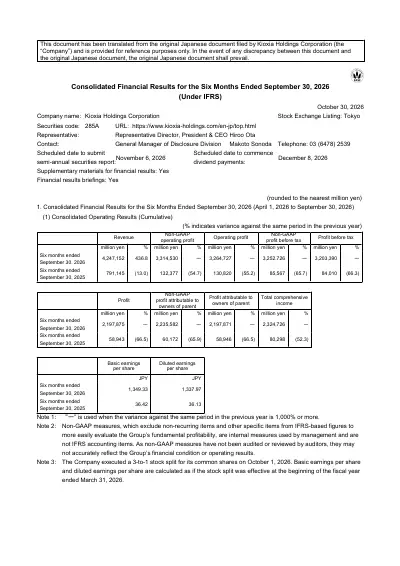
This will be the financial highlights. For the second quarter highlights, as you can see from the left to right, you can see there's revenue, adjusted non-GAAP gross profit, non-GAAP operating profit, or free cash flow, as well as capital efficiency.
You can see that revenue has marked record highs quarter on quarter. It has increased by 1.4 times, and it is 2,480 billion yen, and including the 66.6 billion yen for JV-related sales as well.
This is a record high. Then when it comes to non-GAAP gross profit after adjustment, this was record high as well.
Quarter on quarter, it was 1.5 times, and it was 2,091.9 billion yen, and the margin was 84%. After excluding JV-related items, the margin was 87%.
Next will be the non-GAAP operating profit. This was also record high, and quarter on quarter, it was 1.5 times, and it was at 1,988.3 billion yen, and the margin was at 80%.
When it comes to net profit, it will be available on the next slide. It was 1 trillion 3,000 1,348.6.
That was also record high. There was operating cash flow, which is going to be net of CapEx spending.
That was also record high, and quarter on quarter, it was 1.7 times. It was 1,438 billion yen.
By the way, all of the numbers were record highs. As a result of that, when it comes to capital efficiency, you can see that our ROIC number, return on invested capital, was 102%.
In this world, this is something that is pretty much unprecedented. If we were to look at the capital cost is 10% with WACC, the ROIC minus WACC, there's a 10% which is 90%.
It is an astonishing number. As a result of that, a net cash, 1,127 billion.
The net cash, you can see the small numbers, and the balance sheet on the left-hand side, when it comes to cash as well as cash equivalents, all of the borrowings have been minus, and that is 812.7 billion yen. Then the share buyback that was completed back in August, there was 800 billion yen that has been allocated, and that's the cash out.
Another highlight to note here, you can say that there is revenue as well as non-GAAP operating profit after adjustments. In the past year, for fiscal year '25 in the 12 months, it is the full year's worth that has actually been posted in the three months from July to September.
You can see that our profitability has been improving quite significantly. Moving on to page nine, slide nine, please.
You can see the first quarter as well as the second quarter guidance as well, which has been announced at the end of July. This is a comparison sheet.
On the left, we have all of the revenue, non-GAAP operating profit, non-GAAP net income, as well as non-GAAP EBITDA, as well as non-GAAP earnings per share, EPS, as well as exchange rates. On the left, you can see the results for the first quarter, and then the second quarter guidance was available in pink, and the very right will be the results.
All of the second quarter results have, of course, been above the guidance. Revenue guidance was 2,390 billion, whereas the results were 2,480 billion.
This is in alignment with the previous slide. For non-GAAP operating profit, the guidance was 1,900 billion, whereas the results was 1,988.3 billion.
As you can see, the margin was above 80% levels. The first quarter margin was 75%; therefore, it is exceeding quite significantly at 80% levels.
The non-GAAP net income, the guidance was 1,280 billion, whereas the results were 1,348.6 billion. The margin is 54.4%, a significant hike.
Non-GAAP EBITDA, this was 2,065.7 billion. The margin was 83% levels.
As a result of this, a non-GAAP base earnings per share, the guidance was 778.57 yen, whereas this result is showing that it was 833.94. Exchange rate, in the first quarter, we were expecting 160 yen to the dollar.
Second quarter is 161 yen to the dollar, the yen has weakened by a yen. When that happens, operating profit-wise, there is about 14 billion Japanese yen worth of impact.
It's about 14 billion out of the 2. 2,400 billion, and therefore it is very miniscule as an impact.
There are two things that I would like to note: one will be the ASP increase, and the other would be bit growth. This will be the increase in our bit growth.
ASP-wise, on average, it is the mid-20% increase. Then when you look at the like-for-like basis, it will be the low 30% increase.
For bit growth, it is in the low teens, a percentage of increase. The second quarter, ASP has risen, and then also bit growth has also risen.
Moving on to slide 10.
Akira Menju
We have the sales by application here, and you can see the different colors on the slide. The pink part would be SSD and storage; the blue would be smart device.
If you take a look at the right side of the slide, we have SSD and storage. It's 1.616 trillion yen, and blue, smart device, is 788.9 billion yen.
On a Q-on-Q basis and also on a Y-on-Y basis, we have been able to grow, but it is a substantial growth. The reason behind this is on the right side.
For the smart device, the sales price significantly increased, and it drove the majority of this quarter's revenue growth, and we have been able to achieve an all-time high in sales revenue. On the bottom, we have the SSD and storage results.
For PC and others, the mix was 65%, and for data center and enterprise, it is mid-60% range. The SSD shipment, driven by strong AI server demand combined with higher ASPs, and this contributed to a record segment revenue.
As a result, on the very left in pink, the SSD and storage accounts for 65% of the total. Smart device is 32%.
We mentioned that it will be about 60% give or take, but it has elevated to 65%. The BiCS FLASH, which we call BiCS8, this would be our core product now, and we have been able to have this product to drive the sales.
Please turn to page 11. We have the results by application.
We have the figures on a quarterly basis and also on a yearly basis to see the trend. For all applications, the quarterly revenue was a record high.
You can take a look at the bar graph on the bottom. The third from the left would be the Q3 the Q1 to Q4 figures for FY25, and we have the Q1, Q2 figures of this year, and we also have the full year results of FY25 on the right side.
It's very obvious is on the right. When we look at the Q2 breakdown, the pink is SSD and storage, it's 1.616 trillion yen; the blue, smart device, is 788.9 billion yen.
If we compare this with last year's figures, SSD and storage for last year was 1.3626 trillion yen, and this accounted for 58% of the total, and now we've been able to reach 65% in the second quarter. You can see that we have been able to steadily grow the SSD and storage business.
The annual results of FY25 was 2.3376 trillion yen, but when we look at the Q2 results, it is 2.48 trillion yen. This quarter alone has already exceeded last year's full year results.
SSD storage is the driver of the performance. On the other hand, if you can take a look at the foreign exchange rate on the very bottom, if you take a look at the left, we started off with 145 yen in Q1 last year.
The yen has depreciated, and this has an impact of a couple billions of yen, but compared to the revenue of 2.48 trillion yen, it is a limited impact. Please turn to page 12.
I'd like to have you take a look at our cash flow results for the second quarter. On the left, we have the bar chart.
We have 791 billion yen on the very left in the small font on the bottom. This would be the cash balance as of the end of June 2026.
On the very right, for the end of September 2026, the cash balance is 1.3973 trillion yen. I will be referring to the balance sheet afterwards, but cash and equivalents is this value.
The ups and downs: on the very left, we have 791 billion yen, that's the balance, and the operating cash flow is added on to that, 1.5132 trillion yen, and from there we have the net CapEx of -75.2 billion yen subtracted. We have the core free cash flow of 1.438 trillion yen.
This would be free cash flow affiliated to our business operation, and we track these figures, and going forward we will be using this core free cash flow as a key index. We have the adjustment, and we have -827 billion yen.
The majority of this would be the 800 billion yen coming from the share buyback, and we have the adjustment of -4.2 billion yen, and we get to the cash balance of 1.3973 trillion yen as of end of September. On the right, I have the explanation of operating cash flows, as I mentioned, due to the increase in selling price and the increase in sales of data center and enterprise SSDs, the operating cash flow had improved.
We also have the production expansion of generation eight BiCS FLASH. Operating cash flow is 1.7 times on a Q-on-Q basis, it's a record high.
When we look at the investing cash flow, the gross CapEx is 84.6 billion yen. The government grants is 9.3 billion yen included in here.
If we net these figures together, we get to the 75.2 billion yen on the left side. The generation one the generation eight and generation 10 BiCS FLASH would be subject to our investment, and so a lot of the investment is coming from this production of Gen 8 and 10, and the financial cash flow includes the share buyback of 800 billion yen.
What do we do with this cash? Towards the second half of the year, we will continue to spend on CapEx, and I will be talking about this in the end, but we have been able to build up this much cash, and so we would like to use this for interim dividend.
Turning to page 13, this would be the balance sheet. Let me go into detail.
We have been able to significantly improve our financial soundness. The equity ratio has improved to 50%.
On the left side, we have the assets. We have two bar graphs here.
The left would be FY25 end of the year figures, and on the right, we have the end of second quarter FY26 figures. What I would like you to take a look at first would be the total value of our balance sheet.
FY25 was 3.6901 trillion yen, and now it is 5.8839 trillion yen. If we subtract this, it's about 2.1 trillion yen, basically 60% of our assets has increased.
Even if our assets expand this much, when we take a look at the ROIC, the investment efficiency is improving, and so the assets are enlarging, and whether the investment efficiency is going down, it's actually going on the opposite direction. If you take a look at the right side, we have the liabilities and equity.
There are two bar graphs here as well. The left would be FY25 figures, and we have the second quarter of FY26 figures.
What I would like to mention here is we have an increase of equity ratio. It used to be 38% as of end of FY25.
It is at 50% in second [unclear] FY26. We have 100 billion yen.
This is profit that we have increased, and therefore, there are higher income taxes payable that we have added into the chart. On the top, we have bonds FY25 was 3.9 billion yen is in the second quarter.
A little more than 400 billion yen of senior loans have been paid in quarter one. It's a full repayment.
On the right side, I have the days of inventory. I think 100 days would be the cruising speed, but as you can see, as of FY26 quarter two, it's 94 days, and so these of inventories are in line with the cruising speed.
If you can take a look at the next slide, please. We have the third quarter forward guidance for FY27 or 20 7.
We have the Q2 actual on the left, and we have the guidance on the right side. Revenue, the Q2 results was 2.48 trillion yen; Q3 guidance, we have set it at 2.5 trillion yen.
It's a 1% increase. Non-GAAP operating profit, the second quarter was 1.9883 trillion yen, margin is 80%, and we want the margin to be flat for Q3, and the value is expected to be 2 trillion yen.
Non-GAAP profit before tax is 1.9612 trillion yen for second quarter, and the Q3 guidance is set at 1.985 trillion yen, the margin is flat. Non-GAAP net income is 1.38486 trillion yen for Q2 results, and Q3 guidance is at 1.365 trillion yen, almost the same.
On a Q-on-Q basis, everything is pretty much plus 1%. Non-GAAP earnings per share, Q2 was 833.94 yen, and this is an increase of 2% for the third quarter guidance at 854.24 yen.
The EPS is increasing, and even with this much of the balance sheet, there is the buyback impact, and this 2%, for example, if we look at the 1% increase of the profit, the earnings per share of non-GAAP is increasing. This would be the financial highlights, but if we can go back to slide eight, please.
It's not on here, but first half is something that [unclear] tend to look at. I think you can easily [unclear] the figures, but to talk about the first half total, the revenue was 1.671 trillion yen if we add the 2.48 trillion yen, you can get the sum.
The operating profit Q1 was of non-GAAP net income was 887, and we are 1.3486 trillion yen. If we add that, it would be 2.
[unclear] 6 trillion yen. That's the financial highlights.
Now I would like to talk about how we plan to enhance corporate value. We are examining various measures to enhance growth investment, and including contingency, if there is any excess of cash, then we want to make sure that we return that to shareholders.
If you could take a look at the bottom of the slide, investment and spending required for growth, obviously future capital expenditure will be included in here, and we also have R&D investment that will support CapEx, we also have investment in human capital, and as strategic investment, we obviously will be eyeing the M&A opportunity, and we also have other future expenditures, and so these will be defined as necessary cash. Then in the middle, we want to make sure we secure financial soundness.
We want to make the net cash position. We want to make sure that cash is higher than interest-bearing liability.
We need to take a look at the capital market, and the debt-equity cost does fluctuate, and so we will be looking at the cash balance, but we want to ensure that cash will be higher than interest-bearing liability. On top of that, if we have excessive cash, then we will be returning to shareholders, and we would like to return [unclear] percent of excess cash to shareholders, to be more specific, progressive dividends as a guiding policy with flexible share buyback.
On the next slide, I have the specifics of shareholder return. Conventionally, we can pay interim dividends.
We were not able to really clearly state, but our cash flow is very strong at the moment, and so we would like to boldly pay interim dividend. The shareholder return, if you take a look at what we have done so far, the 800 billion yen of share buyback, which was complete in August 2026.
We still have been able to [unclear] the net cash position, and so you can see that share buyback is improving the capital efficiency. Expected to be 48 billion yen, as you can see on the bottom, yen per share.
In October, we have split it to three, and so the post-stock split basis will be 30 yen. Year-end dividend, we will be looking into this.
This is still TBD. Flexible progressive dividends as the guiding policy, and additional shareholder return such as share buyback.
That's what we have in mind for shareholder return. If you take a look at the right side, we have the thoughts and resource of shareholder return.
We will prioritize growth investment, but if there is any excessive cash, then 100% of that will be allocated to shareholder return. Dividend and buyback would be the means of shareholder return.
This would be the first dividend since being listed, and it is very fortunate that we are able to pay this dividend, and so we would like to use this opportunity to thank you very much for your support. Lastly, I would like to summarize the key takeaways of the second quarter earnings call.
There are three points: one is AI demand continuing to accelerate. The Q2 exceeded total fiscal year 2025 revenue.
The Q3 revenue, I did report this in the guidance, but revenue and profit is expected to reach record high for the four consecutive quarters. The demand is so strong.
It was pushed forward to second quarter, product mix has changed, and there is data center sales that is increasing, and so because of the longer lead time, some of the Q3 orders that should have been recognized in Q3 has been split into Q3 and Q4. That is impacting how Q3 results look like, but all of that will be coming in in the fourth quarter, and so we're expecting a boost in the fourth quarter.
That's why the growth momentum will further accelerate through Q4. Kioxia's FY26 bit shipment growth year on year is expected to be in the high teens.
This is the growth that we're expecting. Number two is the structural demand visibility extending into CY27 and '28.
Data center and enterprise demand is going to offset the softer smartphone and PC demand, with robust demand growth expected in CY28 as well. Both short term, mid term, and long term, we have been able to grow, I am being very repetitive.
The same as Micron as well. In calendar year '27, the market bit growth is expected to be in the low 20% range.
Our bit growth is also expected to be in line with the market. For calendar year '28, the multiyear LTA covers well over 50% of the gigabyte shipment volume.
The remaining 50%, what do we do with that is still under discussion. At least we have been able to reach 50%.
For calendar year 2027, the allocation has already been finished, it's sold out. We are enjoying high demand, and we are continuing to work on value creation driven by our strategic priorities.
We also want to maintain financial soundness. We also clarified shareholder return.
We will aim to return 100% of excess cash to shareholders over the mid to long term. We also will be paying an interim dividend of 90 yen per share.
Year-end dividend is TBD, but we are expecting a slight increase in dividend. Share buyback has been completed in August 2026.
The prior one was 800 billion yen. Our strength, I think there are three strengths: one is the technological advantage from BiCS8 to BiCS10.
Number two would be our long established relationship with our customers. We are able to provide products in a timely manner that meets their technological demand, and we also have a very strong financial soundness.
This would be the three key strengths that we boast. That's it for me.
Thank you very much. We will now go into the Q&A session.
Moderator
Mr. Menju from the Finance Department will be joining the stage for the Q&A session.
Please ask your questions to either Mr. Kawamura, Mr.
Fujikawa, or Mr. Menju.
If you have a question, please use the raise hand function. When your name is called, please unmute yourself and speak.
Please use the Q&A function for questions in text. You can ask your question either in Japanese or English.
Questions are limited to two per company. We will take further questions if time allows.
The Q&A session will end at 8:15 Japan time. Due to limited time, we may not be able to take all questions, but your understanding is greatly appreciated.
If you have a question, please raise your hand.
Yu Yoshida
Yoshida-san from CLSA, please unmute and click. It will be one question and one answer; therefore, if you have two questions, please start with just one answer.
This is Yoshida from CLSA Securities. This is surrounding your guidance and how we should be observing this.
I think there is a increase in revenue by 1% quarter on quarter, and bit-wise, I do understand that this is going to be split between the second and fourth quarter. This 1% revenue increase quarter on quarter, and apart from forex impact, especially for ASP, we do understand there's a blended situation, and there could be a apple-to-apple comparison difference.
If so, please explain. An LTA is probably going to start from the fourth quarter, and with that start, what kind of an impact could we be expecting?
Yoshihiko Kawamura
Can we try to understand exactly how we should be understanding the fourth quarter in extension to the third quarter? Please excuse me that I skipped explaining this.
We are seeing a strengthening of the yen, and as you can see on slide 14, the forex is 157 yen to the dollar, and right now the yen is strengthening. Therefore, it is about a 4 yen movement, as you can see in the caption at the top.
It is about 55 billion Japanese yen negative impact. We are going to be absorbing that in the guidance.
As for what we do in the fourth quarter, Menju will be mentioning some numbers. First starting with bit volume.
There are some that we sold in the second quarter, as mentioned. The demand was extremely strong, therefore, we decided to cater to that.
Secondly, the product mix. The data center enterprise area shift is starting to happen in terms of product mix, and therefore, for the third quarter heading into the fourth quarter, we have a longer lead time when we engage in production.
Therefore, fourth quarter, we will be seeing a very big hike in volume, but for the third quarter, there are quite a bit that is shifting to the fourth quarter, therefore, it's remaining pretty much unchanged. That would be for the bit volume.
When it comes to ASP, up until the second quarter, we were seeing a rise in ASP, and like-for-like, it was about the front half of the 30% levels. Our data center and enterprise is faring very well, and coming into the third quarter as well, this is still continuing.
Therefore, data center enterprise ASP increase most likely could be happening.
Akira Menju
On the other hand, when it comes to mobile PC area, ASP increase, it could be a little moderate. That is how we observe the situation, and that would be for the ASP front.
We did say that there is a yen strengthening by 4 yen in terms of forex, and together with this, it is a 1% increase in our revenue. In terms of volume as well as ASP, when you exclude forex impact as a whole, there is a plus in total.
When it comes to ASP, it is a positive that we are expecting. I think bit volume-wise, we don't think it will change much.
The second question, this is surrounding shareholder return. That would be on slide 17.
Yu Yoshida
I think there was excess cash that you were discussing, and you are going to be returning that in the medium to longer term 100%. When it comes to investment as well as some spend to determine the excess cash, how do you define that?
Exactly how much excess cash do you think you will ultimately land with? When it comes to dividend payment as well as buyback, exactly what is the breakdown?
We do understand there is a progressive dividend that you are considering, but at the end of the term, exactly what kind of a balance between share buyback and dividend do you think is suitable?
Yoshihiko Kawamura
Allow me to respond. I think we should be on slide 16.
When you look at the left-hand side, when it comes to our growth investments, when it comes to CapEx spend in the future, as well as R&D investment, as well as investment in human capital, we do have a budget. It will be within that budget, and then we will be allocating these numbers within the three-year medium-term management plan period.
Strategic investments will be M&A, there will be a counterparty. We do have plans, but we don't know if all can be materialized, and it could slip.
There are other contingencies that we need to account for, but I think if the strategic investment doesn't happen in line with the plan, then what happens? It will have a big impact on excess cash.
If the M&A just slipped, and then we have more excess cash, including that, it is going to be in a 100% return that we are considering. When it comes to the breakdown between dividend as well as buyback, we are just starting to pay dividend, therefore, we need to see exactly what the balance will be looking at our evolution of the stock price as well.
We went for an 800 billion buyback, and therefore, the buyback is definitely bigger than the 800 million dividend payment, and I do believe this trend will continue for a while. Depending on how our stock price evolves, we are going to be determining the dividend based on exactly how our landing numbers will look like.
Then we look at EPS as well as the market environment to consider buyback in a more I think agile manner. I do believe that based on dividend, we will be considering that buyback as well, but nothing is decided.
This is our thinking. Thank you.
Yu Yoshida
Thank you very much.
Virginia Wang
Hello, this is Fujiniya from Nomura Securities. Can you hear me?
Moderator
Yes, we can hear you.
Virginia Wang
I also have two questions: one, regarding shareholder return, I would like to clarify, AI will be penetrating going forward, and CapEx itself will probably be going up and down, I understand that, but your competitors are also saying that they are returning 100% of their excess cash to shareholders, but prepayment and financial guarantees excluded, but for LTAs, I don't think you are requesting for prepayment. In case there is a downtrend, I think you want to save room, and so will you be having certain level of reserve?
Yoshihiko Kawamura
Yes, this is Kawamura speaking. Yes, we do have that thought, but the market is extremely strong at the moment, and so rather than withholding cash, the cash itself does not have return, basically we want to use it for investment.
Having said that, as a contingency, we do want to have some cash on hand, but basically the thought is to use it for investment, but we do want to have some cash reserve. I can't tell you how much we're talking about, but that is the thought.
We want to make sure we strike the right balance and how we hold cash. Thank you.
Virginia Wang
My second question is ASP, how we think about the bit price. In the fourth quarter, you mentioned that the growth will further accelerate, and as it was mentioned earlier, you have a multiyear LTA agreement that will start, and so the bit price, will you only be able to get that from mix improvement, or depending on the market conditions, will you still be able to raise the bit price?
Can you tell us your thoughts around that, please? Mr.
Yoshihiko Kawamura
Menju will be explaining that.
Akira Menju
The demand is extremely strong, and we're expecting this to continue for calendar year 2027 as well, and so the opportunity for ASP to increase, I think there is enough room for it to actually happen. From the April quarter, the ASP has increased significantly.
The end product, the customers of that, and depending on the demand for that, I think it will be different by application on how much the ASP will go increase. For mobile, the ASP spread, we believe, will be moderate, but overall, I think there is room to increase, but there will be difference by application.
Virginia Wang
Thank you very much for the comprehensive answer. That's it from me.
Moderator
Nakamura-san from Goldman Sachs Securities, please.
Shuhei Nakamura
Thank you. The first question is surrounding the third quarter guidance prerequisite.
In your briefing, you were mentioning that from the second quarter to the third quarter, the volume is going to be flat, and then it's going to be 2.5% negative in terms of the forex impact, and therefore, net-net, ASP is going to be a couple of percentages of increase. When it comes to like-for-like ASP evolution, as well as a product mix impact that we could be expecting in the third quarter, and that's my understanding, from the second to third quarter, can you maybe share with us exactly how those numbers should be moving?
Moderator
I would like to invite Menju to speak.
Akira Menju
When it comes to ASP, there's data center enterprise ASP going into the third quarter should be rising continually, and that's how we are observing. On the other hand, when it comes to mobile PC area, it will be more gradual and moderate, and that is something that I did mention in my previous commentary.
When it comes to product mix, data center enterprise, it will continue to increase. In the second quarter, normally the mobile area, as a volume, is usually larger, and that trend is continuing into the third quarter.
When we look at second quarter and third quarter, is there a big fluctuation in mobile? Not really.
As a result of that, it is the 1% increase that we were mentioning in terms of profitability. When it comes to mobile PC, you said it was going to be moderate.
Does that mean that ASP is going to decline? It will not decline.
However, when it comes to how much it will increase, it probably will not be increasing as much as before. However, we don't think it will decline.
Most likely, when we look at the overall ASP, it's maybe, dollar-based, it's only going to rise by 3%, 4%, and mobile PC is very moderate, and data center is going to rise solidly. It seems like the math doesn't really work.
What we're considering right now is that it's going to be a very moderate ASP rise, but depending on the application, we are considering some areas will be flat. We are about to start negotiations, therefore, we don't know what the landing number will look like yet.
By application, there could be quite a bit of a variance in terms of the ASP projection. Thank you.
Shuhei Nakamura
When it comes to the third quarter bit that you're expecting to ship out in the third quarter, how much has already been decided in terms of its pricing?
Moderator
Fujikawa will be responding. Thank you.
Takero Fujiwara
Right now, I would say about 50%, and 50% is still under negotiation, so that is yet to be decided. Thank you.
The second will be how to think about excess cash. People have been asking surrounding this excess cash.
In the previous IR Day, you said that three years of CapEx spending is going to be 470 billion on average per year, and there's Kitakami Area 3 investment that you have announced as well. When it comes to CapEx spend scheduled for this year, or maybe for the next three years, exactly what the level is going to look like?
Yoshihiko Kawamura
You did explain about within your balance sheet how much cash you would like to have on your balance sheet, that was a question as well. Is it going to be how many months' worth that you have in mind?
If you have something, please explain. This is Kawamura.
When it comes to CapEx spend, we are currently in the midst of our medium-term management plan. Each year, it's about 4,700 4,800 billion 470 to 480 billion that we're considering, something a little less than 500 billion.
We do need to continue to have a CapEx spending within the three-year budget. We may be front-forwarding what we were supposed to use last year, so that is going to be above 480 billion.
It is maybe a little less than 600 billion, a little more than 500 billion that we're expecting to use. Across the three years, based on our current medium-term management plan, we are currently thinking maybe 450 to maybe times three.
We have no intention of changing our CapEx spend significantly across the three years. When it comes to how much cash we should have on our balance sheet, for one quarter in the three months, it could be in line pretty much with our revenue.
I think that's something that we most likely should have, and that is sort of like a reference that we do have, but it does depend on how we consider R&D spend as well as CapEx spend. It will be relevant to that, and therefore, exactly how much cash we should have will be relevant to these discussions.
It will be about three months' worth of revenue that we are hoping to have in our hands as cash.
Shuhei Nakamura
Thank you.
Mikio Hirakawa
Hirakawa-san from BofA Securities. This is Hirakawa from BofA.
I have two questions. I also have a question on ASP.
This morning, your competitor had said that the ASP will continue to increase on a quarterly basis in FY27 ending June. For CY27, can you tell us what the ASP trend is going to be from whatever is visible at the moment?
Mr.
Akira Menju
Menju will be answering to your question. The demand and supply balance is going to impact the ASP, and that demand and supply balance for CY27 is also expected to be tight.
We will probably be in short in supply. We're pretty sure about this.
As the ASP has increased to the current level, even if the increase is moderate, whether it will permanently continue to increase or not, we do not know. Recently, the data center and enterprise segment is very strong, and we do believe that the ASP will go up to an extent.
There can be some applications where the ASP will continue to increase, but at this point in time, we don't have that much visibility.
Mikio Hirakawa
Thank you very much. My second question is what you mentioned in the beginning.
You mentioned that the demand is increasing for QLC. The QLC revenue mix is how much at the moment, and the Kioxia QLC, what is the competitive advantage, and is that tied to the revenue growth at the moment?
I know that the supply is tight, and it may be difficult to increase share, but if the QLC revenue is going to continue to expand, then with that impact the margin and share? Mr.
Moderator
Fujikawa will be answering to that question.
Toshiaki Fujikawa
Generally speaking, within the AI system, TLC is mainly for KV cache or high-speed SSD. On the other hand, QLC is for data lake, it's a large-size storage that's used in data centers.
That's the rough definition. As data storage, the data storage is also increasing, and I think there was I guess some rumor about a replacement with HDD, but QLC SSD is also increasing for warm water storage, and TLC is also increasing as well.
The customers will be deciding which they want to use depending on what use case they want to go forward with, whether it's TLC or QLC. TLC and QLC both are growing.
For Kioxia's case, as we have mentioned, we have the 240 TB, which is LC9 QLC SSD. We've already started mass production, and we are able to progress with certification, which is something that makes us in a very advantageous position.
The U.2 server alone, that's 98 PB, which is a very large capacity. With that, system will be available, and so enterprise and hyperscalers together, we are trying to further penetrate and expand into these areas.
For CY27, I would say about 30% of bit will be going to QLC. That's the CY27 outlook.
For CY28, that is expected to increase to 40%. TLC and QLC, we want to promote both.
That's our current position. Thank you very much.
Moderator
Thank you. Yasui-san from UBS Securities, please.
Please forgive me. Fujiwara-san from Citigroup Securities, please.
Thank you.
Takero Fujiwara
This is Fujiwara from Citigroup Securities. We can hear you.
Allow me to start with the first question surrounding shareholder return. You have updated your shareholder return policy.
At this timing, you are not going for a buyback. Is there a reason why you decided to forego buyback this time around?
Previously, I think you were mindful of the stock price. Furthermore, when it comes to the current excess cash level, exactly what is the backdrop to the current level?
That's question number one, please.
Yoshihiko Kawamura
Thank you. The reason why we didn't forego buyback this time around, there was 800 billion buyback that we went for back in August.
Therefore, we need to look at how our stock price is going to be evolving, and going to the second half, we need to be monitoring and observing exactly how our investments are going to happen. That's why we decided to just temporarily hold a buyback, which is going to be in continuation with August.
That's the reason why we decided to go for a dividend payment. There's really no specific reason apart from that.
We are going to be accounting for strategic investments as well, and then in conjunction with that, we consider buyback, so that is going to be something we will be considering, but we don't know at what timing that will happen. Thank you.
Takero Fujiwara
I would like to learn as a follow-up, when we look at the current balance sheet, your excess cash is not that large. Is that the correct understanding?
Yoshihiko Kawamura
I did mention before there will be tax payment that will be happening going forward, and that is going to be a significant amount that we are expecting to need to pay. Second half, we will see some profitability ramp up as well, and that will be another round of tax payment.
That's something that we need to account for at the moment, and therefore, we are increasing cash on hand at the moment due to that tax payment that we do need to anticipate. Thank you.
Takero Fujiwara
Moving on to the second question. There are LTAs.
For '27, it's sold out, and then 50% above 50% plus coverage is already there for '28. From '29 and beyond, you are discussing what is going to happen.
When it comes to '28 and '29, how far are you in discussions with your customers? How far are you in negotiation with the customers, because your peers are probably discussing '29 already?
I will have Fujikawa respond.
Toshiaki Fujikawa
When it comes to long-term demand visualization, as well as exactly how much growth investment we need to make, I think the key enterprise hyperscaler customers, when it comes to business engagement for the future, we want to deepen that relationship going forward, and based on that, a multiple LTA is something that we are discussing at the moment. As Kawamura mentioned in the outset, CY27 is sold out, and CY28, 50% plus is pretty much decided already.
Exactly how much are we going to be increasing, that will be the upside flexibility, and how that is going to be looking.
Yoshihiko Kawamura
Please give us a moment to fix this technical issue. I hope you can hear me.
Yes, we can hear you. Great.
Wonderful.
Toshiaki Fujikawa
Allow me to continue. As for 2028, CY2028, it is a little above 50% already.
Are we going to be increasing this further, but for upside flexibility, are we going to keep it as is? That's something that is under consideration, and dialogue with customers are proceeding.
Furthermore, when it comes to 2029 as well as 2030, '27 and '28 is pretty much fixed. Therefore, there's quite a bit of demand coming from the customers as well.
Therefore, for '29 and '30, for long-term scope, there will be business schemes that we will be developing from here on, and we are starting to engage in dialogue with the customers. Thank you.
Kenji Yasui
This is the final question. Yasui-san from UBS, please.
Let me just ask one question, then. I know I'm being persistent, but how should we look at ASP?
Let me just reconfirm. The guidance is pretty much flat Q-on-Q, even if it were to increase, it's 0 to 0.5%, but the demand is very strong.
It's still strong until next year. On a Q-on-Q basis, in the previous quarter, it's gone up by 35%, and so on a Q-on-Q basis, that's suddenly going to be flat.
I think that's actually difficult to realize, and so what you're saying and the figures don't seem to match. Mr.
Menju mentioned that towards next year, the demand and supply is tight, but you mentioned that it's unclear, it's difficult to see, and so
Akira Menju
we kind of expect that it will continue to increase by 5% to 10%, but if there's uncertainty, is the ASP too high that it's difficult to further increase, or are you just simply being conservative? Mr.
Menju will be answering to the question again. Regarding the price, when we look at the third quarter, we are about to go into negotiation with our customers, how that's going to unfold, we don't know.
Compared to the current assumption, there's a possibility that it may be higher. Maybe the way I worded it, I mentioned that visibility is not clear for CY27, but this is not referring to the price going down or the price is something that we need to monitor because there's a possibility that it may still increase.
The ASP increase and the level of how much it will increase is something that we are carefully monitoring at the moment. If I can add on to that, FQ3 guidance, what's happening is, as Mr.
Kawamura mentioned earlier, there are long-lead-time products, and the mix is changing due to customer demand, and so from a bit output perspective, from FQ2, it's pretty much flat with FQ3. Then we are going to catch up in the fourth quarter, fourth quarter is expected to be very strong.
The ASP for CY27, the ASP will be fixed depending on the demand and supply situation, if there is a shortage, which we believe there will be a shortage, then we believe that it will be in an increasing trend. At least at this point in time, there are no signs of a price decrease.
It's just that from early this year to mid this year, the ASP has gone up significantly, and therefore, we believe that it may be difficult to grow in the same pace. That's why we believe our image is that the increase is going to be moderate.
Moderator
With this, we would like to end the Q&A session. The questionnaire screen will appear after exiting the session.
Your feedback will be referred to for future IR activities. We very much appreciate your cooperation.
We will now end the Kioxia Holdings second quarter FY27 earnings call. Thank you very much for making time despite your busy schedule.