Sekisui Chemical Co., Ltd.
Q2 FY2027 · Earnings Call TranscriptOctober 30, 2026
Ikusuke Shimizu
I am Shimizu. Thank you very much for joining us today despite your busy schedule.
Now, let me begin my presentation. Page 1.
Here, we have summarized the key points of today's presentation, especially the message I would like to convey. First, regarding our performance for the first half: we started the first half amid an uncertain market environment due to the worsening situation in the Middle East.
Against such circumstances, we steadily addressed raw material and component procurement constraints, and promptly passed on higher costs to prices. We were also able to reliably respond to front-loaded demand.
As a result, our first-half results achieved significant increase in sales and profit, with net sales, OP, and ordinary income all reaching record highs. Also, M&A investment centering housing businesses in growth-expected areas also progressed steadily, and Nishida will explain about this later on, but regarding LB business, we've decided to withdraw.
For the second half, we anticipate a certain reaction to the front-loaded demand of the first half. While focusing on the development and preparations for further growth from the next fiscal year onward, we expect increased sales and OP.
For the full year, we aim for substantial increase in sales and profit, record full-year profit with net sales of 1 trillion and 491 billion yen, and OP revised upward by 8 billion yen from the April plan to 123 billion yen. The last part of this page is concerning shareholder returns.
Based on our first-half results, we will set the interim dividend at 41 yen per share, an increase of 1 yen from the July forecast. We plan an annual dividend of 82 yen, an increase of 2 yen, marking 17 consecutive periods of increased dividend.
We'll continue to aim for both aggressive investment and returns. Moving on to page 2, I would like to explain the progress of our film-type perovskite solar cell business.
As for sales, starting from this fiscal year, we've delivered a total 8 units to 4 municipalities, focusing mainly on metal roof of public facilities with low load-bearing capacity as shown here. In addition, we've decided to invest 9.5 billion yen in production technology innovation for further performance improvement and cost reduction.
We'll continue full efforts to establish the Sakai 100-megawatt line toward a product supply launch in the first half of FY2027. That concludes my presentation.
Thank you very much.
Tatsuya Nishida
Hello, I am Nishida. Next, I will explain our first-half results.
Page 3 shows the actual exchange rates. Page 4 is the overview of our first-half financial results.
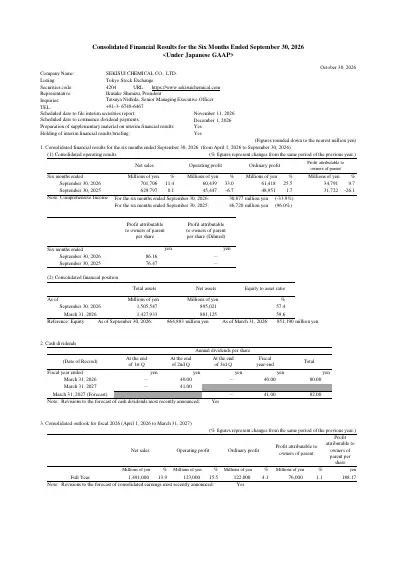
In the first half, net sales, operating profit, and ordinary profit all reached record highs. We recorded 5.1 billion yen in extraordinary losses to replace defective batteries sold in the past, and 2.6 billion yen for asset disposal, mostly inventories, and other costs related to our withdrawal from this business.
This was mostly recorded in the first quarter. As a result, net profit was 34.8 billion yen, up 3.1 billion yen year-over-year.
Next, please go to page 5. This page shows first-half results by segment.
All segments achieved higher sales and profits. On a company-wide level, both sales and profits rose significantly, exceeding our July forecast.
Operating profit reached record highs in High Performance Plastics, Urban Infrastructure and Environmental Products, and company-wide. As mentioned earlier, we decided to exit the LB business in the other segment after assessing its profitability and future prospects.
We will explain each segment in more detail later. Page 6 breaks the results down by the first and second quarters.
In High Performance Plastics and Urban Infrastructure and Environmental Products, the second quarter demand pullback was milder than expected. For Housing, profits were weighed towards the first half last year, but are expected to shift to the second half this year, partly due to opening order backlogs.
Medical profit declined in Q2. Both were broadly in line with our July forecast.
Next, page 7 analyzes our first-half results. On the left, sales increased by 71.9 billion yen year-over-year to 701.7 billion yen.
On the right, higher raw material costs from the worsening situation in the Middle East were offset by higher selling prices, improving margins. We also captured strong demand for high value-added products, including electronics and aircraft-related products in High Performance Plastics.
By responding effectively to raw material procurement difficulties and demand brought forward, we achieved a substantial increase in volume and product mix. Cost control also contributed, and results came in well above our July forecast.
From page 8, I will discuss our revised plan for the second half. We assume this exchange rate, as you can see.
Page 9 shows our market assumptions. In the top left, smartphone shipments were below the previous year's level in Q2, as expected.
We expect a slight recovery from Q3 onward, but shipments are still forecast to remain below last year. At center left, we expect the semiconductor market to remain at a high level.
In the bottom left, global automobile production was broadly in line with expectation in Q2, but from Q3 onward, we expect it to be below both our previous assumptions and last year's level. In the top right, housing visitors: showroom visits declined in the first half, and overall visitors were below last year's level.
We expect this trend to continue from Q3 onward. Housing starts are expected to increase slightly year-over-year this fiscal year, but in the mid-term, the gradual downward trend remains unchanged.
In the bottom right, domestic naphtha prices turned downward in Q2, but are still expected to be well above our initial assumptions. Page 10 shows the revised second-half plan by segment.
We expect net sales and profits to increase in the three segments other than Urban Infrastructure and Environmental Products Company, as well as company-wide, with record-high profits. We expect some pullback in High Performance Plastics and Urban Infrastructure and Environmental Products Company.
For the second half, we plan sales of 789.3 billion yen and operating income of 62.6 billion yen, aiming for record highs in both. Other segment is as shown.
We will continue upfront investments slightly above our April plan. Page 11 analyzes the revised second-half plan.
On the left, sales are projected to increase by 109.8 billion yen to 789.3 billion yen. This increase includes approximately 55 billion yen from new M&A in the housing business this fiscal year.
On the right is operating profit. Volume and mix are expected to fall short of the April plan due to a pullback from the first-half level and fewer housing units sold.
However, we expect year-over-year growth led by High Performance Plastics. We expect higher raw material costs to continue, but will seek to offset them through selling prices.
We expect fixed costs to rise due to spending in growth areas, including M&A-related expenses. Meanwhile, exchange rates and the impact of new M&A on the left-hand side are expected to contribute positively.
Overall, our revised plan is operating profit of 62.6 billion yen, up 1.5 billion yen year-over-year. Page 12 shows our revised full-year plan.
We expect sales and profits to increase in every segment and company-wide. We're also raising our operating income forecast from the April plan.
High Performance Plastics, Urban Infrastructure and Environmental Products, and the company as a whole are expected to achieve record-high profits. Page 13 summarizes our full-year profit plan.
We aim for record-high operating profit of 123 billion yen and ordinary profit of 122 billion yen. Despite this year's extraordinary losses and last year's gains from share sales, we expect net profit to rise to 76 billion yen.
We plan to raise the annual dividend by 1 yen from our April plan to 82 yen per share, making the 17th consecutive year of dividend increase. Finally, page 14 shows our consolidated performance trends.
In this first year of our mid-term plan, we will steadily progress towards our FY2028 operating profit target of 150 billion yen. With EBITDA expected to reach another record high, we believe our earnings power is steadily strengthening.
We will continue to allocate management resources to investments that lay the groundwork for future growth. Thank you very much.
Akira Asano
I am Asano, President of the High Performance Plastics Company. Thank you for your time today.
I will now explain the overview of our company. First, please look at page 16.
This shows our company's performance trend since FY2022. For first-half FY2026, the electronics field was driven by robust semiconductor demand, the mobility field grew on firm aeronautical applications, and the industrial field saw front-loaded demand due to worsening conditions in the Middle East, resulting in increased sales and profit across all three fields, with first-half result reaching record highs of 264.2 billion yen net sales and 38.3 billion yen in OP.
Now, on the other hand, for second-half FY2026, growth markets in the electronics and mobility fields are expected to remain firm, similar to the first half, and in the industrial field, despite negative rebound to the first-half front-loaded demand, we aim to increase net sales and OP year-on-year through the expansion of high-growth product groups, targeting record-high profits for both the second half and the full year. Next, page 17 explains the first-half FY2026 performance and YoY variance.
First, regarding volume and mix, we achieved growth exceeding July forecast in all three strategic field. Growth was particularly driven by semiconductor-related products in the electronics field and aeronautical components in the mobility field.
In the industrial field, general consumer goods such as tapes and adhesives also grew more than expected, compounded by front-loaded effect to secure products ahead of the worsening Middle East conditions, and higher raw materials costs from soaring naphtha prices were offset by agile selling price improvements, and fixed costs were compressed below July forecast, resulting in a YoY sales increase of 40.6 billion yen to 264.2 billion yen, and OP increase of 10 billion yen to 38.3 billion yen. Next, page 18 explains the variance compared to the previous year for the second-half FY2026 revised plan.
As for volume and mix, while we expect a reaction to the first-half demand in social infrastructure field, whose renamed from the industrial field starting in the second half, the electronics field can expect continued expansion of related products driven by robust semiconductor demand. In the mobility field, in addition to capturing firm demand for aeronautical components, we expect growth in NHPP films centering on HUD wedge-shaped films supported by increased adoption of color and design film for EVs in the auto market.
On the other hand, regarding raw materials cost, while selling price improvement progressed in the first half, naphtha price may remain high due to worsening Middle East conditions, and we factor in worsening impact from US-Canada tariff effect, expecting impact amount to be larger than the first half. We've also factored in an increase in fixed cost resulting from bringing forward growth preparations for sales expansion from the next fiscal year to respond to rising semiconductor demand for which further market expansion is expected.
Consequently, our revised plan targets net sales of 266 billion yen, YoY increase of 33 billion yen, and OP of 33.2 billion yen, YoY increase of 2.2 billion yen, aiming for record-high profits in both second half and full year. Finally, page 19 explains net sales in three strategic fields and trends in KPI.
First, electronics field: while products for LCD remain firm, semiconductor market is expanding rapidly, and we expect significant growth in the second half following the first half. We'll focus particularly on increasing demand and market share in the non-LCD field centering on high-performance semiconductors, as well as on winning new orders.
We'll also work to further expand heat dissipation materials as their adoption progresses in semiconductor inspection equipment and electrical components. On the other hand, in the mobility field, who sees continued weakness in automobile production volume, mainly in China, first-half sales struggled to expand for NHPP films other than HUD wedge-shaped films.
However, from the second half onward, since the number of vehicle models adopting color and design films is expected to increase, we'll continue to focus on expanding the sales of NHPP films centering on HUD wedge films. In aeronautical applications, customer production volume increases, higher added value, and the acquisition of new air mobility customers are progressing smoothly, and further sales expansion is anticipated.
In the social infrastructure field, although a reaction to the first-half front-loaded demand is expected for general consumer goods, we expect a certain growth in the second half as well, driven by selling price improvements and the expansion of growth area product groups, including sensing and care material products. We'll continue to focus on securing spreads and expanding our divisional business.
With this, I would like to conclude my presentation.
Masahide Yoshida
I am Yoshida from the Housing Company. I would like to start my presentation.
Please turn to page 21. First, I will review the first-half results and the revised plan for the second half.
Although home sales declined amid a weaker new-build market, growth in the renovation and residential businesses offset the decrease. Company-wide, both net sales and operating profit increased, reaching 278.8 billion yen and 16.8 billion yen, respectively.
In addition, growth investments in our priority areas are progressing well. In the second half, we target a fifth consecutive year of revenue and profit growth, with record-high revenue and operating profit.
We will ensure profits through our existing businesses, further accelerated with newly consolidated companies. We expect growth in sales and profit for the full year, and will target record-high sales and profits.
Next, please turn to page 22, where we review our first-half results. The chart on the left shows revenue.
All three segments—housing, renovation, and residential—recorded growth. Company-wide revenue rose by 20.1 billion yen, exceeding our July forecast.
The chart on the right shows the analysis of operating profit. In the housing business, the number of houses sold fell by 132 year-over-year, and higher material costs also weighed on results, reducing operating profit by 900 million yen.
In the renovation and residential businesses, higher margins helped offset higher fixed costs from strengthening our teams. Operating profit rose by 800 million yen and 1.3 billion yen, respectively.
Overall, operating profit increased by 500 million yen, exceeding our July forecast. Next, please turn to page 23 for the analysis of the revised second-half plan.
On the left, the plan calls for an increase of 72.7 billion yen in company-wide net sales, significantly above the original plan. This reflects the expected contribution from consolidated Noble Home, Mirai Toshi Kaihatsu, and Ozbuild, as announced in the first half.
Noble Home is included in housing, Mirai Toshi Kaihatsu in residential, and Ozbuild in other. The operating profit analysis on the right also reflects the impact of these new consolidations.
The impact on each segment is shown at the bottom of the slide. In housing, we expect more homes to be sold, but higher material and fixed costs are expected to reduce operating profit by 800 million yen.
In renovation, we plan to expand orders by increasing our sales staff, leading to an 800 million yen increase in operating profit. In other, newly consolidated companies, including Ozbuild, whose consolidation is planned from the fourth quarter, are expected to contribute 3.5 billion yen.
Company-wide, we plan for operating profit of 23.7 billion yen, an increase of 2.9 billion yen. Finally, please turn to page 24 for an update on each business.
First, the top left section covers new housing orders. In the first half, rising interest rates put pressure on customers' budgets, making detached homes challenging.
However, strong sales of multifamily housing, where demand remains firm, helped orders reach 102% of the previous year's in value. We do not expect the market to recover in the second half.
We will promote premium products in urban areas and more affordable products in regional areas to stem the decline in the number of orders, and achieve 103% of the previous year's order value. Turning to renovation on the right: orders from existing Heim owners increased, driven by growth in exterior painting and kitchen renovations, as well as steady demand for air conditioner replacements.
For renovation sales to external customers, we strengthen our sales structure by adding dedicated staff, and aim for continued growth. Next, the bottom left section covers the residential business.
In real estate, the number of rental units under management increased steadily, and our property acquisition and resale business also grew. In the second half, we will also realize the benefits of consolidating Mirai Toshi Kaihatsu from the fourth quarter, and accelerate growth.
The adjacent section covers community development business. Condominium sales are ahead of plan, we have raised our full-year revenue forecast by 1 billion yen.
We will continue to actively develop new projects. Finally, in the bottom right section, we further accelerated growth investments in these priority areas.
We have secured resources that were previously lacking through external sources, and have also made progress in strengthening our management foundation. From the second half onward, we will ensure these initiatives deliver tangible results.
That concludes the presentation on the Housing Company.
Yoshiyuki Hirai
I am Hirai from the Urban Infrastructure and Environmental Products Company. I will now explain our result.
Page 26 is for performance trends. In first half FY2026, overcoming Middle East raw material constraints, we secured spreads and inventories, achieving record-high profits: net sales of 123.2 billion yen and OP of 13.2 billion yen, with an operating margin over 10%.
For the second half, assuming continued non-residential market slumps and demand adjustment risks, we plan net sales of 130.7 billion yen, OP of 13.5 billion yen. For the full year, we aim for the highest profit update for the fifth consecutive period and first ever OP margin exceeding 10%.
Page 27 for first half performance analysis: net sales increased by 11.2 billion yen and OP increased by 5.1 billion yen. As for the gap against the July forecast centering on pipe and building materials, we had anticipated a negative rebound to the increased shipment in Q1 from Q2 onward, but it was not the case, and volume and mix increased.
Thanks to early penetration of new pricing and fixed cost shifting to the second half, both sales and profit finished above the July forecast. Page 28 is for variance analysis for the second half.
We plan net sales increase of 2.3 billion yen and OP decrease of 1.6 billion yen. We expect negative volume and mix impact will continue, driven by ongoing weakness in the non-residential sector, specifically project cancellations, delays, and extended lead time due to labor shortages and rising construction costs, compounded by significant inventory adjustment in the market following the strong performance in the first half.
Although price adjustment will offset the continued high cost for raw materials and procured goods, they're insufficient to cover the decline in volume and product mix, resulting in downward revision to both sales and OP versus the April plan. Despite such difficult circumstances, we will focus on securing spread and share increase through expansion of prioritized products sales to achieve our plan.
Page 29 is for three strategic fields. Regarding second-half sales, due to large fluctuations from quarter to quarter, we have presented the average of Q3 and Q4.
For pipe systems, the second-half average sales are projected at 30.1 billion yen, totaling 60.2 billion yen, an increase in sales. For piping materials, despite ongoing non-residential slumps and inventory adjustment risks, improved selling prices will boost sales.
For CPVC, competition is intensifying in our mainstay Indian market, we'll focus on expanding sales outside India. For housing and infrastructure composite materials, the second-half average sales are projected at 22.6 billion yen, totaling 45.2 billion yen, up in sales.
Although market conditions for the non-residential sector remain weak, we aim to gain market share in fire-resistant and non-combustible materials by expanding sales of new products and others. FFU continues to perform strongly with expanding adoption in Europe.
For infrastructure renewal, the second-half average sales are expected at 12.3 billion yen, totaling 24.6 billion yen, increase in sales. For pipeline renewal in Japan, orders have expanded centering on larger diameter pipes; our market share is steadily improving.
Overseas, we'll focus on steadily capturing projects pushed from first half to the second half and winning new ones. Aqua Systems faces a decline in plants due to last year's large project completion, but is focusing on water supply panel tank replacement demand.
The three bottom-right graphs show steady growth in priority expansion products overseas and growth-driving businesses. That concludes my presentation.
Thank you.
Hiroyuki Yamashita
Hello, I am Yamashita. I am going to explain about our Medical Business.
Please turn to page 31. In the first half of FY2026, net sales were 45.2 billion yen and operating profit was 4.9 billion yen.
Despite sluggish market conditions for diagnostic reagents in Japan and China, the impact of our profitability improvement measures helped us achieve year-on-year growth in both sales and operating profit. As for the revised plan for the second half, we expect sales of 50.5 billion yen and operating profit of 7.2 billion yen.
We aim to achieve record second-half profits by fully realizing the benefits of our profitability improvement measures, while also laying the groundwork for medium to long-term growth. Our current profitability improvement measures are scheduled to be completed in the second half.
Next, on page 32, I will review first-half performance. As shown in the chart on the left, net sales increased by 1 billion yen year-on-year to 45.2 billion yen.
As shown in the chart on the right, operating profit increased by 400 million yen to 4.9 billion yen. The key factors are as follows.
Our domestic and Chinese diagnostic businesses were affected by weak market conditions. In addition, some projects in pharmaceutical sciences were canceled.
On the other hand, earlier than planned orders for our diagnostics business in Europe and the United States, together with fixed cost controls, helped us slightly exceed the forecast made in July. Next, on page 33, I will explain the revised plan for the second half.
As shown in the chart on the left, sales are projected to rise by 1 billion yen year-on-year to 50.5 billion yen. As shown in the chart on the right, operating profit is projected to increase by 600 million yen to 7.2 billion yen.
We expect conditions to remain challenging in the diagnostic reagent markets in Japan and China. We also expect costs to rise due to the situation in the Middle East.
Despite these conditions, we will continue to control fixed costs and maintain our operating profit plan as set in April. As shown in the analysis of operating profit at the upper right, although our diagnostics businesses in Japan and China will be affected by market conditions, we will work to secure new projects in pharmaceutical sciences.
We will also fully realize the fixed cost savings from our profitability improvement measures, and aim for record profit in the second half. Finally, on page 34, I will highlight the overview by business.
First, diagnostics in Japan, shown at the upper left: in the first half, the diabetes domain grew, but results fell short of the April plan. In the second half, we will focus on expanding our share in clinical chemistry, immunoassay, and blood coagulation.
Next, diagnostics overseas, shown at the upper right: in the first half, sales rose as demand in clinical chemistry and immunoassay shifted forward in Europe and the United States. In the second half, we will further strengthen B2B alliances to drive sales growth.
Finally, pharmaceutical sciences, shown at the lower left: in the first half, the suspension of some orders led to a decline in net sales in the second quarter. In the second half, we will focus on securing new projects through collaboration.
That concludes my explanation of the Medical Business.