AGC Inc.
Q3 FY2026 · Earnings Call TranscriptNovember 5, 2026
Kazumi Tamaki
It's time, let's get started. Welcome to the earnings briefing of AGC Inc.
for the third quarter of fiscal year 2026. My name is Kazumi Tamaki, General Manager for Corporate Communications and Investor Relations, serving as moderator.
Today's attendees are: Yoshio Takegawa, Executive Vice President and CFO, and Tomoyuki Shiokawa, Executive Officer, General Manager of Finance and Control Division. First, CFO Takegawa will provide an overview of the financial results for the third quarter.
We will then have a question and answer session. We are planning to finish at 3:50 PM.
Your cooperation is appreciated. I now ask CFO Takegawa to start the presentation.
Yoshio Takegawa
I am Takegawa, CFO. Thank you for joining us.
Please turn to page 3. Key points of cumulative results for the third quarter of 2026 and the full year forecast.
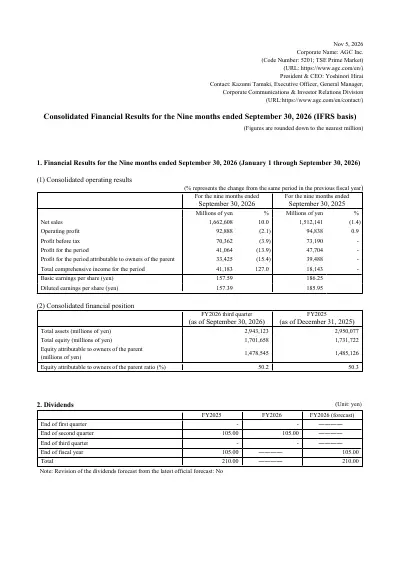
Year on year, net sales increased by ¥105.5 billion, while operating profit decreased by ¥1.9 billion. Shipments increased for chemicals in general and electronic materials, and prices increased for integrated chemicals and architectural glass in Europe.
Still, profit decreased due to deteriorating profits for essential chemicals Southeast Asia, automotive in Europe and the Americas, and architectural glass in Europe on higher material prices and manufacturing costs. Also, profitability improvement measures were recorded in other income and expenses.
Full year forecast is revised downward due to higher costs in automotive and essential chemicals Southeast Asia, and lower than expected volumes in architectural glass and life science. Also, other expenses are projected to be higher than last year and the initial forecast.
Please turn to page 6. A closer look at third quarter results using the income statement, year on year comparison.
Sales were ¥1,662.6 billion, up ¥150.5 billion, despite such negatives as lower shipments of architectural glass and life science, owing to such positives as weaker yen, higher shipments of chemicals and electronic materials, and the pricing policies in integrated chemicals and architectural glass Europe. Operating profit was ¥92.9 billion, down ¥1.9 billion, despite above mentioned positive factors and lower fixed costs for life sciences, due to higher raw material prices and higher manufacturing costs.
Business profit was ¥76.2 billion, down ¥1.1 billion, despite such positives as gain on sale of affiliates and the absence of impairment losses on biopharmaceuticals CDMO recorded in the previous year, due to higher costs for restructuring programs and loss on sale of property, plant, and equipment. Profit before tax was ¥70.4 billion, down ¥2.8 billion, and profit attributable to owners of the parent was ¥33.4 billion, down ¥6.1 billion.
Page 7. Results by segment.
Architectural glass, automotive, and electronics posted increased sales and decreased profit, while chemicals saw increased sales and profit. Life science posted improved profitability.
Page 8. Year on year and quarter on quarter variance analysis of operating profit.
First, year on year decline of ¥1.9 billion. Sales volume, price, and product mix: positive ¥32.3 billion, due to increased shipments of chemicals in general and electronic materials, as well as pricing policies in integrated chemicals and architectural glass Europe.
Fuels and raw materials: negative ¥17.7 billion, with chemicals and architectural glass Europe particularly affected. Cost and others: negative ¥16.6 billion, due to increased depreciation and cost increases in automotive in Europe and the Americas.
Quarter on quarter, increase of ¥2 billion. Sales volume, price, and product mix: negative ¥1.8 billion, and raw material and fuel prices: negative ¥4.8 billion.
Cost and others: positive ¥8.7 billion, owing to the non-recurrence of one-time expenses recorded in Q2. Page 9.
During the first nine months, we implemented various profitability improvement measures, as reflected in other income and expenses. Main items were as follows: In architectural glass, workforce optimization and other structural improvements in response to sluggish demand in Europe.
In automotive, sale of replacement glass installation business in Europe to concentrate resources on upstream businesses. In chemicals, decision to end production at the integrated chemicals UK site by year end, following the weak performance due to rising costs.
In life science, sale of Colorado CDMO site completed, except for part of the land. Accordingly, ¥15.5 billion in other income and ¥32.2 billion in other expenses were recorded up to Q3.
Please turn to page 10. Statement of financial position.
Total assets amounted to ¥2,943.1 billion, ¥7 billion lower than at the end of last year. Exchange rates had a negative impact of ¥24 billion.
Debt-to-equity ratio was 0.40. Page 11.
Cash flow statements. Operating cash flow: positive ¥150.1 billion, and investing cash flow was negative ¥120.8 billion, resulting in free cash flow of positive ¥29.3 billion.
Page 12. CAPEX, depreciation, and R&D expenses.
For the first three quarters, CAPEX totaled ¥139.8 billion, depreciation was ¥147.4 billion, and R&D ¥43 billion. Main projects were as listed here.
Next is results by segment. Page 14.
Architectural glass. Sales were ¥337.2 billion, up ¥16.4 billion, and operating profit was ¥9.4 billion, down ¥0.6 billion.
In both Asia and Europe and the Americas, sales benefited from the weaker yen. In Asia, shipments increased in Southeast Asia, but decreased in Japan, resulting in lower sales.
In Europe and the Americas, price increases offset higher material and fuel costs, but shipments decreased due to sluggish demand. Operating profit decreased despite increased sales, due to lower shipments in Europe and Japan, and increased costs from facility repairs in Japan during Q3.
Page 15. Automotive segment.
Sales were ¥417.6 billion, up ¥32 billion, while operating profit was ¥15.4 billion, down ¥8 billion. Sales increased on positive effects of the weaker yen, increased sales volume in Europe, and improved product mix in Japan and Europe.
Operating profit decreased despite the above mentioned positive factors, as manufacturing costs increased due to productivity deterioration in Europe coming from higher portion of high-performance products, and in North America due to operational issues. Page 16.
Electronics. Sales were ¥270.8 billion, up ¥11.1 billion, and operating profit was ¥33.9 billion, down ¥2.1 billion.
Display posted lower sales despite rising sales prices for LCD glass substrates, due to a decline in shipments of specialty glass for displays from the planned business exit. Electronic materials saw an increase in sales due to increased shipments of semiconductor-related materials, including EUV photomask blanks, and optoelectronics, and the benefit of a weaker yen.
Despite these positive factors, profit decreased due to rising manufacturing costs and impact of the weaker yen on display. Breakdown of operating profit was display 20% and electronic materials 80%.
Page 17. Chemicals segment.
Net sales was ¥515.7 billion, up by ¥84.4 billion. Operating profit was ¥43.7 billion, up ¥41 billion.
Both integrated chemicals and essential chemicals Southeast Asia benefited from weaker yen in terms of net sales. Integrated chemicals net sales increased by ¥35.6 billion, due to higher sales prices and increased shipments for semiconductor and other electronics.
Essential chemicals Southeast Asia net sales grew by ¥50.7 billion, thanks to increased shipments due to capacity enhancement in Thailand. Although higher net sales at integrated chemicals contributed to OP, the impact of rising raw material and fuel prices and deteriorating market conditions at essential chemicals Southeast Asia was significant, resulting in a limited increase in OP.
Approximately 90% of operating profit was from integrated and 10% from essential chemicals Southeast Asia. Please turn to page 18.
Life science segment. Net sales was ¥100.2 billion, up ¥4.1 billion, and operating profit was actually a loss of ¥12.6 billion, but improved by 6.
[corrects herself] ¥3.6 billion. Net sales benefited from weaker yen.
In Q3, compared to Q2, contract volumes for biopharmaceutical CDMO decreased due to seasonal and other factors. Operating loss shrank due to reduced fixed costs, such as the closure of a biopharmaceutical CDMO site in Colorado.
Compared to Q2, P&L deteriorated due to a decline in contracted projects caused by seasonal factors and other reasons. Please turn to page 19.
Performance of our strategic businesses. Net sales was ¥402.8 billion, up ¥39.5 billion year over year, and operating profit was ¥57.6 billion, up ¥16.9 billion.
Net sales across all strategic businesses increased year over year, with growth in performance chemicals and electronics contributing to the rise in profit. Operating profit from strategic businesses accounted for 62% of the group's total operating profit.
Next, I would like to explain the full-year earnings outlook. Page 21.
As mentioned in the beginning, we have revised downwards the full-year earnings forecast, which was provided on 6th of February. Net sales remains unchanged at ¥2.2 trillion, but operating profit has been revised downwards to ¥120 billion, down ¥30 billion.
Net profit attributable to owners of the parent is revised downwards by ¥37 billion to ¥40 billion. Year over year, net sales is up ¥141.1 billion, operating profit down by ¥7.5 billion, net profit attributable to owners of parent down by ¥29.2 billion.
In our full-year FX assumptions, we have revised the US dollar to ¥160 and euro to ¥180. Page 22.
Forecast by segment. The far right column shows the variance from the initial forecast.
Net sales forecast was revised downwards for architectural glass and life sciences, and upwards for automotive and chemicals. However, the overall forecast remains unchanged.
Operating profit is explained on the next page. Please turn to page 23.
Operating profit forecast was revised downwards by ¥30 billion. By segment, this is ¥1 billion for chemicals, ¥15 billion for automotive, ¥9 billion for architectural glass, and ¥8 billion for life sciences.
In chemicals, while integrated chemicals is expected to overperform against the initial plan, essential chemicals Southeast Asia is expected to underperform, resulting in this downward revision of ¥1 billion. Looking at each segment, essential chemicals Southeast Asia has been impacted by soaring raw material prices and weaker market conditions, resulting in downward revision.
We will continue our exiting pricing strategy and production efficiency improvements. Automotive downward revision is due to rising manufacturing costs in North America and Europe.
We will implement headquarters-led strengthening of manufacturing and technical management. In the architectural glass segment, sales volumes in Europe and Asia fell short of initial forecast due to economic downturn, and costs rose as a result of soaring energy prices in Europe.
We also had unplanned facility repairs in Japan. In Europe, we will optimize production capacity and workforce in line with demand, and in Asia, we will continue our pricing strategy, and also improve productivity and continue to enhance value-add for our products.
In the life sciences segment, cost increased due to delayed start of production for newly contracted projects and delayed sale of the Colorado site. Order intake is showing signs of recovery.
We will expand our order book and maintain stable production. Page 24.
Outlook for each segment in Q4, comparing it against Q3. Architectural glass.
In Asia, shipments are expected to increase due to seasonal factors. Efforts will continue to adjust prices and improve productivity.
In Europe and the Americas, while South America is expected to remain strong, economic downturn in Europe is set to continue, and recovery in shipments is expected to be limited. We will implement price adjustments and cost control measures.
Automotive. Shipments are expected to decline due to seasonal factors.
We will continue to improve our product mix and improve our productivity at a quicker pace, and profitability in Europe and Americas, which remain areas of concern. Electronics.
In the display sector, shipments of glass LCD substrates expected to slow down slightly. We will continue with our efforts to improve profitability.
Among electronic materials, shipments of semiconductor-related materials such as photomask blanks and EUV lithography expected to increase. Optoelectronic materials are entering a period of adjustment, and shipments are expected to decrease.
Page 25. Chemicals.
Within integrated chemicals, shipments of fluoropolymers are expected to decline in Q4 due to concentrated shipments in Q3. However, the business environment remains favorable.
In essential chemicals Southeast Asia, while caustic soda shipments are expected to increase, PVC shipments expected to decrease. Profit is expected to improve, but remain at low level.
Life sciences. Net sales in small molecule pharmaceuticals and agrochemical CDMO are expected to increase due to seasonal factors.
Net sales in biopharmaceutical CDMO expected to increase, partly due to higher utilization at the Copenhagen site. Page 26.
Strategic businesses. Compared with our initial forecast, net sales is revised down by ¥10 billion to ¥550 billion, and operating profit revised upward by ¥5 billion, which is now ¥85 billion.
Although life sciences is expected to be below initial forecast, OP forecast for strategic business as a whole is revised upwards due to strong performance in performance chemicals and electronics. Page 27.
Outlook for CAPEX, depreciation, and R&D. Compared to the initial forecast, CAPEX is expected to increase by ¥15 billion to ¥205 billion, due to higher construction costs and weaker yen.
Depreciation will be ¥195 billion, up ¥12 billion, and R&D outlook remains unchanged. Page 28.
Regarding shareholder returns, there is no change to the stable dividend policy targeting DOE of approximately 3%, and the planned year-end dividend remains unchanged at ¥105 per share. That concludes my presentation.
Thank you.
Kazumi Tamaki
We will now move on to the Q&A session. If you have a question, please click the Q&A button and type in your question.
We also accept questions via audio in Japanese. If you wish to ask a question this way, please click the raise hand button at the bottom of the screen.
The moderator will call on you. When speaking, please unmute your microphone, and please state your name and affiliation before asking your question.
Your brevity is appreciated. We will only accept one question at a time.
From SMBC Nikko Securities, Maeda-san please.
Eiji Maeda
Thank you. Maeda from SMBC Nikko.
I have one big question. I'm looking at slide 9 and 23 as well.
I'll start with slide 23. One-time issues this year, for example, sluggish production of automobiles, and natural gas prices are increasing, and I suppose there is a time lag effect.
For chemicals, there is the inventory issues as well, as well as the Colorado site being sold. What are the impact of those one-time items, both positive and negative, in a qualitative way please?
Also, what will be the prospects of making a recovery next fiscal year? As for page 9, can you talk about the structural reform efforts and what will be the margin for improvement?
Kazumi Tamaki
Thank you for your questions. Regarding the one-time issues and other income and other expenses recording, what will be the impact for next year is your question.
Shiokawa-san will take that question.
Tomoyuki Shiokawa
Thank you very much for your questions. The one-time factors...
It's hard to say, but as for other income and expenses, sale of business, and sale of assets, and termination of production are all in the tune of ¥10 billion or so. Those are one-time factors.
As for the one-time issues above operating profit, it's really hard to say, but with the delay in sale of Colorado site, I think it will be in billions of yen. As for the gas price in Europe, well, due to the election effect of the US, the price has come down somewhat today, but until yesterday, the gas price was increasing very rapidly.
As for the surcharge, because of the time lag, we suffer, especially when prices are increasing. Most probably, we expect, again, billions of yen of impact.
For chlor-alkali price, the selling price, and ethylene price, they're fluctuating very rapidly, very hard to generalize, but in light of inventory level, we believe the time lag is in the order of several months. This could have an impact of billions of yen, again.
As for automotive business, for the deterioration of the manufacturing cost in North America and Europe, we're talking about rather sizable amount. They are one-time in a way, but we saw impact of ¥15 billion so far.
As for the fourth quarter, it's not likely to be over, we're hoping that by the first half of next fiscal year, we will be able to recover. Thank you.
Eiji Maeda
As for page 9, for non-operating, again, they are one-time. For example, sale of affiliate, and closures as well.
Can we expect a positive on operating profit next fiscal year, or would that be a negative as well?
Tomoyuki Shiokawa
On operating profit basis, we will be applying IFRS 18, and so we can't really compare apple to apple, but on the current operating profit basis, we are confident that we can improve.
Eiji Maeda
I see. Thank you.
Kazumi Tamaki
Thank you very much, Maeda-san. Next is Nishiyama-san from Citigroup.
Yuta Nishiyama
Yes, this is Nishiyama, Citigroup. Thank you.
I'm looking at page 23, and I have some questions. Impact of Middle East.
The assumption for oil price was adjusted to $100, and you have explained to us that the impact is minor. It's been three months.
Essential chemicals and architectural glass in Europe seem to be having an impact from what's happening in Middle East, especially for essential. The spread actually has improved from the beginning of term.
I know that there is some time lag, but you have also introduced a surcharge. You have made quite big downward revision.
Can you please explain the background of this? Also, between the worsening of the manufacturing cost for automotive.
In the second quarter, the impact was going to be about ¥10 billion or ¥20 billion, and you also explained that it would improve during the second half of the year. I see a gap between what I see on the slide versus what you told us before.
Can you please explain the reason behind this downward revision?
Kazumi Tamaki
Thank you for the question. Takegawa will respond to your question.
Yoshio Takegawa
Thank you for the question. I would like to explain this step by step for essential chemicals Southeast Asia.
PVC price is recovering slowly, but ethylene prices have started to go up again, and fluctuation is happening again and again, spread is not necessarily improving over time. The profit is still positive, although it has declined quite a lot.
Now this profit level is lower than what we had expected. Including the situation in the Middle East, we need to stay focused on the material and the fuel prices.
Moving on to architectural glass, Europe. Gas prices.
Yes, it's true that we have implemented surcharge, which means that we can recover this with a delay. Recently, yes, it went down, but over the last few months, it continued to go up in terms of prices.
This monthly facing the negative impact is pushing up our cost. For the long term, we believe that we can make a recovery, but this gap may persist till the end of the year.
That's one factor. For architectural glass, more than we had expected, demand for architectural construction in Europe is declining, and that is having a big impact in terms of why we're not achieving the plan.
Last but not least, automotive. Situation is slightly different between North America and Europe.
In North America, it stemmed from quality issue, followed by facility problems, and that ended with a lower level of inventory and a tight production. Manufacturing, we have been implementing countermeasures, but now the situation is quite tight.
We also had to provide support for urgent transportation in various areas, which pushed up the cost. The problem with quality as well as facility have been resolved mostly, but there is a tight situation between inventory and manufacturing, and it will take some more time before we can see improvement there.
Also, at the same time, we will be changing the structure so that hopefully we can break even and become positive in the second half of next year. It will take some time.
As for Europe, high-value-added products, very expensive, but also very difficult to manufacture. That's the kind of products that we are making, and we had a problem with productivity, and we had cost worsening.
We had facility problem at the same time as well. It has taken long time to identify the causes of these problems.
We actually exported glass to Europe from other regions, we kicked off backup systems. If not before the end of this year, early next year, we believe that profitability will improve.
Yuta Nishiyama
¥15 billion in automotive is pretty big. Between first half and second half, what would be the split in terms of cost impact?
Can you give us an idea?
Yoshio Takegawa
Between first half and second half, the situation was very different between Europe and North America. In North America, Q2 and Q3 had the biggest losses, whereas in Europe, we saw bigger loss cost in the third and fourth quarters, rather than the first and the second quarters.
Yuta Nishiyama
I understand. Thank you.
Kazumi Tamaki
Thank you, Nishiyama-san. Next, Kono-san from Nomura Securities please.
Tasuku Kondo
Thank you. Kondo from Nomura.
I have questions on life science. Sales and profit for Q3.
Your presentation materials indicates that due to seasonality, sales were sluggish, but year on year, the sales went down by over 10%. Can you explain the reason why?
For quarter on quarter and year on year, the profit has gone down. Is this due to one-time factor is my question.
Thank you.
Kazumi Tamaki
Takegawa will take that question. For life science
Yoshio Takegawa
for Q3, sales and profits both deteriorated. There are several factors.
First, in Europe, the summer vacation was rather long, and concurrently, we implemented repair, maintenance, and therefore, the utilization rate went down and costs were incurred. That's one factor.
Also, during the first half to the third quarter, the new orders were not coming in that strongly, and that is shifting to the fourth quarter. These are the factors behind the Q3 results.
Now looking at the current situation, for October and November, we are seeing improvement in sales and profits primarily in Europe on a monthly basis. For bio business, we expect to achieve breakeven point.
We expect improvement for the next fiscal year. Thank you.
Tasuku Kondo
Regarding sales, your medium-term plan expected expansion, what is the current situation compared to the plan? As for the improvement that you expect for the next fiscal year, what will be the size of that improvement?
Yoshio Takegawa
Regarding sales, year on year, we're not seeing a big increase. In fact, due to the foreign exchange impact, we're not seeing much difference.
In relation to your second question, for the fourth quarter, we do expect increase in new orders, especially for Copenhagen site. We expect sales to be of the size that could turn profitability to be achieved, in other words, above the breakeven point for October and November.
Tasuku Kondo
Thank you very much. That is all.
Kazumi Tamaki
Thank you. Next, Daiwa Securities, Hirakawa-san, please ask your question.
Noritsugu Hirakawa
Hello. This is Hirakawa from Daiwa Securities.
I have a question about electronics. Competitors are talking about increasing prices for display, and in the second quarter, because of weaker yen, the cost was getting higher, and you mentioned that you might be thinking about increasing the prices for display-related products.
Now based on the earnings results this time around, what is your view on pricing, including a potential price increase for display? Thank you.
Kazumi Tamaki
Takegawa will respond to your question.
Yoshio Takegawa
Yes, display prices. Price increase is being attempted, but what is a specific percentage increase, well, it's difficult for us to actually comment on the specifics.
Compared to 2024, in 2025, we saw an increase in the lower end of the single-digit percentage. In '26, again, we're seeing a similar level of price increase, but unfortunately, yen is getting weaker, and we don't see any appreciation of yen, which is impacting our earnings negatively.
In terms of price increase, we already had a plan and assumptions, and as we expected, it is increasing steadily. That's all from me.
Noritsugu Hirakawa
Looking into next fiscal year, I understand there's negotiation and also different situations, but the price increase will be similar to last year or this year, or maybe you will try a little bit more in the next fiscal year as a possibility?
Yoshio Takegawa
Next year, we will try to increase the price at about the same level as what we did in this fiscal year in order to cover the cost, and also in order to provide higher functionalities and features. We will be trying to increase total price.
Noritsugu Hirakawa
I understand. Thank you very much.
That's all from me.
Kazumi Tamaki
Thank you, Hirakawa-san. Next is Shikanai-san from JPMorgan.
Mio Shikanai
Thank you. Shikanai from JPMorgan.
I have questions on electronics. Quarter on quarter, profitability is expected to go down.
Usually, for seasonality, Q3 should be expecting improved profitability. When you break down into display versus electronic material, what was the situation regarding profitability, as well as price increases?
Thank you.
Kazumi Tamaki
Of the electronic segment, the direction of profit and loss for display and electronic materials subsegments. Takegawa will answer.
Yoshio Takegawa
For display, as mentioned earlier, we will continue with price increases, as well as enhanced functionality being provided, so that we could maintain profitability even under the yen depreciation situation. For electronic materials, overall, the demand in semiconductor-related applications are still very robust.
EUV mask blanks, CMP slurry, for all those product areas. For optoelectronics, this year, as we moved towards higher functionality, higher performance, this was a transition period.
During the first half of the year, shipments increased, but on a full-year basis, as we move towards higher proportion of high-performance products, we are hoping to see improved profitability towards next fiscal year.
Mio Shikanai
If I could get to the details. How about the fourth quarter?
You said that price increases will continue for display, but you're expecting shipments to go down. In terms of profit rate, you're hoping that you can maintain the current profit rate?
Yoshio Takegawa
For display, for December, basically, we would like to raise prices so as to secure profitability. As for the yen depreciation situation, there could be some ups and downs.
Mio Shikanai
I see. Thank you.
Kazumi Tamaki
Thank you. Nissay Asset Management, Nakayama-san, please ask your question.
Thank you. Nakayama, Nissay Asset Management.
Can you hear me?
Iori Nakayama
Yes. Thank you for this opportunity.
I have to make a tough statement. Mr.
Hirai assumed the position of president, and then there's been one revision after another. This earnings announcement that shows each business getting worse than what we thought in the previous earnings announcement.
I understand that there are external factors, environment, but there may be some factors that are specific to AGC when we try to compare you with other companies. From the management perspective, what are the intrinsic, internal factors, or challenges that you see?
Can you please share that with us? Murano-san is assuming the position of president.
Change of leadership. What is this message, and what is the background of this change?
Can you please explain that as well?
Yoshio Takegawa
I believe that there were two questions. Five years in a row, we are revising the numbers downwards.
What are the internal challenges that we see? Takegawa will take the question.
For the other question, as of 1st of January next year, we will have a new president, Murano. Now I think that these are the right people to answer that question today, we'd like to take this offline.
Takegawa will take your first question. Thank you.
Both internal and external factors, there were many this time around. We were not given stringent enough view on the extrinsic factors, which means that this is the responsibility of management, and we should never repeat this again.
I know that we have repeated already five times, but leading up to the next fiscal year, we need to formulate a solid plan and execute on that plan that we can achieve. If you look at the content of the downward revision this time around, it's a mixture of both intrinsic and extrinsic factors.
The biggest intrinsic factor was automotive loss cost, ¥15 billion. This is North America and Europe.
This was not about the market. This was not big impact from the Middle Eastern situation.
Most of this was loss cost related to manufacturing. We need to make recovery as quickly as possible.
As you can see on the slide, North America is a big piece of this. We need to review the structure of North American business and improve that.
This initiative has to be led by the headquarters. We need to make improvements for the short term, but also we need to really improve and reorganize the manufacturing structure itself.
Another factor was related to essential chemicals. Now in this case, we were affected by the market prices.
PVC price may go up, but the spread doesn't improve, for example. This was not what we had expected, and also quite difficult to respond to.
In terms of operational improvement, we're talking about productivity improvement, efficiency improvement. This is about operation.
We're not saying that we are having problems with facility, but material may have to be ordered in small lots, and also depending on the situation, we should be able to manufacture at a smaller lot level. This kind of operational activity is quite challenging, and I cannot exactly say how much loss we have experienced, but we know that there is room for improvement here.
Another extrinsic factor was delay in sales of the Colorado site and also start of the new order, new contracts. Other than that, all the intrinsic factors, we need to deal with them ourselves, and we need to provide a more conservative view, careful view, on external, extrinsic factors, so that we can make improvements and also achieve the budget in the next fiscal year.
Thank you. A quick follow-up.
Different businesses are experiencing problems, and it seems as if the management doesn't really understand the depth of the problem and where the problems are happening. They only notice when the problem becomes big enough and serious enough, and then take countermeasures.
Iori Nakayama
I think this is a repeated process. We saw it in life science, and also in automotive this time.
Nissay Asset Management see these concerns, our concerns, and if you believe that this is a problem, what will be the countermeasure, the plan to address this?
Yoshio Takegawa
This is a very difficult question, but also very fundamental at the same time. We have an in-house company system, which means that we delegate the operation to each company within the group.
In other words, corporate, the headquarter, does not get involved in the details of operation, because that would make the company system meaningless. If we delegate too much, sometimes, yes, the damage gets big enough and then the headquarter realizes.
That kind of situation happens. We need to really revisit the roles and responsibilities in terms of how much to be delegated to the company level, and how much the headquarter should be involved.
Iori Nakayama
Thank you. Thank you very much.
Thank you, Nakayama-san. Next, that would be the last question.
Shibata-san from SBI Securities please.
Ryunosuke Shibata
Thank you. Shibata from SBI Securities.
I'm looking at slide 41. Maybe this has already been referenced earlier, automotive, life science, and chemicals, through the restructuring efforts, how much profit improvement can we expect next fiscal year?
That's all.
Kazumi Tamaki
Thank you for your question. Shiokawa will answer that question.
Tomoyuki Shiokawa
Thank you. For automotive, as Takegawa-san said earlier, in a way, what we have been suffering from are all our fault, resulting in ¥15 billion this year.
We'll have to make sure that we more than make up for this figure, and we're confident that we can do that. As for life science, in a way, it's hard to give you some specific figures, but we're hoping that we can at least achieve breakeven, or do even better to move into a positive territory.
As for chemicals, we are ending production in UK, integrated chemicals in UK, and it's hard to really talk about specific figures, but this should result in optimizing our production structure to a certain extent. We're hoping that the first half of the single digit, or of millions— hundreds of millions of yen could be achieved in terms of improvement next year.
Thank you.
Kazumi Tamaki
With that, we will conclude the Q&A session. If you have any further questions, please contact us at this mail address that you see on the screen, or you can call us in Japanese.
Please help us improve our future webinars, please take a moment to complete our quick survey. With that, we will conclude today's briefing on the third quarter results.
Thank you very much for your participation.