Renesas Electronics Corporation
Q3 FY2026 · Earnings Call TranscriptOctober 29, 2026
Operator
Thank you very much for taking your precious time to attend Renesas Electronics' fiscal 2026 third quarter earnings call. We thank you very much indeed.
For today, simultaneous interpretation is made available. Please click the interpretation icon at the bottom of the screen and select the language of your choice.
Mr. Shinkai, please turn your video on.
Today's session is attended by our CFO, Mr. Shuhei Shinkai, as well as other staff members of the company.
After a few words from Mr. Shinkai, we would like to provide you with explanation of the third quarter results, which will be followed by a Q&A session.
We expect to finish the entire session in about 60 minutes. The materials to be used for today's presentation is already posted on the IR site of our corporate homepage.
Mr. Shinkai, please turn your microphone on and begin your presentation.
Thank you.
Shuhei Shinkai
I am Shinkai, CFO of the company. Good morning to you.
From this time around, the earnings call update method was reviewed. In June of this year, at the Capital Market Day, our mid- to long-term business direction and strategies, as well as the aspirational financial targets, were presented to you in a comprehensive manner.
The progress of those mid- to long-term things will be explained during the full-year earnings call, also at the Capital Market Days, from Mr. Shibata.
The recent or the quarterly performance of the company will be explained mainly by myself. Please be aware of that.
Now, if I could begin the presentation using the presentation slides, but before that, in the third quarter of this year, I would like to just briefly talk about the highlights of the third quarter results, as well as the outlook for the fourth quarter. The first third quarter actuals, with the industrial and infrastructure sales came in higher than the projected numbers.
On actual Apple-to-Apple basis without the impact of forex, it was 1.18% increase compared to the plan. As for the third quarter, on the 1st of July, the timing business was transferred.
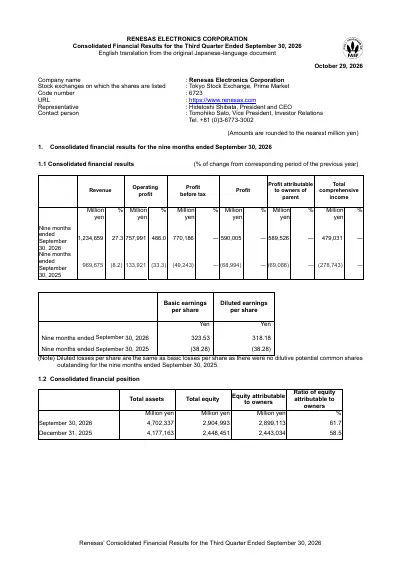
We completed that transfer, the GAAP-based operating profit, we recognized the proceeds from the sales of ¥458.3 billion. For the third quarter, on a Q-on-Q basis, excluding the foreign exchange impact on Apple-to-Apple basis, 4.2% Q-on-Q increase was recorded.
The details was driven by the growth of automotive, SOCs, and also the fourth generation started off, and also the MCU 28 adoption spreads, so that was also a factor, and also industrial infrastructure continue to be strong. The fourth quarter outlook, if I try to summarize for the full year of 2026 on a year-on-year basis, 26.4% revenue increase is expected for the landing.
There's also foreign exchange favorability, but on a year-on-year basis, a 20% increase is expected for the full year. Now, for the mid- to long-term aspirational targets, towards these goals, we will continue to grow, and we are also tackling to increase the production capability.
The in-house production will be expanded through capital expenditures. In the third quarter, fourth quarter, we will continue to make those capital investments.
Now I would like to go into the explanation using the presentation slides. Now, if you can go to page 3, this is a disclaimer here.
As I said at the outset, on the 1st of July, the timing business was transferred, those were excluded from the non-GAAP numbers, and the GAAP-based third quarter numbers recognizes the proceeds from the transfer of this timing business, the gains from that sale. The fourth page, the third quarter actuals are presented here.
If you look at the shaded part on the left, those are the third quarter. If you can look at that for the revenue, ¥453.
50- ¥435.2 billion, gross margin 59.4%, operating profit ¥150.5 billion, operating margin 34.6%, EBITDA ¥173.4 billion, and profit attributable to the owners of parent ¥125 billion, foreign exchange ¥161 to the dollar, ¥185 to the euro. As always, that's the timing business, excluding all that, the year-on-year comparison excluding timing business is presented on the right-hand side of the screen.
Then for the third quarter, there was one-off accounting-related factor, excluding that, we wanted to show this Apple-to-Apple as much as possible so that we can explain the real strength. Excluding the foreign exchange and the one-off factor, if you look at the second column there, that's already presented, it's the one that says that the excluding of foreign exchange and also the foreign exchange impact and also the one-off factor, the ship and debit transaction-related adjustments are this one-off factor, the ship and debit.
We had made a quotation for the provisions, and then based on the actual sales to the customers, we have settled that. We have changed the methodology for the quotation, so that's the reason why we have decided to make this adjustment one-off here.
The number was quite the significance, so that's the reason why we have decided to exclude this as a one-off factor, and so it's just a technical adjustment. If you can look at the next page, this is the comparison vis-à-vis the plan.
The third quarter revenue, gross margin, and also the OP margin, I would like to explain them one by one versus the plan. If you look at the column versus the plan, revenue was +1.2%, and however, on a like-for-like basis was higher, it came in higher on Apple-to-Apple basis higher than the plan, but because of the foreign exchange impact and also the one-off factor, those factors that canceled out each other.
Now, the actual demand, 1.8% the incremental revenue, if you look at the actual demand, automotive compared to plan was slightly higher, infrastructure, IoT, industrial and IoT was higher, therefore, the vast majority came from the contribution of IIoT. Then there are three major factors here: data center actual demand increased, and also consumers, and also the back-end supply improved, therefore, we were able to have an increase in collection, and also as for the mass market in the industrial sector, AI and semiconductor-related demand increased.
Those were the three major factors behind this upside compared to the plan. Now, as for the gross margin compared to the plan, 1.9 percentage point increase compared to the plan, and weaker yen, mix improvement, and the cost reduction for production were the major factors.
In weaker yen 20%, mix improvement 50%, and also the cost reduction 30%, those are the contribution towards this improvement versus the plan. As far as the mix improvement is concerned, the data center and also the supply improvement, that was the factor behind the revenue improvement, and so likewise here, the digital power, DPU improvement was a contributor for the mix improvement.
Also when it comes to the production cost reduction, the write-down and write-off of inventory did not occur as much as what we had planned, so that resulted in lower-than-expected expenses. Also for the OP or operating margin compared to the plan, 2.1% higher compared to the plan.
The gross margin, the upside factors for the gross margin was the same here for the OP margin, and there were increase in expenses, but the increase in the revenue, those canceled out each other, more or less. The decline was the decline of expenses due to the freezing or the review of the hiring plan, and also AI infrastructure investment inside the company, and also the increase of the STI-related provisions offset those favorabilities, the actual landing numbers came in more or less in line with the plan.
If you look at the right-hand side, on a Q-on-Q basis, gross margin was more or less in line with the projection, and also for the operating margin, on a Q-on-Q basis, we anticipated a expense increase and we landed according to the plan. By segment, IIoT, on a Q-on-Q basis, there has been a significant increase, as you can see here, but when it comes to the gross margin, foreign exchange and mix were also a factor, and also for the operating profit, the scale increase was the major driver behind the good performance.
If you look at the next page, this is the quarterly performance of the revenue. Overall, year-on-year, 30.2% 30.2% increase; on a Q-on-Q, 7.4% increase.
The numbers on the brackets are the actuals or Apple-to-Apple excluding the one-off factor and the foreign exchange, 22.3% cruise increase year-on-year and 8.6% increase quarter-on-quarter. The next page.
Inventory, left-hand side is the DOI, and Q-on-Q, third quarter, work in progress and completed is increasing, and die bank increased, and production increased too, and work in progress also increased. These are the major factors.
Fourth quarter, quarter-on-quarter, there's increase to be expected. Die bank and production capacity fulfillment, by which work in progress will be increase, and fourth quarter has inventory increases to be expected.
In addition, on the right-hand side, sales channel inventory shows third quarter, Q-on-Q, for inventory increases, and auto and industry has been increasing in inventory. On the other hand, for automotive, more than assumption, the sell-through is increasing, fulfillment it's not so large, but it is being increasing as a trend.
Fourth quarter, channel inventory fulfillment is to be continued. For auto, as mentioned at the beginning, 27 nano and R-Car mainly will be fulfilled so that demand fulfillment preparation will be made.
For industry, infrastructure, data center is still at low level in inventory levels, but in actual amount, it will be increased, and we will work on that. Next page, please.
For CapEx and utilization, for processes wafer, third quarter is as assumed. Kawashiri plant earthquake impact, wafer input had been delayed, but impact is very small, and it is 59% as a result.
The fourth quarter expects some increases. On the right-hand side, there is the CapEx situation shown.
Third quarter has MCU and local government power to be increasing production, and in-house factory utilization increases, and R&D investments that have been in-house, which is ¥111.2 billion to be fixed. Increases in production is 80% of overall.
For MCU domestic Naka plant, and for power, mainly for the post-end process for Malaysia factories to be handled for increasing production, and domestic Saijo factory where production will be increased, and the post-process and entering processes is where it will handle those processes. The third quarter continues for AI infrastructure post-processes mostly, and in-house factory capacity increases will be worked on.
Next page. Fourth quarter and full-year forecast.
For the fourth quarter, on the left-hand side, there's a shaded portion to be referred to. Revenue and profit: ¥454 billion for revenue, and ratio 58.0%, 32.0% for OP, and forex dollar ¥157 and euro is ¥178 expected respectively.
The contents will be explained. Revenue: ¥454 billion is shown at the center.
Year-on-year, on the right-hand side, is 29.4%, Q-on-Q is 4.3% of increases expected. Q-on-Q 4.3% will be explained where yen appreciation factors and third quarter one-time factor may be included, but excluding that, it will be around 4.2% of increase to be expected in revenue, as written at the revenue excluding forex and one-time impact.
This 4.2% Q-on-Q increase for the revenue, for data center and industrial increases are mostly the portions. For automotive, 27 MCU deployments and Japan Gen 4 deployments are the main drivers for the growth.
Gross margin: 58% is Q-on-Q 1.4 points a decrease to be expected. Yen appreciation and mix and production expense increases are included.
More than 50% is mix factor, and the remainder is forex and production expense increases. For the production expense in CapEx, as has been explained, gradually there is more investment into production increases, investment-related expenses in the fourth quarter is increasing.
Year-end maintenance is also necessary, repair works expenses will concentrate at the end of the year. 32.0% of operating margin, 2.6% reduction occurs.
In the fourth quarter, OpEx increase is expected, and there are about three factors to this: one is the office upgrading and infrastructure, internal IT and AI infrastructure to be prepared for, and investments for that are necessary, and R&D investments. There are some seasonal factors where it concentrates towards the end of the year, and other portions are also included.
Q-on-Q, operating expenses is increasing thereby. At the bottom, there is the sensitivity of forex.
Fourth quarter forex sensitivity has it where ¥1 $1 to yen fluctuation and impact to operating profit is shown. In dollar case, it's ¥2.2 billion, and operating profit ¥1.1 billion.
In euro, in sales, 0.2 billion, and operating profit impact is 0.1 billion. Dollar ¥100 and euro 120 means the performance forecast 32.0% is 26.2%.
In addition, for the appendix, please jump over to page 17. Operating profit, the third from the top, 563 billion is shown.
As mentioned at the outset, timing business transfer proceeds is booked here equal to 430 billion. That is the conclusion of the slide explanation.
Operator
Thank you. Now we'd like to move on to the Q&A session.
I would like to first explain how to give a question. If you have a question, please press the raise hand button on the screen.
From those who have raised their hands, we would like to call the name of the person and the company. If you are nominated, you are able to make a statement, please unmute the microphone yourself and begin your question.
In the interest of time, we would like to limit the number of questions to two questions per one questioner. All right, first of all, Goldman Sachs, Takayama-san, please begin.
Please unmute yourself and begin your question. Thank you.
Daiki Takayama
My first question is the revenue for data centers and also digital power that is a portion of that in the third quarter and also for the fourth quarter. Can you give us the outlook for the fourth quarter?
Also, as you ramp up your production inside the company, what is the output that can be expected for the first quarter of next fiscal year? How further can you increase your production?
I would like to confirm these points. When it comes to the profit margin in the third quarter, because IIoT profit margin has been increasing, I'm sure that data center performance is improving.
Other than memory interface, digital power is also I believe is improvement. Can you explain those trends, if you could?
Also related to data center, agentic AI impact, if you see any impact from that, if you can comment on that point as well. That's my first question.
Shuhei Shinkai
All right. Agentic AI impact, it's not possible for us to quantify that yet.
However, the industrial and also the mass market business of ours is indirectly affected by that in the form of revenue increase. That's how we see it.
We need to further analyze and study this impact. Also, digital power and memory interface trends in the third quarter to the fourth quarter, we're expecting the growth quarter-on-quarter.
Data center overall, at the whole company level, in the third quarter, 21% it was a contribution to our total sales. In the fourth quarter, its contribution will rise further from the 21% level to a higher level.
Therefore, this will be a one driver of our growth. As far as CapEx is concerned, digital power front-end and also digital power middle-end and also the back-end, for those needs, we are going to make investments.
Also, the memory interface front-end, currently from foundry, we are securing these from the foundries, but we are going to increase the capacity for test at the back-end. That is our plan, therefore, CapEx impact on revenue growth, in that regard, digital power contribution will likely be higher in terms and also its impact scale will be larger.
In a phased manner, the supply will increase gradually. One of the major steps will be next year first quarter at Saijo.
Those capacity increase investment output will come in in full strength from the first quarter next year. Therefore, we expect that will have a boost to our revenues.
Also, digital power, if you single that portion only, Saijo production increasing investment and also the foundry capacity increase investment, including all these things, in 2026, compared to 20- fiscal 2026, double to 2.5 times at the run rate, production increase is expected from next fiscal year first quarter. That is a contribution that we foresee right now.
Also, as far as the mix is concerned, memory interface, digital power, the customer architecture platform, those are quite well diverse. Therefore, the cost configuration and also gross margin breakdown is quite different from customer to customer, from platform to platform.
Just like market share, this changes quite dynamically. That will be the major factor behind the change of the mix.
As a general trend, gradually, as the product matures, the yield will also improve, and also depending on the maturity of the production, the gross margin will also improve. In the near term, it will be affected by the mix, and that may seem to be significant.
Daiki Takayama
Thank you. Thank you very much for that.
A supplementary question regarding the data center breakdown, you mentioned the breakdown. On a Q-on-Q growth, third quarter versus the fourth quarter, what is your projection for that?
Also, and that is going to result in a increase in the first first quarter on a run rate basis, is that what you see? Is that correct?
Right,
Shuhei Shinkai
third quarter, fourth quarter comparison, if I give you some numbers, we are expecting an increase approximately 10-some percent, mid-teen percent is the growth that we are expecting. We can fairly say that if you consider the comparison between third to fourth third quarter to fourth quarter, mid-teen growth increase is what we project.
Also from '27 onwards, fiscal '27 onwards, especially because we are going to increase the capacity mainly for the digital power with increased production capacity, we are expecting a significant growth from '27 onwards. Third quarter, fourth quarter, Q-on-Q increase of mid-teen level, and the first quarter you will be able to expect a higher growth rate because of the increased capacity.
The capacity of the overall data centers, digital power is the area where we are going to increase the capacity, and that will come for, let's say, less than 50% of the total. Digital power will increase due to the capacity increase, but for others, it will grow at the normalized level.
If you can understand it that way, that will be good.
Daiki Takayama
Thank you very much. The second large question is about with the time, 450 billion of proceeds is expected, and for its use, three months or six months ago, treasury stocks or some kind of investments were mentioned.
We'd like to know what are your thoughts about this? From a more wider perspective, I suppose performance expense and valuation and stock prices are rather difficult to link together.
What are the factors by which improvements and evaluation increases can be gained? Including the treasury stocks to be acquired, what is the intent of the company?
Shuhei Shinkai
For SiTime, proceeds was booked, but half is cash and half is in stocks that we acquired, and the stock portion is not cashed yet. On the other hand, the cash portion has been acquired.
For its use, capital allocation framework basically accordingly is applied in order so that it can be used, CapEx and deleverage and also the investments towards growth areas would be considered. Presently, as mentioned within this slide, our in-house capacity will be increased so that CapEx will be reinforced for that sake is our thought.
Other than that, growth area investment possibilities will be searched for continuously, and we will prioritize and determine what is most important, and accordingly, whether we will acquire treasury stocks or not will be determined. At this moment, CapEx is what we prioritize more.
For valuation, always Capital Market Day timing is where we talk about our matrix, and it is as in line with that matrix: organic growth through which sales growth may be gained, and scale expansion to be materialized is one point, and valuation gap will be filled in and further reinforced, and then there would be payout out of that to be worked on, and business itself will have the mixes to be changed. Through digitalization, composition of the businesses will be changed.
Those are the plans we have. That's all for the answer.
Is there some kind of delay in the payout for them? Because for the cash, there is ample amounts and there is some kind of additional portion to be considered.
Investments, is it so heavy next year or after the year has ended? Maybe you can think in more neutral terms to use them in other ways.
It is the latter policy. What kind of items for investments we have, as in balance with the annual budget, we will consider.
In addition to that, if it's M&A, there are opportunities for various projects that may be arising, and we will look at them carefully at appropriate timings. We will decide what is best.
One timing is at the year-end, and that may be one of the milestones.
Daiki Takayama
Thank you very much.
Operator
Thank you. Now we'll move on to BofA Securities, Hirakawa-san, please unmute yourself and begin your question.
Mikio Hirakawa
Thank you. BofA, my name is Hirakawa.
I have a question relating to automotive semiconductors on a Y-on-Y basis 19% increase, you're seeing signs of recovery. Two questions here: one is what is the actual demand recovery?
If you divide with the inventory elimination, what is the contribution of these two factors for the increased performance? As far as the demand recovery is concerned, you said R-Car 4 and 28-nano.
I think you talked about the possibility of share gain, share improvement. The market improvement and also the share gains, if you look at your own opportunities for business expansion, can you just sort out what is the contribution of the two these two factors for your performance improvement?
If you can also talk about the sustainability of this performance, that be appreciated.
Shuhei Shinkai
The automotive increase of a year-on-year increase of 19%, how we analyze that, that I think was the question, right? The foreign exchange, the weaker yen favorability is also included in this number.
If you exclude that, on a year-on-year basis, 13.3% increase in revenue was the result for the third quarter. The inventory in the channel, we are, as I said, that we have been building up the channel inventory.
When you look at the sell-through, only half of that level is the sell-through. The actual demand has been improving, and that accounted for the half of the 13.3% increase, and the remaining half is due to the increase of inventory.
The sell-through improvement, which translates into the actual demand improvement, the driver behind this was the, as I said earlier, the 28-nano MCU, especially in China. China is OEM is adopting this more broadly, that's one factor.
Also SOC, the new Gen 4, recently, I think this is primarily expanding among the Japanese customers. From the third quarter to the fourth quarter, those are all increasing.
28-nano MCU, mainly among the Chinese customers, we are expanding our sales, and that is also projected going forward. Also, the R-Car Gen 4 beyond Japanese customers, the adoption by other regions customers are expected going forward.
Overall, the legacy decline is muting the growth to some extent. To some extent, there has been offset factor from that, but still, our unique growth drivers are the MCU as well of 28-nano and Gen 4 R-Car.
That's the two major distinctive driver for us. Follow-up on that, the 28-nano MCU expanded adoption by the Chinese OEMs, is this only one company or multiple companies?
What's Multiple companies. Multiple companies,
Mikio Hirakawa
okay. Got it.
Thank you very much. Then my second question, this relates to all segments of your business.
Currently, the product lead time for each sub-segment, can you talk about the current status of your lead time, if there's any difference between different segments? Also in 2027 or towards early 2027, given the situation and how are the order faring?
If you can give us some guidance towards 2027 up to, let's say, half years into 2027.
Shuhei Shinkai
The backlog for each of the segments basically is performing very favorably. Internally, the data center-related and also others, we classify into these two different categories and look at the general trends.
Also for these other segments, we continue to see strong backlog demand, the backlog coming in quite strongly. Also the lead time for data center is also getting longer, and therefore, the backlog cover until the first half of next fiscal year is already there.
That is the current status. On an ongoing basis until the first half of next year, we have a coverage with a backlog already.
Mikio Hirakawa
Then. That applies to non-data center-related for automotive and IIoT, you believe the current market conditions will continue into the first half of next fiscal year?
Shuhei Shinkai
To be more precise, the data center lead time is getting longer, we have a first half coverage already. Other than that, the situation's mixed, but backlog, generally speaking, is building up favorably, even for other segments.
That's what I wanted to say. Thank you.
Operator
Thank you very much. Next, UBS Securities, Yasui-san, please.
Please release the mute and post your question.
Kenji Yasui
Thank you very much. UBS, Yasui is my name.
There are two from myself. The unit price increases is first question around from this March.
Each competitor has started to increase prices, as they said. When would the effects arise?
I think it should be around July or thereabouts. Is there an effect of the unit price and also the gross margin increases should be expected?
Is there such an effect? For unit prices,
Shuhei Shinkai
we have been looking at them very carefully, and basically, the cost increases in supply chain and others has been considered in order to work for that.
Kenji Yasui
What about the third quarter, was the question. To that,
Shuhei Shinkai
it's not so much, but slightly unit prices have been revisited, and that in the third quarter has been impacting. On the other hand, gross profit margin to be improved significantly is not the level of impact that has been reached.
Kenji Yasui
It depends on the levels. 0.5%, for example, of contribution, is that the level of contribution that was achieved?
Shuhei Shinkai
Not to that level. Please understand that it is not to that level.
Kenji Yasui
Thank you very much.
Shuhei Shinkai
There are various products. It's not for all.
Kenji Yasui
On the other hand, what is lacking should be rising in unit prices. What is the product that is easier to raise the unit prices?
Shuhei Shinkai
Generally speaking, mass-market products have unit prices that are quite easy to increase. On the other hand, there are cost increases to be added on from that perspective as according to products.
Exposure or cost structure may change as according to how easy it is to see that the costs are increased. All in all, on average basis, mass-market products are easier to revise the prices.
Kenji Yasui
Thank you very much. The second question is about data center.
Digital power, considering the capacity is 2 to 2.5 times to be expected for next year, memory interface or CPU having a major strength is what I have heard about. Capacity considered, what is the sense of level?
In data center, mass markets are growing, and I'm not sure of its definition. What is the sense of scale of the data center's mass market?
Is it, and what kind of products are included in that? Can you give some insights?
Shuhei Shinkai
Digital power, 2 to 2.5 times is the runtime production capacity, and it's not that it will contribute cleanly next year. It will start out in order, so that is one point I needed to revise and comment on.
For data center or memory interface, it is where the front-end process can be considered, and capacity for that to be expanded and acquired is where presently we are working on. What if we have the capacity?
It's reverse to that. The actuality is about the capacity to be more considered.
The mass market, for example, for data center, air conditioning, direct application is not grasped in many areas which are in the mass market, and that in AI, data center, semiconductor, production equipments is where they would be applied into. That is what we assume.
This has to be reviewed more deeply, and I would like to explain more details when things are more clear. Intuitively, industrial is where mass markets are included in.
Is that the case? That is so.
Kenji Yasui
Thank you very much. That's all.
Thank you very much.
Operator
Thank you. Moving on to the next question, Daiwa Securities, Oka-san, please begin.
Please unmute yourself and begin your question.
Junji Okawa
Thank you very much for today. My name is Oka from Daiwa.
I also have two questions. Some overlap, regarding the gross margin, I would like to reconfirm.
The third quarter, gross margin has improved significantly. Memory interface was good, but digital power was not favorable in the past, but of course, this is affected by the mix already.
Is it also improving? Then in the fourth quarter, if you listen to your story, the industrial and data center is also likely to increase and the mix may improve, I think, according to what you said, and also because of the unit price improvement.
Then so the profit margin for the fourth quarter, what is your outlook? With the digital contribution coming in, but is that really going to decline this much?
If you can give us your view for the third quarter, fourth quarter, that be appreciated.
Shuhei Shinkai
The third quarter, digital power, first of all, if it increases, the gross margin coming down, not really. What we call digital power includes many diverse sub-product lines or the different sets of products are included under there.
Therefore, depending on how these products, the results are different because digital power comprises of new products as well as old products, and things on many different platforms, it's a mixture of them. Depending on the change of the mix, the numbers could change dynamically.
Digital power overall, it's not going to push down the gross margin necessarily. That's one comment that I wanted to add in the beginning.
Then now the third quarter compared to the forecast, gross margin improved compared to the plan, and this was due mainly to the digital power and memory interface. Those were the drivers behind this performance.
Amid digital power, there are many different elements there, and some with the higher gross margin increased, and that was a driver. Also memory interface also had a contribution because its gross margin is also better.
Towards the fourth quarter, on a Q-on-Q basis, gross margin 1.4 percentage point decrease is expected, but the mix accounts for, let's say, 50% or more of that decline, and because within digital power, that many mix will change in itself, this time around, this will have a negative impact on the gross margin. That is the difference between the third quarter and the fourth quarter.
Now, more than half of the element was the mix factor, but the remaining half will be, as I mentioned earlier, this will be coming from the investment for production capacity. We are going to increase our cost, and also the maintenance towards the year-end would also be done.
That expenses are also included there. Although these are one-off things that will have an impact to deteriorate the gross margin.
That's all. Thank you.
Junji Okawa
Thank you. Within digital power, the gross margin, some will have a lower gross margin.
Is there any room for improvement of these? Are you contemplating any measures to improve the gross margin of those products?
Shuhei Shinkai
As I said a little bit earlier, these are the new products, therefore, the yield is generally lower. Because of these reasons, gross margin are low with some of the products.
For those, as the product continues to mature, we can expect an improvement. On the other hand, the production mix, depending on the site of production, maybe we are using some old subs or foundries, there's a difference there.
At those cost increases by the site of production, those will have an impact to both deteriorate or improve the margin. That's how we see it.
Junji Okawa
Thank you. My second question is about the memory interface and the digital power.
Compared to three months ago, can you give us an update of the demand situation? You talked about the run rate 2 or 2.5 times, that's quite a large difference.
Also, memory interface, the CAGR 2% increase was your original projection, but I think you're already achieving some upside to that. Can you give us some mid- to long-term direction?
I heard that you're going to elaborate on this in the fourth quarter or the Capital Market Day, but can you give us an answer for that?
Shuhei Shinkai
Compared to three months ago, I would say that on a continual basis, we continue to hold a very bullish outlook. That's the reason why we are going to increase the capacity for production so that we can respond to this increased demand.
That is our priority that we are tackling right now. Most recently, the backlog, this is not a mid-term thing, but backlog is increasing in a very steadfast fashion, so that's another reason we are taking this view.
Compared to three months ago, we continue to see a very strong outlook.
Junji Okawa
The growth rate, is it rising because of the prices or demand?
Shuhei Shinkai
I would say rather the visibility into the next platform and how much we can contribute to them. The visibility vis-à-vis the program is getting higher.
That's the situation.
Operator
Thank you. Next, Nikkei BP, Nakanishi-san, please unmute and post your question.
Thank you very much. Can you hear me?
Shuhei Shinkai
Yes.
Thank you. Nikkei BP, Nakanishi is my name.
The market perspective and data center especially is the area of question I have. Next year, there'll be direct current 800V in the market to be launched.
Towards that, the development situation and when will it be where it will contribute towards the performance?
Shuhei Shinkai
800V is the version we are very much proactive in working on. Firstly, in our device is GaN, gallium nitride to be applied for the 800V solution.
Major customer's architecture candidate structure is including that in order to secure the projects. We are proceeding with our activities for the technology lineup or capability: 800, 48 to or 12, 800 to 6 respectively, and as of this October trade show, the minimum size version has been exhibited.
There are various lineups to be supplied so that it can be applied within the architecture. It's not that we have had them applied and that sales is set up yet, but it is a very important area, we would like to focus on it so that we can secure the business cases.
That is the situation for the 800V version.
Thank you very much. With the customers at this moment, is there some kind of dialogue and some kind of considerations, I suppose?
The application is not yet established, but in the market, when it's launched and it is supplied, then some contribution, or in time frame wise perspective, what do you expect is the progress?
Shuhei Shinkai
In our mid- to long-term plan, 2030 or '35 being this and that level for sales plan or target are set. This 800V DC solution in 2030 and '35 is in our minds, and I'm sure it will contribute greatly within that time frame.
Thank you very much. To add on to this, with this 800V and others, next year, the perspective of the market is what I'd like to know about.
For data center, the capacity level has been mentioned, and when will this continue? In 2027, the demand may fluctuate to a certain level, or EV compared a more stronger situation may be continuing.
Can you comment on this?
Shuhei Shinkai
For data center, you mean? For the data center, it will continue that demand is strong, and sales channel and inventory will become continuously thin.
As asked previously, there is a lot of accumulation of the backlog, and in 2027, there would be expected major increases. In the second half of 2027, is that trend to continue?
Towards the second half of '27 or rather, it will continue to be strong.
Thank you very much.
Operator
Thank you. Since we're running out of time, the next question will be the last question for today.
MUFG Morgan Stanley, Yoshikawa-san, please begin your question after unmuting yourself.
Kazuo Yoshikawa
Morgan Stanley, my name is Yoshikawa. I have two points.
It was already asked earlier regarding your capital allocation plan. For CapEx, you're going to increase the allocation to CapEx, I think that was the nuance that you have given to us.
The quarterly disclosure numbers are based on decisions, it's very difficult for us to foresee. Next year or the two years from now, on a payment basis versus the sales number, 5%, I think, was the projection on your capital allocation plan.
What kind of upside should we expect?
Shuhei Shinkai
CapEx amongst capital allocation, on average, it's going to be 5% to the revenue as the mid-term average. In reality, it changes year by year, in reality.
Right now, what is already decided at this point of time, and all together for this fiscal year, more than ¥200 billion of CapEx was planned for this fiscal year, and so this is money linked with the investment for the facilities, cash out is general done at that point of time. There is a one-year or two-year lapse vis-à-vis the plan.
The cash out timing from that perspective, the cash out is expected to be done from next fiscal year onwards, so that's our current projection. For the near term, 5%, there are some years where we will spend more than 5% of revenue, but if you even them out or take an average, 5% of revenue is the medium-term model, and I think the actual numbers will converge with that level.
Kazuo Yoshikawa
All right, thank you. Understood.
Then if that's the case, the revenues is growing in itself, the investment is going to be a downside pressure on the free cash flow. For your leverage already at this quarter, your target level of net debt-to-EBITDA 1 times or lower is already achieved at this quarter.
I'm not just saying that return is the absolute good, but your target of shareholder return, phased increase and more than 30% of free cash flow, I think you're well-positioned to achieve that, and it will balance well with other growth investments. What's your view on that?
Shuhei Shinkai
Yes, as you rightly pointed out, at an adequate timing, we would like to discern the best priority and make a decision. I think that's what we should do.
As it was asked earlier, one good milestone is the end of the fiscal year.
Kazuo Yoshikawa
Thank you. My second question is about your SG&A.
Up until the first half of this year, even when you average out, ¥100 billion per quarter was the total amount for the combined amount of R&D and SG&A. Now at the second half of the year, if I also take into consideration your guidance, ¥110 billion per quarter is currently the run rate, I think.
You mentioned that you have to make office investments, and also you raised some items for expenditures. Is this level going to be your new normal?
Or is this just a one-time thing? Is this inflated due to one-off costs?
Shuhei Shinkai
As we previously mentioned that the SG&A OpEx run rate would be ¥100 billion-plus per quarter, and this year, if you take an average for this year, that's going to be the level per quarter. Mr.
Yoshikawa, as you mentioned, for the second half, ¥110 billion per quarter is the average amount. Then when we talked about the financial model, as far as OpEx is concerned, primarily R&D expenses, for the growth of the company for the future, we have to make proper investments.
That is the policy that we are adhering to. Of course, this is about a balance with the revenue growth rate, but the OpEx investment size is not going to be considered a one-off thing.
We would like to make continuous investments. That is our view.
Kazuo Yoshikawa
Understood. Thank you.
Operator
Today's session will be concluded here. Lastly, there will be remarks from Mr.
Shinkai.
Shuhei Shinkai
Ladies and gentlemen, thank you very much for today. The third quarter and fourth quarter mainly had been explained.
Recently, there is a very healthy situation that is continuing. For automobile, production volumes are very strong, but we have our independent strength: 28-nano MCU and Gen 4 are starting up, and the strong situation will be continued accordingly.
Infrastructure and industrial is also expected. Going forward, growth will be continued, and for that sake, R&D and CapEx and other factors will be continued, as we mentioned today.
We would like to conclude at this point. Thank you very much for your participation.
Thank you, and goodbye.
Operator
With that, Renesas Electronics' 2026 third quarter financial report will be closed. Thank you very much for your participation.