IHI Corporation
Q2 FY2027 · Earnings Call TranscriptNovember 4, 2026
Hiromi Oshima
I am Hiromi Oshima, Managing Executive Officer in charge of Group Finance and Accounting at IHI Corporation. I will now present our financial results for the second quarter of fiscal year 2026.
The upper section presents the highlights of the second quarter results. Orders increased significantly in defense and civil aero engines, while overall orders declined year on year, due to the rebound from large projects of the energy business booked in the previous year.
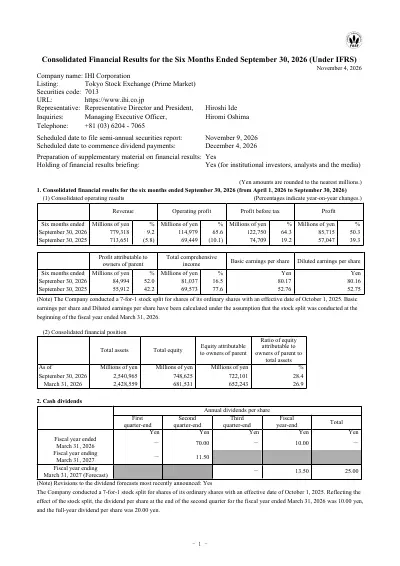
Revenue and operating profit increased, reaching record highs, driven by civil aero engines, as well as contributions from planned property sales. The lower section shows our forecast for fiscal year 2026.
We are firmly convinced that our growth strategy outlined in the medium- to longer-term direction announced in May this year is progressing steadily, and that we have entered a new stage of growth. Reflecting these developments, as you can see, we are raising our full-year forecast further, following the upward revision announced in August.
We are expecting to hit another record-high profit. Even excluding gain on sale of property, we are forecasting to hit a record-high profit.
In addition, reflecting our strong performance to date, we plan to increase the annual dividend forecast by 2 yen from the August forecast up to 25 yen per share, an increase of 5 yen from the previous fiscal year. This slide shows an overview of the second quarter results.
Although orders declined due to the high base in the previous year, both revenue and profit increased significantly, reaching new record highs. Please refer to the reference information at the bottom of the slide.
It shows operating profit on an underlying basis, excluding temporary factors. As you can see, operating profit increased by 18.6 billion yen year on year, from 52.1 billion yen of the previous fiscal year up to 70.7 billion yen, and the operating profit margin has also improved significantly from 7.3% to 9.1%, an improvement by 1.8 points, representing a major improvement in profitability.
As a result of business portfolio transformation, our earnings power has steadily improved. Returning to the table above, cash flows from operating activities declined due to an increase in working capital associated with business expansion.
However, cash flows from investment activities improved as a result of planned property sales, leading to an overall increase in free cash flow. I will now walk you through the details, but overall, we view these results as very strong and highly positive.
Next on revenue. Revenue increased significantly year on year by 83.6 billion yen, excluding the impact of lower revenue resulting from the business divestments in the previous fiscal year.
Total revenue growth was driven by civil aero engines, which achieved significant growth year over year, supported by strong demand. Defense and nuclear energy also performed steadily.
In addition, stable revenue businesses achieved revenue growth due mainly to LCB expansion in energy. Overall, we achieved substantial revenue growth in an ideal manner, with both growth businesses and stable revenue businesses expanding.
Next is on operating profit. Please look at the section in the center of the slide showing the increase in underlying operating profit.
Here, we are comparing operating profit on a like-for-like basis, excluding one-off factors. Operating profit increased significantly year on year by 18.6 billion yen, from 52.1 billion yen in the previous fiscal year to 70.7 billion yen in this fiscal year.
This substantial increase was driven by higher revenue from civil aero engines and nuclear energy, supported by expanding demand, growth in our LCB business, including domestic coal-fired carbon solutions and power systems, such as emergency power generators for data centers, as well as improved profitability contributing to higher earnings, reflecting improved profitability of energy projects and improved selling prices for vehicular turbochargers. As a result, underlying operating profit increased significantly.
As a temporary factor for this fiscal year, 14 billion yen of losses were recorded associated with divestments of overseas energy subsidiaries, which were offset by the impact of weaker yen. In addition, gain from planned property sales, which are being carried out to secure funding for growth investments, further contributed to earnings.
As a result, we achieved record-high profit for the second quarter. This slide shows operating profit in aero engines, space and defense.
Overall, in addition to the positive impact of foreign exchange movements compared with the previous year, we have seen significant growth in the aftermarket business for civil aero engines, and we are seeing strong overall growth. Please refer to the middle section of the chart.
The planned deliveries of install engine had a negative impact on profit by approximately 2 billion yen. However, profit from the aftermarket business increased significantly by 11 billion yen year on year.
We are also beginning to see the benefits from improved profitability in our MRO business, where capital investment is progressing. Overall, we believe performance has remained very solid, driven primarily by civil aero engines.
As many of you may be aware, shipments of install engine have a negative impact on profit in the short term. However, they serve as a source of revenue for the aftermarket business over the medium to long term.
In addition, R&D expenses and personnel costs are necessary upfront investments to achieve medium- to long-term growth. Our earnings structure is evolving into a more desirable one, in which we are steadily increasing profits while making substantial upfront investments to lay the groundwork for future growth.
This is a reference slide showing the yen-based revenue for civil aero engines. The chart on the left shows revenue for the second quarter of the previous and current fiscal years.
All of the spare parts, install engine, and MRO businesses achieved major growth, achieving 28% year-over-year revenue growth. The chart on the right shows the trend in revenue since fiscal year 2022.
As you can see, we have been achieving steady growth over time. This slide is also for reference.
It shows only spare parts revenue from the revenue figures on the previous slide. To show the trends excluding foreign exchange effects, the figures are presented in US dollars.
Please note that the presentation currency differs from the previous slide. Please look at the chart on the left.
Supported by strong demand, the spare parts business, a key source of profit, is expanding significantly. The line graph shows net revenue from spare parts sales calculated by offsetting the gross-based sales against maintenance costs.
Even in US dollar basis excluding foreign exchange effects, revenue increased by 20% year over year. The chart on the right shows the trend in US dollars since FY 2022, confirming steady growth even on the US dollar basis.
As stated above the chart on the right, despite persistently high aviation fuel prices, our revenue growth forecast remains unchanged. Next, I will explain our financial position.
In FY 2026, the ratio of equity attributable to owners of parent has improved significantly, supported by the accumulation of profits from business growth and planned property sales. These efforts to strengthen our financial position were recognized by JCR, which recently upgraded our long-term issuer rating by one notch from A to A+.
Due to the nature of our businesses, such as defense and bridges businesses, many projects undergo customer acceptance in the fourth quarter. As a result, inventories tend to accumulate during the second and third quarters, but towards the fiscal year-end, we will work across the group to reduce working capital, particularly inventories.
Next, I will explain our cash flows. Cash flows from operating activities declined year on year, reflecting the rebound from increased advance payments received in the previous fiscal year and higher working capital to support revenue growth in the civil aero engine business.
Meanwhile, cash flows from investing activities improved due to property sales completed by the end of the second quarter, resulting in an overall improvement in free cash flow. Though Phase 1 remains a period of investment execution, given the rising interest rate environment, we are scrutinizing investment opportunities more rigorously than ever.
We will focus on investments on projects that offer reliable returns that should lead to substantial growth in free cash flow over the medium to long term. This is the final slide on our financial results.
As shown at the top of the slide, we have completed all business restructuring measures planned under the previous medium-term management plan. We decided to divest an overseas subsidiary in the energy business, the last major transaction, at the end of September, and completed the equity transfer on October 15th.
As mentioned at the beginning, the series of business portfolio reforms implemented since FY 2024 has significantly improved group-wide profitability. However, business portfolio reform never ends.
We will continue to review and optimize our business portfolio, responding appropriately to changes in the external environment. Next, I will explain the forecast of consolidated results for FY 2026.
We have revised all our FY 2026 forecasts upward from the previous forecasts. Orders have been revised upward significantly, reflecting a large-scale project in domestic carbon solutions.
We have also raised our annual dividend forecast by 2 yen from the August forecast. As highlighted in blue on the far right, our latest forecast also indicates substantial year-on-year growth in both revenue and profit.
I will explain the factors behind the increase in operating profit from the previous fiscal year on the next slide. This slide shows the latest operating profit forecast and the factors behind the change from the previous fiscal year.
As before, please look at the operating profit figure in the center and the underlying figure in parentheses. Excluding temporary factors, operating profit is expected to increase by 36.3 billion yen year over year.
This reflects significant operating profit growth driven by civil aero engines and defense businesses, as well as LCB expansion in the energy segment, including carbon solutions and power systems. Together with planned property sales, we aim to achieve record-high profit for the second consecutive year.
As shown here, in addition to growth businesses, stable revenue businesses, particularly the LCB business in the energy segment, are now contributing to profit growth. We believe this reflects the results of the business restructuring measures we have steadily implemented over the years.
Finally, I will explain shareholder returns. Let me explain our annual dividend forecast for FY 2026.
We have revised our previous forecast of 23 yen per share upward by 2 yen, reflecting recent strong business performance. As a result, we plan to pay an interim dividend of 11.5 yen per share and a year-end dividend of 13.5 yen per share, bringing the annual dividend to 25 yen per share.
This represents an increase of 5 yen from the previous fiscal year. Going forward, we aim for sustained growth in dividends per share through FY 2028, the end of Phase 1, while balancing business growth with the strengthening of our financial foundation.
In Phase 2, beginning in FY 2029, we will consider all options for shareholder returns. This concludes our presentation of the financial results for the second quarter of FY 2026.
Thank you very much.