Sun Frontier Fudousan Co., Ltd.
TTSE:8934Q2 FY2027 · Earnings Call TranscriptNovember 10, 2026
Takeshi Hirahara
I am Takeshi Hirahara, Division Director of the Administration Division. I will provide an overview of the financial results through page 19.
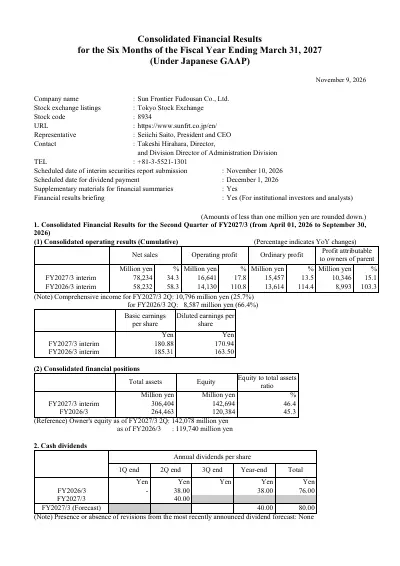
For the first half of the second year of our medium-term management plan, both net sales and profit reached record highs. On a profit basis, we have achieved approximately 60% of our full-year forecasts.
Turning to key topics, six hotels opened during the current fiscal year, bringing the number of rooms under operation to 4,638. In addition, the AIRAHS Group, a residential leasing brokerage company with 67 offices in the Tokyo metropolitan area and approximately 45,000 transactions annually, has joined our group.
We will continue to practice our corporate philosophy as we work to maximize the corporate value of the group and help resolve social issues. For the first half, net sales were ¥78.2 billion, gross profit was ¥24.1 billion, and ordinary profit was ¥15.4 billion.
The ordinary profit margin was 19.8%, and the equity ratio was 46.4%. By achieving these management indicators, we will bring the current medium-term management plan to a successful conclusion.
This is the consolidated statement of income. Despite rising interest rates, the real estate revitalization business drove performance, with net sales increasing 38.1% and gross profit increasing 19.6% year on year.
Selling, general, and administrative expenses increased 25.9% year on year, mainly due to higher personnel expenses. We will continue to control costs while securing capable talent.
This chart shows the quarterly trend in ordinary profit. In the second quarter, ordinary profit reached a record high on a quarterly basis as well.
We will continue working to achieve stable growth while minimizing quarterly volatility as much as possible. Dividends are in line with our initial forecast.
Excluding the fiscal year ended March 2021, when the dividend was maintained at the same level, we forecast a dividend increase for the 14th consecutive year. We will continue to balance shareholder returns with proactive investment while maintaining a stable financial foundation.
Next is the consolidated balance sheet. Total assets increased by ¥41.9 billion from the end of March to ¥306.4 billion.
The main factors were the ¥13.4 billion capital increase through a third-party allotment to ITOCHU Corporation under our capital and business alliance, as well as a ¥16.1 billion increase in interest-bearing debt associated with properties acquisitions and value-enhancement investments in the real estate revitalization business. Our financial institutions have highly evaluated the soundness of the group's finances and the rigor of our acquisition criteria.
Backed by our investment capacity, including the capital and business alliance with ITOCHU Corporation, we will continue to make proactive investments for growth. Next, I will explain performance by business segment.
The segment profit margin of our core replanning business declined 3.7 percentage points year on year to 26.5%. Nevertheless, in response to changes in the business environment, we are working to shorten project periods while maintaining high margins based on the value we create.
This slide covers property acquisitions. By the end of the first half, acquisitions had reached 95% of the full-year target.
To mitigate interest rate fluctuation risk, we have therefore tightened our acquisition criteria further. The chart on the left shows the breakdown by product category of the ¥85.5 billion acquired in the first half.
The chart on the right shows the product mix of inventories totaling ¥169.5 billion at the end of the first half. These two charts highlight three points: first, the balance between short-term and medium- to long-term projects; second, product diversification; and third, the expansion of new businesses.
This slide shows actual and forecast gross profit from property sales, together with inventory trends. Based on the results shown here, we will achieve our earnings forecast for the current fiscal year while continuing to build the unrealized gains in inventories shown at the bottom right, which will form the foundation for future earnings.
The real estate services business is integrated with and complementary to the replanning business, serving as the platform through which our group provides a one-stop, high-value-added value chain. We aim to create synergies in the residential business by leveraging the talented people, network of 67 offices in the Tokyo metropolitan area, and customer base of the AIRAHS Group, which joined us in July.
In the hotel and tourism business, we identify and carefully select locations that fit our business model. In the hotel operation business, we promise guests a heartwarming and enjoyable stay delivered by our staff.
Together with local residents, we make use of local resources to bring vitality to each community. Finally, in the construction business, one year has passed since the Otake Kensetsu Group joined our group last October.
We will continue to pursue synergies in both human resources and operations, with our corporate philosophy as the foundation. In the overseas development business, more than 80% of the units in our second condominium development project in Vietnam have been contracted for sale, and we are targeting completion in the first half of the next fiscal year.
Please view this slide together with the following two slides as a single sequence. First, this slide demonstrates the high profitability and stability of our flow-type businesses.
Next, this slide demonstrates both the rapid growth and sustained high profitability of our stock-type businesses. As a result of the trends shown on the previous two slides, gross profit from stock-type businesses is expected to exceed fixed costs, including SG&A expenses, for the second consecutive fiscal year.
As we continue to grow, the stability of our business portfolio is increasing. We will further strengthen our growth capacity by creating a mutually reinforcing relationship between our businesses and our people.
Seiichi Saito
I am Seiichi Saito, President and CEO. I will now explain our growth strategy and the progress of initiatives in each of our businesses.
First, this slide summarizes our current view of the business environment. The global economy is supported by investment in AI-related fields.
At the same time, developments in the Middle East and the impact of rising interest rates create downside risks that warrant caution. More recently, following the U.S.
midterm elections, volatility in global equity markets has increased. We must closely monitor the potential impact on credit markets.
The Japanese economy remains firm at present, but uncertainty about the outlook is increasing. There is an even greater need to create added value and improve productivity in order to offset the rising costs of labor, construction, and interest.
Against this backdrop, Tokyo's five central wards continue to see lower office vacancy rates and higher rents, and the leasing market remains strong. Meanwhile, in the real estate investment market, rising interest rates and other factors are leading investors to become more selective depending on location and asset type.
In the hotel and tourism market, the number of inbound visitors is down year on year, partly due to China-related factors. However, spending per visitor has increased, and we expect the market overall to remain resilient and firm.
We will continue to prepare carefully for uncertainty in the global economy and sudden changes in financial conditions, while steadily advancing our businesses in line with our plans. Next, this slide provides an overview of our Long-Term Vision 2035 and Medium-Term Management Plan 2027.
Under the medium-term plan, our basic policy is to promote business-linked diversification through client-focused manufacturing and heartwarming services, thereby helping to resolve social issues. Based on this policy, we are implementing a range of strategies and initiatives.
In the final year of the plan, the fiscal year ending March 2027, we will achieve net sales of ¥150.0 billion and ordinary profit of ¥30.0 billion. We also aim to accelerate growth and bring forward the achievement of our long-term targets by leveraging our alliance with ITOCHU Corporation and other initiatives.
This slide provides an overview of the growth strategy under our current medium-term management plan. In our three priority markets of office buildings, hotels, and residential properties, we combine our manufacturing capabilities in architecture and construction with our service capabilities in real estate services and hotel operations.
Through this business model, we will advance diversification and expand growth. We will also maximize business synergies with ITOCHU Corporation and other group companies to increase the number and scale of projects, diversify asset types, and expand our geographic reach.
This slide presents specific examples of initiatives under our alliance with ITOCHU Corporation. We are currently undertaking seven joint investment projects in the office building revitalization business.
We have also strengthened collaboration in the sales strategies for replanning properties by utilizing the networks of ITOCHU REIT Management and other ITOCHU Group companies. Next, I will explain how we are strengthening our earnings structure under the medium-term management plan.
In our flow-type businesses, which are centered on property sales, we are diversifying asset types. In stock-type businesses such as real estate services and hotel operations, we are diversifying into related fields.
While steadily increasing overall revenue, we will raise the proportion of revenue generated by stock-type businesses, which are more resilient to market fluctuations. Over the three years of the current medium-term plan, we project 25% revenue growth in flow-type businesses and 90% growth in stock-type businesses.
As a result, we plan to increase the stock-type business share of revenue by 10 percentage points to 40% in the final year of the plan. In the previous fiscal year, the stock-type business share of revenue had already risen to 37.6%.
Next is our investment funding plan. We recently revised upward the total business investment plan for the three years of the current medium-term plan to ¥350.0 billion.
Cumulative investment through the first half of the current fiscal year was ¥172.3 billion. Including contracted investments, progress has exceeded ¥190.0 billion.
When executing these investments, we will continue to emphasize capital cost considerations, including profit margins and investment recovery periods in each business, while investing proactively for future growth. I will now explain recent initiatives in each of our businesses.
I will discuss both our flow businesses and stock-type businesses, using several specific examples. First is the flow-type replanning business.
As a recent example, I would like to introduce the building shown on the left side of the slide. This is a seven-story office building in Chuo Ward.
The basement floor had been used as a restaurant, but because that use was not well suited to the property, we converted it into an office and created a set-up office. We also upgraded the building's air conditioning systems and converted the lighting to LEDs, improving its environmental performance.
As a result, the building received the highest rating of five stars under BELS certification. Tenant leasing progressed smoothly, rental income increased, and we were able to sell the property as a highly occupied, highly profitable building with strong environmental performance.
Next is our new office building development business. We develop new office buildings in Tokyo's five central wards by applying the value-creation expertise cultivated through real estate revitalization.
In particular, we incorporate our expertise in set-up offices from the design stage to create buildings with distinct Sun Frontier value. The photograph on the left shows a newly built property in Nihonbashi.
It was completed in March and sold in June of this year. In addition to its iconic exterior and strong functionality, the building offers high added value in terms of environmental performance.
We created set-up offices at the time of completion so that incoming companies could begin using their offices promptly. Tenant leasing progressed smoothly, and we were able to hand over the building with the purchaser fully satisfied.
The map on the right shows the locations of completed and current projects in our new building development business. To date, we have completed and sold eight new buildings, including one sold this fiscal year, and nine projects are currently underway.
Next, these charts show trends in property acquisitions and net sales in the office building business. For each fiscal year, the bars are color-coded to show the breakdown among replanning projects, new building projects, and small lot ownership projects.
While the revitalization of existing buildings will remain the core of the business, we will diversify asset types and expand the overall scale of the business. Next is the residential business.
We are developing residential businesses tailored to the characteristics of countries and regions where populations continue to grow, including Tokyo, New York, and Vietnam. Our initiatives include 11 newly built and revitalized rental apartment buildings in Tokyo and 16 revitalized apartment buildings in New York.
In Vietnam, we are currently developing our second condominium project. In Tokyo, we sold one newly built soundproof apartment building in July.
In Vietnam, structural work on the condominium was completed in September, and construction is progressing smoothly toward completion in May next year. Approximately 90% of the units have already been sold.
I will now discuss the current status of our stock-type businesses. First, let me explain leasing and property management.
Our leasing division operates a community-based branch network concentrated in central Tokyo. We currently have 13 offices, mainly in Tokyo's five central wards.
Our property management division combines a variety of services while making effective use of this leasing capability to expand the number of buildings under management. We currently manage 580 buildings.
We plan to increase this to 600 by the end of the current fiscal year and to 1,000 under our long-term vision. Next is the rental conference room business.
We have continued to expand the number of locations each year, and the business is growing. Most recently, our second location in the Yokohama area opened in October.
We now operate 20 facilities with a total area of 11,254 tsubo. Our target for the current fiscal year is 13,000 tsubo, and under the medium-term plan, we intend to expand further to 16,000 tsubo.
Next is the hotel business. We have expanded the number of hotels under operation through new development, renovation, and revitalization, and proactive use of M&A.
We currently operate 41 hotels with a total of 4,638 rooms. Tabino Hotel LIT Toyokawa Station, a 112-room hotel, is scheduled to open on November 15th.
Including the Toyokawa property, three more hotels with a total of 523 rooms are scheduled to open during the current fiscal year. By next March, we expect to operate 44 hotels with 5,161 rooms.
Looking further ahead, including properties currently in the planning stage, we expect to expand to a total of 55 hotels with 6,518 rooms. The chart on the left shows trends in occupancy rate and average daily rate across our hotel portfolio, while the chart on the right shows trends in gross profit and the total number of rooms.
Occupancy and average daily rate reached record highs in the previous fiscal year, but we expect them to decline slightly year on year in the current fiscal year. This reflects the reactionary decline following the Osaka Expo effect last year and the opening of approximately 10 new hotels this fiscal year, which is expected to lower the overall occupancy rate.
Gross profit, however, is expected to grow steadily, supported by the increase in the number of hotels under operation and strong performance at existing hotels. Thanks to these factors, the second quarter performance is progressing smoothly and in line with our plan.
Next is M&A. In July, we acquired 100% of the shares of AIRAHS, a residential leasing brokerage company operating in the Tokyo metropolitan area.
The AIRAHS Group operates 67 offices across Tokyo and three surrounding prefectures and handles approximately 45,000 rental brokerage transactions annually. By combining AIRAHS's customer base, transaction data, and leasing capabilities with our expertise in real estate revitalization, development, sales, and management, we will accelerate the expansion of our residential business.
We will create further group synergies and translate them into increased earnings for the group as a whole. This slide summarizes the group's major M&A initiatives to date in chronological order.
We have pursued M&A in the office, construction, and hotel businesses. The acquisition of AIRAHS was our first M&A transaction in the residential business.
We will continue to use M&A proactively to strengthen existing businesses, expand related businesses, and achieve further growth. This concludes my presentation.