SoftBank Group Corp.
Q2 FY2027 · Earnings Call TranscriptNovember 10, 2026
Operator
Welcome to the SoftBank Group Corp earnings results announcement for the second quarter of the fiscal year ending March 2027. Before we start, please turn your mobile phone to the silent mode.
I would like to introduce today's participants. From left, we have Yoshimitsu Goto, Board Director and CFO; Kazuko Kimiwada, Corporate Officer, Senior Vice President and CAO; Mark Agnew, Executive Partner, SB Investment Advisers and SB Global Advisers; Ian Thornton, Vice President, Investor Relations, Arm.
Today's announcement is live broadcast over internet. Now, I would like to invite Yoshimitsu Goto to present you the earnings results and business overview.
Yoshimitsu Goto
My name is Goto, CFO, SoftBank Group. Thank you very much for your time today.
First, I would like to touch on the environment and the today's circumstances. In United States, after the midterm election, there are several movements going on, and we would like to stay focused how that is going to change or move.
Understand there are some concerns over corporates, AI corporates, hyperscalers. Some people talked about credit risk for those hyperscalers.
Some people talk about data center construction in United States. Some people also worries about the job security or working environment security.
Each one of them is something that we also need to focus on and understand the situations, as we are also the company which has a relation to AI business. When you look at the human history that we've been experiencing, the Industrial Revolution and trying to achieve the next level after developing technologies and so on, and with that we've been able to see the great changes in the working styles or lifestyles of the people, I believe that we are at the kind of [transitions?]
to the next levels with AI, and we believe we are making a progress, one step ahead towards AI. That doesn't mean that there is any end of this steps.
It is like in a space universe that we've been keep moving up, or we are making a step forward. The technologies, I believe it's irreversible.
Not refusing such developments of the technology, but rather we need to learn and understand how can we live together with those technology, so that that can be changing to our lifestyles and working styles. One can be a challenge for us, and that also relates to our corporate philosophy, which is Information Revolution — Happiness for everyone.
I believe that this corporate philosophy has been there for our company in the past 43, 4, 5 years, I believe. I think it is also need to understand how can we benefited from such technology or AI, and I think that we also need to play a role to actually communicate and share such benefit.
As I'm showing you this slide, this is just a part of the benefit, and this is the kind of a benefits that we learn and hear from the OpenAI's example. For example, ChatGPT users save an average of 40 to 60 minutes per day at work, or 300 million or over people each week use ChatGPT for health-related advices, or 75% of ChatGPT users at business can perform tasks they previously could not.
These are the kind of a one of the examples of the benefits that we've been receiving from AI. There are several positive effects to your daily life.
Masa, our Chairman, CEO, often say that back in year 2000, when we call the internet bubble, if we look back that moment, one measurement can be the number of users of internet, for example. In the past history of human being that the number of users has been growing, keep growing, and such AI services is adding even more users on top of such number of users of internet.
How are we going to behave? Not really betting around just with the ideas, but because we believe that the benefit that we'll be able to receive from such technology development is unlimitedly growing.
With the understanding of the advancement of AI and technology, we would like to steadily making a forward steps. For example, we've been always sharing our focus in four pillars.
One is the AI model, which represented by the investment in OpenAI that we completed $30 billion in follow-on investments. The second pillar, AI chip, Arm actually has been making a great progress in the past 3 months, and Arm's share among major hyperscalers exceeding 60% by the end of 2026.
AI infrastructure, data center or data center-related companies investment is the actions that we've been making. For example, SB Energy, which is our subsidiary, they have signed the 20-year lease agreement with OpenAI for data centers with 8 GW IT capacity.
Also, we have completed acquisition of DigitalBridge, and we are very glad to understand that they have a great expertise, know-hows, experiences in the digital infrastructure investments and hopefully that we'll be able to collaborate together going forward. The fourth pillar is physical AI.
There are some several progress. For example, Gravis Robotics, which is the company which developed the autonomous driving AI for the construction machines in Switzerland.
Also, AutoStore in Norway, this is a company which developed the automation systems for the warehouse, and they have signed the strategic supply agreement with Amazon this time. Zipline, they provides the distribution service using the autonomous flying drone in United States.
With this financial round, they have raised $1.5 billion at a $21.5 billion valuation. I will be touching on this company later, but they've been actually making it happen to provide several services in United States.
These are the four pillars that we've been focusing in this quarter. These are the results that we made as a result of we making a progress forward.
Because it's a quarterly results, it's only for the 3-month period of the results, which is a little bit short. I would like to share the progress in the past 3 months and also financial highlights that I would like to touch on for today's opportunity.
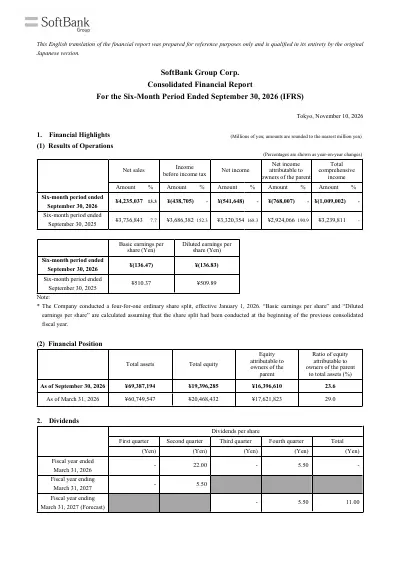
There are four highlights. First, investment gain, ¥1.7 trillion.
Net gain or loss, this time is net loss of ¥0.8 trillion for the first half of the fiscal 2026. Net asset value, which is an important measure for us, ¥59.8 trillion.
This is the ¥20 trillion increase compared on year-on-year basis. The market has changed and declines largely, our asset also follow suit.
This ¥20 trillion increase actually comes down, and I will come to the numbers later. For also completed $30 billion follow-on investment in OpenAI.
The last, for this second quarter, we, I believe, as long as I understand, quarterly financing-wise, this was the largest financing quarter in the history. About ¥9 trillion, or $56.5 billion, has been raised in this second quarter.
Utilizing the financing proceed, we have repaid $40 billion bridge facility ahead of schedule, which was originally structured early this year. The consolidated results, first half, ¥2.2 trillion declines in the investments gain or loss resulted in ¥1.7 trillion.
Last quarter was a kind of a record high, compared to the last quarter, it has a actually the big decline from the previous quarter, ¥2.2 trillion. The ¥1.7 trillion itself is something that I believe is a good enough number.
Also, income before income tax or net income respectively that you see the loss of the ¥438 billion or ¥768 billion respectively. On your far right on this graph, this is from the evaluation loss of Intel.
That was a one of the largest factor. As a result, a negative ¥133 billion loss.
This is a quarter number, but we are not very much chasing the short-term ups and downs. In a full year, that we would like to see a kind of a result as a kind of business.
For the net income, net minus ¥1.1 trillion. There are two major reason.
We recorded loss on power generation-related equipment for AI data centers in the United States, it's about $3.7 billion negative. Another one is that we have raised $7.4 billion in August 2026 through prepaid forward contracts backed by Intel shares.
After then, Intel share price declines. This records the derivative loss.
If the share price increase after the derivative transaction, that also records the same way. Due to that increase in Intel share price following the contract.
In the United States, the impact to P&L from the AI data center equipments that I would like to break it down. First, equipments, because data center is going to be rush in terms of the constructions, and competition is going to be fierce going forward.
There is a relatively long lead time equipments therefore the data centers. For those that we have procured in advance, for the data center projects or the power project, before they are finalized, we have placed an order and also procured.
Later on, that's going to be allocated and assigned to each respective project. We made a bridge investments in advance to secure power generation equipment in anticipation of shortage.
$9.5 billion here is the cumulative amount, total amount. This 9.5 relates to how we've been procuring the equipments.
As I mentioned earlier, while that we start launching the project one after another, those equipment is going to be allocated and assigned, and then we collect the investment. That was a kind of a flow that we've been expecting.
Later on, because such project has been witnessing the rapid development of the technology, and we also need to aim for even better results of the project, that we had a review of the project portfolio, and based on that, we have revised certain power generation equipment procurement strategy. As a result, we recorded a loss related to nonrefundable advanced payment and modifications to signed contract, which resulted in $3.7 billion losses.
Also, while that we're discussing with the vendors who will be making a purchases, and at the time of the purchase, we've been entitled to rebates on future equipment purchases up to $2.1 billion. This data center project is just a beginning, and that it will take next 5 years, next 10 years, and so on, and the size is going to be growing.
Based on that assumption, for the mid-term or mid- to long-term, we believe it's positive to be entitled with such rebates. This $2.9 billion loss has been recorded, and the balance as of September 30 is $6.6 billion.
This $6.6 billion equivalents is going to be utilized for Portside power generation projects and so on. So, $9 billion of the about $9 billion the equipment has been reviewed, and followed by the review of the project portfolio, we have revised the strategy.
The remainings is going to be utilized for the future projects. Also, we have entitled to rebates on future equipment purchases.
Along with the new challenge that we are making, this accounting treatment has been occurred. From the accounting perspective, as of today, what do we need to record, what do we need to value?
These are the numbers that we need to recognize as of today, and that has been fully reflected to our accountings. Now, let me talk about key indicators: net asset value, loan-to-value, and cash position.
Those are to us most important key indicators. As for net asset value, it was about ¥60 trillion as of the end of September.
Loan-to-value, 15.9%. Cash position, ¥5 trillion.
From a safety perspective, those numbers are what we are pleased with. Looking back in terms of net asset value, for example, second from the right, 59.8 was as of end of September.
Since then to date, taken into account of the latest share price, the NAV as of today is ¥44.7 trillion. It's down from 59.8.
However, from global perspective, this is not something that we are uncomfortable with. This chart starts the first quarter of FY2024 and show quarterly trend.
From that long-term perspective, you may say that you are coming back to where you were in 2024 in the only last 3 months, but that's necessarily the true. SoftBank's net asset value in the long run is going through like this.
In this chart, far left, FY1998, there was a internet bubble era, and the share price increased sharply. The market went through ups and downs, and some startups may have gone bankrupt, and the net bubble got bursted in the end.
Looking back, what was the net bubble, you may ask, because some companies grew since the net bubble burst, and a few of them has become what now we call hyperscalers. Again, my point is, we are not swayed by short-term up and down, and rather, we want to keep a focus on a long-time horizon.
Now, loan-to-value. It was 15.9% as of end of Q2, but the net asset value went down by ¥20 trillion, like I said earlier.
Compared to net asset value, well, it's hard to say how much it is as of now, but it's suffice to say it should be higher than 15.9%. I should have said earlier when I talked about NAV, or net asset value.
OpenAI is going through a new finance funding round, which I'm sure you are aware of by looking at media. Until official announcement is made, we have not factored in that numbers in our reports.
Once official release is there, and then OpenAI's valuation is finalized and confirmed, that will be reflected in our loan-to-value and net asset value, which is likely in the third quarter. We should expect good representation of OpenAI's a good valuation.
Then it should be positive to LTV as well as net asset value. Nonetheless, as of today, we are well under 25%, which is suffice to say we are operating the business in a very safe manner.
Cash position, ¥5 trillion as of end of September. On the 1st of October, we invested in OpenAI.
That said, still, even as of today, we have plenty a cash position. Now, let me talk about Arm.
In the second quarter, they hit the record high of revenue, increased by 27% year-on-year. In terms of EPS, fully diluted, again, they had the record second-quarter EPS, or 33% increase year-on-year.
Here's Arm's guidance for the third quarter in terms of revenue and fully diluted EPS. For revenue, $1.454 billion, or 24% up.
Of course, there is a range of plus/minus $50 million, but well above analysts' consensus. Likewise, for EPS, above analysts' consensus.
Third quarter, Arm continues to grow in a very steady manner. About Arm's business, adoption of Arm technology in data center is growing rapidly.
As data centers are power hungry, and that might be one of the reasons why some people are not happy with data center. Arm's CPUs are highly energy efficient, the total shipment of Arm's technology has grown rapidly, and it's been growing exponentially since September 2018.
As announced, Arm AGI CPU, which is driving Arm's data center share, it's designed for agentic AI, and quality is well recognized. Compared to x86-based CPU, Arm's has two times better performance with the same power.
Like I said earlier, Arm's expanding share at top hyperscalers over 60%. Guys like Amazon and Microsoft are adopting Arm's technology more and more.
It was only 15% in 2024, but now well above 60%. Now, let me shift focus to OpenAI.
Cumulative investment amount, $64.6 billion. We completed follow-on investment, and we have about 13% ownership in OpenAI.
OpenAI's growth is supported by those integrated three layers. Those layers are enhancing OpenAI's value each other.
Layers are products and platforms, AI models, and compute. They've got a full-stack approach.
Again, those layers are enhancing OpenAI's value, and feedback from the customers are reflected in enhancement of the model development. That should help developing better and more enhanced models going forward.
How good Open model is, it's shown here on this chart. This is an assessment by a third party comparing different models by different companies.
The vertical shows performance, horizontal shows cost. There are Anthropic and Google models, and as you can see, top left, OpenAI, it's great performance and lower cost.
OpenAI is very distinctive compared to other models in terms of performance and cost. The higher it goes, the better from cost at per performance per cost perspective.
That's how the graph should be interpreted. ChatGPT has been continuously a weapon of OpenAI, especially for consumers, and they are building massive user base.
ChatGPT weekly active users hit 1.2 billion as of September 2026. It's been only 4 years when this was launched, and it's a very unique in terms of such high growth of customer base.
This slide shows rapidly built a massive user base. Compared to other products, ChatGPT reached 1 billion users only in 3 years, which is the fastest app in history to reach that level.
Again, in terms of consumer segment, ChatGPT Plus is one of the growth drivers, and their ARR reached $1 billion in August, or 10 times just in 5 months. I have been talking about consumer aspects of OpenAI's product, but in a competitive environment of AI, enterprise business should be better in terms of contribution to model company's bottom line.
In fact, OpenAI achieved original target 6 months ahead of schedule. Currently, enterprise share of total revenue account for 50%.
Before, people criticized OpenAI that OpenAI was doing business only for consumers, or they're not strong in enterprise area, but OpenAI is expanding enterprise business like this. The Codex has been adopted much wider than before.
Initially, Codex was designed for software engineers, but now Codex is integrated in ChatGPT Work, which is for enterprise use cases. Since the integration, the adoption has been growing, and in fact, combined weekly active users reached over 40 million.
It's been again only 8 months since the launch in February, and it grew by 40 times, which is amazing. OpenAI's business model and financial soundness have been much, much more stronger in the last few months.
OpenAI's ARR as of September was about $50 billion, or it grew 25 times in the last 3 years. Especially in the immediate last month, it was up 70% from July to September.
Next is AI infrastructure. Growing AI usage actually drives data center demand.
Last year, installed capacity was 82 GW. Based on the numbers, 5 years later, 2030, demand forecast is about 274 GW, which actually exceed exceeding the demands largely.
The gap of the demand and supply, and this is actually required for the latest edge information services. It is necessary to make an efforts to satisfy such demand.
These are the latest portfolio of SoftBank Group for the data center. In the middle is the Portside Technology Campus, 8 GW.
Offtaker is OpenAI for 20-year contract. On your left, Milam County AI data center, 753 MW, again, OpenAI as an offtaker for 15-year contract.
Far right, AI data center in France, which was announced recently. In total, 5 GW is aimed.
Offtaker is to be determined. We expect there are many demands from corporates, and lots will require such capacity.
From the financial point of view, it is important that we make sure that we have a safety and healthy financial management while we operate this state develop the data center project. SBG is expected to be funded through project finance, non-recourse to SoftBank Group, referring to the high-credit offtaker.
On your right, you see the scope of delivery. Data center building with power infrastructure, SoftBank Group will be working on.
There, it's going to require servers, GPUs. Such IT equipments will be prepared by offtaker.
Therefore, while securing our financial discipline, we will be developing our data center projects. That's how we are proceeding our projects.
The progress or the status of Portside project, which is the joint project with governments, and this is located in Ohio. Back in August, SoftBank Energy, our subsidiary, signed 20-year lease agreement with OpenAI, and also NVIDIA agreed to provide the credit support to OpenAI for 4.25 GW portion with IT load basis.
NVIDIA is going to supply the compute infra of the data center, and also committed to invest $3 billion in SB Energy. Out of $3 billion, $1.5 billion has already been funded, which is very positive in terms of enhancing enhancement of the capitals.
For French project, total 5 GW targeted. First, by 2030, we would like to achieve 3.1 GW.
1.3 GW in Dunkirk has also been assigned as a French government fast-track designation. 1.0 GW in [Bosco?]
, this has already been assigned designated as the French government fast-track designation. We would like to well collaborate with French people to make this project in a good progress.
As you all aware, there are several concerns been expressed over data center. Therefore, that we would like to make sure to work in partnership with local communities.
By doing so, hopefully that we'll be able to have a good understanding from the local communities about our data center project. For example, Milam County in Texas, they have a track record of developing 900 MW of power generation capacity in Milam County.
There are some concerns that you will be out of water, or you'll be out of power. Actually, there are already the track record of developing such megawatt of the power generation.
As for water, understand there are some concerns over it. We may be overusing water by for for the data centers and so on.
We are having an initiative to minimize water use with closed-loop air-cooled system. In addition, we will be having such initiative to support the local economy by hiring and sourcing locally.
Through such initiative, that we would like to proceed our projects. In Malaysia, we also making an advancement of AI infrastructure.
That we made an announcement yesterday together with Grab, that and also PETROS, the state-owned energy company of Sarawak, Malaysia, that we announced together to plan to build AI infrastructure. It is going to be the phased project, and a planned initial investment is $1.85 billion.
We are taking about $1 billion, Grab $750, and PETROS $100 million. In total, with those three players, that we would like to aim for the success launch of this and success progress of this project to develop 5 GW or more of AI compute capacity over the long term.
In infrastructure business, we made an investment in DigitalBridge. Acquisition transaction has been completed.
Regulatory approvals all provided. They focus on digital infrastructure, and asset under management is about $121 billion, which is quite a large global asset manager.
Investment about $3.1 billion, which is already completed the end of September. They do have a very attractive portfolio underneath of them.
On the very top is the data center-related portfolio companies they have invested, for example, Vantage, Switch. Both of them are very well-known player in the market, as well as DataBank and other cell towers investments, for example, JTOWER in Japan has been invested by them as well.
Next is Vision Fund that I would like to share with you the current status. Investment gain or loss in the past 3 months, not much big movement this time for this quarter, slightly increased.
The breakdown, you see Vision Fund 1 and Vision Fund 2. For the case of Vision Fund 1, there are several positive factors, such as ByteDance.
At the same time, as a public company, Coupang has been experiencing the decline in share price. Net-net, it's about a flat.
For Vision Fund 2, there are several portfolio companies actually showing a good results, but at the same time, SilverBand 7, which I referred to earlier for the energy-related investment, was done together with SBG, and for that that we have a loss. Still, the result was plus $558 million.
The cumulative investment return, I believe that it's good to see for the long term, and for the Vision Fund 1, showing a very good return, $113 billion cumulative investment return. Vision Fund 2 is actually also showing the good results, $144 billion cumulative investment return.
Of course, we've been experiencing ups and downs, but overall, I believe that they are making a good direction. Investment monetization is actually going smoothly.
Steady progress has been made. Like, LensKart been monetized, in total, about $1.5 billion investments sales.
Not only public securities, but for the private companies, there are some buyers who has interest that we've been monetizing, which leads to this results. Listing pipelines, those which we've witness the filing for OpenAI, IPO is OpenAI or SB Energy, those two are one of the material pipelines for which has already filed for IPO.
The Prism, which a former formally known as Oyo, is another one for for listing pipeline. On your right-hand side, ByteDance, Revolut, Fanatics, Neural, those are also the pipelines or the portfolio companies that we have a good expectation in the future.
The total fair value of those is $147 billion. Now, let me talk about physical AI.
We have three pillars here: autonomous mobility, automation infrastructure, and robotics. Robotics, it's going to be leading to humanoid in the future, and robotics might be most relevant to general public like us.
We invested in 30-plus companies in those key areas. Let me pick up some points.
First, Gravis Robotics. What they do is they retrofit existing construction equipment with sensors and AI control systems to enable autonomous excavation and loading.
This solution should help address labor shortage and improve productivity on construction sites. Now, AutoStore.
We invested in this business a long time ago. This is Norwegian developer of warehouse automation systems.
AI-powered robots automatically transports storage bins, and AI-powered robots automatically pick items in a warehouse. They are well recognized, and in fact, in August, they entered into a strategic global supply agreement with Amazon.
That was one of the biggest news back in summer. The third company that I wanted to introduce to you is Zipline.
This is a US autonomous drone delivery service provider. They raised $1.5 billion at a $21.5 billion valuation.
They work with Walmart, for example, to launch 300 additional sites through its partnership, and Uber. Uber is targeting 1 million deliveries per day with Zipline by 2029.
That should be a huge step toward the time when many people would enjoy Zipline. Let me share with you the video now.
It's kind of amazing, and I hope that they can address concerns around the thieves of delivered items. Uber sometimes struggle to hire workforce, and there was a dispute between the management and the unions.
For users and for the operators like Uber, this is a great technological advancement that is useful and helpful. Last, but not the least, let me share with you, once again, the financial policy, which remains unchanged.
As we maintain LTV below 25% in normal circumstances and maintain at least 2 years' worth of bond redemptions in cash position. This is very simple, which is good for not only professional institutional investor, but also retail investors.
In fact, we have a lot of retail investors helping us and supporting us, and also, we have retail creditors. We want to represent easy-to-understand financial policy as our fundamental position.
In the second quarter of FY2026, like I said earlier, in the second quarter this year, I think that we had the biggest financing quarter in our history. Part of the financed money was for investment, and other for repayment or redemptions.
In fact, we fully repaid bridge facility before maturity. As for investment, this chart compares FY2025 and '26.
Since the beginning of this fiscal year, we have invested in OpenAI three tranches, and also, we invested in DigitalBridge, ABB Robotics. Those are a big investment activities this year.
Maybe for the fully year, we might end up investing more than last year. About repayment of bridge facility before maturity, in February and March, we agreed with OpenAI to make an investment of $30 billion.
Back then, we signed bridge facility of $40 billion. We told OpenAI that we already had done a financing to invest into OpenAI of $30 billion.
How much has been used? In fact, this facility allows us to invest not only OpenAI, but also other businesses like DigitalBridge and ABB.
We drew down from this facility to invest in DigitalBridge and ABB, and the last tranche of OpenAI is supposed to be done in October 1st. As of September, we had undrawn commitment.
That $10 billion for OpenAI's final tranche was financed separately, so that's why we canceled this undrawn commitment. In the end, we were able to repay fully ahead of schedule, which is planned March 2027.
Again, 2 months ahead of schedule, we were able to repay bridge facility. I think from bank's perspective, the early repayment will be appreciated, because if repayment is not completed closer to the maturity date, banks are getting worried and agitated.
I think from relationship with banks' perspective, that early repayment was good. The permanent finance or long-term loan and the bond issuance, including issuance in the US, and asset monetization, those are the sources for repayment of facility.
This is a very traditional methods for us to tap into, and those are the sources for repayment, as you can see here. In the second quarter, if you go down deeper, those are financing highlights.
By combining seven, eight methods, each and every method is challenging, and we have very busy time sometime. We have an access to the retail market, retail bond market in Japan and in the US, and we issued 144A-basis a bond in the US.
From asset-backed finance perspective, we utilized margin loan backed by Arm shares, and we had loan using OpenAI shares. Combining those financing methods, we raised the funds in second quarter FY2026.
In August, we raised $7.4 billion through prepaid forward contract or colored contract. The timing was good.
For credit ratings, we obtained a new issuer credit rating from Fitch. Fitch is now with us as a credit rating agency, and Fitch rating is BBB+, outlook stable.
We will make sure that we stay communicating with rating agencies, as usual. Before closing, just so Fukuoka Hawks won the Japan Series championship once again this year, which was a great news.
Masa has sent us a lot of messages. He said at an interview the other day, this is the AI era starting, history is going to be created.
He also mentioned that what is going to happen is too big, big that what I have done so far looks so small. Of course, there are some concerns about security, and I think now is the time to take a look at AI once again to be ready for AI's growth.
We don't want to compete against AI. We people have different lifestyles, and that's the matter of fact.
The people's lives are completely different from AI's world. We ask ourselves who we are, and AI, as they grow, it's going to be a part of our lives naturally and blended with us naturally.
Eventually, our life would be built around AI in the future. That's how people have been evolving.
Again, our corporate philosophy: Information Revolution — Happiness for everyone. That's all from myself.
Thank you very much.
Operator
Now we would like to take questions. First, we would like to take questions from the floor.
Please wait for the microphone and start with your name and affiliation. For those participating online, please access Zoom using the instructions provided in the email sent you in advance.
To avoid audio feedback or looping, we kindly ask that anyone asking questions refrain from connecting to any live streams other than the Zoom webinar. If you have questions, please click the Raise Hand button and wait until you are called on.
If you wish to withdraw your question, please click the Lower Hand button. If you are joining the Japanese Zoom, please ask your question in Japanese.
We would like to take up to two questions per person, so that we can take questions from as many people as possible. Now, we would like to take questions from the floor.
The very front line with the brown jacket gentleman, please. Excuse me, MJ from Bloomberg.
M.J. Lee
I have two questions, please. First, you are reviewing the project profile, you mentioned earlier, but you procured equipments in advance, and that's also been reviewed, I understand, from your presentation.
Reviewing the profile, can you share with us more details about how you've been reviewing your project profile, for example, Ohio project? Are you expecting the downsizing of Ohio project, for example?
Yoshimitsu Goto
As for Ohio project, we are not discussing to downsize or anything. Project itself is making a good progress so far.
The reviewing is the mid- to long-term data center project strategy. What kind of strategy is most appropriate at the time is something that we always like to revisit.
If it's the project that we already have a track record of 10 years or 20 years, it's not really the case, but if it's a traditional power projects, because we have a track record that we do not have much cases like we have been doing this time by purchasing or procuring the equipment in advance to a project itself, but this time it's the AI data center project, which is very new. A year ago that we thought that this is good and best, 2 years ago that we thought this would be the best.
Later on that there are things that we believe that is most appropriate now with doing this way. That's something that the company needs to reflect those situations.
At the same time, when you look at the demand and supply, the demand is very large, so that we do believe that there are competitions. Therefore, that sometimes that we believe we need to procure in advance.
At the same time, there are cases where that we need to revisit and revise based on the most appropriate level for the projects. We would like to take an action as fast as possible, and also that should be reflected to the accountings.
Thank you.
M.J. Lee
To confirm, the recorded loss, has that been canceled, the orders?
Yoshimitsu Goto
The recorded loss is only at the level of paying the reservation fee, and that reservation fee has you'll not be coming back. To revisit and review the contract, there are costs relates to that.
There are some additional cost onto it. Adding all that, that we are recording as a loss this time.
M.J. Lee
Thank you. My second question, which is extension of my first question, and this is the other companies' things, that Elon Musk tweeted saying that the SoftBank is defaulting on turbine [border?]
orders. Any comments on that?
Yoshimitsu Goto
We have no idea what kind of intention was that, but this is simply not correct at all. There is no such default.
As I explained earlier, we remain focused and on track to execute our AI infrastructure plans.
M.J. Lee
Thank you.
Operator
Thank you. Next question from the floor.
Yagi from Nikkei.
First question about midterm election in the US. Democrat won, and states like Texas and Ohio, the governors who were against data center buildings were elected.
SB Energy and SB Neo, what do you think the result of the midterm election would have on those businesses?
Yoshimitsu Goto
About the result of election, we are not in the position to make a comment. There are professionals to analyze the result of elections.
Regardless result of elections, data center businesses and a lot of different opinions about data center business in the US have been what we have been aware of even before the election. We stay focused on building good relationship with communities.
Related to the question, data center projects run by SB Energy, according to the prospectus, there were five projects, and it looks most of them have been not started yet. About the progress of SB Energy's project, do you think we should anticipate some delay?
Yoshimitsu Goto
The new US administration or leadership may require more time to discuss or review data center projects. When or if such a thing happens, we will try make sure that our anticipated projects won't be delayed.
Next question is about ABB Robotics acquisition. The Chinese authorities issued on 4th of November that they would not accept the acquisition.
You originally plan to complete acquisition by the end of this fiscal year, I wonder if that kind of US-China sorry, China's government objection would affect, and how are you going to complete the acquisition regardless?
Yoshimitsu Goto
As of today, I don't have any extra comment other than already publicly announced comments. We work closely with ABB, and whenever an event happens that we should disclose, we'll definitely do that immediately.
Nonetheless, we remain work closely with ABB.
Operator
Thank you. Any other questions from the floor?
Tatsuya Goto
Goto from TV Tokyo. Thank you very much.
I have two questions. First, you talked about some concerns over AI, but 3 months before, there are some changes in the risk assessment.
What kind of risks have been focused more compared to the 3 months ago? Also, the data center review, project review, is there any big changes compared to 3 months ago?
Yoshimitsu Goto
The risk as an investment company is a question, that how are we going to look at the risk? For example, the case of data center project, assume that there are some delays in schedule, that itself is not a material risk from the investment company's point of view.
When it comes to more direct, for example, OpenAI investments, as an investment company, this is something that we are very much interested in. When it comes to fundamentals of OpenAI, they are doing quite steadily growing, as I mentioned in earlier slides.
For the mid- to long-term AI development and visions, we are continuously expecting their future growth. What's happening in short-term period, we do not recognize as a material risk as an investment company.
When it comes to financial risk, for example, net asset value, which is one of the most important KPI for the company, if it's extremely declining, that will be the risk for the loan-to-value. That's something that we always need to pay attention to.
As far as we see that KPI, we are seeing a very safe level. Compared to 3 months ago, 6 months ago, we've been able to achieve the upside exceeding the risk or the negatives.
But 3 months later, that we don't believe that we are facing the material risk since then. When there's any sign of those market crash, there are things that we do need to consider.
As of today, I believe that we are making a safety drive of the business.
Tatsuya Goto
For mid- to long-term period, risk-wise, you don't really see the changes from the 3 months ago?
Yoshimitsu Goto
Yes, that you are correct.
Tatsuya Goto
Political landscape changing in United States, that I believe you've been having a good relationship with Mr. President Trump, which is quite a good in terms of making an investment in United States.
We've been seeing the big loss in the Republicans, but the top dialogue may have changed the scene, and is that going to impact to your business itself?
Yoshimitsu Goto
Actually, the project itself has been already launched or schedules to be launched one by one. As somebody asked earlier, the result of the midterm election itself does not really have an impact to the data center project of overall.
Of course, that overall that there are some voices over the conservative view on the data center constructions, which may impact to the overall data centers, not limited to ours project. As Masa and the President's relationship does not really impact to those itself.
Tatsuya Goto
Thank you.
Operator
Any other question from the floor? Yamashita from Yomiuri newspaper.
Related to that question, hyperscalers and AI developers are often criticized that it's a kind of a cash is circulating among those supply chain. For example, NVIDIA and OpenAI and SoftBank, it's like a structure is such a way that moneys are just circulating around those stakeholders.
There are some external risk like a market condition. IMF, in fact, said that there is a risk of going backward.
Risk around money circulation is often covered on the media, but is that a risk or not,
Yoshimitsu Goto
we need to assess, evaluate more in detail before coming to conclusion. Because it ultimately depends on who provides credit.
For example, if it's a bank, they look at how the money they offer is going to be repaid, and what kind of credit supports are provided to the borrowers. That's that aspect that money is provided by a bank.
From credit perspective, such a round-tripping transaction is negative or a risk, because stock transactions doesn't matter to debt providers. Hyperscalers' credit, the question is how the hyperscalers' credit is viewed.
Just an example. There are a lot of hyperscalers out there: Microsoft, Amazon, maybe not NVIDIA, but there are a lot of hyperscalers.
From our perspective, they are enjoying much higher credit than ours.
Should we anticipate risk around the round-tripping transaction? If you look at one-by-one transactions one by one, I'm sure that as a money provider, they have concluded there should be no risk.
Money provider, you mentioned, does that include SoftBank?
Yoshimitsu Goto
We are not providing debt. Like data center project or power generation project, we are equity provider.
Banks and the creditors are debt providers, and to them, the most important thing is where the money is coming back from. We are small equity provider.
I think you are talking about loan providers, or risk for loan providers that might be brought by a round-trip transactions.
Operator
Any other questions, please? Asamura from Nikkei Business.
Masahiro Asamura
I would like to ask you about the financial strategy. The share price is declining, therefore that net asset value has been declining compared to September.
LTV has been widening. Based on that understanding, investment strategy maybe defense mode instead of offense, but still, having said that, you've been able to securing the safetyness and healthiness of your financial policy.
Therefore, that you are still in the offensive mode for the investment activities?
Yoshimitsu Goto
That's a very good point. In short-term financial action and the mid- to long-term financial action may different.
Short-term period, we've been seeing some widenings, under such circumstance, we cannot be the same behavior. This is not the environment that we can be all offense in terms of investment.
We do need to take a look. It's not like a completely stop in terms of the activities, but I think that we should have some discussion that should take a look at the moment.
I think that we need to kind of balance between gas and brake, so that we'll be able to manage our loan-to-value less than 25%. I think that you are correct that we do need to have a balance and manage the gas and brake, and that's something that we should be doing for the short-term period.
Masahiro Asamura
When it comes to long-term period, you still focusing all AI?
Yoshimitsu Goto
All in AI is not something that I can answer yes or no, but we've been preparing for the AI investments for the mid- to long-term period, yes. Actually, for the mid- to long-term-wise, I think that it's a good time to buy.
Usually, that the best timing for the investment is when you see the price decline, but at the same time, that's the time that you need to take a look. It's a little bit difficult to take a balance in between those two, though.
Operator
That's all from questions from the floor. Now, let us take question from online participants.
Again, please turn off access to a live streaming other than Zoom webinar. First, Mr.
Chayama from Toyo Keizai magazine.
Ryo Chayama
I have two questions. First, about revision of procurement plan of US power generation equipment.
I think, my question was, what was the original plan, and what was the revised plan? Could you share with us as much as possible?
Since it's going to be a long-term project, I suspect you may need to revise the strategy, again, how are you going to control risk of losses going forward?
Yoshimitsu Goto
You're talking about our strategy, and our decisions around our strategy is something that I want to refrain from commenting on. I think there are different aspects.
Or maybe a different types of discussion, for example, of what kind of equipment would be better suited going forward. That discussion might be the equipment that we thought would be needed turn out to be challenging to acquire, more so than we thought before.
We did that kind of revision or assessment in a very conservative manner, and we recorded impairment loss, for example. I cannot promise it's not going to happen again.
Going forward, we need to discuss how to evaluate assets that are not in use anymore.
Ryo Chayama
Next question is about AI infrastructure development in Malaysia. In the US, because of the midterm election, I think it's more challenging to build data centers in the US.
Investment in Malaysia is for the purpose of diversifying investment geographically, or in other words, how are you going to build a portfolio geographically in terms of AI data centers?
Yoshimitsu Goto
Yes, AI data centers build, or product or services, are what we want to do to share a good things with the people in the community. Talking about projects in Malaysia, we, as a part of Asia, we are pleased that we announced this kind of big project in late Malaysia, and we hope that we have this kind of opportunities going forward again.
It's not for the purpose of diversifying risk, or de-risking concentration, not necessarily. We made this decision from global strategy perspective.
Operator
Thank you. For the interest of time, this was the last question.
Thank you very much. This concludes the SoftBank Group Corp earnings results announcement for the second quarter of the fiscal year ending March 2027.
This video footage of this meeting will be distributed on demand from our corporate website. Thank you very much again for joining the SoftBank Group Corp earnings results announcement for the second quarter of the fiscal year ending March 2027.