Air Canada
Q3 FY2026 · Earnings Call TranscriptOctober 29, 2026
Operator
Good evening, ladies and gentlemen, and thank you for standing by. Welcome to Air Canada's third quarter 2026 earnings conference call.
All lines have been placed on mute to prevent any background noise. After the speakers' remarks, there will be a question-and-answer session.
I would now like to turn the call over to Amanda Murray, Vice President of Financial Planning, Strategy, and Investor Relations. Amanda, please go ahead.
Amanda Murray
Thank you, Christa. Hello, bonjour, et bienvenue à notre revue des résultats du troisième trimestre 2026.
Welcome to Air Canada's third quarter 2026 earnings call. Thank you for joining us today.
With me today are John Di Bert, our Chief Financial Officer, and Mark Galardo, our Chief Commercial Officer and President of Cargo. Other members of our executive team are also here for the Q&A.
Rob Fyfe, who represents the Board of Directors, is with us as well. Before we begin, a reminder that today's discussion may contain forward-looking information about Air Canada's outlook, objectives, and strategy.
Actual results could differ materially due to various assumptions, risks, and uncertainties. Please refer to our Q3 2026 earnings release, our 2025 annual MD&A, our third quarter 2026 MD&A, and other filings available on aircanada.com and on SEDAR+.
With that, I'll turn the call over to John.
John Di Bert
Thank you, Amanda, and good evening, everyone. Bonjour à tous.
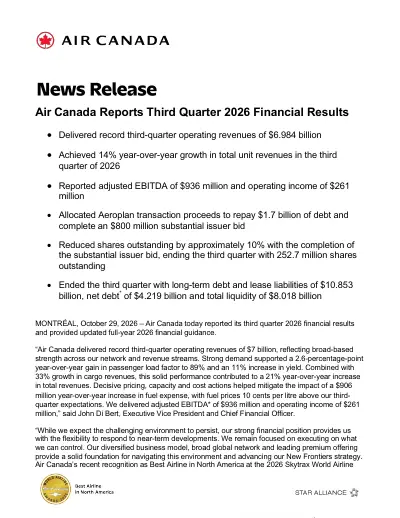
I'll start with the headline. This quarter showed the resilience of Air Canada.
Strong commercial execution delivered solid results despite higher fuel costs. Operating revenues grew 21% to $7 billion, with passenger revenues growing at the same rate.
Even taking into account last year's labor disruption in Q3, this quarter showed the strength of our commercial strategy: almost 6% more capacity, an 89% load factor, up nearly 3 percentage points, and yields up 11% year-over-year. More seats, fuller planes, and higher fares.
That translated into adjusted EBITDA of $936 million, essentially in line with last year while absorbing a $906 million of higher fuel costs, driven by 68% higher fuel prices year-over-year. Adjusted EBITDA margin of 13.4% declined from 16.6% last year.
I want to thank our employees, who delivered a safe, consistent, and caring service to our customers over a very busy summer period. Their focus and professionalism are what turn our plans into results, quarter after quarter.
Our recent recognition as the Best Airline in North America at the 2026 Skytrax World Airline Awards, the 10th time we've received this honor since 2010, reinforces the strength of our offering and our commitment to our customers. Je tiens à remercier nos employés d'avoir assuré un service sécuritaire et constant pendant une période chargée.
Leur engagement et leur professionnalisme transforment nos plans en résultats, trimestre après trimestre. Allow me to step back from the quarter for a moment.
Over the last couple of years, we've made meaningful progress in strengthening Air Canada. We've reduced leverage, further strengthened our balance sheet, and substantially lowered our share count.
We have also built on our solid commercial foundations and reached new agreements with all employee groups. The scale of our hubs, the breath of our global network, premium products, and the strength of Aeroplan give us differentiated customer propositions and support more diversified revenue streams.
Together, these achievements give us resilient and financial flexibility to keep investing in our fleet, network, our customer experience, and our people, while creating lasting value for our customers, employees, and our shareholders. We are building a stronger, more resilient airline, focused on structural and sustainable value creation.
Mark will begin with our commercial performance, and I'll follow with our financial results and outlook before we open the lines for questions. Mark, over to you.
Mark Galardo
Thank you, John, and good evening, everyone. Bonjour à tous.
J'aimerais d'abord remercier nos employés et nos clients. I'd like to start by thanking our employees for their continued focus on operational excellence, and our customers, whose loyalty we greatly appreciate.
Our third quarter results represent another consecutive quarter of record revenue for Air Canada and validate the continued resilience of our commercial model. They demonstrate the strength of our foundation and the importance of our diversified revenue streams, our far-reaching global network, and our higher-yielding customer segments.
Q3 operating revenues and passenger revenues reached a record $7 billion and $6.3 billion, respectively, both up 21% year-over-year. Importantly, for the first time in our history, all months of the third quarter produced passenger revenues above $2 billion.
Both total and passenger unit revenues increased 14% year-over-year. With more than a third of our quarterly sales made before April 1st, passenger unit revenues increased the most in our North America markets.
This is where a closer booking window enabled us to better reflect higher fuel prices at the time of booking. On almost 6% more system capacity, we capitalized on persistent demand strength to deliver leading load factor performance amongst North American peers in this more leisure-oriented period.
Today, our hubs are some of the best-connected international gateways in North America. Leveraging this scale, our sixth freedom revenues were up 16% year-over-year, despite the longer booking window, driven by a stronger year-over-year performance on the Pacific and LATAM corridors.
Turning to our customer segments, Air Canada remains well-positioned to capture premium demand, and premium cabin revenues increased 19% year-over-year. Even in the summer period, corporate revenues performed well, up 22% year-over-year.
A core strength of Air Canada's commercial strategy is our ability to offer a competitive product for every type of customer, with a value proposition no other Canadian airline offers: the breadth of our global network, our premium products, and Aeroplan. Aeroplan continues to play an important role in our commercial ecosystem, especially in premium segments, and rewards our customers for their loyalty and engagement with us and our partners.
Our customers consistently engage strongly, with third-party gross billings collected year-to-date totaling $1.6 billion, an 11.5% increase year-over-year. These billings represent amounts charged to Aeroplan program partners for points issued.
Lastly, cargo revenues grew 33% year-over-year, driven by higher yields and favorable freight pricing, while other revenues increased 11% on higher Air Canada Vacations ground package revenues and higher Aeroplan non-air revenues. Looking ahead, revenue quality continues to strengthen as our pricing actions increasingly reflect higher fuel costs.
However, given the timing of the recent fuel increase and the booking curve, we do not expect to fully recover the incremental costs in the fourth quarter. For Q4, at this point, we are seeing sustained yield strength, with load factors broadly flat year-over-year.
For context, this is against a very strong fourth quarter last year, when we reported record profitability and Q4 PRASM growth versus 2024. Beyond that, we are actively reviewing capacity and revenue against conservative forward fuel expectations.
To date, we have proactively removed more than 2 points of planned capacity from the first quarter of 2027, and we will continue to proactively adjust capacity and fares to protect margins over the course of the year. Winter demand remains resilient across most geographies, despite some pressure in the domestic market.
Air Canada Vacations bookings are an important barometer of leisure demand, and we're encouraged that early bookings for sun markets are outpacing capacity growth and generating stronger revenues. Our new international routes are booking well, and we are pleased with the initial results of our Airbus A321XLR.
This aircraft has a fuel burn per ASM below comparable widebodies, which is a real advantage in this current fuel environment. Supporting a better supply-demand balance in these markets, the XLR is delivering a more favorable margin profile than other aircraft types on comparable routes.
As always, we retain the flexibility to allocate aircraft and capacity to areas of strength and mitigate our exposure to less favorable conditions. As we move into the shoulder months, an important part of our commercial strategy is reshaping our seasonality around less commoditized periods.
This is where demand from premium and corporate customers is strongest, and where our structural advantages matter most. As that demand strengthens in the shoulder period, we continue to adapt our schedule and commercial strategies to capture the growing opportunities in spring and fall.
More broadly, we continue to accelerate a number of core commercial priorities to support revenue generation into 2027. We've enhanced our offering with more preferred seats on our high-density 777s and the launch of branded fares in premium cabins.
In late August, we unveiled our new summer 2027 routes, generating considerable excitement amongst our customers and Aeroplan members. Earlier this month, we launched Embark, our platform for small and medium-sized businesses, which are the bedrock of the Canadian economy.
To close, the third quarter was another quarter of solid commercial performance against a volatile backdrop, and another validation of the resilience of our commercial platform. We have the agility and flexibility to manage through a volatile environment, and are confident in the opportunities ahead.
We remain focused on leveraging our structural advantages as we execute on our 2027 plan. Thank you, merci, over to you, John.
John Di Bert
Thank you, Mark. Third quarter adjusted EBITDA was $936 million for an adjusted EBITDA margin of 13.4%.
These results demonstrate the underlying strength and the resilience of our [business?] .
They were achieved despite fuel prices being significantly higher than we had originally planned and reflect the actions we took throughout the year to improve fuel recovery through pricing and capacity management. Let me provide some additional context.
Mark already discussed our solid commercial performance, driving a 21% increase in revenues. Operating expenses were 22% higher than in the third quarter of 2025, driven by a $906 million increase in fuel expense, which was driven by a 68% year-over-year rise in fuel price per liter.
At our Q2 call, our Q3 assumption for fuel was $1.38 Canadian per liter, or $3.70 US per gallon. Our actual fuel price averaged $1.48 Canadian per liter in the quarter, approximately $4.00 US a gallon.
That's an intra-quarter $140 million headwind, and it includes the benefits of fuel hedging gains of $22 million in Q3. In all, we recovered 46% of incremental fuel expense, below our original expectation of 60%, primarily due to the significant increase in fuel prices experienced in September.
We expect our recovery rate to improve to 70% in Q4. Fuel recovery remains a question of timing, not demand.
When fuel spiked in September, approximately 50% of our fourth quarter bookings had already been sold, creating a natural lag before our pricing actions could be fully reflected in fares. Our commercial actions continue to offset a meaningful portion of higher fuel costs, and our recovery rate will grow as those actions work through the booking curve.
Our objective remains to achieve full fuel recapture over time. While fare increases remain the primary tool to offset a higher fuel environment, we will also pace our growth to protect unit revenues and margins through 2027.
Turning to costs. Unit cost performance was broadly in line with our expectations.
Adjusted CASM increased 3.3% to 14.45 cents. The increase mainly reflected higher labor costs, higher sales and distribution expenses, and higher depreciation as new aircraft entered service.
This was partially offset by lower other operating expenses and our 6% capacity growth. With new four-year agreements concluded with IAM and Unifor, the labor agreements reset cycle is now largely reflected in our cost structure, allowing us to focus on productivity and cost-containment initiatives as we grow the airline.
Unit cost performance in the quarter was also favorably impacted by the timing of maintenance and other costs, which we expect will materialize in Q4. Below the operating line, adjusted pre-tax income was $328 million.
Adjusted net income attributable to shareholders of Air Canada was $214 million, and adjusted diluted EPS was 75 cents. Turning to cash generation.
Third quarter free cash flow usage was $440 million, largely reflecting lower operating cash flow, including the seasonal unwind of advance ticket sales, and higher capital expenditures. Year-to-date, we have generated $1.3 billion in positive free cash flow, including approximately $500 million in proceeds from sale and leaseback transactions.
Turning to our balance sheet, we ended the quarter with net leverage of 1.3 times, comfortably below our target of 2.0 times or less. Our liquidity was $8 billion at the end of Q3, a healthy 32% of trailing 12-month revenues.
Our capital allocation priorities remain unchanged: maintain financial strength and flexibility, invest in the airline, and third, return excess capital to shareholders. Our financial flexibility is a pillar of our resilience and a true competitive advantage.
That strength matters amid volatility and enables us to look through near-term pressure on earnings when assessing leverage. In August, we used the proceeds from the Aeroplan transaction to repay a $1.2 billion US bond maturity.
As a result, we have no material corporate debt maturities until April 2028. Turning to investments in the airline.
Fleet capex will step up through the end of 2026 and into 2027 as deliveries ramp up. New aircraft improve our customer value proposition, open network opportunities, deliver efficiencies, and lower our unit costs over time.
The A321XLR is an early example. On a comparable transatlantic stage length, it is burning roughly 15% to 20% less fuel per ASM than a widebody aircraft on a comparable route.
This is meaningful in any environment, but it matters even more in this current fuel environment. Scheduled aircraft deliveries in the fourth quarter include six A321XLRs, our first two 787-10s, and seven A220s.
We expect these aircraft to generate attractive returns and support long-term value creation. Finally, consistent with the commitments we made at our Investor Day, we returned capital to shareholders through the completion of an $800 million substantial issuer bid in September.
The transaction reduced our shares outstanding by approximately 10%, 252.7 million shares outstanding as of September 30, 2026. It's our lowest share count since 2009, and well below our 2028 target of under 300 million shares, two years ahead of schedule.
We do plan to renew our NCIB program in November, but will remain opportunistic in repurchasing shares. Now let's turn to the outlook.
For the rest of 2026, our commercial trends remain strong, and we expect them to extend into the winter season. We have narrowed our capacity and our cost ranges to reflect limited variability in the fourth quarter, while keeping room for fuel volatility.
Fuel remains the largest variable in our outlook. At this time of year, we anticipate about 1/2 of our Q4 fuel needs to be exposed to fuel price volatility.
We are planning for a Q4 all-in fuel price of $1.72 Canadian per liter, or about $4.60 US per gallon, compared to $1.29 Canadian per liter, or $3.50 US per gallon in our August outlook. This higher fuel assumption is the principal change for a full-year outlook and is driving the adjustment to our expected profitability and cash generation.
We now expect full-year ASM growth of approximately 2.75%, aligned with the midpoint of our prior guidance. We expect adjusted CASM to increase 5.5% to 6% versus 2025.
While the timing of certain costs has shifted from Q3 to Q4, affecting the year-over-year comparison, we continue to expect adjusted CASM growth to be lower in the second half of 2026 than in the first half. Over time, we expect our fleet renewal and the benefits of scale to support decelerating our unit cost trajectory.
We expect adjusted EBITDA to be between $2.4 and $2.7 billion, which is approximately $500 million below prior guidance at the midpoint. The change reflects our higher fuel assumptions for the fourth quarter.
We now expect breakeven free cash flow, plus or minus $150 million, compared with our prior guidance range of $200 to $500 million. Year-to-date, we have generated $1.3 billion of free cash flow.
Our guidance continues to assume approximately $1 billion of sale-leaseback transactions in 2026, which is supported by signed definitive agreements. Though we are not yet providing guidance for 2027, we are planning for fuel to stay elevated.
On that basis, we still expect to reach pre-pandemic capacity levels, but we're carefully reviewing the pace of capacity growth to protect unit revenues, margins, and returns, while retaining flexibility to respond to demand. Our diversified earning streams, our strong balance sheet, and our financial flexibility support our long-term strategy, and they give us confidence in our ability to execute as we head into 2027.
We remain well-positioned to play both offense and defense. To conclude, our priorities are clear and unchanged: one, manage the controllables, including commercial actions, capacity, cost, and operational performance; two, protect our margins, returns, and cash generation while maintaining the strength of our balance sheet; and third, continue advancing the value creation framework we set out in New Frontiers.
With that, back to you, Amanda, for questions.
Amanda Murray
Thank you, John. Christa, please open the line for questions from analysts.
Operator
Thank you. If you would like to ask a question, please press star followed by the number 1 on your telephone keypad to raise your hand and join the queue.
If you would like to withdraw your question, again press star 1. We do kindly ask that you limit yourself to one question and one follow-up.
For any additional questions, please requeue. Your first question comes from Konark Gupta with Scotiabank.
Please go ahead.
Konark Gupta
Thanks, and good afternoon. My first question, I guess, is on the fuel here.
It's understandable that the fuel prices have run up a lot, the fuel recovery rate has to come down in Q4. Can you help us understand some of the moving parts in that fuel absorption rate, John?
What kind of fares are you underwriting these days on fuel price, and are you expecting the fuel price to kind of taper off from here, or this is an ongoing assumption for the next, call it, six months as well?
John Di Bert
Good evening, Konark. I think, first and foremost, we take the world as it is, right?
You've got fuel running in the $1.70 to $1.80 range pretty constantly right now, our posture is that that is with us for at least the foreseeable future. We continue to price.
We had expectations of $1.40 to $1.45 kind of fuel pricing recovery as we went into the quarter. We had a spike, we'll be looking to continue to push pricing actions in as particularly as we look into Q1.
With respect to fuel prices, we won't make any speculation other than the fact of taking the world as it is today. Maybe Mark has some comments on the pricing environment.
Mark Galardo
Good evening, Konark. Look, it took us several weeks, if not months, to kind of level up with in the fall with fuel prices that were closer to $1.40, $1.50 a liter.
Going into Q4, had fuel stayed at that level, we would have covered most of the incremental fuel bill, if not all. However, since kind of early fall, it's run up to $1.70, $1.80, and then moved up pretty quickly.
At this point in time, certainly we are trying to push further increases in market, but it will take some time before the market fully levels up with where the fuel price is today.
Konark Gupta
Okay. No, that's great color, thanks.
Then, maybe on the transborder side, while I have you, Mark, the market seems to be in a structural decline here for some time. Do you guys expect or are you guys, I would say, building capacity again in anticipation of demand coming back potentially, or are you just playing on a spot basis?
Mark Galardo
Konark, if you look at our Q3 results on transborder, they were excellent. Our revenue growth was quite good, our yields were quite solid, and our sixth freedom continues to grow.
On transborder, you've got a couple of structural tailwinds that are helping us: one, the strength of the US dollar; secondly, we've got a pretty favorable supply-demand balance and the profitability levels that we're enjoying on the US market right now, the margins are slightly higher than they are on domestic. As I look forward, I see much of the same for Q4 and for Q1.
Got no reason right now to be concerned about the state of the transborder market.
Konark Gupta
Thanks for the time.
John Di Bert
Thank you.
Operator
Your next question comes from the line of Atul Maheswari with UBS. Please go ahead.
Atul Maheswari
Good evening. Thanks a lot for taking my questions.
Can you maybe double-click on the portion that you mentioned about fourth quarter bookings? Could you give us some sense of what kind of trends you're seeing by various geographies, and then any color on how early 1Q bookings are shaping out would be helpful.
Mark Galardo
Sure. What you're going to see overall right now for the fourth quarter is load factors are generally flat year-over-year.
As I mentioned in my script, our fuel recovery and therefore yields are higher on North America, because the booking window is much closer in, whereas international typically books further out. Given that backdrop, we should expect that North America has the highest yields, with obviously flat load factors year-over-year, and international trailing a little bit.
Atul Maheswari
Thank you.
Operator
Your next question comes from the line of Fadi Chamoun with BMO Capital Markets. Please go ahead.
Fadi Chamoun
Thank you. Mark, I just want to come back to the demand resiliency.
As you look at the progression month-to-month since the fuel started to kind of rise materially in late August and kind of into the fall period, have you not seen an impact from a load factor perspective? I guess you've called out Q4 flat load factor, but we've seen much stronger performance before that.
Are you starting to see any resistance on the demand side? I'm just trying to think, as you go into next year in your plan to grow capacity, how should we be thinking about the market's ability to kind of absorb what you have planned from a capacity perspective, given where fuel prices are today?
Mark Galardo
Thanks, Fadi. Obviously, we saw very strong end of Q3 with September and October, which I called out previously, being quite strong.
The demand overall, too, from within Canada still remains relatively stable, kind of up a little bit. What we've seen is the growth rate is decelerating a little bit, whereas in prior quarters we would have seen market demand growth between 4%, 5%, we're now seeing demand market growth between 2% and 3%.
Certainly what's helping us is how diversified our network is. Certainly, the sixth freedom portion of our network is also helping, as we're tapping into new traffic sources.
That's kind of helping us offset a little bit. Going into Q1, much of the same.
Our current booking posture for Q1 has flat load factor build so far.
Fadi Chamoun
Appreciate it.
Operator
Your next question comes from the line of Savi Syth with Raymond James. Please go ahead.
Savi Syth
Hey, good afternoon. I know you're not kind of ready to talk about capacity growth for next year, but if I look at your fleet plan, just overall, seats are growing high single digits, and it sounds from your commentary that you might be, if fuel prices stay high, maybe in that kind of low-to-mid single-digit range probably capacity growth.
Curious on how you achieve that and then what we should think about in terms of the impact on unit cost as a result of that.
Mark Galardo
Savi, we're looking at a bunch of scenarios right now in terms of flexibility and agility of how we deploy capacity. Our focus right now is really the first half of '27, because that's where we anticipate that fuel prices will continue to be relatively high.
We've removed 2 points out of Q1. We are looking at the more marginal flying reductions, so that would be midweek cancellations on certain routes.
We're going to be looking at reducing utilization somewhat. As you can see by the suspension of our Singapore route, we're also kind of re-evaluating the ultra-long-haul part of our business, as that's a bit more exposed to the higher fuel prices.
Right now we're still very much contemplating a variety of scenarios. What we can say definitively is for Q1, we've removed 2 points of capacity, and we'll leave it there.
John Di Bert
Maybe just I'll take the back end of your question on CASM. We have a 5.5% to 6% range for 2026 on CASM growth year-over-year.
Yes, for sure, had we had the higher single-digit capacity growth in 2027, we would have been expecting a very favorable impact to CASM. I still think that, as we get through the plan cycle here, we'll see the benefits of newer aircraft, continued scale improvement even at lower rates of growth, and that should still produce a decelerating CASM growth year-over-year.
We'll work through that, and as we get into '27 guide, we'll talk through it. Expectations are still that we're going to start to have a curve to the downside on year-over-year growth in CASM.
Savi Syth
That's super helpful. Just if I might follow up on kind of the demand question earlier.
Curious what you're seeing on the corporate side and if maybe some of that slowing, is that more leisure and being kind of more price sensitive? Just curious how corporate is doing here.
Mark Galardo
No, corporate continues to evolve very favorably into Q4. It's up double digits, kind of in line with Q3.
Savi Syth
Got it. Perfect, thank you.
Mark Galardo
Thank you.
Operator
Your next question comes from the line of James McGarragle with RBC Capital Markets. Please go ahead.
James McGarragle
Hey, thanks for having me on. I just had a quick follow-up here on that capacity planning on 2027.
Just to confirm, would you be deferring any of your new planes, or potentially retiring any of the old ones? I just want to make sure I'm modeling any adjustments to potentially capex or free cash flow correctly into 2027.
John Di Bert
For '27, I think the new fleet remains an advantage in the sense that they are more cost-effective, more fuel-efficient, and they'll provide better service and even some premiumization. I think we'd be looking more at utilization on the older fleet and, as Mark said, reducing some of the marginal flying, at the same time, utilization on older aircraft or aircraft that need specific high-cost maintenance.
We'll try to balance all of that. No significant change in the expectation other than, as every year has been for the last couple years, there'll be some movement with delivery schedules and timing, but we'll deal with that as it comes.
James McGarragle
Then just in terms of your balance sheet, obviously it's in really good shape right now. Can you just give us an update on how you guys are thinking about capital allocation into Q4 and into 2027?
I'll turn the line over after that. Thank you.
John Di Bert
Thank you. We've been very consistent with capital allocation.
First and foremost, we have worked to protect the balance sheet. Work that we did in Q3 is further proof of that, that we have no maturities through April 2028.
That's in good shape. High liquidity relative to last 12 months of revenue, over 30%, gives us a lot of flexibility.
We're going into a capex cycle, and that's been kind of planned and telegraphed for a long time now. That starts with quite a few deliveries in Q4 and then through 2027.
That will start to normalize past that in '28, '29, but for now, I think it's keep the balance sheet strong, grow responsibly with that, invest in the airline so we can create the platform for value creation for the long term, which we're confident continues to be our main objective here. Then, thirdly, returning shareholder value, but I think on that one we've achieved a lot, right?
We're at 252 million shares outstanding. We feel very good about the share count.
We've deployed now probably almost $2.5 billion of cash over the last few years. We'll be very opportunistic with the NCIB, and we'll see how '27 evolves as well with fuel and cash flow, all those things will be considered.
Operator
Your next question comes from the line of Jamie Baker with JPMorgan. Please go ahead.
Jamie Baker
Hey, good evening, everyone. John, I got interrupted, I'm hoping you didn't already address this, but a question on leverage.
How do we think about the cadence of where leverage heads next? Obviously, next year is a bit intense from a capex perspective.
You've got the buyback plans. Just kind of curious how you're, I guess, triangulating between leverage and your IG aspirations.
John Di Bert
Yeah. I think the math is going to be the math.
We're going to have probably a couple of lighter quarters as we go through higher fuel environment if it stays as it is. We'll see as that moves through.
I think my comment would be that we built the airline to be very resilient, strong liquidity, from an overall strength of the balance sheet, nothing changes. The math, obviously, given earnings and the pressure that comes from some of these spikes on fuel, is going to take its toll over the next couple of quarters.
We'll see some pressure on the leverage ratio. My expectation is that we work through that, but our aspirations for investment grade were really all about converging our '28 and 2030 objectives, and I think that those remain intact.
The work here is to get there responsibly, and put ourselves in a position to have both cash generation and an investment grade opportunities as we kind of work through the next probably 12, 18 months.
Jamie Baker
That helps. Then second, for Mark, and I'm sorry to beat a dead horse here on fuel recapture, and I realize the calculus might differ between airlines, but the 70% estimate for the fourth quarter is a little bit lighter than what we've heard from others.
You've got factors like the pace of domestic fare increases, you mentioned the booking curve in your prepared remarks. I guess my blunt question is whether there's any elasticity component baked into the 70% assumption.
Any thoughts there? Thanks in advance.
Mark Galardo
Absolutely great question, Jamie. One of the items that differs between Air Canada and kind of our American peers is the composition of our network.
We're almost 60-40 long-haul to short-haul. American peers are typically 30-70.
The closer-in booking window for North America allows a higher recapture, just basic math. We have a much longer kind of tail for international long-haul bookings, and as a result, once those bookings are in, it's hard to recapture, because the bookings are made, and we typically have a strong base of bookings basically two months out.
That's really a contributing factor as to why our recapture rates are a little bit lower.
Jamie Baker
Okay. All right, that's perfect.
Thank you very much.
John Di Bert
Thanks, Jamie. Thanks, Jamie.
Operator
Your next question comes from the line of Cameron Doerksen with National Bank. Please go ahead.
Cameron Doerksen
Thanks. Good evening.
Actually, I'll maybe follow up on that question, just based on what you've just described there as far as the recapture and where the booking curves are. If we assume that fuel prices kind of stay where they are into 2027, do you think you can fully recapture the price of fuel in Q1, or is that something we should think about more as kind of still Q2 or later?
Mark Galardo
Cameron, it's hard to say. Right now, like I said earlier, it took about several months to get to a place where the market fully prices in fuel closer to about $1.50 a liter.
Now the market has to readjust to $1.70, arguably $1.80 a liter, and I can't say that the market's there just yet. Obviously, we are going to aspire to getting ourselves there and have the highest possible recapture, but we've yet to see the market fully price in the latest cost of fuel.
Cameron Doerksen
Okay. No, that's helpful.
Just on capacity, you mentioned that you'd pulled about 2 points out of your Q1 plans. What are you seeing from competitive capacity?
We've had a look at some of the sun destination plan capacity for this winter, and some of your competitors are got some pretty aggressive capacity plans, which seems might be a challenge given where the price of fuel is. What are you seeing from your competitors as we look into 2027 on the capacity plans that they have?
Mark Galardo
If you look into Q1, there's a lot of capacity in the sun market, and obviously with Cuba no longer being a destination that one can travel to, capacity is being redistributed onto markets where maybe we were one of two players on the market, now there's a third or fourth player. We see a little bit of pressure on the sun market.
We're seeing a little bit of pressure on the Pacific as kind of the Chinese ramp up their post-pandemic capacity. On the domestic market and transborder, generally speaking, we're looking at low-single-digit capacity growth.
Cameron Doerksen
That's helpful. Appreciate it.
Operator
Your next question comes from the line of Daryl Young with Stifel. Please go ahead.
Daryl Young
Hey, good evening, everyone. Just wanted to ask on the transatlantic.
Nice to see a return to growth there. Wondering how much or I guess where you stand from a pricing standpoint to some of the international carriers, and as hedge books roll off, is that going to be another opportunity for growth into '27, or how are you thinking about competition there?
Mark Galardo
On the transatlantic, again, one of the issues or one of the challenges of the transatlantic is, again, that lag between a far-out booking window and when fuel prices are actual. That's led to the lower recapture rates.
Typically, two months out, you have 70% to 75% of the bookings already on hand. As we go into Q4 and Q1 and more pricing increases roll in, we should see higher yields across the Atlantic.
We've seen a little bit of a demand slowdown in the last two, three weeks. Obviously, there's been protests in Europe.
We expect that to be transitory, but overall we see stable market demand.
Daryl Young
Okay. Then looking out to your 2028 targets with $30 billion of revenue, it seems like from a capacity perspective, you're going to be sort of behind the curve of where you were when you originally set that, but you've maintained that.
Is that a function of pricing staying higher through your forecast period, or how should we think about sort of a hockey stick for capacity coming back in '28?
John Di Bert
I think that the capacity management we'll do for 2027 will be a function of the market we're in and how we work through that. We would expect to have eventually the full capacity of our fleet utilized appropriately.
There's going to be obviously some pricing implications as well, and we'll see where that lands. It's too early to tell now what the pricing environment will be as we kind of get into 2028.
I think overall, the plan remains solid in the sense that we've executed on a lot of the expectations that we had. We need to see how the next six months develop, and then we'll look forward to see how 2028 kind of moves through.
Most of the difference has come from the adjustment we made from the 787-10 order. Besides that, it'll be a question of deliveries and should they all come in, when they need to come in, and we'll kind of tighten up against the ASMs for '28 as we get closer to the year.
Daryl Young
Got it. Thanks very much.
Operator
Your next question comes from the line of Andrew Didora with Bank of America. Please go ahead.
Andrew Didora
Hey, good evening, everyone. John, I was just trying to kind of understand the implied fourth quarter guide here.
I think the CASM and fuel stuff certainly makes sense, but just on revenues, I know it's been asked in other ways, but I guess the way we are running our model seems like RASM for 4Q, probably high single digits, obviously a pretty decent decel from 3Q and even 2Q, and kind of more in line with 1Q. Just curious why would that be in this type of fuel and pricing environment?
Then, Mark, any color on kind of as we move into 4Q, kind of what are some of the regions, geographies, or demand buckets that would drive that change?
Mark Galardo
Thanks, Andrew. I'll take the second part of the question.
Going into Q4, we don't see RASM up high single digits. RASM won't be as strong as it was in Q3, because we're rolling over some comps where last year in Q4 we had a record Q4 in terms of PRASM performance.
Certainly, you should anticipate that PRASM will be in the double-digit-type environment. Again, as I stated before, the North America markets are more resilient.
They've got a closer-in booking market, which allows us to pass on more of the recapture than international long-haul, which typically books 60, 90, 120 days out. Typically, 60 days out, you already have 70%, 75% of the traffic already on the books.
While we see yields accelerating in Q4, PRASM will decelerate slightly from Q3 to Q4, but still be comfortably in the double digits.
John Di Bert
Maybe, Andrew, I'll just add something if it helps. It may or may not, but absolute pricing in terms of levels of pricing from Q3 to Q4 are going to be pretty much where we expected them to be as we went through the conversation on our Q2 call.
The difference really is we've burned probably about a billion 300 million liters of fuel in Q4. The difference between $1.72 and the $1.29 per liter that we guided is over 40 cents.
You kind of get a number right there, it's in the mid-$500s. If you look at the midpoint to midpoint, we're pretty much there.
That's the number. September was also a headwind, offset some of that.
If you add another $100-plus million for September, it'd be over $600 million of fuel pressure from the last time we provided guidance. The real issue is not necessarily on the revenue line.
Yes, that's going to take some time to increase from here, but where we are is pretty much where we expected to be. Where we're not is on the fuel number.
Andrew Didora
Thank you for that. Then maybe, John, just as we think about unit costs heading into 2027, I know you don't want to guide that yet, but you clearly anniversary kind of all of your labor agreements.
Back half of '26 is kind of up mid-single digits. Would you expect that to begin to bend down as we move into the first half of '27, given the way you think about capacity right now?
John Di Bert
Yes, even with a little bit of a pare back here in terms of just the first half of the year, particularly on capacity, we have to get through some additional work and just kind of work through the planning cycle here, but expectations would still be that we would start to see some deceleration of the year-over-year increases. They've been in that 5% range for a few years now, and I'd expect to see a reduction in year-over-year CASM growth in 2027.
Andrew Didora
Thank you.
Operator
Your next question comes from the line of Chris Murray with ATB. Please go ahead.
Chris Murray
Thanks, folks. Maybe a different way to think about where the recovery is in terms of fuel.
Where are you in the booking curves right now as we go through Q4 and into Q1? Can you give us some sense of an idea what's left to book, both internationally and domestically, just I guess with the volatility of fuel price, I'm trying to understand what might be already in there, what you have left to kind of catch up to, and if fuel prices move in your favor, is there some recovery possible as we go further into the year?
Mark Galardo
Chris, I'll take that one. For Q4 right now, obviously October is behind us, but in general for Q4, we're roughly about 80-odd percent of our bookings already on hand.
Going into Q1, we've got roughly 30% of our bookings on hand. Like I've said, load factor year-over-year is relatively flat.
I'm not going to break it down North America-international, just give you the headlines here closer to 30%. Like I've said, we are trying to get the market to level with the actual fuel price.
It will take some time for that to happen. Generally speaking, when you have a sudden fuel spike like this, carriers around the world are testing the elasticity of demand, and certainly we've seen some inelastic behavior, but once they feel that the elasticity is certainly onside, they will float further increases in, and that's basically where we are in terms of trying to level closer to $1.70.
Chris Murray
Okay. The other question I had for you was on freight and cargo.
I was just trying to understand how much of that cargo business is tied into the passenger, how much is tied into dedicated freighter? I've noticed that you've got some new routes that you're trying to work into Europe right now.
Just trying to get a sense of the growth rate, very strong in the quarter. Is that something that we should be expecting to continue for the next little while as even a natural offset to what's going on with fuel and how that pricing is proceeding?
Mark Galardo
The cargo business is doing extremely well. Going into Q4, you should anticipate, again, much of the same, but the booking curve for cargo is so close in.
Because it's so close in, the recapture rates are very, very high, almost covering 100% of the incremental fuel price. We are expecting the strongest October on record for our cargo business, much the same in November.
If you kind of break it down, widebody to kind of freighter, you're looking almost 75% of the revenue being widebody belly, the balance being the freighter, but of course the widebody belly is fed by the freighters that are coming in from a variety of destinations in LATAM, the USA, and now a new service to Amsterdam to help us take advantage of, generally there's a lot of tailwinds in the cargo market right now.
Chris Murray
That's helpful. Thanks, folks.
Operator
Your next question comes from the line of Tom Fitzgerald with TD Cowen. Please go ahead.
Tom Fitzgerald
Hi, thanks so much for the time. Question on sixth freedom revenues.
You mentioned earlier the new traffic sources you've been leaning into. I think a lot of that's Latin America to APAC and EMEA.
Could you just talk about what you're seeing there, how we should think about that portion of sixth freedom growing with a year of learning under your belt and as you guys optimize that into 2027?
Mark Galardo
No, this is an exciting part and a growth part of our business, Tom. We're really excited about what we see ahead.
For Q4 right now, revenue is closer to 20% up year-over-year on the sixth freedom side. Much of that is the LATAM to Europe and LATAM to Asia business that we supplemented last year, and we're doubling down this year, and so far that's doing quite well.
As we look into that same dynamic into Q1, we see even further acceleration. Again, it's really a new accrete of source of revenue, certainly helps us in preserving high load factors in the quarter.
Tom Fitzgerald
Great to hear. Really helpful.
Just a quick accounting one on maybe for John, just on Aeroplan. If we just take the proceeds in in the filings for this quarter, that that 570, that's running up about like 13% year-over-year, year-to-date up like 11.5%.
Is that like low double digits a safe run rate for proceeds if we kind of model out '27 and beyond, and then just taking maybe like 10% of that for net income to then get to the the minority share share interest? Thanks again for the time.
John Di Bert
Maybe why don't we take that one off, and you can maybe with myself and Amanda give us a call, and we'll walk you through it.
Tom Fitzgerald
Fair enough. Maybe I think I have a follow-up then, just on longer-term, how do you think about the mix shaking out on sixth freedom between US sixth freedom and then Latin America sixth freedom?
Thanks again for the time.
John Di Bert
Yeah.
Mark Galardo
From a percentage perspective, certainly there's a lot more growth just as a function of how small the base is on LATAM. That's why this summer we're extending service to Guatemala, we're certainly extending service to Lima, we're going to be extending service to a bunch of cities in Mexico, all with the primary objective of growing the sixth freedom business to and from LATAM year-round, and consistently kind of over the years to come.
We think that's a huge opportunity given our geography. We think we've got a right to win there, and so far the execution suggests that that's exactly what's happening.
Definitely an exciting growth part of the business.
Operator
Your next question comes from the line of Jack Ewell with Jefferies. Please go ahead.
Jack Ewell
Hi, it's Jack on for Sheila. I thought maybe just to drill in the customer types for a second.
Last quarter, I believe the main cabin RASM trailed premium by about 3 points, and I was wondering how that gap trended into Q3 and what bookings indicate for Q4. I just think the last quarter it was encouraging to hear that main cabin was holding in despite the fare surge this year.
Mark Galardo
Jack, in Q3, it's been a tale of two seasons. In July and August, typically this is a low point for premium demand, travel, and yields.
Then in September, it comes roaring back, and much the same for October. We had relative parity between premium cabin and main cabin in Q3.
It's in Q4 where we expect that to diverge.
Jack Ewell
Got it. No, that's very helpful.
Then I guess maybe just a follow-up on Savi's question from earlier. I know corporate revenue accelerated into the 20% range this quarter, just reflecting continued very strong demand.
I was wondering if you could talk about the trends by region across domestic and international, and if there's any sectors specifically driving this. Maybe my last question on it is just has your introduction of the basic fare offering in premium helped boost corporate yields, as we'd assume that fare option is blocked by a lot of corporate travel teams?
Mark Galardo
Jack, on the branded fares, we rolled it out on the North Atlantic, but we haven't fully scaled it throughout our system yet. We're barely into month two, the results are still early.
We think there's a lot of promise here, and based on the proxy of other of our peers who've instituted similar products, we think there's a lot of potential here. Right now, too early to comment on the success of that.
From a total kind of geography split on corporate revenue, we're seeing double-digit growth primarily in Canada and US. The reason for that again, it's the same kind of phenomenon, this is a much closer booking-in window where you can price in higher recovery rates on fuel.
Atlantic corporate typically books a little bit further out, those recovery rates are a little bit lower, but all three of those services are comfortably in the double digits in terms of increased revenue.
Jack Ewell
Got it. Thank you for the thoughts.
Operator
That concludes our question-and-answer session. Amanda, I'd like to turn it back over to you.
Amanda Murray
Thank you very much for joining us today. Should you have any questions, please reach out to myself or Ivan Zarate at Investor Relations.
Thank you, and have a nice evening.
Operator
Ladies and gentlemen, this does conclude today's conference call. Thank you for your participation, and you may now disconnect.