Ag Growth International Inc.
Q3 FY2026 · Earnings Call TranscriptNovember 12, 2026
Operator
Thank you for standing by. This is the conference operator.
Welcome to the AGI third quarter 2026 results conference call and webcast. As a reminder, all participants are in listen-only mode, and the conference is being recorded.
After the presentation, there will be an opportunity for analysts to ask questions. To join the question queue, you may press star then one on your telephone keypad.
As a courtesy to management and other participants on the call, please limit yourself to two questions. Please note that lines will be muted after two questions, and you are welcome to rejoin the queue if you have further questions.
Should anyone need assistance during the conference call, they may reach an operator by pressing star then zero. Before we begin, we caution listeners that this call may contain forward-looking information and discussion, and that actual results could differ materially from such forecasts or projections.
Further, in preparing the forward-looking information, certain material factors and assumptions were used by management. Additional information about the material factors that could cause actual results to differ materially from the forecasts or projections and the material factors and assumptions used by management in preparing the forward-looking information are contained in our third quarter MD&A, financial statements, and press release.
In addition, our MD&A contains reconciliations on additional non-IFRS terms and measures such as adjusted EBITDA, free cash flow, net debt, and leverage ratios, among others. AGI's third quarter press release, MD&A, and financial statements are available on the AGI website and SEDAR+.
I would now like to turn the conference over to Paul Brisebois, President and CEO of AGI. Please go ahead, sir.
Paul Brisebois
Thank you, operator, and good morning, everyone. Thank you for joining us to discuss AGI's third quarter 2026 results.
With me today is Haaris Uddin, our Chief Financial Officer, who joined AGI in August and is participating in his first earnings call with us. Haaris will walk through our financial results in more detail following my remarks.
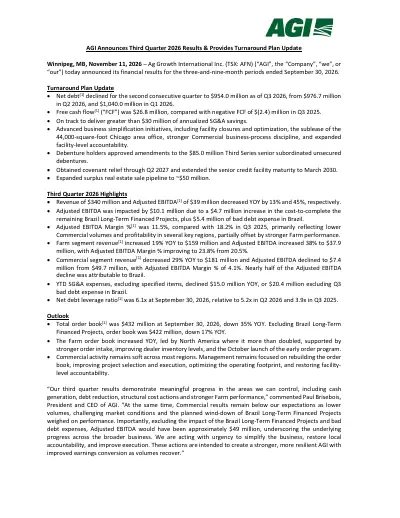
Our third quarter continued a theme we've described throughout the year: two different businesses moving in two different directions. Farm is clearly improving.
Year over year, Farm revenue was up 19%, Farm adjusted EBITDA was up 38%, and our North American Farm order book more than doubled from a year ago. Commercial, on the other hand, remains under pressure globally, weighed down by the cycle, a cautious macroeconomic backdrop, regional conflict, trade-related uncertainty, and the planned wind-down of our long-term finance projects in Brazil.
We are not satisfied with our consolidated results, but we know what the issues are, we're fixing the ones within our control, and the progress is measurable. We generated $27 million of free cash flow in the quarter, reduced net debt for a second consecutive quarter, remain on track to deliver more than $30 million of annualized structural cost savings, and continued to simplify our footprint and operating model.
After quarter-end, with the support of our debenture holders, we addressed our nearest debt maturity. Let me begin with an overview of the quarter.
Consolidated results reflect strong momentum in Farm, offset by a difficult quarter in Commercial. Farm delivered another strong quarter.
Revenue increased 19% to $159 million, driven by 23% growth in North America. Farm adjusted EBITDA increased 38% to $38 million, and margin expanded more than 300 basis points to 23.8%.
Higher volumes, disciplined pricing, and a leaner cost base are all showing up in these results. Commercial revenue decreased 29% to $181 million, and adjusted EBITDA declined to $7 million from $50 million, for a margin of 4.1%.
Nearly half of the decline in Commercial adjusted EBITDA was attributable to Brazil, roughly a quarter to EMEA and APAC, and a quarter to North America. Two items in Brazil weighed on the quarter and are worth calling out directly: a $4.7 million cost overrun on the one remaining Brazil long-term finance project, and a $5.4 million provision for bad debts related to certain customers in our traditional Brazil business.
Together, they cost us approximately $10 million of adjusted EBITDA in the quarter, taking us from $49 million down to $39 million. The most encouraging part of the quarter continues to be the North American Farm.
At quarter-end, our North American Farm order book had more than doubled year over year, with strength in both portable handling and permanent handling and storage product categories. Order intake has stepped up meaningfully over the last several months, dealer inventories continue to normalize, and we have implemented price increases across portable and permanent products to help offset steel cost pressure.
Our early order program launched in October, and participation to date has been solid. It has given us improved visibility into dealer and customer intentions heading into 2027.
Putting this together, the evidence increasingly points to 2025 as the bottom for our Farm business. The pace of recovery from here will depend on farmer sentiment, which remains measured, with better commodity prices partly offset by input cost inflation and trade uncertainty.
That said, while the Farm cycle is showing improvement, North American Farm revenue is still well below the levels we saw in 2023, which leaves meaningful room to recover. Overall, we are encouraged with our Farm business as we head into Q4 and 2027.
In Commercial, it helps to separate what the market is doing from what we control. On the market side, we are dealing with a tough combination of factors globally: cautious macroeconomic environment, regional conflict, and trade-related headwinds.
In EMEA, the conflict involving Iran has effectively frozen near-term opportunities in several Middle East markets, and is also having a negative impact on our rice milling business in India. The renewed escalation in Ukraine has put previously approved projects on hold, with knock-on effects in neighboring Eastern European markets.
We're seeing positive project activity in Africa, and our pipeline and order book continues to build in this region, but it is only a partial offset to challenges elsewhere. I want to spend a few minutes on North America Commercial, because it shows how we are simplifying the business and what that can mean for future earnings.
Earlier this year, we closed our Chicago-area office, which housed a centralized team that owned many processes required to run the business. We returned accountability for quoting, pricing, and execution to our facilities.
Since then, we have completed a diagnostic review of our North America Commercial operations, with the key takeaway that in core facilities, financial underperformance was driven primarily by quoting and pricing on projects booked under the former centralized model. These projects were executed in Q2, Q3, and part of Q4, with a very clear impact on margins.
Together with low absorption due to lower volumes through core facilities, the misquoted commercial work compounded the challenges in this area of our business. We have already acted on this.
Local facility-level leadership now owns the key processes around quoting, and in October we approved a corrective plan to help accelerate recovery. Some of these lower-margin projects will continue to work through our results for the remainder of the year, but as they are completed and replaced with work quoted by the people who know the product and the customer best, we expect this drag to lift.
This is one example, but it reflects a broader principle behind our operational simplification: the people closest to the customer and the shop floor make better decisions. Early indicators are encouraging.
Since July, North America Commercial has won projects in our quoting pipeline much more consistently, with approximately 60% of decided customer projects won since July, above our 55% target. In addition, versus the first half of the year, our average won deal size is up over 20%, and our quoting activity is up nearly 20%.
The pipeline is getting larger, with bigger individual opportunities in it, and we're winning more often. To further support the overall simplification of our business and reduce EBITDA drag where it exists, we continue to simplify our footprint.
Over the past several months, we have closed or are in the process of closing several commercial facilities that were not economically viable at current volumes, and we are consolidating that activity into our other plants. This includes the closure of several subscale facilities in North America and subleasing of our 44,000 square foot Chicago-area office.
These actions do two things: they remove EBITDA drag today, and by running more volume through fewer facilities, they improve absorption and give us better scale on lower volumes. That means more earnings torque as the market and volumes come back.
At the same time, we continue to invest selectively where we can win. Our Clay Center bin line remains on track to launch in the first quarter of 2027, supporting our effort to recapture US storage volumes.
A recovery in North America Commercial and the full impact and implementation of our corrective actions will take time, but the foundation is improving. Moving on to an update on Brazil, where we see two things are happening at once.
First, as planned, our long-term finance projects are rolling off. Revenue from these projects declined $30 million or 50% year over year, and the related order book is now under $10 million, compared with $159 million a year ago.
This was a deliberate decision to reduce balance sheet credit and execution risk, and it was the right one. It does mean Brazil will continue to be a headwind in 2027 to year-over-year comparisons as these contributions roll off.
The cash benefit of halting the long-term finance projects is already visible. Our incremental investment in non-current receivables was $17 million in the quarter, compared with $42 million a year ago, and this builds off the $100 million-plus we collected from legacy project receivables in the prior quarter.
Further cash investments should continue to drop off to nominal amounts moving forward. Second, the operating environment has become more difficult.
Interest rates remain high, credit conditions are tight, and the political environment is changing. Credit conditions in Brazil remain challenging, and we continue to assess collectability across the portfolio.
We're staying close to our customers while managing credit carefully. Our traditional equipment Brazil business has a long history and a strong market position, and we intend to keep it lean and disciplined through this period with tightened credit terms and approvals.
Strengthening the balance sheet remains our top priority. Net debt has now declined for two consecutive quarters, and we have extended both our senior credit facilities and our nearest debenture maturity.
In October, our third series debenture holders approved amendments that extend the maturity of the $85 million debentures from December 2026 to December 2030. This addresses our nearest maturity, and when combined with the covenant relief and maturity extension of our senior credit facilities, it provides us with additional time to execute our plan.
Our next priority is the convertible debentures maturing in 2027. The strategic review committee, together with our financial advisors, are actively reviewing refinancing and recapitalization alternatives to address these maturities.
Looking ahead, we expect the Commercial segment to remain under pressure due to geopolitical turmoil, the roll-off of the Brazil long-term finance projects, and the final work-through of lower-margin North America projects all filtering through our results. Our Farm business will continue to show improvement, with further progress in our early order program primarily populating our production schedules for the first half of 2027.
In closing, we know what the issues are, we are fixing them, and the progress is measurable. This has been a difficult year for AGI, and I want to be direct: our Commercial results are not where they need to be, but the actions we have taken are real and they are showing up where we can control them: stronger Farm performance, positive free cash flow, lower net debt, a lower cost base, a simpler footprint, and the nearest debt maturity addressed.
Every dollar of debt repaid, every dollar of cost removed, and every facility we make more accountable increases AGI's flexibility and long-term earnings power. I believe the business we're building will be leaner, more resilient, and better positioned to generate sustainable returns through the cycle, with meaningful upside as markets recover.
Thank you to our employees for staying focused and showing up for our customers, and to our partners and shareholders for your continued support. I'll now hand the call over to Haaris.
Haaris Uddin
Thank you, Paul, and good morning, everyone. I'm pleased to be joining my first call with AGI.
I'll focus my remarks on the following areas: margins for the quarter, free cash flow and capital spending, leverage and liquidity, and the order book. Starting off with margins for the quarter.
Consolidated adjusted EBITDA margin declined approximately 700 basis points from 18.2% to 11.5%. The primary driver was our Commercial segment, where margins declined from 19.5% to 4.1%.
This reflected lower sales volume and the resulting underabsorption of fixed costs, the roll-off of higher-margin Brazil long-term finance project contributions, the cost overrun and bad debt expense in Brazil that Paul referenced earlier, as well as the margin impact from the mix of projects currently being executed in North America. Farm was a meaningful offset, with margin expanding over 300 basis points to 23.8% on higher volumes, pricing discipline, and our lower cost structure.
On SG&A, third quarter expenses excluding specified items increased slightly year over year. The increase was driven by the $5.4 million bad debt expense in Brazil.
Excluding that item, SG&A had a slight decline during the current quarter. Year-to-date, SG&A is down $15 million or $20.4 million excluding the Brazil bad debt expense, which keeps us on pace for the $30 million of annualized run-cost savings.
For clarity, the structural cost savings we referenced will be captured primarily, but not entirely, in the SG&A line item. Free cash flow was $27 million in the third quarter, a significant improvement from a use of $2 million in the prior year period.
This quarter also marks our second consecutive quarter of generating free cash flow, a trend we are focused on continuing. This improvement in free cash flow during the current quarter was driven primarily by disciplined working capital management and strong collections in North America.
We also continue to tightly manage capital spending. Maintenance capital expenditures were 0.5% of revenue, below our historical range of 1% to 1.5%, and investment in intangibles has reduced versus historical levels as well.
Our limited growth capital is concentrated almost entirely at Clay Center, where we are adding a new bin line that we believe is a critical investment in a strategically important market for AGI. Moving on to leverage and liquidity.
Net debt declined for the second consecutive quarter to $954 million versus $977 million in Q2 and just over $1 billion in Q1. Our all-in net debt leverage ratio increased to 6.1 from 5.2 at the end of the second quarter.
The increase was driven by lower trailing 12-month adjusted EBITDA as a strong third quarter of 2025 rolled out of the calculation, rather than an increase in debt. Under our senior credit facilities, the leverage ratio as calculated under the credit agreement was 4.12 at September 30th, compared with the maximum of 4.75.
As a reminder, the covenant steps down to 4.50 through year-end, 4.25 through March 2027, and 4.0 through June 2027, before reverting to 3.75 thereafter. At September 30th, liquidity was approximately $78 million, comprised of $45 million of cash and $33 million of availability under our senior credit facilities.
With respect to order book, our total order book was $432 million at September 30th, down 35% year over year. Excluding Brazil long-term finance projects, the order book was $422 million, down 17%.
This distinction is important, as a significant portion of the year-over-year decline reflects our deliberate shift away from large, capital-intensive, long-term finance projects, rather than a comparable reduction in our underlying equipment business. The composition tells the same story as our results.
Our Farm order book was up roughly 65%, led by North America. Pressure remains concentrated in Commercial, where the order book was down about 44%.
That reflects the roll-off of the Brazil long-term finance projects, lower traditional order intake in Brazil, a significantly lower order book in EMEA amid geopolitical uncertainty and increased competition, and lower North American Commercial backlog following slow order intake through recent quarters. India was roughly flat year over year.
In short, the North American Farm cycle is turning, and the visibility it provides is improving. However, our Commercial business is not there yet, and our focus there is on converting improving quoting activity into profitable orders.
Before I close, I want to reiterate the mandate I have from Paul and our board as AGI's new CFO. We are focused on driving greater cost discipline across the organization, improving cash generation, and strengthening our balance sheet through a sustained reduction in debt and leverage.
We are approaching each of these priorities with urgency and discipline, whether that is through improving our compressed margins in our Commercial segment, exploring non-core asset sales, or any of the other initiatives we have in motion. While there is more work to do, I am optimistic that a consistent focus on execution will put us in a stronger financial position over time.
Change takes time and will not happen overnight. It will be a journey, but we would like to thank our shareholders for their continued support during this period.
Thank you for joining us this morning. Operator, we can now open the line for questions.
Operator
Thank you. We will now begin the analyst question and answer session.
To join the question queue, you may press star then one on your telephone keypad. You will hear a tone acknowledging your request.
If you are using a speakerphone, please pick up your handset before pressing any keys. To withdraw your question, please press star then two.
As a reminder, please limit yourself to two questions and rejoin the queue if you have additional questions. The first question comes from Hamir Patel with CIBC Capital Markets.
Please go ahead.
Hamir Patel
Hi, good morning. Paul, you referenced price increases underway in some product categories.
How large are those increases and what percent of your business is benefiting from those?
Paul Brisebois
Good morning, Hamir. As steel prices have escalated substantially in the market.
Obviously, on different products lines that we have, we have to take different approaches based on steel content in particular. There's other cost bases that are going up.
On average, we're looking at on our galvanized bin lines, we've escalated pricing a couple of times to order of magnitude 10% to 15%, and on our portable lines in around 3% to 5%. Then, obviously, when we quote projects, we take current steel pricing and take that into account.
Hamir Patel
Great, thanks, Paul. That's helpful.
Just thinking about Q4, looks like consensus is currently at $43 million of EBITDA. Based on what you've seen so far this quarter, do you see sequential EBITDA improvement from the $39 million in Q3?
Paul Brisebois
Obviously, we're not giving guidance at all. We continue to have a drag on our Commercial business.
The Farm business continues to be optimistic, which is good, going into early order program into Q4. I would see continued results similar to Q3 going into Q4, not in terms of the absolute number, but the trend.
It'll be a challenge for the remainder of the year as we go forward. We're really setting the base for having a successful 2027 with all the changes we're making.
Hamir Patel
Fair enough. Thanks, that's all I had.
I'll turn it over.
Paul Brisebois
Thank you.
Operator
Thank you. The next question comes from Steve Hansen with Raymond James.
Please go ahead.
Steve Hansen
Good morning, guys. Congrats on the progress you've made this far.
I just wanted to ask about the free cash flow profile. You've had some good success at managing working capital down and tightening up different areas like capex.
How should we think about the free cash flow profile going forward? I'm just thinking about the order book growing in particular in North American Farm and whether you need to start restocking dealer inventory or start restocking your own system.
How do you feel about that free cash flow profile going into the next couple quarters? Thanks.
Haaris Uddin
Hey, Steve. Thanks for the question, really appreciate it.
Obviously, cash generation is one of our highest priorities. As you mentioned, we generated about $26.8 million of free cash flow in Q3, and that's about following $63 million in Q2.
At the end of the day, we have seen some benefits, as you mentioned, from our working capital being released. However, it's fair to say that we can't expect that much working capital to obviously be released every quarter.
Q1 is typically more of a quarter where we build up inventory as we look for our higher demand seasons in Q2 and Q3. Based on the seasonality of the business, we can't necessarily say that we're going to have this much free cash flow every single quarter.
However, it is definitely still a priority and we're still looking to generate as much cash as we can, whether that's through working capital efficiencies or through selling non-core assets, etc. That's basically what we expect moving forward.
Paul Brisebois
Just to add to that, Steve, specifically on dealer inventory and the build-up at warehouses, it is low right now, we do see a build-up happening in Q4, Q1.
Steve Hansen
That's helpful, thanks. Just as a follow-on, it's a broader question on the refi efforts still in flight here.
Can you maybe just speak to some of the most likely outcomes or maybe the options you're evaluating to refi the converts as they stand today? Just as a related note is how the asset sale pipeline is maturing.
I notice the $50 million number was referenced, but just trying to get a sense for how those are all going to sequence. Thanks.
Paul Brisebois
Sure. Highest priority for our strategic review committee and our financial advisors, they have a clear mandate with regards to the refinancing of our two debentures that are coming up in 2027.
We'd like to get those cleared out sooner rather than later, so that is the highest priority and we're working closely with them. Obviously, we were happy with the current one on the amend and extend and the positive result on that December 2026 debenture.
The SRC and financial advisors are looking at all options. In talking to shareholders, they've made it very clear that they would like non-dilutive options, and we take that to heart.
We take it seriously, and we're looking at how do we move forward with non-dilutive options with regards to those two debentures. As it relates to the asset monetization of the $50 million, we're making progress, but it's slower than we would like it to be.
I anticipate that we'll get some small wins before the end of the year, and we'll get a couple more before the end of Q1, but the goal is to have it all finalized, the $50 million in hand, by H1 of 2027.
Steve Hansen
Very good. Appreciate the time.
Paul Brisebois
Thanks, Steve.
Operator
Thank you. The next question comes from Michael Tupholme with TD Cowen.
Please go ahead.
Michael Tupholme
Thank you. I was wondering if you can talk about the amount of revenue that was generated in the quarter from the Brazil long-term finance projects, and then also remind us on what that looked like in half one.
As we think about those projects, this additional cost that was incurred, the $4.7 million in the quarter, is there any risk of additional costs of that nature as you close out the remainder of those projects in future quarters?
Paul Brisebois
Hey, Michael. I'll take the last question first and I'll get Haaris to answer the first question you had.
This is the last project, and it's ending at the end of November. We don't foresee any incremental costs beyond this.
We're actually going into running that facility. This is really the last that we're going to see of these long-term finance projects, and we're going to be happy to have that done and out of the way.
I'll let Haaris talk about your other question.
Haaris Uddin
Thanks. As Paul mentioned, again, we don't really expect a significant amount of revenue from these long-term projects moving forward as they will be completed, and we don't plan on doing any additional of these long-term finance projects in the future with regards.
A big part of that again because of our focus on the balance sheet, focus on cash generation. At the end of the day, we need to ensure that we're doing sales that are paying in the short term so we can address our leverage as soon as possible.
Our focus really is more on the traditional business in Brazil, and that's consistent with the farm equipment sales and basically lower-sized projects, which are less of a credit risk and less of a risk based on the current macroeconomic factors in Brazil.
Michael Tupholme
I guess just trying to understand though contribution as well in the quarter, as well as in the first half, more from the perspective as we look to 2027, which is clearly where we need to focus at this point, but what sort of the void from those is just as we think year over year, that's what I was trying to get at, I guess.
Paul Brisebois
I'd say in the past, we have talked about a gap of about $180 million is the gap that we're going to need to fill from a revenue perspective.
Michael Tupholme
That's the gap that exists as we look at '27, look backward to the comp in '26?
Paul Brisebois
That's typically, yeah.
Michael Tupholme
Thanks. Hopefully, I didn't use up all my questions.
That was meant to be kind of one there, but if I can, I just had one more follow-up there.
Paul Brisebois
Go ahead.
Michael Tupholme
We talked earlier in the call about working capital, free cash flow in the quarter, working capital, potential needs going forward. There was some discussion around the asset sales and the timing there.
As we think about all of this together, are you able to comment on how we should think about the leverage ratio and sort of if there's a new target, and how we should think about the pathway to getting there just to give us some sort of parameters to think about this?
Haaris Uddin
I can try to take that one, and Paul can jump in. At the end of the day, I honestly don't want to provide any guidance because that's obviously not what we're looking to do.
In terms of what we're doing, it's not going to be a quick fix. We didn't get into this sort of situation over a single quarter or even a single year, the recovery is also not going to happen in a single quarter.
It's going to take some time. I agree.
I still think we've made some meaningful headway when it comes to reducing our leverage. In Q1, we were over $1 billion in total debt, and now we're down to about $954 million.
We have seen some progress, and we're hoping to sort of put more fuel to the fire by doing some additional non-core asset sales to bring that leverage down even further. It's really the top priority, and it's really the mandate that I've been given from Paul and our board to really focus on.
Michael Tupholme
Thank you.
Operator
Thank you. The next question comes from Tim Monachello with ATB Cormark.
Please go ahead.
Tim Monachello
Hey, good morning. First question's just on I guess the Brazilian credit situation that you flagged in the MD&A.
Can you speak to how much of your receivable balance sits in Brazil and might be at risk, and I guess related, the bad debt expense, that was not related to the large projects in Brazil, is that correct?
Haaris Uddin
Hey, Tim. Thanks for the question.
Haaris here. That bad expense, it did relate to the receivables in Brazil.
It was quite unfortunate because without that and the cost overrun on the long-term project, we were actually looking at a pretty strong quarter. It's a bit unfortunate that that happened.
The reality is Brazil is going through some tough times. You look at the recent political elections.
From our feedback from farmers and our customers, it wasn't favorable for them. You look at the rising interest costs, you look at the rising inflation, you look at the rising bond yields.
All of these sort of factors go into our credit assessment when we're looking at our receivables. Based on that, we decided that we should probably take a bit of an allowance based on where we think the economy is going.
It's obviously something we're going to continue to revisit on a quarter-by-quarter basis to ensure that we do have a big enough reserve in place. With regards to our receivables, yeah, we have about I'd say about 90 about $90 million Canadian from the traditional business in our current receivables.
Again, that's something that we are currently managing quite closely just to ensure that there's no more bad debt, no more surprises. Now, can I for sure tell you right now that there won't be any bad debt moving forward?
Absolutely not. Again, it's something we're really trying to limit, and we've really put in a lot of safeguards in place, whether that's ensuring that we have a higher customer deposit upfront or ensuring that the payment terms aren't as long.
We're really trying to get away from these long-term finance projects because they've done us no benefit, and there's no point in making sales if you're not going to collect at the end of the day.
Paul Brisebois
Maybe just to add to it, we are no longer doing financing on any projects,
Haaris Uddin
and
Paul Brisebois
the bad debt was related to our traditional business, not to the finance projects.
Tim Monachello
Got it. Then Project E, which sounds like it's near completion, I think there's still about $110 million of sort of long-term finance related receivables on the balance sheet.
What do you think the prospects are for selling that receivable on the last project?
Haaris Uddin
Sorry, could you repeat that last part of the question?
Tim Monachello
I'm just curious if you're going to end up selling the remaining long-term finance receivables. What the prospects are?
Haaris Uddin
Oh, yeah. Honestly, it's definitely something on the table.
With that being said, it's not something we obviously want to sell for $0.10 on the dollar. It's obviously something we want to get a meaningful return on.
When it comes to sort of evaluating these things, you have to also look at how the current economy is doing there as well, right? Obviously, the bigger the risk, the higher the discount rate would be.
We're still assessing it, but again, it's obviously definitely on the table, it's just something we don't want to sell for pennies on the dollar. I'm not saying that's what we would get right now, but it's just something that we're going to continue to look at and monitor.
Tim Monachello
Okay. Then if I could just sneak one more in.
Just curious if you could speak a little bit about additional levers that you might be able to pull to monetize additional assets or business lines before the converts mature or start maturing in June.
Paul Brisebois
Tim, we are in process on other initiatives beyond the $50 million that would have a meaningful impact to delever and put cash onto the balance sheet and onto our debt. Those are in progress right now.
Tim Monachello
Would those be scale opportunities, like business line sales, perhaps?
Paul Brisebois
Yes.
Tim Monachello
I'll turn it back, thanks.
Operator
Thank you. The next question comes from Ali Meklai with RBC Capital Markets.
Please go ahead.
Ali Meklai
Hey guys, stepping in for Andrew Wong, who couldn't make it today. Thanks for taking the question.
On the Commercial segment, with Brazil unwinding, long-term projects rolling off, flat quarter-over-quarter revenues, is it fair to say that the segment is at a trough, at least the core part of it?
Paul Brisebois
I missed the first part of that, sorry.
Ali Meklai
Oh, yeah, I was just saying that on the Commercial segment, Brazil is unwinding, long-term projects rolling off, quarter-over-quarter revenue was flat, is it fair to say it's at a trough?
Paul Brisebois
I think that is fair to say. Quite honestly, the way that I'm looking at our Commercial business is similar to the Farm business in 2025.
We believe 2025 was the bottom, and we're seeing that with 2026 being better and seeing some momentum. I would call 2026 the bottom.
Particularly from a margin perspective for us, the initiatives that we have in place to restructure the business, reprioritize and decentralize our business with a focus on margin improvement will absolutely play out in 2027 regardless of whether the market comes around or not. If the market comes around as well, which we can't control any of the geopolitical issues or trade issues that are out there, but if the market comes around, that will be a nice multiplier for us as we go into 2027.
Ali Meklai
Thanks, that's helpful. Just one more.
As you work through the asset dispositions, can you help us just understand what the other side of that might be, if there's any top-line impact from the $50 million of real estate sales or further business simplification?
Paul Brisebois
On the $50 million, there's really no impact with regards to EBITDA. Those are assets where we've already made consolidation activities, they're idle assets that we're selling off.
No impact.
Ali Meklai
Thanks. That's all for me.
Paul Brisebois
Yeah.
Operator
Thank you. The next question is a follow-up from Tim Monachello with ATB Cormark.
Please go ahead.
Tim Monachello
Thanks. Just quick follow-up.
The liquidity on your senior facilities I think you said was about $33 million, correct me if I'm wrong. It sounds like you've got an improving outlook for Farm, and if Commercial's hitting a bottom in '26 and going to improve in '27, your working capital requirements might be significant.
What's the plan to manage liquidity, repay debt in a, I guess, rising or potentially rising activity environment?
Haaris Uddin
For sure. Nice to hear from you again, Tim.
Thanks for the question.
Tim Monachello
It's been a while.
Haaris Uddin
When it comes to sort of our liquidity, yeah, we did get covenant relief, as we disclosed in our statements at the end of Q3. Obviously, like any good relationship, it's a bit of give and take between us and our bank syndicate.
Basically, one of the things they had asked for was basically a temporary cap on our current credit facility. That is why that number is showing as 33 available.
With that being said, we've done a fair amount of forecasting around this, and we're quite comfortable. This wasn't sort of a limit imposed to us by our bank syndicate.
This was basically a open conversation that we had had, and basically we had ensured, and they wanted to ensure also, that we had enough to manage our working capital moving forward. Despite the decrease in availability which you're noting in the 33 million, we are still confident that we have enough to sort of manage our cash moving forward and have enough for that Q1 build-up that we've historically had.
Tim Monachello
Great. I appreciate it.
Haaris Uddin
No problem.
Operator
Thank you. This concludes the question and answer session.
I would like to turn the conference back over to Paul Brisebois for any closing remarks. All right,
Paul Brisebois
thank you very much, everyone, for joining the call. I want to just thank, again, our employees, our customers, and shareholders for their continued support as we continue to make progress against our plans and rebuild AGI.
Hope everyone has a great day.
Operator
This brings to a close today's conference call. You may disconnect your lines.
Thank you for participating, and have a pleasant day.