Altius Minerals Corporation
Q3 FY2026 · Earnings Call TranscriptNovember 11, 2026
Operator
Good day, ladies and gentlemen, and welcome to the Altius Q3 2026 financial results conference and webcast call. At this time, all lines are in a listen-only mode.
Following the presentation, we will conduct a question-and-answer session. If at any time during this call you require immediate assistance, please press *0 for the operator.
This call is being recorded on Wednesday, November 11, 2026. I would now like to turn the conference over to Flora Wood.
Please go ahead.
Flora Wood
Thank you, Vincent. Good morning, everyone, and welcome to our Q3 2026 conference call.
Our press release and interim filings came out yesterday after the close, and are available on our website along with this conference call presentation. This event is being webcast live, and you'll be able to access a replay of the call along with the presentation slides.
You would also have seen at 7:30 a.m. our definitive agreement to acquire TNR Gold, and we can answer questions on that as well.
With me in the room, I have Ernie Ortiz, VP Corp Dev, and online, I have Brian Dalton, CEO, and Stephanie Hussey, CFO. Brian and Stephanie will be our main speakers, and Ernie's also here for questions in the Q&A.
The forward-looking statement on slide 2 of the deck applies to everything we say, both in our formal remarks and during the Q&A. With that, Stephanie is up first to take us through the numbers.
Stephanie Hussey
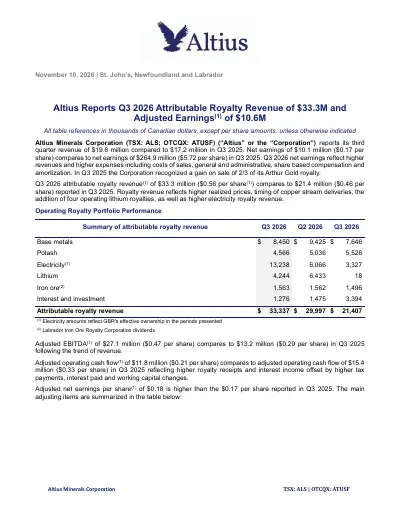
Thank you, Flora, and good morning, everybody. Yesterday, we reported Q3 net earnings of $10.1 million, or 17 cents per share, reflecting higher revenues and higher expenses, including cost of sales, share-based compensation, and amortization, when compared to last year.
Earnings in the third quarter of 2025 reflected a gain on our partial sale of the Arthur royalty. Royalty revenue of $33.3 million, a record, and adjusted EBITDA of $27.1 million for the third quarter, reflect higher realized prices, timing of copper stream deliveries, the addition of four operating lithium royalties, as well as higher electricity royalty revenue.
Operating cash flow of $11.8 million reflects higher royalty receipts and interest income, offset by higher tax payments, interest paid, and working capital changes. Adjusted net earnings of 18 cents per share for the quarter was higher than Q3 2025, with the main adjusting items being foreign exchange and revaluation of derivatives.
During Q3, we announced a number of significant transactions, which we previously touched on in our Q2 call. On July the 21st, we closed a bought-deal public offering of 3 million common shares at a price of $60.50 per share, and received net proceeds of $174 million.
On July the 24th, we completed an amendment to our credit facility to upsize to $350 million from $225 million, replacing the previous term and revolving debt with a single revolver, with no principal payments required going forward. The debt balance outstanding of $87 million was transferred to the amended credit facility at closing, and maturity was extended from August 2028 to July 2030.
The corporation completed a drawdown of $100 million on the revolver at the end of July. On July the 30th, the corporation completed a share purchase agreement with Northampton and certain funds managed by affiliates of Apollo.
The purchase consideration paid by Altius was $167 million US, and it was funded through existing liquidity, consisting of cash on hand and debt. Altius increased its effective interest in Great Bay Renewables from 29% to 50% following the transaction.
Current total liquidity available to the corporation is approximately $500 million, and includes cash on hand, $163 million available under the revolver, as well as $150 million potentially available as an accordion feature, subject to certain criteria under the terms of our expanded credit facility. During the quarter, we paid total cash dividends of $6.1 million, and issued approximately 6,000 shares under the dividend reinvestment plan.
Yesterday, our board of directors approved a quarterly dividend of 11 cents per share, to be paid to shareholders of record on November the 30th, with a payment date of December the 15th. In August, we also renewed our normal course issuer bid, which will end no later than August 21st, 2027.
There were no shares repurchased under the NCIB in Q3. With that, I'll turn it over to Brian.
Brian Dalton
Thank you, Stephanie. Good morning, everyone.
Today, in addition to reviewing the quarterly results that we published last night, we also get to talk about a new acquisition. This morning, we announced that we've entered into an arrangement agreement to acquire TNR Gold.
The key features of the transaction, from our perspective, are the addition of a royalty on the advanced-stage Los Azules copper development project, and the consolidation of the remainder of a royalty interest we already partly held relating to the operating-stage Mariana lithium project. The Altius hallmark attribute that these assets have in common is large, very large resource endowments and all of the life extension and production rate expansion optionality that comes from that.
I won't take up too much time describing the transaction details, but do draw your attention to the release that just hit the wires. We're very happy to welcome TNR TNR shareholders to Altius, and to thank them for recognizing the enhanced strength and value that the combination offers both sides of the deal.
Turning now to the quarterly results, during Q3, we continued to integrate around our lithium royalty acquisition, and the increased interest we acquired in ARR, while also closing on an equity raise and the restructuring and expansion of our credit facilities, as Stephanie described. We also continued to be busy in expanding our PG equity portfolio and the longer-term royalty pipeline.
Subsequent to the quarter end, we announced a transaction to acquire a royalty on a development-stage potash solution mine in Saskatchewan. The team has been busy.
Our operating royalties performed well again in Q3 Q3, with revenues continuing to ramp up in line with or slightly better than our strong five-year growth outlook. We also continued to gain positive signals relating to a number of pre-production stage royalties that are keeping us optimistic that our revenue growth trajectory can extend well beyond our currently published outlook period.
In lithium, there were some ups and downs. Sigma experienced a period of production shutdown due to permitting-related challenges.
These have since been resolved, and the operation is back up and running and continuing to advance its stage 2 expansion. Core continued its restart work at Finniss, and is expecting first production during the current quarter.
Mariana, 3Q, and Goulamina continued to ramp up production levels and advance expansion planning and execution efforts. Lithium prices gave up a lot of their sharp earlier increases, and are arguably now back below incentivization levels, while demand growth continues to occur at a remarkably high rate, and inventories remain relatively thin.
In base metals, we note that Chapada had another very strong production quarter, while also breaking ground on construction of the infrastructure required for expanding operations and incorporating higher-grade ore from the new Sauva discoveries. Silvercorp continued on track with construction at Curipamba, while PFS work continued at Gunnison Copper.
Vale indicated that it is now exploring expansion options at Voisey's Bay following successful completion of the ramp-up of its two new underground mines. Base metal prices were generally stable during the quarter, in spite of heightened global economic and geopolitical volatility and uncertainty.
We saw a particularly strong quarter on the electricity front, with GBR, and in turn ARR, making its largest portfolio contribution to Altius to date. This was partly due to our increased ownership, but also reflected the continued commissioning of royalty projects that were developed both through our longer-lead-time developer investments as well as directly into operating-stage projects.
There continues to be a lot of growth activity occurring within the electricity generation portfolio, with 15 royalty projects currently under construction and expected to commission over the next couple of years. A significant share of GBR's revenue this past quarter has come through the financing of fully refundable interconnection deposits.
Pardon me. These deposit amounts are becoming increasingly burdensome for project proponents as grid authorities seek to winnow out connection request congestion.
By providing this capital on behalf of proponents, GBR allows them to instead focus their direct capital resources on project advancement. While GBR makes a spread over its own financing facilities' costs when providing these deposits, and maintains control over the refundability mechanics, its main objective with this business line is to drive royalty corporate development initiatives.
The hope is that as projects advance through interconnection queues and refundable deposits require replacement with non-refundable deposits, that we will be able to continue to support our partners with royalty-based capital into projects which at that point will have been de-risked from the key interconnection progress perspective. In potash, we heard continued favorable commentary from our operators, who are expecting record global demand this year and then again next, as well as constrained production and shipping abilities from major global competitors.
Prices continued to edge up in most regions. Each of Nutrien and Mosaic continued to describe the potential for low-cost production growth that could allow them to hold or grow market share as total demand steadily increases.
This ability to grow capacity incrementally remains solid for the next few years before more meaningful brownfields-type expansions will be required if market share is to be maintained. Subsequent to the quarter, we acquired royalty interests in a new potash mine project being advanced by Buffalo Potash.
This project employs new patented solution mine technologies that are intended to improve efficiencies relative to conventional solution mining. Buffalo has since commenced the introduction of solution to the targeted potash horizon in what is referred to as its initial production module.
Benchmark quality iron ore prices were down during the quarter, however this was offset by increases in premiums for higher-purity concentrates and pellets. IOC production also improved quarter-over-quarter, but continued to be relatively low as a percentage of nameplate capacity.
While significant investments in improving ore accessibility and equipment and plant performance are made across the operation, these investments have continued to result in IOC not paying equity dividends to shareholders, and hence, why our shareholder dividend being derived entirely from royalty revenue lately. Kami partners Champion, Nippon, and Sojitz continued to advance feasibility work and discussions with stakeholders.
We also heard good news concerning potential major hydroelectric agreements and development in the region that offered the potential to solve for that particular project design bottleneck. In Project Generation, the team was busy identifying equity-level deployment opportunities that mostly included royalty creation components as well.
This work is serving to continue to grow our longer-term royalty pipeline, and builds upon strong progress last year that was highlighted by the rapid advancement of the Arthur Gold project and our underlying royalty interest there. At Arthur, AngloGold Ashanti continued to advance its feasibility study.
They have stated that they are targeting decades of sustained production at approximately 500,000 ounces per year, while also noting that current exploration targets have the potential to substantially expand the district's annual production capacity. For those interested, I would here highlight a property tour presentation that AGA has recently published to its website.
The potential for additional growth and scale outlined within that presentation is the stuff of geologists' dreams. With that, let me turn it over to questions, but first let me once again thank my fellow team members for their incredible efforts.
You're the smartest, hardest-working team in the business, and it's an absolute privilege to work with you. Thank you.
Operator
Ladies and gentlemen, we will now begin the question-and-answer session. If you would like to ask a question over the phone lines, you will need to press * then the number 1 on your telephone keypad.
If you would like to withdraw your question, just press the * then the number 2. Again, that'll be *1 for phone questions.
If you want to submit your question over the webcast, you may do so by clicking on that question-and-answer panel, and enter your question and submit. Thank you.
We will be taking phone questions now. First question comes from Orest Wowkodaw from Scotiabank.
Please go ahead.
Orest Wowkodaw
Hi, good morning. Wondering if you could give us a bit more color on the acquisition from this morning.
The press release mentions, I guess an NPI on the Josemaria project, which I assume is part of the Vicuña District with Lundin/BHP. Can you give us some details on what the royalty is and what, say percentage of Josemaria it may cover?
I'm just not sure if it's just a sliver of it or if it covers the whole deposit. Thanks.
Brian Dalton
Hey Orest, yeah, it covers two, two claim units, I guess, within the overall land package. It doesn't actually cover any of the known mineralization, but the southeast corner of the Josemaria deposit basically touches right at that corner.
I would look at it as sort of longer-term optionality within the district, rather than it being something related to any of the known mineralization to date. Yes, it's a net profits interest royalty.
Orest Wowkodaw
Oh, I see. It's—
Brian Dalton
I would definitely call it lower priority than the other two assets we described in the presentation, but good longer-term optionality.
Orest Wowkodaw
I see. It's not part of the current reserves, resources, or mine plan?
Brian Dalton
Maybe just catches a corner of it.
Orest Wowkodaw
Got it. Then just, I like the fact that you're adding some more copper exposure here into the portfolio.
I'm just wondering also if you're seeing more opportunities out there that could be similar to this that, I guess could advance that copper exposure.
Brian Dalton
Some. We've got our own list of the projects that we think have a shot at coming into this market and solving for that deficit that we all see looming.
Some of those, particularly as they mount up for project finance, the indications we're getting are that there will be some cracks at some things there. Now, it's a question always as to whether or not those operators will try to stream byproducts versus the copper that we'd be interested in.
There is some stuff brewing. Obviously, there's lots of people dusting off studies and trying to get to the point that they're targeting investment decision dates, and that sort of thing, which obviously the first time we've seen that in more than a decade.
Orest Wowkodaw
Fair enough. Obviously we've seen Altius has been very active on the transaction front in the last year or so.
Should we anticipate that could continue through 2027?
Brian Dalton
Maybe. Other than, when we closed the Arthur transaction, we did feel, wouldn't call it pressure, but an opportunity to redeploy that capital into even more assets, and then things that are more probably along our more traditional commodity interest lines.
This one was more of an opportunistic thing rather than any kind of big concerted effort. I just like right now the growth optionality that's already embedded in the portfolio across current operating assets, or things that are under construction or that we think can get sanctioned.
If something really attractive comes along, sure, we'll be there. It's not an imperative by any means.
We're in really good shape for this market and what's coming.
Orest Wowkodaw
Excellent color.
Brian Dalton
Thank you.
Operator
The next question comes from Craig Hutchison from TD Cowen. Please go ahead.
Craig Hutchison
Hi, guys. Couple questions, just on the renewables royalty business.
Just with the change in political fortunes in the US here, do you guys see that as an opportunity for you guys? Obviously, Democrats were pretty pro-renewables.
That's the first question. Just, you mentioned your opening remarks around these interconnection deposits, obviously very lumpy kind of quarter-to-quarter, but how should we think about it maybe going into Q4, and is there any kind of expectations around that into 2027?
Thanks.
Brian Dalton
It's a good question. The change in the Congress that's coming, if it's going to be a tailwind or headwind.
Some would argue that, sort of the restraint that the data center industry is going to face might represent a longer-term decline in demand. I don't really buy that, because quite frankly, there was never any way to ever provide enough electricity for what was being touted anyway.
I guess more broadly, for sure, the Democrats are certainly leaned more towards— at least it's not a full-on assault on the industry like it has been, right? Now again, despite that, despite a full-on assault on the industry, in a really ironic way, this recent administration has probably done more for growth of the industry than any of the prior recent Democrat governments.
Who knows? I just know that the US needs so much new electricity generation overall, data centers or no data centers.
If you can get it on the grid, if you can connect to the grid, there's going to be somebody that wants to buy that power and help you finance your project. It's a busy, busy pipeline there.
Craig Hutchison
Just on the interconnection deposits, any kind of visibility into Q4 on that, or thoughts in terms of what we should kind of factor in going into next year?
Brian Dalton
Still lots of demand there. Again, I said it in the prepared remarks, there's the amount of those deposits has been ratcheting up pretty heavily as, really what's going on, the queues are just too congested, and so they're forcing deposits on developers.
It takes out some of the weaker, more speculative players, but there's real projects are really feeling the strain, I think, of having to put up that much deposit alongside of trying to continue to advance their project. No, the team's got a really good pipeline.
I don't know how sustainable that business is in the long haul at this point. It's going to be a function of how this interconnection congestion issue, how persistent that becomes and how much the system operators feel the need to continue to press back with these big deposits.
I don't see any let-off in it in line of sight. Again, it's a sort of a new thing, and we've got a really neat position there, and hopefully it leads to a lot more longer-term recurring cash flows through royalty deployments, but I just can't promise it right now.
For now, we're enjoying it.
Craig Hutchison
Thanks, Brian. Appreciate the color.
Brian Dalton
Cheers.
Operator
Your next question comes from John Tumazos from John Tumazos Very Independent Research. Please go ahead.
John Tumazos
Thank you for taking my question. Could you review the time table for the TNR assets, or which year you think each one will begin to report revenue?
Brian Dalton
Mariana is already in production, they're in ramp-up right now, so that should begin to flow very, very soon. The Los Azules asset, I can just basically just refer to what McEwen Copper has published.
They're targeting final investment decision in the middle part of next year, and they've described about a three-year construction window post-FID. They're targeting somewhere in 2030, and that would be a leachable operation.
From a revenue perspective, I think we'd be looking more at 2031, probably, for royalty revenue if their plan comes to fruition.
John Tumazos
Thank you very much.
Brian Dalton
Thank you for the question, John.
Operator
Your next question comes from Gabriel Chou from Woolfen Research. Please go ahead.
Gabriel Chou, your line is open. Please go ahead.
Gabriel Chou
Oh, sorry. I was on mute.
Apologies for that. I just wanted to go back to the renewable side.
Given the deep demand you're seeing, could you perhaps talk about the bottleneck or where you're seeing bottlenecks that would act as a sort of upper limit for the GBR growth?
Brian Dalton
That's kind of what GBR is designed to do, right, is find bottlenecks in the sector and to find ways to address them. Obviously, we all know the interconnection process is an absolute key bottleneck, and that's really just a function of the state of the grid right now.
Another one, though, would relate to, we've seen a lot of the tax credits starting to fade out, a lot of what's happening today is people rushing to beat those deadlines. Beyond that, that leaves a hole in the capital stack overall that's going to impair or certainly probably reduce the amount of tax equity that these projects see, so that gap will need to be filled somewhere.
We're pretty confident that our offering is going to be able to substitute very well for a chunk of that. Beyond that, it's the stuff that we all hear about.
It's just difficult to source equipment, everything from transformers to panels, you name it, there's just tightness and bottlenecks everywhere. It's generational-level increase in demand growth, and the system is straining all over.
It's everything really, there's bottlenecks and challenges everywhere, and that's our job, find solutions for it.
Gabriel Chou
All right. Then I'm just wondering that given, you just mentioned the capital hole, do you think there's more opportunities to allocate additional capital to that side, or are you thinking maybe—
Brian Dalton
I think royalty financing can substitute really well for tax equity here. I guess the flip side of that is, really, honestly, compared to a few years ago, what we see right now is that if you've got an advanced-stage project, you can pretty much name your duration for, even contract with, really high-quality counterparties for long durations.
That's obviously really supportive of the amount of leverage you can put on one of these projects. Still, I think really our job is to think about the equity side of the equation and the holes that are there and finding ways to substitute for that.
That is where we're getting a lot of traction right now, is where most of our discussions and term sheets are flowing around, is people that are thinking about ways they can optimize the equity returns on their projects with our capital.
Gabriel Chou
See. All right, I'll just leave it there.
Appreciate that then.
Brian Dalton
Thank you.
Operator
Your next question comes from Mac Well from ATB Cormark. Please go ahead.
Mac Well
Hi, good morning. Just could you remind us on Zijin's Tres Quebradas expansion, what's the timing on that expansion?
Brian Dalton
Maybe Ernie, you might want to step in on that one for me. I don't actually know if there's a timeline that's been published.
Ernie Ortiz
That's right, Brian. They haven't published a specific timeline, but recall from acquiring Neo Lithium to actually first production it was quite fast, between 2 and 1/2 to 3 years.
Based on what they're doing, it could be before the end of the decade that they're in first production for Tres Quebradas, and they are seeing efficiencies for phase 2, where the chemical plant is very likely going to be on the salar, it could be reducing costs as well as transportation. As Brian said, there's been no specific timetable, but based on what they did at phase 1, we think it could be before the end of the decade, and they are fully committed to Argentina and Tres Quebradas.
Mac Well
Okay. You mentioned there was some adverse weather, some rainfall, I guess, in the ponds.
Does that have a tendency to get worked through within a year, or is that something that can drag on production for longer?
Ernie Ortiz
Good question. I think what we'll see given the adverse weather patterns this year was with a much stronger El Niño, Rio Tinto and a few others in Argentina called out the adverse weather.
We'll see, but what is comforting to see is that they're still increasing output overall, and they have aims to expand, overall, that they're seeing some improvements. As far as when that gets ameliorated, we'll have to see.
Mac Well
Okay. Thanks.
While you have the mic, on Core Lithium, is there an expansion plan after this ramp-up?
Ernie Ortiz
I think over time, they do have expansion plans. If you recall originally, the DMS plant was 1 million tonnes of ore.
They are now specifically calling for 1.2 million tonnes of ore, and they do have plans for potentially expanding beyond that from what we gather and what's in the public domain. The ramp-up is going well.
Production started in the third quarter, and first shipment is on track for this fourth quarter. The team and I will actually be on site next week.
From our discussions, everything is ramping up smoothly, but they do have plans to potentially grow as the market continues to expand.
Mac Well
Okay. Great, thanks.
Those are my questions.
Operator
Again, if you would like to ask a question, please press * then the number 1 on your telephone keypad. Again, that'll be * then the number 1 on your telephone keypad.
There are no further questions at this time. I'll turn the call back over to Flora.
Flora Wood
Thank you, Vincent, and thank you, everybody, for joining us. Thank you especially for the great questions, and we'll look forward to talking to you again when we report our year-end results.
Brian Dalton
Thanks, everyone.
Stephanie Hussey
Thank you.
Operator
Ladies and gentlemen, this concludes today's conference call. Thank you all for participating.
You may now disconnect.