Allied Properties Real Estate Investment Trust
Q3 FY2026 · Earnings Call TranscriptOctober 29, 2026
Operator
Hello everyone. Thank you for joining us and welcome to Allied Properties REIT Third Quarter 2026 Earnings Conference Call.
After today's prepared remarks, we will host a question-and-answer session. If you would like to ask a question, please press star one to raise your hand.
To withdraw your question, press star one again. I will now hand the conference over to Cecilia Williams, President and CEO.
Please go ahead.
Cecilia Williams
Thanks, Pascal, and good morning, everyone. Welcome to our Q3 conference call.
Please note that certain statements we make during the course of this conference call that are not statements of historical facts may constitute forward-looking information and forward-looking statements about future events or future performance. These statements are based on management's current expectations and are subject to risks, uncertainties, and other factors that may cause actual events or results to differ materially from historical results and/or from our forecasts, including those described under the heading Risks and Uncertainties in our 2025 annual report.
Material assumptions underpinning any forward-looking statements we make include those described under the heading Forward-Looking Statements in our 2025 annual report. In addition, certain non-IFRS financial measures may be discussed on this call.
References to non-IFRS financial measures are only provided to assist you in understanding our results and performance trends and may not be appropriate for any other purpose. For further discussion on these matters, please refer to our 2025 annual report under the heading Non-GAAP Measures.
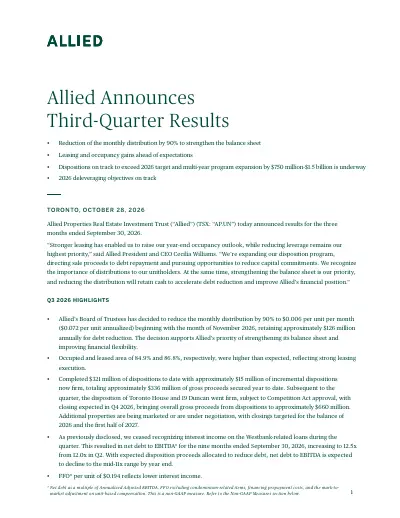
Turning to our prepared remarks before we take questions. Before discussing our quarterly results, I want to address our decision to reduce the distribution and expand our disposition program.
These actions will retain more cash in the business and accelerate debt reduction. We recognize that Allied's performance has been disappointing for our unitholders and that this distribution reduction adds to that disappointment.
We understand the importance of both the income you receive and the value of your investment. We're accountable for improving Allied's financial position, and these decisions are both difficult and necessary steps toward that goal.
Our priorities are clear: reduce leverage, streamline the portfolio, and convert our leasing progress into recurring cash flow. Moving to the quarter.
We're seeing encouraging momentum in our operating business. Leasing activity continues to strengthen, occupancy is ahead of our expectations, and our leasing pipeline continues to grow.
These are important indicators that demand for our workspace is improving and that the underlying fundamentals of our portfolio are moving in the right direction. JP will elaborate on that shortly.
The improvement in leasing has not yet translated into stronger financial results. There's a lag between signing leases and tenants taking occupancy and paying rent.
At the same time, the later timing of dispositions has kept interest expense elevated for longer, while lower interest income and reduced expense capitalization are also weighing on earnings. Together, these factors are driving the lower earnings outlook.
Our leverage remains too high. We need to reduce it while the cash flow benefit of our leasing activity builds.
That is why we're retaining more cash and accelerating dispositions. The distribution reduction will retain $126 million annually within Allied.
This additional cash will support debt reduction while preserving our capacity to meet the leasing and capital requirements of the portfolio. We're on track to exceed our 2026 disposition target of $500 million.
Between executed sales and firm agreements, we estimate year-end proceeds of approximately $660 million. With all proceeds directed at debt repayment, we remain on track to meet our year-end debt-to-EBITDA target of mid-11 times.
To continue reducing debt beyond 2026, we've increased our multi-year disposition program by between $750 million to $1.5 billion. As we select properties for sale, we'll balance near-term deleveraging objectives with strategic importance and long-term return potential.
Our objective is to reduce debt and concentrate our capital in the properties we believe offer the strongest future returns. We're increasingly confident in the earnings potential of the portfolio.
Our priority is to unlock that potential by putting Allied on a stronger financial footing. There are two other updates I'll address.
At 150 West Georgia, our priority is to maximize recovery of Allied's outstanding loan. Construction delays and ongoing discussions with an established operator have moved the expected resolution into 2027.
We're pursuing alternatives with our advisors and have retained Finnegan Marshall to monitor construction progress and costs. As construction advances toward completion, our objective is to provide greater clarity on the path to recovering our loan.
Next, King Toronto. We remain on track for completion in the second half of 2027, as previously disclosed.
We continue to work with advisors to ensure the project progresses as expected. I'll now turn the call to Craig for more detail on our financial results, outlook, and financing plan.
Craig MacIntyre
Thank you, Cecilia, and good morning, everyone. As this is my first earnings call as CFO of Allied, I want to start by saying how pleased I am to be taking on the role.
Over the past quarter, I've had the opportunity to work closely with our team, and I look forward to engaging more directly with our investors and analysts. I'm stepping into the role at an important point for Allied.
While operating fundamentals are improving, our financial position requires focus and decisive action. My priorities are clear: strengthen the balance sheet, reduce leverage, and improve the sustainability of our cash flow.
With that in mind, I'll focus my comments today on our third quarter financial results, our revised 2026 outlook, and the actions underway to strengthen the balance sheet. Starting with the quarter.
Our results reflect continued pressure on earnings even as the operating fundamentals begin to improve. FFO was $38 million, or $0.194 per unit, compared to $65.7 million, or $0.470 per unit, in the same quarter last year.
The year-over-year decline had three principal drivers. First, operating income was approximately $12 million lower, reflecting non-renewals, dispositions, and the lower capitalization of operating costs.
Second, interest income declined by approximately $9 million, as no new interest income was recorded on the Westbank-related loans in the quarter, as we had previously disclosed and had anticipated. Third, interest expense increased because the amount of interest being capitalized declined materially as development and upgrade projects were completed.
Before capitalized interest, gross interest expense actually decreased by approximately $4 million, or 9%, reflecting the reduction in our overall debt balance compared to the prior year. Turning to AFFO, the decline was more pronounced.
AFFO was $21.6 million, or $0.110 per unit, compared to $61.2 million, or $0.438 per unit, in Q3 last year. The decline reflects a higher volume of leasing costs associated with the increased activity in our portfolio.
Regular leasing expenditures were $10.5 million in Q3, compared to $1.7 million in the same quarter last year. While these leasing costs weigh on AFFO today, they drive higher occupancy and future cash flow as rents commence.
We expect a partial cash flow contribution from the leasing activity in 2027, with the full benefit reflected in 2028. In short, leasing and occupancy are improving, but that improvement has not yet fully translated into earnings.
Before turning to the outlook, I'll briefly touch on our investment property valuations. During the quarter, we recorded a fair value loss of approximately $39 million across investment properties and properties held for sale.
Within the investment property portfolio, valuation changes reflected update leasing activity, additional capital requirements, and selective adjustments to cap rates based on market evidence and recent transaction activity. Overall, valuation parameters were relatively stable during the quarter.
Turning to our outlook. We are updating our 2026 earnings expectations.
Starting with NOI, we now expect $300 to $305 million for 2026, compared with our previous outlook of $310 to $320 million. Relative to our previous outlook, the reduction approximately reflects a $4 million impact from the timing and increased volume of dispositions, a $2 million impact from the decaptalization of operating costs, and a $2.6 million impact from non-recoverable realty taxes that we had previously disclosed.
Turning to FFO, we now expect $170 to $175 million for the year, compared with our previous outlook of $185 to $200 million. In addition to the lower NOI I just described, the revision approximately reflects $3.5 million in higher interest expense, primarily due to disposition timing and lower interest capitalization, and $3 million of lower interest income, primarily related to the Westbank loans.
A meaningful part of the reduction in near-term earnings reflects the actions we are taking to reposition the balance sheet, including a larger disposition program. This distinction matters because our priorities are clear: reducing leverage and strengthening the balance sheet remain our highest financial priority.
That brings me to the balance sheet. At September 30th, net debt to EBITDA was 12.5 times on a nine-month annualized basis.
The increase from Q2 was primarily the result of lower EBITDA, as no interest income was recorded on the Westbank-related loans, while overall debt remained relatively stable during the quarter. This leverage level is far too high, and reducing it is our absolute financial priority.
Alongside the cut to the distribution Cecilia outlined, we are materially expanding our disposition program as a key tool to reduce debt. We have completed $321 million of dispositions and have firm agreements for approximately $340 million of additional sales expected to close in the fourth quarter, including Toronto House and 19 Duncan.
Together, completed and firm transactions represent approximately $660 million of gross proceeds, significantly exceeding our original 2026 target of $500 million. With additional dispositions expected to close before year-end and the proceeds directed towards debt repayment, we remain on track to reduce leverage to our mid-11 times target.
Getting there will be an important step, but it will not complete the work. We need to continue to be aggressive in bringing down leverage.
With that, we are extending and expanding the disposition program into 2027 and beyond, targeting an additional $750 to $1.5 billion of asset sales as part of a multi-year approach to further reduce leverage and optimize the portfolio. From a liquidity perspective, we remain well supported by multiple sources of capital.
Our recently extended credit facility provides significant capacity, while our substantial portfolio of unencumbered assets provides additional financing flexibility. These sources are complemented by our disposition program.
Together, this provides us with ample liquidity as we continue to delever and address our upcoming maturities. Our most significant upcoming maturity is $700 million of unsecured debentures in April 2027.
We currently expect to repay at least $350 million of those April maturities with disposition proceeds. Importantly, $350 million is not intended to be a ceiling.
As we continue to expand the disposition program, our objective is to use additional proceeds to further reduce the amount we need to refinance. We expect to refinance the remaining amount with either secured or unsecured debt, with a focus on the source of capital that provides us the most attractive pricing and terms available to us at that time.
As I close, let me reiterate our overarching financial priority: strengthening the balance sheet. Our objective is to bring down leverage meaningfully and quickly, preserve our investment grade credit rating, and address our upcoming maturities in a disciplined and proactive way.
That is why we are accelerating dispositions and it is why we are cutting the distribution, allowing us to preserve capital and retain additional cash to fund the business and accelerate deleveraging. We have clear objectives and we are taking necessary steps to achieve it.
This will remain at the center of our capital allocation decisions as we move through 2027. With that, I'll turn it to JP.
J.P. Mackay
Thanks, Craig. I'll start with our leasing performance and outlook, followed by an update on our leasing pipeline, and conclude with observations on market conditions, our leasing approach, and the strength of Allied's operating platform.
Starting with leasing performance. We are very encouraged by the strong and sustained momentum in our leasing program, as evidenced by: one, our continued outperformance in leasing market share; two, occupancy that continues to outperform our quarterly expectations; and three, a leasing pipeline that is now the largest since we began recording this metric, which is a positive leading indicator.
This momentum gives us greater confidence in the trajectory of occupancy. Based on leasing completed to date and ongoing negotiations, we are raising our year-end occupancy outlook to 86 to 86.5%, from 84 to 86%.
In Q3, we completed 7.6% of the total new leasing activity, while representing 5.5% of the total rental stock in the markets in which we operate. This underscores the quality of our portfolio and strength of our operating platform.
Equally encouraging, our total leasing pipeline has increased 49% since the beginning of the year, demonstrating continued improvement in operating fundamentals. Our portfolio continues to outperform the market in Montreal, Toronto, Kitchener, and Calgary, and our Vancouver portfolio is in line with the market because of higher vacancy in our Gastown submarket.
Our occupied and leased area in Q3 ended slightly higher than Q2, at 84.9% and 86.8% respectively, and ahead of the expectations communicated on our Q2 earnings call. Importantly, occupancy increased despite Sun Life vacating 56,000 square feet at our de la Gauchetière portfolio in Montreal, our largest known non-renewal of 2026.
In Q3, we completed 427,000 square feet of total leasing activity. 387,000 square feet of leasing activity occurred in the rental portfolio and 40,000 square feet occurred in the development portfolio.
Within the rental portfolio, 226,000 square feet represented new leasing, reflecting a conversion rate of 22%, and 161,000 square feet represented renewals. Leasing activity in Q3 was concentrated in our heritage workspace segment, which accounted for 70% of total leasing activity.
Our heritage and modern portfolios are 87% leased, and our flex portfolio is 79% leased. New leasing spreads in Q3, excluding our flex workspace segment, increased 3.4% when comparing the ending to starting base rent and 15.9% when comparing average to average.
Average total leasing costs year-to-date are $5.19 per square foot per annum, compared to $7.01 in 2025. Average leasing costs for new leases are $6.74 per square foot per annum and $3.77 for renewals.
As we grow occupancy and stabilize the portfolio over the next few years, we expect the aggregate volume of leasing costs to remain elevated. This does not reflect higher leasing costs per square foot, but rather the increased volume and velocity of leasing activity across the portfolio.
The composition of our leasing profile remains anchored by professional services and TAMI users, which collectively represented more than three quarters of the transaction volume in Q3. Our retention and replacement rate was 73.6% in Q3, in line with our forecast, and 72.6% year-to-date, slightly ahead of expectations.
Rental rates increased 2.8% on an ending to starting basis and 3.4% on an average to average basis, also in line with our forecast. As mentioned earlier, our largest known non-renewal in 2026 was Sun Life at our de la Gauchetière portfolio in Montreal, representing 56,000 square feet, which expired at the end of August.
We are in advanced discussions with a TAMI user to backfill up to 45,000 square feet of the Sun Life space, with lease commencement in Q4 or Q1. Looking ahead to 2027, our largest known non-renewal is SQI, a Crown corporation of the Province of Quebec at 747 Square-Victoria.
As part of a broader public sector consolidation, SQI returned 18,000 square feet in September and is expected to return approximately 55,000 square feet in December next year. Importantly, this is approximately 45,000 square feet less than we anticipated when we reported Q2 results.
We are already at the offer stage with a prospective user to backfill the SQI space in 2028. There are no material known non-renewals in 2028.
Lastly, sublease availability was unchanged quarter-over-quarter and is 2.7% of GLA. The weighted average lease term of space available for sublease is 6.2 years, which reduces the risk of indirect vacancy and loss of economic productivity.
We are pleased to report that after the quarter, we consented to a sublease for the remaining portion of the Shopify space at The Well. With this, the entire Shopify space at The Well is now subleased.
Moving to our leasing pipeline. Our leasing pipeline continues to strengthen.
We currently have 1.95 million square feet of activity underway, the largest pipeline since we began reporting this metric. This comprises 1 million square feet of new opportunities and 950,000 square feet of renewals.
Of the new activity, 515,000 square feet is at prospect stage and 485,000 square feet has progressed to the offer stage. Our total pipeline has increased 49% since the beginning of the year and 12% compared to Q2.
For context, our quarterly pipeline averaged 1.3 million square feet in 2025 and 950,000 square feet in 2024. Turning to market commentary.
The bifurcation of the office market is becoming increasingly pronounced. Premium assets near transit that deliver compelling workplace experiences continue to attract strong demand, supporting rent growth and moderating concessions.
Lower quality inventory remains under pressure and generally requires greater incentives to attract and retain users. We continue to see positive leasing momentum in our core concentrations of downtown West Toronto and downtown South Montreal, extending a trend that began in the second half of 2025 as tightening availability in trophy assets pushed demand into Class A buildings in and around the CBD.
In contrast, more peripheral submarkets generally remain challenged. Toronto's Bloor Street corridor and Liberty Village continue to lag downtown activity, while demand in Montreal's Mile End and Mile-Ex remains limited, despite our leasing success.
Kitchener remains slow as well. Vancouver presents a similar divergence, with Gastown and Yaletown lagging the financial district, while the Broadway Corridor experiences robust activity.
Calgary remains stable despite increased availability in the broader market resulting from M&A-driven consolidation in the energy sector. We continue to believe the path to market stabilization will unfold in two phases.
Phase one is underway and driven by higher physical utilization, flight to quality, and return to office mandates. Phase two will be driven by improved economic output and employment growth in office-using sectors, propelling further expansion and fostering demand from new entrants to the Canadian market that have been largely absent for five years.
Lastly, I'll discuss the steps we're taking to build on our leasing momentum and how the strength of Allied's operating platform is supporting those efforts. In March, we introduced several initiatives designed to increase engagement with the brokerage community and reduce friction in the leasing process.
These included tour and commission bonuses for new leasing, as well as accelerated commission payments. At the same time, we introduced measures to make it easier for small and mid-sized organizations to lease space with us, including short-form gross rent leases, end-to-end construction oversight, and greater availability of built-out space.
These initiatives have been well received, as reflected in the growth of our leasing pipeline, and demonstrate our willingness to be flexible and responsive as we work to increase occupancy. The momentum in our leasing program also reflects the strength of our operating platform and our continued focus on user experience.
For the past seven years, Allied has retained Grace Hill KingsleySurveys to independently assess user satisfaction across our portfolio. Our 2026 results were very encouraging, with every performance indicator either improving or maintaining parity with the prior year.
Most notably, Allied's Net Promoter Score, a leading indicator for tenant retention and leasing activity, was 180% above the industry average. These results reflect the commitment of the entire Allied team to deliver exceptional workplace experiences.
We believe the combination of strong user satisfaction, improving market fundamentals, and a more flexible and responsive leasing approach positions us well to build on our leasing momentum and drive occupancy higher. I'll now turn the call back to Cecilia.
Cecilia Williams
Thanks, JP. Our focus is on execution: close the dispositions, apply proceeds to debt repayment, and converting signed leases into recurring cash flow.
We know confidence will be earned through results and we'll continue to report on our progress. With that, Pascal, we'd be pleased to take questions.
Operator
We will now begin the question-and-answer session. Please limit yourself to one question and one follow-up.
If you would like to ask a question, please press star one to raise your hand. To withdraw your question, press star one again.
We ask that you pick up your handset when asking a question to allow for optimum sound quality. If you are muted locally, please remember to unmute your device.
Please stand by while we compile the Q&A roster. Your first question is from the line of Jonathan Kelcher with TD Cowen.
Jonathan, your line is open.
Jonathan Kelcher
Thanks. Good morning.
I guess my question and follow-up will be on the Westbank stuff. First, just on 150 West Georgia, is Telus still at the table there?
If not, are there other interested parties in that property right now?
Cecilia Williams
Thanks for the question, Jonathan. I'm not at liberty to identify who's at the table.
I can just confirm that we are currently engaged with interested parties.
Jonathan Kelcher
Okay. Have those parties changed over the last six months?
Cecilia Williams
I know you're trying to get me to identify who it is, but I'm sorry, I'm just not at liberty.
Jonathan Kelcher
Okay. Then, I guess, as a follow-up, it said in the press release that you're pursuing opportunities to reduce capital commitments.
I'm assuming that relates to King Toronto. Can you maybe provide a little bit of color on that and maybe what something there could look like from a high level?
Cecilia Williams
My reference to that is really just to make it clear that we are looking at all alternatives to make progress in our near-term deleveraging efforts. I'm not going to get into specifics at this stage, but we will provide updates between quarters as we make progress on certain initiatives.
Jonathan Kelcher
Okay. Am I right to assume that it does relate to King Toronto?
Cecilia Williams
I don't think you should make any assumptions, Jonathan. Just understand that it is underlying our urgent desire to look at all alternatives to address our debt levels.
Jonathan Kelcher
Thanks. I'll turn it back.
Cecilia Williams
Thank you.
Operator
Your next question is from the line of Lorne Kalmar with Desjardins. Lorne, your line is open.
Lorne Kalmar
Thanks. Good morning.
Just wondering, with this enhanced focus on leverage reduction, what do you view as being sustainable long-term net debt to EBITDA level for the REIT?
Craig MacIntyre
Hey, thanks, Lorne. Craig here.
In terms of a longer-term target, at this point, we're not fixated on a specific range other than, obviously, we want to get back to a more sustainable level. When you look at an investment grade REIT, usually that's sort of in the sub-eight times range, but in terms of the timing to get there, it's going to take us time to get down from where we are today.
There's a lot of work to do in terms of the deleveraging, but from a just pure long-term sustainability perspective, something in the sub-eight range is certainly healthier.
Lorne Kalmar
Okay. Then just on the disposition program beyond 2026, was just wondering how you guys came up with the target range.
It's obviously pretty wide. If there are certain assets that are in mind for the disposition program or if everything's kind of on the table at this point.
Craig MacIntyre
I would say it's purposely wide range, Lorne, just in the sense that, obviously, we're looking at this over a multi-year period, all with the intention of trying to find ways to continue to bring down leverage. We want to maintain the ability to be flexible and that's why we're looking at it more as a multi-year plan as opposed to kind of putting out another kind of annual target.
Ultimately, we're not putting ourselves in a position where we want to be forced sellers by any stretch, and we're really looking at it as an opportunity to be flexible, but always with the opportunity to both delever and in some cases optimize the portfolio. In terms of the types of assets that we would consider selling, the focus is still going to be on trying to sell more of our sort of non-core and non-strategic assets.
I think if you look at what we sold this year, they would almost all meet that definition. We're aware that, in terms of being able to make progress and accelerate, there may be certain opportunities where we need to sell select more core and strategic assets, really where there's an opportunity to drive good pricing and good deal economics.
No asset is necessarily off the table. We're looking at the whole portfolio, but obviously the focus here is still making sure that we're left with a portfolio that we want to operate long term.
Lorne Kalmar
Perfect. Thanks so much.
Operator
Your next question is from the line of Frederic Blondeau with Green Street. Frederic, your line is open.
Frederic Blondeau
Thank you and good morning. Just want to discuss the Westbank loans that accounts now for 30% of your current market cap and the REIT, as is exposed to $1.5 billion debt maturities over the next two years.
Dispositions will have a limited impact here, especially when asset values continue to be written down. From a capital allocation strategy, how is bailing out the developer a prudent strategy here?
What are your views and what is the ultimate goal here?
Craig MacIntyre
I would say, Frederic, in terms of the upcoming maturities, the dispositions will have quite a meaningful impact on our ability to repay. As it sits today, we're looking at repaying about $350 million of the $700 million coming due with the dispositions where we have line of sight.
I would perceive that more as a floor. Our intent is obviously to repay more of that $700 million.
I would say that the cut to the distribution will help a little. Then, obviously, into the following year for 2028, there'll be more proceeds from the distribution cut as well that will help pay that debt.
With a combination of both disposition proceeds and the cut to the distribution, we're not really relying on these loans at the moment to fund our upcoming maturities.
Frederic Blondeau
Okay. Back to my question, how is bailing out the developer fits into your capital allocation strategy today?
Look,
Craig MacIntyre
our intention here is to maximize the proceeds that we're getting back on these loans. In terms of 150 West Georgia, we believe the best approach to that is to work with our partner to facilitate a transaction with a proven operator at this point.
We believe that's the best way for us to maximize the return of our loan proceeds.
Frederic Blondeau
Got it. Then as a follow-on, given where the stock is trading at this point, especially this morning, what would be your thoughts on a more formal potential strategic review?
Cecilia Williams
On a strategic review? Sorry?
At this point, we're always assessing all of the strategic alternatives available to us. If you mean specifically a sale of the company, now is not the time to pursue that.
We would not achieve value for our unitholders.
Frederic Blondeau
Okay. Thank you.
Operator
Your next question is from the line of Brad Sturges with Raymond James. Brad, your line is now open.
Brad Sturges
Hey, good morning. I guess similar to the first questions, but I'll ask it differently.
Obviously, you're framing the urgency around the deleveraging program and all options on the table, where would pursuing another equity recapitalization fit into that strategy among the alternatives of asset sales in order to sort of accelerate that debt repayment plan and maybe give you some flexibility on the operations?
Cecilia Williams
We're not pursuing an equity raise. It's not anywhere on the horizon.
Brad Sturges
Okay. Appreciate that.
Then just in terms of the increase in the occupancy target, obviously, you highlighted some of the drivers there. Just wanted to clarify if asset sales or changes in PUD would be impacting those occupancy numbers for the end of the year.
Craig MacIntyre
Brad, no, year-to-date, transfers have impacted occupancy favorably by only 20 basis points.
Brad Sturges
20 bps. Okay.
Last question, just Shopify, good to hear that that's been subleased. Any further context you can give in terms of the sublease term or the type of users in the space?
Craig MacIntyre
Brad, we're really excited to share more. Unfortunately, we just can't today, but we will certainly do so as soon as we can.
I'll just conclude by saying we are absolutely thrilled with the outcome.
Brad Sturges
Okay. Thank you.
Cecilia Williams
Thanks.
Operator
Your next question is from the line of Mario Saric with Scotiabank. Mario, your line is now open.
Hi,
Mario Saric
good morning and thank you for taking the questions. My first one is just coming back to King Toronto.
It was good to see the target completion date unchanged. That said, from an overall organizational risk assessment perspective, should the REIT fail to deliver the condos on time, can you maybe talk about the financial implications and kind of the recourse to the broader REIT versus the project itself?
People are generally concerned in terms of what the exposure is on this site. In terms of providing clarity on what that maximum exposure could be, I think would be helpful.
Thank you.
Craig MacIntyre
Hey, Mario, it's Craig. Look, King Toronto remains sort of firmly on track from a timing perspective and based on our current projections.
I think what you're referring to is the outside Tarion date, which would be in May of 2028. Our expectation is to deliver the units in advance of that timing.
That's kind of where we're focused right now, and we're comfortable kind of with the current cost and the timing projections we've got in hand.
Mario Saric
Right, but to the extent that those projections prove optimistic for unforeseen circumstances, has a risk assessment process been done to determine what the exposure is to the REIT?
Craig MacIntyre
At this stage, Mario, our focus is really just on pushing the project forward and making sure that we meet the deadline. Obviously, in the instance where that deadline would be missed, we would have to be back to the drawing board in terms of how we're approaching both the sales of the project and the overall impact.
From our perspective, like I said, we're focused on pushing the project to completion and making sure that we're delivering on the timeline.
Mario Saric
Okay. Then just maybe a couple of follow-ups on the target dispositions post-'26, the $750 to $1.5 billion.
In terms of the target or the IFRS disposition cap rate, presumably you have an idea of what those assets could look like. What would the estimated IFRS cap rate be at the $750 versus the $1.5 billion today?
Craig MacIntyre
Mario, I'm not sure at this stage it would be kind of a materially different cap rate between the two. Obviously, we're still working to identify potential assets for sale, but I think if you were to look at kind of the blended cap rate of the overall portfolio, it's a good indicator of where we think we would be able to execute on some of these deals.
I think recent transactions that we've been executing have been kind of well in line with our IFRS fair values.
Mario Saric
Got it. My last really quick one, on the receivable provision to date of the $172 million that's been taken, can you share how much of that relates to 150 West Georgia?
Craig MacIntyre
At this stage, it relates to King Toronto primarily.
Mario Saric
Okay. Thank you.
Craig MacIntyre
Thanks, Mario
Operator
next question is from the line of Matt Kornack with National Bank of Canada Capital Markets. Matt, your line is now open.
Matt Kornack
Good morning, guys. Just with regards to free cash flow, obviously these moves improve your cash flow retention.
Is it fair to say, I know you're going to sell assets and things will move around, but with this move that you've made yesterday, that you're retaining about $60 to $70 million in cash flow a year?
Craig MacIntyre
Matt, at this stage, I wouldn't want to put out a target, a future-looking target on cash flow retention. What I would say is that the full intention of the distribution reduction is so that we're retaining more cash and then ultimately using it to repay debt.
In terms of a run rate, too early for us to say, honestly, because, like you said, there's a meaningful amount of dispositions that we've got in the pipeline as well.
Matt Kornack
Fair enough. Then these moves are credit-positive at the end of the day, regardless of the fact that you're starting with a higher leverage base.
Have you kind of engaged with the rating agencies and some of your stakeholders on the bond side? We're talking as if you need to repay every dollar of debt, but in actuality, you can probably mortgage or get unsecured debt for funding the business on an ongoing basis.
Could you give us a sense as to how those discussions are going and your thoughts on kind of using the disposition proceeds to repay what type of debt, mortgage or unsecured debt at this point?
Craig MacIntyre
Matt, great question. Look, from our perspective, maintaining the investment grade credit rating is a top priority, regardless of the type of debt that we will continue to look to source.
We have got an ongoing and constructive dialogue with DBRS, and they're aware of the plans and obviously our deleveraging trajectory and kind of how we intend to approach our 2027 maturities. Importantly, the actions we're taking today, which you've highlighted, are being perceived as proactive.
The distribution reduction, the expanded disposition program, they're us taking that more aggressive kind of front foot in terms of the deleveraging. In terms of looking at the types of debt we would use on a go-forward basis, just as it sits today, secured debt is sort of meaningfully more attractive right now as it relates to unsecured.
There's anywhere from sort of a 50 basis point gap in pricing between secured and unsecured. Truthfully, the demand for what I would say high-quality office in the secured space is at really, really high levels, and what's intriguing for us is that it's in terms that is greater than five years as well.
The ability for us to potentially raise a pretty decent amount of secured financing for terms longer than five years and likely do so at more attractive pricing than a five-year unsecured bond is a really attractive thing for us and something that we're kind of well underway investigating at this point.
Matt Kornack
Okay. Interesting.
Then, just maybe shifting gears, we haven't talked about it, but occupancy actually did move up on an in-place basis. It does seem like things are stabilizing.
Could you give us a sense as to kind of what tenants are saying? Then maybe broader, because I think there's some concern around what AI will ultimately do to office jobs and all of our jobs.
If there's any sense in terms of discussions around that when you're talking to tenants about taking office space, that'd be great.
J.P. Mackay
Matt, we haven't seen any negative impact from AI on our leasing activity. In fact, we've seen a net positive impact as there are more and more AI or AI-adjacent firms seeking space in our markets.
We're encouraged by that near-term leasing trajectory. Of course, there are questions with respect to the longer implication of AI on office-using employment, specifically around automation versus augmentation, the former having more of a detrimental impact on office-using employment, and we continue to evaluate the medium- to longer-term risks.
In the near term, we are seeing a net positive from AI. With respect to the broader market and our raised outlook, we are really encouraged by the strength of our leasing pipeline and the diversity of the prospect base across the country.
What's even more encouraging is a lot of our demand is coming from existing users who are expanding, and so we are negotiating in an environment that's not competitive, meaning there is not a competing landlord providing an alternative for that user as they're an incumbent tenant within our portfolio. We're really encouraged by the increased expansion activity we're seeing.
We're currently pursuing some of our largest expansions that we've pursued in recent years alongside long-term renewals, and when we evaluate expansion activity relative to contractions this year, there's a net positive absorption of approximately 87% 87,000 square feet year-to-date, and we certainly expect that to increase in the near term. We're really encouraged, Matt.
I've never been more optimistic on the state of our leasing program in the context of the past five years as I am today.
Matt Kornack
That's good to hear. Maybe quickly, just follow on to that, can you give us a sense as to maybe the industry, sorry if I missed it, of the tenant that's taking the remaining Shopify space?
Then, maybe broadly, are you starting to see some of the excess demand from downtown cores spill out into the east and west side of Toronto and your portfolio more broadly?
J.P. Mackay
Matt, I'd love to share more about the counterparty. I just can't right now with respect to the Shopify sublease, but as soon as we can, we will.
I'll just reiterate how pleased we are with the outcome there. I do think that that sublease is a reflection of what you've just described, the continued expansion of the demand radius from the core in Canada's urban centers into the periphery, much of which is driving the sustained growth in our leasing pipeline.
You're absolutely right. That growth persists and continues to benefit Allied's portfolio in particular, given the concentration of assets we have in and around the CBD in our markets.
Matt Kornack
Okay. Thanks for the update.
Operator
Your next question comes from the line of Dean Wilkinson with CIBC. Dean, your line is now open.
Dean Wilkinson
Thank you. Good morning.
Just going back to a question that's kind of been passed over a few times here. On the disposition increase, could we expect that there is probably going to be an impact to the implied occupancy levels as a result of that?
Or another way of asking the question, is it going to be the higher-vacancy assets that you're going to look to sell, where maybe there's some value add and sort of shore up the portfolio?
J.P. Mackay
Dean, year-to-date, transfers have had a 20 basis point impact on occupancy, they have not had a material impact on the growth in occupancy. Longer term, we will continue to identify lower-yielding assets that we can sell to support deleveraging on an accretive basis to FFO.
As Craig alluded to earlier, we are focused on deleveraging and are prepared to evaluate all options within our portfolio. There is no asset that's off-limits in our portfolio to support our ongoing efforts to delever.
Craig MacIntyre
Dean, I would only add that occupancy is not going to be the driving factor for our disposition program.
Dean Wilkinson
Got you on that. Sort of crystal ball look out a couple of years, where do you think sort of the ultimate occupancy, sort of the bogey is, can we see this portfolio go back to, say, the 2017, 2018 kind of days, or is it somewhere in between where we are in that figure?
J.P. Mackay
For the time being, Dean, we remain committed to our three-year outlook, and we will provide updates to it as appropriate. In the interim, we're focused on our near-term execution and really pleased with the velocity of leasing within our portfolio across all markets.
Dean Wilkinson
Fair enough. Thanks, guys.
Operator
Your next question is from the line of Pammi Bir with RBC Capital Markets. Pammi, your line is now open.
Pammi Bir
Thanks. Good morning.
Maybe just piggybacking off that last question, for 2027, I think you had previously put out a target of 86 to 88% occupancy on an in-place basis. Are you still comfortable with that?
I think, JP, your commentary on this being the strongest leasing, I think you've ever seen in the last five years in the portfolio. Just curious if you think that is still achievable.
J.P. Mackay
Pammi, we look forward to updating our outlook for 2027 when we release our Q4 results in the new year. In the interim, we're focused on our outlook for 2026 and pursuing it.
Pammi Bir
Okay. Maybe coming back to the disposition outlook, the $750 to $1.5 billion, how much of that do you think you could actually transact on over, call it, the next few quarters, or even maybe the next year?
I'm just curious if you have a sense of where, as you kind of prepare your budgets, where leverage should trend or where it could get to by, call it, the end of next year as well.
Craig MacIntyre
Hey, Pammi, it's Craig. I would say the intention of it being described as a multi-year program here is so that we avoid putting out kind of an annual view or a quarterly target at this point.
Obviously, the intention here is for us to move with pace and move with urgency, we're going to be looking at this and moving this along quickly. We're not going to be in a position where we want to be putting out more near-term targets, ultimately because we want that flexibility when we're selling assets to not feel like we're being forced into selling assets, and we want to be able to make sure that we're driving the appropriate pricing.
It's really about how we're managing that relative to our deleveraging objectives. Ultimately, our deleveraging objectives, mid-11 times by the end of this year, and then kind of mid to low 10 times by the end of next, those are still kind of where we're at, but ultimately the intention here is to move fast.
Pammi Bir
Okay. I guess again more so in terms of an outlook perspective, but from a G&A and interest standpoint, you're still capitalizing sizable amounts here, I'm just trying to sort of reconcile how we should think about that in 2027, and should we expect those capitalized amounts to continue to drop off, clearly that's obviously contingent partly on the development pipeline, but just trying to get a better sense of what that could look like.
Craig MacIntyre
Pammi, it's obviously dropped off pretty materially. I would say it'll continue to drop off.
When we come out with 2027, more detail on 2027 in Q4, we'll be able to give you a bit more clarity on kind of where we think that will run.
Pammi Bir
Then maybe coming back to 150 West Georgia, you mentioned earlier you're pursuing alternatives there. Just trying to understand what that might entail, and at this stage, or at some point, let's call it in the next quarter or so, is it a possibility that $270 million loan to Westbank is impaired?
Cecilia Williams
There is a possibility of that, yes, but we don't see that today.
Pammi Bir
Okay. Lastly, maybe just on King Toronto, any changes at all in terms of the default rate assumptions?
Maybe if you can remind us where those sit today in terms of the potential defaults on buyers closing?
Craig MacIntyre
Pammi, at this stage, there's been no change to the default assumption. We've got a sales team that's been well stood up and is interacting with existing buyers at this point, and nothing really to note other than no change.
Pammi Bir
Would that level still be, call it, 35%?
Craig MacIntyre
30%.
Pammi Bir
30?
Craig MacIntyre
30, yes.
Pammi Bir
Yeah. Okay.
Thanks very much, all. I'll turn it back.
Cecilia Williams
Thank you.
Operator
Your next question is from the line of Mario Saric with Scotiabank. Mario, your line is open.
Mario Saric
Hi, thanks. Just one more quick one for me.
On 19 Duncan and Toronto House, based on the disclosure, looks like those will be sold for about $325 million. How much of $37 million fair value write-down in this quarter would be attributed to those two assets, if any of it?
It's a little.
Craig MacIntyre
In this quarter, it's roughly $10 million.
Mario Saric
Sorry, Craig? $10 million?
Craig MacIntyre
It's roughly $10 million, yes.
Mario Saric
Okay. Are you able to share what the blended cap rate would be on the $325?
Craig MacIntyre
On the $325, on sort of call it in place today, it's sub-four, and then given some of the recent leasing at 19 Duncan, if you factor in some of the recent leasing, it's in and around the four cap.
Mario Saric
Okay. Thank you.
Operator
Your next question is from the line of Matt Kornack with National Bank of Canada Capital Markets. Matt, your line is open.
Matt Kornack
Hey, sorry guys, just a quick follow-up. Mario's question made me remember.
When you generate a loss within the REIT structure, presumably you can carry that forward, but how should we think about the accumulated potential losses and the benefit on the tax side? Is there any benefit to becoming a corp at some point or have you thought about any of those tax consequences?
Craig MacIntyre
Matt, we haven't gone down that road at this point, but I would say, yes, given some of the losses, we have some flexibility. This is part of the rationale around the distribution cut as well.
Matt Kornack
Okay. Fair enough.
Thanks.
Operator
This concludes our Q&A session. I will now turn the call back to Cecilia Williams for closing remarks.
Cecilia Williams
Thank you for your questions today, and we welcome the opportunity to continue to engage further. Thank you.
Operator
This concludes today's call. Thank you for attending.
You may now disconnect.