Aecon Group Inc.
Q3 FY2026 · Earnings Call TranscriptOctober 30, 2026
Operator
Good day, and thank you for standing by. Welcome to the Q3 2026 Aecon Group Inc.
earnings conference call. At this time, all participants are in a listen-only mode.
After the speakers' presentation, there will be a question-and-answer session. To ask a question during the session, you will need to press *11 on your telephone.
You will then hear an automated message advising your hand is raised. To withdraw your question, please press *11 again.
Please be advised that today's conference is being recorded. I would now like to turn the conference over to your speaker for today, Adam Borgatti, Senior Vice President of Corporate Development and Investor Relations.
Please go ahead.
Adam Borgatti
Thank you, Lisa. Good morning, everyone, and thanks for participating in our call today.
Joining me are Jean-Louis Servranckx, President and CEO; Jerome Julier, Executive Vice President and CFO; and Alf MacCallum, Senior Vice President, Finance. Our earnings announcement was released yesterday evening and we've posted a slide presentation on our website which we'll refer to during this call.
Following comments, we'll be happy to take questions from analysts, and we ask that you keep to one question and a follow-up if necessary before getting back into the queue. As noted on slide two of the presentation, listeners are reminded the information we're sharing with you today includes forward-looking statements based on assumptions that are subject to significant risks and uncertainties.
While Aecon believes the expectations reflected in these statements are reasonable, we can give no assurance that these expectations will prove to be correct. Turning to slide three, I'm pleased to share key highlights and accomplishments from the quarter.
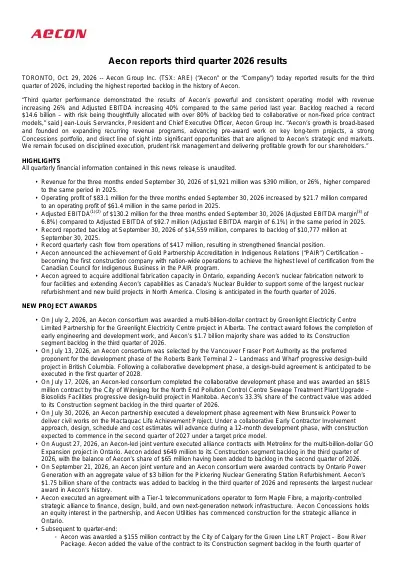
Aecon delivered record quarterly revenue of $1.9 billion, increasing 26% over the same period last year. 71% of the revenue growth in the quarter was organic.
Adjusted EBITDA improved significantly in the quarter to $130 million compared to $93 million last year, an increase of 40%, driven by strong revenue growth and year-over-year margin improvement in the construction segment. Aecon was awarded contracts in joint ventures with an aggregate value of $3 billion for the Pickering Nuclear Generating Station refurbishment execution phase.
Our $1.75 billion share of the contracts was added to backlog in the quarter and represents the largest nuclear award in Aecon's history. The award, along with continued investments in fabrication capacity, reinforces Aecon's position as Canada's nuclear builder, supported by an established record of delivering complex nuclear projects across the full nuclear value chain.
Backlog at September 30th was $14.6 billion, up 39% over last quarter, representing the highest reported backlog in Aecon's history, and underpinned by a diversified mix of long-term projects with appropriate risk balance. Over 80% of Aecon's backlog is tied to non-fixed price or collaborative fixed-price contract models.
We're extremely proud to achieve Gold Partnership accreditation in Indigenous Relations status, becoming the first construction company with nationwide operations to achieve the highest level of certification. Building strong, respectful relationships with Indigenous peoples and communities has long been part of how Aecon operates.
This recognition reflects that history and our commitment to meaningful Indigenous partnerships. We also continue to advance our strategic priorities in concessions, including the launch of Maple Fiber, a strategic alliance to finance, design, build, and own next-generation network infrastructure.
Aecon reinforces its positive outlook, supported by the expectation for double-digit revenue growth for the full year 2026, based on our strategic positioning in sectors with attractive demand profiles, growing recurring revenue programs, and a healthy pipeline of project opportunities. With that, I'll hand the call over to Jerome.
Jerome Julier
Thanks, Adam, and good morning, everyone. I'll cover Aecon's consolidated results, review results by segment, and then address Aecon's financial position.
Turning to slide four, revenue for the three months ended September 30, 2026, of $1.9 billion was up $390 million, or 26%, compared to the same period in 2025. Adjusted EBITDA of $130 million increased 40% compared to $93 million last year, while operating profit of $83 million compared to an operating profit of $61 million in the same period last year.
The improvement in the period was driven by higher gross profit of $70 million compared to the same period in 2025. Adjusted diluted earnings per share was 86 cents in the quarter, an improvement compared to 49 cents in the third quarter of last year.
Financial results in the quarter were impacted by negative gross profit of $9 million from the legacy projects. The final legacy project reached substantial completion in June and commenced operations in July of this year.
Aecon and its joint operations partners continue to pursue commercial resolution on the matter. Backlog of $14.6 billion at the end of the third quarter is the highest reported backlog in Aecon's history and compares to backlog of $10.8 billion at the same time last year.
New contract awards of $6 billion were booked in the quarter and $10.1 billion was booked over the trailing 12 months. Now looking at results by segment, turning to slide five, construction revenue of $1.9 billion in the third quarter was $410 million, or 27% higher than the same period last year.
Construction revenue growth in the quarter was 72% organic and was broad-based with higher revenue in all sectors. The largest increase of $184 million was registered in utilities operations, driven by a higher volume of electrical, gas, and telecommunications work, including contributions from acquisitions completed in the first quarter of 2026.
Nuclear operations increased $130 million due to a higher volume of core refurbishment, decommissioning, and engineering services work at nuclear generating stations in Ontario and the United States. Revenue in civil operations increased $45 million, primarily from higher work volume on power and rail projects and in foundations work, partially offset by a lower volume of highway, road, and bridge construction activity.
In industrial operations, revenue increased $42 million, primarily from a higher volume of field construction work in the United States, with most of the revenue growth attributable to businesses acquired in the third quarter of 2025, as well as from an increase in the industrial components of power generation projects. Urban transportation solutions increased $9 million, driven by a higher volume of subway and commuter rail system work, partially offset by a lower volume on LRT projects that achieved substantial completion or became operational in 2025.
Turning to slide six, construction segment adjusted EBITDA of $132 million compared to $88 million last year, with an adjusted EBITDA margin of 6.8% compared to 5.8% in 2025. The increase was primarily driven by an improvement in gross profit margin in civil and nuclear operations.
More broadly, and as Jean-Louis will further discuss, the improvements reflect the continued shift towards a lower-risk work mix, stronger execution, and the gradual normalization of earnings as legacy project exposure winds down. Turning now to slide seven, concessions adjusted EBITDA for the quarter was $12 million compared to $15 million in the same period last year, largely due to the deferral of intercompany construction profit related to network assets under development.
Turning to slide eight, at September 30, 2026, Aecon held core cash and cash equivalents of $529 million, which is over and above the $537 million of cash representing Aecon's proportionate share of cash held in joint operations. In addition, at September 30, 2026, Aecon had committed revolving credit facilities of $1 billion, of which $342 million was drawn and $4 million was utilized for letters of credit.
Combined with our $960 million EDC Performance Security Guarantee facility, Aecon can access total credit facilities for working capital and letter of credit requirements totaling close to $2 billion. Net debt at September 30, 2026, was $338 million.
This includes only our core cash balances and also recognizes the $320 million repayment agreement for the preferred shares of Aecon Utilities as debt. The repayment continues to be anticipated to close in the fourth quarter of 2026.
Net debt to trailing 12-month adjusted EBITDA was 1.0 times. Aecon generated free cash flow of $645 million in the trailing 12-month period ended September 30, 2026, compared to -$41 million in free cash flow in the same period last year.
Cash performance was driven by relentless focus on working capital management and contract structure. At this point, I'll turn the call over to Jean-Louis to address our business performance and outlook.
Jean-Louis Servranckx
Thank you, Jerome. Turning to slide nine, Aecon continues to drive broad-based growth across our nuclear, civil, utilities, industrial, and urban transportation sectors.
In the third quarter, the construction segment generated record revenue with increases across all sectors. Power and utility services collectively represent 58% of Aecon's $6.4 billion in trailing 12-month construction revenue.
Nuclear is a key part of that position and a genuine differentiator for Aecon, Canada's nuclear builder. Our capabilities span engineering, in-reactor construction, nuclear-qualified fabrication and modularization, refurbishment, decommissioning, and new build in North America.
We are acquiring additional fabrication capacity in Ontario, which will expand Aecon's nuclear fabrication network to four facilities in Canada and the United States to support some of the largest nuclear refurbishment and new build projects in North America. Our concessions portfolio also continues to grow and diversify, leveraging our unique project development, financing, and integrated construction capabilities.
We recently launched Maple Fiber, a majority-controlled strategic alliance with a Tier 1 telecommunication operator to finance, design, build, and own next-generation network infrastructure. Aecon Concessions holds a majority interest in the partnership, and Aecon Utilities has commenced construction for Maple Fiber in Ontario.
Turning to slide 10, I want to spend a moment on the strength of our current positioning and the visibility we have into future growth. We ended the quarter with record backlog of $14.6 billion.
That backlog tells an important story, but it's really only part of the story. On the right-hand side of the slide, we show 10 major projects where Aecon is currently in development or collaborative delivery phases, but where significant future scope is not yet reflected in backlog.
In nuclear, for example, our backlog includes the recently announced Pickering Unit 5 refurbishment and full turbine generator replacement awards, while future opportunity associated with the refurbishment of Unit 6, 7, and 8 is not yet reflected. Similarly, at Darlington, Unit 1 of the new nuclear SMR project is under construction, while the future three units represent additional opportunity under development for work beyond our current backlog.
The same dynamic applies across other major projects and programs shown here, including the Cascade Advanced Energy Facility SMR, the hydroelectric Mactaquac Life Extension Project, the port and marine construction project at Roberts Bank Terminal 2 in Vancouver, the defense project for Arctic Over-the-Horizon Radar Phase 1, and the regional rail network GO Expansion program, where additional programs under development are opportunities to convert to new work over time. The backlog we do report is long-dated.
Approximately 2/3 extends beyond the next 12 months, and over 40%, or $6 billion, beyond 24 months. Taken together, our reported backlog represents only the fully contracted portion of a much broader portfolio of secured and developing work, providing significant visibility into future growth.
Turning to slide 11, trailing 12-month recurring revenue was over $1.1 billion at September 30th, 2026, with recurring revenue from utility services increasing to $987 million from $695 million last year, an increase of 42%. Importantly, this recurring revenue is also not reflected in our reported backlog.
Our MSA programs have a weighted average contract term of approximately three years and a near 100% renewal rate, providing significant multi-year visibility beyond the backlog we report today. Aecon Utilities is generating nearly $1 billion of recurring revenue today, with continued growth across Canada and the US.
It is an integral part of our growth platform, with capabilities spanning power, transit electrification, battery storage, data center electrical infrastructure, airports, and nuclear development. Turning now to slide 12, we have an unwavering focus on risk-adjusted profitability, highlighted by the relationship between our contract mix and our margin performance.
At September 30th, approximately 64% of our backlog was comprised of variable price contracts, which covers cost-plus or unit price work. Of the remaining 36% classified as fixed price, close to half of this was booked following collaborative and fully integrated development phases.
Taken together, approximately 81% of our $14.6 billion backlog is derived from collaborative model or non-fixed price work. On a trailing 12-month revenue basis, approximately 69% of construction revenue was generated from collaborative or non-fixed price contracts.
As our backlog converts into revenue over time, we expect the lower-risk profile of our backlog to continue to support greater predictability in our results. This evolution in our risk profile is particularly important when looking at margin.
This is the right part of slide 12. Construction trailing 12-month adjusted EBITDA margin has increased from 3.7% in the third quarter of 2025 to 5.6% today, while we have maintained a consistent lower-risk revenue profile throughout that period.
This slide 12 of our presentation is extremely important, and we'll come back to it probably during the questions. As we have said previously, our focus is on stabilizing and gradually improving margins.
We've done it, and are focused on driving further improvements in risk-adjusted profitability. Our strategic positioning in key sectors, lower-risk contract mix, stronger execution, and the continued wind-down of legacy project exposure provide a stronger foundation for more predictable performance.
Turning to slide 13, Aecon expects double-digit revenue growth in 2026. Our expectation for a broad-based revenue increase in 2026 and further revenue growth in 2027 is underpinned by secured backlog exceeding $14 billion, recurring revenue programs, recent acquisitions, and a pipeline of project opportunities tied to nuclear and conventional power, critical resource development, mass transit, water, defense, and digital infrastructure.
This clearly positions Aecon at the center of many of the infrastructure priorities Canada needs to deliver over the coming years, while our growing US and international presence provides additional diversification and avenues for growth. In the concessions segment, there are several opportunities to add to the existing portfolio of Canadian and international concessions in the next 6 to 12 months to support trends in aging infrastructure, mobility, connectivity, energy, and population growth.
Aecon's deliberate shift toward a greater weighting of improved risk-adjusted work programs, in combination with a strong focus on operational excellence, is anticipated to support the gradual improvement of adjusted EBITDA margins in the construction segment in 2026 and 2027. Our outlook for 2026 continues to be very positive.
We are excited about the momentum we have built so far this year and remain focused on fully executing our strategy to drive long-term shareholder value. Turning now to slide 14, I want to congratulate our Indigenous Relations team for achieving Gold Partnership accreditation in Indigenous Relations status.
This achievement reflects the dedication of teams across Aecon and the strength of the relationships we have built with Indigenous communities, businesses, and partners over many years. We are proud of what we have accomplished and invite our partners to join us in advancing sustained action with lasting benefits for generations to come.
In closing, I would like to thank our outstanding team at Aecon. In the quarter, over 14,000 team members across all our operating sectors delivered on our potential with an unwavering safety-always mindset and commitment.
We will now turn the call over to analysts for questions.
Operator
Thank you. As a reminder, if you would like to ask a question, please press *11 on your telephone.
You will then hear the automated message advising your hand is raised. We also ask that you please wait for your name and company to be announced before proceeding with your question.
One moment while we compile the Q&A roster. Our first question will be coming from Yuri Lynk of Canaccord Genuity.
Please go ahead.
Yuri Lynk
Good morning, guys.
Jean-Louis Servranckx
Morning. Morning.
Yuri Lynk
Just want to go back to the margin discussion, and if you could maybe go through some of the puts and takes on how the construction segment margin improves from here, particularly if you could address operating leverage, because there has been a notable increase in SG&A, and also if mix has anything to do with it.
Jean-Louis Servranckx
I'm going to begin on a general basis, and then Jerome will probably address the last point of your question. Obviously, we at Aecon, we have been patiently and steadily preparing for this moment and the path forward from here.
I used to give to my team the image of the way the helicopter pilots are being trained in the army. They have to get the left eye totally focused on the instruments, which is for us executing project per project the best we can, and the right eyes pointing 2 or 3 miles ahead, which is about our strategy.
It's exactly the same thing that we have at our management team level, at Aecon. We consider that we have acquired a strategic and unique positioning on the infrastructure market.
We have acquired a derisked project mix, which is very important, and that will give us a much better margin predictability. This page 12, as I announced it a few minutes ago, is extremely important.
If you see the four pure economic figures of the quarter, it means $1.9 billion of revenue, $130 million of EBITDA, a backlog of $14.6 billion, and a creation during the last trailing 12 months of $645 [million?] free cash flow, all this is linked together.
This page 12 is quite important. This 80%, 81% of non-fixed price contract or collaborative fixed-price contract is the global answer to your question, and it's quite important.
Jerome, maybe on the two, three additional questions? Can follow up, for sure.
Jerome Julier
On the margin profile, Yuri, in furtherance to what Jean-Louis just mentioned, margins are increasing when you include legacy projects, obviously as the losses increasingly move to the rearview mirror. If you exclude those losses, what we've seen is a stabilization of the construction margin profile, with the overall risk balance of the business improving.
I would describe that almost as the best-of-both-worlds situation. That was the objective across 2026.
Your question's focused on 2027 where we continue to see opportunities to enhance the margin profile that's informed by the work that we have in backlog and the embedded margins that we see there. I think one thing that's important is not to get ahead of ourselves.
Aecon's executing on a very broad and large, long-term portfolio of projects, with a very strong risk balance, and so we view these things as incremental improvements over time. Just say that the expectation is to be better, just don't want people to get ahead of themselves.
On the operating leverage, I make the observation that SG&A growth in the quarter, a quarter of it, roughly, was tied to incentive compensation, M&A costs, an ERP program implementation, and then additional SG&A from companies that we've acquired over the last 12 months. On that basis, there's a decent level of control there.
Some of this has to do with where you want to book costs, whether you pile them back up into gross profit where we've obviously seen a large expansion in margins or whether you maintain them in the SG&A bucket, which is what we do. At the end of the day, overall, we're seeing an increase in the operating profit margin or adjusted EBITDA profit margin, which I think is the indicator that you want to track against.
Then on the mix front, look, the overall execution mix that we have in front of us is balanced by client type, by region, by contract model, and by sector. That was the case in the last 12 months.
That's the case what we see coming in the future in the next 12 months, I wouldn't see mix as being a determinative factor here.
Yuri Lynk
Last just clarification question. Did I hear you say there was $9 million of legacy costs in the construction EBITDA this quarter?
Jerome Julier
That's right.
Yuri Lynk
Thanks, guys. I'll turn it over.
Jerome Julier
Thanks.
Operator
Thank you. One moment for the next question.
Our next question is coming from the line of Chris Murray of ATB Cormark Capital Markets.
Chris Murray
Please go ahead. Thanks, folks.
Good morning. Congratulations on probably a record backlog build.
Certainly, very positive, and as you noted, lots more to come. I know we're talking about a double-digit number, which I think was sort of expressed to me as higher than 11, less than 98, but I think that if we think about the level of growth that you're going to see over the probably the next call it decade, can you talk a little bit about your ability to manage that growth, both in terms of your staffing, both at the construction management level and also at the trade level?
Jean-Louis Servranckx
Yes, I think I can answer this. Obviously, we are extremely focused on our capacity to perfectly execute this backlog.
We have been investing during the last years a lot on operational excellence, recruiting, training, motivating our workforce at all level, bringing as much loyalty as we can in a rather hot market. We have been extremely cautious about the mix of our different activities between our different sectors.
You don't have the same people renovating tracks or building industrial facilities or working in the nuclear or laying part of electrical grids or pipelines. Those are different kind of people, and our balance of activity helps us on this one.
It just means that we do not see so far a danger in being able to perfectly execute our backlog.
Chris Murray
That's helpful. Then the other question is more around nuclear.
I guess we're expecting some sort of decision, I would think, towards the end of the year, maybe from Bruce, maybe from OPG. Can you explain or kind of lay out what would be involved, depending on what and how those decisions go?
There's also some debate about technology selection. Can you talk about your exposure to both CANDU and if they decide to go Westinghouse, how that would change?
Could you maybe elaborate a little bit on what you've acquired in the nuclear business in Ontario for additional support?
Jean-Louis Servranckx
We are not the one making the decision, obviously, but what is extremely important for us is the position we have been building in nuclear, where I think we are extremely strong. We are going to refurbish the totality of the 14 CANDU units in Ontario.
There is not one single general contractor, except Aecon—we are in association with AtkinsRéalis, who are a kind of different school—but not one single general contractor who has entered into a CANDU reactor for years. If the decision is for CANDU, obviously, we are extremely well-positioned.
This being said, we are also part of the team to build this small modular reactor number one, which is a GE Hitachi 300 megawatt boiling water technology. We are one of the only North American contractors who have fabricated already for Westinghouse their very important ASME III modules.
We are also in full steam ahead in our development phase of the Cascade energy project, which is another kind of reactor, Xe-100. It means that whatever the decision, because we are technology agnostic and because we have an incredible workforce at all level, this will obviously favor Aecon.
When I read Aecon Canada's nuclear builder, I tend to say Canada, the nuclear builder is Aecon. Fabrication is important.
It's one of the key success factor of the generation to come. It's about modularization.
SMR, I used to say, okay, it's small modular reactor, but it should be standardized modular reactor. It means that this is the key of success.
We are getting stronger and stronger. This is why we have been acquiring an additional facility in Ontario, maybe Jerome, you can speak a little bit about it.
This is why we are investing a lot in robotics, and this is why we're extremely focused on tracking all our productivity reports and leads day after day, because it's part of the future. Jerome, you want to speak a little about— Acquisition and fabrication capacity.
Jerome Julier
—acquisition and fabrication capacity? In the release, we announced that Aecon agreed to acquire additional fabrication capacity for the nuclear sector in Ontario.
Provide a little bit more detail on that. It's going to close in the fourth quarter.
Expectation is in the rough area of $50 million. We look to own assets that we view as kind of critical and strategic, and this would certainly be one of them.
The footprint on the facility is larger than our current Cambridge facility, which is continuing to operate and will continue to produce, by roughly 40%. It has additional acreage next to it and expansion capability as well.
These two facilities in Ontario, we have an additional leased facility where we're executing work, and then an additional facility that we have in the United States. Fabrication capacity is what we view as a differentiator for Aecon's nuclear capability.
Candidly, if we're going to meet the needs of what's required here, some of the work absolutely needs to be taken off-site just to manage peaking levels. That's four facilities on the nuclear side of the house, and then we have an additional two facilities on the industrial side, one in Alberta and then one in Texas, where we're also looking to expand.
This is all part of a long-term plan. Your first question was just around execution capacity.
We're thinking about it from a technology standpoint, we're thinking about it from a systems standpoint, we're thinking about it from a real assets standpoint, and as Jean-Louis mentioned, most importantly, we're thinking about it as people standpoint.
Jean-Louis Servranckx
Maybe I can add something on nuclear to close this question. Yes, the new build is important, but the real strong market for the years to come is what we call EPU, enhanced power uprate, or life extension of the reactors.
This is the best return for the utilities is to invest in their existing reactor. Just consider that for each reactor it represents something like $1 billion, more or less.
We are present, of course, through this major component refurbishment program in Ontario, but we are now deeper and deeper in United States on this submarket, which is extremely important. We have more than 1,500 workers in the nuclear industry in US at the moment.
It's quite important to highlight this point.
Chris Murray
That's very helpful. Thank you.
Operator
Thank you. One moment, please, for the next question.
Our next question is coming from the line of Michael Tupholme of TD Cowen. Please go ahead.
Michael Tupholme
Thank you. Good morning.
Jerome Julier
Morning. Morning, Mike.
Michael Tupholme
The first question is just around the outlook. You continue to call for further revenue growth in 2027.
Just given that we're nearing the end of the year here and given the strength of the backlog that you ended the third quarter with and the visibility that that gives you, is there any way to provide a little bit more detail around your expectations for top-line growth in 2027, how you see that evolving?
Jerome Julier
I'll tackle that one. Aecon doesn't provide guidance, but maybe I'll give you some of the underlying factors that can at least help you give a pretty reasonable assumption.
Out of the $14.6 billion of backlog, our expectations, roughly $5 billion will be executed in the next 12 months. In addition, we have something in the order of $1.1 billion of recurring revenue programs.
That's obviously in the LTM has been growing, expect that to continue to grow. Those two together gives you a number, $6.1 billion.
Aecon has a pretty strong history of one, growing the work program on the recurring revenue side, and then additionally securing additional work, and then additional change orders, and additional scopes on work that we have in progress as well. Historically, there's a broad range on these items, right?
If you kind of try to take somewhere like the P25 to P75, something in the $750 to $1.2 billion range, and that gives you an idea that there's something that probably crest the $7 billion mark.
Michael Tupholme
That's very helpful. Thank you.
Then just regarding the outlook, I guess as it relates to new awards, obviously, very strong backlog, record level. You talked in the prepared remarks about all of the various projects that are in the development phase, which give you some further visibility as those will eventually convert.
Can you just speak about the demand environment today as far as the conversations you're having for that next group of projects that could go into the development phase or future awards? I understand the backlog's strong, what you've already been awarded that you're working toward getting to execution, but sort of that next group of projects that's going to kind of feed future years, what are you seeing there as far as activity levels, discussions, pipeline, etc.?
Jean-Louis Servranckx
I will begin. Canada globally has decided to invest, and we have a Prime Minister who has just decided that it is focus for the years to come.
I would tend to say we are optimistic on our capacity to translate this development phase into execution of real projects. We have extremely strong team dedicated to those development phases, we think that the rate of translating it is probably going to be quite high.
I think it was the first part of your question. The second one was about equity?
Michael Tupholme
Sorry. Sorry, go ahead.
Jerome Julier
No, Mike, you can just clarify the second part.
Michael Tupholme
The second part was just it's really a question around the demand environment as it relates to the conversations you're having now that are going to feed into that next round of awards, whether those are awards that get going right away or other projects that enter a development phase for a period of time. I'm just trying to compare and contrast sort of what you're seeing now versus maybe what you would have seen 12, 18 months ago.
Again, I appreciate what you have secured and what you have in the development pipeline is already very robust. I'm looking at sort of other things that have yet to be awarded to you and how robust that looks.
Jean-Louis Servranckx
I think I've covered the answer. Probably in my life, I've not seen such a dynamic situation for infrastructure construction in the five years to come.
Michael Tupholme
That is helpful. I will leave it there.
Thank you.
Jean-Louis Servranckx
Right.
Operator
One moment, please, for the next question. Our next question is coming from the line of Sabahat Khan of RBC Capital Markets.
Please go ahead.
Sabahat Khan
Thanks, and good morning. I guess on the sort of the line of questioning around the backlog and the outlook in Canada that management's been commenting on, I guess, when you look at the pipeline of opportunities, we've all seen the headlines.
Are you sort of comfortable with this level of backlog and do you look at it as a relatively stable range even before some of those nation-building projects sort of start to get into the mix here? Just trying to think about the ability to sort of sustain it at these levels, and I think an optimistic way to look at it is it's at a reasonable level even before we get into the procurement for some of the larger stuff that could come over the next several years.
Just curious on how you're thinking about the pipeline of opportunities, and is it fair to assume much of the stuff we've been seeing in the headlines hasn't really even begun to make its way into the system yet? Thanks.
Jerome Julier
Yeah. I think you're thinking about it the right way, Saba.
Current backlog, clearly, there was just an exceptional quarter of conversion, with regards to backlog additions. We tend to take kind of the 1,000-yard view on this one, which is, backlog on any given period is going to be lumpy, and expectation of kind of a continuously high kind of book-to-bill ratio, exceeding three times.
If you look LTM to LTM, '24 to '25 or '25 to '26, we were at two times or 1.6 times. These are really astronomical levels, we're not really focused on the actual backlog number per se.
I think it's something that others are quite focused on. It's a helpful indicator of work to come, but I think we can say with a high degree of certainty, Aecon's got a comfortable level of work to execute in front of it.
On that basis, it's not kind of a daily thing to be tracked. That being said, could it flex up or down by amounts in any given quarter?
Yes. I don't think people should be focused on it, but given what we have in front of us with regards to projects in validation or development, we could see pretty chunky additions that could press the number upwards.
That being said, as you can see by the overall productivity of Aecon, we're also a business that can basically deliver a lot of revenue, which drives it down. I think on a quarter-to-quarter basis, it's really hard to tell where that's going to land, but I'd say just don't focus on it too much, but it's definitely a possibility to continue to move up.
Sabahat Khan
Thanks. Then just for my follow-up, just looking at the recurring revenue sort of just above the billion-dollar range, is this sort of a number that, given the I guess framework agreement, master service agreement nature of this work, this is something we can think about over the medium term, how do the adds to this sort of line item work?
Just trying to think of the growth outlook over the next few years. Should we just assume, look, recurring revenue back up to over a billion, probably a fair amount to think about when we look ahead sort of '27 and '28?
Thanks.
Jean-Louis Servranckx
I think you're right, and I think we spoke about it when we started. This $1 billion mainly is coming from utilities.
Mainly, those MSAs are 3 years duration, and mainly speaking, the rate of renewal is extremely high. It's superior to 90%, 95%.
Yes, it comes back naturally to the top line. Coming back to utilities, when you see you just realize the growth in terms of revenue, but also the quality, and the predictability of the margin to come in utilities, you probably understand why in Q2 2026, we decided to buy back Oak Hill share.
We negotiated it in Q2, and we are going to execute it in Q4. We had perfectly understood the trend that was coming.
Sabahat Khan
Thanks very much.
Jerome Julier
You're welcome.
Operator
Thank you. Our next question will be coming from the line of Frederic Bastien of Raymond James.
Please go ahead.
Jerome Julier
Hello, Mr. Bastien.
Frederic Bastien
Oh, thank you. Good morning.
Guys, your plans to expand fabrication capacity in Ontario builds on a purchase of a facility in South Carolina earlier this summer. Can you put some numbers around these investments, specifically, what was your fabrication capacity entering the year, and how much are you hoping to add with these two investments, and, in aggregate, where does that position you versus your North American peers?
Jerome Julier
Yeah. The facility in South Carolina is a facility that has nuclear qualifications, and supports programs that we're executing in the United States.
That facility was being leased, and as I mentioned, the strategic nature of fabrication in the kind of paradigm of what we believe comes next, it's just important to have full ownership over these types of assets. That facility plus the existing network, plus we have what we have in Alberta, something in the order of 300,000-plus square feet of fabrication capacity.
The new facility adds something in the order of 120,000 to 100,000, and so kind of pro forma, we're going to be just over 400,000 square feet of fabrication capacity. That excludes the office space and other items tied to it.
Money-wise, something in the order on gross CapEx basis for the new facility, $50 million, including some investments required to support additional craning. Then the facility that we bought in the United States, this wasn't a huge dollar amount, right?
Kind of low tens of millions, $10 or $15 [million?] , I can't remember the exact amount, but ended up being effectively a wipeout against what would have been on a leasehold obligation basis.
Frederic Bastien
I would assume that positions you right at the top in terms of fabrication capacity in North America, but maybe I'm wrong.
Jerome Julier
It depends. There's a lot of ways to look at it, right?
One way is, we believe in the scopes that we attack, it puts us in a very, very strong position, certainly in the markets where we are in a leading position. That being said, look, there's a lot of very high-quality fabricators out there who do structural steel, piping, additional items, right?
That's relatively broad markets. The big differentiation is the ability to do it under nuclear quality programs, right?
That is the barrier to entry. It's not easy, that requires systems, processes, experience, resume that just is not easily replicable.
From that basis, a lot of things can be built in a lot of different places. Off-site construction is clearly a long-term trend here.
We're seeing it across almost every single sector. It's really the number one release valve against capacity constraints, and so from our perspective, getting ahead of this wave, rather than trying to play catch-up, is the right way to do it given what we see in front of us.
Frederic Bastien
Great, that's very useful. Thank you.
Operator
Thank you. One moment for the next question.
Our next question is coming from the line of Maxim Sytchev of National Bank Financial. Please go ahead.
Maxim Sytchev
Hi, good morning, team. Jerome, I just had a brief one in relation to working capital.
Obviously, you freed up a lot in kind of Q3. How should we think about Q4 seasonality in terms of those moving parts?
Jerome Julier
I'm, Maxim, going to turn that one over to Alf MacCallum, our SVP Finance.
Alistair MacCallum
Hey, Max. Thanks for the question.
Our teams did a amazing job in Q3 of reducing our unbilled, resolution of a number of claims, achievement of a number of milestones, and also we've improved our contract management and advanced billing, so that really helped us in the quarter and also for the full year so far. Q4, as working capital can be lumpy, depending on the timing of payments, but I think Q4 be slightly positive, but it won't be what we saw in Q3.
Then, the one big thing, as in construction, you need a really strong balance sheet, I think, so far this year, we've really strengthened the balance sheet, and that sets us up for good growth going forward.
Maxim Sytchev
For sure. Makes sense.
Then, just overall, sort of thinking from sort of more structural perspective, given the amount of growth and given the type of projects you are doing, is there anything we should keep in mind in terms of kind of working capital intensity on a prospective basis, or should it kind of revert back to the sort of difficult projects sort of timeframe? How should we think about that on a prospective basis?
Alistair MacCallum
I think you're naturally going to see improved cash flow from our operations before working capital, just over the course of time with the improvement of EBITDA. Then, I do think that there's still a few opportunities to improve working capital next year, but it won't be at the size of this year.
Jerome Julier
Maybe, Maxim, the way we're thinking about it is, the third quarter's really like a shift in the overall level, right? Then now we want to try to operate more at this new level, just given the way that we're kind of managing the contracts and our turn
Maxim Sytchev
on receivables. That's great.
Thank you so much. Yeah.
Operator
Thank you. One one moment, we have a follow-up from Michael Tupholme of TD Cowen.
Please go ahead.
Michael Tupholme
Thank you for taking the follow-up. Just hoping to get a bit of an update on the Greenlight Electricity Centre contract you announced in early July, just in terms of, I know the project's just getting going, but sort of you can talk about where things stand right now, how we see that ramping up as you move forward.
Jean-Louis Servranckx
Okay. I will begin with a broader answer about power.
It was part of what we disclosed, the share of the power in Aecon activity is now around 58%. This is quite important because, in parallel with the size, the quality of the backlog, what I call the page 12 of the slide presentation, this shift toward power is very important.
A few years ago, we were principally a road and bridge company. We are now definitely a power company.
We will tackle the Greenlight project after, but you probably have noticed that the issue now around us, it's not anymore who can produce the most, but also who can keep energy flowing under stress. This is why our portfolio of power activities and the balance is extremely important.
We are strong in power generation. It may be nuclear, it may be conventional, it may be hydro.
We have also deliberately increased our strength in transmission and distribution. It may be in Canada and US.
You probably have noticed that during the last five to six years, all our acquisitions were about that. It's also about battery storage.
At the end of the year, we will have installed something like 1,000 megawatts of battery storage capacity in Canada. We are getting extremely strong in this.
To come back to power generation, we already tackled nuclear. That hydro is very strong, especially in BC for us.
Conventional, we decided that we had to be in this gas turbine submarket because there will be still a lot of activity within this market. It was one of the main reasons to acquire United 1.5 years ago, to get much more engineering strength.
We have been partnering on this Greenlight with TRC, Técnicas Reunidas, which is probably the best engineer in terms of track record for gas turbine. They have more than 35 of this kind of animals within their backpack already executed.
We like our client, ENMAX is a client that we know quite well. We are very comfortable because it's near Edmonton where we are strong in industrial.
All this just makes that the start-up of this project, which is now in terms of execution advanced at a few percent only and in terms of engineering reaching 40%, 50% of detail engineering, the start-up is extremely good and it's perfectly in line with what we were expecting.
Michael Tupholme
That's very very good color. Thank you.
Jean-Louis Servranckx
Right.
Operator
Thank you. One moment for the next question.
Our next question's coming from the line of Ian Gillies of Stifel. Please go ahead.
Ian Gillies
Morning, everyone.
Jerome Julier
Morning. Morning.
Ian Gillies
With the changes in regulatory framework being made in Canada, how are you guys feeling about the risk on project deferrals and the like over the next 12 to 24 months with so many new projects coming online?
Jean-Louis Servranckx
You probably have listened to the Prime Minister during the summit on Invest in Canada, this one-year rule and one gate to get approval. All this goes into the right direction.
We can obviously see, in terms of authorization to proceed, environmental assessments, and all kind of preparatory works, we can obviously see that it's getting better. Infrastructure projects are big animals, they are not all easy, but it's going into the right direction.
We are not that much worried with this issue as we were a few years ago.
Ian Gillies
That's helpful. Then, labor's tight in certain jurisdictions, immigration's reasonably low right now, things are ramping up.
When you look across the scope of services that Aecon provides, do you feel like there's any areas where you may need to beef up, whether through acquisition or really aggressive hiring? I'm thinking areas like electrical, mechanical, any sort of specialty services that could get tight based on the types of projects coming forward.
Jean-Louis Servranckx
Part of the answer is about the balance of our activity. As I've been saying, you don't require the same kind of people to do mining, installation on nuclear near Toronto, or some roads in Alberta.
This is a kind of parachute or resiliency insurance that we have. Second point, Aecon is an old company, I would tend to say.
I've been working in construction all my life. I've never seen this kind of loyalty from our workforce in favor of their company.
This is important, we are working a lot on it, because, yes, the market is tense. When you speak about aggressive recruitment, it's not exactly this.
Usually, the one who begin to work with Aecon try to go on working with Aecon during all their life, and this is what we are trying to promote. Now we know that at the federal level, at the provincial level, they are working a lot at the moment to increase the capacity of attracting and entering new labor within Canada.
That's good, at all level, project management staff, trades, and we are participating with the different levels and kind of governments to this discussion to be sure that we can have the necessary workforce in the years to come.
Ian Gillies
That's helpful. Thanks very much.
I'll turn it back over.
Jean-Louis Servranckx
Yeah.
Operator
Thank you. This does conclude today's Q&A session.
I would like to now turn the call back over to Adam for closing remarks. Please go ahead.
Adam Borgatti
Thanks very much, Lisa, and appreciate everyone's attention today. Welcome any feedback or questions that you may have post-call, and have a great rest of the day and into the weekend.
Operator
Thank you for joining today's program. You may all now disconnect.