Boyd Group Services Inc
Q3 FY2026 · Earnings Call TranscriptNovember 11, 2026
Operator
Good morning, everyone. Welcome to the Boyd Group Services Incorporated 2026 third quarter results conference call.
Listeners are reminded that certain matters discussed in today's conference call or answers that may be given to questions asked could constitute forward-looking statements that are subject to risks and uncertainties relating to Boyd's future financial or business performance. Actual results could differ materially from those anticipated in these forward-looking statements.
The risk factors that may affect results are detailed in Boyd's annual information form and other periodic filings and registration statements, and you can access these documents at SEDAR's database, found at sedarplus.ca, and EDGAR, at www.sec.gov. Boyd released its 2026 third quarter results before markets opened today.
You can access the news release, as well as the complete financial statements and management discussion and analysis, on the company's website at boydgroup.com. The news release, financial statements, and MD&A have also been filed on SEDAR+ and EDGAR this morning.
On today's call, Boyd will discuss the financial results for the quarter ended September 30th, 2026, and provide a general business update. We will then open the call for questions.
I'd like to remind everyone that this conference call is being recorded today, Wednesday, November 11th, 2026. I would now like to introduce Mr.
Brian Kaner, President and Chief Executive Officer of Boyd Group Services Incorporated. Please go ahead, Mr.
Kaner.
Brian Kaner
Thank you, operator. Good morning, everyone, and thank you for joining us for today's call.
On the call with me today is Jeff Murray, our Executive Vice President and Chief Financial Officer, and Steven Sobara, Vice President, Investor Relations and Capital Markets. During the third quarter, we continued to make solid progress across our business.
We expanded margins through the disciplined execution of Project 360 and the realization of acquisition synergies, while continuing to outperform industry volumes and generate positive same-store sales growth, supported by a sequential improvement in total cost of repair. We also launched a normal course issuer bid, reinforcing our commitment to a disciplined and balanced approach to capital allocation, with a focus on supporting our existing operations, strengthening our market position, and creating long-term shareholder value.
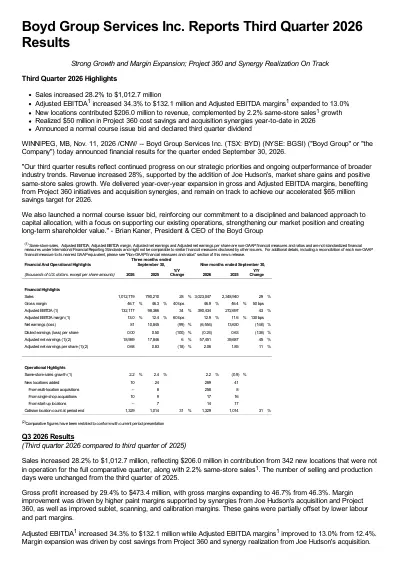
Revenue increased 28% compared to the third quarter of 2025, while adjusted EBITDA grew 34%, with adjusted EBITDA margins expanding to 13% from 12.4% last year. While I'm pleased with the margin improvement we've achieved this quarter, it's important to take a step back and look at the progress we've made since launching Project 360 in the fourth quarter of 2024.
Since that time, we've improved adjusted EBITDA margins by 230 basis points, reaching 13% this quarter compared to 10.7% in the third quarter of 2024. This progress reflects the benefits of several initiatives we implemented over the past two years.
In 2025, we introduced our indirect staffing model and made significant progress in bringing scanning and calibration services in-house. We continued building on that foundation in 2026, generating additional savings through indirect procurement and realized synergies from the Joe Hudson's acquisition ahead of schedule.
When we launched Project 360, we set a goal of delivering $100 million in cost savings between 2025 and 2029. With the addition of approximately $40 million in expected synergies from the Joe Hudson's acquisition, which closed in January, that target increased to $140 million.
Through the end of the third quarter, we've realized $90 million in savings, with another $15 million expected in the fourth quarter, bringing the total to an expected $105 million by year-end. Looking ahead, we expect to capture the remaining $35 million between 2027 and 2029, with a growing emphasis on using technology and AI to improve shop productivity, streamline operations, and drive further efficiencies across the business.
Turning to Joe Hudson's, as I discussed last quarter, we completed the conversion of its locations onto Boyd's systems in an accelerated manner. We now have greater visibility into the business's operational performance.
Our focus is now shifted to embedding Boyd's customer-centric operating model, including our successful WOW Operating Way and our regional management incentive structure across the Joe Hudson's locations. The sequential revenue trend versus the prior year improved during the third quarter, with positive momentum continuing into October as the locations progressed under Boyd's operating model.
These results support our confidence in their continued improvement and contribution to Boyd's long-term growth and profitability. Turning to industry conditions, third quarter claims data continues to point to a more stable operating environment, with repairable claims volumes estimated to be down 1% to 3% year-over-year.
As we've seen throughout 2026, industry conditions have improved compared to last year and remain broadly consistent with our long-term planning assumptions. We continued to outperform the broader market in the third quarter, generating 2.2% same-store sales growth, driven by higher volumes and modest improvement in total cost of repair.
Our continued market share gains reflect the strength of our insurer relationships, improving carrier performance, and broad regional market coverage. In October 2026, same-store sales remained positive, with continued volume growth supported by a sequential increase in total cost of repair.
As we've discussed previously, monthly performance can fluctuate, we remain focused on underlying trends over the longer periods rather than any individual month's results. I'll now pass the call over to Jeff, who will provide a more detailed analysis of our third quarter results.
Jeff?
Jeff Murray
Thanks, Brian. During the third quarter, sales increased 28% year-over-year to just over $1 billion, driven by $206 million of incremental sales from 342 new locations not in operation for the full prior year period and 2.2% same-store sales growth, as we continue to successfully outperform industry volumes during the third quarter.
During the quarter, Joe Hudson's locations contributed $170 million in total sales. Gross profit increased to $473 million in the third quarter, up 29% year-over-year, and gross margin increased 40 basis points to 46.7% from 46.3% in the third quarter of 2025.
The expansion in margins was driven by higher paint margins from acquisition synergies and Project 360 cost savings, as well as increased scanning, calibration, and sublet margins. This was partially offset by slightly lower labor and parts margins.
Turning to operating expenses, in the third quarter, operating expenses as a percentage of sales improved to 33.7% compared to 33.9% in the prior year. This improvement reflects acquisition synergies, cost savings from Project 360, and increased operating leverage from same-store sales growth.
If we look back to the third quarter of 2024, just before we launched Project 360, operating expenses were 35% of sales. Fast forward two years, and we've improved this ratio by 130 basis points, reflecting the success of Project 360 and, more recently, the additional benefits from acquisition synergies.
Adjusted EBITDA increased 34% to $132 million over the third quarter of 2025, while adjusted EBITDA margins expanded to 13% from 12.4% in the prior year period. During the third quarter, we realized approximately $15 million in combined synergies from Joe Hudson's and cost savings from Project 360, bringing the year-to-date total to $50 million.
Adjusted net earnings in the third quarter was $19 million, up from $17.8 million in the third quarter of 2025, as higher adjusted EBITDA was partially offset by higher depreciation expense and increased finance costs. Adjusted earnings per share was 68 cents in the quarter compared to 83 cents in the prior year period.
For the nine-month period ended September 30th, 2026, adjusted earnings per share was $2.06 compared to $1.85 in the same period last year. The company continues to expect maintenance capital expenditures to range between 1.6% and 1.8% of sales for the full year in 2026.
Additionally, capital expenditures associated with the Joe Hudson's acquisition remain on track at an estimated $30 million. As Brian mentioned, we launched a normal course issuer bid in September, providing us with additional flexibility in our capital allocation strategy.
During the quarter, we repurchased approximately $14 million of our shares, and we also declared our third quarter dividend. As at September 30th, 2026, our pro forma net leverage ratio was 2.9 times compared to 3.1 times at the end of 2025.
I will now pass it back to Brian for closing comments.
Brian Kaner
Thanks, Jeff. As we approach the end of 2026 and I reflect on the year, I'm proud of what our team has accomplished.
It has been a busy and productive year for Boyd, as we successfully integrated Joe Hudson's, realized meaningful synergies, and continued to make progress on Project 360. Importantly, throughout the year, we've maintained our focus on what has been core to Boyd's success for many years: delivering a strong customer experience, improving carrier performance, and building lasting relationships with our insurance partners.
This focus has been a key driver of our ability to consistently outperform the broader industry and will remain central to our strategy going forward. With that, I'd now like to open the call to questions.
Operator?
Operator
We will now begin the question-and-answer session. Please limit yourself to one question and one follow-up.
If you would like to ask a question, please press *1 to raise your hand. To withdraw your question, press *1 again.
We ask that you pick up your handset when asking a question to allow for optimum sound quality. If you are muted locally, please remember to unmute your device.
Please stand by while we compile the Q&A roster. Your first question comes from the line of Sabahat Khan with RBC Capital Markets.
Your line is now open. Please go ahead.
Sabahat Khan
Good morning. Maybe just for the first question, wanted to get a bit more color, Brian, on the commentary you made about TCOR.
It sounds like over the last few quarters, the claims volumes are in a reasonable place, there's likely some market share capture, and maybe TCOR and pricing might be the delta versus going higher on the same-store sales side. Can you just maybe give us an update on where TCOR is, pricing discussions with your insurance partners, how those are looking?
Thank you.
Brian Kaner
Yeah. Good morning, Sabahat.
On TCOR, look, we we have seen now, even leading into October as we said in the prepared remarks, that, TCOR continues to improve. We've said for quite some time that the underlying metrics beyond TCOR, behind TCOR were still moving as they normally moved.
We still saw normal pricing increases on the labor side, we still saw normal price movement on parts through the inflationary environment that we're in, and what what had been muting that was just a year-over-year impact of more total losses, bigger tickets coming out of the repair set, driving down or mixing down the overall TCOR. We saw that level out in, Q3, and we continue to see it now, stable as we get into the into the fourth quarter, and that's giving us now, that's that's allowing the the underlying movement in price to actually illuminate.
Obviously the other thing that is is driving price up is the increase in calibration services. We continue to see a higher penetration rate of calibration services on the average ticket that we're seeing, and all of those things are starting to move the ticket back in a more positive direction, still muted from the, I would say still muted from the call it 4% that we expect, but certainly moving its way back towards them.
Sabahat Khan
Great, and then maybe just an update on sort of the start-ups. I think you might have had a few planned for this quarter.
I might have caught that wrong, but don't think those happened. Maybe just give us an update on the infrastructure you've set up on the new store openings, how many are expected through late this year, and maybe the cadence into sort of what could we expect annually going forward?
Thank you.
Brian Kaner
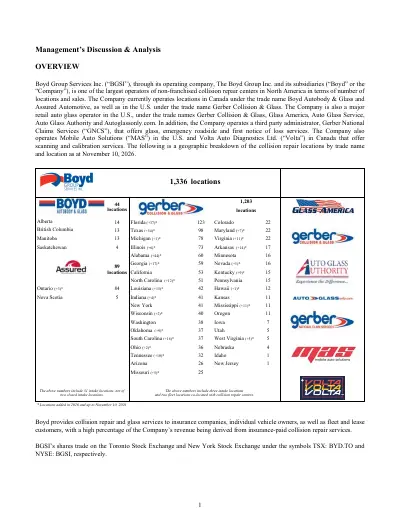
If you saw in the in the MD&A, I think we flagged we've got 34 new location new start-up locations planned for the next 12 months. Like any construction project, we'll see delays where things shift, slightly out in and out of quarters.
You saw after the quarter, subsequent to the quarter, we announced, seven, seven new locations opening subsequent to the quarter, after 10 in the quarter, not not just start-up, but all acquisitions. I think you'll you'll I would sug- suggest that we'll get to that kind of 30 to 35, maybe pushing 40 some years of start-up locations, which is which is in line with what we said, back in the five-year when we launched our five-year plan.
Great.
Sabahat Khan
Thank you.
Brian Kaner
Thanks.
Operator
Your next question comes from the line of Chris Murray with ATB Capital Markets. Your line is now open.
Please go ahead.
Chris Murray
Thanks folks. Maybe just turning to some of the margin performance and just kind of the cadence as we're sort of walking into I guess the target or getting closer to it.
Can you just talk about how you're seeing kind of the entire system now behaving with margins and your confidence level of being able to get to I guess the targets that you've set, and how we should think about kind of margin cadence and the pace of improvement as we go into next year?
Brian Kaner
Look, as it relates to the pace of improvement, we said that the balance of the Project 360 savings would come in ratably, the pace of improvement should be thought of as the incremental savings that are yet to be achieved on Project 360 coming through ratably. That should be the pace of change.
Obviously, some incremental same-store sales will help give us a little bit more leverage and push that up a little bit more. I'm actually very pleased with the cadence that we've been on.
As I said in my opening remarks, we've seen a 230 basis point improvement from the time we started this project at the end of call it Q3 of 2024 to now what we just reported in Q3 of 2026. The progress on the actual project itself has been very much so in line with what we've expected.
The pace, as I said, will be more tempered as you go forward. I think just commenting more broadly on Q3's sequential decline in EBITDA rate, we normally see a 50 to 60 basis point downward movement in Q2 or Q3 versus Q2, just based on some of the seasonality related to our glass business in particular.
If you think about that, if you would have normally seen 60 basis points of downward pressure, 50 basis points of downward pressure, we offset that with Project 360 savings. We did have some incremental costs in the quarter that related to things like fuel costs and utility costs that were a little bit elevated versus a year ago that ate up some of that savings, and then we had a little bit of leverage loss.
I think, but by and large, I'm very pleased with where we're at from the progress against the 14% goal that we set in February.
Chris Murray
That's helpful. Then just one question on acquisition and single-store acquisitions.
We talked a little bit about each start-up locations and, understandably, construction will throw those schedules around. At the pace that you're kind of running through single-store acquisitions right now, just trying to think of how's the environment out there?
I know that with midterms sometimes can throw things around with sellers trying to figure out how to optimize their sale price, things like that. Are you seeing any change in the market, or is the pace that you're kind of adding stores, like single-store operators right now, is that kind of the way we should be thinking about call it 6 to 8 a quarter type of thing is a good cadence to be thinking about?
Brian Kaner
Look, I think we've said this before. The fourth quarter always tends to be our largest quarter from an acquisition perspective and store opening.
I frankly wouldn't expect anything different this year. I will say that, because we are taking a more measured approach to acquisitions, i.e., we're focusing on building density, getting in that number one or number two position in the markets that we operate in, that shrinks the pool of available opportunities that are out there for us.
It doesn't mean that there's not a lot of available opportunities. It just means that we're looking for the right opportunity that, again, has the right-sized box, gives us the ability to do $3.5 to $4 million of volume out of a location, and when we find that, we're happy to engage and purchase.
If we don't find that, then we're going to be more apt to look for brownfields and greenfield opportunities to build in those markets. It really is just there's nothing behind it right now.
The sellers in the marketplace outside of the bigger, certainly the regional MSOs and some of the larger players that are out there, I think given where we're trading, have to start to see their multiple expectations contract. We're not a buyer in that environment, but the opportunity for single shops is still out there.
Chris Murray
We'll leave it there. Thanks, folks.
Brian Kaner
Great. Thanks.
Operator
Your next question comes from the line of Mark Jordan with Goldman Sachs. Your line is now open.
Please go ahead.
Brian Kaner
Hey, Mark.
Mark Jordan
Hey, good morning. Hey, thank you for taking my question.
Can you talk about how same-store sales trended throughout the quarter and maybe what you're seeing quarter-to-date? I know you said it was positive in October, but just any color as it relates to maybe the rate of change?
Brian Kaner
I think what we said in the opening remarks is what I would reflect on again. We said that the volume continues to be positive, and we're starting to see some incremental TCOR.
Those two things at least point us to an environment we're positive. We're evolving our messaging away from giving a pointed amount, because we want people to focus on the underlying business performance.
We're not providing additional quantitative details. We highlighted during the month of October, we saw continued volume growth, once again, we outperformed the industry as well as that sequential improvement in TCOR.
I think it should give us the sense that the marketplace continues to be positive.
Mark Jordan
Perfect. Thank you very much.
Just one follow-up. As we think about the parts mix between aftermarket and OEM, how that might have impacted margins for the quarter, can you just talk about that a little bit?
Because I know it was noted that parts margins were lower year-over-year.
Brian Kaner
You want to take that?
Jeff Murray
Sure. We have seen just really there's been some shifting I think in the marketplace, and so there's really not much to say.
There's been some pretty positive improvements year-over-year in terms of gross margin. There's a lot of factors that were positive, there were a couple that were slightly negative, and we mentioned the parts and labor as being a couple of them, but they really weren't all that meaningful, and so some element of it was aftermarket parts related, but again, I would focus more on the net positive overall.
Brian Kaner
I'd just follow on to that, typically on a quarter-over-quarter basis, Q2 to Q3, the erosion that I talked about in the EBITDA margin, most of that falls in gross margin. If you just think about the sequential margin decline, we did report a couple of tenths of points of benefit on a year-over-year basis, but the sequential margin decline is simply more tied to that seasonality and the seasonality is more tied to just the reductions we see in the glass business as we get into the third quarter.
Mark Jordan
All right. Thank you very much.
Brian Kaner
Great. Thanks.
Operator
Your next question comes from the line of Steven Hansen with Raymond James. Your line is now open.
Please go ahead.
Brian Kaner
Hey, Steve.
Steven Hansen
Good morning guys. Thanks for the time.
Brian or Jeff, I just want to ask you about your conviction in the buyback around that opportunity that you see there. Valuations have obviously come down a fair bit.
Brian, you just referenced that it's more expensive to buy the multi-shop MSOs now. Single shops may be still doable, but how do you feel about the pace of the buyback relative to some of the opportunities for acquisitions out there in the market?
Thanks.
Brian Kaner
Look, as our business evolves, does our capital allocation opportunities, that includes the addition of share repurchases. The focus of the business remains on directing capital towards the opportunities that frankly offer the most attractive risk-adjusted returns and create long-term shareholder value.
We're not going to be prescriptive about what we're doing on share buybacks. I think we have that as an option in our capital allocation strategy now, and if there aren't other places to deploy capital, it does certainly become an option for us.
Steven Hansen
That's helpful. Then just lastly, I just wanted to go back to just the M&A environment just quickly and how you think some of the smaller shop sellers, I think it sounds like the multiple stack or multiple opportunity there is still quite good.
Some of the smaller-tier MSOs are still probably off the table, but does the flywheel allow you to continue to move fast enough to meet your targets, or do you feel like you can slow a little bit and focus on the greenfield opportunity a little more, I don't know, aggressively if that's the right word, but how do you feel about that single-shop MSO versus the greenfield opportunity?
Brian Kaner
I I mean look, I think the the desire to the acquisition strategy is still there's a whole new unit growth strategy, is still predicated off of building out market density or building out market density. As we've talked about before, we have we have a map that has dots on the map, and our acquisition team is out in the marketplace looking for the opportunities to fill that dot on the map.
I it it seems it it comes across as a little bit more opportunistic, where we'll go into the marketplace. It's just a pacing of the it it's just the pacing of the the way that the team can get into the market to fill those opportunities.
If you get into a market and you realize that there's not somebody to buy in the market, now you've got to get somebody that's out looking for land in the market or looking for a brownfield opportunity in that market. I think it's because we've gotten a lot more purposeful with our capital deployment and have just gotten very specific around where we want to grow, that that inherently will slow the pace.
If I, had a shotgun approach to buying across the United States, there's all kinds of places. I'm sure there's places I could, buy in Wyoming, and Idaho, and Montana, and, places that I ultimately don't want to be, but the opportunities to go build out densification just narrows the pool of of things that we can go do, or places that we can go buy, and that I think puts it it puts a little bit of pressure on the pace, but that's okay, because it's ultimately driving, we know that the the success of those, we're hedging our, our bets on success on the ones that we are buying.
Jeff Murray
Brian, I'll just add, too, that because we're opportunistic, it is lumpy if you look back over time, and as a result, it's been lumpy over time and it will continue to have some level of lumpiness. The start-up strategy does mitigate that to some degree because you're going to have some bleeding in that are essentially planned for like that, but otherwise we're still lumpy.
Brian Kaner
Look, we said in the MD&A we've got 34 new start-up locations. Those are the ones that we have certainty around, and acquisitions will, as Jeff said, they'll just be lumpy.
Steven Hansen
Very good. Appreciate the time.
Mhm.
Operator
Your next question comes from the line of Derek Lessard with TD Cowen. Your line is now open.
Please go ahead.
Derek Lessard
Good morning Brian, Jeff, Steven. Hope you're well.
I just wanted to maybe just hit on the volume trends in the quarter. It was down 1% to 3%, but that seems like it was a bit of a deterioration compared to Q2, I think it was down 0% to 2%.
Maybe just talk about some of the trends that you were seeing there and then maybe specific to you guys. Looks like you did outperform the industry a little bit better in Q3, if there's anything you'd like to point out there.
Brian Kaner
You're right that the volume in the quarter did contract a little bit. I think a large portion of that is if you look at vehicle miles traveled in the quarter, you saw some suppression in vehicle miles traveled in the summer months.
That's largely what probably drove the decline in volume, still within the range that we expect it to be, it didn't go back down to the high single digits. It just stayed in that band.
Relative to our performance against it, remember we said there was a little bit more TCOR movement in the quarter, so that gave us a little bit of incremental spread against how the market was performing. We talk about claims in terms of units, we talk about same-store sales in terms of dollars, so that incremental TCOR helped us increase the spread, albeit the volume spread if you will was probably fairly consistent.
Jeff Murray
I think it's also worth pointing out, it's the third quarter in a row now that we're essentially in that typical range of 0% to 3%, so that's positive.
Brian Kaner
Yeah.
Derek Lessard
Absolutely. Thanks for that coloring.
Maybe one last one for me, just correct me if I'm wrong, too, I think you guys are pretty much done on the internalization of your scanning and calibration. Are you able to quantify the margin impact on that $90 million year-to-date realized, or maybe just highlight sort of the biggest margin bucket contributors to the $90 million in savings you've realized so far?
Jeff Murray
Derek, you're talking about just the overall progress on both Project 360 and the synergies from the Joe Hudson transaction?
Derek Lessard
Right, and I guess what did the scanning and calibration contribute to those savings that you've realized?
Brian Kaner
I don't know that we haven't split out the incremental improvement we're getting from scanning and calibration. I think I'll answer your first part of your question.
We are at the threshold that we said we would be at. We're at and beyond, frankly, the 80% coverage of internalization.
That team needs to continue to build as you see higher penetration rates of calibration services now, it isn't that the journey is done, because now we need to continue to add staff to maintain the growing environment that we're in. I just want to make sure we're clear, the $90 million that you're referencing is, we said we'd be at $105 million by the end of the year on total Project 360 savings, not a year-to-date, but a project-to-date is the $90 million, so that's project-to-date as of the quarter, that includes Joe Hudson synergies.
Remember that and when we get the incremental $15 million in the fourth quarter, we'll be $105 million towards our goal of $140 million, with the remaining $35 million that's out there being really, as we've talked about before, coming from investments in technology that'll help drive efficiency in our stores.
Jeff Murray
Maybe just add to prepare you that the internalization of scanning and calibration was not part of that. That was not part of those numbers.
However, there was some element of the synergy element.
Brian Kaner
It wasn't part of Project 360, it was part of Joe Hudson synergies. I'd think about it that way.
We've got $15 million to achieve in Q4, and we'll have another $35 million that will come in ratably throughout the balance of 2028 and 2029.
Derek Lessard
Got it. I think that was my point.
It was the scanning and calibration margin improvement on the back of the synergies.
Brian Kaner
No, some of the pull-forward in synergies is driven by the faster internalization of scanning and calibration versus what we had anticipated. You are seeing some of that in that number.
Yep,
Derek Lessard
got it. Thanks, guys.
Brian Kaner
Yep.
Operator
Your next question comes from the line of Gary Ho with Desjardins Capital Markets. Your line is now open.
Please go ahead.
Gary Ho
Thanks. Good morning.
First question, just on the Joe Hudson contribution. I think it's roughly $170 million in the quarter.
Feels like that business is running a little bit lighter than it was acquired. Correct me if I'm wrong, maybe seasonality.
Your disclosure noted a trend versus the prior year improved through 3Q and into October. Perhaps can you update us on the progress on kind of stores moved onto the Boyd operating model, and fixing some of the underperforming stores and the path to growth from there?
Brian Kaner
Look, we, as said on the last call, we accelerated the integration of Joe Hudson because when we got the business, or when we closed at the end of October, we actually got the business on January 9th for all intents and purposes. There had been erosion in that business in that period of time, so as we picked that up and we started to realize what tools we had in the available operating environment to run the business, we realized that they didn't have the same type of tools and data visibility and business processes that, frankly, we had in the Boyd business.
As we bought that, we realized we needed to integrate more quickly. We did that, and now, as I said in the prepared remarks, the focus now is just on improving client scores, that we know will drive incremental volume, making sure that we've got the staffing in the stores to deliver on that volume, and implementing the WOW Operating Way within that environment, and as we do that, we continue to see sequential progress from the business.
No, you are right, there is seasonality from Q2 to Q3, we do see that. The whole South normally sees a dip from Q2 to Q3.
What we're referencing is as we look on a year-over-year basis, the business is actually getting better. We do continue to see improvement there, and it will take a little bit of time.
It takes a little time for us to get the metrics that we normally look at, to get enough data behind them for us to form an opinion on what's happening. I'm actually, as I've said before, I have confidence in the fact that what we bought with Joe Hudson will ultimately be there.
We bought ourselves now an opportunity with the air cover coming from mental synergies, an opportunity to get the revenue flowing in the business the way that we had expected it to, and that's progressing each and every month as we go forward.
Gary Ho
Thanks. Appreciate that.
Then my second question, just want to touch on self-pay. Some industry peers have pointed to self-pay repairs approaching historical highs, just with more work not going through insurance carriers.
Just curious kind of what you're seeing with your own customer experience there, and how does that affect volumes, average ticket, and margins?
Brian Kaner
We certainly do see, albeit a small piece of our business, we do continue to see self-pay growing at a pace that's greater than what the insurance volume is, but it is growing off of a much smaller base. You're right on the average ticket on a self-paid job is much lower than an insurance-paid job.
Look, our focus today still remains on providing great service for the insurance partners that we do business with. It's the largest portion of our business.
As we continue to focus on client metrics and driving performance and driving, frankly, outperforming our competitors on metrics, we continue to accrue more volume from that. On customer pay or self-pay, we've started to introduce tools like the Sunbit financing program in our business that will allow a consumer to be able to finance a self-paid job.
We're taking steps towards being able to be more amenable to a consumer, but the focus of the business still remains heavily on our insurance partners.
Gary Ho
Great. Those are my questions.
Brian Kaner
Great. Thank you.
Operator
Your next question comes from the line of Bret Jordan with Jefferies. Your line is now open.
Please go ahead.
Bret Jordan
Hey, morning, guys.
Brian Kaner
Hey, Bret.
Bret Jordan
On the self-pay question, I guess the ticket's lower, but is the margin potentially higher in the sense that you're not negotiating with an insurance company on labor rates, et cetera?
Brian Kaner
No, I wouldn't reflect it that way. I think that the challenge with consumer pay is you're actually dealing with somebody that might be more price competitive because there's a threshold by which they can do the repair versus not do the repair.
It's why consumer pay is really not something that's so prevalent in the MSOs, because often times you'll see that they want to do different things with the repair, maybe not fix it completely, maybe not do something that needs to get done on the vehicle, and our job, as collision repair providers, is to make sure that we complete the repair, we get the car back on the road safely, we do everything that needs to be done, and insurance carrier work allows us to do that. When you get into consumer pay, I think you get into a lot more negotiating of what can or should be done, not that it's so price-sensitive from a rate perspective, but there really isn't any discernable margin difference between the two.
Bret Jordan
Okay. Then sort of a macro question on the space, you said down 1% to 3%, sort of in line with longer-term expectation.
Is there any pent-up demand out there? Obviously being down high singles a year ago, you'd think there would be more cars driving around with a dent, and that customer, when they can come up with a deductible, might fix it.
Is there a chance that you're going to see some snap back, or are we sort of back to normal and don't expect any surge of pent-up demand?
Brian Kaner
We've said this in previous discussions, when you look back to that 2007, 2008 timeframe when we were in the financial crisis and unemployment was high, there was a bounce back year, I think it was 2011 that became the bounce back year. Could there be something, certainly, is that what we're banking on?
No. I think history tells you that there could be something like that, but that's not the way we're thinking about the business right now.
Jeff Murray
Where it could come up is through overtime rollover of loans, rollover of leases, that could be where it starts to come through, but it would sort of bleed in over time. Yeah.
Bret Jordan
Okay. Great.
Thank you.
Brian Kaner
Yep.
Operator
Your next question comes from the line of Daryl Young with Stifel. Your line is now open.
Please go ahead.
Daryl Young
Hey, good morning, everyone. Looks like the free cash flow generation was quite strong this quarter, but EPS was a little weaker than I might have anticipated.
Is that a function of maybe some lease accounting, depreciation nuances, or is it more operating leverage in the seasonally weaker Q3 period?
Jeff Murray
No, I would agree. It's probably more the former, the right-of-use asset depreciation and other depreciation on assets from our growth is probably the one that's contributing the most.
Daryl Young
Got it. That's all for me.
Thanks very much.
Brian Kaner
Thanks, Daryl.
Operator
Your next question comes from the line of Tristan Thomas-Martin with BMO Capital Markets. Your line is now open.
Please go ahead.
Tristan Thomas-Martin
Hey, good morning.
Brian Kaner
Hey, good morning.
Tristan Thomas-Martin
Just a point of clarification. The moving away from giving quantitative numbers, is that just strictly for the quarter ahead?
Just want to make sure nothing else is changing.
Brian Kaner
You faded in that last part of your question. Say that again?
Tristan Thomas-Martin
Oh, just the moving away from giving quantitative numbers, that's strictly talking about the quarter ahead, right?
Brian Kaner
That's talking about the month that we're currently in. We're not going to continue to talk about the month that we're in, because as we know, there is variability in the business, and 1 month does not make a trend.
Tristan Thomas-Martin
Got it. Then just on the paint benefit, I think a couple quarters ago, you called out it was tied to volume-triggered rebates.
Is it still that, or is there something else going on there? It's really that
Brian Kaner
you must be on a cell phone. It's hard to hear you.
Can you say that again, just slower?
Tristan Thomas-Martin
Sorry. Yep.
[laughter] Just excited to be here. Just the paint benefit, in the past, you've called out volume rebates.
Is it still volume rebates as you expand, or is there some other benefit in there?
Jeff Murray
No, it's still volume rebates. It is just the ability to have volume rebates come through to the bottom line.
Would you say anything else in terms of where the paint benefits come from? It's primarily just as we continue to grow, we can concentrate more volume.
Brian Kaner
Got nothing more to add there.
Tristan Thomas-Martin
Okay. Great.
Brian Kaner
Sorry about that. I was not picking up on paint, Tristan.
That part I just missed it.
Tristan Thomas-Martin
No, it's 100% my fault. 100% my fault, I'm sure.
Thank you, though.
Brian Kaner
All right, appreciate you. Thank you.
Operator
Your next question comes from the line of Razi Hasan with Paradigm Capital. Your line is now open.
Please go ahead.
Razi Hasan
Good morning. Thanks for taking my questions.
Most of them have been answered, but just a follow-up on TCOR. Brian, did you mention you saw total losses lower in the quarter, or were they just stable from where we've been at?
Brian Kaner
It's actually just stable, what we're not seeing is a negative impact from the year-over-year impact, but we are seeing it just be relatively stable.
Razi Hasan
Great. Then just lastly, I'm not sure if I missed it, how should we think about gross margin exiting the year, in line sequentially, any color that you can provide would be helpful there?
Brian Kaner
Anything, Jeff? We've always talked about gross margins kind of operate in a band.
I think the band has gotten tighter over the years as we've gotten bigger. Sequentially, I think we see heavier hits as we get into the fourth quarter, which ultimately likely suppresses some of the other positives that we would see, I think stable margins is probably the best bet.
Jeff Murray
Glass would be a seasonally low period through the winter seasons versus the summer, and so that can have a moderating effect on gross margin.
Brian Kaner
Yeah.
Razi Hasan
Thanks very much. I'll leave it there.
Operator
Your next question comes from the line of Carol Adu-Bobie with Scotiabank. Your line is now open.
Please go ahead.
Carol Adu-Bobie
Good morning. This is Carol on for Jonathan Goldman from Scotiabank.
Thanks for taking my question. I wanted to ask, have you been dealing with any incremental inflation on parts, paint, and logistics since Q2?
I know you mentioned there was a year-over-year impact, but I just wanted to clarify if it accelerated in the quarter, and has this continued into the fourth quarter?
Brian Kaner
We actually got our contractual paint increase in the second quarter. We certainly have seen a little bit of incremental inflation on paint.
That has to roll through the paint and material rates, and as that rolls through, obviously the TCOR will continue to move up, and the slight margin compression we saw from that will go away. The other parts inflation, labor inflation, I wouldn't say we've seen anything different in Q3 versus Q2.
Carol Adu-Bobie
I appreciate the color. Just a broader question, but as you continue to realize these Joe Hudson synergies and Project 360 moves towards the more mature phase, and the cadence of margin improvement becomes more modest, what additional cost actions or process improvements could you undertake to continue to drive that margin improvement?
Brian Kaner
Look, I think that one of the biggest focuses of the business going forward is going to be the use of technology to lessen the administrative burden of claims in our business. I've said this in other times, almost half of our people are just simply in stores that are moving a claim to the back of the shop.
If we can continue to focus in on leveraging technology, leveraging agentic AI, leveraging other technologies to make that process more efficient, there is a big cost pool that is out there for us to be able to go attack. We've started to do some things now with agentic AI.
We've got agentic AI now answering calls and after hours to schedule repairs, we've got follow-up on opportunities going through an AI agent. We are starting to really see some of the benefits of AI really accruing in this business to make the part of our business that's really getting the car to the back more efficient.
Carol Adu-Bobie
Appreciate the color. Thanks for taking my questions.
Brian Kaner
Thank you.
Operator
Your next question comes from the line of David Bellinger with Mizuho. Your line is now open.
Please go ahead.
David Bellinger
Hey, good morning. Thanks for the questions.
I want to ask about the leverage point of the business. There's an investor perception out there that you need to be in this 3% to 5% same-store sales growth bracket in order to get EBITDA margins higher.
I know you've got a lot of the Project 360 synergies and cost cuts coming in, can you talk about where the comp sales growth has to be in order to get EBITDA margins higher? Should we think about it as more of a low single-digit sort of qualitative measure in order to get there?
Brian Kaner
Jeff has talked about this in the past. If you look back 10 years, the average same-store sales growth was around 4%.
When we were getting that 4%, the margin expansion was anywhere from 10 to 15 basis points of call it operating leverage that we were getting out of 4%. I think that's probably where the expectation of margin expansion through the 3% to 5% range comes from.
Obviously we've expanded margins through very very prescriptive actions in the business, and continue to see those things and continue to have those opportunities to do that. Have every bit of confidence that when we start to get ourselves into that 3%, 4% range, that we can certainly see the same type of benefit we've seen historically.
David Bellinger
Got it. Thanks for all that.
Just wanted to follow up on the insurance commentary. Are there any carriers that you're looking to do more or less with, and maybe just talk about the concentration of where claims come from today for potentially where that could shift to?
Thank you.
Brian Kaner
I won't I won't comment on, we I won't comment on specific carriers. The majority of our business, as we know, comes from, or as comes from, insurance carriers, and our focus is on, there there's lots of different regional, we understand the different regional coverages by carrier, our focus is on making sure that we're, we are taking care of every carrier that we do business with, and so, I'll just leave it at that.
Operator
Your next question comes from the line of Thomas Wendler with Stephens. Your line is now open.
Please go ahead.
Thomas Wendler
Hey, good morning, everyone. Thanks for taking my question.
Just one quick one from me. We've seen some total loss thresholds increase in a few states, Oklahoma and Rhode Island, how impactful can these be to total loss rates?
Then with that and insurance premiums moving lower, you'd expect deductibles to move in kind, is there a scenario where total loss rates don't just stabilize, but they start to decrease?
Brian Kaner
I think if you see more regulation like that, I think you will see them start to decrease. Total losses are getting a tremendous amount of attention in the industry right now.
We know that it's not a great customer experience, there's more people that are upside down in loans right now, if their car gets totaled, they end up not only not being able to get a car, but they end up writing a check to get out of the car that they're actually in. We know that it's not a great experience.
I think many people are picking up on that, inclusive of the insurance carriers. Insurance carriers are seeing, if you trust the data that's out there, the data that CCC would reflect or that JD Power reflects is 40% of people after a total loss event switch insurance carriers.
The attrition after a total loss event versus a repair event that's 7% is super high. That's got carriers' attention, it's got OEs' attention because people are actually defecting from the brand after a total loss event.
I think there is a lot of positive momentum in the industry to push total losses down. We haven't seen that yet, but I do think, as you said, if those things start becoming more pervasive in the marketplace, raising the threshold, Rhode Island raised it to 85%, if you see people raising thresholds to 85%, those borderline total losses will end up becoming repairable vehicles again and ultimately help our business.
Thomas Wendler
Perfect. I appreciate all the color.
Brian Kaner
Yep, thanks. We'll see you next week.
Thomas Wendler
See you guys next week.
Operator
There are no further questions at this time. I will now turn the call back to Mr.
Brian Kaner for closing remarks.
Brian Kaner
Thank you, operator. Once again, everybody, thanks for joining the call today.
We look forward to reporting our fourth quarter results in the new year. Thanks again and have a great day.
Operator
This concludes today's call. Thank you for attending.
You may now disconnect.