Cascades Inc.
Q3 FY2026 · Earnings Call TranscriptNovember 5, 2026
Operator
Good morning. My name is Joelle and I will be your conference operator today.
At this time, I would like to welcome everyone to the Cascades Third Quarter 2026 Results Conference Call. All lines are currently in listen-only mode.
After the speakers' remarks, there will be a question-and-answer session. I will now pass the call to Hugues Simon, CEO for Cascades.
Mr. Simon, you may begin your conference.
Hugues Simon
Thank you, operator, and good morning, everyone. Before we begin, I would like to introduce a new member of our team.
Martin Brisson joined Cascades this week, and he will serve as Vice President, Corporate Strategy and Investor Relations. Martin brings more than 20 years of experience, and his arrival will strengthen our strategic capabilities as we plan and execute the company's next phase of growth.
Martin?
Martin Brisson
Thank you, Hugues. I am excited to join the team and look forward to meeting and working with all of you in the coming weeks.
Good morning, everyone, and thank you for joining our third quarter 2026 conference call. We will begin with an overview of our operational and financial results, followed by some concluding remarks, after which we will begin the question period.
Today's speakers will be Hugues Simon, President and CEO, and Allan Hogg, CFO. Before turning over the call, I would like to highlight that certain statements made during this call will discuss historical and forward-looking matters.
The accuracy of these statements is subject to risk factors that can have material impact on actual results. These risks are listed in our public filings.
These statements, the investor presentation, and the press release also include data that are not measures of performance under IFRS. Please refer to our Q3 2026 investor presentation for details.
This presentation, along with our third quarter press release, can be found in the Investors section of our website. If you have any questions, feel free to contact us after the session.
I will now turn the call over to Hugues Simon, our CEO, who will begin with a review of our Q3 performance. Hugues?
Hugues Simon
Thank you, Martin. First, I would like to acknowledge the ongoing commitment of our employees to safety, which remains one of our top priorities.
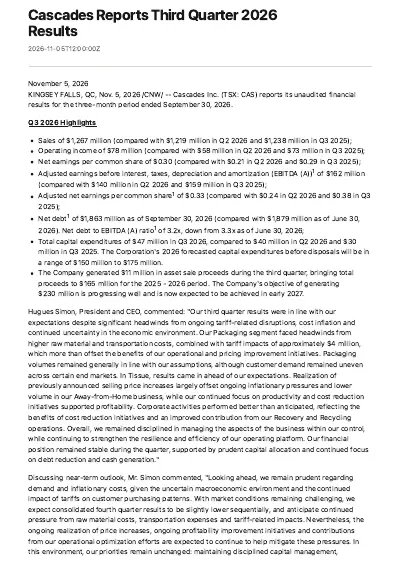
Thanks to their vigilance and engagement, we achieved a record safety performance in the third quarter of 2026, a significant milestone that reflects our collective dedication to maintaining safe and healthy workplaces across our operations. Our third quarter results were within our expectations, despite significant headwinds from ongoing tariff-related and cost inflation disruptions.
Considering these challenges, I am pleased with our performance in the third quarter, which reflects the rigorous implementation of price increase initiatives and improved operational execution across the organization. In our Packaging segment, our results were slightly below expectations.
Tariffs on corrugated boxes, molded pulp, plastic products, and certain URB grades, totaling $4 million in the third quarter, combined with elevated raw material costs, placed additional pressures on our results. Despite these challenges, we implemented commercial and operational actions during the quarter that are expected to support improved performance going forward.
Packaging volume remained generally in line with our assumptions, although customer demand remained uneven across certain end markets. In Tissue, results came in ahead of our expectations.
The combined impact of our selling price increases, productivity improvements, and disciplined cost reduction initiatives enabled us to largely offset continued inflationary pressures, most notably in transportation costs. At our Bear Island facility, we continued to improve, achieving a record production volume again this quarter, with a 4% sequential increase.
Since the launch of our initiative one year ago, we have delivered a 23% improvement. Our Corporate Activities performed better than anticipated, reflecting the benefit of cost reduction initiatives and improved contribution from our recovery and recycling operations.
We continue to focus on the areas within our control, strengthening the resilience of our platform in an environment that remains impacted by macroeconomic and geopolitical uncertainty. Raw material index prices for white and brown grades of recycled fiber respectively increased by 12% and 19% sequentially, and by 15% and 29% compared to the same period last year.
Hardwood pulp and eucalyptus prices also increased, rising as much as 29% sequentially and by 3% year-over-year. Delivered raw material costs to our mills were further impacted by recent transportation disruptions and higher fuel surcharge costs.
We provide an overview of average quarterly costs and key trends on slides 7 and 8. Moving now to the results of our business segments, which are highlighted on slides 9 through 14 of the presentation.
Our Packaging segment delivered higher sequential results in the third quarter, as operational execution and market conditions improved. Sales increased to $807 million, up 5% sequentially, while adjusted EBITDA increased 5% to $126 million.
EBITDA margin remained stable at 15.6% in the third quarter. Results benefited from higher average selling prices, which more than offset significantly higher recycled fiber costs.
Total shipments remained stable at 426,000 short tons, reflecting continued solid paper demand and good operational execution across our containerboard platform. External paper shipments slightly decreased by 1%, and box shipments increased 2%, equal to the adjusted industry increase.
We continued to have a strong production level in the quarter at Greenpac, and Bear Island continued to operate above 90% of its total production capacity during the quarter. On a year-over-year basis, packaging sales increased 1%, while adjusted EBITDA declined to $126 million from $136 million in the third quarter of 2025.
The year-over-year comparison reflects significant raw material and transportation cost inflation, partly offset by improved selling prices and continued progress on our profitability improvement initiatives. Total shipments decreased modestly, reflecting the closure of the Niagara Falls recycled containerboard mill in August 2025 and the impact of the sale of our West Coast box plant in the first quarter of 2026.
However, on a comparable asset basis, year-over-year box shipments increased 5%, surpassing the adjusted industry 1.6% increase. Results in our Tissue improved significantly during the third quarter, supported by favorable pricing and continued operational progress across our manufacturing platform.
Sales increased to $415 million, up 1.5% sequentially, while adjusted EBITDA increased 34% to $47 million. EBITDA margin improved to 11.4% compared to 8.6% in the second quarter.
The strong EBITDA improvement reflects the benefits of pricing initiatives implemented in the beginning of the third quarter, combined with lower production costs, which more than offset ongoing inflation in raw material and transportation costs. Total shipments were 118,000 tons compared to 121,000 tons in the second quarter.
Retail shipments increased 2% at 73,000 tons, while Away-from-Home volumes were lower sequentially by 10%, primarily reflecting the impact of one customer ceasing operations during the quarter. Year-over-year, adjusted EBITDA improved by $1 million, with higher average selling prices and cost reduction initiatives offsetting the negative impact of lower volume, higher transportation, and raw material costs.
I'll now pass the call to Allan, who will briefly discuss some of the financial highlights. Allan?
Allan Hogg
Yes, thank you, Hugues, and good morning, everyone. Let's start with the specific items recorded during the quarter, which impacted operating income by $6 million on slides 15 and 16.
The main items consisted of gains from the sale of assets, restructuring costs related to cost-saving initiatives, and lastly, impairment charges of $7 million. Slides 17 and 18 illustrate the year-over-year and sequential variance of our Q3 adjusted earnings per share and the reconciliation with the specific items that affected our quarterly results.
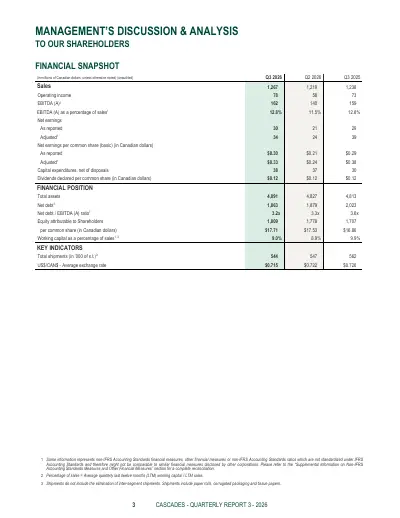
As reported, Q3 net earnings per share were 30 cents. This compared to net earnings per share of 21 cents in the previous quarter and net earnings per share of 29 cents in the same period last year.
On an adjusted basis, net earnings per share were 33 cents in the current quarter. This compared to net earnings per share of 24 cents in the second quarter of 2026 and 38 cents for the third quarter last year.
As highlighted on slide 19, third quarter adjusted cash flow from operations totaled $119 million, down 13% from $137 million in the same period last year. This decrease is primarily due to higher financing costs paid in 2026 and lower dividends received from our joint ventures.
Slide 20 provides detail on our capital investments, which totaled $112 million year-to-date. For 2026, our expected capex remained unchanged, in the range of $150 to $175 million.
Moving now to our net debt reconciliation as detailed on slide 21. Sequentially, net debt decreased by $16 million during the quarter.
Proceeds from asset disposal reduced debt by $11 million. Our leverage ratio went down to 3.2 times and our available liquidity under our credit facility stood at $708 million at the end of September.
In September 2026, we partially redeemed $100 million U.S. of our outstanding 2028 senior notes.
$345 million U.S. remains outstanding and is expected to be repaid through future operating cash flow, asset monetization proceeds, or liquidity under our revolving facility.
Financial ratios and information regarding maturities are detailed on slide 22. Additional information and analysis can be found on slides 26 through 34 of the presentation.
With that, I will turn the call back to Hugues for a few closing remarks before opening the line for questions. Hugues?
Hugues Simon
Thank you, Allan. We provide our outlook for Q4 on slide 23.
Looking ahead, we remain prudent regarding packaging demand given the uncertain macroeconomic environment and the continued impact of tariffs on customer purchasing patterns. Although market conditions remain challenging, we expect consolidated results in the fourth quarter to be slightly lower sequentially, while still confirming our run rate adjusted EBITDA above $600 million for the second half of 2026.
This outlook is supported by the continued realization of price increases, ongoing profitability improvement initiatives, and contributions from our operational optimization efforts. We nonetheless expect continued pressure from raw material and transportation costs, as well as tariff-related impacts.
As you are aware, U.S. tariffs and Canada's counter-tariffs came into effect during the quarter.
The estimated direct impact of these tariffs, net of mitigation initiatives, amounted to approximately $4 million, representing 2.5% of adjusted EBITDA, primarily impacting our Packaging segment. On October 23rd, the U.S.
administration excluded certain products that were subject to tariffs. Corrugated boxes, as well as plastic and molded pulp packaging products, are no longer subject to tariffs, significantly reducing the expected financial impact on our results.
However, certain laminated board products were added to the Section 338 list. While this is expected to have an immaterial impact on our consolidated results, we now estimate the ongoing annual direct impact on adjusted EBITDA to be less than $10 million.
Our profitability improvement initiatives continue to deliver good results. Following the $30 million in benefits realized in 2025, we estimate that a further $50 million has been captured thus far in 2026.
The remaining $20 million required to achieve our objective is expected to be captured in Q4. We are also making good progress on our asset monetization objectives, having realized $165 million of proceeds against our $230 million target.
Although the timing of some transactions have extended beyond our original expectations, a number of discussions remain ongoing. We're also undertaking a deeper evaluation of our recovery and recycling platform to optimize our asset portfolio, enhance operational efficiency, and strengthen integration with our paper manufacturing operations.
Finally, our priorities remain unchanged: maintaining disciplined capital management, enhancing productivity across our asset network, optimizing our customer portfolio, and executing initiatives that strengthen the long-term resilience and competitiveness of the business. As we approach 2027, despite ongoing inflationary pressures, market conditions in both Packaging and Tissue are evolving favorably, and recent price initiatives are expected to provide additional benefits next year, as their full impact will be reflected in our results.
While macroeconomic uncertainty and cost inflation remain important considerations, we are encouraged by the momentum across our businesses. Combined with our continued focus on execution, this positions us well for 2027 and gives us confidence in our ability to deliver a stronger financial performance and target an adjusted EBITDA above $650 million.
With that, we'll now open the line for questions. Operator?
Operator
Merci. Si vous voulez poser une question, veuillez s'il vous plaît composer étoile suivi du 1 sur votre clavier téléphonique.
Si vous voulez retirer votre question, composez étoile 2. Thank you.
If you would like to ask a question, simply press star then the number 1 on your telephone keypad. If you would like to withdraw your question, please press star 2.
Again, if you have a question, please press star 1. We'll pause for just a moment to compile the Q&A roster.
Your first question comes from Sean Steuart with TD Cowen.
Sean Steuart
Look forward to working with you. A couple of questions.
Hugues, I want to start with packaging markets and wondering if you can give some context on tension and I'm thinking strong containerboard price momentum that has unfolded through the year. How is the industry and I suppose Cascades specifically been able to raise corrugated box prices at the same pace?
Have you been able to? Is there any tension between very tight board markets and corrugated box markets right now?
Hugues Simon
Thank you for your question, Sean. Great question.
Basically, if I start by splitting rolls versus boxes, with the number of closures that happened in 2025, the market on rolls is extremely tight, our ability to move forward with announced price increases is progressing well. As there's been three price increases in 2026.
As for boxes, there's capacity to produce additional boxes in some markets, but with the rolls being tight, we're able to raise prices. The lag is a bit different than previous quarters, and that relates mostly to two different things.
First is it's unequal the level of demand in some of the markets. Food and beverage is more resilient as far as volume, we're trying to focus on areas where we can have stable volumes that are resilient to the geopolitical and the current economy.
That behavior is a bit different from a timing perspective, but we're able to get the pricing versus some of the customers that have been impacted. One example, in Eastern Canada, there's more companies impacted by tariffs, we see more of a slowdown in box makings in the province of Quebec versus elsewhere in Canada.
Recently, as the U.S. administration did change some of the tariffs, we'll see how that evolve, but for us, we're trying really to focus on customers that have a resilient demand level across the year.
Sean Steuart
Hey, thanks for that detail. Allan, appreciating you'll probably roll out 2027 more formal guidance with the Q4 results, but any initial read on 2027 capex plans?
I suppose the bigger question is, has the balance sheet deleveraged quickly enough and do you have line of sight on further deleveraging that you're comfortable increasing the discretionary spend in 2027?
Allan Hogg
I believe in terms of cash usage, it will be quite similar as this year. However, as Hugues mentioned in previous calls, we are getting ready to unlock maybe some project and or some decision-making to strengthen the company.
Maybe there will be some project that will be launched, but in terms of cash usage, I think it will be limited, maybe more in the year after or towards the end of the year, we'll see. I think you're right, with the balance sheet situation, that's exactly where we want to be to be able to have optionality and maybe accelerate or unlock some decisions.
So.
Sean Steuart
With respect to those decisions, whether they're later next year or 2028, any updated thoughts on tissue versus corrugated box plant spend, where some of those opportunities are clear and present?
Hugues Simon
Great question. We've always said in the last few years, we want to provide Cascades for options.
We're progressing well with different options that we have, and to be quite honest, this instability in the economy is creating some opportunities. What I like is that we're positioned very well in both segments, and it does provide for option, but at this point, we're going to keep our options open and continue to work on all of them to make a decision sometime in the coming years.
Sean Steuart
Okay. Thanks very much.
That's all I have for now.
Hugues Simon
Thank you.
Operator
Your next question comes from Hamir Patel with CIBC. Your line is now open.
Hamir Patel
Hi, good morning. Hugues, in the slides you referenced a major Away-from-Home customer ceasing operations.
Can you speak more to that and how quickly could you rehome those tons, and would you expect to kind of grow consumer or do you see further opportunities on Away-from-Home?
Hugues Simon
Thank you for your question, Hamir. Basically, Away-from-Home is roughly a third of our tissue business.
That customer that ceased operation actually sold its own private brand to a new company that is kind of entering the paper component of distribution. We have an agreement with them, we feel that our way to recover the reduction in cash flow generation is going to be rather quickly, talking less than a year.
As far as volume, it's going to go slower, but that component of the business for us is not what's generating the most cash flow for Cascades, we see that for Tissue, it has a non-material impact on our coming quarters.
Hamir Patel
Great. Hugues, maybe just on Bear Island, sounds like generally things have been trending in the right direction, but perhaps some recent operational hiccups.
If you just give us an update on how that facility is performing and when do you expect it to be fully optimized and contributing from an EBITDA standpoint?
Hugues Simon
In Bear Island in the recent quarters, we went as high as 95% of our total capacity. In the third quarter, we were just above the 90% level.
In the previous quarter, we've said that we're going to start focusing on cost reductions initiatives and make the mill on a cost reduction pattern from a usage standpoint from material. We're also testing speed.
If you recall in a couple quarters ago, we've achieved targeted speed for all of the grades that we produce, which is a good thing. We believe that we can actually run at a faster pace, we're testing some of that as well.
We had a minor hiccup in September of 2026, which kind of reduced for a couple of days the production. Looking at October, we're back to where we were in the previous month.
Really, in the past when Bear Island was struggling, we were going back to the 80% of the capacity, and now when we struggle, we'll be in the 90% to 92%, and when it goes well, we'll be above the 95%. 2027, we expect to see the mill running at basically close to capacity.
My definition of close to capacity is above 93%, and then we're going to play with grades where we have started to produce lighter basis weight, which will provide for less tonnage, but more sales and more profitability for the mill. To me, we're exactly where we want to be.
We're actually ahead on lighter basis weight, which is one differentiation that we have versus our peers where we can grow that at additional profitability for Cascades.
Hamir Patel
Great. Just last question I had, with respect to the tissue price hikes, what sort of percent are you realizing, and maybe if you could just break it down for us across the different end markets, what the sort of timing of when you'd expect that to flow through?
Hugues Simon
We don't disclose percentage per segments and even per subsegment in Tissue, but what I can say, the pricing was announced this summer, it's basically mostly fully implemented. It's two-speed, Hamir, on pricing.
Retail, extremely busy. We're sending everything we can produce, we like our pricing position in Retail.
Our customers, partners, they like it as well. They can sell more.
We've actually doing some changes in some of the ways that we distribute with some of the customers, so that they have more in stock throughout the week, so that we have no missed sales. We're really in a phase of optimization for Retail.
In Away-from-Home, it's been a bit more difficult, although it's a good business, but not as good as Retail. Been impacted by some of the imports from overseas in the United States, there's more capacity from people to import, but we're focusing really on the level of service and the additional quality that we can provide in the Away-from-Home.
Hamir Patel
Great. That's all I had.
I'll turn it over.
Operator
Your next question comes from Ahmed Abdullah with National Bank Capital Markets. Your line is now open.
Ahmed Abdullah
Good morning, and thanks for taking my question. Just touching on your fourth quarter outlook, with additional pricing benefits seeming that they're coming through, how much of the sequential decline in that outlook kind of reflects normal seasonality and versus cost pressures that could kind of persist into 2027?
Hugues Simon
We don't provide a mix per specific items, but what I can say about the fourth quarter is that, between the second and the third quarter, we've seen significant increase in energy costs, fuel, diesel being one. We expect in our forecast to have high energy costs for the full fourth quarter.
We also expect to have unequal demand from packaging customers, mostly in boxes, in the fourth quarter, given all the geopolitical, some of the tariffs in some of the regions. Seasonality has always been lower volume in the fourth, we also expect a lower month of December as far as volume, with shipments kind of phasing down in the last week of December.
For us, we're still going to run most of our operations at full pace in the month of December to create a bit of inventory for the season in 2027. We feel that we could have more inventories to get prepared for the busy season that's going to come back faster.
In Packaging, with the changes that we've made in some of the customer mix, we feel we're going to have more stability in the first quarter than what we had before, having more resilient demand from a key component of our customers. As recent as this week, we saw some energy prices go down and some of the pressure go down.
We've seen that before in the previous month, in the third quarter as well, if that's a trend, that's an upside for Cascades, because as far as volume, we have gained market share in the third quarter. We have gained market share where we wanted to gain market share.
We feel we're positioned well, and if you recall in I think it was the first or the second quarter of the year where we said we've been cautious for the coming quarter, but if demand levels go up, we'll be able to capture the spike. The message is the same right now.
If there's a spike, we'll be able to capture it. In some of the regions, it's tighter than others.
Our operations as far as percentage of what we do for boxes were higher in the East, and that's where we have the most capacity to take some additional capacity. Right now in Canada, Western Canada has more business than Eastern, and when you look at the way the tariffs were implemented from the United States with steel, automobile, and aluminum, Eastern Canada is impacted more, and we see that from a demand level in Eastern Canada.
Ahmed Abdullah
No, that's very helpful. Just touching on that demand, box shipments grew kind of ahead of your industry benchmark that you referenced.
How are kind of customer order rates holding into the fourth quarter, and how much further growth do you see from new business that you've kind of already won?
Hugues Simon
If you recall in the first quarter, we were not satisfied with the onboarding of new customers, and we did say that we needed to upgrade our level of execution, which is what we did in the second quarter and we saw some results. We're continuing to see some of the results.
We feel that October is behind us, October's been a good month, it's busy. Our cautiousness, if that's the right word, is more for the month of December, where sometime post-Thanksgiving, we see a heavy reduction in demand levels, and given where Christmas is positioned, then the shipments in the last week of December can be challenged as well.
Although if customers are in need, we'll be able to serve them and get the extra volume out the door to get extra sales in 2026.
Ahmed Abdullah
That's fair. I'll queue back up.
Thank you for taking my questions.
Operator
Again, if you would like to ask a question, please press star 1. Your next question comes from Matthew McKellar with RBC Capital Markets.
Your line is now open.
Matthew McKellar
Hi, good morning. Thanks for taking my questions.
Toward the end of the prepared remarks, I think you mentioned some sort of deeper evaluation of recovery and recycling operations, and I think how they integrate with your system. Apologies if I captured that incorrectly, please correct me if so, but can you expand on that point a bit?
What has prompted the review, what's being evaluated, and what do you hope to achieve? Thank you.
Hugues Simon
Thank you for your question, Matt. Great question.
Basically, we have a recycling operation that is nationwide, starts from British Columbia all the way to the province of Quebec. The review we're doing is we're looking at our operations.
The key that is really important for Cascades is security of supply at a competitive price. We start with that, and then we're making an assessment, where should we be positioned, how should we be positioned, who should we be partnering with, making sure that the security of supply is good for all of our operations.
When you look at where we have paper mills, we made a significant investment at Bear Island in the last few years, and that's where we need to buy more. We're shuffling that and saying, what's the best way to serve our operations going forward?
I'll note as well that in Canada, the regulations about who owns the fiber has changed over the recent years, it's something that needs to be part of the equation, keeping in mind that security of supply at a competitive price is key for us.
Matthew McKellar
Very helpful detail. Thank you.
Then last for me, you mentioned customer mix changes in Packaging a couple of times, talked about onboarding some customers, and it sounds like you've brought some more resilient business into the portfolio. I'm not sure how you'd quantify it, but are you able to help us understand how meaningful the shift in your portfolio of business has been over the past while?
Thank you.
Hugues Simon
It's a never-ending process where you always want to have a customer mix that fits your kind of equipment so that we're more efficient. I give you a few examples.
If we can have longer runs in some of our box plants, we gain efficiencies, and we're able to share that efficiency gains with our partners, being more competitive in price in exchange for more volume. Then it enables us to look at the kind of equipment that we have, and then make decisions on do we have the right mix of equipments going forward as well, understanding that we live in a world where the geopolitical and the economy, the swings are a lot faster than what they were before.
Having more stability of the type of customers that we have, we need to bring that to an optimum mix given the kind of assets that we have. It is early in the process.
We started working on that just roughly a year or maybe five quarters ago. When you look at the net gain in market share versus industry over the last year, we are making progress.
Keep in mind that we also sold one facility on the West Coast, when you compare our number, we need to take that into account. For us, having longer runs on some of our key equipment is something that has good value, we're willing to work in a different way to make sure that we capture as much value for Cascades.
Matthew McKellar
Great. Thanks very much.
I'll pass it back.
Operator
Thank you. There are no further questions at this time.
Mr. Simon, please continue.
Hugues Simon
Thank you, operator. Before I conclude, I'd like to turn it to Allan, who has a few statements to make.
Allan Hogg
Thank you, Hugues. Before we conclude, I would like to share a personal update.
After 36 years with Cascades, including the last 16 serving as CFO, I have informed the company of my intention to retire. While no official date has been set, my retirement is planned for the second half of 2027.
This timeline will allow us to implement a structured succession process and ensure a smooth and efficient transition. I look forward to reconnecting with many of you between now and then.
Thank you very much. Hugues, I'll turn it back to you for the closing remarks.
Hugues Simon
Allan is in front of me, thank you for those 36 years and the two and a half supporting me as a CEO. Great asset for Cascades, and also thank you for providing the company with such a good period to do a good transition that's going to benefit Cascades.
I also like to thank all of the Cascades employees for their dedication and contribution throughout the quarter. Their commitment, their teamwork, and their determination to be better every day remains in the heart of our execution-focused culture.
We live in a world where everything changes fast, and engaged employees do make the difference, thank you to all the Cascadiers and Cascadières. Thank you, everyone.
Operator
Merci, mesdames et messieurs. Cela met fin à la conférence d'aujourd'hui.
Vous pouvez maintenant raccrocher. Thank you, ladies and gentlemen.
This concludes today's conference call. You may now disconnect.