Canadian Natural Resources Limited
Q3 FY2026 · Earnings Call TranscriptNovember 5, 2026
Operator
Good morning. We would like to welcome everyone to the Canadian Natural's 2026 third quarter earnings conference call and webcast.
After the presentation, we will conduct a question and answer session. Instructions will be given at that time.
Please note that this call is being recorded today, November 5th, 2026 at 9:00 a.m. Alberta time.
I would now like to turn the meeting over to your host for today's call, Lance Casson, Manager of Investor Relations. Please continue.
Lance Casson
Thank you, Operator, and good morning everyone. Welcome to Canadian Natural's 2026 third quarter results conference call.
Before we begin, I'd like to remind you of our forward-looking statements, and it should be noted that in our reporting disclosures, everything is in Canadian dollars unless otherwise stated, and we report reserves and production before royalties. Also, I would suggest you review the advisory section in our financial statements that includes comments on non-GAAP disclosures.
Speaking on today's call will be Scott Stauth, President, and Victor Darel, Chief Financial Officer. Also with us in the room this morning is Robin Zabek, COO of E&P; Jay Froc, COO of Oil Sands; and Ron Laing, Chief Commercial Officer.
Scott will begin by going through our strong operational results that for many reasons includes strong overall execution at Horizon, thermal, and conventional E&P. Victor will then go through our financial results, including significant returns to shareholders and material net debt reduction in the quarter that results in an immediate increase of share repurchases.
To close, Scott will summarize prior to opening up the line for questions. With that, over to you, Scott.
Scott Stauth
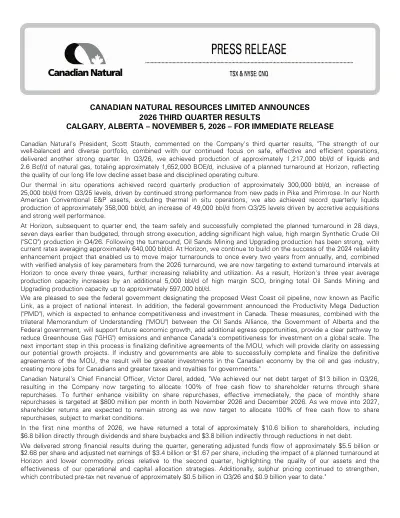
Thank you, Lance, and good morning everyone. Q3 2026 was another strong quarter for Canadian Natural, highlighting the strength of our long-life, low-decline asset base, and our continued focus on safe, reliable, and effective operations.
Our diverse portfolio delivered resilient production through the quarter, even with a planned turnaround at Horizon, with total production averaging approximately 1.65 million BOEs per day, an increase of approximately 31,000 BOEs per day from Q3 2025, reflecting the depth and flexibility of our asset base and the quality of execution across our operations. At Horizon, subsequent to the quarter end, we safely and successfully completed our planned turnaround in 28 days, 7 days ahead of schedule.
This achievement adds approximately 23,000 barrels per day of incremental, high-margin SCO production in the fourth quarter, enhancing both production and cash flow. Complimenting that, oil sands mining and upgrading production has been strong, with current production at 640,000 barrels per day.
Importantly, based on the success of the 2024 reliability enhancement project and analysis completed during the 2026 turnaround, we are now extending the turnaround intervals at Horizon from once every 2 years to once every 3 years. This continuous improvement initiative increases average production capacity by approximately 5,000 barrels per day of high-value SCO over the 3-year cycle, and further enhances the reliability and top-tier competitiveness of our oil sands mining and upgrading operations.
Operationally, we achieved several production records during the quarter. Our thermal in situ operations delivered record quarterly production of approximately 300,000 barrels per day, an increase of 25,000 barrels per day, or 9% compared to Q3 last year.
At Jackfish, we achieved record production of approximately 143,000 barrels per day, exceeding facility nameplate capacity by approximately 23,000 barrels per day. Strong performance continues to be supported by the new SAGD pads at Pike 1, which are producing approximately 46,500 barrels per day while maintaining an industry-leading steam to oil ratio of 1.7 times.
In our North American conventional E&P business, excluding thermal in situ production, we achieved record quarterly liquids production of approximately 358,000 barrels per day, representing growth of approximately 16% from Q3 2025 levels. Included in this performance was record North American light crude oil and NGL production of approximately 217,000 barrels per day.
These results reflect the value created through our recent strategic acquisitions and strong drilling results and the strength of our development program. Looking ahead, we expect a very strong fourth quarter, driven by strong performance in oil sands mining and upgrading, continued strength from our thermal in situ operations, and reliable execution across our entire portfolio.
Finally, we are encouraged by several developments that support the long-term competitiveness of Canada's energy sector, including the designation of the proposed PacificLink Pipeline as a project of national interest, continued progress towards finalizing the memorandum of understanding between industry, Alberta, and the federal government, and the introduction of the Productivity Mega-Deduction, all of which support investment in major capital projects and strengthens Canada's competitiveness on a global scale. Together, these initiatives have the potential to support responsible future growth and create many more jobs, more taxes, and more royalties for all Canadians.
With that, I will turn it over to Victor for the financial review.
Victor Darel
Thank you, and good morning. As Scott already noted, we delivered strong operational results in the third quarter of 2026 and are set up for an even stronger Q4, with the planned turnaround at Horizon completed ahead of schedule.
We delivered strong financial results during the quarter, generating adjusted funds flow of approximately $5.5 billion, or $2.68 per share, and adjusted net earnings of $3.4 billion, or $1.67 per share. Our ability to generate significant free cash flow and consistently deliver solid results is underscored by the strength of our high-quality asset base and our operational effectiveness.
Our business continues to benefit from a highly diversified product mix and strong marketing strategy. Approximately 66% of or 66% of our total targeted 2026 liquids production is high-value SCO, light crude oil, and NGLs.
During the quarter, SCO pricing averaged a premium of $5.65 U.S. per barrel to WTI, reflecting strong diesel pricing.
Sulfur pricing also remained strong, contributing approximately $500 million of pretax net revenue during the quarter and approximately $900 million year to date, and further contributing to the strong returns this year. In the first nine months of 2026, we have returned a total of approximately $10.6 billion to shareholders, including $6.8 billion directly through dividends and share buybacks, and $3.8 billion indirectly through reductions in net debt, further enhancing long-term shareholder value.
Our industry-leading dividend remains a key component of our shareholder return strategy. Following the dividend increase earlier this year, 2026 is the 26th consecutive year of dividend increases, and reflects the sustainability of our business model, the strength of our balance sheet, and the durability of our asset base.
Subsequent to quarter end, the Board approved a quarterly dividend of 62.5 cents per common share, payable on January 5th, 2027 to shareholders of record at the close of business on December 15th, 2026. Most importantly, we achieved our net debt target of $13 billion earlier than anticipated, ending the quarter with approximately $12.1 billion in net debt.
This advances shareholder returns in the form of buybacks to 100% of free cash flow, per our policy. To further enhance visibility around shareholder returns, effective immediately, we are targeting monthly share purchases of $800 million in both November and December 2026.
Year to date, including the dividend just paid in October and our targeted share repurchases in Q4, we are on track to deliver significant direct shareholder returns in 2026, equating to over $5 per share, underscoring the strength of our free cash flow generation and disciplined capital allocation framework. Looking forward into 2027, we expect shareholder returns to remain strong as we continue to prudently balance free cash flow generation and capital allocation priorities.
Our balance sheet is exceptionally strong, our assets continue to generate significant free cash flow, and our flexible capital allocation framework positions us to continue to drive resource value growth and deliver leading returns to shareholders. With that, Scott, I'll turn it back to you.
Scott Stauth
Thanks, Victor. In summary, our world-class asset base, our culture of discipline, and our relentless focus on being the most effective and efficient operator continue to differentiate Canadian Natural.
The operational milestones achieved during the quarter, including the completion of the Horizon turnaround ahead of schedule, the extension of Horizon's turnaround intervals to 3 years, and record production across several areas of our operations are further examples that demonstrate the strength of our long-life, low-decline asset base, and our commitment to safe, effective, and efficient operations. In addition, we are seeing growing momentum behind policies and initiatives that support investment, improve competitiveness, and recognize the importance of Canada's energy sector, creating a more favorable environment for long-term growth and value creation.
Combined with disciplined capital allocation and shareholder alignment, these initiatives position us to continue to deliver long-term value for our shareholders. With that, I will open it up to questions.
Operator
Thank you. Ladies and gentlemen, we will now begin the question and answer session.
Should you have a question, please press the star key followed by the number 1 on your touchtone phone. You will hear a prompt that your hand has been raised.
Should you wish to decline from the polling process, please press the star key followed by the number 2. One moment, please, while we assemble the queue.
Your first question comes from Doug Leggate of Wolfe Research. Please go ahead.
Doug Leggate
Good morning, everybody. Thanks for taking my questions, Scott.
Nice to see the ride to the 100% return. I wonder if I could ask a couple of I guess kind of bigger-picture questions.
I'd love to get your perspective on what's going on with WCS. We heard from Cenovus the other day that they were talking freight amongst other things.
Love to know what you're thinking about that dynamic. Then secondly, the MOU is obviously on everybody's mind in the middle of November.
I'm wondering your prognosis for that timeline. What are the enabling parameters that you would need to see to commit to another leg of growth over the longer term?
Thank you.
Scott Stauth
Thanks, Doug. With regards to WCS, I would suggest that when you think about the impacts of the increased Venezuelan production, the high shipping rates, those would be the factors that we see as having some implications to the widening of the differential.
Fundamentally, if you look at the spread between Hardisty and Houston, that value is still an approximate to the transportation costs. I don't think we're seeing the system as being completely full, and I would also add to that that the DRA expansion on TMX is from our view starting to take effect, and so that adds 90,000 barrels a day of additional egress to the system.
Doug, I would say the system is close to full, it's not full, and the factors around the spread between Hardisty and Houston indicate that, and the positive sign is that the DRA is going to add additional barrels going to the west coast. I feel pretty good about where we're at in terms of pricing, and we'll see what happens as we go forward with WTI.
Doug Leggate
Thank you. On the the Thank you.
Go ahead.
Scott Stauth
On the MOU, Doug, I would suggest that the primary focus needs to be on achieving the outcomes that each of the parties are seeking to accomplish, and that is to be the primary focus. The secondary focus is the date of November 15th.
It's more about focusing on ensuring that we get it right than focusing on a particular date to get it completed and signed. I would suggest that everyone's working together in the right direction to try accomplish it, and so just emphasizing the focus on getting it right rather than having the focus on the particular date.
Doug Leggate
Thank you, guys. Appreciate the answers.
Scott Stauth
Thanks, Doug.
Operator
Your next call comes from Dennis Fong of CIBC Capital Markets. Please go ahead.
Dennis Fong
Hi, good morning, and thanks for taking my questions, as well as congratulations on a really strong quarter. My first question here is just around Horizon.
I was hoping you could elaborate a little bit more on some of the work completed or the discoveries that you had just around the work at Horizon that kind of provides you confidence in terms of extending towards the 3-year time horizon for turnarounds. Secondarily to that, in terms of what opportunities have you guys been able to unlock in terms of keeping the plant or the facility running while either smaller work or smaller amounts of maintenance can be completed that again could potentially help further raise the bar even further on a go-forward basis?
Scott Stauth
Thanks, Dennis. Leading up into 2026, and we had completed the final tie-ins in 2024 of the reliability enhancement project, and that project mostly entailed enhancing the reliability for the primary upgrading unit, in particularly the front-end diluent recovery unit heaters and the vacuum distillation unit process heater as well.
We built in the additional reliability that enabled us to not have to shut down to clean those furnaces. Secondary to that, we have done some work in our secondary upgrading units as part of the reliability project to enhance that reliability, and position ourselves to answer the second part of your question, to where we can have a part of the secondary units out of service, a distillate treater or a gas oil hydrotreater could be out of service for minor turnaround activities and not actually impact the production because we would be producing into tankage while those units are being serviced.
That's really helped on the back-end side of the upgrader. Then if you fast forward to 2026, all those things combined in addition to our continuous online monitoring of performance of all the equipment throughout the entire upgrader, we had a strong belief that we were in a very good position to be able to extend the turnaround.
We needed to confirm that by going into the units and ensuring that the conditions that we had expected were actually realized, and that became the case, and that gave us the confidence to be able to move forward to performing a turnaround once every 3 years. All of that gave us the extended turnaround, Dennis.
It also improved the overall reliability, and it actually helped us increase our production over the past number of years.
Dennis Fong
Great. Really appreciate that color and context there, Scott.
I wanted to shift my second question to focus on the thermal heavy oils. Clearly, the drill-to-fill program at Wolf Lake Primrose has really been helping in terms of, hey, backfilling the oil treating and handling capacity there, but does still seem like steam capacity there may be a little bit of a limiting factor.
How do you think about the progression or the potential development of that asset, A, in the drill-to-fill component of the program, and obviously dealing with steam limit on the upper end, versus, we'll call it, potentially situations that occur or arise if some version of a deal around royalty incentives do follow through?
Scott Stauth
Yeah. Dennis, with regards to Primrose Wolf Lake, the primary plan there is to have pad adds that maximize the capacity of the steam plants.
The process treating facility has additional capacity, the steam plants are the limiting factor there. If you think forward about where we would be going in the future to take advantage of that additional processing capacity and with the potential constraints with steam plants, we would lean towards thinking about the solvent enhancement opportunities so you'd reduce your steam usage and be able to take greater advantage of that existing capacity that we have in the processing plant for processing the oil, Dennis.
We continue to work on that. We have the steam flood there.
That's also working very well. That's helping us prioritize steam to our new wells in Primrose.
The next step would be as we think about future growth opportunities there would be to looking at things such as solvent, and that directionally is where we're headed, Dennis.
Dennis Fong
Great. Thank you so much.
I really appreciate the color. I'll turn it back.
Operator
Your next question is from Menno Hulshof of TD Securities. Please go ahead.
Thanks, and
Menno Hulshof
good morning, everyone. Maybe I'll start with a question on what drove the decision to move to monthly buybacks through the end of the year.
Should we think of this as a sort of a 2-month trial that was partially triggered by this week's sharp pull back, or is it plausible that you extend rateable monthly buybacks into 2027?
Victor Darel
Thanks for the question. No, I wouldn't say that it's a trial period.
Effectively, we just really want to make sure that shareholders understand the share buyback target here over the near term, and we'd expect to continue on a similar basis should free cash flow continue to look strong in the new year. When we look at the forward curve right now, we still see very strong levels of free cash flow generation, and so looking forward to pretty strong 2027 and strong rates of share buybacks in the year.
I'd expect it to continue at this rate until we see changes in commodity pricing, and I think the pricing conditions this week aside, I think that we're pretty comfortable where we're at.
Menno Hulshof
No, that's great. Just to confirm, we should just assume $800 million per month until you tell us otherwise or we see it in the public data?
Victor Darel
That's right. I anticipate we'll do a good job communicating if we need to make a change.
Menno Hulshof
Terrific. Thank you.
Then second question, just on your increase in commitments on TMX and the increased export capability that comes with that. Can you just give us a sense of how that capacity became available, how you're managing the freight rate cost risk, and then how much of that part of the cost structure have you managed to lock in?
Thank you.
Scott Stauth
Yeah. You bet.
If you look at the increased capacity on TMX, that came through the process where TMX came out and moved volumes from spot to firm as part of the overall toll settlement process, so that's where that came from. Then secondly, your question on the actual egress part of it for our movements work, we have contracts for ships to move our product, and so that's how we're working the deliverability through our mainline commitments.
Menno Hulshof
Perfect. Thanks a lot, Scott.
I'll turn it back.
Operator
As a reminder, if you would like to ask a question, please press star 1. Your next question comes from Greg Pardy of RBC.
Please go ahead.
Greg Pardy
Thanks. Good morning.
I wanted to come back to what Dennis was asking about, and Scott, you'll know where the question's going, right? Is if you've managed to move from 2 to 3 years, is it conceivable that you could see further extensions, maybe to 4 to 5 years, not entirely uncommon with big effectively refineries, which is what you guys are running.
I'm just curious as to whether that evolution is possible in your minds.
Scott Stauth
It's possible, Greg. What we'd like to see is again a focus on our on-stream online monitoring of all of the equipment, and then as we get into the next turnaround, which would be in 2029, we will be able to determine at that point whether or not the next step to 4 years or, as to your point out, potentially 5 years is within the realm of that.
I would just argue today that we don't see anything that would prohibit that, but at the same time, our view is we made a couple of big steps in the last couple of years. We want to ensure that we can confirm that everything that we've worked on, and we've developed, and our plans are solid before we take that next step.
Greg Pardy
Understood. Maybe just shifting gears.
Big working capital tailwind in the quarter, give or take, a couple of billion. I'm just curious what Victor's thinking maybe with respect to the cash tax payable in the first quarter of '27.
I think we have a couple of billion in there right now as a headwind on working capital, but just wondering if that number's still reasonable, or whether we should lift that higher.
Victor Darel
I would say modestly higher than that, Greg, 2, 2 3, 2 4, could be a little higher. It could depends on profitability here in the last quarter, but as we're already mostly the way through.
It's a pretty regular, of course, payment. I don't see anything unusual there.
We've got that modeled into the share repurchase program, the $800 million target holds unless we see a real significant shift in commodity pricing here. I think your number's pretty dead on, maybe just a tad low.
Greg Pardy
Understood. Thanks very much.
Scott Stauth
Thanks, Greg.
Operator
There are no further questions at this time. I will now turn the call back over to Lance Casson.
Please continue.
Lance Casson
Thank you, Operator, and thanks to everyone for joining the call this morning. If you have any questions, please don't hesitate to call.
Have a great day.
Operator
Ladies and gentlemen, that concludes today's conference call. Thank you for your participation.
You may now disconnect.