Canadian Pacific Kansas City Limited
Q3 FY2026 · Earnings Call TranscriptOctober 28, 2026
Operator
Good afternoon, everyone. My name is Bo, and I will be your conference operator today.
At this time, I would like to welcome everyone to CPKC's third quarter 2026 conference call. The slides accompanying today's call are available at investor.cpkcr.com.
All lines have been placed on mute to prevent any background noise. After the speakers' remarks, there will be a question-and-answer session.
If you would like to ask a question at that time, simply press *, then the number 1 on your telephone keypad. If you would like to withdraw your question, press *2.
I would now like to introduce Mr. Chris de Bruyn, Vice President, Capital Markets, Tax and Treasurer.
Please go ahead, sir.
Chris de Bruyn
Thank you, Bo. Good afternoon, everyone, and thank you for joining us today.
Before we begin, I want to remind you this presentation contains forward-looking information. Actual results may differ.
The risks, uncertainties, and other factors that could influence actual results are described on slide 2, in the press release, and in the MD&A filed with Canadian and U.S. regulators.
This presentation also contains non-GAAP measures outlined on slide 3. With me here today is Keith Creel, our President and Chief Executive Officer; Nadeem Velani, our Executive Vice President and Chief Financial Officer; John Brooks, our Executive Vice President and Chief Marketing Officer; and Mark Redd, our Executive Vice President and Chief Operating Officer.
The formal remarks will be followed by Q&A. In the interest of time, we would appreciate if you limit your questions to one.
It is now my pleasure to introduce our President and CEO, Mr. Keith Creel.
Keith Creel
Thanks, Chris, and good afternoon, ladies and gentlemen. Thank you for joining us on the call today.
First and foremost, I want to extend a heartfelt thank you to our 20,000 strong family of railroaders across the three countries that produced the results our team has the honor of discussing today. We're extremely proud of what this team's delivered during this quarter, handling strong growth, running the railroad extremely well, and continuing to create opportunities across this very unique network.
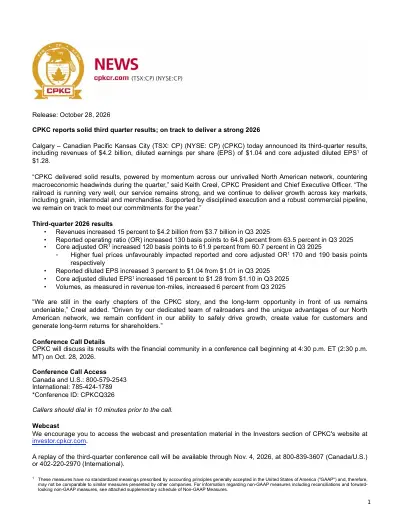
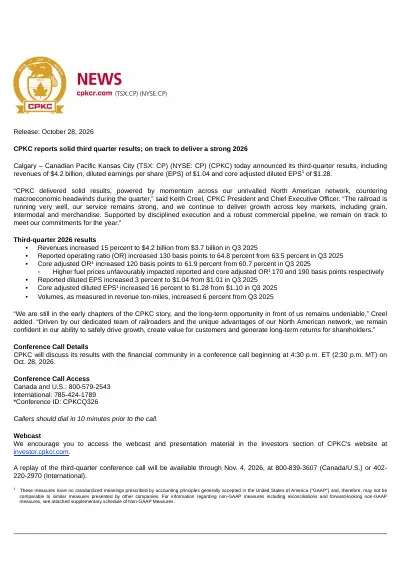
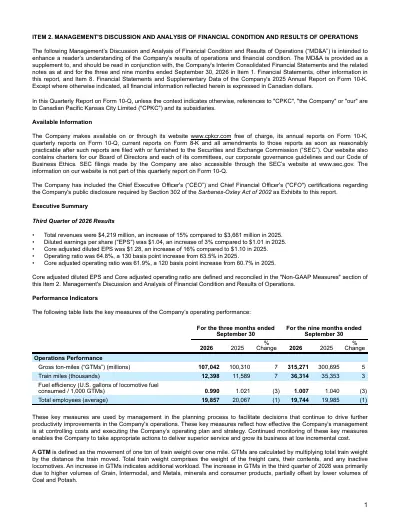
Looking at the quarter on the results side, we delivered third quarter revenues of $4.2 billion, volume growth of 6%, an operating ratio of 61.9% that generated 16% adjusted EPS growth. Against a pretty dynamic backdrop, I'm pleased with what the team has delivered.
We handled 6% more volume while continuing to improve the performance of the railroad, and more importantly, there is so much more opportunity in front of us. On the car velocity, train velocity, fuel efficiency, terminal fluidity, all showed strong improvement year-over-year in operations, and this credit belongs to Mark, his senior team, and the railroaders across our network executing our plan every day.
Nick Walker, Greg Squires, Jason Ross, Brad Robertson, Braden Teed, Tom Bargonier continued to provide strong leadership, and I'll tell you we're fortunate to have a deep, experienced, and talented bench of operating leaders across this network. We've invested ahead of growth, we've got the people, the locomotives, and the infrastructure aligned with our demand.
We're prepared to grow, and we're becoming better railroaders each and every day. Operational excellence is a journey, it's not a destination.
There's more opportunity to be mined, and rest assured, I'm confident this team will continue to find it. On the commercial side, John and his team continue to convert the reach and the opportunities this network creates into new markets, new products, and profitable, sustainable growth during the quarter.
We established all-time volume records in domestic intermodal, international intermodal, and U.S. grains.
These outcomes reflect strong service discipline in the market and unique options this network creates for our customers. We also announced a meaningful expansion of our relationship with Elk Valley Resources to move their product from the mines that we serve in Southeastern British Columbia to Vancouver for global export.
This expanded agreement reduces complexity, strengthens end-to-end supply chain, and positions CPKC and EVR to grow together for years to come. Our Canada-Mexico land bridge is another powerful proof point which continues to generate value in the face of uncertainty.
When we brought these two railroads together just over three years ago, this traffic was about 100 million in annual revenue. We expect to exit this year north of 600 million.
This is not growth we inherited, it's growth that we created, taking a challenge and turning that challenge into an opportunity, creating new markets enabled by this unique North American network. Importantly, we delivered 6% volume growth despite headwinds across certain markets during the quarter.
That tells you something about the quality and the diversity of our growth opportunities as we remain well on track for another year of mid-single-digit volume growth. It also speaks to the alignment between our operating and commercial teams.
The operating team delivers the service, the commercial team takes the service to the marketplace and creates opportunities. They've been doing it consistently since we brought these two networks together over 3.5 years ago.
The bottom line, when you combine industry-leading operations, a unique network built for growth, and a hungry, disciplined commercial team, you create a very compelling outcome. Let me leave you with this: the larger message has not changed.
We have a railroad that's running extremely well, a differentiated network, a deep pipeline of growth opportunities that are in front of us. I'm proud of what the team has delivered in this quarter, but rest assured, we are not satisfied.
We know there's more work to do, and more importantly, opportunity to capture. The team will remain focused on execution, taking care of our customers, converting these opportunities into profitable, sustainable growth.
With that, I'll turn it over Mark to walk through the operation, John to give you some color on the markets, and Nadeem will close it up before our questions, elaborating on those numbers. Over to you, Mark.
Mark Redd
Thank you, Keith, and good afternoon. I want to begin by thanking our railroaders for another strong quarter of execution.
Our network is running very well, delivering reliable service for our customers while supporting continued growth across the business. We saw strong improvement across several of our operating metrics: train speed improved 8%, dwell improved 7%, car miles per car day increased 10%, locomotive productivity up 4%, fuel efficiency improved 3%.
These results demonstrate the strength of our PSR operating model. In a review of the safety results, our personal injury frequency was 1.12, which is 20% higher than last year.
Our train accidents improved 60% to 0.46. While we are pleased with the train accident results, the increase of the personal injuries does not meet our standard.
Safety is a never-ending journey. We will learn from every incident, reinforce the fundamentals, stay focused on what matters most, every railroader going home safe at each and every shift.
Turning to labor, in the U.S., we reached agreements that bring employees from several separate agreements under our MidSouth agreement. This simplifies how we operate, provides greater flexibility, helps us run a more consistent, reliable service for our customers.
I'm also pleased to announce that we have two new collective agreements with BLET, SMART, have been ratified on the DM&E and Soo Line properties. In Canada, CPKC and the IBEW agreed to binding arbitration, ending the strike involving approximately 300 signal and communications employees.
Turning to capital, we continue to make disciplined investments in safety, growth, and efficiency. We have received 170 of the Tier 4 locomotives from Wabtec, we're beginning to receive 35 more from Progress Rail.
In total, we expect to bring on 300 new locomotives through 2028. We're already seeing benefits in these investments.
The newer locomotives have contributed to more than 35% reduction in our service interruptions on our 100-series trains in Canada, a 10% reduction in interruptions in our Western Canadian grain fleet, while improving fuel efficiency on both services. We are strengthening the tools that our service design team uses to plan and operate the railroad.
We've recently moved into the new planning platform that gives the team near real-time visibility into traffic and network conditions, along with a greater control of the data and the models used to build the operating plan. This in-house tool replaces a legacy third-party application.
That visibility allows us to evaluate operating scenarios faster, responding to changing traffic patterns sooner, refine the plan as conditions change. This is what disciplined PSR execution looks like: better information, quicker decisions, and even more tighter alignment between the operating plan, our resources, and customer demand.
In closing, I'm proud the way that the railroaders continued to execute across the network. This railroad is running well.
We're building on that strong foundation with disciplined investments in our people, capacity, equipment, and technology. Together with our PSR model, these investments are improving reliability, creating capacity, positioning us to safely handle John's and his team's growth.
We're never satisfied. We will keep controlling what we can control, keep our foot on the gas, and continue making this railroad better every day.
With that, I'll turn to John.
John Brooks
All right, yeah, thank you, Mark, and good afternoon. The CPKC team and this unique network produced another record quarter, driven by strong operating and commercial execution.
We delivered record Q3 freight revenues and RTMs, up 15% and 6%, respectively. Cents per RTM increased 9%, reflecting sustained pricing strength and higher fuel surcharge revenue.
Our capacity and reliable service support new business initiatives and share gains, while disciplined pricing remains a core focus. Moving on to the next slide, I want to highlight the consistency of our industry-leading growth.
We have delivered consistent RTM growth across our three-nation network, with year-to-date Q3 volumes, ex-coal, up 17% since the merger. That performance, despite a tough macro backdrop, is driven by disciplined commercial execution, self-help initiatives, and strategic share gains.
Our strong service product, network fluidity, and available capacity provide the foundation for this growth. Now, taking a closer look at our third quarter revenue performance, I'll speak to the FX-adjusted results.
Starting with bulk, Q3 was another record quarter for grain, with record revenue, RTMs, and carloads. Revenue increased 27% on 23% volume growth.
Canadian grain volumes increased 35%, driven by a high carryout of stocks following the record harvest, growth into our Mexico market, and strong Vancouver exports. U.S.
grain volumes increased 13%, driven by strong corn demand into Mexico and exports through the PNW. Now looking ahead, we expect continued grain volume growth through the end of the year and into early 2027, supported by healthy supply and demand fundamentals combined with our diverse market reach.
We are also very encouraged by new crush production coming online in both Canada and the U.S., including our new contract with LDC at Yorkton. Potash revenues were up 8% on a 7% decline in volume, with performance reflecting the impact of Canpotex's Portland terminal maintenance during the quarter.
Now looking ahead, export demand fundamentals remain healthy, and Portland's maintenance is now completed. We expect a return to solid growth for the remainder of the year.
To round out bulk, coal revenue declined 1% on an 11% reduction in volume. The decrease continued to reflect production-related challenges at the mines.
However, as expected, this volume headwind is continuing to moderate. More importantly, as Keith mentioned, I'm very excited about our new five-year contract with EVR.
This agreement establishes a strategic long-term partnership for CPKC and EVR, resetting to what good service looks like for our Canadian coal franchise. Now moving on to merchandise, energy, chemicals, and plastics revenue increased 9% on flat RTMs.
Higher energy prices have shifted some of our commodity flows into shorter-haul domestic and export market, creating a headwind versus our expectations on the quarter. As energy prices moderate over time, we expect those trade flows to normalize.
At the same time, I can tell you this team remains laser-focused on controlling what we can control, and that's winning new business and pursuing self-help opportunities that will only set us up well as we go to 2027. Forest products revenue increased 9% on a 2% volume growth.
We delivered solid and resilient growth in this space despite softness in housing and cross-border tariffs. Our focus on industrial development opportunities supports growth against the softer macro backdrop.
The metals, minerals, and consumer products area revenue increased 13% on 8% volume growth. We continued to deliver growth and record quarterly volumes in steel, aluminum, and metal, supported by good demand from industrial production and construction activity.
Moving to the automotive area, revenue increased 5% on a 5% volume decline. While the quarter was significantly impacted by plant retooling and production holds, we remain confident in the long-term growth outlook for automotive franchise.
We have line of sight to return volume growth for the fourth quarter and into 2027, supported by share opportunities and the conversion of short sea traffic to rail. Now closing with intermodal, revenue increased 21% on a 10% volume growth and all-time record performance.
Domestic intermodal volumes increased 7% in the quarter. Growth was supported by strong performance across our Canadian domestic lanes, along with continued strength in our U.S.
lanes and Mexico cross-border service. Our SMX product with CSX continues to build momentum, with volumes up 30% sequentially.
Our service reliability on both our MMX and SMX intermodal products position us well to continue to build trust with our customers and capitalize on favorable truck-to-rail conversion opportunities. In international intermodal, volumes increased 11%, driven by continued strength in shipments from the Port of Vancouver for Gemini and also CMA.
Our capacity at both the port and inland terminals support reliable service and sustainable, profitable growth. We are particularly excited about the recent federal funding announcement for the Port of Saint John, including significant investments in the port, water access, warehousing, and rail efficiency.
This nearly $500 million investment will unlock capacity to handle up to a million TEUs of capacity and support growth through this premier gateway for years to come. To close, the growth we are delivering is differentiated and sustainable.
It is supported by strong service, disciplined pricing, and an expanding pipeline of self-help opportunities that are unlocked by this unique network. We are well-positioned for a strong finish to the year, and I remain confident in our ability to carry this momentum into 2027 and beyond.
With that, I'll pass it over to Nadeem.
Nadeem Velani
Great. Thanks, John, and good afternoon.
I'm pleased with the solid results the team delivered this quarter. Strong volume growth, disciplined pricing, and continued productivity gains drove 16% growth in core adjusted diluted EPS, despite the margin pressure from higher fuel prices.
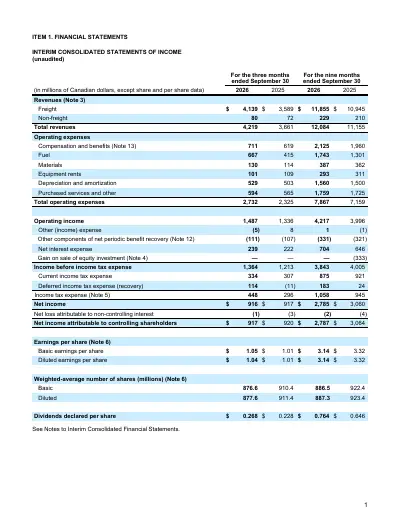
Now turning to our third quarter on slide 15, CPKC's reported operating ratio was 64.8%, our core adjusted OR was 61.9%, up 120 basis points from last year. Diluted earnings per share was $1.04, and core adjusted diluted EPS was $1.28, up 16% versus last year.
Taking a closer look at our expenses on slide 16, I'll speak to the year-over-year variances on an FX-adjusted basis. Core adjusted comp and benefits expense was $708 million.
The year-over-year increase was driven by higher stock-based and incentive compensation, wage inflation, and volume-related expense. These increases were partially offset by strong productivity gains, including lower overtime and workforce efficiencies.
Looking ahead, we now expect full-year headcount to be down slightly. This, combined with mid-single-digit volume growth, continues to drive strong labor productivity and operating leverage.
Fuel expense was up 56% year-over-year, driven by a 53% increase in average fuel price, as well as higher volumes. The change in fuel price was a 190 basis points headwind to core adjusted OR in the quarter, while providing a modest benefit to earnings.
Our continued focus on fuel efficiency, supported by our locomotive investments, drove a 3% improvement in the quarter and generated $21 million in savings. Materials expense was up 12% year-over-year, driven primarily by higher fuel prices on our non-locomotive fleet.
Lower locomotive material costs partially offset the increase. Equipment rents were 9% lower versus prior year, as improved network performance and cycle times more than offset the impact of increased volumes.
Depreciation and amortization expense was up 4%, driven by a larger asset base. Core adjusted PS&O expense was $568 million.
The year-over-year increase reflected inflation, volume growth, and other operating costs, partially offset by lower casualty costs and productivity gains, including lower crew and terminal costs. Overall, I'm pleased with the operating leverage we delivered in the quarter.
Volume growth, disciplined pricing, and continued productivity improvements drove double-digit earnings growth, despite higher fuel prices creating pressure on the operating ratio. Moving below the line on slide 17, net interest expense was $239 million, or $235 million excluding purchase accounting.
The increase was driven primarily by interest on new debt, partially offset by debt repayments. Income tax expense was $448 million, or $369 million adjusted for purchase accounting and significant items.
We continue to expect a full-year core adjusted effective tax rate of approximately 24.75%. Now turning to slide 18 and cash flow, our earnings growth continues to translate into strong cash generation.
Year-to-date net cash provided by operating activities is up 12%, while adjusted free cash flow increased 59% to $2.4 billion. Year-to-date capital expenditures were $2 billion, down 12% from last year, and we remain on track to deliver full-year capex of approximately $2.65 billion, a 15% reduction versus last year.
Our targeted investments over the last several years in network capacity and locomotives are delivering tangible benefits, as demonstrated by our operating, productivity, and fuel efficiency performance. Through the first three quarters of the year, our disciplined approach to capital management delivered over $4 billion of shareholder returns through share repurchases and dividends, reflecting a balanced and opportunistic allocation of capital.
Stepping back, I'm pleased with the overall performance in the quarter. We delivered strong earnings growth and cash generation, while continuing to improve productivity across the business.
As we move into the fourth quarter, we remain focused on execution, and we are very well-positioned to deliver on our full-year guidance. With that, let me turn it back over to Keith.
Keith Creel
Okay. Thank you, gentlemen.
Operator, if you could, let's open it up for questions.
Operator
Certainly, Mr. Creel.
Thank you. Ladies and gentlemen, at this time, if you do have any questions, please press *, then the number 1 on your telephone keypad.
If you do find your question has been addressed, you can withdraw your question by pressing *2. As previously highlighted, please limit yourself to one question.
We'll go first this afternoon to Steve Hansen with Raymond James.
Steve Hansen
Good afternoon, guys. Thanks for the time.
Keith, I'm hoping you could provide a little more color on this new Elk Valley agreement, your additional or higher share of the haulage, and just what kind of growth you might contemplate through the new term. It does sound like service and route simplicity played a role here.
Curious if the investment announcements in Neptune also played a role recently. Thanks.
Keith Creel
Thanks, Steve, thank you for the question. Just in context, if you go back to the last contract, I guess, with our competitor, Canadian National, historically, before that contract, CP originates 100% of this coal and terminated 100% of the coal, kind of from the mine to the tidewater.
Now this coal goes to the North Shore. CNX is our agent as they do for potash, as they do for grain.
This last contract, CN and back then I guess it would have been Teck Coal, introduced an interchange at Kamloops, which you have 100% of the traffic we originate that some interchanged to CN at Canadian National to go to those same locations at tidewater in Vancouver. I think we all understand, every time you introduce a handoff and/or interchange, you create complexity and an opportunity for introducing supply chain cost and/or compromising reliability.
I would suggest, over the period of that contract, that has happened in small and large part to a point that in our negotiations, that became a topical point. What's happening now is about half of the traffic that today interchanges to our competitor at Kamloops to go to the North Shore of Vancouver will be reclaimed back to CP origin to destination, and the interchange at Kamloops will be eliminated for that traffic.
About a train and a half will flip back to CP's route cradle-to-grave.
Steve Hansen
Very helpful. Thanks.
Keith Creel
Thanks, Steve.
Operator
We'll go next now to Brian Ossenbeck with J.P. Morgan.
Brian Ossenbeck
Afternoon. Thanks for taking the question.
Maybe just a big picture question for John, just how you're thinking about the pricing opportunity going forward and balancing that with volume growth, and of course, network resources. I would assume there's some inflation you're expecting to cover, but in terms of just the broader truckload market and all support that we'd see from the market itself, should we expect something a little bit better than usual when we think about just kind of the run rate, maybe that mid-single digits?
Of course, probably an impact from the Canadian grain being lagged with a fuel surcharge. We appreciate some comments on that.
Thanks.
John Brooks
Brian, I'm bullish on the pricing outlook. It's been a pretty good run, and I think you've seen our commercial team be extremely disciplined in the marketplace.
That's not going to change. I'll just be candid.
Renewals continue to be that 3% to 4%, or even more in some cases. I don't see that changing.
We're going to stay aggressive on that front. Obviously, the fuel surcharge, where it's at in the marketplace, kind of has introduced another dynamic that we're keeping an eye on and making sure that we're competing in the markets like we need to be.
I continue to have a pretty favorable outlook to close out this year. Most of our book is already pretty much renewed, but I got a favorable outlook as we look into the beginning of 2027.
Operator
Thank you. We'll go next now to Fadi Chamoun with BMO Capital Markets.
Fadi Chamoun
Yes, good evening. You talked about the deep pipeline and growth going forward.
I was hoping you can elaborate on kind of what verticals, what do you see, share with us some thoughts on where these opportunities are as you go kind of over the next 12, 24 months. Any kind of high-level idea on how to think about RTM growth in 2027, given this kind of deep pipeline, and now you have a bit of a visibility into the grain and the coal story, I guess, going into next year.
How do you see things shake out from an RTM growth next year?
John Brooks
Fadi, I don't think they're going to let me quite guide to '27 yet, but I will give you some color. Certainly we've had a really good bulk year this year.
Those compares are going to be tougher as you look at 2027. I'll tell you, I'm still pretty bullish that we have not wrung out all the opportunity specific to this grain franchise.
We continue to uncover more and more opportunities into the southern part of our network and growth into Mexico and driving efficiency there. Despite what I do see as tougher comps in that space, I'm convinced we have some upside in there.
This crush market and the development of that business, not only in Canada, but also in the U.S., has been pretty good. It really diversifies our grain business.
Those crushers got to crush 365 days a year. They're a production facility.
That's really good business, and I think that's an area that you should look to as some upside. Keith mentioned the land bridge earlier.
I've spent here the last few weeks in Mexico meeting with customers, and that area only continues to build momentum. That's both carload type business and steel products and paper products, but it's intermodal opportunities in that, too.
I expect to build on that land bridge. I would suggest to you that we're also in the early innings of this domestic intermodal story.
I remain bullish on our team's ability to convert truck opportunities. I've talked about we've got a hunter group in Mexico that is keenly focused on uncovering those opportunities and converting new customers.
We're working close with CSX on our SMX product that only provides further upside. We posted really good international numbers this year on some wins.
Between the opportunity and the investment that's going to go in at Saint John, there's a lot of upside there. We continue to see, albeit singles and doubles, we continue to see growth at Lázaro.
Who knows, as you see, the canal has had some challenges here on water levels. You could have a potential West Coast U.S.
strike with the longshoremen in 2027. We continue to be pretty bullish on Lázaro also in terms of growth.
That's a few nuggets that are out there, let alone some of the other things that we have coming down the pipeline.
Keith Creel
John, Fadi, if I could add that point about the strike in the West Coast. I think we all understand the complexity of how that might develop, and what's true now that wasn't true the last time is we have a viable, reliable route from Lázaro into the Houston markets and into the Midwest that shippers did not have a chance or an opportunity to diversify their risk relative to that strike.
I would suggest that will be part of the playbook, and once you get some of that traffic on your railroad, they experience the service, they experience the reliability, it may not all stick, but from a diversification play, we've realized our experience is some of it will. I think that bodes well to our growth aspiration.
Mark Redd
One comment I'd make is just also just staying in front of John with capacity. I know we are lockstep with different things that he's doing, business he's bringing on this railroad, we certainly got locomotives in place, resources in place for crews, and certainly better agreements that I spoke about that we can move people around in and around that southern part of U.S., Shreveport area, for sure.
Fadi Chamoun
Appreciate it. Thanks.
Operator
Thank you. We'll go next now to Jonathan Chappell with Evercore ISI.
Jonathan Chappell
Thank you, guys. Good afternoon.
John, I know they won't let you talk about the '27 RTMs, but maybe as it relates to the fourth quarter, you're running at about 5.5%. You've spoke of a lot of favorable things in your favor right now from auto to potash, etc., and then you also should still have some carryout, I would think, from the grain side.
How do you think about momentum for the rest of the quarter, given some of those things that seem to be shifting potentially from headwinds to tailwinds?
John Brooks
Jonathan, it's gas on. We're going to push it as hard as we can.
I think the markets are not perfect. There's ups and downs, and we've got some headaches that are out there.
We're going to push it hard. To your point, as I think about the bulk areas today to close out the year, I think it looks pretty good.
Domestic intermodal, our international business, I think looks pretty good. We've had a little bit of a rough go in the automotive sector here, but we also had chip issues and that in November, December last year.
Those compares will turn for us in those months. I'm super proud of my merchandise team.
That's an area that has just been strapped with tariffs and issues and ups and downs, and you've seen in the numbers, we've continued to battle in forest products and in the merchandise sector to post some pretty good numbers there. I'm not going to give you a number, but I'm optimistic that we can close pretty strong.
Thanks.
Operator
Thank you. We'll go next now to Ken Hoexter with Bank of America.
Ken Hoexter
Hey, great. Good afternoon.
Maybe I know you've talked a lot about maybe capturing some of the good grain crop, or I guess continuing it, but I don't think we got your expectation for next year in terms of, do you expect it to be down 5%, 10%, given the crop, or do you make that up? Then maybe just your thoughts on capacity.
You talked about buying locomotives and getting them on board. Where do you feel like you are in terms of this mid-to-upper single-digit RTM growth in terms of your ability to sustain that, or should we expect a rise in capex into '27?
Thanks.
Keith Creel
Ken, I'll let John address the commercial question. When it comes to capacity, I'll just remind everyone, we made a commitment to the STB with our transaction to build out this network to handle high single-digit RTM growth.
We haven't experienced that yet, but we've invested the capital, the infrastructure's there, we got the locomotives, we got the cars, we got the terminal, the track capacity, we got a new bridge. We're built for growth.
There'll be no issues with us adjusting our capital envelope.
John Brooks
Ken, we're going to finish the year as I mentioned, $2.65 billion this year. You might get a modest increase off of that given where the Canadian dollar is, but outside of that, we've guided long-term $2.6 to $2.8 billion range of capex, you should expect that range.
Nadeem Velani
Ken, there's no doubt we're coming off a record crop. I think the numbers are bouncing around still a little bit.
Feels like it's narrowing in on the 76 to 78 million metric ton area, what would that be, down, I don't know, about 8% or so. That being said, I know there's some growing territory in Southern Alberta and Southern Saskatchewan that historically we've had struggles the last few years in terms of drought and that, that are actually producing much better results this year.
We're optimistic actually in our growing territory that in some areas, we might actually be a little ahead of last year. We'll see what that all produces as we go in the next year.
I would say so far the customers are signaling sold-out demand pretty much through the end of this year, and I think the early outlook on Q1 is they remain fairly bullish. We'll see how that plays out.
Ken Hoexter
Great. Thanks, guys.
Appreciate the thoughts.
John Brooks
Thanks,
Operator
Ken. We'll go next now to Walter Spracklin with RBC Capital Markets.
Walter Spracklin
Thanks very much. Operator, good afternoon, everyone.
I just want to come back to your Elk Valley Resources agreement there, and congratulations on that. The question I have is really for how we model that now with all the moving parts that we saw this year with the outage at the mine level, and now you're recapturing half of what you lost to CN before.
It just makes it really difficult to look out to next year and put a number on what we should look at next year. I know that if we just go back to last year's numbers, you're up, that brings you up 15%, 20%, but now layer on this business, are we getting in that 20% range for what you could be up year-over-year in the coal set?
Just any kind of given the moving parts there, really appreciate any guidance you can provide on that particular vertical.
John Brooks
Walter, that's a tricky one. There is a lot of moving parts there.
I think Elk Valley has been pretty transparent around some of the challenges at the mines. That being said, the performance certainly has been much better, and we're watching it closely as we move through Q4 here.
I think if you look at year-over-year, their volumes overall probably going to end up 15% plus down in terms of tonnage. Honestly, it's kind of early in terms of what they're looking towards 2027.
When we have a better handle on what 2027 looks like in terms of their total tonnage output, that'll give us a better look. I apologize for skating around it a little bit, but the crystal ball's still a little cloudy on our side.
I think the bottom line is we feel really good about where we stand with them in terms of this additional train, train and a half to Neptune. In addition, as you've seen, they've signed a long-term agreement with Westshore, which is right in our wheelhouse too, and we expect some good growth there.
The combination of the two lines up for a good growth story. We just got to get nailed down exactly what this tonnage is going to look like for next year.
Operator
Thank you. We'll go next now to Chris Wetherbee with Wells Fargo.
Chris Wetherbee
Hey, thanks. Good afternoon, guys.
I thought slide 10 was helpful in terms of putting some perspective on what you guys have been able to accomplish since you closed the deal a few years ago. I guess as you think about where you stand now and the opportunities sort of in front of you, I know it's been a challenging sort of maybe a more challenging macro than you might have expected when you closed the deal, but you guys have obviously executed well through this.
Do we still think about sort of a 2 to 3 point sort of revenue premium or volume premium for the deal? I don't know if we can talk a little bit about that, and I know the farther we get away from it, the more difficult it is probably to pull these two apart.
Any big picture perspective, Keith or John, on how you guys are thinking about that as we look out to '27, '28?
John Brooks
I can tell you the expectation in the room is yeah, we're going to beat by 1 to 2 points consistently. Honestly, as much as I'm proud of our success and what we've been able to produce, you've said it, it's been in the face of a pretty tough macro environment.
Who knows, I've stopped guessing on when that may turn or not turn. At some point things will get favorable.
I think that gives us a tailwind, and you can rest assured, Chris, that I think we're going to continue to push hard. There's a lot of opportunities that I mentioned earlier that I still think produce and have the opportunity to produce for the next few years sort of an outweighted RTM performance against the industry or our peers.
Operator
Thank you. We'll go next now to Benoit Poirier at Desjardins.
Benoit Poirier
Good afternoon, everyone. Just in terms of nation-building project, we've seen quite a lot of positive news flow going forward in terms of energy, mining.
We also saw a latest announcement from Strathcona Resources on crude by rail. I was just wondering if you could provide maybe John or Keith an update how you see energy performing going forward, and if you would be able to quantify any potential upside from those nation-building projects longer term for CPKC.
Thank you.
John Brooks
Benoit, as I think about some of those projects, obviously, we're tightly working with Major Projects Office on a number of opportunities that are out there. I think there's pretty good alignment in terms of what some redevelopment could look like in Vancouver, and particularly the South Shore, as it relates to energy.
I think it's a little early to tell. You can probably guess what some of those projects might be, but I think it's a little early to tell on how that plays out.
I mentioned it earlier, and maybe it doesn't fit directly in the energy sector, we're super excited about basically the first project coming out of this Trade Diversification Corridor fund being all centered on Saint John. I think it's a testament to that acquisition that we made a few years back for the short line, it's a testament to the Irvings' belief in that opportunity in the port and DP World and and Hapag and Maersk and CMA and those steamship lines that have supported that port.
I can tell you it's a big part of our growth profile as you look to, let's say 2027 to 2030.
Benoit Poirier
That's great. Thank you very much, John.
John Brooks
Yes.
Operator
We'll go next now to Brandon Oglenski at Barclays.
Brandon Oglenski
Hi, good afternoon, and thanks for taking the question. I apologize in advance to everyone on the call, cuz I'm going to be that guy and ask about M&A, Keith.
Because I think you have followed your responsive requests last month, and obviously your competitors did that as well. I know you think this should be rejected on the merits, but can you speak to what was in those requests, and then maybe more specifically on the comments that we heard from [Closer?]
as well? Thank you.
Keith Creel
Thanks for the question, Brandon. First let me say this: CPKC in our initial filing, and you'll see in our subsequent filing November the 18th, we're not asking Santa Claus to visit us on Christmas.
I can tell you that. We're being very strategic, we're being very pinpointed, we're being very surgical, asking for, number one, complete rejection.
We don't want a condition, we don't want a concession. We don't think it's needed, we don't think UP needs it, we don't think NS needs it.
In spite of this narrative that the nation needs it, to create something that represents that much risk, that much market power forever is completely unneeded and unnecessary. Not now, and I say not ever.
That being said, if the STB finds a way to approving their deal, and I think you clearly understand I don't believe the facts lead to a yes, that being said, what you're going to see in our filing, again, not a Santa Claus list, but protections over gateways that are meaningful, that to this point the applicants have not offered, shipper access to protect competitive alternatives, to mitigate the market power that something as colossal as UP-NS would create for perhaps an industry like chemicals. I think they would be very concerned about that.
Removing restrictions on remaining independent railroads that hamper their ability to provide competition to UP-NS as well, paper barriers, etc., etc. Again, not a Christmas list, a reality list.
We think this whole thing, if you want to talk about Christmas, maybe it looks like a bag of coal. This isn't anyone trying to get a gift.
Since you've asked the question, I think I might as well address, and I've tried to, and you're probably going to say, 'I don't believe you,' bite my tongue, but quite frankly, the representations that continue to be made in support of UP's ambitions need to be dispelled. There's been quite a few references, and I would say absolutely based on fact misrepresentations of truth.
One I'll start with is this whole analogy about if it's good for Canada, it's good for the United States. They've got two transcons up there.
Why shouldn't we have one in the United States? I think maybe to quote one of the commenters, 'One of them doesn't like us to have the same thing here.'
Let's talk about what the same thing is. Scale and size matters, whether you want to admit it or not.
In Canada, you put the two railroads together, it's 21,000 route miles. You look at UP's network alone, it's almost double that.
You put the two networks together, two and a half times that. You think about the populations, think about how capital-intensive it is to run a railroad, to maintain a railroad.
In Canada, and I think Jim knows this, because he came from Canada, there's about 40 million people today, an economy that's fed and supports 40 million people. United States, 350.
Scale matters. California, 39.
Why don't we take that argument to California? I would say you could probably support two Class I railroads in California.
Guess what? There is two Class I railroads in California.
Size and scale matters. Then the other very, very critical component, and I would suggest that UP would not want the same.
I'm not going to speak for them, I'm just going to assume they wouldn't. That comes to the regulatory regime that we exist and operate in Canada in a world where you have two railroads that connected all the major metropolises across the country.
There's something called zone switching, zone interswitching, with a prescribed non-compensatory zone switch rate that's clear and transparent to every customer. If they don't like your rate from point A to point D, they can exercise a zone switch and have complete transparency to what the rates are and how they can compete and create their best outcome from a customer's point of view.
That doesn't exist in the regulatory regime with the STB. To get into a rate case with the STB takes a prolonged period of time, takes a lot of money.
Quite often, a lot of customers have said it's not worth whatever it requires to try to get that outcome. In Canada, FOA, you get a decision in 60 days.
It's pretty quick, it's pretty swift, and it's not consequential when it comes to the money that's on the table, the money that you have to pay to get the outcome that you believe is worth fighting for. That's critically important.
You can't ignore that. To say it's the same, it's not the same.
It's completely, completely different. I think some of the other points that are completely different, if you think about the two railroads, you think about their aspirations.
Let's get to this comment about union support. 50% of the union support the merger?
Maybe 50% of the shingles or 50% of the organizations, I haven't gone back and fact-checked that, but I know for a fact that if you get to the voting union members between those two railroads, almost 70% diametrically opposed. That's a misrepresentation.
It's simply not true. Now let's talk about this end-to-end.
What? CPKC, they were end-to-end.
The STB looked at their deal. They offered zero concessions.
There was zero for them, there's zero for us. Again, I go back to scale and market power.
We were the two smallest railroads coming together to still remain the smallest rail network in Class I rail network in North America. We haven't created any concentrated market power.
When it comes to enhancing competition, even to the new rules, we were truly end-to-end. There was zero overlap.
We didn't need anyone to come in to solve an overlap problem. We were hand-in-glove in Kansas City.
We were additive to customer options, not diluted in any way. It's not the same.
To misrepresent it as if it is, I think it's insulting. It's just not true.
The single-line service point, that's one where I agree. I'm an advocate, I said this from the beginning.
There are definite benefits of single-line service and eliminating handoffs. I just spoke of one a few minutes ago at Kamloops.
It can't be at all costs. In contrary to some of the representations, not all shippers have 10,000 cars that when you benefit through single-line service and turn those assets and allow them to reduce their capital costs, yes, that's true.
What about the smaller shippers that are out there in the world, which far outnumber those 10,000-car shippers, that own those assets? Again, single-line benefit is true, I'm an advocate for it, but not at all costs.
Not if you create something so large with so much scale and reach that creates so much market power that it takes customer options away. Again, I think the truth matters, and I think making proper representations matter.
I think in the end, this regulatory body, from my experience, wants to hear the truth. That's the final point I'm going to make.
This process, in and of itself, to me, has been compromised with the way these applicants have behaved. We've heard about it, rumor, conjecture, second-hand comments about being said, 'If you're not for us, you're against us.
Don't be on the wrong side of history. Remember the Louisiana Purchase.
Don't side with the losers.' I got a whole list.
Because guess what? My phone rings and people tell me when they get threatened.
Customers share that. Then I read a letter accusing other railroads of being the ones that threaten.
Where I come from, that's like calling a kettle black. Let's be honest about this.
That's what this dispute is that you've read about last week, that the judge ruled on Friday that this video that the applicants have said is proprietary and confidential and has trade secrets, whatever the representations were, that was recorded at a SWARS conference with over 900 participants. Number one, really?
Number two, just share what was said. Let people make their own opinions about whether or not they were or were not threatened if they weren't in support of this transaction that should it not get approved just because they didn't support that rates were going to get raised to teach them a lesson.
That's why we want the video to be public. It's not confidential.
It was said in a public domain, and I believe it was said with intent to chill the room. I'm kidding, but not kidding.
To me, in the context of a merger that will change the landscape of this industry forever, and put this country at undeniable risk from an operational standpoint, and a market power standpoint, this isn't a place to be kidding. Some of these customers that I guarantee you the STB wants to understand their concerns, the fors and the against.
That's their livelihood. To suggest you're kidding in a venue like that, I don't think you just lay that off and ignore that.
At a minimum, it's reckless and it's irresponsible. It's wrong.
The applicants have liked to make a lot of airline representations and their analogy of why this merger is necessary. Let's go to the airline industry.
What if any of us were to go into an airport and made a joke and said, 'There's a bomb'? I think that would be shocking.
Once the dust is settled, even if we said we were kidding, before they took us away in handcuffs and put us in jail, rest assured, there's no way that you can assure that someone, one of those customers, feels comfortable getting on that plane or getting on that train. How do you uncrack that egg?
I don't know how you do. I really don't.
To me, this process is compromised. Again, the STB, ultimately, they're the regulator, they're the ones that have to make the decision.
I believe that the applicants have put them in a quandary. How will they ever know that they're about to make a forever decision that all the fors and against have been properly represented, and when there has been a chill, rest assured, there are people out there, there are customers out there, and I know there's at least one or two that's spoken directly to me, and I would suggest there's a whole lot more than that, that have not had the courage to speak, nor will they speak, because they're afraid of being retaliated against.
Again, not a joking matter. I believe the STB has been backed into a corner.
I think the applicants have placed them at a quandary. I'm not 99.999% certain of what they might decide, but I'm 100% certain they've got a tough, tough road ahead of them to try to assess facts and application that I would argue is incomplete because of the applicants' behavior.
Brandon Oglenski
Thank you for the thorough response, Keith. I think a lot of people appreciate it.
Thanks.
Operator
Thank you. We'll go next now to Scott Group with Wolfe Research.
Scott Group
Hey, thanks. I guess after that, maybe I'll do a near-term operating ratio question.
Nadeem, any thoughts or color on how to think about margin Q4? Then just one more on Tech if I can, if our notes are right from five or six years ago, this was a ballpark $100, $150 million revenue loss for you, is that the right way to think about getting about half of that back, is that fair?
Nadeem Velani
That's fair ballpark, Scott. Obviously depending on what EVR's volume is for next year, that's going to play a role, but you're in the ballpark.
I appreciate the OR question, Scott, first time I appreciated, but I'd say that when you think about Q4 last year, it was a different environment as far as fuel prices and so forth. We'll have a bit of a headwind year-over-year with fuel, but the way volumes are started out, October's been extremely strong.
If we saw fuel prices hurt us a little bit just as far as the timing of fuel surcharge, and also some crack spread pricing that impacted fuel prices. I'm sure your models have fuel price impact on us a little bit less than our results came in, I think that's where there's been a bit of a gap.
Now if things turn and we start seeing diesel prices, spot prices improve, certainly we'll see a benefit from it. Bottom line is, I feel very comfortable we'll have a sub-60 OR in Q4, given the volume environment, given as Mark mentioned how well the network is running.
We should have a decent weather environment in north of the border in Q4. Far it's been good, and so that always plays a role.
I feel very good about our ability to finish the year strong and have a sub-60 OR.
Scott Group
Thank you, guys.
Nadeem Velani
Thanks, Scott.
Operator
We'll go next now to Konark Gupta with Scotiabank.
Konark Gupta
Thanks and good afternoon. Can you frame expectations around cents per RTM, Nadeem, in Q4, as it relates to the fuel impact?
Then broadly for you, John, maybe similarly, are you seeing any dislocations in the more price-sensitive markets due to fuel or fuel-driven inflation?
John Brooks
Konark, just so I understand, saying fun sensitive markets relative to the somewhat extreme fuel surcharge inflation that we're seeing?
Konark Gupta
Competing with trucks in some markets, and also there's some price sensitivity in some pockets in your end markets.
John Brooks
No, I think I mentioned it earlier. We are seeing it in certain areas, and whether it just be difference in mechanisms across the rail industry as a whole, different in how mechanisms roll on, roll off against our truck competitors and, well frankly, all modes of transportation, it is a pretty significant piece of revenue that's on there right now.
Frankly, I'll tell you, customers are looking month-to-month, I think, in some instances on how to ship and how to manage that, or looking at other market alternatives in terms of how they might be able to get goods. I do believe that is a real issue that I think we're all facing right now as we manage some of these markets.
Nadeem Velani
Konark, I'd assume year-over-year, cents per RTM, kind of high single-digit increase year-over-year. RTMs, as of yesterday, are up a little over 6%.
High single-digit cents per RTM improvement year-over-year, you get pretty significant revenue growth, that's how we're tracking so far.
Konark Gupta
Great. Appreciate the color, guys.
Thank you.
Operator
Thank you. Ladies and gentlemen, that's all the time we have for questions this afternoon.
Mr. Creel, I'd like to turn things back to you, sir, for any closing comments.
Keith Creel
Once again, thanks for your time this afternoon. I hope you take away from this call that this company is enjoying some strong operating momentum.
Mark, thank you and the team for that. As long as we continue to operate safely and efficiently against this backdrop of overall favorable demand environment, you can expect us to close this year strong and carry that momentum into 2027.
We look forward to talking to you and sharing our results on the next call. Happy holidays, Happy Thanksgiving, and Merry Christmas for our U.S.
colleagues. Feliz Navidad for our Mexican colleagues, and Merry Christmas, of course, for our Canadian as well.
Thank you.
Operator
Thank you very much, Mr. Creel.
Again, ladies and gentlemen, this brings us to the end of today's meeting. We do appreciate your time and participation.
You may now disconnect.