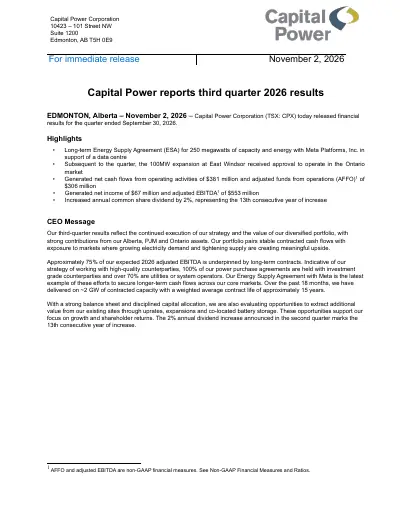
Capital Power Corporation
Q3 FY2026 · Earnings Call TranscriptNovember 2, 2026
Operator
Good day, and thank you for standing by. Welcome to Capital Power Q3 2026 analyst conference call.
At this time, all participants are in a listen-only mode. After the speakers' presentation, there'll be a question-and-answer session.
To ask a question during the session, you'll need to press *1 on your telephone. You will then hear an automated message advising your hand is raised.
If you would like to remove yourself from the queue, press *1 again. Please be advised that today's conference is being recorded.
I would now like to turn the conference over to Roy Arthur. You may begin.
Roy Arthur
Good morning, everyone. My name is Roy Arthur, Vice President, Investor Relations and Business Partnerships.
Thank you for joining us to review Capital Power's third quarter 2026 results, which we published earlier today. The quarterly report and presentation for this call are available on our website.
Before we begin, let me outline how we will spend our time today. First, our President and Chief Executive Officer, Avik Dey, will walk through our key messages and a business update, including the strength of our contractual foundations, the upside embedded in our business, and our growth potential that we see beyond that.
Subsequently, our Senior Vice President, Finance and Chief Financial Officer, Kevin Macintosh, will review our third quarter highlights and financial results. Avik will then close with a few remarks before we open the floor to questions.
A quick housekeeping item, I'd like to remind everyone that today's discussion includes forward-looking information and references to non-GAAP financial measures and ratios. Please refer to slide 19 of the presentation for the applicable disclosures.
With that, I'll turn it over to Avik.
Avik Dey
Thank you, Roy, and good morning, everyone. Before I begin today, I just want to acknowledge the results of the Alberta referendum on October 19th.
Firstly, an incredible day for Canadians and a great expression of democracy from Albertans. We experienced historic voter turnout and soundly approved and endorsed a strong Alberta within a united Canada.
I think it's a great day for Alberta, great day for Canada, and importantly, a great day for Capital Power as a strong and proud Alberta company. There are three key messages we want you to take away today.
First, we have a solid foundation of high-quality contracted cash flows. Our earnings base is stable and includes long-term contracts with a diverse set of investment-grade counterparties.
Second, we have significant embedded upside with a de-risked path to execution. That upside sits within the assets we already own, with contracting and merchant value driving our AFFO per share growth.
We have already made significant progress crystallizing this upside. As you'll hear Kevin talk about, our foundation of contracted cash flows together with our merchant upside delivered a record adjusted EBITDA this quarter.
This reflects the strength of our diversified business and its underlying fundamentals. Third, strong fundamentals in our core markets are creating new development and contracting opportunities.
In addition to the potential for M&A, we are seeing value beyond the embedded upside through contracted development opportunities at our sites with utilities and large-load customers. With that as a backdrop, I will add some context around each of these.
Let me start with our contracted cash flow. It underpins a significant portion of our growth, services our debt, and funds our growing dividend.
About 75% of our EBITDA is under long-term contract. That's by design.
Long-term contracting has always been core to how we run the business, and our contracts have historically averaged 9 to 11 years weighted average contract life. These contracts are also high quality.
Between 80 and 90% of our contracted EBITDA is with investment-grade counterparties, and more than 70% is with utilities or system operators. This contracted base gives us stability.
In addition, we have upside from merchant power prices, and our supply and trading team actively manages that risk. Together, they offer a balanced and compelling total return proposition.
Our contracted portfolio also offers a clear path to growth, and our track record continues to show we can deliver on it. In 2025 and '26 to date, we have contracted nearly 2 GW, inclusive of projects brought into service.
In the near to mid-term, approximately 3 GW in our portfolio is available to contract, as legacy contracts expire starting in 2029, with uprates at our existing sites adding further optionality within that. Beyond the embedded upside, we see meaningful opportunity to develop and contract new generation at our existing sites.
The opportunities I've just walked through, and the discipline we bring to capturing them, reinforce our confidence in meeting our 2030 targets, which include 8 to 10% growth in AFFO per share, and 13 to 15% total shareholder returns. As previously highlighted, since '25, we have contracted and put into service approximately 2 GW across multiple jurisdictions at materially higher prices, with a weighted average contract life of approximately 15 years.
This represents approximately 14% of our fleet, about twice the peer average over the same period. Our recent contracting success is not a one-off.
It is a strategy we have proven, and one we continue to execute. This contracting opportunity is part of a larger story.
Across our portfolio, we see up to $1.25 billion of incremental annual adjusted EBITDA upside above our 2026 base. There are two parts to that upside.
The first is approximately $400 to $550 million from re-contracting and uprates across about 3 GW of capacity. A further $375 to $700 million represents merchant upside linked to Alberta and PJM power prices across approximately 5 GW of capacity.
Tightening supply and demand fundamentals in both markets support this opportunity, and our existing assets position us well to benefit. What makes this upside compelling is how it is captured.
It requires no new shares, no new project debt, and limited growth capital, which makes it highly accretive to AFFO per share. This upside is not theoretical.
We are already making meaningful progress delivering on this opportunity. We have hedged over 40 TWh of power in PJM and Alberta from 2027 and beyond, in addition to recently contracting nearly 2 GW of capacity.
Together, this not only de-risks our long-term growth profile, but also reduces the amount of M&A needed to achieve our 2030 growth targets. Where we do pursue M&A, our focus is on expanding this embedded opportunity set.
I've talked about the value in our existing fleet, and it's significant, but it highlights the question, what comes next? Strong demand across our core markets is creating development opportunities beyond the embedded $1.25 billion of adjusted EBITDA upside I just discussed, and we see multi-gigawatt potential across our key markets.
As demand grows, customers not only value speed to power, but reliability, commodity risk management, and commercial regulatory expertise. We've talked about that before.
It's the combination of these elements that makes us, Capital Power, stand out. We are an investment-grade counterparty with a proven operating track record and deep customer relationships in the markets we operate.
Our commercial and trading expertise lets us structure these agreements and manage the risks behind them. Our sites add a brownfield advantage on top of that embedded upside.
We can potentially use our existing land, generation, and interconnect to add new generation faster and at a lower cost than a alternative greenfield project. We've built a trusted presence in our host communities through years of proactive engagement.
No location is a better example of this than Genesee right here in Alberta. Speed to power also depends on equipment, and turbine supply has been one of the industry's biggest constraints.
That's starting to shift. Recently, we've seen more credible listings of complete or unused turbine packages, though asking prices remain high.
We've seen this pattern before in previous cycles. It's too early to call a turn, but these early signs give us confidence that we can secure the equipment we need to deliver development growth in line with or better than our stated return targets.
With that, I'll turn it over to Kevin to take you through our third quarter results.
Kevin MacIntosh
Thank you, Avik, and good morning, everyone. I was reflecting this morning about this being such an important time of the year.
Teams across Capital Power are putting finishing touches on 2027 plans, while also staying laser-focused on finishing 2026 strong. This takes incredible commitment, and I'm so proud of how teams across the company continue to deliver.
I'll start our third quarter highlights, then walk through our financial results, which include record quarterly adjusted EBITDA contribution, and close with an update on our 2026 guidance. During the quarter, we announced a 250 MW long-term energy supply agreement with Meta.
We also continue to advance uprates at Arlington Valley and Hummel, with completion expected in 2027. On the development front, approximately 180 MW of solar capacity is advancing towards commercial operation in 2026 and 2027.
Operationally, we generated approximately 14.5 TWh across the portfolio, up 8% year-over-year, with 60% coming from our US fleet. We have also now completed 68% of our total planned outage days for 2026.
Turning to our financial results, in the third quarter, adjusted EBITDA was $553 million, up $76 million from the third quarter of 2025. This record quarterly adjusted EBITDA contribution demonstrates the strength of our diversified portfolio.
The increase was driven mainly by higher contributions from Hummel Station and Rolling Hills, which benefited from stronger PJM power prices and summer demand. Our Canada flexible generation segment also delivered high results.
Favorable portfolio optimization, higher generation, and pricing at Goreway, and contributions from our Ontario battery storage projects more than offset lower spot power prices and lower generation in Alberta. These gains were partially offset by a lower contribution from La Paloma, where the financial hedges put in place after the acquisition settled less favorably than last year.
AFFO was $306 million, down $63 million year-over-year. Despite higher adjusted EBITDA, AFFO reflects higher sustaining capital spending, mainly from a heavy maintenance schedule across our Alberta fleet, rotor replacements at Rolling Hills and Harquahala, and planned maintenance at Hummel Station and Rolling Hills.
We also had higher year-over-year net finance expense and current income tax expense. Year-to-date, adjusted EBITDA was $1,308 million, up $142 million.
That increase was driven by a full nine months of operations at Hummel Station and Rolling Hills, along with the same factors as the quarter. AFFO was $788 million, down $34 million compared with the prior year.
That reflects the same pressures from sustaining capital, finance expense, and taxes. These were partially offset by $174 million in clean technology investment tax credits recognized in the second quarter for eligible Canadian renewables projects.
Bottom line, this was a record quarter for adjusted EBITDA. Where parts of the portfolio were softer, gains elsewhere more than made up for it, which shows the value of our diversified portfolio.
Based on our performance year-to-date and our outlook for the rest of the year, we are reaffirming our 2026 guidance for adjusted EBITDA of $1,565 million to $1,765 million, and AFFO of $890 million to $1,010 million. Strong performance supports these metrics remaining within range.
The guidance range for 2026 sustaining capital expenditures has been revised to $350 million to $370 million, previously $290 to $330 million, reflecting unplanned outage work primarily for the US flexible generation fleet and the advancement of a planned outage from 2027 into the fourth quarter of 2026 to ensure high reliability through 2027. The increase is event-driven, and a significant portion relates to insurable events.
Insurance recoveries anticipated in 2026 and 2027, together with concessions from original equipment manufacturers, are expected to meaningfully offset the cash impact associated with higher sustaining capital. Overall, we remain confident in the resilience of our portfolio and the durability of our cash flows.
Our contracted base provides stability, and our embedded contracted and merchant upside give us a clear path to growing cash flow per share. Before we move on, I want to point to something that sets Capital Power apart, our long record of dividend growth.
Since 2016, our dividend has grown from $1.51 per share to now $2.79 based on our 2026 estimate, an increase of about 85%. We kept that growth going through commodity cycles, market changes, and big shifts in our portfolio.
During the quarter, we announced a 2% dividend increase for 2026, marking our 13th straight year for dividend increases. We have set this at the low end of our previously communicated 2 to 4% annual dividend growth through 2030.
This reflects our confidence in the cash flow from our contracted fleet, while keeping room to fund the growth opportunities in front of us. Our message is consistent.
We invest with discipline, grow our cash flow, and return a meaningful share of it to shareholders. With that, I'll turn it back to Avik for closing remarks.
Avik Dey
Thank you, Kevin. Before we open it up to questions, I'll bring us back to where we started.
Everything we've talked about today rests on a stable base. Our long-term contracts with investment-grade counterparties give us predictable cash flow, and that stability is what lets us invest with confidence and keep growing the dividend year after year.
On top of that base, we have growth that doesn't depend on buying anything new. It already sits within the assets we own.
As we contract and capture merchant value across the fleet, that upside is the clearest driver of our AFFO per share growth through 2030, and we have a well-defined path to deliver it. Beyond that, demand from utilities and large-load customers is creating real contracting and development opportunities at our existing sites.
With M&A on top of that, we have more levers to create value, and a runway that extends well beyond the near term. The takeaway is simple: a stable base, growth already within our assets, and new opportunities taking shape.
We're confident in where Capital Power is headed, and we're moving with discipline to capture it. Together, that is a business with the stability of a utility and the growth of an IPP.
We're excited about the opportunities ahead. With that, I'll turn it back to Roy.
Roy Arthur
Thank you, Avik. Operator, we are now ready to take questions.
Operator
Thank you. As a reminder, if you would like to ask a question, please press *1 on your telephone.
You'll hear the automated message advising your hand is raised. We also ask that you please leave your name and company to be announced before proceeding with the question.
One moment while we compile the Q&A roster. Our first question will be coming from the line of Robert Hope of Scotiabank.
Please go ahead.
Robert Hope
Good morning, everyone. Can you maybe give us an update on what the M&A environment is looking for, both on the contracted side as well as we'll call it the merchant side on the PJM market, kind of what headwinds and tailwinds are you seeing in terms of your evaluation as we have seen the assets continue to transact?
Avik Dey
Thanks for the question, Rob. I would say this year has been a tale of two stories.
The year started out with considerable activity, in particular around larger transactions. On the single-plant side, we were seeing less come to market.
Then, with the regulatory environment, moratoriums, and some of the announcements in the year, I think the back half of the year has more or less been locked up. I think there's been very few assets come to market.
In the context of the overall strategy, I think '26 feels like a pause in the M&A market relative to single-asset opportunities. I think the larger transactions, we know the ones that have already traded, but I expect to see '27 become more active again on single-plant transactions.
Hopefully that answers the question. I think just, while I've got the mic on M&A, I can say, overall, the partnership with Apollo, as we've evaluated opportunities, continues to be strong.
I think there's strong alignment there in terms of how we view the landscape on US generation. We continue to be excited about the merchant opportunity set.
I think if anything, I would say, our focus will be going forward really trying to identify those single-plant opportunities, and probably more of a focus on the bilateral side of it, and sourcing and originating opportunities, with a continued focus on PJM and where opportunities present themselves, or ones that we originate in MISO and potentially WECC, less of a continued focus on ERCOT from the M&A standpoint. Hopefully, that answers the question.
Robert Hope
Yep, that's great. Then, could we go back to the commentary on turbine availability in the preferred markets?
What specifically is driving your view that there could be a turn in the market? Are we seeing some competing projects falling away, increasing supply, is the supply chain catching up, are there other factors?
I guess secondly there, does this potentially accelerate or move forward your uprate thinking?
Avik Dey
I think my overall comment would be, and I think we've been consistent on this, our business plan has been focused on stability and predictability, and as you've heard me say time and time again, we're focused on high-quality counterparties and focused on hyperscalers and large-scale data centers. What we've observed in the market, as moratoriums have come to fruition in the US, and many of these slots were taken by other counterparties is, in the chase for speed to power, in certain instances we're seeing the ability to swap slots and take deliveries in 2028, 2029, '30.
I wouldn't call it enough to pick the trend, which is what my comments were, but I think if we needed turbines on a specific project, we're seeing a better ability to capture them, and it's really about trading slots near term in exchange for longer term, and working with counterparties or even the parties that actually own those turbines directly. I think we feel better about it.
Again, not ready to call a trend. I don't think there's anything structural in the market happening that's saying supply chain is catching up or competing projects are falling away.
As I said last year a number of times, we continue to see the market high-grading the data centers. A data center is not a data center is not a data center.
The ones that are near term, that are high-quality counterparties, that are having chip deliveries in the next two to four years, I think those projects are all going to go forward, and I think we're going to have better access to equipment in supply chain over the coming two to three years. Again, not enough to call a trend, but I think we're seeing an opportunity there for companies like us who have stayed the course on trying to stay focused on contracted opportunities.
Robert Hope
That's great. Thank you.
Operator
Thank you. One moment for the next question, please.
Our next question will be coming from the line of Benjamin Pham of BMO. Please go ahead.
Benjamin Pham
Hi, thanks. Good morning.
I just want to start off with a organic growth pipeline. I know you have a number of projects you're advancing now.
You have wind turn now coming to service. The US storage pipeline, track record, expectations, and you seem quite bullish on the outlook going forward.
Maybe just give us an update perhaps how we should think about the replenishment of that organic growth pipeline, and perhaps any sort of timing on that. Thank you.
Avik Dey
Thanks, Ben. The way I would characterize how we're thinking about growth is I would anchor on the $1.25 billion of adjusted EBITDA coming at us through the combination of uprates, re-contracting, and merchant exposure.
As we think about replenishing the inventory to your question, I think we've got nearly 3 GW of available capacity, nearly 25% of our fleet that's up for opportunities, including uprates and expansions. On the greenfield side, I would say we don't have an active portfolio of new sites.
I think as we continue to work with partners, and to my earlier response to Rob's question on fleet availability, we've continuously evaluated site potential, but it's always been in the construct of having a party willing to contract with us, and potentially in tandem with existing capacity. I think whether we're acquiring new plants with that expansion capacity, like what we did at Rolling Hills, looking at new sites, I think the inventory will fill in and around that 3 GW on the existing fleet.
I would draw a perimeter around our existing markets and say Capital Power is going to do what they do in places that require natural gas for baseload or critical capacity, in markets we can wholesale power and contract, and if there's opportunities to expand or potentially build on a contracted basis, we'll evaluate that. Does that answer the question, Ben?
Benjamin Pham
No, it does. Thank you.
Maybe just based on that, a separate question on capital allocation. You mentioned M&A been quite slow this year, but could pick up next year.
You have re-contract opportunities. Notice your stocks down quite a bit quarter-over-quarter, and it's reflected in the corporate expense from what I can see.
How do you view stock buybacks against the growth side of those things?
Kevin MacIntosh
Morning, Ben. It's Kevin.
Thanks for the question. Obviously, it's an option, but it's not one that I think we're going to execute, unless we see a considerable further weakness.
We're in an enviable situation in that we have very little in terms of major capital commitments, as relates to organic growth. We do have lots of options.
We obviously monitor the question of share buybacks, but I would say no imminent plans to initiate an NCIB.
Benjamin Pham
Okay. Got it.
Thank you.
Operator
Thank you. One moment for the next question, please.
Our next question will be coming from the line of Mark Jarvi of CIBC. Please go ahead.
Mark Jarvi
Thanks. Good morning, everyone.
Just to continue on the commentary on M&A, Avik, just, obviously, positive commentary around the upside in existing assets and being able to hit the targets. How do we interpret your comments?
Is it reduced reliance on M&A to get to the 8 to 10%, or do you still feel like M&A can be there and you're hitting potentially the top end or exceeding that 10% AFFO per share target?
Avik Dey
I won't anchor myself on your comment, but I'd say the latter is more likely than not. I would not say a diminished focus on M&A.
In fact, I think '27 is going to be more active than last, given that '26 was effectively a pause. I would really call into focus that my comments were around the fact that we don't need it.
We've got so much embedded growth on the existing portfolio and fleet. In the last two years, we've re-contracted 2 GW of capacity alone.
I think as you look out and you look at the opportunity set, we are going to be even more laser-focused on finding opportunities to acquire that meet the criteria for us of having embedded upside that, because of our focus on operational excellence and commercial execution, that we can garner excess returns as a result. I think, if anything, it's just going to be more refined, a focus on M&A rather than looking at everything in the market.
It's going to be back to basics for us on trying to find and identify those plants that we think we can really add value for ourselves and for our customers.
Mark Jarvi
Okay. Then, just given the amended RVP in PJM and IRA's not going through, just where does that land you right now?
Could you contract Hummel as it stands right now, given some of the uncertainty, and how is that informing what you're either actively working on or contemplating at Rolling Hills today?
Avik Dey
I won't pick out Rolling Hills or Hummel specifically, but what I would say in PJM is that we continue to see activity around bilaterals. We expect that to continue to happen.
I think the recent announcement with Google and Constellation really speaks to that in terms of uprates supporting the bilaterals in response to bring-your-own-generation. We continue to see that trend.
To answer your question directly, we are evaluating multiple opportunities there. I think the market as a whole is pushing forward, even with IRAs, on delivering capacity against the ratepayer-paid pledge, as well as the bilateral as a result.
Mark Jarvi
Just to follow up on that, are you indicating then that you think contracts are tied to some incremental megawatts at the sites, or can it be contracting without having to change the capacity of the unit?
Avik Dey
Specific to us, I would say we're more than 80% hedged when you look over a 3 to a 4-year period of time. We do have the opportunity to contract there.
I would say all of us who are players in PJM are very focused on new capacity for contracting, but that ability to contract continues to be there. I think our focus [cough] is really around meeting incremental power in support of the bilaterals as part of the broader process in the PJM.
Mark Jarvi
Understood. Thanks.
Operator
Thank you. One moment for our next question, please.
Our next question will be coming from the line of Shar Pourreza of Wells Fargo. Please go ahead.
Shar Pourreza
Hey guys, good morning.
Avik Dey
Hey, Shar.
Shar Pourreza
Hey. Just PJM a little bit, just in light of the deals we've seen, obviously, in the RTL and Google obviously didn't take sort of the clean energy attributes for Constellation.
As we're think about the capacity obligations, are you thinking sort of CT, storage, and should we assume new capacity bringing on is around 25 to 30% of the hyperscalers' needs? Because that seems to be a bit of the rule of thumb on new capacity.
Avik Dey
I think I can speak to our perspective, and I think more broadly for the market, I think you're bang on with that estimate. When you look at our fleet in particular, how we marry new capacity, and I would say today we're primarily focused on CT, but that amalgamation of CT, CCGT, storage, I think is where we are going.
In particular on the storage side, what it does is it helps alleviate some of the pressure around grid reliability, it serves multiple purposes by incorporating that into overall energy solution. We're seeing the same thing in Canada.
We've already seen it in Ontario around utility-scale batteries and what it does to support resiliency. We have two of those projects that are co-located on thermal sites.
I think it's a good rule of thumb. I think for us in particular, when you look at Rolling Hills, that's obviously the solution.
I think there's a broader opportunity there as well down the road. It's not one that we're specifically focused on today in terms of the CCGT potential on that site, but I think the opportunity is there in medium to longer term.
Shar Pourreza
Got it. Perfect.
Then, as you highlight the 400 to 550 of incremental opportunity on contracting and uprates, does the margin economics on that change if it's a portfolio deal versus co-located or asset-specific, and any kind of direction in negotiations or the inbounds you're getting at this point?
Avik Dey
Actually, let me answer it this way. The ability to price that marginal electron is predicated on duration, counterparty, and speed to market.
There's competing value in each of those pillars. I think we've demonstrated over 17 years we're pretty good at identifying how to maximize NPV per kW based on our assessment of the commercial opportunity, the opportunity cost, and the capex.
When you look at where we're headed on the RVP and in PJM, because I think your question is most relevant to PJM, the market is focused on the uprate opportunity, because in the 15-year contract period, it's the uprates that are going to be very competitive relative to CONE. There is a pricing difference when we're looking at contracting existing assets on existing capacity versus new capacity around an uprate in service of bring-your-own-generation.
That's really more tied to what's on the denominator of total capex versus here's what the pricing sensitivity is to the customer, if that makes sense.
Shar Pourreza
It does. That's actually super helpful.
I appreciate it, guys. Thanks again.
Avik Dey
Thanks, Shar.
Operator
Thank you. One moment for the next question, please.
Our next question is coming from the line of John Mould of TD Cowen. Please go ahead.
John Mould
Hey, morning, everybody.
Avik Dey
Hey, John.
John Mould
I'd like to start maybe, just at Genesee, the efforts that you've made there to be able to bring more capacity, either to the market or for some kind of contracting opportunity. Just wondering how that effort's going, how you're thinking about the work you've done with AESO there, potential timelines for getting some of that incremental capacity unlocked.
Then maybe not to cast the net too widely, but just more broadly, kind of how you're thinking about the Genesee site, just in terms of longer-term contracting opportunities, and how your thinking's evolved over the course of the year as you've had various discussions on that potential.
Avik Dey
Thanks, John. Let me start by saying Genesee continues to be our crown jewel asset as a company.
Just to put it into scope, and, John, I know you've seen the site, and many of you have, Manhattan is 15,000 acres in terms of areal extent. The Genesee site is 26,000 acres.
It's 1.7 times the size of Manhattan. It happens to be in a location that's 50 km from a major center, and within reach of three points of contact on fiber, critical access to water, critical access to pipeline, and critical access to high-voltage transmission.
You've all heard me say that time and time again. The difference today versus a year ago, and it's a result of a lot of the hard work by not just ourselves, but our peers in the industry, AESO, Minister Neudorf and his team, and the province overall, I would say today Alberta is ahead of many of the jurisdictions across North America because, in effect, Alberta took their moratorium two years ago in how they established Phase 1 and Phase 2.
Today, where we look across the US and there's hundreds of moratoriums in place, we're now well into the process of bringing new capacity through Phase 2. When I sit back and look at Genesee, I see a site that's got significant potential because of the existing infrastructure, the existing footprint, our relationship with communities in and around our site given our long 40-year operating history.
I think because we've been at the forefront in partnership with government on putting together and supporting the Phase 1 and Phase 2 initiatives, I think the market overall is in a position where we're now bringing forward projects, whether it's ours or others. Today we're very proactively looking and talking about potential opportunities through Phase 2 at Genesee.
I think you can expect us to advance those efforts. I think Phase 2, in terms of establishing the rules of the road for bring-your-own-generation, we're getting closer to resolution on that.
I can say we're in active conversations around building a power solution for potential customers on that site. I can't give a sense of timing.
I can't give a status update on where we are. I would say things are progressing.
We've always known we had one of the most attractive sites in North America, because we've got excess capacity that's able to be in service today, technically speaking. Obviously we have to continue down the regulatory path to unlock those megawatts.
I think, more importantly, the tenor of how Alberta's viewed as a market for hyperscalers, and how it concurrently addresses reliability and affordability concerns of the consumer while also bringing new capacities into the market, I think Alberta's in an enviable position today relative to other markets, and we're excited to be right at the forefront of that.
John Mould
Thanks for all that detail, that's helpful. Then, maybe just one on La Paloma, and I know I asked about this last quarter, but just wondering what you're seeing in the resource adequacy market, just given it's quite a bit more opaque than some of the other real markets we might see.
How you're thinking about contracting that capacity via resource adequacy agreements versus other options. You're not doing 2027 guidance today, but just how should we think about the step-down next year in that resource adequacy contracting versus the overall gradual step-down into 2029?
Avik Dey
I would say as you step back and look at the California market, you highlight the weakness in the RA market. We continue to look at contracting opportunities, not in a position to comment on that.
Obviously, batteries is having an impact on the market there. I think medium to longer term, we're more constructive, and seeing a market that gets back into the double digits, well into the double digits.
I think, overall medium to long term, we're more bullish than bearish, and I would say small 'b' bullish, but we continue to, yeah, think of La Paloma as a site that's critical to reliability in California, and an important part of delivering grid reliability there, and we've got multiple options to whether expand or contract around that site. I know it's a bit of an open-ended response, but I think generally, recognizing short-term pressures there, we feel like we've got some options to commercialize there.
John Mould
I'll leave it there. Thank you very much.
Operator
Thank you. One moment for the next question.
Our next question comes from the line of Maurice Choy from RBC Capital Markets. Your line is open.
Maurice Choy
Thank you, and good morning, everyone. Just want to come back again to Alberta, and want to see what you are hearing as to why the AESO Phase 2 announcement seems to be taking a longer time to get over the line.
Avik Dey
Hi, Maurice. We continue to expect to see resolution there in the coming weeks and measurable in low single-digit number of months.
I wouldn't say the delay is really just working through the logistics and details of it, as the province prepares to bring forward legislation around it. I think it's really nothing more than that.
Maurice Choy
Maybe just a quick follow-up. What's your expectation as to when the first intake will take place?
Avik Dey
I think I would just refer you back to my comment, measured within weeks to low-digit months, but I don't have more certainty than that. I would say imminent.
No,
Maurice Choy
that's great color. My second question, if I could just look at $1.25 billion of incremental EBITDA upside from re-contracting and merchant power upside.
I believe this is obviously up from $1 billion back in the investor day last year, and something that you've been socializing a little bit more since September. Can you just refresh us on how much of this $1.25 billion will actually be realized before the end of this decade, thereby contributing to the 8 to 10% CAGR, and how much you think will be post-decade?
Avik Dey
Yeah. I'll take a first crack at that, and Kevin, feel free to add.
The only reason we don't anchor on 2030 is because a few of those re-contractings, the upside is on the outside of 2030 calendar year, and you can point to some of the re-contractings we've announced. I would say without being able to be very specific, the majority of that is actually captured prior to 2030 and inclusive of 2030.
The reason we've put it as an approximation is only because, technically, some of the higher contracting rates start in a post-2030 timeline. Not dramatically later than that, but we couldn't pinpoint it to 2029 Q4, which is why we've given the guidance we have.
I think the economic value of it has been captured now, and that's how we've elected to show it to you from a portfolio perspective. Kevin, anything you want to add there?
Kevin MacIntosh
No, the only thing I'll add is that it's a function of commercial discussions, we understand the importance of understanding the timing of the cash flows, and once we get deals done, we'll make sure that the disclosure is clear so that you understand both impact on EBITDA as well as on AFFO.
Maurice Choy
Maybe as a quick follow-up to that, one of the disclosures that you made today was that one of your facility maintenance is moved from 2027 to Q4 this year. Is this moving of the maintenance timing driven by what you see in the market, or is this something where the facility requires immediate work?
Kevin MacIntosh
Hey, Maurice. It's Kevin.
We went in and did a borescopic inspection in the third quarter, and there was some debate as to whether we could make it all the way to this spring or not. When you just think about the calendar, we thought economically it made sense to bring the unit down now so that next spring, we're ready to go with very high reliability on that asset, heading into the summer.
Maurice Choy
Understood. Thank you very much.
Operator
Thank you. Our next question will come from Patrick Kenny from NBC CM.
Your line is open.
Patrick Kenny
Thank you. Good morning, everyone.
Maybe just back on the data center front and outside of the regulatory delays being experienced on both sides of the border, just wanted to get your thoughts on the level of local support or any opposition you might have to deal with on the ground across the portfolio, how your team might be looking to get ahead of any of these NIMBY challenges that might come up, whether it's at Genesee, Midland, Rolling Hills, or elsewhere?
Avik Dey
Thanks, Pat. I appreciate the question because I think this is one of our core competencies and competitive advantages.
I think most importantly, you articulated at the beginning of your question, the local response. This is about local engagement, and it can't be in response to bringing in large load at the time you want to bring it in.
It's really about that ground game engagement with your plants in the communities and then open conversations and communications with stakeholders. I think we've demonstrated we've done that for 17 years of our existence in the communities that we're in.
Our legacy having come out of a municipal utility predicated the importance of that engagement with local communities. Whether it's our community teams, our stakeholder engagement teams, our regulatory, our GR folks, it's a multifaceted approach that requires expertise, it requires people, it requires boots on the ground.
I think we've established that rapport and that dialogue in each of our key markets. Obviously we are new to Ohio and Pennsylvania, those are two arenas that were working to establish ourselves in the same light that we are better established in places like Arizona and Alberta and Ontario and Michigan.
That approach is not about data centers. It's about being good stewards and partners in the markets we're in as a power generator.
As part of that, you've heard me say this for 3.5 years, I said it in Q3 of 2023, we did not see these opportunities coming forward unless you were partnered with stakeholders and delivering affordability and reliability improvements and enhancements to customers in the markets we serve. This to me is the single largest infrastructure challenge we've faced in the last 75 years.
We're connecting 40-year regulated infrastructure to 20-year data centers that are fueling 5-year chips, and 80% of the capex is sitting in the 5-year chips. The scale of what's in front of us is what we've never seen, the complexity of it is also more complex than we've ever seen, and it's about building large infrastructure for customers that have long-term needs, and that means it feels like hard work, and I think we've demonstrated that we can do that as a power generation provider.
Patrick Kenny
Thanks for that. That's great color.
Then maybe just operationally as it relates to the milder temperatures here, and these El Niño conditions likely to persist through the winter, resulting in perhaps lower generation as well as lower pricing volatility, just curious how you might be thinking about mitigating or optimizing the fleet through the winter, including perhaps accelerating any turnaround or uprate opportunities?
Kevin MacIntosh
Hey, Patrick. It's Kevin.
Just as a reminder, we actually had one day last week where we kind of settled it was over $250 a megawatt-hour, it was one day last week, right? It just kind of underscores that the market is pretty volatile.
I think some participants are pricing their marginal megawatts fairly aggressively. I think that when we think about 2027 from a hedge perspective, we've got 80% kind of across the portfolio.
The team will be looking pretty opportunistically to lock in more hedges when it makes sense. It's interesting, some of these Super El Niño case studies, there are some where obviously it's very, very warm, but there are others where there are periods of deep, deep cold.
That said, no real plan to advance turnarounds or move the timing of turnarounds at this point in time.
Patrick Kenny
Great. Thanks, everybody.
Operator
Thank you. I am showing no further questions from our phone lines.
I now like to turn the conference back over to Roy Arthur for any closing remarks.
Roy Arthur
Thank you, operator. Thank you to everyone for joining us for the call today.
This brings the call to the conclusion. We thank you for your continued interest in Capital Power.
Have a great day.
Operator
Thank you. This does conclude today's program.
Thank you for participating. You may all disconnect.
Everyone, have a wonderful day.