Dorel Industries Inc. Class A
Q3 FY2026 · Earnings Call TranscriptNovember 10, 2026
Operator
Good morning, ladies and gentlemen, thank you for standing by. Welcome to Dorel Industries third quarter 2026 results conference call.
At this time, all participants are in listen-only mode. Following the presentation, we will conduct a question-and-answer session.
To join the question queue, you may press * then 1 on your telephone keypad. Should you need assistance during the conference call, you may reach an operator by pressing * then 0.
Before turning the meeting over to management, please be advised that this conference call will contain forward-looking statements subject to a number of risks and uncertainties that could cause actual results to differ materially from those anticipated. I would like to remind everyone that this conference call is being recorded today, November 10th, 2026.
I would now like to turn the call over to Martin Schwartz, President and CEO. Please go ahead.
Martin Schwartz
Thank you, operator. Good morning, and thank you for joining us for Dorel's third quarter earnings call for the period ended September 30th, 2026.
With me today are Jeffrey Schwartz, CFO, and Jason Kazmir, Vice President of Finance. We'll take your questions following our comments, and please note that all figures mentioned today are US dollars.
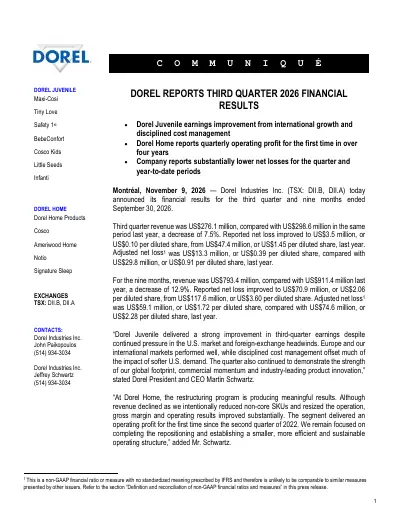
Dorel Juvenile delivered a strong improvement in third quarter earnings despite continued pressure in the US market and foreign exchange headwinds. Europe and our international markets performed well, while disciplined cost management offset much of the impact of softer US demand.
The quarter also continued to demonstrate the strength of our global footprint, commercial momentum, industry-leading [unclear]. At Dorel Home, the restructuring program is producing meaningful results.
Although revenue declined as we intentionally reduced non-core SKUs and resized the operation, gross margin and operating results improved substantially. The segment delivered an operating profit for the first time since the second quarter of 2022.
We remain focused on completing the repositioning and establishing a smaller, more efficient, and sustainable operating structure. As always, Jeffrey will review the detailed financial results.
Before turning the call over to him, I would like to add some context on the quarter and the priorities shaping our outlook. Dorel Juvenile generated third quarter revenue of $221.9 million, up .8 from last year.
Growth in Europe and international markets offset continued sales pressure in the United States, again demonstrating the value of our diversified geographic footprint. More importantly, profitability improved substantially, with third quarter adjusted operating profit at $12.1 million compared with $6.6 million last year.
While the quarter did include a substantial tariff refund, we use its benefit to support promotional activities in a highly competitive environment, and to offset the year-over-year negative impact of foreign exchange rate variations. As traditional, in the third quarter, the industry-leading Cologne Juvenile products show took place in Germany.
We brought customers, partners, and teams together at our global preview event in conjunction with the show. We showcased our product pipeline, supported important customer discussions, and reinforced our focus on innovation and long-term partnerships.
New product highlights, including the complete Oxford family of strollers, the Cabin, the Flex, and the Flash, and the new Maxi-Cosi feeding categories supported by launch presentations. Retailer response was strong, with 88% of retail partners rating the event 8 out of 10 or higher.
We heard from our customers that we continue to be the leader in innovation in our industry. The majority of this innovation comes from our European team, with the focus on core categories under the Maxi-Cosi brand.
The success over the past several years has also driven Maxi-Cosi growth in our international markets and in Canada. While we have yet to see meaningful growth within the United States, something we have been addressing during the year, we have reorganized the product development team responsible for that market, including the transfer of several key leaders.
They are instilling the processes and best practices from Europe within the team, and we expect to replicate their success. We will launch these new products in the market throughout 2027.
We also held our first Asian customer conference in Shanghai and participated in the CBME Shanghai, strengthening relationships with distributors and increasing the visibility of Maxi-Cosi and Tiny Love in a strategically important region. Our brands continue to earn strong third-party recognition.
Across Latin America, teams advanced child safety education and consumer engagement. Campaigns in Brazil and Chile promoted the correct use of child restraint systems, while baby shower programs and activations in Chile and Mexico connected our brands with families at an important stage of the parenting journey.
On a global basis, we have changed several management positions. These changes are intended to strengthen accountability, improve collaboration, and support faster, more integrated execution.
This is part of the growth plans for Dorel. At Dorel Home, generated third quarter revenue of $54.1 million, or 30.9% below the prior year, reflecting the continued wind-down of the legacy home furnishing business.
For the first time in over four years, we delivered an adjusted operating profit at $1.7 million for the quarter. This compares to an adjusted operating loss of $10.2 million last year.
In North America, the quarter combined improving performance in the ongoing Cosco business with the continued liquidation of legacy inventory and preparation for a smaller distribution footprint. Cosco delivered its highest quarterly sales since the first quarter of '25 and its strongest performance against budget during that period.
In summary, Dorel Home's third quarter showed meaningful progress in rebuilding Cosco and reducing the cost base even as the wind-down of the legacy business continued to weigh on revenue. Our priorities are to protect liquidity, complete the remaining restructure, execute the warehouse transition, convert customer opportunities into confirmed business, and restore sustainable profitability.
We remain focused on discipline, execution, and on building a simpler, more resilient Dorel Home. I will now ask Jeffrey to review the financials.
Jeffrey?
Jeffrey Schwartz
Thank you, Martin. Good morning, I'll review the financial performance for the third quarter of 2026.
I refer to certain non-GAAP measures, including adjusted gross profit, adjusted operating profit or loss, adjusted net loss, organic revenue growth, and free cash flow. Overall, we had a significant improvement in our adjusted net loss in the third quarter of 2026 at $13.3 million, or 39 cents per diluted share, compared with $29.8 million, or 91 cents per diluted share last year.
Unique to this quarter, restructuring costs were actually a net recovery of $7.7 million and reflect the gain on the sale of our Tiffin facility, offset by employee severance and termination benefits. As a result, our third quarter net loss was $3.5 million, or 10 cents per, 10 cents per diluted share, compared with $47.4 million last year, or $1.45 per diluted share.
All the improvements came in both segments, which I will detail. Revenue for the quarter was $276 million, down 7.5%.
Organic revenue declined 7.9%. The decrease was concentrated in Dorel Home.
As everybody knows, we are exiting a significant amount of product categories, and that reflected, of course, a lot of the non-core SKUs that I was just talking about. Dorel Juvenile revenue was essentially flat, with improvements outside of the US offset by the softness in the US market.
Third quarter gross profit increased by $23.4 million, 48.9%, and gross margin improved by 980 basis points. Excluding restructuring costs, adjusted gross profit increased by $10 million, or 17.3%, and adjusted gross margin increased by 530 basis points.
The underlying improvement was driven by Dorel Home, where higher margins in the core business and lower overheads, significantly lower overheads, more than offset the sale of non-core SKUs at minimal margin. Gross profit also included $9.6 million of IEEPA tariff refunds received during the quarter.
However, much of that was used to support promotional activity in the highly competitive environment in the US, and to offset this year's negative impact on foreign exchange. If we go to the Juvenile segment, third quarter revenue was $221 million, up 1.7%, while organic revenue was relatively flat.
Growth in Europe export markets, Brazil, and Australia were offset by lower revenue in the US. What is interesting today is that Dorel Juvenile business has changed so that from a revenue standpoint, we're about equal between our US business, our European business, and our all other business around the globe.
That's been quite a change where the US had dominated our sales for many years. Our success is really coming from outside the US to date.
Juvenile's third quarter profit increased by $1.5 million, or 2.5%, and gross margins improved by 40 basis points. Juvenile operating profit was $11.3 million compared to $4.9 million last year, and adjusted operating profit was $12.1 million.
Over to the Home business, which I really think we've sort of turned the corner now. Third quarter revenue is $54 million.
As both Martin and I have discussed, we were out of many of the non-core SKUs, and this is a more realistic number moving forward. Home third quarter gross profit increased by $21.9 million, and gross margin improved to 16% from a negative 17% last year.
Excluding restructuring costs, adjusted gross profit increased by $8.6 million, and adjusted gross margin improved to 12% from a negative 2.7%. Excluding the tariff refund benefit, adjusted gross profit increased by $5 million, and gross margin by 5.3%.
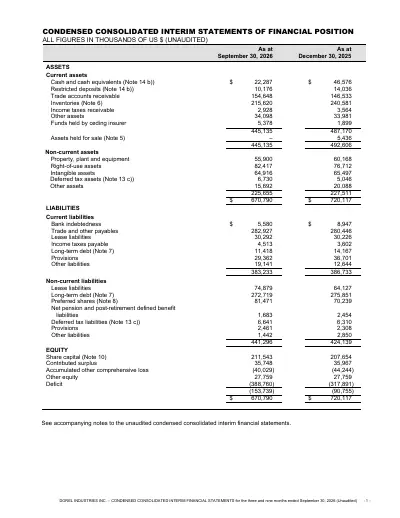
Home reported operating profit of $12.3 million compared to the operating loss of $25.6 million last year. On September 30th, 2026, we amended our financing agreement, and as at that date, the company was compliant with all financial and other customary covenants, and classified its loans under the senior secured asset-based revolving credit facility and term loan facility as long-term.
Total financing costs consist of both cash and non-cash items, as detailed in our public disclosure, and of the $22 million reported in the quarter, 13.2 of that was non-cash. The sale of the Tiffin warehouse closed during the quarter for net proceeds of $12.5 million and generated $9.6 million gain recorded within the restructuring costs.
This transaction supported our broader efforts to reduce the Home footprint and monetize non-core assets. To summarize, third quarter results show substantial year-over-year improvements in profitability despite lower consolidated revenue.
Dorel Home delivered meaningful margin and operating cost progress as its restructuring advanced, while Dorel Juvenile maintained essentially flat revenue and improved reported operating profits in the challenging US market. At the same time, we remain focused on liquidity, debt costs, and covenant compliance.
We will continue to take disciplined action on working capital spending, capital allocation, and asset monetization while supporting growth opportunities at Dorel Juvenile and in completing the repositioning of Dorel Home. With that, I'll pass it back to Martin.
Martin Schwartz
Thank you, Jeffrey. For our outlook, looking ahead, we expect market conditions in the US to remain difficult through the fourth quarter, with expected continued pressure on consumer demand, retailer ordering patterns, and competitive pricing.
Outside the United States, we remain encouraged by the performance of our European and international businesses, supported by strong customer relationships and a promising pipeline of innovative new products, and we have made several strategic changes within the segment to deliver those same benefits to the US. Additionally, we will continue to take a disciplined approach to pricing, cost management, and inventory, while working closely with our retail partners to strengthen our competitive position.
At Dorel Home, the priority is continued execution of the transformation plan. We are concentrating the business on its strongest platforms, eliminating costs around our excess warehouse footprints, and maintaining discipline around inventory, working capital, and cash management.
We are encouraged by the momentum at Cosco and expect it to continue, driving the turnaround of Dorel Home's new business model. Across Dorel, our teams are operating with focus and accountability.
While the environment remains uncertain, the third quarter demonstrates that the actions we are taking are producing tangible improvements to profitability and operating discipline. With that, I'll ask the operator to open the lines for questions.
Operator?
Operator
Thank you. We will now begin the question-and-answer session.
To join the question queue, you may press * then 1 on your telephone keypad. You will hear a tone acknowledging your request.
If you are using a speakerphone, please pick up your handset before pressing any keys. To withdraw your question, please press * then 2.
We will pause for a moment as callers join the queue. The first question comes from Cheryl Zhang with TD Cowen.
Please go ahead. Cheryl, your line is open.
Jeffrey Schwartz
We don't hear the question.
Operator
Cheryl, your line may be muted on your side?
Martin Schwartz
Why don't we circle back to her after a few other questions?
Operator
Sure, will do. We will pause for a moment as callers join the queue.
Jeffrey Schwartz
Okay. Are there any other people in the queue?
Operator
There are. Give me one moment, please, while I get Nevan put back into the queue.
The first question today will come from Nevan Yochim with BMO Capital Markets. Please go ahead.
Nevan Yochim
Hi guys, you've got Nevan on for Steve today. I wanted to start on the Home business.
If you sort of strip out the tariff refunds and maybe some of the other one-time items in the quarter, is that underlying business profitable at this point? I believe in Q2 you mentioned that the Cosco line was profitable, I'm just wondering has that continued, and then can you comment on Nodio?
Jeffrey Schwartz
The Cosco business is actually enjoying very good profitability. A good way to think about our Home business today is in three pieces.
There's a Cosco piece, which is doing well and is absolutely in a profitable area. Nodio, which we're changing up to sort of start absorbing some of the lines of products in the US that used to exist under what we call the Dorel Home Furnishings, but which is actually going away.
Nodio will start picking up some of the larger accounts, not all the accounts, but some large accounts in the US. Today they're about break-even.
We expect them to move into the black next year as their volume increases and their overheads stay relatively flat. The last piece of the business to think about is what we call legacy, and that's still the costs related to the old business: leases, some employees, stuff like that, the old inventory which has been pretty much written down, but still has a value.
All of that still exists, and that definitely is where the cost is. As we get rid of that, and we are making progress to get rid of the legacy business, what remains is a profitable business, yes.
Nevan Yochim
Great. Thanks for clarifying that.
Then just so on that legacy business, I believe it was the warehousing, and then it sounds like a little bit of inventory that still needs to fall off. Just an update on when you'd expect that to happen.
Jeffrey Schwartz
Again, we're very focused on that. Sometime next year, again, I can't announce any significant progress until it's actually done, but we're looking at reducing our footprint through negotiated or sublet deals with the landlords.
On the inventory, it's dropping. We have a new push now.
We both need to get out of the warehouses, so that's another incentive to get out, and we're trying to move as much as we can. On the positive side, in Q3, we did move enough inventory at a price above sort of the book value, so that was added back against restructuring charges as well.
There's a few million bucks in that area too. It is moving, and we're getting there.
Sometime next year, I don't want to put an actual quarter in at this point.
Nevan Yochim
That's fair. Then on the Home business, when you think about looking forward, obviously there's been a number around the restructuring.
Just wondering if you can provide some guidance on sort of what you're seeing quarter-to-date sales trend. I'm trying to gauge when we could start to see revenues turn positive on a year-over-year basis.
Then can you confirm...
Jeffrey Schwartz
Are you talking in the Home business or the Juvenile?
Nevan Yochim
That's right, in the Home business, yeah.
Jeffrey Schwartz
The Home business,
Nevan Yochim
yes. Home, yeah.
I just wanted to confirm, are you still targeting sort of that just under $200 million range on a annual run rate business for the remaining Home business?
Jeffrey Schwartz
That's the right ballpark. That's a good question.
When are we going to see a positive number? Because some of that number is sales of legacy inventory, right?
That's going to continue to drop, the sales of legacy inventory. Again, I think the best way to think about is like you just said, it's in the $200 million range of go-forward business.
Nevan Yochim
That's helpful.
Jeffrey Schwartz
I can't exactly know which quarter that's going to be, but that's probably a better way to look at it. Aha.
Nevan Yochim
Okay. I'm just going to sneak one more in before I re-queue.
On the Juvenile business, can you give an update on what you're seeing in the US market? Has there been any sequential improvement in either the category demand or the customer order levels relative to what you saw in Q2?
Jeffrey Schwartz
In Q2, you mean.
Nevan Yochim
Right? In Q3 or what you're seeing today...
Jeffrey Schwartz
Are you talking about right now, what we're seeing today, or...
Nevan Yochim
That's right, yeah.
Jeffrey Schwartz
Today, the demand is still tough. The demand is muted.
It's been a very strange year in the industry, where many of the major players received a lot of tariff refunds. A lot of them have reinvested that in promotional activity, which means that it's probably the best time to buy baby products in the US was this year, as some of that money was returned, in a sense, to customers through lower prices.
That caused a lot of havoc, as it's not a constant. It's promotional activity, one month, this company is promoting, another month, that one's promoting, and it just makes for a very choppy, difficult year.
On top of that, demand is down in general. It's been difficult from that point of view.
Having said that, what we have planned for next year with our new products is material, and should make a big change. We've been very successful with our new product introductions in the last couple years, particularly in the last couple of quarters, in Europe and in around the world, because most of the export market uses European product as opposed to American product, and we've made the decision earlier in 2026 to move that European-style product to the US.
That's why we're excited about what next year looks like.
Nevan Yochim
Glad to hear that. I'll pass the line.
Thank you.
Operator
The next question comes from Cheryl Zhang with TD Cowen. Please go ahead.
Cheryl Zhang
Hi, good morning, Martin and Jeffrey. Can you hear me now?
Jeffrey Schwartz
We can hear you now.
Cheryl Zhang
Perfect. Sorry about lots of technical difficulties earlier.
Good to see the progress this quarter. I wanted to start with Juvenile, and apologies if I'm repeating some of the questions earlier, but you noted several strategic changes within that segment that should deliver benefits to the US.
Could you just elaborate on what those changes are and when we should be expecting benefits flowing through?
Jeffrey Schwartz
The biggest one, and I think ever since I met you or any analyst or anyone trying to understand the company, is it's really about product. That's what drives everything.
You need to do everything else right to make sure you're profitable and all that, but we haven't been as good as we should be in the US. We kind of went down a separate path from what we were doing everywhere else in the world, and we've redone that concept, and we started earlier this year.
New products take time, and they don't show up in three months or so. We're well on our way.
We're deep into a lot of the new product stuff. I'm very excited about things that either have new features, new innovation, new price points, all sorts of exciting stuff that we think is going to be a material impact.
It lands throughout all of 2027, but a little bit more, it's heavier in the second half of 2027 in the US. In the meantime, we've launched already, and I think Martin talked about the Cologne show, we had a couple of amazing strollers that have hit the market now and are doing exceptionally well.
If you know anything of Dorel in Europe, we've always been looked at primarily as a car seat company. Right now up there in the top ranking of car seats, but not necessarily a stroller company.
I think we're changing that. I think what we have in the market today in Europe, and what Europe is also that bleeds into the rest of the world other than the US, is a material change in opportunity.
I will say that we've gone on this plan for two to three years now, where we're trying to rebuild and be exceptional in the juvenile industry, and other than the US market, which is about a third, it's only a third of what we're doing, everything else is on plan or exceeding plan. We're pretty excited, and now all the focus, you can imagine, top management and everything, is focused on bringing back the US.
Martin mentioned we brought over some product development expertise that helped design Europe, and we brought back to the US, and we're following the same game plan we did in the US. That's probably the most material.
Certainly we're looking at cost cutting. Certainly we're looking at being more efficient, keeping our factory going.
Like all the standard stuff that business needs to do to improve, all of that's happening as well, but nothing really materially changes until all that new product hits the market next year.
Cheryl Zhang
That's very helpful color, thank you. You also noted lower Juvenile SG&A costs due to lower product liability insurance.
Is this one-time or a sustainable run rate going forward?
Jeffrey Schwartz
A lot of it's sustainable. A lot of the SG&A reduction, it's everywhere from some staffing to better efficiencies, lower IT costs.
A lot of different things are happening. Our run rate has been good on product liability, and we expect that to continue for a while.
No, I think this is sustainable.
Cheryl Zhang
Great. Recently we've been hearing some inflation in foam and aluminum.
Are you seeing any notable impact of those on your business, and how should we be thinking about Juvenile operating profit for Q4 and maybe into 2027?
Jeffrey Schwartz
As we said, Q4, we're challenged on the top line in the US. Everything else is on plan.
I don't think those costs have hit, but I will tell you that as we look forward into 2027, there is definitely a pressure on our supply chain costs. We're doing the best we can at this point, but I would expect to see some price increases to us from our suppliers coming at some point in 2027.
Cheryl Zhang
Understood. Switching gears to Home, can you give us an update on where you are in terms of eliminating legacy costs, like what roughly is left for Q4 and onward?
Jeffrey Schwartz
I would say it's relatively flat, our costs right now. Again, I can't get into exactly when, but we do expect to have some reduction in our footprint starting at the beginning of 2027, so that's going to have an impact.
As we move out the inventories, we'll have an impact. There's a number of things.
I don't have the exact date because, hey, we've got to sell off the rest of the inventory. There's costs related to actually doing that.
Footprints, as I mentioned, we'll we'll have a obviously better at next quarter, once the year's ended, we'll have a better idea of that.
Cheryl Zhang
Got it. Are the IEEPA refunds done, or are you expecting more in the coming quarters?
Jeffrey Schwartz
Under Canadian accounting, we only record them when we receive them versus in the US, US GAAP, I guess our competitors who have US GAAP have declared all of their, we we do expect more to come. Keep in mind, we particularly on the Juvenile side, that money was pumped back into the business.
It would have been nice if it was just like a nice bonus on top, but we had to get fairly aggressive on some promotions, and we had to fund those promotions, and that's the money that we used to fund them.
Cheryl Zhang
Right, makes sense. Do you have a sense of roughly how much is left to come, or...
Jeffrey Schwartz
I don't want to put it out there, because, A, I don't know exactly when. It's not at our discretion as to when that money comes in.
There's, I would say a significant amount that is not all filed yet and at risk, we'll put it that way. Nobody's guaranteed that that money is going to come in.
If I give you a number and it doesn't come in, that's not going to look good. There is obviously more than the number we have today, but I'm not sure exactly.
I don't want to disclose exactly what it is, because like I said, we haven't filed it all yet.
Cheryl Zhang
Understood. That's fair.
Just last one from me. Last quarter you noted that you have some contracts that help protect you against freight inflation.
Are those still in place, or are you starting to see some of the impacts of higher fuel costs flowing through?
Jeffrey Schwartz
I'd say the answer to that is probably both. We are seeing in some markets definite impact.
At the same time, we do have some contracts that are keeping us below market in certain areas. I think a bit of both is the answer.
Cheryl Zhang
This was very helpful. Thanks so much.
Jeffrey Schwartz
Okay.
Operator
We now have a follow-up from Nevan Yochim with BMO Capital Markets. Please go ahead.
Nevan Yochim
Thanks, guys. I just wanted to clarify on the Juvenile margins in Q3.
If we exclude the tariff refunds, they're roughly flat year-over-year on an operating basis. Am I understanding your comments that we should expect a similarly flattish year-over-year result into Q4?
Jeffrey Schwartz
Again, you have to be really careful. I debate this all the time internally with our accounting department.
It seems simple, just remove the tariffs and then that's what you're left with. Not necessarily.
Without the tariffs, we wouldn't be spending the promotional dollars that we spent to be competitive with all our competitors who are spending their tariff money in the marketplace. That's in there.
That's in the margin, that the reduced margin because of that is sort of supplemented by the tariffs in a sense. It's not a clean break where you just carve out the tariffs and say, well, that's what your real margin is.
Be very careful doing that analysis, because I assure you that if people didn't get tariff refunds, the amount of promotions that both ourselves and the competitors did would not have happened. Am I clear on that?
It makes it murky, I get it, but, again, we have to choose our battles, because it's real cash when we promote, and we have to make sure that we get what we think is the best time to do the promotions. I can't give you a forecast into Q4 on that.
We'll have to see. Q4 is just a very choppy quarter, and that's why we have some concerns about it.
Nevan Yochim
That's fair. Understood on the movements there in the margin.
Final question for me, just on your financing costs. I know a few one-time items this quarter just given the change in the debt covenants.
I'm wondering what is a reasonable quarterly finance cost as we look ahead? Then just to confirm, on your preferred share dividends, do you expect those to continue to be paid out in shares for the foreseeable future?
Jeffrey Schwartz
On the second question, yes, that's the PIK. Again, as we've mentioned many times out there, the goal of Dorel is to eventually get the Juvenile business to a point where we'd be able to sell it.
We're getting there. We're making a lot of progress on that.
The financing that we have in place today is not financing that you would want to have if you were an ongoing business that was planning to be in business for 5 years, 10 years. It's just too expensive.
What it is, is it's good bridge financing to get us to a point where we can generate significantly more EBITDA, and that's sort of the play here, if I can use that word, to keep it that way. That's why it is expensive, and the PIK is adding up and adding up, but again, think of it as a bridge financing to get us to the point where we'll have a lot more equity value than debt value.
As far as the run rate, I'll have to look at that. Probably closer to 18 is my best guess.
Nevan Yochim
That makes sense. Thanks so much for taking the questions today.
Jeffrey Schwartz
Welcome.
Operator
This concludes the question-and-answer session. I would like to turn the conference back over to Martin Schwartz for any closing remarks.
Martin Schwartz
I just want to thank all of you for joining us today, listening to our story, and joining us to take a close look at our future. Wish you all a great day.
Thank you.
Operator
This brings to a close today's conference call. You may disconnect your lines.
Thank you for participating, and have a pleasant day.