Enbridge Inc.
Q3 FY2026 · Earnings Call TranscriptNovember 6, 2026
Marlon Samuel
Good morning, and welcome to the Enbridge Inc. third quarter 2026 conference call.
My name is Marlon Samuel, and I am the Vice President of Investor Relations and Insurance. Joining me this morning are Greg Ebel, President and CEO; Pat Murray, EVP and Chief Financial Officer; and the heads of each of our business units: Colin Gruending, Liquid Pipelines; Matthew Akman, Gas Transmission; Michele Harradence, Gas Distribution and Storage; and Allen Capps, Renewable Power.
At this time, all participants are in a listen-only mode. Following the presentation, we will conduct a question-and-answer session for the investment community.
Please note this conference call is being recorded. As per usual, this call is being webcast, and I encourage those listening to follow along with the supporting slides.
We will try to keep the call to roughly one hour, and in order to answer as many questions as possible, we will be limiting questions to one plus a single follow-up if necessary. We will be prioritizing questions from the investment community, if you are a member of the media, please direct your inquiries to our communications team, who will be happy to respond.
As always, our Investor Relations teams will be available after the call for any follow-up questions. On to slide two, where I will remind you that we will be referring to forward-looking information on today's presentation and Q&A.
By its nature, this information contains forecast assumptions and expectations about future outcomes, which are subject to the risks and uncertainties outlined here and discussed more fully in our public disclosure filings. We will also be referring to non-GAAP measures summarized below.
With that, I will turn it over to Greg Ebel.
Greg Ebel
Thank you very much, Marlon, and good morning, everyone. We appreciate you joining us today.
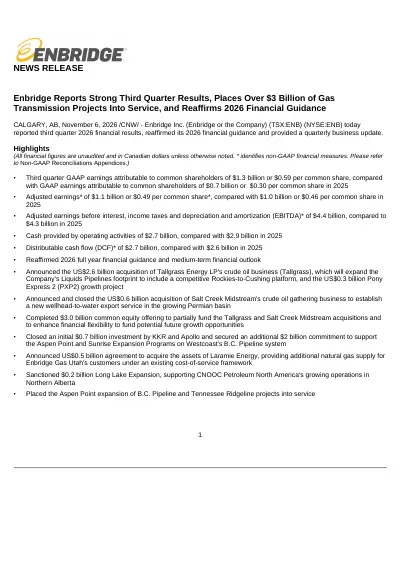
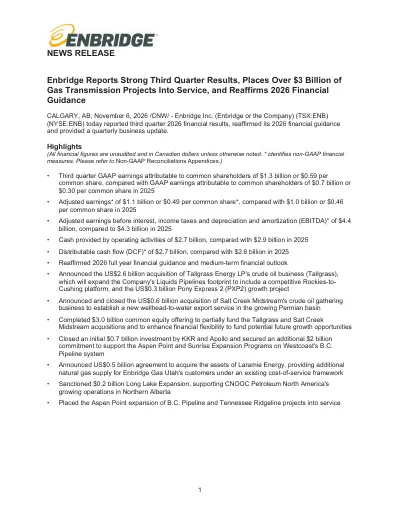
We delivered another quarter of strong operational and financial performance, positioning us to achieve our 2026 financial guidance for the 21st consecutive year. During the quarter, we made a number of important strategic announcements that continue to strengthen our long-term growth outlook.
Our announcements also included my intent to retire at year-end and Michelle's appointment as the next CEO of Enbridge. Now looking at the quarter, utilization remained strong across all four of our businesses, reflecting the essential nature of the diverse energy infrastructure we operate.
We placed two projects into service in our gas transmission business, Aspen Point in BC and Tennessee Ridgeline, and we also filed agreement in the Enbridge Gas Ohio rate case this quarter. We closed the previously announced West Coast partnership with KKR and Apollo, providing financial flexibility to fund our organic growth opportunities.
We also announced the acquisition of Tallgrass's crude transportation business and acquired Salt Creek Midstream's crude gathering assets, both of which expand our liquids pipeline footprint across some of North America's most attractive producing regions. To support those strategic transactions, we completed a $3 billion common equity offering.
In liquids pipelines, we sanctioned the Long Lake expansion with our regional oil sands business, supporting Cenovus' growing operations. In our gas distribution business, we announced the acquisition of natural gas supply assets that will increase the amount of affordable gas that we can provide for our Enbridge Gas Utah customers.
Taken together, these transactions demonstrate our disciplined and versatile approach to capital allocation, allowing us to capitalize on opportunities that align with our strategy. Now before discussing the business updates, let me offer a few comments about my upcoming retirement.
Four years ago, when I accepted the board's invitation to take on the Enbridge CEO position, I was focused on accomplishing four things in relatively short order. Improving our customer focus and experience.
Second, improving the investor experience. Third, I wanted to expand our footprint in both the Canadian and U.S.
markets. Finally, ensure that in three to four years, the board would have a great CEO successor from within the company.
As a management team and with my board colleagues, we got working on all those priorities immediately. Today, our customers have a growing set of offerings across all of our businesses.
They have shown their great support for us by backstopping virtually all of our $38 billion in growth backlog. Investors have seen good returns via both growing dividends and share appreciation, and today, our geographic footprint in Canada and the U.S.
is bigger than it's ever been. Our assets continue to benefit and grow from the all-of-the-above energy infrastructure build-out that we believed was getting underway, and today still has a long runway ahead.
Last but not least, after a multi-year succession planning effort with the board, I'm thrilled that we have an excellent leader in Michele Harradence to lead and advance Enbridge into its next growth chapter. Michele has played a critical role in leading our gas distribution and storage business in recent years, and brings extensive operational, commercial, and leadership experience.
Michele is set to take on the CEO role January 1st, and I have great confidence in her, the leadership team, and our great women and men in the field delivering safely and reliably 24/7 as they continue building on the strong foundation we have established. I'm very proud of what we've accomplished together and thank them for their incredibly hard work and support.
This'll be my last earnings call. My first was with Duke Energy more than 20 years ago, and some of you were investors and analysts then, and so I appreciate all the support and counsel over the years.
Thanks to you all. Now, as we head towards the end of the year and into 2027, the macro backdrop for the energy environment remains very constructive, with demand for reliable and affordable energy continuing to grow across North America and globally.
Population growth, manufacturing investment, electrification, and rapidly rising power demand are creating new requirements for energy infrastructure. At the same time, North America's resources are increasingly important to global energy security, thus supporting growing export demand for both oil and LNG.
Taking a look at the map, we see a number of regions in the continent that are expecting significant energy demand and supply growth into the next decade, and all four of our businesses are currently capitalizing on that opportunity. In liquids, we continue to anticipate significant growth in Canada and expect more certainty on that growth in the near future as governments and industry progress policy alignment.
In the spring of 2024, we expressed a strong view that supply growth out of Western Canada would reach 1 million barrels by 2035. Not many shared our view at that time, but today, that prediction is probably too low.
This growth will require expansions of the Alberta regional oil sands business, increased diluent supply, support for carbon sequestration and transportation, and increased capacity out of the basin, all areas in which we are an industry leader currently and see numerous future opportunities. In gas transmission, we see significant demand all over North America, including in British Columbia, the U.S.
Northeast, and the U.S. Southeast, as well as along the Gulf Coast, where Texas Eastern and Valley Crossing assets are strategically located.
All of our utility franchises are also seeing tailwinds from population growth and power demand. In fact, we're seeing more opportunities in the U.S.
than when we initially decided to buy the gas utility assets in 2023. Lastly, renewables will remain an important part of the generation mix needed to meet North America's growing power demand.
Our all-of-the-above approach to energy investment allows us to win in multiple ways, regardless of the commodity type, color of the electron, or frankly, the ever-changing makeup of governments. We deliver multiple sources of reliable and affordable energy, and that works for our customers and investors in all conditions.
During the quarter, we announced two accretive and strategic liquids acquisitions that further strengthen our North American crude oil franchise. The acquisition of Tallgrass's crude oil business, which includes the Pony Express Pipeline and Powder River Gateway System, will build on our existing Rockies footprint and adds new connectivity to the DJ and Powder River basins.
Importantly, the acquisition will add access to growing supply regions while creating additional customer optionality across our broader liquids network over time. We also announced the acquisition of Salt Creek Midstream's crude gathering assets in the core of the Delaware Basin.
This transaction strengthens our Permian position and extends our wellhead-to-water strategy, adding high-quality gathering infrastructure upstream of the Gray Oak Pipeline and our Ingleside export terminal. Together, these acquisitions build upon our existing network advantages and expand our ability to provide integrated solutions across North America's most important crude oil corridors.
As previously mentioned, this quarter, we sanctioned the Long Lake expansion supporting Cenovus' growing operations in the Western Canadian Sedimentary Basin, adding a new lateral pipeline and storage tank while also expanding multiple lines in our regional oil sands system. The project is expected to cost $200 million and enter service in 2028.
We also closed a successful open season on Flanagan South, which is the downstream component of the resequenced MLO2 project. This just further highlights our demand-pull pipelines and our ability to modularly expand our system based on our customers' current and long-term needs.
As we indicated at our last quarterly earnings call, we see a number of opportunities across our liquids footprint, and these two projects are evidence of that. We're encouraged by the increasingly constructive industry outlook and are well-positioned to support our customers with our leading liquids pipeline network.
Regardless of evolving market conditions or public sentiment for oil, our mainline system has continued to operate at or near capacity. Volumes have steadily increased over the years, and we are confident as supply grows out of the Western Canadian Sedimentary Basin, so, too, will our capacity to support our customers.
The mainline's many advantages, like reliability and safety, market access to refining capacity, and established ratemaking model continue to reinforce the long-term value proposition of the franchise to our customers and investors alike. Turning to gas transmission, fundamentals remain exceptionally strong across the continent.
The portfolio remains robust with a number of high-quality opportunities supporting growing LNG and power generation demand. Starting in Canada, Aspen Point entered service under budget and ahead of schedule, providing additional transportation capacity to support regional demand growth and LNG exports on the West Coast.
With the current West Coast toll settlement expiring at year-end, negotiations are well-advanced, with an agreement and CER approval expected to be realized in early 2027. We also closed the previously announced $2.7 billion joint venture with KKR and Apollo, providing us with financial flexibility as we advance our organic project backlog.
We're also advancing a number of opportunities across Texas Eastern after seeing strong customer demand on various paths for incremental capacity. Within our Permian joint venture, the Blackcomb pipeline has now entered service, providing up to 2.5 Bcf per day of capacity out of the basin, and the 2.6 Bcf per day Bay Runner pipeline has achieved mechanical completion, ready to move gas to the Rio Grande LNG facility.
In the U.S. Northeast, we continue to progress the previously sanctioned Algonquin Enhancement project, and the team is working hard on commercial negotiations with customers on Project Beacon, a further expansion of the Algonquin system.
We appreciate the strong support from the state governments like Massachusetts to quickly achieve federal approval of such projects. More generally, we are having a number of conversations with power and utility customers in both the U.S.
Northeast and Midwest, and the opportunities in the region remains robust. Despite some construction challenges on the Tennessee Ridgeline project, it entered service on time on November 1st, ready to provide natural gas to our customers under long-term take-or-pay agreements.
Further south, Florida continues to be a growing market for gas, driven by power demand, population growth, and industrialization, and we're looking at opportunities through our interest in the Sabal Trail pipeline and our connected storage assets along the Gulf Coast. It's worth remembering that across the gas transmission business, we have almost 90 Bcf of natural gas storage projects already sanctioned, positioning us to support the growing power demand and LNG opportunities on both sides of the border.
Now stepping back, these projects are part of a much broader opportunity set. Across the franchise, we see a growing set of near-term opportunities driven by demand for LNG, power generation, and utility load growth.
Our extensive existing network positions us well to capture that growth through capital-efficient expansions of our existing infrastructure. As we've said before, natural gas remains one of the most attractive areas of growth across North America energy systems, and Enbridge is uniquely positioned to benefit from that trend.
Turning to GDS, today we are announcing an agreement to acquire the gas assets of Laramie Energy, expanding gas supply supporting Enbridge Gas Utah. The transaction leverages our existing successful Wexpro business model to provide our utility customers with a stable, cost-of-service source of natural gas, helping improve affordability and moderate commodity price volatility, while providing us a utility return without taking on commodity exposure.
The transaction will close following regulatory approval, which we expect to receive later this month. We've also reached a settlement in the Enbridge Gas Wyoming rate case, with rates expected to be effective in early 2027.
In Ohio, we made meaningful progress on the rate case that was filed last year. Settlement was filed for approval during the quarter, with increases to our revenue requirement, rate base, and equity thickness, which will support investment in the system as we continue to serve our customers safely and reliably.
Both these rate cases reinforce our strong track record for achieving constructive regulatory outcomes across our gas distribution business while focusing on affordability for our customers. Now turning to renewable power, our renewable power business continues to focus on disciplined, customer-backed growth.
Since 2002, we have built a renewable power portfolio of more than 8 gigawatts across North America and Europe, including more than 2 gigawatts of projects under construction. These projects under construction are supported by long-term contracts with high-quality counterparties, including 1.4 gigawatts of generation capacity with Meta.
We continue to see opportunities to grow this business with hyperscalers and blue-chip customers seeking reliable, long-term power solutions. With that, let me turn the call over to Pat Murray.
Pat Murray
Thanks, Greg, and thanks, everyone, for joining us today. We delivered yet another strong quarter supported by consistent and high utilization across our diversified asset base.
Adjusted EBITDA increased by $167 million compared to the third quarter of 2025, reflecting continued strength across our business. The decrease in liquids pipelines results reflects impacts similar to the first two quarters, with lower tolls on the mainline deliveries and reduced throughput on the Flanagan South pipeline due to high PADD II utilization and market pricing dynamics.
In gas transmission, year-over-year results benefited from favorable contracting and rate case settlements in our U.S. assets.
Gas distribution benefited from higher rates in Enbridge Gas Utah and North Carolina due to recent rate cases, and customer growth in Enbridge Gas Ontario. Renewable power was up slightly as the first phase of Sequoia Solar was placed into service at the end of 2025.
The year-over-year increase in DCF was primarily driven by the higher adjusted EBITDA, which I just spoke to, as well as reduced maintenance capital spend, partially offset by higher financing costs associated with incremental debt issuances. As Greg noted, management's been very focused on securing new growth projects, but we've also been very focused on improving results within our existing assets.
Continued cost discipline, optimization efforts, and increased buying power have helped us mitigate inflationary pressures, with those efficiencies reflected across our operating costs, maintenance capital that I just spoke to, and our growth projects. Given our strong performance to date and confidence in the underlying business, I'm pleased to reaffirm our 2026 guidance and expect results to finish at the midpoint of the range.
The strength and resilience of our business model enable us to deliver reliable results across varying market conditions, even amid macroeconomic uncertainty and commodity price volatility. As we look to the remainder of 2026, strong commercial and regulatory execution in gas transmission, the tailwinds realized in Q2 at Seaway, provide positive support, while we continue to reflect lower liquid market access contribution and higher U.S.
interest rates in our outlook. Let's now turn to our capital allocation priorities.
Our capital allocation strategy remains consistent. We continue to equity self-fund organic growth backlog while maintaining a strong balance sheet.
As Greg mentioned earlier, we completed a $3 billion equity offering this quarter to de-risk financing of our recent acquisitions. By funding these transactions with a balance of debt and equity, we maintained our targeted leverage profile while preserving financial flexibility to capitalize on significant organic growth opportunities we continue to see across the business.
We also increased our financial flexibility for funding that organic portfolio through our capital recycling initiative with KKR and Apollo that closed this quarter. This transaction provides further capacity beyond our base annual investment of $10 to $11 billion.
Our debt-to-EBITDA ratio at the end of Q3 2026 was 5.1 times, driven by quarter-end foreign exchange movements as the CAD to U.S. dollar spot rate spiked to close at 1.42.
On an FX-adjusted basis, leverage would have remained within our target range. Looking ahead to the next quarter, we expect to be in a similar position in regards to leverage, as we close the previously mentioned acquisitions, but on a full-year run-rate EBITDA basis for these assets, we expect to remain well within our leverage target.
Our track record of shareholder returns remains strong, with $39 billion returned in the form of dividends over the past 5 years and a further $40 to $45 billion expected through the next 5 years. Supported by a $38 billion backlog, we have a well-defined path to growth through the decade, driven by a disciplined focus on low-risk, accretive brownfield investments.
I'll now hand it back to Greg for some closing remarks, but before I do, I'd like to thank Greg for his leadership, guidance, and many contributions to Enbridge over the last 10 years. It's been a privilege to work alongside you, and I wish you all the best in your well-deserved retirement.
Greg Ebel
Thanks, Pat. It's been a great pleasure working with you as well.
As we step back and look at Enbridge today, I believe our investment proposition remains compelling. We continue to offer a combination of stability, strength, consistency, growth, and optionality that is difficult to find elsewhere in the energy infrastructure sector.
Our low-risk business model, diversified franchise mix, and predictable cash flows provide a strong foundation for long-term value creation. At the same time, we have one of the largest growth backlogs in our history, supported by approximately $38 billion of secured capital and significant opportunities above and beyond.
The strategic actions we took this quarter, including the Tallgrass and Salt Creek acquisitions, further expanding the opportunities available across our liquids franchise while still continuing to prioritize the balance sheet. Enbridge is one of the only energy companies that can allocate capital across crude oil, natural gas transmission, gas utilities, and renewable power with scale and flexibility.
We believe that positions us well to capture growing North American energy demand while continuing to deliver attractive returns to shareholders. As I look back at the incredible success we've achieved together this past decade, I'm reminded of exactly what it is that makes Enbridge unique.
We are the largest transporter of liquids in North America and handle some of the most complex egress systems in the world, and we'll continue to grow this segment well into the future. Our gas transmission business stands at the precipice of the largest demand cycle in recent history, driven by growing power, industrial, and LNG needs.
We own and operate the largest North American gas utility business, and we continue to see growth beyond what we initially forecasted when we first acquired the U.S. utility business a couple of years back.
The renewable power business has grown into a significant player in the industry, backed by some of the largest hyperscaler and blue-chip customers in the world. Few companies touch as many lives as Enbridge every day.
Our assets carry the energy that powers economies, strengthens communities, and underpins modern life across North America. I know that Enbridge is in good hands with Michele and the rest of the leadership team, and as a forever shareholder, I look forward to the future ahead.
Thank you for your time this morning. Operator, we're now ready to take questions.
Operator
Thank you. We will now begin the question-and-answer session.
In the interest of time, please limit yourself to one question and one follow-up. If you would like to ask a question, please press star one to raise your hand.
To withdraw your question, press star one again. We ask that you pick up your handset when asking a question to allow for optimum sound quality.
If you are muted locally, please remember to unmute your device. Your first question comes from the line of Robert Catellier with CIBC Capital Markets.
Robert, your line is open. Please go ahead.
Robert Catellier
Hey, good morning, everyone, and congratulations to both Greg and Michele on the big transition here. I think, since I'm first, I'll start with that.
Michele, I know it's really early for this question, but what do you think investors should expect will remain the same under your leadership, and where could we see capital allocation priorities and portfolio construction evolve after the transition starts?
Michele Harradence
Oh sure, thanks Robert, and I appreciate the question. I think it's really important that folks understand that certainly my vision for this company is very much grounded in our past.
For over 75 years, we've been disciplined capital allocators, exceptional project developers, and top-tier operators. What that's done for our investors, by the way, I have family members who've owned Enbridge shares since we IPO'd in 1953, they remind me of this all the time, and that's generate predictable, durable cash flows.
So 31 consecutive years of dividend increases. That dividend aristocrat status, it's held by a very small group in energy, and I think it demonstrates our long-standing commitment to our shareholders regardless of what economic, political, or commodity cycle we're in.
As far as I'm concerned, Enbridge is North America's preeminent energy infrastructure company, and it's built on an incredible foundation of four premier franchises. What we have, the footprint, the quality of our assets, the quality of our people really gives us advantages others just can't have.
What I think you're going to be seeing, not just from me, but from what is a very strong executive leadership team, is that we build off of that foundation. We continue to operate our existing businesses exceptionally well.
That's safety, reliability, cost discipline, and capital efficiency. Those have been and will continue to be very core for us.
We've got a great set of assets, and we're going to protect the foundation of what drives that value for our shareholders. We're going to be the partner of choice.
We're going to continue to be the partner of choice for meeting North America's growing energy needs. That's not only that recognition we have now for all of the above, but more of the above.
What we're really appreciative of and seeing is that pragmatism and balance are there. I think you'll see Enbridge at the center of all of those conversations.
Then the key thing is finally, we're going to continue to translate those advantages into superior long-term returns for our shareholders. That's just continuing to be what you already know us to be: disciplined capital allocators, attractive risk-adjusted total returns, and a real suite of competitive projects that are meeting the demand for energy.
We're talking about taking a great company and making it even better here. With that, we're going to continue to be grounded in those energy fundamentals.
That's what's drove us to spend $19 billion on the gas utilities a few years ago, and you just saw us invest over $3 billion in expanding our liquids footprint this past quarter. We believe in the future, the energy that our customers produce and demand, whether it's natural gas liquids or renewable energy, and we'll keep doing that.
Robert Catellier
Thank you. That was a very wholesome answer.
I just had a quick small one on the liquids business. There was a small project for the oil sands lateral with Cenovus.
I find that interesting because we haven't seen something like that in a little while, maybe you can update us on the customer momentum in terms of oil sands projects and some of the various MLO options.
Colin Gruending
Hey Robert, good morning. Thanks for the question.
A astute observation. Indeed, it's been quiet up there for a number of years and for obvious reason, but I think we're on the cusp of a huge cyclical and hopefully sustaining growth wave up there.
As we've got a strong position in the oil sands region, seven trunklines, lots of laterals, lots of customers, and I think a number of the bigger customers are in the midst of a big negotiation. They are likely positioning some projects to grow their supply as well.
In the interim, some of the smaller customers are already kind of moving ahead, and the Cenovus announced today is an example of that, an existing customer where basically twinning a lateral over to one of our trunklines to grow their existing production. I think it's a sign of more to come, and we'll certainly look to capture our share.
There's a lot of operating leverage in these systems. They're pre-built.
There's some headroom in them. I think it's a pretty exciting leg of one of the legs of the stool we haven't talked about in a long time, but it's one of the boats that gets floated right when the tide rises, and we've got other boats in the fleet we'll talk about probably later in the call.
Greg Ebel
Robert, just a quick add to that. I think the team's super seized with that opportunity, and Colin's bang on.
Let's not forget, and I see some discussion of this, our position on what I'll call antecedents there, things like diluent. We're in a great diluent spot in that region, so that's domestic.
Don't forget, as we see this growth, and we're seeing great moves by the Canadian government to make it more attractive, import of diluent, too. We have a little thing like Southern Lights that people seem to forget about, I think we're in a great spot, and the team's working really hard, and as the becomes more clear on production growth that we're starting to see, I think there'll be opportunities not only regionally, but also with things like diluent.
As our regional system is partially owned by our Indigenous partners, which is a critical component here of getting this right, getting it done quickly, and making sure as many people participate, not only our investors, not only our customers, but also our Indigenous partners, I think that's a huge competitive advantage for us.
Robert Catellier
Thanks, everyone, and congrats again.
Greg Ebel
Thanks.
Operator
Your next question comes from the line of Jeremy Tonet with JP Morgan. Jeremy, your line is open.
Please go ahead.
Eli Ong
Hey, this is Eli on for Jeremy. Just wanted to wish Greg the best in the next chapter and congratulate Michele and look forward to working with you in the new role.
Starting with the Permian landscape, obviously, there's been significant platform expansion across multiple fronts. Can you frame what the strategy looks like from here?
Are there complementary assets that make sense, or do brownfield expansions make more sense at this point, or both?
Colin Gruending
Eli, it's Colin, I can talk about crude system if that's what you're looking for. I could recap the whole 7-8-year journey here, but you've seen us kind of crawl, walk, run into the basin on a very disciplined basis port, then the pipe now reaching further up in the gathering system, and by the way, we're going to rename Salt Creek and very creatively, Enbridge Permian Gathering System.
There may indeed be more of that. I think I would emphasize the word selective, right, and create that super-system, that value chain, that one-stop-shop service for our customers.
I think you're seeing it develop. We have ambition for more, but disciplined, right, disciplined.
We believe in the basin. It's a great basin, like all the basins, frankly, and I think you've seen us invest in two U.S.
basins here recently with tuck-in acquisitions, all in kind of service of the greater vision that North America's got a huge role to play here to supply itself affordably and increasingly the world. We like all the basins.
We think there's a higher oil price floor long-term and certainly a lot more terminal value than some have been thinking. A lot of conviction in all the basins, but the Permian near the top of that list.
Greg Ebel
The gas side, too, Matthew, I know your team's been working at that, you want to comment on your goals in the Permian?
Matthew Akman
Thanks, obviously we've been working on the Whitewater assets, and I don't know if everyone noticed, but Bay Runner is mechanically complete now and ready for Rio Grande to start utilizing it, and so we're very excited about that. We've announced recently, as the storage expansion, Tres Palacios, another 25 Bcf a day, which is all related to moving and storing a lot of that gas.
The next phase of this for the industry and for us is some very exciting opportunities to move that Permian gas further east and west. You might have noticed that we have a whole bunch of exciting commercial activity around that in both directions that we're working diligently on and seeing very strong interest.
I think that Permian opportunity, both directly out and then from some of those points further beyond, continues to be a very exciting opportunity for us.
Eli Ong
Thanks, and then opening remarks obviously referenced upward revisions in WCSB production, and as we look across the landscape, we've seen a number of expansions sanctioned. Just want to get a sense of your longer-term expectations for incremental egress beyond MLO1, and when might we see updates on that front?
Thanks.
Colin Gruending
Eli, yeah, it's Colin, I can take that. I think Greg mentioned that we have successfully closed an open season here recently on Flanagan South, which is more of the same, right?
I think this is the third kind of expansion of Flanagan South. We have another open season still open on Southern Access Extension, which will close later this year, both trending to a capital FID or a series of capital investments in those downstream pipes, likely by the next quarterly call.
You recall we initially had paired this with MLO2, i.e. the mainline upstream companion expansion, but given policy uncertainty in Canada, it was untimely to align customers to underpin that mainline capital investment at the time.
We disaggregated, focused on the downstream part, which is trending successfully, and so that will pull incremental barrels through our mainline path, and we can come back at the appropriate time with MLO2 or a different version of it, MLO 2.A, 2.1, or MLO3, whatever, and rebalance the system. Because it's important that these downstream contracts come with entitlements for downstream verification on the mainline.
When the mainline is apportioned, right, these contracts get filled, which is very valuable in a time of apportionment, which we think will persist on the mainline for the foreseeable future. That's a quick update on our mainline path.
We also have other egress ideas in development on Express, as you would imagine, as well.
Eli Ong
Appreciate the color.
Greg Ebel
Thanks, Eli.
Operator
Your next question comes from the line of Rob Hope with Scotiabank. Rob, your line is open.
Please go ahead.
Rob Hope
Morning, everyone, and I'll also add my congrats to Greg and Michele. Maybe the first question is on capital allocation.
We've seen Enbridge be quite acquisitive this year with three relatively large tuck-ins. Can you maybe provide a incremental color there?
Are these just opportunistic? Are you seeing increasing opportunities on the tuck-in side, and could we continue to see each runway on that capital allocation side as well?
Greg Ebel
Pat may want to add to this, too, but Rob, first of all, thanks for your congrats. Appreciate that.
Look, we're very diligent on this front. You're right, and you don't always have the timing when things come in, but I and Michele, I'm sure, will not see any difference in this.
She's been involved with all these acquisitions. They've got to be accretive.
They have to add to our strategic footprint as well, and they've got to be able to be carried on the balance sheet, right? Those things are absolutely critical to keep us within our 4.5 to 5 times, which is why you saw us issue the equity in three pretty large deals.
They're tuck-in, but in terms of when you add them all up. I don't see that changing.
We'll be very diligent on that front. As Colin just laid out, the Salt Creek assets that we bought really complete the wellhead-to-water situation.
Obviously, the Laramie acquisitions in the GDS area, that's critical from an affordability, but also rate base growth perspective. Then new optionality for customers, etc., and just a new basin to be involved in with the Tallgrass assets as well.
That's critical. We've got to be able to finance it.
We've got to keep into our balance sheet metrics, and it's got to be accretive from the get-go. Pat?
Pat Murray
Maybe just add a couple things there. First one being the other metric we really look at is what it does to our growth going forward.
If you think about the optionality and stuff of all these assets, I think it helps with that ongoing growth. We wanted to make sure that we funded it appropriately, because to be fair, the vast majority of our growth is going to come from our organic program, and we need to make sure that we're funding that appropriately, hence why we went and got the capital that we needed.
They kind of all happened at the same time. As Greg said, you can't always time that, so that's part of it.
I think the plan going forward, and it has been through time, is to continue to lean on that organic growth to expand the company, and we want to make sure we have the capacity to continue to do that.
Rob Hope
All right, that's great. Then maybe for my second question, I want to go back to the concept of crawl, walk, run in the Permian.
The West Texas Express is kind of the first, we'll call it Enbridge-led and wholly-owned gas pipeline out there. You've done it largely in partnerships to date.
Is this a shift in how you're looking at the basin? Could we see you do some incremental projects largely being self-led?
I guess secondly there, how did the West Texas open season go?
Matthew Akman
Hey Robert, it's Matthew, thanks for the question. It is, as I said, it's a very exciting area for us.
I think naturally, when you look at where gas is landing out of there, and there's a lot of it around Katy, for example, we have a lot of assets that store gas around there and then move it from there already, Texas Eastern, of course, across the Gulf Coast. Then there are greenfield opportunities like you talked about, intrastate stuff.
West Texas Express is one of those. We've seen strong demand across those corridors from a wide range of customers, from utility, LNG looking to push that gas offshore, and of course, power customers.
You've seen, as you mentioned, you referenced the open season we had on West Texas Express, and it is really that full range of customers that we're seeing express interest in that stuff. It's a little bit early, but we have seen strong indications of interest, actually, in both directions out of there, and we think we have the expertise and the mousetrap.
I think you're right. It's more on our own in those areas because we can utilize some of our brownfield corridors, we can utilize our storage positions, and of course, our execution capabilities that our customers rely on across our entire system.
Stay tuned on those projects.
Rob Hope
That's great. Thank you.
Greg Ebel
Thanks.
Operator
Your next question comes from the line of Maurice Choy with RBC. Maurice, your line is open.
Please go ahead.
Maurice Choy
Thank you, and good morning, everyone. Wanted to just touch on one of your prepared remarks about winning in multiple ways regardless of the changing government.
Enbridge obviously has dealt with many permutations of the U.S. political landscape over roughly 75 years since IPO, I can appreciate that you can work with everyone.
If I could ask you to dive a little bit deeper into that and can you share what opportunities you think may perhaps open up a little bit more given the election results and the political partners you'll be working with, and which businesses may perhaps require a little bit more focus and engagement moving forward?
Greg Ebel
Sure. Maurice, you're right, we're in 40-plus states and all the provinces, different countries.
First thing I'd say, you will recognize that our all-of-the-above strategy has been one we've stayed very true to for a very long time, and why is that? One, yeah, the diversification's great, but it's also the best way to achieve what I think has been a big issue in recent elections: affordability and reliability.
We go to those jurisdictions where the opportunities are recognized around that, hence you see where we bought gas assets in very productive locations like North Carolina and Utah and Ohio. You've seen us be in the renewable business for a very long time and careful in those areas.
Even in places like the Northeast on the gas side of things, governments that may not always have been entirely supportive of us, you would have noticed in my comments we now have governors of states like Massachusetts asking the federal government, which as you know is a different stripe, to actually quickly approve gas pipelines. For us, it's like the long-term fundamentals matter the same way Colin was just talking about on the liquid side.
You will see growth. Long-term fundamentals around gas, you see that happening in the jurisdictions, and then just the overall move to electrification, the need for power, all that works well for the gas business, works well for the renewable business as well.
We're not typically following the shiny item, we're following the fundamentals, and that means the ability to stay close with the governments of all different stripes and really add value for consumers and our customers, and in the end, that's what works best for investors.
Maurice Choy
Thank you very much for that. If I could just ask about your project sanctionings, through Q3 this year, I think you're about halfway through your target of sanctioning up to $20 billion for 2026 and 2027.
Is this $20 billion target still something you're looking at? What are some of the push and takes or even areas within your pillars of growth that you're looking at that might push this $20 billion higher or lower?
Greg Ebel
For sure. Again, that's sanctioned, right?
The opportunity set would be obviously a multiple of that. Look, I think you're going to continue to see opportunities in all of them.
Colin just went through the opportunities on the liquid side, Michelle's business, and Allen Capps's business on the power side, and then, of course, Matthew on the gas side. Look, this is a very long runway.
I think you'll get a great opportunity Investor Day when Michele comes forward and lays this all out of just how great the opportunity is on a go-forward basis. As we've said, we see that continued 5% growth right through the end of the decade, and just since our last Investor Day, I think our backlog's up 50% from even that time.
There's no doubt, gas is the big winner right now in this full electrification. You see that in our business.
Just this quarter, the gas transmission business is up double-digit, the gas distribution business is up double-digit. Those kind of give you some indication where things are.
Then with the changing government structures, attitude, etc., and really an improved market in Canada, and then just the global need for North American energy, I think you're going to see oil and exports of gas and oil create great opportunities for us, too. That's the whole purpose of structuring the company the way it is, that in ebbs and flows of macro issues, government changes, etc., that Enbridge always has opportunity to grow in one, if not all of its sectors.
Maurice Choy
Thanks for that. On behalf of my partners at RBC, my best wishes and congratulations to both Greg and Michele.
Greg Ebel
Thank you.
Operator
Your next question comes from the line of Manav Gupta with UBS. Manav, your line is open.
Please go ahead.
Manav Gupta
Good morning, Greg. We will definitely miss you.
In four years, you took a company fits $15.5 billion EBITDA to $25 billion, 20-plus, $20.5 billion-plus, and then positioned it well for a decade. That's a very enviable track record.
I'll keep my question just to one. Woodfibre LNG is big part of the growth in 2027.
Can you give us a status update on how that project is progressing? Thank you.
Matthew Akman
Sure. Hi, Manav, it's Matthew.
Still on track for first gas in the next year. Lots of progress, been up to the site to visit recently, lots of good construction activity, breakthrough on the pipeline tunnel, which is key milestone, drilling continues, and so the site looks great.
Obviously, there's going to continue to be lots of work to do between now and then, but still remain on track for that in-service date.
Manav Gupta
Thank you so much. I'll turn it over.
Operator
Your next question comes from the line of Ben Pham with BMO. Ben, your line is open.
Please go ahead.
Ben Pham
Hi, thanks. Good morning.
I just want to start off with Tallgrass, and you mentioned it in your prepared remarks in your thought process around the rationale for the acquisition. Could you maybe unpack the longer-term outlook with Tallgrass?
You have the initial economic of 10 to 11 times EBITDA. Is there more expansions beyond PXP?
Is it part of a broader MLO sequencing, anything you think of that late-decade outlook with Tallgrass? Thank you.
Colin Gruending
Hey Ben, it's Colin. Thanks.
We're excited about this opportunity. I think it falls in the opportunistic category that was asked about earlier, and it also falls in the framework of the kind of the all-the-basins we like in North America.
This is a pipeline from a series of light basins. It has supply diversity.
Fundamentals look attractive, especially in the Powder. It comes with an expansion opportunity in construction.
We like that. We think that it's contracted.
We think it makes sense. We'll be looking to further expand that value chain and super-system as well in light oil service.
Think of it as kind of a like-for-like substitution of Enbridge into Tallgrass. Longer term, sure, there's other opportunities, you could imagine, but for the foreseeable future, we see this in light oil service, and we'll try to expand that light oil franchise.
Ben Pham
Got it. Thanks for that.
Switching to the BC pipeline, you reference a toll settlement expiring year-end, and you're working on a new agreement into 2027. Could you perhaps highlight what you're targeting in this new settlement?
I know you reference you like to see better returns in BC and in previous remarks. Is that a part of that conversation as well?
Matthew Akman
Thanks for the question, it's Matthew. First, as you can imagine, this is a very good type of business environment to be talking to our customers about this kind of thing, because it's a very robust environment now, and so that's the kind of environment where you can find win-win solutions with your customers, and that's what we always look for.
Of course, the BC assets are one of the lower-returning assets in our gas portfolio, and we've got a lot of capital we're putting in there, we're definitely looking for higher achieved returns there to compete with all the great U.S. opportunities that we have, and I think our customers understand that.
When you look at the fundamentals up there, the first production is growing, I think that's going to accelerate. You look at the need for just diluent with growth in oil production, and a lot of that liquids-rich gas in the BC Montney.
We see acceleration. I think our customers do, too.
Then, of course, there's the opportunity offshore, terrific government and stakeholder support for that, and there's opportunity for increased drilling. The customers really want to see growth there, and we want to grow with them.
In that context, there is an opportunity, we think, to continue to maintain very competitive tolls for them while also achieving higher returns, as you know our nameplate return there is just above 10 on 40. We're working, and we've made great progress.
We're not quite over the finish line yet, but we're making great progress on this kind of a win-win solution where we can earn higher returns, and they get toll certainty. We do expect to finalize that year-end or very early in the new year, and that's trending quite well.
Ben Pham
That's good color. I also want to extend my congratulations to you, Greg, on your well-deserved retirement.
It's been a great run, and also Michele on your promotion.
Greg Ebel
Thank you.
Operator
Your next question comes from the line of Theresa Chen with Barclays. Theresa, your line is open.
Please go ahead. A reminder, if you are muted locally, to please unmute your device.
Go ahead, Teresa.
Theresa Chen
Hello, can you hear me now?
Greg Ebel
There we go.
Theresa Chen
We
Greg Ebel
got you, Theresa. Thank you.
We can hear you now.
Theresa Chen
Excellent. Sorry about that.
First, wanted to echo congratulations again to Greg and Michele. I wanted to go back to the PRB discussion.
As you prepare to integrate these assets later this year, can you provide more color on your macro and growth outlook within the region itself into next year? Longer term, going back to Colin's comments about other opportunities potentially involving Express, is there an opportunity to connect these assets with Express to provide incremental WCS egress into the Mid-Con and ultimately the Gulf Coast?
Colin Gruending
Thanks, Theresa. I think I'll maybe just re-emphasize what I said earlier.
I don't know if you heard the response fully, but yeah, we're thinking light service for this Pony series of assets. That's what it's in service for today.
Those customers are cross-customers of ours from around the continent. We need to serve them.
There are some exciting things we can do further with our partners. There's great partners we're stepping into here with SM Energy as well in light oil service.
That is our focus for the foreseeable future here. Sure, there's long-term optionality, if those basins were to deplete, but we don't see that anytime soon.
Greg Ebel
I guess the other thing is just on that front, we bought it for what it is today. We believe in the fundamentals from an oil perspective.
You see some growth there, in particular, the current price of oil, which we actually think is probably more in line with what you'll see in North America. We've always been in that kind of $80 range, that makes everything hunt pretty darn close.
You're even seeing, not PBR, but if you're looking at the Bakken, you're seeing well counts go up there. I think there's plenty to do with the product that we're moving there today to serve those customers without thinking or being too concerned about the future optionality, which is nice to have.
Colin Gruending
Maybe on the downstream. You talked more about the upstream map, but the downstream map into Cushing and beyond to other markets, there are some things we can do there that can enhance existing partnership and service for those light oil customers.
That's something to think about, too, Theresa.
Theresa Chen
Understood. Then turning to the gas side of things, would you be able to provide an update on Project Beacon following its successful open season, and how have those commercial discussions progressed to date, and what are the key gating items from here?
Matthew Akman
Thanks, Theresa, it's Matthew. Happy to talk about Beacon, and this is a great example of a project that's really founded on affordability.
The key theme of the day, and it's something where we see commercial and stakeholder interest getting stronger all the time in the environment we're in. As we had a successful open season earlier this year, and we've been working on commercializing the project since that time.
Of course, these brownfield projects have a fair bit of complexity, there's some subtlety in that, and we're making good progress and working through that while talking to our customers. We do see a strong potential for commercialization of this by very early in the new year.
That's what we're aiming for. We're still talking to our customers, but it's trending very well.
I think for us, and again, this is a win-win type of project, because it crushes the basis, it's demand-pull, it's all about affordability, it's got strong political support on both sides of the aisle. You've seen some of the governors write letters asking for acceleration of permitting of it.
We believe the environment is right, the demand is strong, and we hope to have some more concrete news on the commercialization of it very early in the new year.
Theresa Chen
Thank you so much.
Greg Ebel
Thanks.
Operator
Your next question comes from the line of Aaron MacNeil with TD Cowen. Aaron, your line is open.
Please go ahead.
Aaron MacNeil
Hey, morning, all, thanks for fitting me in, and I'll echo the congratulations to both Greg and Michele. Maybe I'll start with Colin.
You briefly mentioned other egress opportunities under development on Express. Can you expand on what you're evaluating and how those opportunities compare with sort of further MLO expansions in terms of timing and customer demand?
Colin Gruending
All and any. You should imagine that we've got engineers that have dozens of ideas and are engineering them oft just to see what fits which pistol.
We're well aware of the various competing bigger greenfield ideas, and so we will continue to offer up kind of a series of expansions, and to the questions earlier around kind of singles and doubles and incrementalization of supersystems, that's what we have. We have this incumbency, and we're going to play to those strengths, whether it's on the mainline path with its seven pipelines or the Express path, which, as a reminder, has a presidential permit for larger volume.
You should think about everything from small expansions to bigger expansions and all the kind of physical scope that goes with that. We're at the ready, we'll continue to offer those up, and I think that is the strength of our playbook that Michele talked about.
We'll continue to have these available, and we're quite bullish on the basin, we think our suite of singles and doubles, if I'll call it that, brownfield projects, are quite executable and economic, and at worst would be insurance to the bigger greenfield moonshots.
Aaron MacNeil
No, fair enough. Then maybe bringing the sort of U.S.
midterm election discussions specifically to Ohio and the new governor there, I think early indications would point to some pragmatism, but you've highlighted sort of 10 gigawatts of data center and power opportunities in the state. Obviously, Enbridge Gas Ohio gives you a significant utility presence there.
Has the election outcome changed how you think about the pace or nature of that opportunity, either within the utility or on the gas infrastructure side?
Greg Ebel
I think I'll let Michele speak to the utility side, but yeah, we have all our businesses there. It's one of the few places where we've got renewables there, we've got obviously serve refineries there, and of course, GTM has Texas Eastern there, too, all of which goes to affordability, which is what I heard in the election, which is maybe turn to you, Michele, from a utility perspective.
Michele Harradence
Yeah, 100%. I think you'll see that the governor-elect, like a lot that were elected this week, got there by taking a moderate and a balanced approach.
If we look across our jurisdictions, and certainly Ohio is a good example of it, that the ones that are the most effective at attracting investment are those that have that policy clarity and the regulatory processes that match it. Ohio, and we like to have a little healthy competition between our franchise areas, but Ohio passed North Carolina recently as the number one place to do business according to CNBC.
That's by having that certainty, that clarity, that sort of thing. Certainly with Governor-elect Acton, she's been pretty clear.
She's not opposed to data centers, but she does expect the data centers to meet certain standards, the foremost of which would be being responsible operators, paying their own way. We're seeing that largely across the board.
Now in Ohio, they introduced recently the concept of a large load framework, and so they've been getting ahead of this for a while, and they've introduced this concept of a large load framework that's really intended to address those sorts of concerns that folks have. Again, as Greg said, from an affordability perspective, Enbridge Gas Ohio is the lowest cost to serve of all the four of the utilities, and that's by a significant amount, because we provide that access to the east, to the commodity, which is really a competitive commodity.
One of the things I'd be remiss if I didn't point out is that for our customers across the board, their typical electricity bill is somewhere between one and a half to two times what they pay for natural gas. We like to remind that whether it's Chick-fil-A in North Carolina or McDonald's in Ohio, for what it costs to feed a family of four, you're heating your home for a good couple of weeks with natural gas, keeping it competitive like that is what we're doing.
No, we're not concerned. Maybe the last thing I would just say is, as much as there's been a lot of data center focus in Ohio, and I think it's location between New York and Chicago makes it pretty special, our growth there has largely been focused on modernization.
We have a $4 billion modernization program there that's in the riders, that continues to be in the riders, short-cycle capital. The data centers and power generation is kind of the gravy on top of that, I would say, that we were watching.
Matthew, anything you'd add?
Matthew Akman
No, that's perfect. It's good.
Aaron MacNeil
That's great. Appreciate all the color there, and congrats again.
Thanks for this.
Michele Harradence
Thank you.
Operator
Your final question comes from the line of Patrick Kenny with National Bank. Patrick, your line is open.
Please go ahead.
Patrick Kenny
Thank you. Good morning, and my congrats to Greg and Michele as well.
Just on the momentum around LNG expansions along the West Coast, even over and above LNG Canada Phase 2, just curious how we should be thinking about future expansions of T-South or other parts of the West Coast system to provide more feedgas capacity, especially into the Lower Mainland? Then, what capital-light opportunities might be available on the system, but also if larger scale, given the regulated nature of the return profile, just curious if you might be open to taking on a little bit more risk, or whether it's the capital or the operational front, in exchange for an opportunity to earn higher ROEs?
Matthew Akman
Hey, Pat, it's Matthew, thanks for the question. I think you're on point about the potential and higher returns as well.
Just as a reminder, we have a very significant capital expansion program going on now. Sunrise, multi-billion-dollar project, will add a few hundred thousand a day there on that system, which is good.
Actually, we just brought Aspen Point online, and that was 1.2 billion, just under that, adding over 500,000 on T-North, fully contracted for 25 years. Those are great projects.
As you point out, there's a lot of potential. We're probably two or three LNG export facilities behind where we want to be in Canada off the West Coast, I think, and we're all singing from the same songbook there now.
We have opportunities for that. As you're probably aware, we have a permitted pipeline to the West Coast, so that's a potential opportunity that we'll work through.
I think your question was more around the T-South and T-North opportunities there, and I think certainly, again, if there were further expansions beyond these ones we're working on now, which are quite substantial, then we'd be looking for higher returns on that. We're not super keen on more risk.
I think it's more we'll always taking construction risk, but we're not big on things like volume risk, as you know. Again, we do think there are opportunities for win-wins with our customers on those, and we'd be looking to market-based, competitive returns if we do further expand the West Coast system up there after these large expansions we're working through currently.
Greg Ebel
Hey, Patrick, the one thing just so we're not remiss and leaving out, Matthew, is storage. Remember, we have the only storage facility, the only one, in British Columbia, and we are currently expand that.
We bought that a couple of years ago fully seeing these LNG opportunities. That does provide upside optionality, because as they're contracted different than, say, regulated pipe, and I think you're going to see the team continue to create opportunity there as well.
Full on, and our partnerships with the West Coast and working with some other players, I think there's LNG opportunities aplenty there.
Patrick Kenny
That's great, guys. Thanks for that.
Then moving over to the oil side, and I guess on the back of the Long Lake expansion, wondering if you could just provide an update on the total opportunity set that you see over the next few years for your regional oil sands franchise. Also, while you're at it, maybe your interest level in perhaps becoming involved in the Pathways pipeline, just given your expertise and vested interest in seeing the Pacific Link pipeline going ahead to support more production growth out of the oil sands?
Colin Gruending
Good shoehorning a couple of questions right at the end there, Pat. Yes and yes, in short.
We see significant opportunity. I think there was a question near the beginning of the queue with this, right?
It's kind of been a part of the business that we'd had long built out a decade or two ago, and it's flattened out. There's a huge wave of production coming up in Alberta that we need to get to the Edmonton and Hardisty hubs.
We have some pre-built capacity there. As a reminder, we've got seven trunklines up there.
Then there's laterals, there's terminaling, etc., for a number of customers. You should expect us to be chasing all that very assertively.
It's competitive, but we've got some incumbent advantages. Secondly, on the carbon pipe opportunity, yes, we're interested in that with the right risk package, obviously.
I think we have a lot of capabilities to bring to bear. We have seven trunklines already in that corridor.
I think we're capable of building an eighth efficiently and safely, and to Greg's reminder earlier, we have Indigenous partners to the tune of 11% of that package. We've got a strong partner there to help attract, enable both the oil pipe and the carbon pipe solutions for industry.
I think we're set up pretty well there and keen to get back into that region and a third leg of the stool.
Greg Ebel
Mid-November is when we look for settlement of deals between the producers, Alberta, and the federal government on the full round of packages, if you will, that accelerates growth. Looks like everybody's lining up well.
Canadian government put together a positive budget yesterday. Obviously, we know the Alberta government's separate, I'd be watching there mid-November, and then it's all on for regional activity for Enbridge.
Patrick Kenny
Perfect. Appreciate all the color, guys.
Greg Ebel
Thanks.
Colin Gruending
You bet.
Operator
This concludes our Q&A session. I will now turn the call back to Marlon Samuel for closing remarks.
Marlon Samuel
Great. Thank you.
We appreciate your ongoing interest in Enbridge. As always, our Investor Relations team is available following the call for any additional questions that you may have.
Once again, thank you, and have a great day.
Operator
This concludes today's call. Thank you for attending.
You may now disconnect.