Ero Copper Corp.
Q3 FY2026 · Earnings Call TranscriptNovember 3, 2026
Operator
Thank you for standing by. This is the conference operator.
Welcome to the Ero Copper third quarter 2026 operating and financial results conference call. As a reminder, all participants are in listen-only mode and the conference is being recorded.
After the presentation, there will be an opportunity to ask questions. To join the question queue, you may press * then 1 on your telephone keypad.
Should you need assistance during the conference call, you may reach an operator by pressing * then 0. I would now like to turn the conference over to Farooq Hamed, VP Investor Relations.
Please go ahead.
Farooq Hamed
Thank you, operator. Good morning, and welcome to Ero Copper's third quarter earnings call.
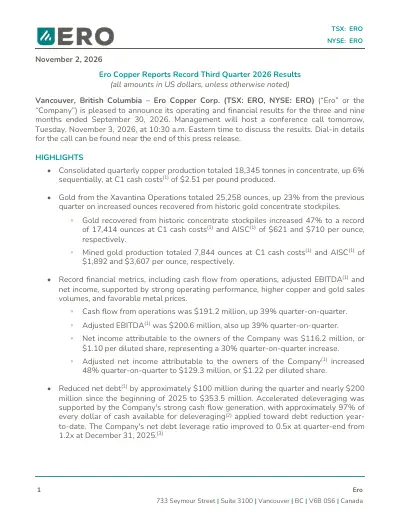
Our operating and financial results were released yesterday afternoon and are available on our website, along with our financial statements and MD&A for the three and nine months ended September 30th, 2026. A corresponding earnings presentation can be downloaded directly from the webcast and is also available in the presentation section of our website.
Joining me on the call today are Makko DeFilippo, President and Chief Executive Officer; Wayne Drier, Executive Vice President and Chief Financial Officer; Gelson Batista, Executive Vice President and Chief Operating Officer; and Courtney Lynn, Executive Vice President External Affairs and Strategy. Before we begin, I'd like to remind everyone that today's discussion will include forward-looking statements, which involve risks and uncertainties that may cause actual results to differ materially.
For a detailed discussion of these risks and their potential impact on our business, please refer to our most recent annual information form available on our website as well as on SEDAR and EDGAR. Unless otherwise noted, all figures discussed today are in US dollars.
With that, I'll now turn the call over to Makko DeFilippo.
Makko DeFilippo
Thank you, Farooq, and good morning, everyone. As always, we will keep today's prepared remarks short to allow sufficient time for Q&A.
Before turning to the quarter, I do want to take a step back for a moment. Despite recent market volatility and lingering questions about the pace of AI infrastructure spending, the underlying value of high-quality copper production, strong free cash flow generation, and a tangible organic growth pipeline has never been more clear.
This brings me to what I hope will be the four key takeaways from today's call. First, our operational performance is translating directly into cash generation and balance sheet strength.
This year, we've applied 97 cents of every available dollar towards debt reduction. Our commitment to our balance sheet has resulted in a net debt reduction of approximately $100 million in Q3 alone.
For Ero, this means greater flexibility to continue advancing our organic growth projects, including Furnas. Second, our cash operating margins remain strong.
Cost savings from our One Ero initiative and a successful foreign exchange hedge strategy are working in tandem, as intended, to offset the impact of inflationary pressures we're seeing at Ero and throughout the mining sector. Third, our copper business continues to perform well, and we remain well-positioned to achieve our full-year copper production guidance.
Fourth, the gold concentrate program we launched at Xavantina in late 2025 has provided us with real operational and commercial flexibility this year. We now have assays for the in-process material we expect to sell over the next eight weeks, and based on those results, we expect a combined 75 to 80,000 ounces of gold from Xavantina this year, a record for the company by any measure.
With those takeaways in mind, let me now turn to the quarter. As you have seen, we delivered record financial performance this quarter and year-to-date, establishing new high-water marks across all key financial metrics.
Our results reflect progress. In particular, I would point to the sequential quarterly increases in plant throughput at our copper operations.
Both Caraíba and Tucumã are set to achieve record annual throughput volumes this year. Operating momentum across our business, paired with metal price tailwinds, contributed to record cash flow from operations of approximately $191 million and adjusted EBITDA of over $200 million, both up nearly 40% quarter-on-quarter and an impressive 260% since our third quarter of last year.
On a year-to-date basis, we've generated over $420 million in cash flow from operations and $470 million in adjusted EBITDA, up approximately 60% and 110%, respectively, compared to this time last year. Against this backdrop of improving operational performance, it should be no surprise that this was our seventh consecutive quarter of accelerated deleveraging.
When I look back and compare our vastly improved net debt leverage ratio of 0.5 times in Q3 to our peak of 2.6 times at the start of 2025, I cannot help but be proud of our team's commitment and focus to this objective. Turning to our operations themselves, our copper business produced 18,300 tonnes of copper during the third quarter at a consolidated C1 cash cost of just over $2.50 per pound.
Throughput volumes at Caraíba and Tucumã remained strong during Q3, increasing quarter-on-quarter by 8 and 14%, respectively. We continue to expect Q4 to be the strongest operating quarter of the year and are on track to achieve full-year copper production guidance.
On the cost side of the equation, since the onset of the US-Iran conflict, we have pointed to a potential 10-cent per pound impact on our reported cash costs as a result of the inflationary pressures we're seeing and the flow-through of a stronger BRL on our functional currency. We have now reflected that in our consolidated C1 cash cost guidance for the year.
Offsetting this from a cash margin perspective, through the first nine months of the year, we have generated realized gains of $30 million from our foreign exchange hedge book. This protection is in place to protect our business against exactly the type of environment we have operated in during the first nine months of this year.
Wayne will speak to how we, as management, view this margin protection in the context of our adjusted C1 cash costs in more detail. At Xavantina, while mine performance was just short of 8,000 ounces and objectively below our expectations in Q3, total gold produced and recovered grew by 23% quarter-on-quarter to a record of approximately 25,000 ounces.
Increasing production from historic concentrates was a key operational focus for us this year, given the slow start to mining operations in the first half. At sub-$750 per ounce of all-in sustaining costs, it is perhaps no surprise why we prioritized the sale of this material.
The investments we made during the first half of the year to enhance our drying capacity of historic concentrates are paying off as we enter the second half of the year. As a result, we expect total gold from Xavantina of between 75 and 80,000 ounces this year.
Transitioning into our growth pipeline, at the Furnas project, we completed the 45,000-meter Phase 3 drill program in August, completing the entirety of the exploration component of the earn-in agreement with Vale Base Metals more than two years ahead of schedule. Drilling results have consistently demonstrated high-grade continuity within the deposit and extensions at depth and along strike.
We expect to provide the full results of the Phase 3 program prior to year-end. In parallel, we're moving forward across all technical work streams to support the project's pre-feasibility study, and we expect to publish this in 2027.
The work we have done and are continuing to do to strengthen our operating performance and improve operating margins through our One Ero program are translating into strong free cash flow generation and record financial performance. With that, I'll turn the call over to Gelson.
Gelson Batista
Thank you, Makko, and good morning, everyone. As Makko outlined, we had strong metal production in Q3, and are expecting improved performance across all three operations in Q4.
I will provide some additional detail on the underlying operating drivers and our expectations for the remainder of the year. At Caraíba, copper production totaled 9,387 tonnes during the quarter at C1 cash costs of $2.89 per pound produced.
Production increased by 12% over the previous quarter, driven by higher plant throughput, grades, and recoveries. Costs in the quarter were impacted by accelerated waste stripping costs at Surubim open pit and elevated road fleet maintenance costs.
Both of these cost centers were heavily influenced by the elevated diesel price environment in Q3. Looking ahead, we expect stronger production at Caraíba in Q4, driven by higher mined and processed grades coming from deeper high-grade benches at Surubim, combined with contributions from the Pilar underground mine, positioning us well to achieve full-year production guidance.
C1 cash costs are expected to decline in Q4 with increased production volumes. At Tucumã, copper production totaled 8,958 tonnes at C1 cash costs of $2.12 per pound produced.
Production and costs were similar to the prior quarter, as a planned decrease in process grades was offset by a 14% increase in plant throughput. Recoveries were impacted in Q3 due to operational adjustments that were required coming out of a mill liner replacement and maintenance shutdown.
This was a temporary impact, which Makko spoke to on our Q2 conference call. Looking to Q4, we expect production to benefit from higher throughput rates and increased metallurgical recoveries.
C1 cash costs are expected to decline sequentially, supporting our maintaining full-year production and cost guidance for Tucumã. The three new filters we're installing were delivered to site in late Q3, and we remain on schedule to finalize their installation and commissioning prior to year-end.
At Xavantina, mined gold production totaled 7,844 ounces at C1 cash costs of $1,892 per ounce produced in Q3. Mined and processed grades increased, as expected.
However, as Makko noted, operational delays in accessing key high-grade stopes resulted in lower grades processed during the quarter. Looking ahead, we expect mined and processed tonnage and grades to improve in the fourth quarter.
This outlook is supported by all-time record development levels achieved over the past few months. Gold recovered from historic concentrate stockpiles increased by 47% from the previous quarter to 17,414 ounces at C1 cash costs of $621 per ounce, as the operations benefited from the mobile filter press and inductor dryer commissioned at the end of June.
Looking to quarter four, further increases in throughput volumes along with an improved grade profile we expect will translate directly into lower C1 cash costs. We expect historic concentrate volumes to remain robust, based on the volumes shipped and in process so far through October, as Makko mentioned.
I will now turn the call over to Wayne to walk through our financial results.
Wayne Drier
Thank you, Gelson, and good morning, all. Our third quarter financial results reflected a 10% and 47% quarter-on-quarter increase in copper and gold sales volumes, respectively, coupled with strong metal prices.
These factors together drove quarterly revenue to $348 million, up 22% from the second quarter. As Makko noted, we achieved record quarterly cash flow from operations, which increased to $191 million, while adjusted EBITDA increased to a record of $201 million, both measures up 39% sequentially.
The strong financial performance allowed us to accelerate debt reduction, with repayments of $70 million in the quarter against our revolving credit facility, bringing total repayments in 2026 to $105 million. As a result, net debt declined by $99 million during Q3 to approximately $353 million, while last 12-month adjusted EBITDA increased to $657 million.
Together, these factors reduced our net debt leverage ratio to approximately 0.5 times. Our liquidity position also improved during the period, increasing $82 million to $264 million, including $114 million of cash and cash equivalents and $150 million of availability under our revolver.
Turning to foreign exchange, a stronger real continued to adversely impact our reported operating costs and capital expenditures during the quarter. However, on a cash basis, our hedge program worked as intended, generating $10 million of realized gains in the quarter and bringing the total foreign exchange gains through the first three quarters to $30 million.
While these gains mitigate the cash impact of the stronger real, they are not included in our reported C1 cash costs. To better capture how we think about our cash margins at Ero, if we were to apply the year-to-date $30 million of realized gains to the operations on a pro rata basis, this would translate to a 15-cent per pound reduction in consolidated copper C1 cash costs and a $50 per ounce reduction to Xavantina's C1 cash costs over the full year.
This is illustrated on slide 17 of the webcast presentation. With that, I'll pass the call back to Makko for some closing remarks.
Makko DeFilippo
Thank you, Wayne. Before we open the line for questions, let me bring everyone back to the four points I opened with.
First, we are turning operating performance into cash generation. We've put 97 cents of every dollar available towards debt reduction this year, including approximately $100 million of net debt reduction in Q3 alone.
Second, our copper business is performing well, and we remain on track to meet our full-year production guidance. Third, the gold concentrate program at Xavantina has us on track for approximately 75 to 80,000 ounces of gold this year, a record for the company.
Fourth, our One Ero program and our BRL hedge strategy are working in tandem and as intended to maintain strong cash operating margins, despite the inflationary pressures we're seeing across the sector. Finally, looking a little bit further ahead to Furnas milestones, we remain on track to deliver the pre-feasibility study in 2027.
Thank you for joining us this morning. Operator, we are ready for questions.
Operator
Thank you. We will now begin the question and answer session.
To join the question queue, you may press * then 1 on your telephone keypad. You will hear a tone acknowledging your request.
If you are using a speakerphone, please pick up your handset before pressing any keys. To withdraw your question, please press * then 2.
The first question comes from Fahad Tariq with Jefferies. Please go ahead.
Fahad Tariq
Hi. Thanks for taking my questions.
With the leverage ratio, net debt to EBITDA, now at 0.5 times, can you talk a little bit about the shareholder return program, when we should be expecting some sort of announcement, and just how the management team is thinking about shareholder returns? Thanks.
Wayne Drier
Thanks for the question. Look, I think I covered it fairly extensively on our capital markets day in September in São Paulo.
We're well on that journey. We're below the leverage ratio where we wanted to be.
We're on track to repay the revolver, and certainly with the current price environment, the expectation is that will be repaid during Q4. We have very active discussions with our board and think around what that shareholder return framework will look like.
I think you'll just have to see when we're ready to put that out to the market.
Fahad Tariq
Okay. Then just on the Brazilian real, it's weakened pretty substantially over the past couple of weeks since the election.
How should we be thinking about the effect of that in the fourth quarter as it pertains to the hedges and the floor price in the second half along with the operating cost impact? Does it net out?
Wayne Drier
I'll take that question as well. Obviously, we have already in place our hedge book for 2026, and so we're fairly well-covered for Q4, that obviously doesn't cover the entire amount of opex and capex, and certainly, some of these tailwinds we've seen following the election will help.
I think if we look through to 2027, we actively manage our book in a proactive manner. We have taken advantage of some of this weakening to put in place some hedges for 2027, we're starting to build our book for 2027 as well.
Makko DeFilippo
Maybe just to add to that question, as we think about Q4, I think it's important to note that the way that our hedge strategy works is, we protect the floor, in this case for Q4, of 5.54, so that's our protection level. We participate in the exposure of the BRL all the way up to our ceiling, which is 6.42, and that's showed on slide 8 of the webcast presentation.
When you think about where we were in the first nine months of the year versus where we are today, should we see continued weakness in the BRL, we will participate in that up until our cap of 6.42.
Fahad Tariq
Got it. Thank you.
Operator
The next question comes from Orest Wowkodaw with Scotiabank. Please go ahead.
Orest Wowkodaw
Hi, good morning. Great to see the cash flow generation.
I had a couple questions on Xavantina. The grade was quite low in Q3.
I'm wondering if you've now seen the turn in Q4 in terms of a grade that's, say, closer to reserve grade?
Makko DeFilippo
Look, I'll jump in, Orest, and then Gelson can comment on this. We expect Q4 to be the strongest quarter of the year.
I think some of the key high-grade stopes, as Gelson pointed to in the conference call, that we had planned coming in late Q3 were shifted a bit, those are coming in Q4. I think with Xavantina, it's important to keep in mind that when we think about reserve grade, that's an average of a life of mine.
We obviously every month, every quarter, we mine stopes that are well above that range in some instances, as we saw the last couple of years, and then some that are lower. It's obviously a blended grade when we think about reserves.
What I can tell you is that looking at our results here, we do see grades climbing, as expected. It's well-supported by our infill drill program and channel sampling that we have for Q4, we're feeling pretty good about the stopes that were into now and kind of mining Q4.
I don't know, Gelson, if you've got anything to add there?
Gelson Batista
No, thanks, Orest, for the call. I think Makko mentioned well there about the stopes that we got into this quarter, and then we're back on track, have no further.
Makko DeFilippo
I think, Orest, Gelson mentioned this, too. Xavantina, real priority for us.
Not coming out of the first half, obviously, we're behind where we had hoped to be in terms of development and mine performance. I think a good leading indicator for us, as Gelson mentioned there, achieved record developments the last three months, or all-time historic record development levels.
We're certainly not out of the woods yet. I think it's too early to declare victory.
Based on achieving the development, being ahead on development, being in some higher-grade stopes, seeing that flow through, I think is a strong indicator for where we think Q4 is heading.
Orest Wowkodaw
Thank you for that. Just as a follow-up, you're guiding to, I believe, 15,000 ounces of gold from the concentrate sales in Q4.
Why are you thinking it's going to be lower than Q3? Are you expecting sort of a pick up in the rainy season late in the year, or I'm just wondering if that's a conservative estimate, or is there something constraining volume here in Q4?
Makko DeFilippo
Look, obviously, we made big investments in the drying infrastructure on site. We saw that flow through in Q3.
That did coincide with a seasonal dry period, which obviously helps that dryer perform well. I'd say the reality, Orest, is that our approach in the concentrates has been consistent.
We can only provide forward-looking information for the information that we have available on hand. What we have today in dried inventory or drying inventory is that 9,000 ounces.
Obviously, we expect to add more to that, but the 15,000 is what we have assayed and available today. I would say that includes also over 6,000 ounces that were invoiced in October, right?
I think that's an important thing to keep in mind as you think about Q4.
Orest Wowkodaw
Thank you for that. Just finally, if I could just switch gears for a second, can you give us an update on the shaft sinking project in Caraíba, in terms of current expectations for completion and how much capex is remaining on the project?
Makko DeFilippo
Sure. I'll jump in here, and Gelson can pick up if I miss anything there.
As of right now, we're about 1,250 meters complete. That means that we've got about 300 meters to go, if you follow where that progress has been, as we talked about in our capital markets day.
We still expect to complete that shaft in Q1, as we outlined in September at our capital markets day. That's an important metric for us.
As I said, when we think about the timing and completion of the shaft, to go back to some of the commentary from Q2, I want to remind everyone that the last shaft that was built in Pilar was in 1986, about 40 years ago. We're certainly not trying to solve for a specific month next year.
This investment will support the operation for, hopefully, decades to come. On the capex side, yeah, look, it's a $370 million investment.
As the end of Q3, spent about $300 million, $70 million to go. We expect to spend a good chunk of that here in Q4 with a balance in through next year.
Orest Wowkodaw
Thanks for that.
Operator
The next question comes from Guilherme Rosito with Bank of America. Please go ahead.
Guilherme Rosito
All right. Thank you for taking my questions.
Good morning, everyone. I have two on my side.
Maybe if we could begin with an update on Tucumã, how are the filters coming along, and what are you expecting for maybe if you can give us some color for 2027 versus what you guys are probably producing in 2026, or how fourth Q is coming along? Then my second was also on Xavantina.
I know you guys commented on that a bit, but if we look at the previous three-year production outlook, it implied 50 to 60,000 ounces in Xavantina, and with the performance we had year-to-date, especially in terms of grades, it seems a bit more challenging than it would have seemed earlier in the year, right? My question is, how are you guys feeling about the three-year production outlook?
Is there any chance you guys think it could be revised lower? Just to hear your thoughts on that.
Thank you.
Gelson Batista
Thank you. Thank you for your question, Guilherme.
Gelson here. In Tucumã, we've got all the filters on site.
They arrived, in last quarter, late last quarter. Everything is on track for completion, by the year-end.
And, we expect, as we mentioned before, to come out of, 2026 at 4 million tonnes per annum, as as we planned before. The filters are on track, and, the team is working there to make sure that we can, complete them on time.
Makko DeFilippo
I think just maybe touching that point, Gelson and I speak about this a lot. If you look at the performance, quarter-on-quarter, even without the additional filtration capacity, huge progress has been made there, reaching that above 800,000 tonnes a quarter.
We're well on our way, and as Gelson said, expect to exit the year there at that 4 million tonne a year rate, which is where we expect to be for 2027. Serving to the question on Xavantina, I would maybe point you in a slightly different direction there.
I think if you look at even our adjusted guidance, obviously, which came down versus our expectations in the early part of the year, that really reflects a delay in ventilation cooling development. If you look at the Q4 in isolation, I think that's a better representation of what that asset's capable of doing, with obviously the transition that happened this year.
Looking at Q4 and multiplying by four, I think is probably a better representation than looking at the full year 2026, especially the first nine months, and getting to that range. I would say that when we think about Xavantina, I think Q4 is more representative of what we think we can do, both in terms of mine performance, throughput volumes, and also process grades.
Guilherme Rosito
All right. Thank you.
Operator
The next question comes from Matheus Moreira with Bradesco BBI. Please go ahead.
Matheus Moreira
Thank you. Good morning, everyone, and thanks for taking my questions.
Two questions on my side. First, at Caraíba, you mentioned that we should see production improving in the last quarter, driven by higher grades.
I'm just wondering how should we expect these grades to extend into 2027, and could you help us understand what would be a reasonable production mix between Pilar, Vermelhos, and Surubim for next year? Then my second question on Furnas, you've completed the Phase 3 drilling program during the quarter, which is roughly two years ahead of the original schedule.
Does that give you room to bring forward an eventual FID, and what are the key milestones that you still need to work through? Then maybe just one more on Furnas on the PFS, which you expect to complete in 2027, can you give us a sense of whether that's more likely to be early or late in the year?
Those are my two questions. Thank you.
Makko DeFilippo
Perfect. Lot to unpack there, if I miss something, I apologize, just ask it again.
Starting with the first question on Caraíba, yeah, look, we've been I think consistent that with the main contributor to higher grades this year from Caraíba as a mix is these lower levels, these lower benches in Surubim. We've been mining at Surubim for the last couple years.
When you look at the last couple years, the strength of that has been really supported by these lower benches, right? They're about 1% copper versus where we were a few years ago.
It's a very high-grade open pit operation, at least those lower levels of Surubim. We do expect to see some of that into Q4 with a bit of a delay there.
In Q3, we expect some of that material to roll forward into Q1 of next year. In our capital markets day, we provided more clarity about the relative mix and how we see Surubim transitioning into N8 for next year and over the next couple years.
I would point you to the capital markets day for that allocation on the mix of relative sources. We do see this transition in 2027 from Surubim into N8.
Again, a little bit of a grade profile difference there, particularly because the lower benches that we're mining now are quite high-grade from an open pit perspective at Caraíba. At Furnas, just to touch on the couple of questions you asked there, so, one, being two years ahead of schedule, look, I think there's very important milestones.
The one that we're able to control directly is the effort put on drilling. We think that with the quality of project that Furnas is, getting well ahead on drilling is one of the best places to put growth capital towards.
We've obviously done that, right? Two years ahead of schedule, as you pointed to.
In terms of pulling forward FID, we still have a couple of levels of engineering to go, including the PFS here next year, and then, obviously, a feasibility study. I would say, let's get through the pre-feasibility study and the work that we're doing now, and then have a discussion sometime next year about that.
The reality, though, is, as said many times, we still have to go through the permitting process. We're obviously familiar with what that entails, having done that for Tucumã quite recently.
That's another key parallel work stream that's happening in conjunction with all the drilling and all the engineering work. We have a couple key milestones on permitting that we're advancing this year.
Those are going well, as we've talked about in our capital markets day as well. In terms of timing of the pre-feasibility study, I'd say, look, yeah, we're working as fast as we can.
If you follow the milestones from the earn-in agreement, we have until September to finalize that. Obviously, we continue to work as fast as possible to get that done.
I would say September at the latest, given the timeline as outlined in the earn-in agreement.
Matheus Moreira
Great. That's very good color.
Thank you. Thanks, Makko.
Operator
The next question comes from Ricardo Monegaglia with Banco Safra. Please go ahead.
Ricardo Monegaglia
Hello, guys. Good morning.
Thank you for taking my questions. I have two.
First on Tucumã, just a quick follow-up. Throughput rose, and that's great, but recoveries fell a bit short of our estimates.
Could you give us some color on what drove it, and maybe how confident are you on reaching that high 80s or low 90s level?
Makko DeFilippo
Perfect. Thanks for the question.
We've spoken about this on our Q2 conference call, right? Right at the end of Q2, we had a mill reline and a major maintenance period that was successfully completed.
We did, however, see an impact on recovery coming out of that. There was operational adjustments that need to be made, largely around the mill ration size that impacted the recoveries for Q3 that was early in the quarter.
Throughout the quarter, we did see an increase in recovery, and obviously, that supports kind of where we think we're going to be through the balance of that year, as Gelson mentioned, improving recoveries into that high 80s range. I would say that, keep in mind that recoveries are a function of grade.
There is a grade recovery curve at Tucumã, as with all copper flotation operations. We'd expect stronger recoveries in Q4.
Over time, there's obviously a relationship to grade. We've got a number of initiatives to help improve recovery as we go forward.
Again, I would say that the read-through on Q3 is really a one-off impact coming out of that maintenance period and some of the operational adjustments that we had to make to improve the circuit, again, with higher throughput volumes during the period as well.
Ricardo Monegaglia
Thanks, Makko. Very clear.
My second question on corporate G&A. G&A in the operations were fairly in line with what we expected, but corporate G&A was a bit higher and growing 30% year-over-year.
Just wanted to understand what could we consider as a one-off, and maybe what run rate do you think we should model for the upcoming quarters and maybe 2027?
Wayne Drier
Good question. The change from Q2 to Q3, which is about $4 million, is actually entirely related to a SAP implementation project, which is underway.
Right now we are basically instituting SAP S/4HANA, which is a cloud-based ERP system through the enterprise. Unfortunately, the IFRS rules under cloud-based systems don't allow us to capitalize that, much like legacy ERP systems.
Those costs are being expensed through the implementation. I think you can expect to see that amount for the next two quarters, two to three quarters.
We expect implementation to be done by Q2. The run rate, certainly, if you look at Q1, Q2, that is our typical run rate.
The change is simply related to the SAP implementation. All
Ricardo Monegaglia
right. Thanks, Wayne, and congrats on the results.
Wayne Drier
Thank you.
Operator
The next question comes from Stefan Ioannou with ATB Cormark. Please go ahead.
Stefan Ioannou
Thanks very much, guys. I'm not sure if I may have missed it earlier, but just maybe to when we were down on site, I guess, a month or so ago at Xavantina, just wondering is the outlook for the concentrate that will be still coming out of the ground, say, through the middle of next year, or is there any additional color on sort of the outlook over the coming quarters for what the gold in concentrate production might look like?
Makko DeFilippo
We don't have an outlook beyond Q4. Stefan, it's a good question.
I think the reality there is, as I outlined, we're comfortable with the eight weeks that we have. All that material's been assayed and is in an inventory or drying process now.
To go beyond that, obviously, would be difficult to provide any information, having even the lack of samples there, as we've discussed a few times here. I do think that there is volume remaining.
We're obviously prioritizing the extraction and sale of that material, particularly in this gold price environment. Again, as I mentioned, sub-$750 all-in sustaining costs, it's probably no surprise why we're doing that.
I think, stay tuned. We'll sort of reconcile some of what's remaining on the balance there.
I think looking at that material continuing for the next couple quarters into 2027 is not an unreasonable timeline. Obviously, can't speak to the grades that are in there, because we don't know, but I think it's reasonable to assume that we will have additional material remaining from which to sell the next couple of quarters.
Stefan Ioannou
Okay. I guess, just simplistically, is it really just a function of the fact that it's obviously underwater, it's hard to really guestimate or estimate how many tonnes you actually still have, right?
Makko DeFilippo
In order to get a representative sample, we'd have to pump all that material out and dry it. If we're going to do that, then we might as well sell it.
The reality is that we just won't be able to sample that material until it's in the drying process, as we saw in Q4.
Stefan Ioannou
Great. Thanks very much, guys.
Operator
The next question comes from Rodrigo Gotardo with BTG. Please go ahead.
Rodrigo Gotardo
Hello, good morning, guys. Good morning, all Ero team.
Two questions on my side. The first one, could you give us an update, how are the updated technical reports for the three current mines evolving right now?
Seems that last one, Ero has made meaningful development in operations, brownfield initiatives. We have new metal prices since then.
What to expect from these studies, if there's a planned timeline, when do you plan to release them, if you could give us an outlook and what you expect from this, would be very helpful.
Makko DeFilippo
Good question, Rodrigo. We had this question, particularly on Tucumã, last quarter.
We do expect to put out an updated technical report on Tucumã this year. That's in the late stages here, stay tuned.
That'll be before year-end. We'll continue with our normal reporting process for Caraíba and Xavantina.
On this call, will not give a steer as to what we're saying there. Obviously, metal prices being where they're at has given us a good opportunity to kind of re-evaluate those plans and make some optimizations.
I'd say the focus for us is still on margin. Stay tuned.
We'll have that discussion later this year.
Rodrigo Gotardo
Perfect. Thanks for the update.
My second question, Makko and all other team, just how do you see the Ero's equity story until 2029 before Furnas, right? We've been seeing many brownfield initiatives, Ero's generating cash, deleveraging in a fast pace.
Just in a broader picture in terms of preparations, project, shareholders' return, how do you see the company until 2029?
Makko DeFilippo
It's a good question. Thanks for that.
I think as I've said many times, the investment case for high-quality assets in copper, ones that are generating significant amount of cash flow in this environment, certainly, I think deserves attention. Obviously, leveraging our assets and the strength of our balance sheet into what we think is truly an incredible growth project in Furnas and setting up the business for to execute on that, is something that we spend a lot of time thinking about, as well as advancing some of the exploration programs, our portfolio.
I think what differentiates Ero in this environment from perhaps, I don't want to say the rest of the sector, I think that's too broad of a brush, but certainly some of our peers, is we're at the tail end of what has been a multi-year, capital-intensive phase. We're seeing we have a few years until we embark on our next pure growth asset, which I think that sets up our business very well to invest not only in the future growth that we have in Furnas, but a couple of organic growth drivers we have around our operations, as we spoke to in detail on our capital markets day.
It's an exciting time, obviously, to see the efforts that we've put into the operations into value drivers, like the concentrate sales program, and obviously, the One Ero initiative that we've been driving, paired to our risk mitigation strategy in the currency, I think is all setting us up well to position the company to execute on our growing organic growth pipeline in Furnas, add additional value through some of our exploration programs and brownfield development projects that we spoke about on our capital markets day. Have a strong balance sheet on top of that.
Our priorities in the short term, I think as Wayne alluded to, when I think short term, the next quarter, obviously, we want to pay down the balance of our revolver. That's a top priority for us as a team, and it's something that we've committed to all of our shareholders back in 2025.
I think, collectively, very pleased to see that on the near-term horizon.
Rodrigo Gotardo
That's very clear. Thanks for the update.
Operator
The next question comes from Anita Soni with CIBC World Markets. Please go ahead.
Anita Soni
Hi, good morning. I apologize if this has been asked, but I just wanted to circle back to Xavantina.
You mentioned that if we looked at Q4 as a run rate, that would be more indicative of what it could do in 2027. Did you give the parameters around what you were seeing for Q4?
I might have missed that.
Makko DeFilippo
Anita, if you just look at sort of the midpoint of our guidance, obviously, it still implies a pretty big step up in operational performance there. I think the question is, how do you steer yourself to the 50,000, 50,000-ounce rate plus range.
Obviously, I think looking at the full year of 2026 and multiplying that, looking at the first nine months and saying, well, that's representative of what the asset can do, I don't think is fair. I would point to what we expect to do in Q4.
From an operational perspective, we talked about this in our capital markets day, and if you look at where we expect to be, we're sort of triangulating into the 20 to 25,000-tonne a month range from the mine and plant. I think we saw very close to those levels in Q3.
I think the normalized value is about 19,000 a month. We did see the mine come back, as Gelson alluded to.
Big impact there was on grade, as we delayed some access to some of the really key high-grade stopes that we expected at the end of the quarter, and those are obviously transitioning into Q4 here. We did not provide specific parameters.
It was more of a applied mathematical extrapolation based on the midpoint of our guidance and what we've done for the first nine months.
Anita Soni
Sure. Then at Caraíba, I just wanted to ask in terms of the tonnage.
It looks like you've kind of ramped up to that. I think the capital markets day said kind of a 4.5 to 4.7 million tonne per annum sustained throughput, and you're pretty close to that this quarter, if I'm doing the math right.
Do you expect that could be sustained into 2027 at this stage, or is there something that I might be missing in terms of additional tie-ins or other work that needs to be done in 2027 to sustain that rate?
Makko DeFilippo
No, we think that's sustainable. Obviously, from time to time, we obviously do have planned shutdowns that'll impact that on a quarterly basis, but no major tie-ins.
I think the debottlenecking work that the team did, it was led by Gelson here, I think has showed up this year in sequential throughput improvement. We think that pace is representative of what we can do, said, notwithstanding the normal downtime for maintenance in the year, but pretty solid performance from that operation, given where we were just a few years ago.
Anita Soni
Thank you. That's it for my questions.
Operator
We have a follow-up question from Orest Wowkodaw with Scotiabank. Please go ahead.
Orest Wowkodaw
Hi, thanks for the follow-up. Just a clarification question, Makko.
You mentioned there is a tech report update coming for Tucumã before year-end. Is that going to be only updated reserves, resources, or can we anticipate also a life-of-mine production plan updated in that as well?
Makko DeFilippo
Thanks, Orest. We do expect to have updated resource and reserve estimates coming from that operation prior to year-end.
There will be details about the phase of that operation. That's maybe as far as I'm prepared to go on the call.
That's sort of hard enough for 2021, not a huge surprise to anyone on the call. We'll provide some information on the phases, particularly around how the reserves will be extracted.
That work is happening as we speak, and we're well-positioned to put that out before year-end.
Orest Wowkodaw
Thanks.
Operator
This concludes the question and answer session. I would like to turn the conference back over to Makko DeFilippo for any closing remarks.
Please go ahead.
Makko DeFilippo
Thank you, operator, and thank you everyone for joining us. I know it's a very busy time, and so, as always, appreciate the lively Q&A discussion.
It's one of the highlights of the quarter for me, and appreciate the active dialogue. As always, our team's available for follow-up discussions and questions, please do reach out to Courtney, Farookh, or anyone on our team.
For those of you that we're going to see in Toronto, Boston, and Montreal in the coming days, we look forward to seeing you in person. Thank you very much, and talk soon.
Operator
This brings to a close today's conference call. You may disconnect your lines.
Thank you for participating, and have a pleasant day.