Finning International Inc.
Q3 FY2026 · Earnings Call TranscriptNovember 10, 2026
Operator
Thank you for standing by. This is the conference operator.
Welcome to the Finning International Inc. third quarter 2026 investor call and webcast.
As a reminder, all participants are in listen-only mode, and the conference is being recorded. After the presentation, there will be an opportunity to ask questions.
Analysts who wish to join the question queue may press *1 on the telephone keypad. Should you need assistance during the conference call, you may reach an operator by pressing *0.
I would now like to turn the conference over to David Primrose, Executive Vice President and Chief Financial Officer. Please go ahead.
David Primrose
Thank you, operator. Good morning, everyone, and welcome to Finning's third quarter earnings call.
Joining me on today's call is Kevin Parkes, our President and CEO, and we are pleased to be joining you from our operation in Dublin, Ireland. Following our remarks, we will open the line to questions.
This call is being webcast on the investor relations section of finning.com. We have also provided a set of slides on our website that we will reference, and an audio file of this call and the accompanying slides will be archived.
Before I turn it over to Kevin, I want to remind everyone that some of these statements provided during this call are forward-looking. Please refer to slides 9 and 10 for important disclosures about forward-looking information, as well as currency and specified financial measures, including non-GAAP financial measures.
Please note that forward-looking information is subject to risks, uncertainties, and other factors as discussed in our annual information form under Key Business Risks and in our MD&A under Risk Factors and Management and Forward-Looking Information Disclaimer. Please treat this information with caution, as our actual results could differ materially from current expectations.
In addition, unless otherwise noted, this presentation reflects the results of continuing operations only. Kevin, over to you.
Kevin Parkes
Thank you, Dave, and good morning, everyone. We appreciate you taking the time to be with us today.
As Dave mentioned, today we're in our Dublin branch, where we held our board meeting in Ireland for the very first time. It's a wonderful opportunity for our board to spend time with customers, Caterpillar, and employees.
As always, I want to thank our teams, our customers, and Caterpillar for your hard work, trust, and partnership. Finning continues to execute on our strategy.
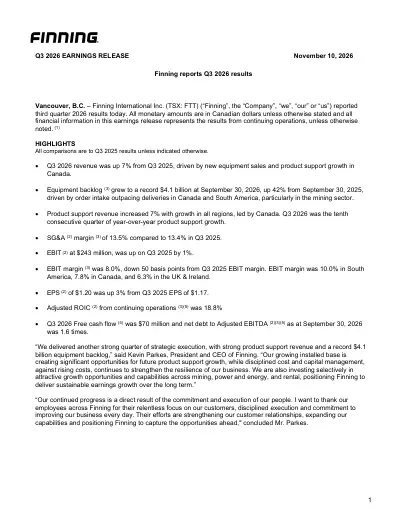
For the second quarter in a row, our revenues exceeded $3 billion. Product support grew year-over-year for the 10th consecutive quarter, up 7%.
We continue to deliver new equipment to our customers, with new equipment sales growing 11% in the quarter. In the same quarter, our backlog exceeded $4 billion for the first time ever, driven by growth across all three market segments.
The growth in backlog reflects the optimism that we are hearing from our customers. We are seeing improved sentiment from Canadian customers as a result of encouraging announcements in the support of build Canada strong.
Activity in both Chile and Argentina remains encouraging, though new and used equipment deliveries were lower due to timing. We saw sustained product support growth in the quarter, despite challenging conditions for our mining customers, and we continue to build strong and resilient capabilities to support our customers and be ready to meet the next phase of growth.
We continue to be optimistic about the opportunities for growth in South America, as production guidance remains robust and the RIGI approval process in Argentina is creating confidence amongst customers when thinking about their investment decisions. I'm particularly proud of the UK and Ireland team's performance this quarter.
In a market that remains challenging for several quarters now, they are driving expansion of the business by adopting a growth mindset, working closely with existing customers, and building our customer base to grow market share. We continue to grow the machine population and engine population across our territories.
That installed base drives the future product support growth, which is the source of our resilience and long-term value creation. We continue to see some variation in our margins, driven by mix and investments in capability and capacity into our product support organizations to capture current and future growth opportunities, which continue to build.
The timing of capability and capacity builds and revenue growth can move around between quarters. Each region has a robust plan in place to drive resiliency through the organization to ensure the conversion of revenue to the bottom line.
As in prior quarters, my prepared remarks will focus on long-term earnings potential we are building, and then Dave will cover quarter results in detail. Please turn to slide 2.
Our performance across three strategic pillars is increasing EPS potential. Product support revenue reached $6.3 billion on a last-12-month basis.
In the quarter, product support was up 7% year-over-year, led by 12% growth in Canada. Canadian product support is growing across every sector, with double-digit growth in Q3 in all market segments.
Oil sands production and pipeline activity continue to grow, and we continue to see market share gains as we work with our customers to help them meet their goals. Our focus on rebuild remains.
Through three quarters of 2026, we have rebuilt more machines than in all of 2025, driven by very strong performance in Canadian mining, where so far in 2026, we have rebuilt double the units compared to all of 2025. This is complemented by strong performance in the UK and Ireland.
We are executing on our rental strategy, with 27% growth in Q3 and 15% growth on a 12-month trailing basis. Our rental business is gaining momentum in each operating region, with Canada leading the way, up 26% in Q3.
We continue to make strategic fleet investments, including the recently announced acquisition of J.F. Hunt Power in the UK.
This acquisition will provide expanded market access and strengthen our power rental business across the territory. We continue to focus our attention on cost and capital discipline to enhance our resilient operating model.
We are investing in our people and capacity to support long-term growth while maintaining strong operating leverage. SG&A as a percentage of revenue was 14.5% on a last-12-month basis, down 50 basis points from the last 12 months Q3 2025.
Invested capital returns increased to 2.36 times. We expect these metrics will continue to reflect our focus on driving resilient, sustainable earnings growth.
We spoke about the data center opportunity on the Q2 call. I'm pleased to say this quarter we have added a major data center order into the Canadian backlog.
We have committed to supplying Caterpillar gensets with a product support contract for this backup power project. These systems will be packaged at our Red Deer operation with minimal investment.
We were able to repurpose our existing footprint and existing decades of experience from the UK and Ireland operation to meet the demands of this generational power opportunity in Western Canada. This is only the beginning, and it's a really encouraging sign of things to come.
We continue to be thoughtful and deliberate about our approach in this space, including evaluating behind-the-meter and bridging power opportunities. We are working closely with Caterpillar and customers to meet demand and deliver on our commitments resiliently.
To close, we are executing on strategy by growing the installed base of equipment and engines, and we are converting that population into product support growth, while maintaining a disciplined cost and capital mindset. You are seeing a more resilient operating model in action, and we continue to be optimistic about the future opportunities, and will execute and drive forward our earnings potential.
With that, I'll hand the call back to Dave.
David Primrose
Thank you, Kevin. I'll now turn to slide 3.
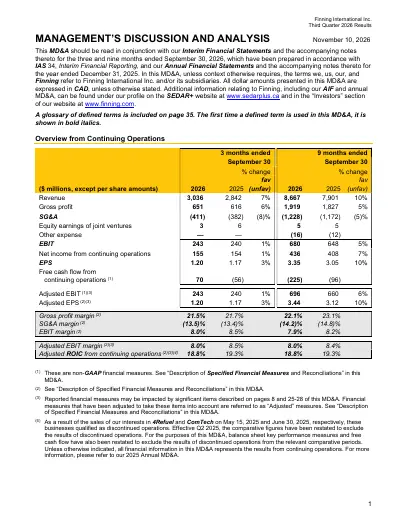
Our Q3 revenue was $3 billion, was up 7% compared to Q3 2025, primarily driven by increases in new equipment deliveries in Canada and the UK and Ireland, and continued product support growth across all regions, particularly in Canada. Revenue exceeding $3 billion for the second consecutive quarter is a clear indicator of our ability to maximize the opportunities developing within our regions.
EBIT was $243 million, up 1% compared to Q3 2025, and EPS of $1.20 was up 3% compared to Q3 2025 EPS of $1.17, reflecting higher earnings and also the benefit of our share repurchases. Long-term incentive plan expense was $14 million this quarter, or approximately 8 cents of EPS impact, driven by strong share price appreciation.
This compares to LTIP expense of $10 million, or approximately 6 cents of EPS impact, in Q3 2025. Our balance sheet and capital efficiency remain strong.
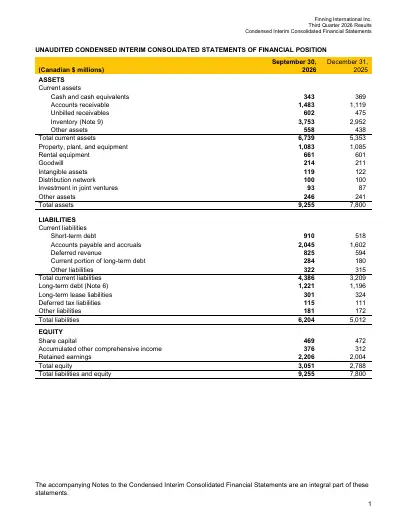
Free cash flow was a positive $70 million, with strong collections offsetting investments in inventory to support growth. Net debt to adjusted EBITDA was 1.6 times at the end of September.
Invested capital turns were up to 2.36 times, and adjusted return on invested capital was 18.8%, all within our target ranges. On slide 4, we show changes in our revenue by line of business compared to Q3 2025 and the composition of our equipment backlog by market sector.
New equipment sales were up 11%, driven by increased mining deliveries in Canada as well as construction deliveries in all regions. Used equipment sales were down 28%, primarily driven by a large mining order in Chile in Q3 2025, partially offset by growth in the construction business in all three regions.
Rental revenue was up 27%, reflecting increasing construction activity across all regions and our increased capacity through targeted investment. Product support revenue was up 7%, primarily driven by strong activity in mining in Canada and construction across all regions.
Despite the strong level of new equipment sales in the quarter, equipment backlog increased to a record $4.1 billion at September 30th, 2026, up 7% from Q2 2026 and up 42% from September 2025. Order intake continued to outpace deliveries in the quarter.
Mining and power and energy order intake in Canada were significant drivers of the increase, with robust orders in construction across all regions in the quarter. The mix of end markets within our backlog remains consistent, with approximately half in mining, about 1/3 in power and energy, and the remainder in construction.
We continue to view backlog strength as demonstrating confidence in future product support opportunities. Turning to our EBIT performance on slide 5.
Gross profit margin was 21.5%, down 20 basis points compared to Q3 2025, from lower product support margins. SG&A margin was 13.5%, up 10 basis points from Q3 2025, primarily due to higher people costs to support growth and LTIP expense.
EBIT margin was 8%, down 50 basis points from Q3 2025 EBIT margin. Q3 EBIT margin was 10% in South America, 7.8% in Canada, and 6.3% in the UK and Ireland.
We continue to execute on opportunities to reduce cost, drive efficiency, enhance operating leverage, and strengthen our resilience to create higher earnings capacity. Moving to South America results and outlook, which are summarized on slide 6.
In functional currency, new equipment sales were down 35% from Q3 2025 due to lower mining and power and energy deliveries in the current quarter. Product support revenue was up 1%, driven by higher construction activity.
EBIT margin of 10% was up 30 basis points from Q3 2025, primarily driven by the mix impact of a higher proportion of product support revenue, partially offset by higher SG&A margin. Adjusted return on invested capital of 22.7% was down 190 basis points, impacted by the increase in average invested capital and lower EBIT.
In Chile, our long-term outlook remains positive and unchanged. In October 2026, Chile enacted tax reform aimed at strengthening the investment environment, including a phased reduction in the corporate income tax rate from 27% to 23% by 2029.
The lower enacted rates are expected to result in a non-cash tax expense of $3 to $6 million U.S. in Q4 2026 from the remeasurement of deferred tax assets.
The benefit of the future lower corporate tax rate will be partially offset by higher dividend withholding tax rates. However, there is a temporary dividend withholding tax reduction that provides more tax-efficient capital repatriation.
In the near term, we continue to expect some moderation in product support growth levels and a more stabilized labor environment through 2028. Demand remains strong for construction in Chile, and we expect infrastructure activity to remain steady.
In power and energy, activity remains strong in the industrial sectors. In Argentina, the outlook continues to be positive, and quoting activity remains high.
We are diligently monitoring what is a dynamic operating environment to ensure we are best positioned to capture opportunities, particularly in oil and gas and mining, as they arise. Turning to Canada on slide 7.
New equipment sales were up 55% from Q3 2025, with strong sales led by mining and ongoing market share gains in construction. Used equipment sales were up 2%, reflecting steady activity in the construction sector.
Rental revenue was up 26%, driven by increasing market activity. Product support revenue was up 12%, achieving double-digit growth across all sectors.
EBIT margin of 7.8% was down 90 basis points, driven by the mix of higher new equipment sales and lower product support margin, partially offset by lower SG&A margin. Return on invested capital from continuing operations was 18%, up 40 basis points.
Our outlook for Western Canada remains positive. Mining activity continues to strengthen, with customers actively looking to increase production and fleet capacity through both performance and investment, as demonstrated by our strong backlog.
In power and energy, oil and gas activity remains strong, and backlog is increasing. Data center sentiment continues to grow, and as Kevin mentioned earlier, we have now added a data center order to the Canadian backlog.
Construction sector activity continues to improve, with customer demand increasing with major project announcements and efforts to debottleneck the project approval process. We expect to see continued positive impact on new, used, and rental revenue, while remaining cautious with respect to the exact timing and magnitude of future projects.
We continue to focus on building resilience by managing costs and invested capital levels while driving productivity improvements. Please turn to slide 8 for our results in the UK and Ireland.
In functional currency, new equipment sales were up 8% from Q3 2025, driven by construction deliveries. Product support revenue was up 4% due to construction activity.
We expect the product support business to remain stable in the short to mid-term. EBIT margin of 6.3% was down 20 basis points, driven by lower gross profit margin from a higher mix of new equipment deliveries.
Adjusted return on invested capital of 22.6% was up 240 basis points year-over-year, reflecting the higher profitability achieved during the quarter and lower invested capital levels. In terms of outlook, market sentiment in construction is improving, but we continue to expect demand to remain soft, in line with low projected GDP growth.
We continue to expect a growing contribution from power and energy as we execute our strategy. Quoting activity remains strong, driven by healthy demand for both primary and backup power generation solutions.
I will now turn it back to Kevin for some closing remarks.
Kevin Parkes
Thanks, Dave. To close, Finning has multiple ways to win.
Our business is diversified across mining, construction, and power generation, and in particular, oil and gas. It's also diversified across Canada, South America, the UK, and Ireland.
Our record backlog of more than $4 billion with growth across all three segments is not simply a measure of future equipment deliveries, it represents a growing population of machines and engines that we expect to support for decades through repairs, rebuilds, and remanufacturing. That is the foundation of product support growth, greater resilience, and long-term value creation.
The growth in AI and data center power demand provides meaningful additional upside, but is not a dependency for future earnings growth. It adds to an already growing business supported by mining production, infrastructure investment, construction activity, and recurring and resilient product support.
At the same time, we're investing in people, capacity, and capabilities required to deliver on this opportunity, whilst remaining focused on resilience and delivering reliable ROIC by converting that growth into earnings. In summary, we are confident in the business we are building and in our ability to create sustainable, long-term value creation for our shareholders.
With that, we'll turn it over to questions.
Operator
We will now begin the question-and-answer session. Analysts who wish to join the question queue may press *1 on the telephone keypad.
You will hear a tone acknowledging your request. If you are using a speakerphone, please pick up your handset before pressing any keys.
To withdraw your question, please press *2. The first question comes from Yuri Lynk with Canaccord Genuity.
Please go ahead.
Yuri Lynk
Hey, good morning. Good afternoon to you guys.
Kevin Parkes
Hi. Hello there.
Yuri Lynk
Kevin, can you talk about your approach to managing costs in South America? You're going through this, we'll call it a lull in activity, but certainly the longer-term looks solid.
Were you happy with the margins and the ROIC in the quarter, and just your overall approach to managing through this period?
Kevin Parkes
Thanks, Yuri. Let me go back in reverse order.
Yes, I'm happy with the ROIC margins in South America. For sure, we've been executing on substantial growth for a number of years now, and we talked earlier in the year about needing to rebalance the cost and capital that we deployed and try and match that timing to the revenue opportunities.
That is really tough to do at times, and what we're not going to do is make knee-jerk decisions on a quarter-by-quarter basis to balance that when ultimately, as most people can see, the long-term opportunity for particularly copper production, but also in Chile, and but also in Argentina, and oil and gas opportunity remains prevalent and optimistic. We have to build that capacity and be ready.
A good example of that is the Alumbrera mine in Argentina, where the first brand-new truck is being assembled right now, and but obviously, it's not generated any product support, but we need skills and capability, tools, and facilities to be able to execute on those opportunities. As we talked about in the last quarter, Sebastian, who's now a quarter into his new role, the team are taking a good, hard look at where they can add resilience and balance those investments and costs, and try and match them to the best of our ability to the upcoming revenue streams.
As I said, we won't make quarter-by-quarter decisions on costs in a way that might inhibit our opportunity to maximize on the opportunity in front of us and best support our customers.
Yuri Lynk
Okay. That's good to hear.
Just on Argentina, my last question. Just wondering if you can give us a flavor for the sales performance, how that's been trending year-to-date or in the quarter, and maybe give us a flavor for the proportion of South American revenue that it's generating right now.
Kevin Parkes
Yeah. On Argentina, there's been a shift, in the quarter, again not to talk about quarter-over-quarter performance, but construction activity was very, very healthy in the quarter, and so we're pleased with that.
That was offset by oil and gas delays in terms of project delays and project execution, and also some delays in equipment arriving and revenue streams in the mining segment. I would say Argentina continues to move in the right direction, and we're optimistic about the future, particularly as we go into 2027 and some of the awards that are available there.
In terms of the proportion of revenues in South America...
David Primrose
I can comment on that. Argentina hasn't taken off yet with the potential that it has, it's still a relatively modest portion of the South America revenue, tends to hover, sort of 10% plus or minus range, but as Kevin said, we have a line of sight through the backlog, but also through the quoting and tenders that we're into right now, but of course, we're not at that point yet, it still remains in that lower range.
Yuri Lynk
Helpful. I'll turn it over, guys.
Thank you.
Kevin Parkes
Thank you.
Operator
The next question comes from Cherilyn Radbourne with TD Cowen. Please go ahead.
Cherilyn Radbourne
Thanks very much, and good morning, good afternoon. I also had a question on Chile, just in terms of the business-friendly changes that have been made to the tax framework.
Curious whether there are other policy changes potentially on the table that the mining industry would like to see, and do you expect an infrastructure investment program at some point?
Kevin Parkes
Yes and yes, Cherilyn. I think what we hear and see from Chile is a real appetite to improve the business conditions and attract investment to get production really moving in Chile.
In fact, I think they are modeling some of their approach on the approach from Argentina, with a slightly different ingredients and flavor. I think this is the first step, and it's an encouraging step, as Dave outlined, the tax reform.
We expect them to build on that with further announcements and enhancements to the operating economics in the region. I think if I think about our quoting activity, if I think about our order intake, our order intake was really strong in Q3, and I expect that to continue into Q4 as we move forward in Chile specifically.
I think that's our best representation of how customers are starting to think about the business environment in Chile. Dave?
David Primrose
I'll just add. The construction industry in Chile today have been dominated mostly by spinoff activity from the Chilean mines.
However, in recent times, we are seeing more and more infrastructure-type work in Chile, and then we're also now seeing some Chilean construction customers do some of the early works for some of the Argentina mines. There's fairly broad base of work for the Chile construction customers.
Cherilyn Radbourne
Great, that's helpful commentary. Switching gears here and thinking about product support margins, you clearly have a large fleet of service trucks, and so I'm curious, are you basically just absorbing elevated diesel prices for now?
Kevin Parkes
Yes, and we always look to take a pragmatic approach to cost increases, and how we manage that into our value proposition. As I said, Cherilyn, that's moved around this week, right?
If you think about the volatility in there, we're not going to determine our product support strategy, long-term product support strategy, and value proposition by adjusting for oil prices on a daily, weekly, quarterly basis. I think, more importantly, I would point to the opportunity in Canada specifically, to look at the types of vehicles we use for service operations that may be a little bit more energy efficient, thus mitigating somewhat the volatility in fuel prices.
We were just talking about that before we joined the call. We're in Dublin today, and then we have a customer event shortly, and there's a brand-new service vehicle out the front here that's a very different service vehicle than we would see in North America or in Canada.
Cherilyn, you followed us for a long time, and we've talked a lot about this, that there are still opportunities in Canada to manage the changes in our product support margin by operating more cost-effectively and efficiently, and a more resilient, shall we say, service vehicle would go some ways to managing that without having to increase our costs to customers.
Cherilyn Radbourne
That's interesting. Thank you.
Kevin Parkes
Pleasure. Thanks.
Operator
The next question comes from Steve Hansen with Raymond James. Please go ahead.
The next question comes from Steve Hansen with Raymond James. Steve, please go ahead.
David Primrose
Not sure if you're on mute or something, Steve, but we can't hear you.
Operator
The next question comes from Devin Dodge with BMO Capital Markets. Please go ahead.
Devin Dodge
Great. Thanks.
Good afternoon. Okay.
Kevin, I wanted to start with a question for you. I think you mentioned that Finning is selectively investing in growth opportunities across mining, power and energy, and rental.
I know you touched on some of that, but just wondering if you could provide some specifics on what is being considered and any kind of timing around those investments.
Kevin Parkes
Broadly, Devin, those investments are in people and inventory right now. We haven't got any large-scale investments in facilities.
We have some dynamic investments at the very front of our business in terms of parts distribution and how we support customers' physical availability. We're working on some of those opportunities, and as I mentioned in my remarks, we have an opportunity to use our Red Deer facility that's been mothballed for some years, which is a It's still a state-of-the-art, fantastic facility, and so there'll be some investments there to ready that so it can do the very best work at the very highest standard.
Broadly, the investments that you're seeing are in not just in frontline technicians, but there's a team that goes behind supporting that, and we're trying to work efficiently. If we had an administration dollar for every service revenue dollar, we're looking to leverage that where we can, and we'll continue to do that.
Most of those investments will be in inventory and people.
Devin Dodge
Makes sense. Thanks for that.
Second question I was going to ask was on ROIC. It continues to be in the targeted range, albeit at the lower end.
Just from where you sit today, what do you think are the main drivers to get to that midpoint of the 18% to 25% range? What would it take to get to the upper half of that range?
Kevin Parkes
I think it's just math, right, Devin? I think improved EBIT margins.
If the EBIT margins are at the top end of the range, that will help us to get to the top end of that ROIC range. We're really pleased with the despite the investments we're making, revenues of twice that of invested capital.
We've seen invested capital turns improve, but there still remains opportunities to improve the capital velocity in the company. It's tough right now because we're gearing up for opportunities, but I think as that growth normalizes, and we don't necessarily have line of sight to that in Canada right now.
I think it looks like it's going to be a decent growth environment for certainly the immediate-term visibility that we have. Again, when that growth rate picks up again, which we fully expect in South America, that will take some capital, too.
I think we always look at that through a cycle, and we want to be within that 18% to 25% range through a cycle. We'll see what that looks like when we look at it through a 5 to 7-year period time frame.
I think that the ROIC range is still relevant. I think that the growth rate that we're experiencing right now and the investments required make it it's kind of hard to get to that high end.
It's more of a mature state, I think, when you're in the middle to top end of that range. The good thing is we're not in a mature state right now.
We're in a growth state.
Devin Dodge
For sure, for sure. All right, thanks for that, Kevin.
I'll turn it over.
Kevin Parkes
Thanks, Devin.
Operator
The next question comes from Krista Friesen with CIBC. Please go ahead.
Krista Friesen
Hi. Thanks for taking my question.
I was just wondering if you can give us a little bit more color on the conversations you're having here in Canada around the prime power opportunity, and what your customers are looking for, and how competitive you feel you are in that market.
Kevin Parkes
Sure. We're having lots of conversations around this opportunity, and more and more opportunities are arising with every week that passes.
I think speed to market and product availability are key drivers of those discussions right now. I think we're always competitive in everything we do.
It's a competitive space, but I think speed to market and execution certainty are the most important things in that power segment right now. I think, when we're talking to customers, it's about the availability of assets.
It's about the engineering performance and execution capabilities. The projects need to have a high confidence of working.
We're talking about in data centers 99.9999% availability. It's not so much a question of being competitive.
I think what it is about a value proposition that delivers on speed to market, engineering effectiveness, product support, and flexibility, because, as you're probably reading, Krista, anyone engine could have four end destinations right now.
Krista Friesen
Right, that makes sense. In these conversations that you're having, are they centering around rentals or new equipment purchases?
Thank you.
Kevin Parkes
A mix and, we are, we are working really hard to make sure that we can deliver solutions to customers whichever whatever their product needs or requirements. I would say that rental/ it's not rental really, it's more a medium-term bridging solution to a a full-time power generation solution is a is becoming more and more prevalent and more and more of a an interesting opportunity for us as we look forward.
We're not looking at that on a project-by-project basis, we're looking at what we think the long-term opportunity is to help customers bridge to final solution, and, we don't we don't think customers give up power capacity very easily once they have it. We we think that could be a a long-term a long-term win.
I think the secret is if we're going to be building, short-term or or expediting on projects, we want to do that in a in a in a engineering way that gives us flexibility and modular, because as I said previously, projects are moving around, and we don't want to have specifically engineered bridging solutions that can't be transferred to other opportunities, either at the end of that bridging opportunity, or if the bridging opportunity changes.
Krista Friesen
Thank you. I appreciate that detail.
Congrats on the backup power order, and I'll jump back in the queue.
Kevin Parkes
Thanks, Krista.
Operator
The next question comes from Steve Hansen with Raymond James. Please go ahead.
Steve Hansen
Guys, appreciate the time. Apologies for earlier.
I had an ambulance screaming in the background, just elected to save everyone the pain. In any event, congrats on that order, the backup power order.
I just was wondering if you could provide us delivery timeline, size, or to some degree of scope, and maybe more broadly, the pipeline of opportunities it stands. You've made a few remarks already, Kevin, but is the order you've just secured, would you consider that sort of the template for what you're looking for going forward?
I'm just trying to get a sense for how this is all going to sequence in cadence going forward.
Kevin Parkes
Not necessarily, Steve. I think so the timeline on that would be end of next year.
It's in the near-term future. I think many of the other opportunities that we're working on are more end of 2027 and into 2028.
Is it the template? It's a standard and simple template that we've been deploying in the UK for over 20 years.
We were discussing that here in Dublin today, actually, that next year will have been and we have some orders for one particular hyperscaler, and it will be our 20th year of working with them here in Dublin. It also helps a little bit with some of the questions, I guess, around how much capacity is being built right now.
I think there's a lot of capacity being built, but ultimately, we have experience here in Dublin of steady state and what I'd call a mature state, and the backlog suggests that that will continue here in Ireland. We're using that experience from here to build standard templates and to execute on those, and the teams are working really effectively together.
I wouldn't suggest that's the template that we're using in all other opportunities. Clearly, we would prefer a prime or bridging data center opportunities, which the one that's in backlog is standby.
We do have a number of prime or bridging opportunities that we're working on. As I just said to Krista in the previous question, some prime new sale opportunities can be very engineer-specific when they are designed for a medium to long-term solution.
In bridging power, we're developing a very specific template that we can offer to multiple customers, and we believe when we build that template, there'll be ample opportunity in the marketplace. I think prime is very specific, and it can be project-by-project basis, backup has some specificity, but we've got a standard template that we execute really well and have done for 20 years here, and then bridging is more of a kind of rental, standard, modular-based opportunity that we're going to build as a market value proposition and specification that can be offered to multiple opportunities.
Steve Hansen
That's really helpful. Thank you.
Just to follow up on a slightly different tack is on rental growth. Pretty notable in the period that it's reflecting some of your investments over the past year or two.
I think CapEx is running about $300 million a year. What inning are we in in that strategy, Kevin?
Are we still early innings? I recall back to the Investor Day several years back, you outlined a pretty strong vision there, but it was sort of paused, and now you're growing here.
Should we expect a similar pace of investment, and how do you think about the growth opportunity still as it stands?
Kevin Parkes
I would say early-ish. I think in construction industries, it's pretty you can expect that to be a kind of steady-state type of investment moving forward.
We still have physical utilization opportunities that We had to invest in the fleet and modernize the fleet in construction industries to make sure we were relevant and had scale, because we hadn't necessarily invested for a number of years. As we move forward, we expect more revenue growth to come from physical utilization of those assets, and we're really starting to see that now.
I think you probably can expect a step up in power generation rental CapEx in line with the bridging opportunities that we've just been speaking to. I would say I'd say steady state in construction, early innings in power, and we're still considering actually what that could look like in some mining applications, too.
David Primrose
What I would add to that is rental was up 27% quarter-over-quarter, and we saw figures like that in South America, even stronger in South America, very strong in Canada, but the UK and Ireland on the power and energy side was kind of in that range as well. Very broad-based between construction and power and energy across the regions.
Steve Hansen
Great color, guys.
David Primrose
Thanks a lot.
Operator
The next question comes from Jonathan Goldman with Scotiabank. Please go ahead.
Jonathan Goldman
Hey, good morning, team, or maybe afternoon for you guys. Just thinking about kind of the comments you made about South America, maybe equipment deliveries is a timing issue.
Is it Are you able to maybe talk about kind of the backlog trends there, whether it's on the growth rate? It's just the color in the disclosures is more directional and kind of end markets than it is regionally based.
I'm just trying to see if some of the orders could be pushed into Q3 Q4.
Kevin Parkes
Definitely, some orders got pushed into Q4 from Q3, but we're encouraged about the order intake in South America as well. The backlog was up in the quarter, and it's up almost 10% in mining, so that's encouraging in the position at the moment in the market that we are.
Encouragingly, it was an easier comp, Q3 versus Q3, but order intake was 4x, more than 4x Q3 2025. As I said before, I'm pretty encouraged with how October's started.
I think we've said that we were in a period of calibration, reorganization, and Chilean miners reorganizing their fleets. I think, if you look at the public figures on production for Chile, You know me, I don't like talking about weather, despite living in Canada, but the winter in Chile was extraordinary this year, and as of course, some delays in projects and some lower utilization and productivity.
Again, quarter by quarter, that's going to move around, but I think we're starting to see some encouraging signs of people moving on investment and awards for new equipment. I think as we move forward, I expect that to continue to build into 2027.
Of course, in Canada, we're already sitting on more than 100 trucks in backlog to be delivered over the next 12, 18-month time frame. I expect Chile to take up some of the slack over the next year.
Chile had the backlog and the drive for two years, and This is one of the beauties of our diversified business across these geographies and commodities, but I expect South America to take up more of that opportunity, and the backlog to be a little bit more balanced as we go through next year.
Jonathan Goldman
That's good color. Maybe switching to Canada, product support growth there has been really strong for a few quarters now, and you're lapping really tough comps and still in the double digits.
Maybe if we're thinking about sustainability of product support growth rates, obviously maybe not at those levels, but maybe some of the drivers that support in kind of the elevated rates that we're kind of used to in the region and that vertical.
Kevin Parkes
I try to keep it simple, Jonathan. Number one is truck population in particularly in the oil sands, but we're also seeing some population build in other parts, in coal and copper, in in in Canada, truck population is the single biggest driver.
I think the second biggest driver is our technician ads, which is causing some growing pains as we add technicians and we bring them up to speed, and some of that, some of that is is in the product support margin discussion in Canada. The third area, I think, is is continued focus on I I mentioned a couple of stats in in in my opening remarks, and that rebuilds are more than double in Canada year-to-date, and I think rebuilds are becoming more prevalent more and more prevalent every year in our business.
We opened an absolute We opened a brand-new workshop in the UK last week that's just purpose-built for rebuilds, and so we see the that product offering and that proposition remaining robust, but even increasing over time. I guess the third area, sorry, that would be three, the fourth fourth area that I would add is is our remanufacturing capability in Edmonton, and so I look at that fairly regularly.
Even in the last three years, we've been at 6 to 8 engines a month remanufactured for the oil sands, and now we're heading towards 14, so that's another good indicator. Actually, we were discussing that earlier this morning, that that business will go to a a night shift, as will our Fort McKay repair facility in the oil sands, too.
A couple of things there, Jonathan, for you to to help point to that.
Jonathan Goldman
That's great color and and really encouraging. Actually, maybe if I can just squeeze in one more.
Capital allocation, it does seem, and it's always been, the priority to invest organically into the business, but if you're going down the menu options after that, how are you thinking about priorities maybe this year and into '27 as well?
Kevin Parkes
I think for sure. As we mentioned just previously, where are those investments?
I think they are in people, but in terms of work invested capital, it is in inventory right now. As you've seen, and we'll always protect the dividend, and we'll buy back stock on a consistent basis, not on a, it'll be on a it'll be at a level, but it won't it won't be opportunistic.
It'll be at a consistent, set level, and we'll adjust that accordingly, but not at the cost of investing in our organic business when we've got such an optimistic view of what's ahead of us. You are seeing you have seen an acquisition in the quarter.
It's a fairly small acquisition. Again, I visited that last week, really pleased with that business.
If there are any of our new employees from J.F. Hunt listening, welcome to the team.
We're encouraged about opportunities like that as we move forward. I think as you look at into into next year, more organic growth to support the growth that we can see in front of us, and then, we are starting to look beyond that in terms of other opportunities in the value chain, specifically with a product support annuity and opportunity.
I think, M&A is coming into our horizons.
Jonathan Goldman
That's interesting. I appreciate the time.
I'll get back in queue.
Operator
The next question comes from Maxim Sytchev with National Bank. Please go ahead.
Maxim Sytchev
Hi. Hi, good afternoon.
I just wanted to ask a question about J.F. Hunt.
Kevin, is that, do you think, sort of a blueprint you can use in other geographies, because, you just talked about M&A in your previous comments, or should we be thinking sort of about broad opportunity from from capital allocation perspective there? Thanks.
Kevin Parkes
Definitely. I think, we the way we look at some of those opportunities, Max, is we have a couple of platforms that we're we're developing.
One of them, would be rental platforms, but, especially in specialty rental, where where the economics are are strong. The challenge we have in in in Canada, to a certain degree, is that there are is finding opportunities of scale versus organic investment.
Just talking about the bridging opportunities that that, Krista asked about, some of the opportunities that we can see ahead of us there, Max, they they will grow our business very very healthily without looking for for acquisitions. We think there's a lot of organic opportunity there.
The other opportunities we're looking at is a is adjacent repair services. Again, in the UK a number three or four years ago now, we we acquired Hydraquip, which is a hydraulic servicing business, which is another good example of a platform.
I think we're we're we're going to continue to look for these opportunities, and not just in Canada, and and look to see where we can grow platforms that you can scale is is really really the challenge.
Maxim Sytchev
For sure. Then just one quick question around sort of, capacity, especially in in Canada, where it feels like all end markets are inflecting concurrently, which is a pretty rare occurrence.
I'm just wondering about if you're seeing any sort of, emerging pressures when it comes to sort of, recruitment, retention, etc., like, I guess, has it become more competitive on the technician side of things? Thanks.
Kevin Parkes
Again another another good debate today at our board meeting. I would say that, whilst we're pleased with our retention rates and our how our how our turnover stacks up against what we what we understand to be the industry standards, we're still very curious about any turnover that we have.
Tim and I spent and his team spent a couple of days in the oil sands. We had a number of town halls, and, our employees are We've created a really good environment here where our employees are open with us, and, we took away a few learnings that could help us with our retention.
That being said, our attraction is probably ahead of schedule, and we're we're really, really encouraged by the type of mid mid-career hires we're able to attract to our company right now that want to come and work for us, maybe from competition. That that is exceeding our expectations, and credit to the team for the environment and the the employee brand that they're creating there.
I would say that it would be naive not to be thinking about constraints in the in the from a technician perspective. We have that, in our minds all the time, but right now, we feel we feel good about it.
Chile is a slightly different situation, and it would be more constrained in Chile because of the the the growth that we've just experienced. As you think about as we think forward, we have to retool and reimagine how we build that workforce in Chile.
Obviously, in Argentina, we're we're building from a fairly low base, so that'd be we expect that to be a fairly challenging a very challenging process. We're we're committed to technicians being the the route to supporting our customers and driving long-term product support, we have a whole team working on it.
Maxim Sytchev
That's great to hear. Thank you so much.
Kevin Parkes
Thanks, Max.
Operator
The next question comes from Ian Gillies with Stifel. Please go ahead.
Ian Gillies
Afternoon, everyone.
Kevin Parkes
Hey.
Ian Gillies
I was hoping you could talk a little bit about Canadian product support margins. You noted that they were down in the quarter.
I was just curious whether you think that's structural or if there's just some temporary items, perhaps it's around Max's commentary around technicians being more challenging to get.
Kevin Parkes
Sure. It's a mix, Ian, and welcome to the call.
It's a mix. I would say the biggest proportion of First thing I would say is I don't see it as margin pressure.
There's no getting away from the fact that the margin is lower. Half of that lower margin is simply mix, okay?
We've talked about this previously, it's mix of the growth coming from our larger customers, who have different value propositions, and so it's also a mix of what I'd call parts and services that we didn't participate in the past because we didn't think they were profitable enough. I think at the current growth rate, at the current product support margins, we would suggest it's a business that's well worth pursuing.
There's also the Which I think you could class some of that is structural based on the mix that you have in the quarter. I think other areas that are more transient, it's probably 2/3 in that area, and so we'll prepare for that, and as I mentioned previously, we'll look to make sure that we run our company resiliently and protect the ROIC.
We believe that the growth rates that we're seeing in Canada, even at the lower product support rates, they're still a good value proposition and a value creation for us and for our shareholders. The more transient area is, obviously, tariffs, which is particularly mining is particularly impacted on that, the more mix you have in mining, the more prevalent the tariff impact is on your business.
The last one is, as we've discussed previously, is what you'd call the efficiency of the people that you're adding into the business and how quickly you can get them up to speed to be productive, which can take a while. It can take a couple of quarters to get a Even if they're fully qualified in mid-career hires, they've got to adjust to the way that we work, they've got to adjust to the new surroundings, and so sometimes it takes a little while to get them to speed, and not least, they spend a ton of time training in the first six months.
If that A lot of that could be just be safety training as we like people to operate within our safety frameworks and our safety standards. I would say 2/3 of it is structural, and we'll continue to grow and adjust to that level, and a third of it is very transient, but it's hard to say how many quarters that continues for.
Ian Gillies
No, that's very helpful detail. I appreciate that.
One more on Chile, because I don't think it got brought up earlier, is it was a very, very heavy strike season in Chile in Q3, not necessarily for you, but in the broader mining industry, and do you think that also had some impact on the business as well, and that should likely reverse course in Q4 or 2027?
Kevin Parkes
100%, yeah. When we have any kind of labor dispute, things get not necessarily physically blocked, but they don't flow through the system as they would do normally.
Whether that's people buying parts or technicians available to work on machines, it causes disruption. I wouldn't sit here today and say any customer disputes had a material impact on our performance in the quarter.
I always preface this, I don't like talking about weather, but weather certainly had an impact. I think it's more a recalibration of fleet.
We did see a number of trucks retired through the summer through their winter period, and the new trucks that we're delivering are not yet hitting that best stride in terms of product support run rate. That's why we feel it's at the lower end of the range, but it is still growing, and we are, if we look at our backlog and our quoting pipeline, we are seeing more incremental trucks going into the market over the next year, 18 months, so that should give us a boost, too, as it is in Canada right now.
Ian Gillies
Understood. Thanks very much.
I'll turn the call back over.
Kevin Parkes
Pleasure. Thanks.
Operator
This concludes the question-and-answer session. I would like to turn the conference back over to Mr.
Primrose for any closing remarks. Please go ahead.
David Primrose
Great. Thank you.
This concludes our call. I want to thank all of you for your participation today, and please have a safe day.
Thank you.
Operator
This brings to an end today's conference call. You may disconnect your lines.
Thank you for participating, and have a pleasant day.