Knight Therapeutics, Inc.
Q3 FY2026 · Earnings Call TranscriptNovember 5, 2026
Operator
Good morning, ladies and gentlemen. My name is Marissa and I will be your operator today.
Welcome to Knight Therapeutics' third quarter 2026 results conference call. Before turning the call over to Samira Sakhia, President and CEO of Knight, listeners are reminded that portions of today's discussion may, by their nature, necessarily involve risks and uncertainties that could cause actual results to differ materially from those contemplated by the forward-looking statements.
The company considers the assumptions on which these forward-looking statements are based to be reasonable at the time they were prepared, but cautions that these assumptions regarding the future events, many of which are beyond the control of the company and its subsidiaries, may ultimately prove to be incorrect. The company disclaims any intention or obligation to update or revise any forward-looking statements, whether a result of new information, future events, except as required by law.
We would also like to remind you questions during today's call will be taken from analysts only. Should there be any further questions, please contact Knight's Investor Relations department via email to [email protected] or via phone at 514-484-4483.
I would like to remind everyone that this call is being recorded today, November 5th, 2026, and would now like to turn the meeting over to your host for today's call, Samira Sakhia. Please go ahead, Ms.
Sakhia.
Samira Sakhia
Thank you, Marissa. Good morning, everyone, and welcome to Knight Therapeutics' third quarter 2026 conference call.
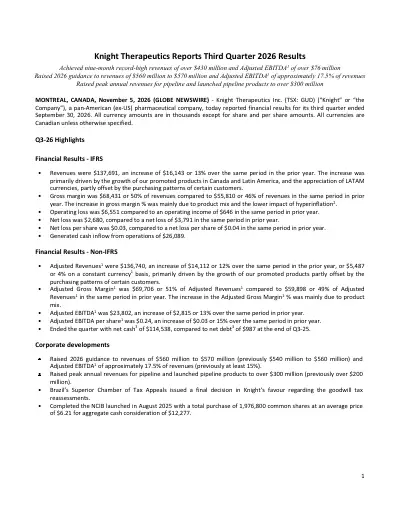
I'm joined on today's call by Amal Khouri, our Chief Business Officer, and Arvind Utchanah, our Chief Financial Officer. I'm pleased to report that this morning, not only did we announce record results for the first nine months of 2026, we also raised our revenue and adjusted EBITDA guidance for the year, and increased the peak revenue potential of our pipeline and launch pipeline products.
We reported $430 million of revenues, and adjusted EBITDA of over $76 million, representing a growth of 36% and 57%, respectively, compared to the same period last year. In fact, adjusted EBITDA for the first nine months of 2026 exceeded the adjusted EBITDA we reported for all of 2025.
This strong performance is the result of our commercial execution, which drove a 39% growth in our promoted portfolio. On the business development front, we signed an exclusive distribution agreement with Kyowa Kirin International for Poteligeo for certain LatAm countries, further strengthening our oncology and hematology portfolio.
We also continue to advance our pipeline. Since the beginning of the third quarter, we submitted [Jemtidza?]
for regulatory approval in Canada, as well as Minjuvi for first-line diffuse large B-cell lymphoma in Brazil. We obtained regulatory approval for Tavalisse in Colombia, Nictenvo in Brazil, and Minjuvi for follicular lymphoma in Mexico.
We also launched Wynzora in Canada, Tavalisse in Brazil, [Jurivast?] in Colombia and Peru, and Minjuvi for follicular lymphoma in Mexico.
We have now executed 22 product launches since January of 2024. As we had previously disclosed, Knight had identified two generic submissions for liposomal amphotericin B under review by ANVISA.
In September, a competitor received approval for a generic and a branded generic to AmBisome. We expect the launch of these products to negatively impact sales and adjusted EBITDA contribution of AmBisome in Brazil starting in 2027.
On to the NCIB, we completed the program launched in August 2025 with a total purchase of nearly 2 million common shares at an average purchase price of $6- $6.21 for aggregate cash consideration of $12 million. I will now turn the call over to Amal to provide more details on Poteligeo.
Amal Khouri
Thank you, Samira. As Samira mentioned, this quarter we announced the signature of an exclusive distribution agreement with Kyowa Kirin International for the commercialization of Poteligeo across certain Latin American countries.
Poteligeo, or mogamulizumab, is a first-in-class humanized monoclonal antibody that targets CCR4, which is a receptor expressed on malignant T cells. Once Poteligeo binds to CCR4 on these malignant cells, it increases the attraction of immune cells to destroy them.
Poteligeo is approved in the United States and Europe for adults with relapsed or refractory mycosis fungoides or Sézary syndrome after at least one prior systemic therapy. These two diseases are the most common subtypes of cutaneous T-cell lymphoma, which is a rare form of non-Hodgkin lymphoma.
Poteligeo's approval is supported by the MAVORIC study, the largest randomized trial in this patient population, in which the product demonstrated significantly longer progression-free survival and a higher overall response rate compared to vorinostat. The in-licensing of Poteligeo illustrates Knight's position as a partner of choice and is the result of our continued focus on building our pipeline while leveraging our infrastructure.
We look forward to making this much-needed treatment option available to patients in Latin America, and we plan to submit Poteligeo for approval over the coming months. I will now turn the call to Arvind to provide an update on our financial results.
Arvind Utchanah
Thank you, Amal. When speaking of our financial results, I will refer to certain non-IFRS measures, including adjusted revenues, adjusted gross margin, adjusted EBITDA, and adjusted EBITDA per share, as well as constant currency results.
Refer to our press release and MD&A and SEDAR+ filings for their definitions. For the third quarter of 2026, we delivered revenue of $138 million, an increase of $16 million or 13% compared to the same period last year.
On a constant currency basis, the increase in revenues was $5 million or 4%. The increase was driven by our promoted products, which grew by 10% in the quarter.
Our launch pipeline products delivered $21 million in revenues, an increase of $12 million or 137% on a constant currency basis, driven by our product launches in Canada and Latin America, including Orgovyx, Imvexxy, Xcopri, Myfembree, Qtern, and Minjuvi. As for our promoted strategic products, they delivered $65 million in the third quarter.
On a constant currency basis, the portfolio decreased by $5 million or 7%, driven by the purchasing patterns of certain customers and lower revenues of Lenvima in Colombia following its inclusion in the direct price control regime in August. The portfolio grew by $2 million excluding the impact of purchasing patterns, driven by our promoted brands, including Cresemba, Akynzeo, and Aloxi, which more than offset the impact of the price reduction in Lenvima.
Finally, our mature portfolio delivered $52 million, remaining relatively stable compared to the same period last year. Now moving on to gross margin.
We delivered an adjusted gross margin of $70 million or 51% of revenues in Q3 '26, compared to $60 million or 49% of revenues in the same period last year. The increase in the gross margin percentage was driven by the change in product mix.
I will now turn to our operating expenses. For the third quarter, our sales and marketing, G&A, and R&D expenses were $48 million, an increase of $8 million or 21% compared to the same period last year.
The increase was mainly driven by the expansion of our sales structure to support our launches and relaunches in Canada, Brazil, and Mexico, as well as additional promotional spend for our launch pipeline products, including Orgovyx, Myfembree, Xcopri, and Minjuvi. It also reflects a larger administrative structure to support our expanded portfolio and higher legal fees related to our tax litigation in Canada and Brazil.
Moving on to adjusted EBITDA. For the third quarter of 2026, we reported $24 million of adjusted EBITDA, an increase of $3 million or 13% compared to the same period last year.
Our adjusted EBITDA per share was 24 cents, an increase of 15% compared to the same period last year. The increase was mainly driven by our higher revenues and gross margin, partly offset by higher operating expenses.
Turning to our liquidity and cash flows. Our revenue and EBITDA growth continues to translate into strong cash generation.
In the first nine months of the year, we generated $96 million of operating cash flows. We ended the quarter with $137 million in cash and marketable securities and a net cash position of $115 million, compared to a net debt position just a year ago.
With our strong balance sheet, $140 million of committed capacity under our credit facility, and an additional $140 million available through its accordion feature, we are well positioned to fund future growth. I will now turn the call over to Samira.
Samira Sakhia
Thank you, Arvind. Now on to our financial outlook for fiscal 2026.
I would like to remind everyone that this guidance is based on the assumption that there is no material adjustment due to hyperinflation accounting in Argentina. In addition, our guidance is based on a number of assumptions, which are described in our press release.
Should any of these assumptions differ, the financial outlook and the actual results may vary materially. As I mentioned earlier, we raised our 2026 outlook for both revenues and adjusted EBITDA.
We now expect to generate revenues between $560 and $570 million, representing top-line growth of at least 24% versus 2025. We also expect 2026 adjusted EBITDA to be approximately 17.5% of revenues, representing EBITDA growth of at least 44% versus 2025.
The increase in our financial outlook is driven primarily by the stronger performance of our promoted products across multiple countries, as well as the LatAm currencies performing better against the Canadian dollar than previously anticipated. Beyond 2026, we are also raising the long-term outlook for our pipeline and launch pipeline products.
Since launch, several of our pipeline products have performed ahead of our expectations. Based on their performance, and with the addition of Poteligeo, we have increased our outlook of peak revenues for our pipeline and launch pipeline products from over $200 million to over $300 million.
In 2022, we expected our then pipeline of 20 product launches to deliver at least $15 million- $50 million of peak sales. Today, we have increased that potential sixfold, due to the strong, stellar performance of our business development team adding more products to our pipeline, as well as the focused execution by our regulatory, quality, medical, and commercial teams in getting these products approved, launched, reimbursed, and prescribed.
The pipeline now covers more than 75 product launches across Canada and Latin America, 22 of which have already been executed. Over the last 12 months alone, the launch pipeline products generated over $67 million in revenues, or more than 22% of our new peak revenue estimate.
Knight's mission is to acquire, in-license, develop, and commercialize pharmaceutical products for Canada and Latin America. Let me put our progress in perspective.
As Knight started in 2014 following Endo's acquisition of Paladin Labs. In 2013, Paladin's Canadian business generated $145 million in revenues.
Knight's Canadian business today has already surpassed that level over the last 12 months, and is continuing to grow. Today, Knight has built a strong platform in Canada and in Latin America.
This year, we are on track to record revenues of $560 to $570 million and adjusted EBITDA of nearly $100 million. Our launch pipeline and pipeline products are expected to generate peak annual revenues of over $300 million, majority of which is coming from products that are already approved, and we have a solid cash position to fund our future growth.
We are a growing, profitable, and cash-generating business, and we are delivering on our mission of acquiring, in-licensing, developing, and commercializing pharmaceutical products in Canada and in Latin America. This concludes our formal remarks.
I will now open up the call for questions. Over to you, Marissa.
Operator
Thank you. Before we begin, may I please remind you, questions during today's call will be taken from analysts only.
Should there be any further questions, please contact Knight's Investor Relations department via email to [email protected] or via phone at 514-484-4483. If you would like to ask a question on this call, please press star followed by the number one on your telephone keypad.
If you are using a speakerphone, please lift your handset before pressing any keys. If you would like to withdraw your question, you may press star 2.
Just a moment for your first question. Your first question comes from David Martin with Bloom Burton.
Please go ahead.
David Martin
Good morning, and congratulations on the quarter. I just wondering, were there any sales of AmBisome to the Brazilian MOH this quarter or in Q3?
Regarding the generic approval, has the 2027 MOH contract gone to the generic?
Samira Sakhia
David, thank you for your question. As we had announced previously, the 2026 contract had been completed by the end of Q2, there were no Q3 sales to MOH.
The contract for 2027 has not been granted to the generic. In fact, our teams are in advanced negotiations, and hopefully they conclude that over the next couple weeks, and we will retain the majority of that contract.
David Martin
That's great. We had expected your EBITDA margins to compress moderately in the second half of '26 as you were building out commercial infrastructure in Mexico and pre-launch spends on Tavalisse in Brazil.
Your EBITDA margin actually ticked up a bit versus Q2. Why haven't we seen the tick down in EBITDA margin?
Is that expected to persist through Q4?
Samira Sakhia
We announced 17.5% for the year. The way we're seeing it is our expenses are actually in line with our expectations.
Our brands are performing better than our expectations, and we expect that to continue. That is why we're raising guidance on the top line, on the bottom line, and, as you saw, we're also raising guidance for the pipeline products because of the performance of the products that we've seen so far.
David Martin
Great. I'll get back in the queue.
Thanks.
Operator
Your next question comes from Doug Miehm with RBC Capital Markets. Please go ahead.
Doug Miehm
Yeah. Great quarter, and, even more importantly, better increase in guidance, and that's where I'd like to start with an initial question.
When you look at the $200 to $300 million increase, how much of that would be due to Poteligeo versus the existing suite of products that you're launching right now?
Samira Sakhia
We don't really provide by product. What I can tell you is the majority of the increases and the majority of the contribution for the $300 million is coming from the products that are already approved.
The majority of the approved products are already commercialized. This is really coming from that.
As when our teams are doing their initial forecast, we are conservative. We also don't include a lot of the second-tier countries like a Chile or a Peru.
As we have been executing on launches, the smaller countries are starting to also be submitted and preparing for launch. There's a whole bunch of different factors that are driving the increase from the $200 to the $300, and not just Poteligeo.
Doug Miehm
Perfect. Then as we think about margins, not necessarily for Q4, but as we think further out into '27 and beyond, and we think about AmBisome, you indicated that you're going to retain the majority of that contract.
Number one, is that going to be at existing pricing that you enjoyed in '26, or could it be lower because of the generics? As a result of that, I'm just wondering how we should be thinking about margins for next year, because, yes, when you're launching products there can be a lack of profitability, but it seems you're doing better than that.
Just directionally, should we be thinking a step back, the same, or could things even improve? I'll leave it with that.
Thanks.
Samira Sakhia
No, great question, Doug. As you've seen, a lot of our products that are in the launch pipeline have actually been on market for several years, their contribution going into next year will be a higher level.
Our launch pipeline products are newer agreements as opposed to kind of the legacy distribution-type agreements that we had when we acquired [Laboratorios Biotoscana?] .
The gross margin is better on these products. While we do expect that AmBisome sales will decline, it is a lower-margin product.
Our higher-margin products will be contributing more. Our expectation is, even though we're investing into next year, we should be remaining consistent over the next couple of years.
Then all of these launches start to contribute more, and that's two three years out, we should expect EBITDA margins to start accelerating.
Doug Miehm
That's great. Thank you.
Operator
Your next question comes from Michael Freeman with Raymond James. Please go ahead.
Michael Freeman
Hey, good morning, team, and congratulations on another extremely strong quarter and a very positive outlook. I wanted to talk about business development.
This engine seems to be very much humming, $115 million net cash, plenty of credit. Wondering if you could speak to how the opportunity set is evolving when it comes to business development, when it comes to product acquisitions or further licensing transactions.
Just how has your view on the market, have they changed given your strengthening position?
Amal Khouri
Good morning, Michael. This is Amal.
Thank you for the question. I think I'm going to give you a somewhat boring answer, which is really we're looking at things the same way.
We're really going to continue executing the same way we have. The type of opportunities we're looking at are similar to all the transactions we've done in the past which are delivering the performance that you guys are seeing quarter-over-quarter.
We're going to continue looking at growth assets in terms of pipeline, new launches. We're going to continue looking at acquisitions of products or portfolios with existing sales that would really kind of provide the cash flow to help us fund the investments while minimizing impact on the bottom line.
It's really what we've been doing that has been delivering these great results. We're going to continue doing more of the same going forward.
As you noted, the balance sheet we have, access to cash and credit we have, there are no restrictions there. We can continue to do the same.
We continue to see a lot of opportunities in our markets.
Samira Sakhia
I'm just going to add another thing is the fact that we are extremely active. We are also becoming the partner of choice for certain partners, and what you've seen is the multiple additions to the portfolio with Incyte, and kind of having this amazing stable of partners gives us access to their pipeline.
The more we do of this, the more products we continue to add.
Michael Freeman
Excellent. Important point.
I wonder if you could touch on in Canada, it looks like the products like Orgovyx, Xcopri, Myfembree, Imvexxy are continuing to outperform. How are these products tracking against internal expectations now that you have a few more quarters under your belt with them?
How much, I guess, growth runway would you expect from these assets?
Samira Sakhia
As you saw this morning, we increased our pipeline guidance number from over $200 to over $300. These products are performing ahead of our expectations.
A part of it is we were extremely cautious because especially Orgovyx and Xcopri, right, had received reimbursement right before we signed our agreements. Again, a huge component of our diligence and valuation work.
The uptake curve of these products has been a lot faster than our original expectations. The fact that also, whether it's Orgovyx or Myfembree, both of them allowed us to expand reach of physicians, which really benefited the products and the portfolio.
You see that with Imvexxy, which is really exceeding across all provinces. The products are great, their access is great, and their fit within our portfolio is amazing, and that is really what is driving their growth.
Michael Freeman
Okay. All right, thank you.
If I could fit one more in, I may have missed this, I apologize, but I wonder if you could tell us a little bit more about Poteligeo in terms of its product profile, expectations for, I guess, its relative importance in your launch pipeline.
Amal Khouri
Sure. Poteligeo is, as I'm sure you saw, is already approved in the US and Europe.
The product has a great profile in terms of clinical data, enters a very high unmet need in second line in mycosis fungoides and Sézary syndrome. Both of these diseases are treated by hem-oncs, it's a really good fit within our portfolio.
The product, to give you an idea, it's doing, I think in the US, is it doing about $200 million U.S. of sales in the last 12 months.
Again, it serves a high unmet need. It fits within the target that we currently are calling on, where we're actually very well established, we're not just calling on them, we're very well established in hem-onc, as you know the rest of our portfolio.
We're really looking forward to bringing this product to patients in LatAm. We're looking at submissions over the coming months.
Michael Freeman
Okay. All right, thank you.
I'm going to pass it on now.
Operator
Your next question comes from Scott McAuley with Paradigm Capital. Please go ahead.
Scott McAuley
Morning, everyone. One thing I wanted to highlight is the cash flow.
Obviously, I think it was year to date, I think it's almost tripled operating cash flow relative to year to date last year. I know in the past, it's always been a bit lumpier, with some quarters kind of more breakeven, and other quarters being big positive numbers.
It looks like we've seen three quarters of pretty consistent positive numbers there. Has anything changed versus in the past?
Kind of what's driving that consistency? Do you expect things to be lumpy quarter-to-quarter going forward, or do you see this consistency continuing going forward?
Samira Sakhia
I'm going to start and then I'll let Arvind add some more. One of the things that you're seeing is we have a diversified portfolio and diversified geographies.
A lot of the increase in the cash flows is coming from our results. That's what's really translating.
The other piece is the fact that we have a more significant portion of our business coming from Canada, where the collection is faster. Arvind, please feel free to add.
Arvind Utchanah
No. No, that's correct.
It's basically we see the growth in our EBITDA translating in our cash flow from operations. We are now operating at a normal level of working capital in '26, and you see that converting directly into cash flow.
To your next question on going forward, it's really there could be lumpiness between quarters, but going forward we do still expect to have a really high EBITDA to cash flow conversion.
Scott McAuley
That's great. Absolutely makes sense.
Touching on the peak revenue number, and it was great to get a bit of context on kind of where you are in terms of getting to that peak. In terms of timing, do you see that as five-year to peak?
Is this a eight-year, ten-year, kind of your estimates on timelines of how you define that peak revenue number?
Samira Sakhia
We look at it kind of on a more near-term, kind of at that lower end of the numbers that you were saying. Closer to four to five years is when these products will start, especially the ones when you think about the products that launched in '24, '25, they will be reaching their peak around then.
Scott McAuley
That's great. Then lastly, obviously growth in the promoted products and the strategic products, and it looks like there really isn't much that's moving from kind of mature to the discontinued part.
Any change in that kind of going forward, like any products that you see that are kind of rolling off or that could start to lose their impact in the next few quarters or years? Obviously, as the launch products are more than making up for that, but anything on the other end of the pipeline where some things are coming off?
Samira Sakhia
Products coming off is a normal course of business, and one of the reasons that we continue to do a lot of business development, whether it's in-licensing or acquisitions. There again, it's really how much do they contribute, how much investment is required to maintain, is it better for us to transition them out?
That is something that we will always be looking at, and it's really the lower contributors that we expect will be falling off. You will also see products moving from launch pipeline to strategic, and we see that is also happening.
Over the last couple of years, if I look at, for example, Lenvima in Brazil, a few years ago that would have been in strategic promoted. Today it's sitting in mature.
That kind of life cycle will continue to happen. What we want to have is our effort is in the products that really drive growth and value and cash flows, and the mature products will continue to fund that, as well as our BD efforts.
Scott McAuley
Great. Appreciate it.
Thanks for taking the questions.
Operator
Your next question comes from Justin Keywood with Stifel. Please go ahead.
Justin Keywood
Good morning. Thanks for taking my call, and nice to see the results.
I just wanted to circle back on the peak product sales combined to be $300 million. My question is, what's the regulatory risk embedded in that expectation?
Is the potential peak sales even higher, and then there's some conservatism applied in assuming there could be some hiccups as far as the regulatory process or potentially even some trials? If there could be some additional color provided on that, it would be appreciated.
Samira Sakhia
Of course. One of the things that I will say is what we're guiding to is at least $300 million, so that does take into account if one thing falls off or is delayed.
The second thing that I can say is, and I said this in our earlier conversation, the majority of that $300 million is actually coming from products that are already approved. There is a lesser component of the $300 is coming from products that are not yet approved.
If you look at the products that are in our pipeline today that are not approved, you've got a product like Poteligeo that is approved in the US, Europe, and I believe also Japan. You've got [Crexont?]
that's approved in US and Europe, a couple of others that are in the pipeline that are also approved elsewhere. While there is always a regulatory risk because different agencies look at product approvals differently, we know that the majority of the products in that pipeline have been approved in other jurisdictions.
Justin Keywood
Understood. Then I'm not sure if I missed this, but on the margin potential in the business, obviously a strong outcome for this year, but any indication on how we should expect margins to progress over the next few years as that new revenue comes into the business?
Samira Sakhia
Sure. One of the things is our newer license agreements are a better gross margin contributor than the older agreements that we inherited.
There you will see that shifting. We are continuing to invest in the pipeline and the promoted assets.
As those products start feeding more to the bottom line, we will see EBITDA margin expansion. It will take a couple years.
I think we'll be staying at these levels for the next couple years, but then we'll start to see more contribution and EBITDA margin expansion.
Justin Keywood
Understood. That's helpful.
Thank you.
Operator
Ladies and gentlemen, if you would like to ask a question, please press star followed by one. Your next question comes from David Martin with Bloom Burton.
Please go ahead.
David Martin
Hi. Thanks for taking my follow-up.
I wanted to go back to the AmBisome MOH contract. The generic, I think you said, was approved in September, but they're not getting the contract this year.
Is that something you'd expect going forward in 2028, 2029, and beyond? Is it because your supply is more stable than potentially the generic, or will they be in play for the 2028 contract?
Samira Sakhia
David, that's a great question. We do believe that they will be in play for the 2028 contract, but to your point, what we see is generic manufacturers go on backorder, and we do have consistency of supply, and we know in fact, this particular company in other markets in LatAm has had supply issues.
We may not have the contract, but we are expecting we will retain some portion of government sales.
David Martin
For '27, you expect you will have the contract?
Samira Sakhia
The team is in advanced negotiations, and they are treading along, and we should be getting there.
David Martin
Great. Over to Crexont and Qelbree, what is the expected timing for the answering questions and resubmission for Qelbree, and what did Health Canada want as far as the NDS for Crexont?
Samira Sakhia
For each of those, the teams are working with the partners to build the data that's required that's being asked. In the one case, there was more changes in manufacturing, so that our partner is working through those.
In the other cases, there's more analyses, and the teams are working through that. As soon as we have submissions or approvals, we're going to be announcing that.
David Martin
Okay. Anything on expected timing?
Samira Sakhia
Not yet.
David Martin
That's it for me. Thanks.
Operator
There are no further questions at this time. I'd like to turn the call back over to Samira Sakhia for closing remarks.
Samira Sakhia
Thank you, Marissa, and thank you for your confidence in the Knight team and for joining our Q3 2026 conference call. Have a great morning.
Operator
Thank you so much for your participation. You may now disconnect.