Hydro One Limited
Q3 FY2026 · Earnings Call TranscriptNovember 10, 2026
Operator
Good morning, ladies and gentlemen, and welcome to Hydro One Limited's third quarter 2026 analyst teleconference. At this time, all participants are in a listen-only mode.
After the speakers' presentation, there will be a question and answer session. To ask a question during the session, you will need to press *11 on your telephone.
You will then hear an automated message advising your hand is raised. To withdraw your question, please press *11 again.
As a reminder, the call is being recorded. I would now like to introduce your host for today's conference, Mr.
Waseem Khalil, Director, Investor Relations at Hydro One. Please go ahead.
Waseem Khalil
Good morning, and thank you for joining us for our quarterly earnings call. Joining me on the call today are our President and CEO, Megan Telford, and our Chief Financial and Regulatory Officer, Harry Taylor.
On the call today, we will provide an overview of our quarterly results, and then we will answer as many questions as time permits during our question and answer session. As a reminder, today's discussion will likely touch on estimates and other forward-looking information.
Listeners should review the cautionary language in today's earnings release and our MD&A, which we filed this morning, regarding the various factors, assumptions, and risks that could cause our actual results to differ, as they all apply to this call. With that, I turn the call over to our President and CEO, Megan Telford.
Megan Telford
Thank you so much, Waseem. Good morning, everyone, and thank you for joining us for our third quarter results call.
This morning, I will provide an update on our recent activities and key accomplishments during the quarter. Following my remarks, Harry will take you through our financial results.
Safety remains our top priority and is at the core of everything we do. Our focus on achieving zero life-altering injuries and fatalities is unwavering.
By continuing to strengthen our safety culture, enhancing awareness and accountability, and fostering continuous learning, we strive to ensure that every employee and contractor returns home safely every day. Ontario's electricity system is entering a period of sustained growth and transformation, driven by population growth, housing development, industrial and commercial expansion, electrification, and the integration of new generation resources.
As electricity demand continues to increase, Hydro One must make significant investments to renew aging infrastructure, maintain the safe and reliable delivery of electricity, and enhance system resilience to support economic growth across the province. On October 7th, 2026, Hydro One filed its joint rate application, known as JRAP, with the Ontario Energy Board, outlining a comprehensive 5-year investment plan for our transmission and distribution businesses.
The plan was developed through extensive engagement across all our customer segments and includes feedback from more than 100,000 customers across the province. The plan reflects a balanced approach to meeting Ontario's growing electricity needs while focusing customer dollars on the work that delivers the greatest value and addresses the long-term needs of the electricity system.
The proposed JRAP 2028 plan responds to system and operating conditions that are materially different from those experienced during the 2023 to 2027 period. Sustained inflation, supply chain constraints, more frequent severe weather events, evolving policy and market dynamics, and increasing demand for customer connections have significantly increased both investment requirements and the cost of delivering essential work.
In response, Hydro One designed a plan that will enable the company to continue meeting Ontario's growing electricity needs while maintaining safe, reliable, and resilient service for customers across the province. Executing this plan will require delivering the largest and most complex capital program in Hydro One's history.
The plan includes connecting new customers and generation, expanding and reinforcing the grid, renewing aging assets, strengthening reliability and resilience, and enhancing the organizational capabilities required to successfully deliver this work. The proposed investments were developed through a disciplined and comprehensive planning process that considered customer priorities, asset condition, system requirements, regulatory obligations, alternative solutions, and the risks associated with delaying critical work.
Throughout this process, Hydro One carefully evaluated investment decisions to improve productivity, capture efficiencies, bundle work programs, and appropriately pace investments, ensuring that the most critical systems needs are addressed while continuing to deliver value for customers. The JRAP 2028 plan proposes approximately $27 billion of capital expenditures across our transmission and distribution businesses from 2028 through 2032.
The plan reflects the scale of investment required to support Ontario's growth, modernize critical infrastructure, and prepare the electricity system for a more electrified future. Within the transmission business, the plan proposes a $16.7 billion investment, or approximately $3.3 billion annually, to maintain reliability, address growing customer demand, expand system capabilities, support government energy priorities, and manage asset and operational risks.
Notably, the plan includes approximately $8.3 billion for new transmission infrastructure projects. These investments are expected to enable more than 6,000 MW of new customer load, connect approximately 2,500 MW of new generation resources, and provide more than 10,000 MW of incremental transfer capacity, helping ensure Ontario's electricity system can support continued growth, economic development, and electrification across the province.
The plan also includes approximately $4.4 billion to renew and replace critical station assets across major asset classes, including transformers, breakers, protection and control systems, conductors, and wood structures. These investments will address aging infrastructure that can increase the risk of equipment failures, extended outages, and reduced operational flexibility.
Station assets play a critical role in connecting generation resources, communities, and major customers to electricity grid, making their continued reliability essential to the performance of Ontario's electricity system. In addition, approximately $2.7 billion of capital will be directed to renew transmission lines across the province, including upgrades to more than 1,400 km of transmission infrastructure.
These lines serve smaller communities, First Nations, businesses, and industrial facilities, helping ensure customers continue to receive safe, reliable, and resilient electricity service while supporting future growth and economic development. Together, these investments will enhance system reliability and resilience, reduce asset-related risks, and ensure Hydro One's transmission network is well positioned to meet the evolving needs of customers and the province for decades to come.
In our distribution business, we are proposing average annual capital investments of approximately $2.2 billion, representing a total investment of $10.9 billion over the 2028, 2032 period. The distribution system plan is designed around an outcomes-driven and customer-focused portfolio of investments that will strengthen the grid, enhance reliability, and improve the customer experience.
Hydro One's large, geographically dispersed, and predominantly rural distribution system operates more than 126,000 circuit kilometers of distribution lines, of which approximately 91% are overhead lines and directly exposed to vegetation and severe weather. The plan focuses on upgrading infrastructure and deploying advanced technologies that will enable us to detect, respond to, and restore power outages more quickly.
Specifically, our distribution capital will focus on maintaining the grid, and we propose spending approximately $3.4 billion of capital to maintain the safe and reliable operation of the existing distribution system. This includes replacing or refurbishing assets, including transformers, cables, and poles across our system, to reduce failures and help power lines to withstand severe weather.
We are also focused on improving the reliability and resiliency of the grid, with approximately $1.6 billion of capital directed to reduce outage exposure and impacts, improve restoration capability, and strengthen the system's ability to withstand and recover from equipment failures and severe weather. This includes the deployment of 5,400 residential energy storage systems, improving reliability as much as 95% for customers that are most impacted by prolonged outages.
To meet Ontario's growing demand for electricity, approximately $3.8 billion of capital will focus on activities that provide customer access, enhance system capacity, and operational capability to accommodate growth, as well as support economic development and the integration of new distribution technologies. This investment will connect over 94,000 new homes and businesses to the grid and increase system capacity.
Through these investments, Hydro One will continue to build a smarter, more resilient distribution network that supports growth, improves service reliability, and meets the evolving expectations of customers across the province. Delivering value for customers was an essential consideration in developing the plan.
We rigorously challenged the scope and timing of investments, distinguished mandatory and time-critical work from projects that could be deferred or re-phased, evaluated non-wires and other alternative solutions, bundled work where efficiencies could be achieved, and embedded productivity improvements across the organization. These actions reflect our focus on delivering essential investments while minimizing impacts on customer bills.
Over the 5-year application period, the impact on customer bills remains modest relative to the scale of proposed investments. For a typical year-round, medium-density residential customer, known as R1, transmission charges are expected to increase by approximately 50 cents per month in 2028, and by an average of $1.14 per month annually from 2028 to 2032.
For distribution, monthly base charges for year-round, medium-density residential customers are expected to decrease by approximately 10 cents in 2028, and remain unchanged over the remainder of the plan period, largely reflecting the benefits of the distribution rate protection program, DRP, for eligible residential customers, together with a proposed customer refund. By continuing to innovate and operate more efficiently, we are focused on delivering the investments needed to support Ontario's growth, strengthen the electricity system, and create sustainable value for customers, communities, and shareholders.
Turning to our current projects. During the quarter, Hydro One submitted a leave to construct application to the Ontario Energy Board for the North Shore Link transmission line.
The line is a 105 km, double-circuit 230 kV transmission line connecting the Wharncliffe area to Sault Ste. Marie.
The $1.3 billion investment is expected to strengthen the connection between the northeast and northwest parts of the province and improve the resiliency of the northern transmission system. The line is expected to be in service in 2029.
Also in the quarter, Hydro One energized the Etobicoke Greenway transmission line. This new 6 km, 230 kV line runs between the Richview and Manby transformer stations in Etobicoke.
The line will add approximately 300 MW of additional capacity to the region to help meet growing electricity demand and strengthen power reliability across Toronto and western Greater Toronto Area. Delivered on time and under budget, the project reinforces Hydro One's track record of executing critical infrastructure investments that support Ontario's energy needs.
The strength of our culture is reflected on how we support one another and the communities we serve. While this commitment is evident throughout the year, it shines especially bright during our annual Power to Give campaign each September.
This year, Hydro One employees once again demonstrated remarkable generosity in a very challenging year, raising more than $2 million and contributing over 7,400 volunteer hours, an increase from 5,200 hours in 2025 to support communities across Ontario. These efforts will have a meaningful and lasting impact on individuals and families where we live and work.
I am incredibly proud of our employees, not only for what they accomplished during Power to Give, but for the spirit of giving they demonstrate every day. Their generosity, compassion, and commitment to helping others embodies our values and reflects the very best of Hydro One.
Hydro One's success continues to be powered by our people. Their dedication, professionalism, and expertise, combined with an unwavering focus on safety, customer service, and excellence, are what set our company apart.
It is gratifying to see their efforts continue to be recognized. Hydro One was named to Newsweek magazine's list of the World's Most Trustworthy Companies for 2026.
The ranking evaluates publicly listed companies with revenues above $500 million across 20 target countries and combines independent surveys of 65,000 residents, generating more than 200,000 evaluations across customer, investor, and employee trust. With that, I will turn the call over to Harry to go through the financial results.
Over to you, Harry.
Harry Taylor
Thank you, Megan. Good morning, and thank you for joining us today to review our third quarter results.
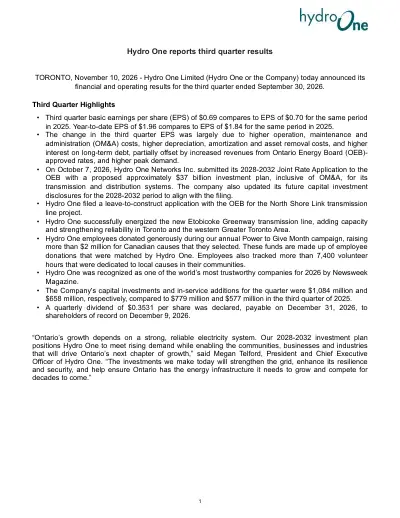
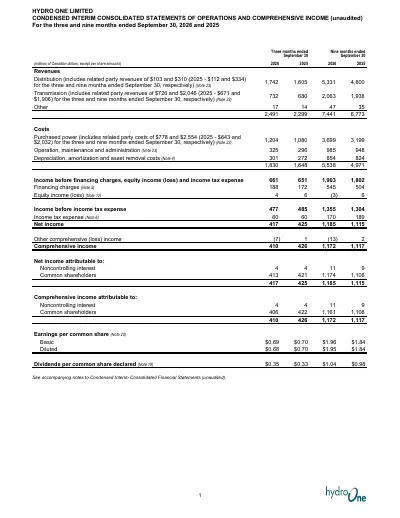
Starting with net income attributable to common shareholders in the quarter, we saw a small decline of 1.9% compared to the same period from a year ago. The significant drivers behind the change this quarter include higher OM&A expenses, largely attributable to increased work program spending, including station maintenance and vegetation management activities; higher depreciation, amortization, and asset removal costs, reflecting increased storm-related asset removal activity and continued growth in the capital asset base; and higher interest expense, primarily due to higher long-term debt balances, partially offset by lower average short-term borrowings.
These drivers were partially offset by higher revenues, net of purchased power, due to higher OEB-approved 2026 rates, as well as higher average monthly transmission peak demand. This resulted in third quarter basic earnings per share of 69 cents, compared to 70 cents in the third quarter of 2025.
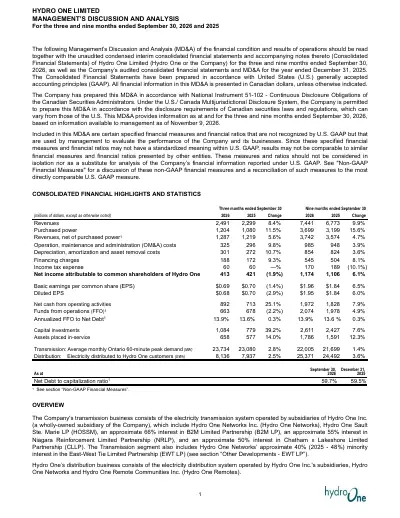
It also resulted in year-to-date earnings per share of $1.96, compared to $1.84 for the same period in 2025. Our third quarter revenue, net of purchased power, increased year-over-year by 5.6%.
Transmission revenues increased by 7.6%, primarily due to higher OEB-approved 2026 rates and a 2.8% increase in the average monthly peak demand compared to the same period last year. Distribution revenues, net of purchased power, increased by 2.5%, mainly due to higher OEB-approved 2026 rates, a 2.5% increase in distributed energy, and a 0.9% increase in the number of customers.
On the cost front, operating, maintenance, and administration expenses in the quarter increased by approximately 9.8% year-over-year. In the transmission segment, costs were 19.3% higher year-over-year, primarily due to increased work program spending, including station maintenance and vegetation management, along with higher asset write-offs.
In the distribution segment, costs declined by 0.6% year-over-year, mainly reflecting lower corporate support costs and the recovery of third-party storm costs and cost deferrals. As these recoveries are offset in revenue, there is no impact on net income.
These were partially offset by higher work program expenditures, including emergency power restoration and lines maintenance. Of note this year, we have experienced more storm days than we did last year, which included the generational ice storm at the end of March 2025.
Depreciation, amortization, and asset removal costs during the quarter were higher by 10.7%. The increase was primarily attributable to higher asset removal costs stemming from increased storm restoration activity relative to the same quarter in 2025, higher spending on station construction projects, and higher depreciation expense reflecting continued growth in the capital asset base.
With respect to our financing activities, we saw a 9.3% increase in interest expense year-over-year. This was mainly due to the increase in our outstanding long-term debt following the additional issuances we executed in Q4 2025 and our inaugural US dollar issuance in Q2 2026, partially offset by lower average volume of short-term notes outstanding and higher capitalized interest.
Our balance sheet continues to be in excellent shape, along with our creditworthiness. Our FFO-to-net debt ratio as at September 30th, 2026, was 13.9% and remains well above the thresholds the rating agencies use to trigger a credit rating review.
Turning to taxes, our income tax expense in the quarter was $60 million, which matched the same quarter last year. As a result, our effective tax rate this quarter was 12.6%, which was in line with the 12.4% achieved the same time last year.
Looking at our capital expenditures, in the third quarter, we invested $1.1 billion, which was an increase of 39.2% from the same period in 2025. The increase was due to investments in Ontario's broadband initiative, investments in transmission line projects, including the Northeast Power Line, North Shore Link, and Longwood to Lakeshore, a higher spend on other major transmission development projects, investments in the advanced metering infrastructure or AMI 2.0 system, and a higher spend on storm-related distribution asset replacements in the quarter.
These were partially offset by a lower volume of transmission station refurbishments and equipment replacements, also lower due to the absence of investment in Sault Ste. Marie for Sault 3 circuit, and a lower expenditure on specified distribution equipment to support long-term projects.
As part of our ongoing disclosure practices and to enhance transparency, we have updated the future capital expenditure estimates included in the MD&A to extend the forecast period through 2032. The update reflects the filing of Hydro One Networks' proposed transmission and distribution investment plan as part of the 2028 to 2032 joint rate application, as well as the investment plan filed as part of the 2028 to 2032 rate application for Hydro One Sault Ste.
Marie. As a result of the extended forecast horizon, estimated future capital expenditures now include estimated capital expenditures and development costs for projects for which a leave to construct Section 92 application has not yet been filed.
Section 92 applications will contain more detailed project information and refined cost estimates, which will be incorporated into future disclosures once filed with the OEB. Outside of the joint rate application, we expect to invest approximately $11 billion for new transmission lines that will ultimately be partnerships with First Nations and will have their own unique rate applications.
The projected capital expenditures and the timing of planned transmission and distribution investments for the 2028 to 2032 period remain subject to OEB approval. Looking at our assets placed in service, in the third quarter, we placed $658 million in service for our customers, which was an increase of 14.0% compared to the prior year.
In the transmission segment, we saw a decrease of 3.9% year-over-year, primarily due to timing of assets placed in service for station refurbishments and replacements. In the distribution segment, in-service additions increased by 28.3% from the prior year, mainly due to investments in the broadband initiative and higher volume of storm-related asset replacements.
These were partially offset by the timing of investments placed in service for system capability reinforcement projects and lower investments in the AMI 2.0 system. Turning to our quarterly dividend, I'm pleased to report that our board of directors declared a dividend of 35.31 cents per share to common shareholders of record on December 9th, 2026, and payable on December 31st, 2026.
Looking ahead, we continue to expect earnings per share to grow between 6% and 8% annually for the current JRAP period, using the normalized 2022 EPS of $1.61 as a base. As Megan noted in her remarks, we recently filed our joint rate application, which outlines our proposed investment plan for our transmission and distribution businesses for the 2028 to 2032 rate period.
I am very excited about this application as it reflects Hydro One's response to materially changing operating conditions while addressing the need to renew aging infrastructure, maintain safe and reliable service, strengthen system resilience, and support economic growth across Ontario. The application will now proceed through the Ontario Energy Board's regulatory review process.
Following approval, we intend to host an investor day where we will provide additional detail on our outlook for the next rate period, including our growth expectations, capital investment plans, and funding plan. With that, we will open the phone lines and be happy to take questions.
Waseem Khalil
Thank you, Megan and Harry. We will now open the call for questions.
The operator will explain the Q&A polling process. As always, we ask that you limit your questions to one question and one follow-up.
If you have additional questions, we request you rejoin the queue. In case we can't address your questions today, my team and I are always available to respond to follow-up questions.
Please go ahead, Shannon.
Operator
Thank you. As a reminder, to ask a question, please press *11 on your telephone and wait for your name to be announced.
To withdraw your question, please press *11 again. Please stand by while we compile the Q&A roster.
Our first question comes from the line of Michael Lonegan with Barclays. Your line is now open.
Michael Lonegan
Hi, good morning. Thanks for taking my questions.
The JRAP application calls for a 10% rate base CAGR, excludes some transmission capital based on transmission awards and expectations for more. What would you say the potential total consolidated rate base CAGR could go to, how much above that 10% could be possible?
Operator
Speakers, please check your mute button. Ladies and gentlemen, please remain on your line.
Your call will resume momentarily. Once again, please remain on your line.
Your call will resume momentarily. Once again, ladies and gentlemen, please remain on your line.
Your conference will resume momentarily. Once again, please remain on your line.
Your conference will resume momentarily. Once again, ladies and gentlemen, please remain on your line.
Your conference will resume momentarily. Once again, please remain on your line.
Your conference will resume momentarily. Speakers, you are now back.
You may resume your conference.
Harry Taylor
Good morning, Michael, and to all callers, apologize for the technical difficulties. Michael, you're asking about rate base guidance beyond what we've given based on the rate application.
At this point, we can't give any more guidance. We will update once we have completed the rate application, had it approved, and also updated any estimates that are included in the current plan outside the rate application.
Michael Lonegan
Great. Thank you.
Then, based on the application as filed and your expected financing of it with First Nations in mind, do we expect rate base and EPS growth to accelerate over the course of the next JRAP period through 2032, or could there be more linearity to it? Anything you could share about the shape of that profile would be helpful.
Thank you.
Harry Taylor
I think it's fair to say that rate base growth and earnings growth will accelerate. A lot of it is dependent on what is approved through the rate application process.
Then as you referenced, our goal is to have a 50/50 partnership with First Nations in all of our future transmission lines. We will recycle the capital as we sell our equity in those lines to fund future projects that will create a growing non-controlling interest both in our balance sheet and in our P&L.
There will be a little divergence between rate base growth and earnings growth, but it shouldn't be material at this point, as the way we see it. A lot of it is dependent for once things settle out.
We will at our investor day give our best outlook once we've got the rate application approved, there is clear guidance on both those dimensions.
Michael Lonegan
Great. Thanks for taking my questions.
Operator
Thank you. Our next question comes from the line of Maurice Choy with RBC Capital Markets.
Your line is now open.
Maurice Choy
Thanks, and good morning, everyone. Maybe just a very quick start to my questioning.
Any early thoughts on what the intervenors or the regulators who have reviewed your application, what are their early thoughts and responses so far?
Harry Taylor
Good morning, Maurice. There's no early thoughts.
We're too early in the administrative process. Our expectations are essentially are what we're proposing reasonable and prudent given the objectives we have in the environment that we're operating.
We haven't seen any specifics to know where their questions or pressure points will be at this point.
Maurice Choy
That makes sense. Maybe if I could then just zoom in a little bit into some of the elements of the application.
I find that one of the most fascinating elements of your application was your proposal to calculate the long-term debt rate for each of the five test years, rather than using the first test year consistently across the remaining test years. Maybe I could just ask you if you could just share with me why you felt this proposal was made, what does it mean for Hydro One shareholders and for your customers separately?
Harry Taylor
It's more a technical piece than anything else. What we have seen with both volatility in markets and our funding needs as we move through the period, that we wanted to have specific forecasts, specific rates for each of the years to give a more realistic picture in terms of what we thought our financing and funding requirements would be at the time, and therefore could be recovered in rates.
It's trying to get more precise, for lack of a better term, and more accurate.
Maurice Choy
Maybe as a quick follow-up and final one for me. Based on how you just justified the need to change the cost of debt to be customized every single test year, how do you plan on reconciling this justification with your intervenors and regulators, given that the ROE is going to be fixed for all five years?
Harry Taylor
At this point, I expect there may be more realism to it, and it will give us a chance to recover what we actually will fund. The reconciliation with ROE being fixed for the period is part of the overall contract that we operate in, and it uses the best information at the time that the ROE is set.
I don't know that we can reconcile the two. The formulaic approach has, I think, served the industry and the customers of utilities in Ontario well, and don't see any need to change it.
Maurice Choy
Understood. Thank you very much.
Operator
Thank you. Our next question comes from the line of Mark Jarvi with CIBC.
Your line is now open.
Mark Jarvi
Thanks. Good morning, everyone.
Appreciate all the details and sharing the capex plan out to 2032. I'm curious how much flexibility is there on that transmission lines, and I guess maybe even although the overall scope of work on the joint rate application, just to manage capex, because it's a pretty substantial ramp.
Just curious about being able to manage contractors, but also the funding requirements.
Harry Taylor
Good morning, Mark. In terms of flexibility to manage, the transmission lines will have their own rate applications as partnerships with the First Nations.
What we try to do with the disclosure is give the full picture with the gross amount that will be spent. This is in our disclosure in MD&A.
We haven't built in the funding, if you will, that we will ultimately receive from the First Nations at this point, and that will be something that's important for us to take you through at investor day. In terms of flexibility and funding, we are building our financing plan to support that level of expenditure right through the period.
As I think we've said before, it's going to be a combination of funds from operations, senior secured debt, hybrid debt, and equity as well. We will be raising equity, we expect, in the next rate period.
The first step is to successfully achieve approval of the rate application, but the funding plan, we'll be working behind the scenes, we'll bring them together, and then determine. We don't anticipate any challenges in funding which would cause us to repace some of the spending.
We know that customers in Ontario want and need the improvements in reliability, resiliency, the growth that our plan is going to deliver. We don't see any challenges from a funding point of view.
Our both procurement teams, our capital projects delivery team are working with our EPC contractors on the transmission side to ensure that the availability of resources and materials will be there. We engage in some pretty long-term planning and long-term commitments after following a competitive process to ensure we're bringing value for our customers to each of these projects.
At this point, we do not anticipate any issues that would cause us to repace things, but we will be vigilant in monitoring trends to make sure that that remains the case.
Mark Jarvi
Given you don't know exactly what would be the outcome of the joint rate application in terms of what's approved, how do you think about planning even just for the first year in 2028, given you won't finalize the plan until 9 months from now, and then you got to start to execute it in short order thereafter? Just any challenges in terms of just moving in the first year of the plan?
Harry Taylor
We're already planning, looking ahead to 2028, say what do we need, what and when do we need it or them. Human resources are as critical as materials.
We're moving on that already. We're not waiting for January 1st to start.
We're confident we have put together a compelling proposal in terms of what we've laid out. If we need to make some changes, then we'll make those changes.
We are planning for full implementation as of January 1st, 2028, and doing a lot to get our organization, our vendors, partners, and our funders, if you will, ready to help support us in this.
Mark Jarvi
Sounds good. Thanks for the time this morning.
Operator
Thank you. As a reminder, to ask a question at this time, please press *11 on your touch-tone telephone.
Our next question comes from the line of Robert Hope with Scotiabank. Your line is now open.
Robert Hope
Good morning, everyone. Appreciate all the JRAP conversations.
I understand it is early days in discussions with stakeholders about what you have filed. As we look forward, and if there is a path towards a settlement here, what milestones should we be looking for, and what timeline should we be looking for?
Harry Taylor
Oh, good morning, Rob. We're in the administrative phase right now, interrogatories, technical conference, etc.
Settlement discussions will begin mid-February time frame and could, depending how they go, could proceed right through almost to June. As we're thinking about this administration and interrogatories, technical through into January, Feb to May, June settlement discussions, and then if we fail to come to a settlement on everything, we move to oral hearing, which will take place over the summer.
Then once we complete the oral hearing process, the commissioners have up to 90—a maximum 90 days to issue the approved rate application.
Robert Hope
Great. Appreciate that.
Maybe switching gears here, the Ontario government has proposed significant changes to LDC governance and kind of planning. What are your initial takes on this, and could this spur increased LDC consolidation in the province, also acknowledging new mayoral terms?
Megan Telford
Hi, Rob, it's Megan, thanks for your question. I would say what's really interesting about LDC consolidation is for us, as we're already the largest distributor, and we're very supportive of what the government has done.
The reforms that you can see are mainly governance reforms in terms of who can sit on the boards, and really asking municipalities to work with their utility to file a 10-year capital plan. That's really very aligned with what we talk about, right?
This need for long-term planning in the province and ensuring the growth. We're very supportive of that.
I think whether it actually leads to consolidation is really in the hands of the municipality. Obviously they'll have new boards that need to discuss whether they can meet those capital plans.
If there is consolidation, we're always very, very prudent about what we would look at and make sure it's in the best interest of the community and our shareholders. We're obviously interested, but we would be very thoughtful about which acquisitions we would do.
Robert Hope
Thank you.
Operator
Thank you. Our next question comes from the line of Benjamin Pham with BMO.
Your line is now open.
Benjamin Pham
Hi, thanks. Good morning.
I want to go back to the JRAP application. Your prepared remarks and the press release that came out when you filed had a really good summary of the compare and contrast of the current JRAP versus the upcoming.
Could you perhaps add a bit more detail to the compare and contrast situation when you think about the outcome of the last JRAP? I'm just thinking about what did you achieve in terms of percent of revenues, or what was approved in the capex plan, and then also the timeline in terms of application to OEB decision?
Harry Taylor
Good morning, Ben. If looking back, if you will, now we're not through the rate period, we will have spent all that we had proposed and as we agreed to in the settlement, if you will, for our Hydro One Networks Inc.
business, but we have not accomplished everything that was in the rate filing at the time. As we dealt with the extraordinary inflation in the industry, we deferred some of the work that we had planned on doing to stay within the envelopes, the spending envelopes that had been approved, we didn't end up generating a back-door rate increase to our customers.
While we will have spent everything that we were approved to have spent, we won't have accomplished everything that we had initially proposed to be accomplished or at least agreed to accomplish in the settlement. That's not something that we like, but we made the decision that it was better not to jam our customers with an unexpected rate increase that the ultimate excess spending could have resulted in the next rate period, and stick within our envelopes.
We did a lot of work to go through the work plan, the work program, and defer the least, if you will, risky or the most discretionary items that there were. We never want to put either resiliency or reliability at any greater risk.
We're working to improve it all. The asset health is the other piece we look at.
We deferred work that would have the least impact on either asset health, reliability, or resiliency. We do want to make that up.
That's part of what we're doing, and we can reset everything for the next rate period, and have some pretty high objectives in terms of what we'll achieve for resiliency, improving resiliency, making up some of the things that we weren't able to do in the last period so that the system is able to enable the growth, but also be more resilient as climate change inflicts some of the damage that it's done on our system.
Benjamin Pham
Just to clarify on the expectation on this JRAP timeline, you've laid out some of the scenarios about 1 year so to decision. Was that the timeline of the last JRAP?
It took about a year to get a decision from OEB?
Harry Taylor
I think we were a little faster. That 1-year timeline in this case would take us right out to the end of the oral hearing phase.
We settled last time. We were about 9 months from start to finish, but we want to be clear what the process could look like if we go the whole way.
Benjamin Pham
I gotcha. I think there was some sort of refiling with inflation as well in the last one.
Harry Taylor
We did have that—you're right. We had that inflation update filing, which extended a little bit the period.
Benjamin Pham
Can I ask, you have a higher capex program in the next JRAP. Your last growth guidance included placeholders for broadband and rate base and a little bit of LDC, which played a little bit.
How do you think about that going forward through 2032, and—I know Megan touched on LDC in some of her response there—is that a lever perhaps for Hydro One if maybe the JRAP capex doesn't get fully approved?
Harry Taylor
On the broadband file, it'll be complete. That project will be done and it'll be in our rate base.
We aren't building any LDC acquisitions into our business plans or the guidance that we give. If something does come that is sufficiently attractive and isn't overpriced in terms of valuation expectations and we can create some value through the acquisition, we will bring that in, and then we will adjust our guidance accordingly.
Benjamin Pham
Got it. That's very helpful.
Thank you.
Operator
Thank you. Our next question comes from the line of Patrick Kenny with National Bank Capital Markets.
Your line is now open.
Patrick Kenny
Thank you. Good morning, everyone.
Just on the ask to increase the equity thickness to 45%, curious if, Harry, you've had any preliminary discussions with the rating agencies with respect to if approved, how this new deemed capital structure might call for say resetting the deck on the corporate capital stack, or perhaps shift the goalposts on you with respect to the FFO-to-debt threshold.
Harry Taylor
Pat, we meet with the rating agencies annually and both review the business, but also look ahead. We spent time with each of the agencies who rate us going through what our proposal and what the implications were.
At this point, we are not planning or expecting to see any change in downgrade rating thresholds. I think rightly the rating agencies are saying, 'We certainly like what you're proposing.
We understand your argument in terms of it meeting the fair return standard and against your comparators. You're even at the low end at 45%.'
It's taking a wait-and-see approach. Once we have successfully received approval of the application, we will then work with them as we work with you and issue the guidance and work through that to see if there are any upsides, if you will, in terms of rating and thresholds.
Patrick Kenny
Got it. Okay.
Thanks for that. Then, I guess, looking at the significant increase in capital budget, as you've outlined, the expected increase to average residential rates looks to be relatively nominal.
I'm just wondering if you can confirm if you include the all 15 ATP projects, what the total impact on customer affordability might look like and I guess what levers you might still be able to pull outside of say peak demand or other factors outside of your control.
Harry Taylor
The 15 ATP projects, a lot of them, more than half, we don't have even Section 92 estimates. Rate impacts are not included in anything that we have included in our joint rate application.
They'll have their own rate application. Transmission, by its nature, doesn't result in significant increases for customers over time.
The transmission portion of the bill in Ontario is much lower than distribution, it's certainly much lower than generation. Each rate application will have that in there and goes through the approval process.
We don't expect anything more than a modest increase in all in transmission rates in Ontario. It's pooled across all transmitters.
Patrick Kenny
That's perfect. I'll leave it there.
Thank you.
Operator
Thank you. That does conclude our Q&A session for today.
I'd like to turn the call back over to Waseem Khalil for any further remarks.
Waseem Khalil
Thank you, Shannon. The management team at Hydro One thanks everyone for their time with us this morning.
We appreciate your interest and your continued support. If you have any follow-up questions that weren't addressed on the call, please feel free to reach out and we'll get them answered for you.
We look forward to seeing everyone at our fourth quarter and year-end conference call in February. Thank you again, and enjoy the rest of your day.
Operator
Ladies and gentlemen, thank you for participating in today's conference. This does conclude today's program, and you may all disconnect.
Have a great day.