Kinaxis, Inc.
Q3 FY2026 · Earnings Call TranscriptNovember 5, 2026
Operator
Good morning, and welcome to the Kinaxis Inc. Fiscal Third Quarter 2026 Results Conference Call.
Currently, all participants are in a listen-only mode. Following the presentation, we will conduct a question-and-answer session.
I'd like to remind everyone that this call is being recorded today. I will now turn the call over to Victoria Hyde-Dunn, Vice President of Investor Relations at Kinaxis Inc.
Please go ahead.
Victoria Hyde-Dunn
Thank you. Good morning, and welcome to the conference call.
Joining me today are Rzat Garayev, Chief Executive Officer, and Herb Yeh, Chief Financial Officer and Chief Strategy Officer. Before we begin, we have a couple of reminders.
We will be discussing our third quarter 2026 results, which we issued after the close of markets yesterday. The earnings press release and slide presentation are available on the Investor Relations website at investors.kinaxis.com.
Some of the information discussed on this call is based on information as of today, November 5th, 2026, and contains forward-looking statements that involve risks and uncertainties. Actual results may differ materially from those set out in such statements.
For a discussion of these risks and uncertainties, please review the forward-looking statements disclosure in the earnings press release and in our SEDAR+ filings. Additionally, we will discuss IFRS results and non-IFRS financial measures, including adjusted EBITDA.
A reconciliation between adjusted EBITDA and the corresponding IFRS results is available in our earnings press release and MD&A, both of which can be found on the Investor Relations section of our website and on SEDAR+. With that, it is my pleasure to turn the call over to Rzat.
Rzat Garayev
Thank you, Victoria, and thank you all for joining us today. I will start today's call with my observations on the third quarter.
Herb will then review financial results and updated guidance before we open the call for questions. First, Kinaxis delivered a strong third quarter driven by new customer logos, renewals, and expansions across our customer base amid healthy demand as organizations manage increasingly complex and volatile supply chains.
Second, we're executing on our five strategic priorities as one connected approach to building and scaling the business: investing in Maestro, building an agentic framework for operational orchestration, executing our new FDE motion, providing training and enablement for our growing partner ecosystem, and staying focused on customer success to deliver value. Third, after three consecutive quarters of outperformance, we're pleased to raise our full-year guidance for total revenue, SaaS revenue growth, and adjusted EBITDA margin.
We have momentum heading into the fourth quarter and remain focused on execution. Let me discuss these topics in more detail.
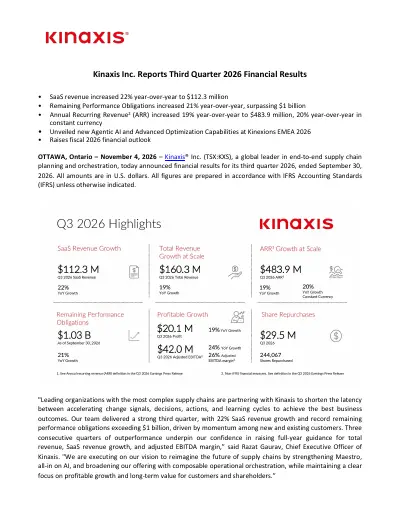
Turning to our third quarter performance, SaaS revenue increased by 22% year-over-year. This marks our third consecutive quarter of 20% or better SaaS revenue growth.
We achieved a new record, surpassing $1 billion in remaining performance obligations. Annual recurring revenue grew 19% year-over-year and 20% year-over-year on a constant currency basis.
We are on track to exceed $500 million in annual recurring revenue by year-end, an important milestone. New business was healthy again, driven by expansions with existing customers and new customer logos.
Specifically, 40% of ARR additions came from new customers. ACV bookings for quarterly expansion from existing customers grew more than 60% year-over-year.
This quarter, we set a new company record with the largest incremental ACV expansion deal. We also closed several large enterprise new wins and renewals under our next-gen pricing, our hybrid pricing model that incorporates Maestro activity units, or MAUs.
Now let me turn to our customers. New customers are selecting Maestro to replace manual, fragmented planning with connected real-time decision-making.
We're pleased to welcome Biogen to Kinaxis as they advance a major end-to-end planning transformation across their global pharmaceutical network. With Kinaxis, Biogen will connect planning across demand, supply, inventory, clinical, and distribution, giving teams greater visibility and the ability to evaluate complex trade-offs concurrently.
Maestro will enable Biogen to make faster, more resilient supply chain decisions while maintaining the service levels that matter most: getting critical medicines to patients around the world. Dr.
Squatch, a fast-growing American personal care and grooming company, is a new Kinaxis customer. As Dr.
Squatch manages demand across multiple sales channels, it is turning to Kinaxis to create a more unified and responsive planning environment. By moving away from manual spreadsheet-driven processes and leveraging real-time scenario planning, Dr.
Squatch expects to improve forecast accuracy, better balance inventory across channels, and reduce lost sales during peak demand periods. We'd also please to welcome WAI Global, a global manufacturer and distributor of automotive aftermarket components, to the Kinaxis community.
WAI Global selected Maestro to strengthen its S&OP processes, leverage advanced simulation capabilities, and explore the significant potential of agentic AI. A major manufacturer in the life sciences industry has selected Maestro as its long-term supply chain planning platform.
By improving inventory expiration management and integrating production and distribution planning, the company is building a more agile, responsive supply chain with a scalable foundation for future global growth. We displaced a competitor at a global consumer health company that is adopting Maestro to gain a holistic view of demand, supply, production, and inventory.
As I mentioned earlier, this quarter we signed the largest incremental ACV expansion deal in our history. This automotive customer significantly expanded Maestro across a business unit as part of its global supply chain planning transformation.
Its goals include operating with greater agility, making more precise end-to-end decisions, responding faster to disruptions, and capitalizing on emerging market opportunities. We're grateful for the trust they continue to place in us.
Next, I'd like to provide an update on the five strategic priorities we outlined last quarter. First, we're investing in core Maestro platform capabilities.
It was a pleasure to welcome customers, partners, and prospects to Kinexions EMEA in Barcelona last week. Registrations more than doubled at this year's event, and partner participation nearly tripled as supply chain leaders from across the region joined us to explore practical ways to turn AI-driven planning and orchestration into tangible business outcomes.
At the event, we outlined the next phase of our product and agentic AI strategy across two connected areas: advancing Maestro with intelligent agentic capabilities for planning and decisioning, and extending our reach with a broader AI-native composable operational orchestration platform. We're expanding how users interact with Maestro through richer conversational AI and semantic understanding while embedding agents and LLMs directly into workflows so they can interpret context, evaluate information, and support decisions as part of the operational process.
At the same time, explainability is being extended into advanced optimization, helping users better understand the factors behind recommendations and strengthening trust as predictive, prescriptive, generative, and agentic AI become more deeply embedded in decision-making. Underpinning this is Kinaxis data fabric.
It provides governed data pipelines for AI, analytics, and decisioning while extending that information into the customer's broader data and analytics environment. Our second priority is building a composable agentic framework for operational orchestration.
Operational orchestration helps customers act on decisions, not just make them. It is a composable, interoperable, and extensible stack that includes multimodal data ingestion using the same data fabric, a semantic intelligence layer for the context graph, a decisioning layer that leverages Maestro and other third-party engines, an agent harness, and a democratized experience layer.
We've seen customer engagement with agents continue to deepen. Agent sessions doubled over the last month.
Token consumption per agent continues to rise, indicating that agents are performing more work. Agents are executing increasingly sophisticated workflows, averaging about 15 steps per session and in some cases exceeding 50 steps.
Together, these trends show that customers are increasingly engaging agents to turn decisions into action. At our recent Maestro Agent Hackathon, customers built agents on our composable platform.
Examples include a network-aware demand investigator, an order feasibility and constraint resolution provider, and a supply shortage root cause investigator. These examples demonstrate how Maestro agents can transform time-consuming planning tasks into actionable insights.
Our third priority is scaling our new forward deployed engineering motion. As enterprises move from AI experiments to deployments, the opportunity is to transform how work gets done and deliver measurable, sustained business outcomes.
To do this, our forward deployed engineers bring together deep supply chain expertise with data engineering, data science, and solution development expertise. Our teams work alongside the customer and our partner ecosystem to shape the opportunity, co-build the solution, deploy it, drive adoption, measure the value created, and continue to evolve the capability in an agile, iterative way as the customer's needs change.
The model also creates a learning loop back into Kinaxis. What we learn from solving real customer problems can inform reusable technology capabilities within Maestro and our operational orchestration platform, helping turn successful customer innovation into increasingly repeatable approaches that benefit the broader market.
Kinaxis is now operationalizing FDE pods across North America, Europe, and India. A growing number of customers are engaging with us on AI-driven supply chain transformation.
We expect to share more about this, including customer use cases and additional details, during our Q4 earnings call. Fourth, are doubling down on training and enablement for our growing partner ecosystem.
Partners are increasingly helping us create demand, enter new markets, accelerate large enterprise opportunities, and scale customer delivery. Year to date, customers have been involved with partners in about 75% of our software bookings.
We've launched a new learning and certification platform and are running boot camps focused on enterprise scheduling, Maestro Agent Studio, and supply chain optimization. 14 partner firms participated, and workshop attendance increased 24% quarter-over-quarter.
Our global systems integrator relationships are also evolving. Historically, partners were often viewed primarily through an implementation lens.
Increasingly, we are engaging with firms such as Accenture, Deloitte, EY, PwC, and Genpact earlier in the customer lifecycle, focusing on opportunity creation, transformation strategy, AI, and delivery. Additionally, partners such as Accenture, Kearney, EY, and Trilium have leaned into our FDE motion by participating in our AI and operational orchestration boot camps.
Our relationships with Google Cloud and Microsoft are increasingly shifting beyond infrastructure to broader go-to-market and joint innovation partnerships. As we build out our operational orchestration strategy, we believe hyperscalers and enterprise AI platforms can become increasingly important channels to customer buying centers.
These investments expand our partner reach and strengthen customer engagement alongside our direct field teams. Lastly and most importantly, we are focused on customer success to deliver value.
Complex supply chains face constant disruption, from supply shortages and shifting demand to fluctuating lead times. We see a much larger opportunity to help customers reduce the latency between signals to decisions and decisions to actions.
We're seeing momentum in value delivery among customers. As a proof point, global scenario planning activity increased 29% year-over-year in the third quarter.
A few customer examples include the following: a MedTech customer that improved forecast accuracy by 7% with our machine learning-based forecasting solution, avoiding $28 million in inventory; and a petrochemical customer who leveraged Maestro to reduce demurrage costs by 15%, inventory by 14%, and supply chain emissions by 90%. We completed over 40 successful customer go-lives in the third quarter.
For example, Asahi Beverages, a leading beverage company, recently went live with Maestro, bringing demand, supply, capacity, and inventory planning together across their businesses in Australia. By replacing disconnected planning systems with a unified concurrent planning environment, they can now better anticipate supply constraints, optimize inventory, and evaluate scenarios to make faster, more informed decisions across their manufacturing and distribution network.
As I wrap up, we are very pleased with our strong performance this quarter. We're harnessing the power of new data architectures and agentic AI, and we're adding top talent globally in critical areas such as machine learning, operations research, and FDEs, all to create value for our customers.
Supply chains power the world, and Kinaxis is the operating system for supply chains. Thank you to our global team for your continued execution and to our customers, partners, and shareholders for your ongoing support.
Let me turn the call over to Herb.
Herb Yeh
Thank you, Rzat, and good morning. Let me start with our third quarter 2026 results compared with the prior year.
Unless otherwise noted, all figures are reported in US dollars under IFRS. Starting with revenue, total revenue was $160.3 million, up 19%, driven by strong SaaS and professional services revenue.
Foreign exchange rates negatively impacted total revenue by approximately $1.1 million. SaaS revenue was $112.3 million, up approximately 22%.
This represents 70% of total revenue, up from 68% a year ago. Growth was driven by momentum from new deals, strong net expansion and renewals among existing customers, and healthy retention rates.
Foreign exchange rates negatively impacted SaaS revenue by approximately $800,000. Subscription term license revenue was $1.2 million and above expectations.
Several expansion deals with existing on-premises customers drove this growth. We expect subscription term license revenue to be about $7 million for the fourth quarter and about $33 million for the full year.
Maintenance and support revenue was $4.6 million, down 16% as expected due to on-premises to SaaS migrations. We continue to see interest among on-premises customers looking to migrate to our SaaS offerings, which gives us the opportunity to help customers modernize.
Professional services revenue was $42.2 million, up approximately 14% and above expectations, with realized rates reflecting the value of our premium services. We continue to expect mid-single-digit full-year growth as we shift more implementation and support work to systems integrator partners.
Turning to remaining performance obligations, SaaS and total RPO balances and growth remained robust, with total RPO surpassing the billion-dollar mark, an important milestone for Kinaxis. Total RPO grew to $1.03 billion, up 21%.
SaaS RPO was $979 million, also up 21%, highlighting the strength and visibility of our recurring business. Over the last three years, SaaS RPO has a cumulative average growth rate of 21%, and total RPO has a CAGR of 20%.
Next, annual recurring revenue increased to $483.9 million, up 19%. ARR grew over 20% year-over-year on a constant currency basis to $486.8 million.
Ongoing strength in our million-dollar-plus ACV contracts and net expansion with existing customers drove $77 million in net new ARR growth year-over-year and $18 million in net new ARR growth sequentially. Approximately 40% of additions to ARR were from new customers, and approximately 60% of additions to ARR were from customer expansions.
Most customer growth came from enterprise or large enterprise customers, reflecting our continued upmarket focus. Now I'd like to move on to our third quarter profitability metrics.
Gross profit grew 22% to $104.5 million. We delivered a gross margin of 65%, up 1.3 percentage points.
This was driven by a higher professional services margin and a more favorable revenue mix as professional services as a percentage of total revenue declined. Our subscription software margin was 77%, down from 79% a year ago.
As we noted on our Q2 earnings call, hosting costs are temporarily increasing as we migrate from private data centers to the cloud. We remain on track with the migration and still expect to complete it by the end of 2027.
Professional services gross margin was 32%, up significantly compared with 24% a year ago, reflecting higher realized rates in the quarter. Operating expenses were in line with expectations.
For the full year, we expect sales and marketing to grow in the high single digits, R&D to grow in the low to mid-double digits, and G&A to grow by approximately 20% inclusive of stock-based compensation compared with last year. Excluding stock-based compensation, G&A is expected to grow by approximately 15% compared with last year.
Adjusted EBITDA increased 24% to $42 million, reflecting strong revenue growth, healthy gross margins, and efficient operations. Adjusted EBITDA margin was 26.2%, up 1 percentage point year-over-year, positioning us well to raise full-year guidance.
Profit rose 19% to $20.1 million with an effective tax rate of about 22% for the quarter. During the third quarter, we repurchased more than 244,000 shares for approximately $29.5 million.
Since that program began last November through the end of September 30th, we've repurchased more than 1.4 million shares for $163 million at an average US dollar price of $111.12. This reduced the total outstanding share count by 3.5% on a net basis.
Yesterday, our Board of Directors approved a new normal course issuer bid plan, subject to TSX approval, that allows us to repurchase up to 2.7 million shares during a 12-month period ending November 11th, 2027. Turning to cash, we ended the third quarter with a strong cash position.
Cash flow from operating activities was $34.4 million, up 2%. Cash, cash equivalents, and short-term investments were $317.9 million, down from $324.7 million at the end of last year, even with $138 million from share repurchases.
Free cash flow margin was 21% in the third quarter, down 3.1 percentage points year-over-year. Trailing 12-month free cash flow margin was 24%.
Higher revenue and a reduced share count led to diluted EPS of 72 cents, up 25% year-over-year. That sums up the Q3 review.
We delivered better than expected top-line results over the past three quarters and remain confident in our Q4 trajectory given the momentum we are seeing among new and existing customers and across go-to-market opportunities. As a reminder, our new FDE motion is not expected to contribute meaningful revenue to our full-year 2026 results.
With this in mind, we're raising guidance for the full year ending December 31, 2026, as follows: We now expect total revenue to be in the range of $640 million to $650 million, an increase from our previous guidance range of $625 million to $640 million. This represents approximately 16.8 to 18.6% year-over-year growth.
We now expect SaaS revenue year-over-year growth to be in the range of 20 to 21%, an increase from our previous guidance of 18 to 20%. This represents a range of approximately $435 million to $438.5 million.
Lastly, we now expect the adjusted EBITDA margin to be in the range of 26.5 to 27.5%, up from our previous guidance range of 25 to 26%. For full-year modeling purposes, I'd like to provide some additional details.
First, we expect foreign exchange rates to remain a headwind for the rest of the year given the strengthening of the US dollar against the euro, the British pound, and the yen. For the full year, we estimate FX-related headwinds to total revenue between $3.5 and $4 million and to SaaS revenue between $2 million and $2.5 million.
Second, we expect full-year basic weighted average shares outstanding to be approximately 27.3 million shares and diluted weighted average shares outstanding to be approximately 27.9 million shares. These share count forecasts do not include the impact of any future share repurchases we may pursue.
Thank you to our global team for delivering another strong quarter. As we head into the final stretch of the year, our focus is straightforward: continue to execute well, serve our customers and partners, innovate, and finish the year strong.
Operator, we're now ready to take questions.
Operator
We will now begin the question-and-answer session. Please limit yourself to one question.
If you would like to ask a question, please press star one to raise your hand. To withdraw your question, please press star one again.
We ask that you pick up your handset when asking a question to allow for optimum sound quality. If you are muted locally, please remember to unmute your device.
Please stand by while we compile the Q&A roster. Your first question from the line of Thanos Moschopoulos with BMO Capital Markets.
Your line is now open. Please go ahead.
Thanos Moschopoulos
Hi, good morning. Your Q4 guidance seems quite conservative if we look at the RPO that you have for Q4 heading into the quarter.
Are you expecting a sharp sequential step-down in PS revenue, or are there other factors to call out? Thank you.
Herb Yeh
Yeah. Thanos, thank you for the question.
Look, we delivered a strong Q3 across revenue, recurring revenue growth, and profitability, and that performance, together with the increased visibility we now have into the balance of the year, allowed us to raise our full-year outlook. You're right that we do have a high degree of visibility into full-year revenue at this time, we're 10 months through the year.
The thing I'd point out, though, that we factor in is that for a new SaaS booking following this earnings call, at most 2 months of the associated annual contract value would be recognized in the current year. Professional services for the balance of the year is also largely visible.
The primary or principal timing variable is really subscription term license transactions where a greater proportion of the contract value is recognized upfront. The other thing I'd point out is that our guidance is on a as-reported basis, and it incorporates our current FX assumptions while allowing for some normal FX variability through the year-end.
Overall, the updated outlook reflects continuing to invest for growth without a significant change in our spending trajectory. That's the point about how we thought about margins.
Rzat Garayev
Thanos, just to add one more thing to that, sequentially from Q3 to Q4, just from a seasonality perspective, PS is typically lower in Q4, just given the holiday schedule, which is pretty normal, and we factored that into our guidance.
Thanos Moschopoulos
Great. Congrats on a strong results for the quarter, and I'll pass the line.
Thank you.
Operator
Your next question from the line of Doug Taylor with National Bank. Your line is now open.
Please go ahead.
Mike Stevens
Oh, hi, this is Mike Stevens on for Doug. Congrats on a very strong quarter again.
I wanted to dig into the MAU in the pricing model. You mentioned a lot of the enterprise wins were including that.
Any sense yet, I know it's early days, on what kind of impact that will have on margins in the future? Even revenue growth, is that expected to sort of be a accelerant on revenue growth, or any insights into that?
Herb Yeh
Yeah. One thing to underscore about MAU and next-gen pricing is that it's a usage-based model.
Meaning the customer, as part of their package, will have a certain allocated number of MAUs, and as long as they stay within their MAU usage for the quarter, that provides them predictability around what their cost is, and it gives us predictability and visibility into what the recurring revenue is. As the clients grow their usage, if they go through the allocated MAU usage, then it's not that they get a surprise bill that says, oh, by the way, you blew through your cap, and therefore, here's a bill, but it's a conversation with the client that says, hey, your MAU usage is trending above what's in your allocated package, it's an opportunity to grow into a larger MAU package.
We are still early in the adoption of NGP and MAU. We are seeing traction, as Rzat mentioned on the call earlier, but what we're trying to balance is giving the client visibility and predictability on what their growth is while providing us that same visibility on the revenue line, but also capturing usage that comes with agentic AI.
Mike Stevens
Got it. Appreciate the insights.
Victoria Hyde-Dunn
Next question.
Operator
Your next question from the line of Kevin Krishnaratne with Scotiabank. Your line is now open.
Please go ahead.
Richard
Hey, this is Richard on for Kevin. Congrats on another strong quarter.
Just a quick question on M&A, looking ahead to 2027, are you able to talk about capital allocation, any thoughts on M&A? Are there any key areas of focus or gaps in the portfolio that could be supported by acquisitions?
Are there tuck-ins or transformational ones?
Herb Yeh
Thank you for the question. Our philosophy and approach to M&A, no change from what we discussed on the last call, which is we're very, very focused on executing against our strategic road map.
You heard Rzat talk about our priorities around continuing to invest behind Maestro, continuing to invest behind our composable operational orchestration platform, the FDE motion. Any M&A that we think about and that we would do would be things that accelerate the plan that we have.
That's one very critical, important point. The second is that, as we've discussed previously, our thinking around M&A is not M&A for the sake of cost synergies, it's not M&A for the sake of just buying revenue.
It is for the sake of accelerating our product road map that ultimately translates into more value for our customers and revenue synergies that we can execute on and thereby deliver value for our shareholders. We don't foresee anything that I think you might or shareholders might think of in the transformational range given what I just said about the types of things we'd be looking at.
There'd be things that would accelerate our own organic road map. These are things that are much more likely to be of the acqui-hire tuck-in types of transactions.
Does that help?
Richard
That's good. Thank you.
Operator
Your next question from the line of John Shao with TD Cowen. Your line is now open.
Please go ahead.
John Shao
Hey, good morning, guys, and thanks for taking my question. I think it's interesting to see a global consumer health company moved away from a competitor.
I believe you also won Asahi Beverages. Is this some kind of new normal that you're gaining momentum in a consumer vertical, which has historically been dominated by competitors like Blue Yonder?
Rzat Garayev
We're definitely seeing a lot of traction in the consumer packaged goods, FMCG, food manufacturing space. We play on the consumer manufacturing space in general.
We're definitely also seeing a lot of opportunities to replace old legacy systems, old legacy deployments as organizations aspire to a different paradigm when it comes to supply chain planning, decisioning, and orchestration. It continues to be a really strong vertical for us, and we see continued traction in the space.
John Shao
That's great color. Thank you.
Rzat Garayev
Thank you.
Operator
Your next question from the line of Mark Schappel with Loop Capital Markets. Your line is now open.
Please go ahead.
Mark Schappel
Hi, thanks for taking my question. Nice job on the quarter.
Rzat, as customers move into the newer MAU-based pricing model, what are you seeing in terms of adoption and spending? Is it just making it easier to get more users on the platform and then grow revenues as it expands, as usage expands, or is it just mainly the benefit of simplifying the initial sale?
Rzat Garayev
I think as we are getting into this MAU-based pricing structure, which, by the way, is structurally similar to what a lot of other enterprise software companies are doing, right? What we're finding is it just allows for the customer and for Kinaxis to really be able to service and employ a broad variety of use cases, right?
What I mean by that is a lot of our deployments now involve automated workflows, agentic capabilities, or in some cases even headless deployments, right? Through an MCP server.
We're able to kind of meet the customer in the way that they want to deploy our solution and work with our platform, and interface with our platform in the way where they're already working. At the same time, we're the system of record for supply chain planning for our customers, right?
When not only are agents that are developed on our platform are leveraging that data, but also third-party agents that are leveraging the Kinaxis Maestro data are pinging our platform, it allows us a way to really be able to monetize the access to that data. It's a multiple approach.
I don't look at this as a way for us to grow the number of users on our platform necessarily. If anything, supply chain planning and decisioning use cases have never had a very large user or seat-based count, right?
It just allows us to deploy the solution and be able to monetize and provide predictability to our customers in the world of agentic AI, which is becoming more and more prevalent in the use cases and deployments that our customers are working with us on.
Mark Schappel
Thank you. That's helpful.
Rzat Garayev
Thank you.
Operator
Your next question from the line of Paul Treiber with RBC Capital Markets. Your line is now open.
Please go ahead.
Paul Treiber
Oh, good morning, and thanks for taking the question. Just a question on the sustainability of growth momentum here.
You've seen growth accelerate, ARR growth accelerate for a number of quarters now. The comps are getting tougher.
How do you think about the growth going forward, remaining in the 20% plus range?
Rzat Garayev
Yeah. Of course, we're not providing guidance for 20 2027 yet.
We will do that on the next earnings call. What I can tell you is, with all the continued volatility and uncertainty in supply chains, it's creating a higher sense of urgency across our customer base to lean in and make investments in Kinaxis, right?
Customers are prioritizing the funding and the provisioning of investments in Kinaxis. That's a very encouraging sign.
As we do that, and as we invest in our agentic AI platform and we expand further into operational orchestration, we're seeing tremendous interest from across our customer base, right? For example, we've held hackathons, we've held boot camps at our Kinexions Barcelona event.
We're going to do the same thing at our Kinexions India event coming up in about a couple of weeks from now. These are all oversubscribed, right?
All of those indications point towards the fact that we have a strong demand environment. Our pipelines are continuing to grow.
We feel really good about this. Our goal here is to do everything possible to continue to sustain really high growth rates while maintaining a disciplined approach to margin performance, right?
We'll definitely provide more details on this in the Q4 earnings call in February.
Paul Treiber
Thanks for that color. Just on the investments, with the raised EBITDA margins, it's now above, I think previously you had a 25% medium-term target.
For the performance being better than a target this year, what are the drivers of that? Was it just investments taking a little bit longer to ramp than you expected, or was it outperformance in the term license side?
Herb Yeh
Thank you for the question. It's an important question.
I think a big driver of that, if you think back to the beginning of the year to where we are now, is a higher STL number than we had anticipated at the beginning of the year. You'll recall STL, it's a significant pull forward in revenue recognition versus our SaaS revenue, but you don't have the same pull forward on the cost to serve, on the COGS.
There's a very direct flow-through from a higher gross margin through to the EBITDA margin. That's been a big driver of that relative outperformance in the EBITDA margin.
That being said, we continue to invest for growth, but in a very efficient manner. That's also been a part of it, which is just operating efficiently while investing behind the innovation that Rzat referenced earlier today.
It's a combination, but STL is a very important driver of it.
Paul Treiber
Okay. Thanks for taking the questions.
Operator
Your next question from the line of Suthan Sukumar with Stifel. Your line is now open.
Please go ahead.
Suthan Sukumar
Good morning, gents, and congrats on a very strong quarter. For my first question, I just wanted to double-click on the FDE model.
Can you share a little bit more about some of the initial traction that you're seeing with this model? In general, how do contract values for an FDE-led deal compare to a typical deal?
Rzat Garayev
No, thank you for the question. We launched the FDE motion just a few months ago, and we've been mobilizing the pods in North America, Europe, and in India.
As I mentioned in my prepared remarks, these pods involve a mix of deep supply chain domain experts, process experts, data engineers, as well as data science and solution development expertise, right? The interest we're seeing from our customer base is quite significant.
We're involved with a number of our existing customers that have deployed Maestro and are now looking to extend beyond the planning and decisioning into how they operationalize those plans. Supply chain systems and supply chain processes are very complex, they're very fragmented, there are multiple systems of record.
As we thread together different outcome flows through our FDE engagement model, we're finding all kinds of opportunities in helping our customers go above and beyond just stopping at planning. The early indications are very encouraging from our point of view, and it's also a great opportunity for us to leverage the base we have for Maestro customers where we have the trust, where we have an understanding of the customer supply chain and then extend beyond that into threading together these outcome flows.
That's what's happening there. Obviously, we're working with some of the early adopters and are creating MVP solutions, and I'll be sharing a lot more details on some of the example use cases in our Q4 earnings call in February, but early indications are again very, very encouraging.
Suthan Sukumar
Okay. Thanks for the color.
On the net new ARR added this quarter, can you guys speak to the attach rate of AI offerings on these deals? You guys did flag some very encouraging agent and token usage stats in the opening remarks.
What do you expect MAU usage, the whole usage component to become a more meaningful component of this AI monetization as I believe that your offerings are still being sold as a premium proposition?
Herb Yeh
Yeah. This is Herb.
On that question, it's still early in our transitioning, first, of clients onto the next-gen pricing, which includes the MAU usage component of the subscription model. We don't have right now, sitting here, the data points to share with you that says exactly how much uplift has come or resulted from the introduction of this.
We talked about it last quarter, but we're still relatively early. Every new proposal that's going out is next-gen pricing that has the MAU subscription component.
We'll update as this continues to evolve for us.
Rzat Garayev
Just to add a little bit to that, just going to level-setting here, right? We have always been leveraging, in 100% of our customer base, predictive and prescriptive AI, right?
Then more recently, we've been adding generative and agentic AI capabilities. So 100% of our customer deployments include AI, right?
I just wanted to mention that firstly. When it comes to agentic AI, it's becoming a bigger and bigger factor in customers, both net new logos making a selection of Kinaxis is becoming a bigger and bigger factor, and in existing customers expanding with Kinaxis.
We're seeing really good and strong uptick in agentic use cases. There's a whole broad variety of agentic capabilities.
We've obviously added a conversational interface to our entire Maestro platform. We've got a Maestro Agent Studio, which we launched earlier this year, which creates a composable studio for customers and partners to build agents, and we're seeing a lot of creativity around that.
At Kinexions in Barcelona, several customers like Jabil, like Sanofi, and others talked about examples of use cases that they've leveraged our Agent Studio for. Then as we expand beyond planning and decisioning into operational orchestration, they very much lean into leveraging both the semantic intelligence layer, but also agentic capabilities that traverse a context graph.
AI is very native to the Kinaxis platform, and what I want to make sure people understand is there is no Kinaxis solution without AI, right? We've been AI-native from day one.
Suthan Sukumar
Thank you for the feedback, gents. I'll pass the line.
Operator
Your next question from the line of Stephanie Price with CIBC. Your line is now open.
Please go ahead.
Sam Schmidt
Hi there. It's Sam Schmidt on for Stephanie Price.
I wanted to ask around the pipeline. Can you give an update about what you're seeing in terms of pipeline conversion, and comment on your level of optimism about RPO levels going forward?
I know Q4 is typically seasonally strong for bookings. Can you share any color on what you're seeing so far?
Thanks.
Rzat Garayev
Thank you for the question. The pipeline is trending strong.
We're definitely seeing, as our sales and go-to-market teams get more and more disciplined, the quality of the pipeline is improving, which shows up in the yield rates. Our win rates have been improving, like I mentioned previously in last quarter's earnings call as well.
We're really happy with the progress we're making both in terms of the quantum, but also as importantly on the quality of the pipeline. The key sort of industry verticals that are driving a lot of the growth in the pipeline include some of our core verticals like in life sciences, especially in pharma and med devices, aerospace and defense, the whole high-tech value chain, as well as in industrial manufacturing and consumer products.
In every one of these key verticals, we're seeing increased traction in our pipeline and also better win rates. I'll let Herb talk about the RPO question that you had.
Herb Yeh
Yeah. I think we continue to feel good, just as Rzat mentioned about the demand environment that we see.
The RPO growth that we've seen the last few quarters we're very very pleased with, and we're not giving forward guidance for 2027. As we don't guide on forward RPO or ARR, but I'll leave it at we feel good about the overall demand environment, the quality of the pipeline, and the win rates that we're seeing.
Rzat Garayev
Look, really proud of the fact that RPO crossed a billion dollars, which is fantastic. Obviously, we continue to be focused on signing multiyear committed deals, and that hasn't changed, and will continue to be the case going forward.
Sam Schmidt
That's good color. Thank you.
Operator
The line is now open for additional questions and follow-ups. If you would like to ask a question, please press star one to raise your hand.
To withdraw your question, please press star one again. Please stand by while we compile our Q&A roster.
Your next question from Lachlan Brown with Rothschild & Co Redburn. Your line is now open.
Please go ahead.
Lachlan Brown
Hi, Rzat, Herb. Congrats on the quarter, and thanks for the questions.
I was wondering if you could expand on the Kinaxis data fabric a bit further, specifically how much does it improve data ingestion and that contextual understanding of supply chain data? Also, how are you monetizing?
Is it included in the core Maestro platform, or is it sold as a separately priced module? Thanks.
Rzat Garayev
Lachlan, thank you for the question. Hope you're doing well.
Data fabric has been an important development initiative. We've built it on the Databricks platform.
Really, there are multiple use cases for data fabric. Primarily, of course, it's for the data ingestion and the integration into a variety of systems where we source the data from for our customers' data.
Also, data fabric is very important as we think about the machine learning pipelines we have that feed into a lot of the algorithmic capabilities that underpin, for example, our demand planning and forecasting solution. Also, data fabric is the same data fabric that feeds both our Maestro planning footprint as well as our extending into operational orchestration.
It's the same data fabric, right? It's an important part of our core platform that enables us to have a common data foundation across everything we do and allows for multimodal ingestion.
What I mean by that is it can extract ETL data, it can have structured data, unstructured data, as well as streaming data, right? It really allows us a lot of flexibility and a lot of scale for us to be able to leverage with our customer base.
It's also allowing for archiving, since we are the system of record for supply chain planning for our customers, a lot of our customers are now going to be able to use our data fabric to also archive scenarios and worksheets and other things like that. It's a really core component.
In terms of the way we're packaging it, data fabric is a core part of our platform fees. It's embedded as part of that, and we're not pricing for it separately.
Of course, based on the usage metrics, it feeds into our MAU pricing structure, as you would expect. That's the way the pricing and packaging works.
Lachlan Brown
Thanks, Rzat. That's very helpful.
If I could also ask, did those 40 customer go-lives in the quarter, did they come in faster than expected? If so, was there any contributing factors to that, like, for example, quicker deployments from AI efficiencies with your SI partners?
Rzat Garayev
That's a really good question. We continue to be very focused on making our customers successful.
As you can imagine, we're solving really hard problems for our customers, right? A lot of these deployments involve significant amount of process changes, operating model shifts, and so there's a lot of change management that underpins our deployments.
Having said all of that, we're seeing incredible opportunity to improve the time to value using agentic AI as part of our deployment methodology, right? We'll talk more about this in 2027, but we are doing a lot of work in a focused way to further accelerate the way we integrate our solution to other systems, the way we configure it, the way we test it and go through the QA environment as part of the implementation cycle.
Every step in that deployment cycle can be made more efficient and can be accelerated using agentic AI, and we're leaning in on that, right? That's really a welcome sort of shift from our customers' perspective.
More to come on this, but early signs are that, despite all the work, there's always an advantageous approach to taking in the way we implement, and agentic AI is helping us reimagine our approach to implementing our solution as well.
Lachlan Brown
Helpful. Thanks for the questions.
Operator
There are no further questions at this time. I will now turn the call back to CEO Rzat Garayev for closing remarks.
Rzat Garayev
Thank you so much, all, for joining. Again, a big thank you to the entire Kinaxis community, our employees, our partners, our customers.
We really appreciate all the support and the momentum we have, and looking forward to speaking to you in the new year. Thank you so much.
Operator
This concludes today's call. Thank you for attending.
You may now disconnect.