Meren Energy Inc.
Q3 FY2026 · Earnings Call TranscriptNovember 11, 2026
Operator
Hello everyone, my name is Cheryl, and I will be your conference operator today. At this time, I would like to welcome everyone to Meren Energy's Third Quarter 2026 Results Presentation.
After the speakers' remarks, there will be a question-and-answer session. Please note that at any time participants on the webcast can submit the questions using the questions button on the webcast interface.
This event is being recorded, and the recording will be available for playback on the company's website. I will now pass the meeting to Mr.
Shahin Amini. Please go ahead, Mr.
Amini.
Shahin Amini
Hello everyone. Thank you for joining us today for Meren's third quarter 2026 results presentation.
My name is Shahin Amini. I'm Head of Investor Relations and Communications at Meren.
I'm joined today by Oliver Quinn, our President and Chief Executive Officer, and Aldo Perracini, our Chief Financial Officer. We will begin with prepared remarks and then open the floor to questions.
Before we get started, I will remind everyone that remarks made during this session are subject to forward-looking statements, which involve significant risk factors and assumptions that could cause actual results to differ materially. More detail on these risks can be found in our regulatory filings on SEDAR+ and on our website.
The information discussed is made as of today's date and time, and Meren assumes no obligation to update or revise this information to reflect new events or circumstances. The company's complete financial statements and related MD&A are available on the company's website and SEDAR+.
With that, I will now hand you over to Oliver. Oliver, please go ahead.
Oliver Quinn
Thanks, Shahin, and thanks everyone for joining us today. Q3 demonstrates strong continued execution on our strategy with production tracking at the upper end of our revised guidance range.
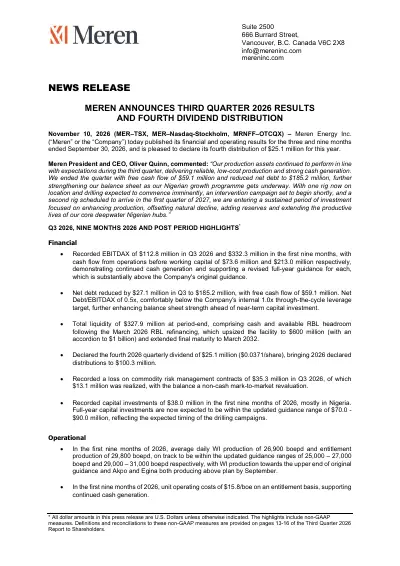
Net debt is down to $185 million, remains at 0.5 times EBITDAX, and we ended the quarter with around $328 million of liquidity. We've also declared the fourth $25 million dividend of the year, taking distributions in 2026 to $100 million and to around $200 million since the Prime amalgamation in 2025.
Maintaining a strong financial position is important as in the short term, we now commence a period of capital investment from Q4 and into 2027. At Akpo and Egina, a drilling program will commence shortly, in parallel with a vessel-led well intervention campaign, and a rig is planned to return to the Agbami area in the first quarter of 2027.
As we head toward year-end, we move into a phase of new activity that will support the existing production base whilst in parallel, we have renewed momentum around the maturation of the significant discovered resource base around our existing infrastructure. I'll come back to the key milestones and what they mean for the production outlook later in the presentation.
Turning to guidance on slide 5, production remains on track, and the financial outlook has further strengthened. We've narrowed working interest production guidance to 25 to 27,000 barrels of oil equivalent per day, and entitlement production to 29,000 to 31,000 barrels per day.
We're also raising EBITDAX guidance to a range of $390 to $440 million, and cash flow from operations to a range of $250 to $280 million. Higher realized oil prices are clearly part of that, but the assets have also continued to deliver.
Capital investment is now expected to be $70 to $90 million in the year. That reduction is mainly operational timing, the associated spend moves into next year as the activity phasing is finalized.
Overall, we expect to finish 2026 with stronger cash generation and substantial liquidity ahead of a much more active investment program in the organic portfolio across the next few years. Moving to slide 6 and Q3 production performance.
We averaged 25,300 barrels oil equivalent per day on a working interest basis and 28,300 on an entitlement basis. The trend through the year largely reflects the planned pause in drilling and natural decline.
That pause was used to reinterpret the latest 4D seismic and improve the selection and sequencing of the next well activity, and as such, has de-risked the upcoming program significantly. The intervention program is getting underway, and the Akpo and Egina drilling campaign is expected to begin this month, starting with the Akpo Far East near-field exploration target.
I'll go through the drilling program in more detail later in this presentation, but the key point I'd like you to take away is that the operationally quiet period is behind us, and we're now entering a sustained period of activity across the portfolio. I'll hand over to Aldo to take you through the financials.
Aldo Perracini
Thank you, Oliver, and hello, everyone. We lifted two cargoes in Q3 at an average realized price of $92 per barrel, representing a premium of around $6 to Dated Brent across July and August when the cargoes were lifted.
With the legacy trigger price forward sales arrangements now behind us, our cargoes are priced in line with the Dated Brent shortly after the lifting date. We also continue to benefit from the amended Akpo and Egina gas sales agreement.
Gas revenue was $12 million in Q3 compared with 4.5 million a year ago. On hedging, we recorded a $35 million loss on commodity contracts in the quarter, of which 13 million was related to settlements during the period, with the balance, a non-cash mark-to-market of open positions at the end of the quarter as oil prices rose.
The purpose of the program is to provide visibility of cash flows to support our capital allocation priorities. For 2027, we have collars on a portion of our production with floors of around $70 per barrel and upside to around $93 per barrel.
The approach is about balance: providing visibility of cash flows that underpin our investment plans while maintaining exposure to stronger oil prices. Turning to the financials highlights.
In Q3, we generated 113 million of EBITDAX and 74 million of cash flow from operations before working capital. This demonstrates the strong cash flow generation of the business, driving a revision in our full-year guidance.
Capital investments was $14 million in the quarter. With the PML 52 rig now expected in Q1 2027, part of the planned spend moves into next year, and guidance has been revised to reflect that.
This reduction reflects the timing of activity with investment stepping up as the drilling campaigns progress. We generated free cash flow of 59 million in the quarter and 77 million year to date.
Operating costs averaged around $16 per barrel in the first nine months. Q3 was higher, reflecting the timing of routine maintenance and nonrecurring operator personnel costs.
That supports strong margins and keeps the business resilient across the oil price cycle. Turning to cash movements for the third quarter.
We began the quarter with 78 million of cash, and our operations generated a further $73 million. We invested 14 million back into our assets and returned 25 million to shareholders through the dividend.
We also drew $41 million under the RBL to manage working capital across the business. As a result, we ended the quarter with 146 million in cash, which puts us in a strong position as investment activity picks up.
Our capital allocation priorities remain unchanged: balancing investment in our highest value organic opportunities, balance sheet strength, and shareholder returns. This approach preserves financial flexibility while supporting disciplined investments into the business.
Next slide, please. Moving to liquidity management.
Net debt fell to 185 million in the quarter with leverage of 0.5 times, half our through-the-cycle target. Following our successful September RBL redetermination, our borrowing base is $513 million, leaving 182 million of headroom and total liquidity of around 328 million.
That strength is particularly important as activity now picks up. It gives us more than enough capacity to fund the drilling program from operating cash flow while maintaining resilience through the oil price cycle.
With that, I'll hand you back to Oliver.
Oliver Quinn
Thanks, Aldo. Now let's turn to the next slide and our business outlook for the next year.
After an extended period without drilling, the next 12 months mark a significant increase in activity for Meren. In Nigeria, we are entering a sustained investment program that runs into the early 2030s, aimed at offsetting natural decline, adding reserves, and progressing our discovered resources through our existing infrastructure to deliver overall production growth.
That activity begins with the PML 2 and 3 drilling campaign around Akpo and Egina. Drilling is expected to commence this month, starting with the Akpo Far East exploration well, located around 5 km from the Akpo infrastructure, and which if successful, could move quickly into a production tie-back.
The campaign then continues with infill wells across Akpo and Egina, alongside the vessel-led well interventions that support near-term production. In PML 52 and PPL 2003, the rig is expected in Q1 2027.
The initial program includes three firm Agbami infill wells that will deliver incremental production in 2027, and appraisal of the adjacent Ikija discovery. The Ikija well supports definition of a future development through a tie-back to the Agbami FPSO.
Alongside the near-term investment activity, the path for the Egina tie-back developments is now much clearer. Following interpretation of the latest seismic data across Preowei, the project is moving ahead through the FEED process in 2027 based on an optimized, lower-cost development concept ahead of FID.
In parallel, the Egina South discovery that sits across two licenses will be appraised through a well in the license adjacent to Meren's position, and this should de-risk the resource range and allow the tie-back concept to Egina to be optimized with no appraisal cost for Meren. Over the next year, there are several tangible milestones for the Nigeria portfolio: delivery of the interventions, commencement of the Akpo and Egina drilling campaigns, arrival of the Agbami area rig, and maturation toward FID for the Preowei and Egina South tie-back developments.
More broadly, the investment environment in Nigeria continues to be supportive with the deep offshore incentives order signed in August that offers tax credits for qualifying projects reaching FID by the end of 2029, further enhancing the investment proposition of Meren's deepwater discovered resource base. Beyond Nigeria, we're continuing to progress the longer-term opportunity set.
On Venus, the operator has said the project is ready for sanction and that it is working towards FID in the near term with first oil targeted in 2030. For Meren, our interest remains fully carried through to first production, giving us exposure to long-term and diversified production growth without any upfront capital exposure.
In South Africa, the minister's dismissal of appeals against the environmental authorizations to drill up to five wells on Block 3B/4B is a positive development for the project. The Nyala prospect remains ready to drill with timing subject to any further proceedings that may be initiated.
Taken together, we're moving into a much more active period for the business. The immediate focus is on executing the drilling program in Nigeria while continuing to progress the series of growth opportunities across the wider portfolio.
That gives a good sense of what we're building towards more broadly, which I'll turn to on the next slide. On slide 12, we can see the direction of the organic business based on the multiple growth options in the portfolio today.
The starting point is the Nigerian production base. The interventions and infill program are intended to offset part of the natural decline and protect the cash flow from those assets, and that's a near-term priority.
The next layer is the discovered resource around the existing hubs. Preowei, Egina South, and Ikija offer meaningful options for production growth as they each mature toward different FID points.
These are greenfield developments with the attraction of utilizing our existing infrastructure and allowing us to optimize CapEx and reduce project risk. Then there is Venus.
Based on the operator's current public plan, Phase 1 could add a long-life production stream around the turn of the decade. Beyond that, we have a portfolio of exploration exposure in Nigeria, the Orange Basin, and Equatorial Guinea that could deliver material upside through a large carried component that minimizes the upfront risk capital required to test these options.
Overall, we move into 2027 with a strong financial position that underpins our ability to deliver growth on multiple fronts: a return to near-term operational activity, development project maturation across several near-field resource projects, and material carried exploration upside options. Thanks for your time, and I'll now hand you back to the operator for questions.
Operator
Thank you. We will now begin our Q&A session.
If you have a question, we ask that you use the raise hand function at the bottom of your screen. Once your name has been announced, you can ask a question.
If you want to withdraw your question, please lower your hand using the raise hand function. Thank you, and a moment for the first question, please.
If you would like to submit a written question, please use the ask a question tab on the right-hand side of the player window. Our first question comes from Jeff Robertson from Water Tower Research.
Please unmute your line and ask your question.
Jeff Robertson
Thank you. Good morning.
Oliver, can you talk a little bit about the tax credit incentives with the new Nigerian incentive order, and how that could affect the ultimate development economics at Preowei? Then, secondly to that, are there other projects in the portfolio that could advance to FID before the 2029 deadline?
Oliver Quinn
Yeah. Hi, Jeff.
Thanks for the question. I think just as a refresher for people on Preowei, that is a 150 million barrel plus gross discovered resource, about 25 km from the Egina FPSO, same license area.
That's a project that actually has made great progress recently. Will move back into FEED after a revised and improved subsurface picture.
Again, will move very fast towards an FID there, stretch target end of '27. It's a pretty exciting big project for us.
I think specifically on the point, look, if you step back again, we've seen a raft of measures from the current government in Nigeria over the last few years in terms of fiscal support, particularly for the deepwater, helping the contracting landscape, kind of bringing more competition there, which ultimately puts pressure on CapEx for these project, which is great from our perspective. The specific incentive that you mentioned there, it's effectively a production tax credit, which is $3, $4 a barrel that would be applied as a credit for projects FID-ed before '29.
Look, I think firstly, we see Preowei, it doesn't necessarily need that fiscal incentive to be attractive to us. It's a good tie-back project.
Of course, that accelerates its value to the JV and therefore means we bring that project as fast-paced as we can to be within that window, and it certainly will be in terms of '29. It adds significant value.
Then secondly on the follow-on, I think there's another, call it a look-alike, of Preowei, Egina South, which as the name gives away, is close to Egina as well. Very, very similar, kind of plus or minus 150 million barrels gross, similar distance tie-back to the Egina FPSO.
The way we look at that is, that's a project that would follow Preowei. Ideally bring Preowei on, and then short period of time later, you bring on Egina South to phase them.
I think even with that then, we would look to certainly get that FID on Egina South within the window of the tax credit in '29, for sure. That will be a driver of the timeline of that project.
Certainly for Preowei, it's very helpful. I think for Egina South and potentially some other tie-backs that are less mature, just adds to the compelling case that already exists in Nigeria.
Jeff Robertson
Can you remind me at Akpo Far East what you might anticipate the production from that project being?
Oliver Quinn
That's kind of super exciting well for us. I think we'll spud that well.
We've said mid-November, and we're almost there. I think we're on track to do that.
Again, that well is about 5 km from the nearest Akpo infrastructure. It is an exploration well, there's clearly some geological risk on that, but relatively low, I would say.
The plan would be to drill that through the end of this year, see what we get, and in a success case, I think we would do some extra work on the well to keep it as a potential producer. Then, maybe somewhere through '27, 6 to 9 months, we'd hook that up as a first well of a wider campaign, a wider development, if you like, of the discovery.
The aim would be to bring accelerated first oil there again in '27. I think we'll see what the well brings, but in terms of rate, I think, first well producer, new reservoir, you'd hope to do something around plus or minus 10,000 barrels a day gross.
Meaningful from a field perspective, for sure.
Jeff Robertson
Then lastly on that, Oliver, have you been able to or has the operator ordered some of the longer lead time items that might be needed to bring that on?
Oliver Quinn
The benefit of the current campaign is that we've got several activities. The rig has arrived in the Akpo field area about 5 days ago, is just getting predrill prep now.
Of course, it's going to drill Akpo Far East. It's then going to go drill in the Akpo field itself.
It's going to drill, not on our license, again, it's going to third-party, but an appraisal well on the other side of Egina South. There's a whole lot of activity in there, and it's the same campaign.
In that respect, there's been planning done to account particularly for the success case on Akpo Far East. It retains that flexibility to again do what we need to do to put a completion in and get that ready for being a producer through '27.
We feel pretty good about that. Thank you.
Operator
Thank you. I will now hand over to Mr.
Amini for the written questions.
Shahin Amini
Thank you very much. We have a couple of questions on the Q3 results, and I'll put these to Aldo.
Aldo, the first one is that given the EBITDAX realized year to date and our revised full-year EBITDAX guidance, this implies that the Q4 EBITDAX could be around 58 to $100 million compared to 113 in Q3. Is this conservatism, or is there something that the market should expect that could weigh on Q4 results?
Aldo Perracini
I think we got to be careful with reading too much into what we see on the implied quarters for EBITDAX. I think the full-year guidance we have to remember is a range, we shouldn't take it as a quarterly forecast.
A single quarter can be quite sensitive in terms of timing of the cargoes and the lifting. We are comfortable with the range, and then we expect to land within it.
Shahin Amini
Okay. Second question for you.
The third quarter realized price of $92.40 per barrel was below the Q3 average Dated Brent of $97. The question is why is Meren pointing to a premium having been achieved?
Aldo Perracini
Again, it comes down to timing on this one. We had two cargoes in Q3, one lifted in July and one lifted in August.
During those two months, the average Dated Brent was around $87 per barrel. Compared to that window, we sold them to a premium of around $5.50 per barrel.
The higher quarterly average actually reflects the price throughout the whole quarter, but we call that we have a discretionary liftings, right? That's what matters for the price realization.
Shahin Amini
Thank you. To the next question, and perhaps this is one for Oliver.
It's regarding future opportunities in Nigeria, and the question is, is Meren looking to expand its working interest in more assets in Nigeria? For instance, there is a next marginal field bid round coming up.
Oliver, can you share your views, please, on opportunities in Nigeria and your potential plans?
Oliver Quinn
Look, I think it segues with the question Jeff asked in the sense of Nigeria and its landscape. Again when we look at two key components here, the first one, of course, begins with the subsurface and the potential of the basins there for resource, and it's very high.
It's prolific petroleum system in the delta. It's prolific petroleum system in the deepwater.
Look, we start with that simple premise that there's a lot of resource here. There's a lot of resource that's discovered, not developed, and there's a lot of resource to be discovered, right?
Great place to play in that respect. Then you move to the second bucket, which we've touched on, which is again, what's the above-ground situation and how attractive is that from an investment perspective?
I think the short answer is it's very attractive right now. I think, from a high level, we have a government that is extremely supportive of the sector, not just in words, but also when you look at the actions.
It's a government that's delivered on that, and we've just touched on some of those fiscal incentives again. That's created a landscape, which you can see across the industry, has brought a lot of confidence.
Project FIDs have increased hugely, particularly in the offshore. Transactions have been moving.
Look, I think it's a good place for the industry, and therefore, as an incumbent with that advantage, it's a great place for Meren. I think, again we're very, as we always are, disciplined on our capital allocation here.
We have some fantastic organic growth projects and very happy to see those have turned the corner really and moving fast. On top of that, we remain open-minded.
If there are good growth opportunities in the offshore in Nigeria, then we're certainly interested. We think those could be a good addition to the current business with the right transaction.
Shahin Amini
A question on Nigerian drilling activity. The point here is that we have previously guided that the rig for Ikija and Agbami could be operating by end of this year, but it has slipped into next year.
How confident are we on arrival of that rig and start of that campaign?
Oliver Quinn
Sure. Look, I think, end of year is always a milestone that triggers a statement like that.
The reality is it's an operational delay. The rig is on contract elsewhere, and that work has been extended, which again is kind of normal business, if you like.
It's very hard to predict the end of a well activity. If a well is an exploration well that's made a discovery and then there's a decision to test or whatever, then that runs on.
That's what we're seeing. I think, if we've been mid-year, we'd have had this few-month pushback before we commenced, and it wouldn't have been as visible.
You trip over into a new year and, it triggers, "Hey, it's '27, not '26," which is all true. Look, the short answer is, very confident that the joint venture is aligned, that Ikija, again, is another discovered resource that, in this case, could be tied back to the Agbami FPSO.
In some ways, a look-alike project is the way to think about it with Preowei and Egina South. For us, it's another great organic growth option.
I think it makes sense with the JV over Ikija are all aligned to appraise that and optimize the potential development plan. The desire's there to do that.
Then when you look at the other part of that program is to drill infill wells on the Agbami field, and I think we see some really exciting wells there that could really lift production. JV is aligned.
Everything is moving ahead. We've had a few months' operational delay just because the rig is active elsewhere, but, normal business, nothing that we're concerned about.
Operator
Thank you. Our next question comes from Jeff Robertson from Water Tower Research.
Please unmute your line and ask your question.
Jeff Robertson
Excuse me. Thank you.
Oliver, can you talk a little bit about the potential for movement among reserve categories in 2027 based on the type of activity you've laid out?
Oliver Quinn
Yeah. I think, again, just as a note on timing, of course, we go through the annual reserves process, and our updated reserves report will get disclosed in Q1.
I think that's a key point for people to look out for to see the actual numbers there. I think, yeah, in terms of the big buckets, I think, 2P is concentrated in Nigeria today, all around the production fields.
Look, I think we look to incorporate in our next disclosure the updated subsurface work on Preowei. Let me say for now that's positive in terms of the 2P number in Preowei, we think that looks better.
Then I think on the other near-field discoveries, which are the big buckets of contingent resource for us, 2C, look, those will, with activity there, drilling on Egina South, drilling soon to come on Ikija, I don't think that moves them into a 2P category immediately, but of course it brings them down the funnel towards that much more clearly. I think we'll be able to line up for people a view there, the visibility of the maturity of those reserves and therefore as they get there, and therefore the value of them.
Look, I think the other big bucket, we haven't really touched on this call, but I'll be guided by TotalEnergies as operator here, but of course, our indirect stake in Venus is maturing. Total have said the field is FID-ready, as it were, from a project perspective, and hopeful that that comes soon.
I think for Meren, that's another area where we would look to be able to add and demonstrate our net share of reserves in that. Of course, I'll let the numbers come out and speak for themselves, but people can see the scale of that project, the numbers that are out in circulation, they can do the math or the maths, depending which side of the Atlantic you are, on that and work out what it means for us.
We would hope to make good progress on adding Venus into our reserves resource report pretty soon.
Jeff Robertson
Oliver, from your understanding, is the Venus FID just trying to tie out the final economic details on or economic terms for the project with the government?
Oliver Quinn
Yeah. I think we're careful here to follow the operator because they're managing this through the final stages.
I think everything that we say mirrors that. We're all fully aligned, I think, in terms of the JV and our ownership in Impact that's in that JV.
Look, the project, I think, as they've said, is project FID-ready, but like all these things, it's the first development, oil and gas development, in the country really, and so there's a lot to go through there when you're the first project. There's a natural kind of time sink, if you like, to get that aligned with the government.
Again, what's our role here? It's to support Impact, and they're doing a good job of supporting the operator and the JV to try and close that down.
Look, I think I'd point people to the statements by the operator. I think they're very positive.
Look, and we think it's a great project, and so, it's a matter of just lining those final pieces up, and then that thing will move pretty quickly.
Jeff Robertson
Lastly, I know Meren does not have an outlook out for 2027 obviously, but based on the increase in rig activity in Nigeria, would you anticipate a similar number of liftings to what will be achieved in 2026 for 2027?
Oliver Quinn
Good question. I think plus or minus, if I say that.
I think we'll see, if you start with the production profile, we've obviously had natural decline feeding through here the last kind of 18 months because we've had this pause in operational activity. Again, as of this weekend, that activity pause is over, we get back to one rig and then again a second rig in '27.
Naturally, that's going to add barrels in the near term and the short term that supports gross field production and therefore supports the kind of lifting. Look, I think we'll let the guidance come out, but I think it would be, not a huge change on our expectations from this year with that kind of increased activity in the fields as well, and that will offset a lot of the natural decline in the fields that we saw this year.
Jeff Robertson
Thank you.
Operator
Thank you. I will now hand back to Mr.
Amini for more written questions.
Shahin Amini
Oliver, here's another one for you at a strategic level. The company is looking at its organic growth opportunity focused on Nigeria.
With the oil price volatility and unstable macro backdrop, is it really realistic that there will be good opportunities for inorganic growth? Any views that you want to share on that?
Following on from that, is there still full strategic alignment on the board and with our major shareholder on the growth of the company and what the future trajectory could look like?
Oliver Quinn
I think, yeah, the inorganic question of course comes up a lot in the sector. I think if you take a step back here, yes, we've got volatility.
We've had that since the Iran war in I guess February last year. I think that's just the latest phase of volatility.
I think that's just the world that we're in for various reasons, and so I think success looks like the ability to find value even though there's volatility around. It's not going to go away.
Look, then you turn that to inorganic opportunities, and I think, look, clearly, there are things out there. There are things out there that would be accretive and value to us, but again, as we've been through the last period, we're very disciplined around what we would do.
We stick to our capital allocation framework because again we keep a fortress balance sheet here because of that volatility, which we've got. We keep cash going into our organic growth investments because they're very high return, and by definition, we're already in them, they're lower risk than external things.
Of course, we've been consistent in '26 in our shareholder return and just announced the last or the next $25 million dividend, the last one for '26. We've returned cash, and I think we've returned cash whilst keeping that balance sheet strong, whilst keeping the ability to fund our organic growth in Nigeria through future operating cash flow.
Look, that means are we a strong player in the inorganic space? I guess we are.
Also that means there's a duty to act with discipline and then really, turn that into operational world, which is, well, how do you seek out the places where there's true value, right? Those situations do exist.
It's just harder work than perhaps in a lower oil price environment. I think you can still find things that make sense.
You've just got to be sure to be disciplined with it, which we are. In terms of the second part of the question, yeah, we've got a very solid cornerstone shareholder, very strategically aligned on our view of the sector, on oil price and outlook, and therefore on growing the business and adding things in as they come along.
I think that's fairly straightforward.
Shahin Amini
A couple of questions that we can put to Aldo now on near-term outlook and next year. Aldo, how many cargoes are currently scheduled for fourth quarter 2026?
How much of the end Q3 underlift can investors expect to clear by year-end? That's part one.
Aldo Perracini
Okay. We expect for the last quarter, and just reminding everyone that this can change in terms of movements in oil price, and costs, and production performance.
However, current indication is that we're going to have two cargoes in the last quarter of 2026. We ended the Q3 with a little bit over 400,000 barrels of oil in underlifted position.
With two cargoes and our current expected entitlement production for the last quarter, we expect to end the year with roughly half of what we had on the underlifting. That's based on the current assumptions.
Shahin Amini
Second part is on the CapEx. There is obviously a CapEx deferral as we are now guiding to the lower end of the original guidance.
CapEx deferred from 2026 to next year, is that going to be front-loaded in 2027, i.e., in early part of 2027, or would it be spread more evenly across the year?
Aldo Perracini
Yeah. I think let's look at CapEx from three different perspectives here, right?
The Agbami-Ikija rig first, which is the one we moved into Q1 next year, once it arrives at mid to end of Q1, it's going to be there for a while, right? We'll be one well in Ikija, and at least three wells in Agbami.
It will remain there for the rest of the year. Now, the rig that has arrived for PML 2/3/4, there will be a combination in that drilling campaign of wells being drilled in our block as well as the Egina South block on the OPL 257 just south of us, which is not our block.
Therefore, once the rig is there, it will be not occurring CapEx or there will be no CapEx to us. Then beyond that, of course, will depend as well on the plan for Akpo Far East, right?
Assuming we have a success on the Akpo Far East exploration well, we expect then the rig to come back soon into the block, and then we'll drill the development wells. Of course, and then in the case that it's not a success, then we will be deciding on the next wells in terms of infill wells for Akpo and Egina.
It will be a little bit more fluid from the PML 2/3/4 perspective. The other part is just the normal operational and maintenance CapEx, including the asset integrity for the FPSOs.
That's the type of CapEx you should expect it going throughout the whole year.
Shahin Amini
Given that fluidity in what could happen operationally, is it too early to give an expected range for full-year 2027 CapEx guidance range?
Aldo Perracini
Yes. It is too early.
Very good.
Shahin Amini
We will update the market in due course once we have the formal guidance on that. There's actually another question we're going to put to you, Aldo.
The Q3 unit OpEx rose to $18.50 per BOE, and that is a rise from $10.70 a year ago. Is this the new run rate now for OpEx?
Aldo Perracini
No. It's not.
In Q3, it reflected the timing of routine maintenance and some nonrecurring personnel costs in terms of the operator's in Nigeria. That was also spread at a lower entitlement volumes as well for the quarter, given, for example, the impacts in Agbami, and also remind you that when oil price is higher, it tends to reduce our entitlement barrels, right, even the PSA fiscal regime.
We see that as a one-off situation in Q3. Then it should normalize back to what we have been seeing in the previous quarters.
Shahin Amini
Thank you. We have one follow-up question, which I will put to Oliver.
That is on the two licenses in Equatorial Guinea. This is obviously taking some time on the farm-down process.
Oliver, is there anything that you can add to what we've already included in the commentary in the presentations, and what is the potential outlook for these opportunities in EG?
Oliver Quinn
I think as we've said, it's still an active process there and looking at the options for both positions. Again, the focus is on saying, can we get something together there that fits within our capital allocation framework, returns required, and discipline.
I think, look, we're progressing that quite well, and I think through the next period, we'll come to a conclusion on the direction there. I think that will be much clearer for the market.
Shahin Amini
Thank you. This reminds me of our farm-down of Block 3B/4B in South Africa, which took longer than market had anticipated.
Once we delivered the farm-down deal, it was a very good farm-down deal to TotalEnergies and QatarEnergy. For a company such as Meren where we are opportunity-rich, it's perhaps good to take our time and wait for the right deal rather than rushing into something that is suboptimal.
Okay. On that note, there are no further questions.
I thank everyone for joining us today for our third quarter results, and well, thank you, everyone.