North American Construction Group Ltd.
Q3 FY2026 · Earnings Call TranscriptNovember 5, 2026
Operator
Morning, ladies and gentlemen. Welcome to the North American Construction Group conference call regarding the third quarter ended September 30th, 2026.
At this time, all participants are in a listen-only mode. Following management's prepared remarks, there will be an opportunity for analysts, shareholders, and bondholders to ask questions.
The media may monitor this call in listen-only mode. They are free to quote any member of management, but ask not to quote remarks from any other participant without that participant's permission.
The company wishes to confirm that today's comments contain forward-looking information and that actual results could differ materially from a conclusion, forecast, or projection contained in that forward-looking information. Certain material factors or assumptions were applied in drawing conclusions or in making forecasts or projections that are reflected in the forward-looking information.
Additional information about those material factors is contained in the company's most recent management's discussion and analysis, which is available on SEDAR or EDGAR, as well as on the company's website at nacg.ca. I would now turn the conference over to Jason Veenstra, CFO.
Jason Veenstra
Thanks, Ray, and good morning, everyone. I'll start today's call with brief commentary on the financials, then pass the call to Barry for his operational and forward-looking remarks, and we'll conclude, as per usual, with Q&A.
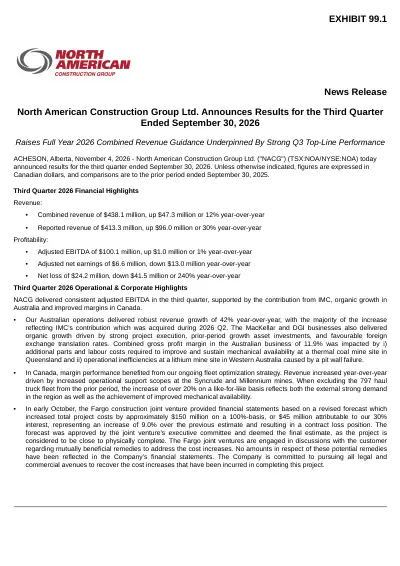
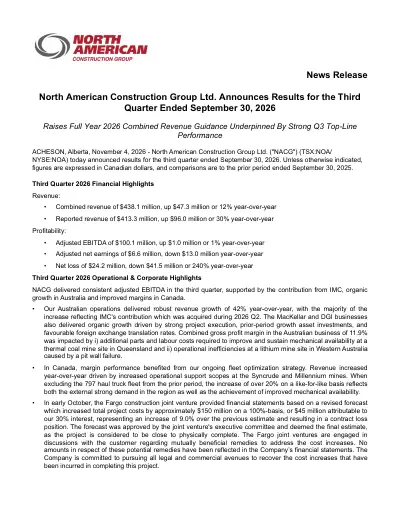
Starting on slide four, we delivered a consistent $100 million of EBITDA in the third quarter on combined revenue of $438 million, which was $47 million up from last year's third quarter. IMC, which was acquired in the second quarter, contributed $74 million of revenue and drove the year-over-year increase.
Excluding IMC, Australia was up organically 5% in the quarter on commissioned growth assets. Canada was up over 20% on a like-for-like basis on much-improved mechanical availability and strong demand in the oil sands region.
Year-to-date, we've generated solid and expected combined revenue of $1.3 billion, which has allowed us to increase our revenue guidance for the year to a midpoint of $1.75 billion. From a top-line perspective, the business is exceeding revenue-generation expectations.
Unfortunately, during the quarter, we also booked a significant life-to-date project adjustment for Fargo, which I'll outline in detail on slide six. Moving to slide five, Australia posted a gross profit margin of 11.9%, down from 14% reported in Q2 and below expectations of between 15% and 20% for the region.
Two primary events drove this approximate $15 million cost increase. In Queensland, we incurred approximately $10 million in additional parts and labor to both improve and sustain equipment utilization at our largest site in that region.
In Western Australia, a pit wall failure at our largest site in that region caused various operational inefficiencies, given the impact to overall mine production, as well as the reconstruction of and inaccessibility to mine site haul roads. Canada posted a 10.5% gross profit margin, which was in line with expectation and a solid increase from the 7% posted in Q2, reflecting disciplined project execution, improved maintenance capability, lower repair costs, and the implementation of continued fleet efficiency initiatives.
Moving to slide six, Q3 EBITDA was consistent with prior year, but EBIT was down, given higher depreciation on higher revenue. Depreciation as a percentage of combined revenue came in at 16%, being a little higher than our expected range midpoint of 15%, primarily on McKellar component depreciation.
Looking at G&A, and when removing the Fargo and acquisition impacts, direct adjusted administrative costs were $20 million, or 4.6% of combined revenue, in line with our 5% targeted threshold and demonstrating operating leverage and discipline on stronger revenue. All told, adjusted EPS was 25 cents for the quarter.
Interest expense increased to $21.3 million from $15.3 million last year, reflecting the financing of our strategic expansion in Australia. Regarding the aforementioned impact of the Fargo project, we received a revised forecast in early October from the joint venture executive committee, which included a 9% increase in total project cost, which had a follow-on impact to us of approximately $50 million to earnings before tax.
This is represented in our financials as a $30 million increase in G&A and a $20 million impact in equity loss. The project is now in a contract loss position, which requires 100% of the loss to be booked.
The project is approaching physical completion, and the estimate we've received is not expected to have a further downward revision. We've added back the loss for adjusted purposes, as this type of project is considered non-core in nature, and as we've discussed previously, we will only enter arrangements in the future which provide operational control, consistent with the other joint ventures in which we are partners.
Moving to slide seven, the business generated $52 million of operating cash flow before working capital, supported by EBITDA performance net of cash interest. Free cash flow was an outflow of $28 million due to the intentional capital spending investment in Canada and an approximate $24 million impact from changes to working capital balances in our core businesses.
Moving to slide eight, net debt remained consistent at $1.1 billion. Trailing 12 net debt leverage is reported at 3.0 times, but is not yet benefiting from a full 12 months of IMC EBITDA.
Based on the Q3 run rate, we are operating at a 2.8 times leverage ratio, with the plan to decrease that moving forward. Slide nine provides context on our debt structure.
We are focused on debt reduction through free cash flow generation over the short term and medium term. During that time, the majority of our debt is at fixed rates and not subject to changes in posted interest rates.
In addition, the majority of our maturities are 2029 and later, giving us the stability and flexibility we need during this phase after significant growth. With those brief comments on the financials, I'll pass the call to Barry.
Barry Palmer
Thanks, Jason, and good morning, everyone. As Jason just outlined, our third-quarter performance highlights both the growth across our platform, with a record for Q3 combined revenue, and the work we need to do to translate that growth into more consistent earnings.
We have a broader Australian platform, with IMC continuing on its growth trajectory during Q3. Our priority is to convert that activity into improved margins and cash generation, as operational challenges in Australia affected the quarter.
We also saw our Canadian fleet gain early traction, with improved mechanical availability and utilization. New awards in Northern Canada and stronger equipment demand in the oil sands were a true highlight of Q3.
Unfortunately, the Fargo project had a major negative impact in the quarter, with delayed completion schedule impacts, rework, and last-minute cost-to-complete escalations leading to a financial loss. Thankfully, this project is in the final completion stages and one not to be repeated in the future.
Moving to slide 11, now looking forward to what's to come, the opportunity ahead remains significant. On slide 12, it sets out our priorities for the remainder of the year.
Our focus is on execution and delivering the operating improvements that support the fourth-quarter expectations. Safety comes first, as it always does.
Across all operations, our objective remains the same: everyone gets home safe. In Australia, we are further optimizing our workforce mix, building on improvements we recently implemented.
Following significant growth in Queensland, we are also reducing discretionary operating costs while fully maintaining customer requirements. In Western Australia, our focus is on integrating IMC and commissioning its expanded fleet to support the work ahead.
In the oil sands, improving mechanical availability and fleet reliability remain central to our operating plan and to our ability to capitalize on the growing momentum we see in the region. We are also preparing for an orderly CEO transition, with continuity in our strategy, customer relationships, and capital allocation.
These are practical priorities, and our teams are focused on carrying them through into the day-to-day performance. Moving on to slide 13, our three strategic building blocks are central to our growth ambitions.
First, scaling our Tier 1 contractor platform in Australia; second, securing infrastructure awards in Northern Canada; and third, expanding our mining services in Canada and the United States. Across our 23 global operating sites, the approach is consistent: we position our people and equipment where our capabilities give us an advantage, deliver for the customer, and earn the opportunities to take on additional work.
Growth creates value when we execute it well and achieve an appropriate return on the capital we commit. Moving to slide 14, Australia remains our largest growth opportunity.
Revenue has grown at a compound annual rate of 36% from the first quarter of 2024 through the third quarter of 2026. As of September 30th, the Australian platform had approximately $2.6 billion of contractual backlog and an $8.2 billion bid pipeline.
MacKellar and IMC give us scale and capabilities to execute larger, more comprehensive scopes across Eastern and Western Australia. They also broaden our exposure to copper, gold, lithium, iron ore, and nickel, while increasing our participation in lower-capital unit-rate projects.
That opportunity is supported by substantial market, including approximately A$280 billion of public infrastructure spending and a A$240 billion major project pipeline over the next five years. Our incoming CEO brings deep Australian and international mining experience to help us build on this position.
Further strengthening our Australian leadership, our incoming Managing Director in MacKellar brings significant market experience and relationships. The immediate task is to improve operating performance as the platform grows.
Workforce efficiency, cost control, and the continued ramp-up of IMC are central to our expectation for a stronger fourth quarter. We need to demonstrate that the scale we have built can deliver more consistent margins and cash returns.
Moving to slide 15, turning to Northern Canada, Nuna continues to demonstrate the value of delivering well on an initial scope and earning follow-on work. In Ontario, successful completion of earlier work led to an additional award that extends our site presence from the fourth quarter of 2026 well into the second quarter of 2027.
Nuna also secured a multi-year extension at a project in Nunavut, as well as a new project in the Yukon. Our Indigenous partnerships remain fundamental to this business.
A new Yukon community collaboration agreement supports training, employment, and business opportunities, adding to Nuna's established relationships across the region. With over 250 heavy equipment assets and a $4.6 billion pipeline, Nuna is also pursuing larger infrastructure opportunities.
These include dedicated subcontractor roles on teams pursuing a port and road project and defense infrastructure, as well as a four-way partnership advancing a northern corridor opportunity. These remain pursuits, with procurement, government, and First Nations processes still to advance.
Our role is to position the business carefully and continue earning customer confidence through execution. Moving to slide 16, in the oil sands, longer haul distances and broader customer requirements continue to support equipment demand.
Canadian utilization increased 30% year-over-year in the third quarter. The priority is to translate that activity into improved operating margins through reliable fleet availability and disciplined project execution.
Our plan remains centered on our vast multi-life heavy equipment assets, with clear objectives for maintenance and operations. Improved availability reduces schedule risk, allows us to serve visible demand more effectively.
We will continue to be selective about work and investment, with returns guiding those decisions. We are now expanding our heavy equipment maintenance and services business.
A recent $135 million, five-year contract creates additional near-term service opportunities with modest growth capital of approximately $5 million for 25 on-highway units and support equipment alongside our existing fleet. This is a useful example of how we can grow by extending our capabilities without a proportionate increase in capital requirements.
Moving on to slide 17, our bid pipeline shows a total of more than $15 billion, including approximately $4.5 billion in active tender and procurement. The opportunities span 14 resource categories, providing a broad range of potential work across our markets.
The size of the pipeline gives us options. Our focus is on converting bids where the scope fits our area of expertise, the risks are understood, and the expected returns meet our standards.
We do not need to win every opportunity. We will remain disciplined as projects move through the awards process.
On slide 18, I'm excited to welcome Brad Rogers, who will join us as President and Chief Executive Officer and a director effective December 1st. Brad brings more than 30 years of experience across mining services, infrastructure, and finance, including as CEO of Jupiter Mines and Bis Industries.
He's also a chartered accountant and former CFO with extensive commercial and corporate development experience. I know Brad is very eager to get started in his new role.
His priorities outlined here build on the platform already in place: advancing North American growth opportunities, embedding operational excellence into daily performance, and maximizing the value of our Australian investment. Progress will be measured through contract awards and backlog conversion, fleet availability, margins, cash conversion, and returns on invested capital.
The objective is clear: stronger cash generation to support deleveraging and total shareholder returns. Our focus through this transition is to maintain operating momentum and continuity for our customers and teams.
Moving to slide 19, turning now to our outlook, contractual backlog of approximately $3.2 billion on September 30th underpins our full-year guidance. We now expect combined revenue of $1.7 billion to $1.8 billion, with a midpoint of $1.75 billion, compared to our prior midpoint of $1.7 billion.
We have also narrowed adjusted EBITDA guidance to $370 million to $400 million, lowering the midpoint from $400 million to $385 million. This reflects the operational challenges in the third quarter while retaining expectations for a strong fourth quarter.
Delivering that outlook requires the operating improvements that we have discussed today. Our updated guidance is focused on revenue and adjusted EBITDA, which we believe provide the clearest view of our operating performance and execution.
Free cash flow can be difficult to forecast consistently, given the timing of customer receipts and project expenditures. We remain focused on disciplined cash management and will continue to report our cash flow as part of our quarterly results.
The principal drivers in Australia, where we expect the continued ramp-up of IMC activity in Western Australia and a return to historical profit margins. In the oil sands, we anticipate a busy winter season supported by improved utilization, fleet optimization, and incremental project scopes.
At Nuna, fleet expansion in Nunavut is expected to provide fourth-quarter uplift. We have clear priorities to finish the year.
Our responsibility is to execute safely, improve margins, and convert the growth across our platform into cash generation and sustainable shareholder value. That concludes our Q3 presentation.
We would be happy to take your questions.
Operator
Thank you. To ask a question, please press star, one on your touch-tone phone.
If you wish to withdraw a question, you can press the pound sign. Once you have completed your questions and would like to return to the queue, please press star, one.
After a brief pause, we'll begin the Q&A section. The first question is from Adam Thalhimer of Thompson Davis.
Your line is open, please go ahead.
Adam Thalhimer
Hey, good morning, guys. Thanks for taking the questions.
Barry, just wanted to say it's been nice working with you during this interim period. Hoping you guys could expand a little bit on slide 17, and it's pretty decent-sized increase, $900 million increase in the pipeline.
Then the total opportunity went up a couple billion dollars. Hoping you could just comment on where that strength is coming from.
Jason Veenstra
Thanks, Adam. Jason here to take that question.
We see the bid pipeline as very strong, just like you, primarily coming out of Australia, but also good momentum in the oil sands.
Barry Palmer
I would just jump on that as well, Adam. There's all kinds of opportunity in the oil sands.
Our fleet is getting fully engaged and with work in front of us. We see great things coming there.
There's all kinds of reclamation programs. There's pit expansions, increased overburden movement demand.
We just see that as being a great spot. To Jason's point, in Australia, there's some big projects we're looking at with some existing customers, as well as new customers, both in the east and the west, that give us great opportunity into the future.
Adam Thalhimer
Feels like there's enough there to possibly drive a record backlog in the coming quarters, is that fair?
Barry Palmer
I think that's fair.
Jason Veenstra
Absolutely. Then,
Adam Thalhimer
real quick on Australia, the issues you had in the quarter, I'm just wondering how much those are contained and the gross margin preferred range of 15% to 20%, if you can get back there in Q4 or is that a '27 event?
Barry Palmer
The increased costs, obviously, that was on one of our big, big, big sites in Australian Queensland. What that is is that's a bunch of maintenance costs that were brought forward in the period that will likely extend into the end of the year.
It's component change-outs, defect elimination on a large fleet on our largest site there, and that's what drove those costs. We see that likely lasting into the end of the year here, and beyond that, we should be caught up with that and things should normalize to where our margins get back to where they belong.
Jason Veenstra
Just to clarify, Adam, our expectation implied in the guidance is that we get to about 13.5% in Q4, leading into getting back into that 15% to 20% range for '27 when we issue guidance on '27.
Adam Thalhimer
Perfect. Since you had the number, do you have the number for Canada, Q4?
Jason Veenstra
That's at 12%, correct.
Adam Thalhimer
Great. Okay.
All right. I'll turn it over.
Thanks, guys.
Barry Palmer
Thanks, Adam.
Operator
The next question is from Yuri Lynk of Canaccord Genuity. Please go ahead.
Yuri Lynk
Hey, good morning, guys.
Barry Palmer
Morning, Yuri.
Yuri Lynk
Just wanted to pick up on the comments around debt reduction, and trying to get a gauge as to how committed you are to debt reduction. How's management thinking about balancing some of these growth opportunities which likely require some growth capital to pursue them with the stated objective of paying down debt?
Jason Veenstra
I can take that one, Yuri. Yuri fully committed, given the statements we've made in some of the slides here, you can see the conviction on debt reduction.
As relates to the bid pipeline, given we don't need to invest in platforms anymore in G&A, it's all incremental. Our number one threshold when looking at opportunities now is the debt leverage impact they have.
The criteria is less than 2.0 times, and so we think we can accomplish debt reduction through leveraging our platforms in the three key regions, Western and Eastern Australia and Canada, and then at the same time directing free cash flow towards debt. The goal remains to get into the low twos and to get to 2.0 in the medium term.
Yuri Lynk
That's helpful. I understand the pipeline for Nuna is improving, but the fact remains we've got a situation here where the Fargo revenues rolled off.
How do we think about some of the revenue puts and takes over the next couple of quarters, given that that's a big chunk of revenue that's rolling off and haven't been replaced yet?
Jason Veenstra
We see Nuna, barring a big win, which we're bidding on some three quite large wins in Nuna, which would be step changes back to the Cote-level revenues out of Nuna. We see about a 10% year-over-year increase in '27 on revenues and similar-type increases in the other three regions.
We'll be providing 2027 guidance with Brad in the coming months, but I'd expect organically, without step-change wins, us to be up kind of 10% year-over-year in revenue.
Yuri Lynk
That's just on...
Jason Veenstra
That's excluding the Fargo impact. That's on organic wins and just the ramp-up that we were having still in Australia and benefiting from that on a year-over-year basis.
Yuri Lynk
Good to hear. Thanks, guys.
Jason Veenstra
Thanks, Yuri.
Operator
The next question is from Sean Jack of Raymond James Limited. Please go ahead.
Sean Jack
Morning, guys.
Jason Veenstra
Morning.
Sean Jack
I just wanted to drill into the maintenance overage as with the Queensland client a little bit more. I'm wondering if there's any intention to maybe adjust contract structures there or just maybe go back to the client and change how things are done just to kind of mitigate the potential for something like this happening in the future, or are you guys pretty locked in to your obligations?
Jason Veenstra
No, it's a good point, Sean. Absolutely we're looking at how we can, I guess, better smooth that sort of thing out.
With the new Managing Director we have coming into MacKellar, that'll be his main task, obviously. It's our biggest client is where we're dealing with this cost increase, and just the way we do business with them.
That's absolutely something that's on our radar and that we're in the midst of putting a plan together to do so.
Sean Jack
Perfect. That's good color.
Then, just on the Canada side, and I apologize if this is stated somewhere in the deck, but would you guys be able to kind of give us some color of where theoretically Canada utilization sits today and potentially, given with what you guys have seen, where we could kind of see utilization rates return to?
Jason Veenstra
Presently, I think we're in that 55% range. Obviously, our operations are to get to 70.
That's what we're focused on with our fleet, as far as focusing on that physical availability and making sure that our units are available to run and utilize to the utmost. That's really where we're trying to get to, but we're presently around that 55 range.
Sean Jack
Perfect. That's all for me, guys.
Thanks.
Jason Veenstra
Thanks, Sean.
Barry Palmer
Thanks, Sean.
Operator
The next question is from John Gibson of BMO Capital Markets. Please go ahead.
John Gibson
Morning, all. Thanks for taking my questions.
Most of them have been answered. I just had a few follow-ups.
Wondering, you typically put out '27 guidance, I believe, towards year-end. Will this still be the case this year or are you still kind of gathering all the pieces, especially based on a strong bid pipeline, or guidance maybe early next year?
Jason Veenstra
With Brad starting on December 1, clearly going to blow through that role, I would expect potentially early in 2027, John.
John Gibson
Appreciate it. Then, could you maybe just expand on some of the infrastructure projects in Canada outside the oil sands that you're bidding on?
Maybe end markets, geographies, that sort of thing. Thank you.
Jason Veenstra
They're scattered kind of all over the place, and Ring of Fire is one we're really keyed in on, up in the Mackenzie Valley area. They're pretty much [laughter] coast to coast in Canada.
John Gibson
Thanks a lot. I'll turn it back here.
Jason Veenstra
Thanks.
Operator
Our next question is from Tim Monachello of ATB Cormark Capital Markets. Please go ahead.
Tim Monachello
Hey, good morning. Good morning, Tim.
Good
Jason Veenstra
morning, Tim.
Tim Monachello
Quickly on just the backlog, it's a pretty meaningful decline quarter-over-quarter. In the financials, it shows I think $775-ish million came out of the backlog, which was higher than the combined revenue estimate.
Then there was a contract in Western Australia that came off the board in the slide deck. There's some re-scoping or contract eliminations between Q3 and Q2?
Barry Palmer
Obviously, the one project that come off in IMC is one that we had hoped to win, and then we didn't win. That's come off there.
There's others that we hope to replace it with, obviously. That was the major hit in Australia.
Just
Jason Veenstra
on the backlog, Tim, we did have one contract which we had an early mutual agreement to exit, and we reflected that through backlog. That was just the mine site conditions were different than what was originally expected, and there was just an agreement to part ways.
That kind of drove that mismatch that you're seeing there.
Tim Monachello
Got it. Okay.
The capital spending year-to-date and in Q3 was higher than I expected. Can you provide maybe some bookends on where you think total capital spending for 2026 will land and how you're thinking about '27?
Jason Veenstra
We expect to be in the kind of $225, $230 range for 2026 for all-in CapEx. I would say we are looking at 2027 being very similar to depreciation, if you see our depreciation run rate of 15%, 16% of combined revenue.
That's where I would expect. As you identified, we made a very intentional decision in Canada to really support the fleet heading into a very busy winter season and what we think will be very busy years ahead.
Q3 will be the high watermark of the year for CapEx.
Tim Monachello
Got it. Then, just to clarify your comments on the CapEx range, is that excluding, I guess, lease finance CapEx?
Jason Veenstra
No, that includes lease finance additions. I don't have that number in front of me, but we just include that as a regular run rate.
If we bring in something on a lease basis, we bring it into our sustaining CapEx, so that is inclusive of that.
Tim Monachello
Okay. Then just to follow up on Yuri's comment, when you think about deleveraging and the scale of growth that you have in your opportunity set, when you think about deploying capital towards some of these growth opportunities, is there an upper end that you would say, we're not going to spend more than X in '27, or is that just a function of the cash flows that will come off these projects or expected cash flows?
Jason Veenstra
No, it's really the ratios. Obviously, the larger the opportunity, the bigger impact it can actually have on our objectives.
We haven't given our business development functions a maximum they can look for. It's more about the ratio and the predictability of the EBITDA that comes with the opportunity.
Again, to the response we gave Yuri, we really are focused on that ratio and what it can do for our business. We want to leverage the platforms we have, and to do that, if the scale is bigger, the math just gets better.
Tim Monachello
Okay. Then can you just talk a little bit about, I guess, the changes in demand that you're seeing in the oil sands and what your expectations are for growth in the oil sands in '27 versus '26?
Barry Palmer
I think that if you heard what Suncor put out, you can tell there's great excitement and capital spending on the way. We've seen this since early in the year where they're looking at just upping their throughput in the plant and, as I said, their haul lengths are getting longer.
It just means more demand for overburden to be moved and the capital projects that support the mine, we're seeing that. That's been ongoing, and we're just going to maximize that with making sure our fleet is fully available, ready to be put into work and bid and win these opportunities.
We see more of the same into the new year. 2027 looks like a great year from everything we're hearing from our clients in the oil sands.
It's blue skies ahead for opportunities for us.
Tim Monachello
Got it. As you think about growth in the oil sands and deploying more capital there, in the context of returns being sort of below where your thresholds have been over the last little while in the oil sands and the fact that you still have MSAs outstanding that sort of dictate pricing, I guess maybe you could talk a little bit about the strategic initiatives you're doing to improve returns within a sort of constrained pricing environment, or maybe you're seeing improving pricing on the margins?
Barry Palmer
What I would say is that we wouldn't look at bringing in more units into the oil sands unless we could sign something that was longer term. We don't want to go out and spend a bunch of capital and bring in fleet to the oil sands and two years down the track, we're trying to look for spots for that equipment.
I think the way we improve our position in the oil sands is to try and do more unit-rate work, where the better we perform, the margin increases with it, and we control that. That's kind of what we would see is, you take more risk, but at the same time we understand the scope and we feel that we can probably do better than we would if we're on simple time and materials.
That's where we see the growth and the margin opportunities.
Tim Monachello
Appreciate it. I'll turn it back.
Barry Palmer
Thanks.
Operator
Thank you. We do not have any more questions on the line at the moment.
Ladies and gentlemen, if you'd like to ask any questions, please press star, one on your touch-tone phone. If you wish to withdraw a question, you can press the pound sign.
Once you have completed your questions and would like to return to the queue, please press star, one. There are no more questions on the line, this concludes the Q&A section of the call, and I will pass the call over to Barry Palmer, President and CEO, for closing remarks.
Barry Palmer
Thanks, Ray. Today will be my final call as President and CEO, and I'm proud of the capabilities our team has built and the company that North American Construction Group has grown into over my almost 45 years with the company.
I can say with confidence that our company is being left in good hands with our existing executive team under the leadership of our incoming President and CEO, Brad Rogers. Our teams remain focused on continued disciplined execution, disciplined growth, and ensuring that everyone gets home safe.
Thanks again, everyone, for joining us today.
Operator
Thank you. This concludes the North American Construction Group conference call regarding the third quarter ended September 30th, 2026.
Have a great day.