Rogers Sugar Inc.
Q4 FY2026 · Earnings Call TranscriptNovember 26, 2026
Operator
Morning, ladies and gentlemen, and thank you for joining us today, Thursday, November 26, 2026, for the Rogers Sugar Inc. fourth quarter results conference call.
At this time, all lines are in a listen-only mode. Following the presentation, we will conduct a question-and-answer session.
If at any time during this call you require immediate assistance, please press star zero for the operator. Before we begin, please be reminded that today's call may include forward-looking statements regarding our future operations and expectations.
Such statements involve known and unknown risks and uncertainties that may cause actual results to differ materially from those expressed or implied today. Please also note that we may refer to some non-IFRS measures in our call.
Please refer to the forward-looking disclaimers and non-IFRS measure definitions included in our public filings with the securities commission for more information on these items. A replay of this call will be available later today.
The replay numbers and passcodes have been provided in our press release, and an archive recording of this call will also be available on our website. I will now turn the call over to Mr.
Mike Walton, President and CEO of Rogers Sugar.
Mike Walton
Thank you, operator, and good morning, everyone. Welcome to our fourth quarter call and full-year call.
This morning, I will cover the fourth quarter and full-year results across both of our business segments, walk you through the progress of our Leap project as we head into the final stretch, and then hand it to JS, our CFO, for a more detailed review of our financial results. I'll come back at the end with our outlook for 2027, and then we'll be happy to take your questions.
Our investors presentation is posted on the investor section of our website if you would like to follow along. 2026 was a record year for Rogers Sugar.
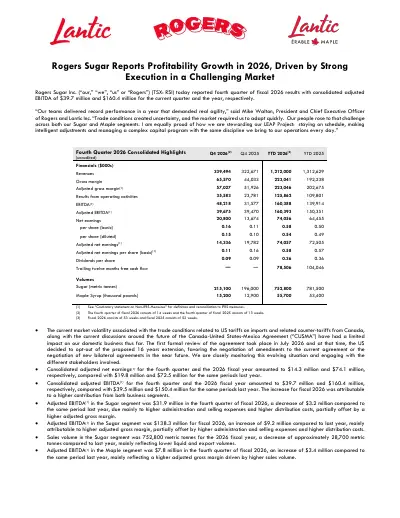
Consolidated adjusted EBITDA amounted to $160 million, the strongest full-year result in the company's history. The environment we operated in throughout the year is what gives that result its real meaning.
Trade policy between Canada and the United States remained unsettled for a second year. Consumer behavior shifted as food inflation worked its way through the grocery basket.
Global demand for certain food ingredients softened. Raw #11 sugar prices showed volatility with downward pressure compared to last year.
Through all of this, we stayed nimble, adapting our approach while never losing sight of what matters most: providing a safe and stable working environment for our employees, delivering for our customers, and creating value for our shareholders. That is what this team does, and 2026 is proof of it.
I want to put this result in a broader context before we get into the numbers. When we set out on the Rogers Refined journey several years ago, we put a 5-year plan together that we believed in.
We executed against it, learning and adapting along the way, and we exceeded our internal targets. Rogers Sugar is nearly 140 years old, and our business is thriving.
What this team did over the last few years was meaningful and material. We reshaped core functions across this business, brought in expertise from across the industry, and rebuilt processes from the ground up.
It is worth stepping back to appreciate what 5 consecutive years of EBITDA growth looks like. In 2021, our consolidated adjusted EBITDA was $91 million.
This year, we delivered $160 million. That is a 76% improvement over that period.
We are a better business, fundamentally better than we were 5 years ago. With a significant expansion project about to come online, a strong balance sheet, and labor certainty across our production network, the platform we have built gives us real reasons for optimism about what comes next.
On to our results. I am pleased to report another year of record profitability and the strongest result in our company's history.
Our consolidated adjusted EBITDA reached $160 million compared with $150 million in 2025, and our adjusted net earnings were $74 million compared with $72 million last year. The whole company can be genuinely proud of this performance and of all that went into making it happen.
Before I get into the results of our business segments, I want to recognize three operational milestones from the year that deserve to be called out. In June, we reached a new 5-year collective labor agreement at our Montreal facility, running through May 2031.
We also extended the collective agreement at our Taber sugar beet factory through March 2032, and in October, we extended the collective agreement at our Granby maple syrup bottling plant through August 2032. Taken together with the Vancouver agreement reached in 2024, we now have labor certainty across the entire production network through the Leap commissioning period and well into the years beyond.
That stability matters enormously as we head into 2027, and I want to acknowledge the commitment from both sides that made those agreements possible. The headline for 2026 for the sugar segment is margin growth.
Per-unit adjusted gross margin improved from $224 per ton in 2025 to $256 per ton in 2026, a $32 per metric ton improvement that reflects the cumulative benefits of the Rogers Refined operating framework: getting the right customer mix, the right product mix, and taking a disciplined approach to cost management. Sales volume for the full year was 753,000 metric tons, a decrease of 29,000 metric tons compared with last year.
In the end, our sales volume exceeded our most recent guidance by 10,000 metric tons. The difference was largely due to opportunistic export sales volume done in the fourth quarter.
That being said, our domestic franchise remained stable throughout the year. In maple, 2026 was a strong year, and the fourth quarter was a record quarter for the segment.
Full-year sales volume of 56 million pounds represented [unclear] over last year, driven by higher sales to existing customers. The year was not without volatility.
The second and third quarters were challenging, and we managed the business accordingly. The fourth quarter saw a meaningful pickup, incremental demand from existing customers, and favorable market conditions.
We are seeing a positive trend in demand, and we are taking proactive measures to make sure we continue to have the supply in place to capture the demand opportunity when it arises. You may have seen recent headlines about supply levels from PPAQ maple syrup reserve.
We want to be clear about how that affects us. We have secured sufficient supply to meet our customer commitments for the first two quarters of 2027.
As we have done in previous years, we will rely on 2027 crop to meet the needs of our customers in the second half of the year. We have the relationships and the purchasing infrastructure in place to manage that, and we are not anticipating any supply disruption.
Turning to Leap, during the fourth quarter, we completed a detailed review of the Toronto logistics infrastructure that was originally designed as part of the project. The conclusion of that review was that a redesigned approach would deliver the same operational outcome at a lower cost for that component of the project.
Those savings have been reallocated to the final phase of work at the Montreal refinery, which is expected to cost more than anticipated. The incremental costs are related to the complexity of the project, in particular as it relates to civil infrastructure for the existing building.
In the end, we expect the overall cost of Leap project not to exceed $300 million. The discipline behind this decision is worth noting.
When costs increased in one area, our team identified a way to offset them within the existing budget envelope. That is the kind of project stewardship we committed to when we launched Leap, and it is exactly what was delivered here.
We remain on track for our expected in-service date of June 2027. I want to set appropriate expectations on what Leap will deliver once it comes into service.
The incremental capacity will ramp up gradually. The domestic market will absorb it over time, and we are not building our 2027 plan around near-term volume increases from Leap.
We have always considered Leap project as a strategic investment aimed at meeting growing needs of the Canadian market in the future. Before I hand it to JS, I want to take a moment on our strategy.
Rogers Refined was introduced to frame a period of meaningful transformation: expanding the Montreal refinery, improving maple profitability, securing long-term labor and supply agreements, and strengthening our balance sheet. That work is substantially done, and 2026 is the proof point.
What we are announcing today is an evolution of that framework to reflect where we are now: a company focused on optimizing what it has built, running a leaner and more efficient operation, and positioning its capital structure to deliver sustainable returns to shareholders. The message for 2027 is consolidating our gains, maintaining our cost discipline, and serving our customers from a stronger platform.
Now I'll hand it over to JS for a review of our financial performance.
JS Couillard
Thank you, Mike, and good morning, everyone. I will now take you through the numbers for the fourth quarter and the full year, then cover other elements related to our financial profile, including free cash flow.
I will then turn it back to Mike for an outlook on fiscal 2027. Before I get into the segments, one point of context worth mentioning is that 2026 was a 53-week fiscal year for us, with a 14-week fourth quarter compared with 13 weeks last year.
That additional week benefits both segments and is worth keeping in mind as you look at the quarterly comparisons and the fiscal 2027 outlook. Total revenues were $1.2 billion in 2026 compared to $1.3 billion in 2025.
The decrease was due to lower average raw #11 prices in the sugar segment, which have limited impact on our profitability given our hedging program, higher sugar refining margin, and higher sales volume in the maple segment. In the fourth quarter, total revenues were $340 million for the quarter compared to $323 million for the same quarter last year, an increase of $17 million, mainly due to higher volume in both business segments, supported by favorable market dynamics and the extra week of 2026.
Consolidated adjusted EBITDA for the full year was just over $160 million compared with $150 million last year, a $10 million improvement and the strongest full-year results in the company's history, as Mike mentioned previously. Adjusted net earnings in 2026 were $74 million, or approximately 58 cents per share, compared with $72 million and 57 cents per share in 2025.
Looking at the fourth quarter, consolidated adjusted EBITDA was just under $40 million, slightly higher than the same period last year. Adjusted net earnings for the fourth quarter were $14 million, or approximately 11 cents per share, lower than last year by 5 cents per share, reflecting the impact of a non-recurring asset impairment charge taken in the fourth quarter of 2026.
This impairment charge amounted to $4.8 million and is related to the logistic design of the Leap project. As Mike mentioned earlier, we completed our review of this portion of the project in the fourth quarter, resulting in a lower overall cost design.
In connection with the changes, an impairment charge was recorded related to engineering costs and other related previously capitalized costs no longer needed for the project. Speaking of the Leap project, we anticipate the overall project cost not to exceed $300 million, and as Mike mentioned previously, this strategic initiative is expected to be commissioned in June 2027.
Now let's take a closer look to the sugar segment, where adjusted EBITDA for the full year was $138 million, an increase of $9 million compared with the same period last year. The improvement was mainly due to some favorable non-recurring adjustments, lower raw sugar procurement costs, and higher contribution from sugar refining activities, partially offset by higher manufacturing costs, non-recurring pension costs associated with the new Montreal collective bargaining agreement, and lower sales volume from lower export sales associated with the trade situation with the US and a reduction of our liquid sugar sales.
For the fourth quarter, adjusted EBITDA was $32 million, a decrease of $3 million compared with the same period last year. The variance was due to higher production costs, partially offset by higher sales volume for industrial and export customers, lower raw sugar procurement costs, and a favorable mix of product sold.
Distribution costs were higher than last year due to non-recurring operational costs. Administration and selling expenses were higher for the full year and the quarter, due mainly to higher cash-settled share-based compensation expense, reflecting an increase in our share price.
In maple, adjusted EBITDA for the full year was $22 million, up slightly from 2025. The fourth quarter was particularly strong, with adjusted EBITDA amounting to almost $8 million, an increase of $3 million from the same period last year.
The increase was driven by higher sales volume and a meaningful improvement in adjusted gross margin percentage to 13% compared with 9% in the fourth quarter of last year. For the full year, adjusted gross margin was 10.8%, up from 10.4% in 2025.
The incremental gross margin for 2026 was directly attributable to the performance of the business in the fourth quarter, where volume showed an increase of 2.3 million pounds. The increase was due to higher sales from some of our large customers and the incremental week of 2026.
The margin also benefited from higher maple syrup purchasing rebate and a favorable sales mix. Turning to our balance sheet and related liquidity, at the end of the fourth quarter, we had drawn $100 million on our revolving credit facility, down $16 million from the third quarter and $47 million from the end of 2025.
Total outstanding convertible debentures were approximately $173 million in face value, including the ninth series 5.5% debentures issued in January, the proceeds of which were used to reduce the revolver. We also have $33.5 million outstanding on the IQ loan supporting the Leap project.
We remain in full compliance with all our financial covenants. Our leverage ratios are currently very good, especially considering our history.
We always planned for debt financing through the Leap construction period, and I'm pleased to say that we will exit fiscal 2026 with less leverage than we originally anticipated. Over the past three years, the incremental adjusted EBITDA increased our operating cash flow, allowing us to fund a greater portion of the Leap project, which reduces our overall draw on the revolving credit facility and lower our cost of borrowing.
As we get into the final phase of the Leap project, we expect our leverage to increase as we anticipate spending about $70 million in 2027 to complete the project. From there, our focus will be on managing leverage down over time, with the target of reducing our ratios of total debt to adjusted EBITDA over the medium term.
Looking at our business going forward, I believe we are well-positioned to achieve this target. Our free cash flow remains strong.
In 2026, we generated $78 million in free cash flow, a decrease of $25 million compared with last year. This reduction does not properly reflect the reality, as we need to consider the timing of income tax installments.
As we normalize for a $15 million payment related to 2025 made in early 2026, our free cash flow would show an increase of $5 million from last year. This is a timing item, not a structural change in our tax profile.
The underlying operating cash generation of this business remains strong. Finally, the board has declared a quarterly common share dividend of 9 cents per share at its meeting yesterday, payable on or before January 20th, 2027.
We have paid a quarterly dividend to our shareholders without interruption for over 16 years, through many challenging business cycles, and now through a period of significant trade uncertainty. That consistency is something we are proud of and committed to maintaining.
With that, I will turn the call back over to Mike for an overview of our 2027 outlook.
Mike Walton
Thank you, JS. Let me close with some thoughts on the year ahead.
In sugar, we are forecasting full-year volume to range between 730 and 750,000 metric tons, broadly consistent with 2026, especially considering the extra week last year. The domestic market demand remains stable, and our customer relationships are strong.
From a pricing standpoint, we are expecting a slight downward pressure due to the current market dynamics, including the competitive landscape. We do expect some reduction in lower-margin export sales given current trade policies between Canada and the US, and that is embedded in our planning.
Underlying North American demand for sugar remains stable, and we continue to manage the business from a position of domestic strength. As I mentioned, the incremental capacity from Leap will begin contributing gradually as it comes into service in June 2027, and we will manage that ramp-up thoughtfully.
This was our first major expansion in 20 years and the largest capital investment in our history. It is intended to meet growing customer demand for the longer term, not just the next few years.
I want to spend a moment on trade, because the conversation has shifted in a meaningful way since we last spoke. We have been saying through 2026 that tariffs have not had a material impact on our business, and that has been true.
What we are watching closely now is something different: the emergence of product bans targeting specific product codes, even where those products are CUSMA compliant. This is a shift from broad tariff policy to something more targeted, and it has the potential to create headwinds for certain of our industrial customers.
If this approach persists and is not corrected, we may be looking at volume erosion in some segments of our order book. We are watching this carefully and will keep you informed.
The CITT expiry review of the 2021 sugar trade measures is also underway, with a final decision expected in May of 2027. We are actively engaged in that process and will continue to provide timely updates of significant developments.
In maple, we are forecasting volume aligned with 2026 levels. The global demand environment remains stable, and we are entering 2027 with momentum.
We are well-positioned commercially, and we expect adjusted gross margin to be above 10% on an annual basis. Collective marketing agreement negotiations between the CIE and PPAQ are ongoing to govern pricing and buying conditions for the 2027 maple crop.
We are expecting inflationary pricing to apply, which should incent producers to continue investing in their operations to support continued market growth. We expect to continue delivering strong financial results in 2027 for both of our business segments.
Capital spending for 2027 is expected to be slightly under $100 million in total: approximately $25 million for sustaining and improvement projects in sugar, $70 million for Leap completion, and $1 to $2 million for maple automation initiatives. With the Leap investment cycle drawing to a close, we expect capital spending to normalize meaningfully in 2028 and beyond, which will have meaningfully impact on free cash flow.
As we head into 2027, our focus is clear: optimizing our operations, delivering for our customers, and building on the platform we have spent the last several years creating. It is fair to say that the step change in profitability that has characterized the last several years is behind us.
The work is now about sustaining what we have built, optimizing our cost base, and positioning the balance sheet to return capital to shareholders as the Leap investment cycle winds down. Thank you all for your time and continued interest in Rogers Sugar.
We'll now open the line for questions.
Operator
Thank you, ladies and gentlemen. We will now begin the question-and-answer session.
Should you have a question, please press the star followed by the one on your touch-tone phone. Should you wish to cancel your request, please press the star followed by the two.
If you are using a speakerphone, please lift the handset before pressing any keys. Once again, that is star one should you wish to ask a question.
Your first question is from John Zamparo from Scotiabank.
John Zamparo
Thank you. Good morning.
I wonder if we could start on the 338 tariffs, and hopefully you could help us frame the impacts of that that's potential for F 2027. How meaningful is that customer segment to RSI if the current rules remain in place?
Mike Walton
The 338, you're meaning the most recent one that included some product bans?
John Zamparo
Yes.
Mike Walton
Yeah. As I said in my comments, those things could create some headwinds as we go ahead should they stay in place.
We are seeing our customers looking for ways to avoid those and continue their operations at least at some scale. At this point, I wouldn't want to speculate on the outcome of that, but it's really early and we have customers that could be impacted by this that have been in business for a long time, and they'll look for paths to manage through this as we all have for the last 2 years as tariffs come and go.
We're hopeful these particular tariffs will get resolved in the near future, but again, we won't speculate. It's early to tell.
John Zamparo
Understood. Is that at all reflected in the volume guide for this year?
JS Couillard
It's JS here. The volume guidance is a range, and we believe that the range we've provided would likely include any potential variation for those customers.
However, it is still early. It's very targeted, and we can't speculate on what's going to happen in the next few months.
There's been a lot of discussion and negotiation. The range that we've provided, we expect would cover some of it.
John Zamparo
That's helpful. There's a comment in I think it's the outlook about sharper competitive conditions or a more competitive landscape.
That seems incremental, and I wonder what's changed in the last quarter or two on this that made it worth flagging as a topic for F 2027.
Mike Walton
It's always been a competitive market in Canada. Canada's one of the few open markets in the world, and we're seeing when we go to a slightly oversupplied market based on demand dropping globally, then you find other people looking for homes for the sugar.
It's a normal cycle. I've been here 46 years.
I've seen it about eight times. It's not material at this point, but it's certainly worth noting.
We compete every day. We compete for the long term, and that won't change for us.
John Zamparo
Okay. One more on the sugar side and then one on the maple side.
I wonder if you can say what you expect for your sugar gross margin or the ability to grow gross profits within sugar, because the volume decline, I think at the midpoint, is down 2%. That's on top of a minus, I think, 4% or 5% for this year, but you grew gross profits pretty meaningfully in F 2026 in a declining volume environment.
I wonder what you think is achievable for F 2027 on a dollar basis.
JS Couillard
JS here. Good question.
I think sometimes the devil's in the details. If we look at the growth in gross margin, there's a few items that were non-recurring in nature, and so we would expect that when you remove those gross margin items for 2026, then 2027 will likely going to be fairly similar to what we've seen.
As Mike mentioned, it is a competitive market. Over the last 2 years, our margin has good increases.
I think we're more at the leveling out level going forward considering the competitive landscape and also the trade environment.
John Zamparo
Okay. Good.
Then on the maple side, the strategic maple reserve, I wonder what your level of confidence is on being able to secure supply in the back half. It sounds like this is kind of usual protocol, maybe just elaborate on what's different this time around and why you have confidence that you'll be able to secure adequate supply.
Mike Walton
It's an excellent question. I appreciate that one.
Good observation. This is situation normal.
It's typical that packers secure enough syrup to take them through to the next crop. We have done that with a little bit of extra, probably, depending on how market continues to grow.
This is situation normal. The PPAQ, it's a normal process where they negotiate with the producers for new pricing contracts.
We had been in a longer-term contract that has ended, and so this is just the normal negotiations. I expect that an agreement will be reached and that that will be the least of our concerns.
The next concern will be Mother Nature giving us a really abundant crop, which would be great.
John Zamparo
Fair enough. Do you need the agreement to be reached to hit your volume targets for F 2027, just to be clear?
Mike Walton
The agreement structures the pricing of the product of the syrup under PPAQ regulations, it sets the pricing. I guess if I followed your path, theoretically, you could get syrup, but you wouldn't know what you were paying for it.
The syrup will come out of the trees when the crop's ready. It's dependent on us and the business side between PPAQ, the CIE, and other others involved to get an agreement in place so that we know what we're paying for our syrup as we go into the crop year.
There's nothing certain in life as we've learned in the last few years with tariffs, but I would expect that we will have an agreement, we'll have business as usual.
John Zamparo
Understood. Thank you very much.
I'll pass it on.
Mike Walton
Thanks, John.
Operator
Thank you. Your next question is from Derek Lessard from TD Cowen.
Your line is now open.
Derek Lessard
Good morning, Mike and JS. Congrats on a strong year.
Just a question on sort of the Leap budget and timeline. Looks like if you remain on track for a June 2027 start and within the $300 million budget, seems like there's a subtle change, though, in the language from you guys saying there was an estimated cost of 280 to $300 to now saying no more than 300.
Just making sure there's nothing to read into that there, and then, finally, what milestones remain, and what are the main risks to the start date?
Mike Walton
Thanks. I know the Leap project intimately well for the last 3 years, and the reason we're a little more precise, maybe, in our view of the cost is simply after 3 years of work, we're flying this big plane around the world, and now we can see the runway.
Construction will largely be done here in the spring, and we've already moved into commissioning sections that were done, if you recall from previous conversations. We're having, while there's areas still under construction, there are areas already being commissioned and ready to go.
It gives us confidence with where we are. I don't see any big risks right now to what we've said.
Everything seems to be clear. We can see things better.
As far as milestones go, there's all kinds of them internally. We've done some massive work on river water pumps.
That's just one part of the process from an equipment point of view, and that was a massive undertaking that was completed in the last few weeks without disrupting the main plant. The teams are working really solid together, and if you want to drive by in mid-January, I expect you'll see the construction crane is gone, and that is going to be a big signal that we are nearing the end of the construction phase.
We're getting close. We can see the runway, and we're getting really close.
That gives me confidence in the numbers.
Derek Lessard
Awesome. Thanks, Mike.
Then maybe just switching over to the maple, the Q4 margin, just maybe add some color on. I think you've benefited from some higher purchasing rebates this quarter, and then I guess, where do you think maple's margin would have landed without them?
JS Couillard
Hi, Evan. It's JS here.
When we look at the year in maple, obviously, the fourth quarter was a record quarter for our maple business from a volume standpoint and also from a margin standpoint. What we need to read a little bit into this is we had accumulated some rebates that were mainly recognized in the fourth quarter, and those rebates are related to the way we use some of the industrial syrup that we were able to purchase.
From an overall global perspective, I think we remain above the 10%, 10% to 10.5% is what we are guiding the market towards to, and that hasn't changed. If you were to do a bit of an average of this year, I think going forward, that's pretty much what we're looking at getting.
Derek Lessard
Fair. Quite a nice volume beat as well in maple.
Did any of the I guess how much of the beat came from stronger underlying demand versus the timing of, I guess, customer purchases, and if there was some timing, did any of those purchases pull volume forward from Q1?
JS Couillard
We're not expecting that. We've seen good momentum carrying from Q4 to Q1.
Obviously, you had the extra week, if you look at the fourth quarter, we have 2 million, 2.3 million pounds more, I'd say probably a million pounds is related to the extra week, but the rest is related to our customers pulling. Demand in the maple segment is doing well, we're always cautiously optimistic, but what we have seen so far in early 2027 is basically a continuation of what we've seen at the end of 2026.
Derek Lessard
Okay. Then just one final one on sort of the outlook.
Curious on how we should be thinking about sugar EBITDA year-over-year. I guess given just given the context of some higher production and maintenance costs, some pricing pressure, and and it looks like flat volumes.
JS Couillard
If I look at next year, the results of the sugar segment from an adjusted gross margin perspective included about, and it's within the MD&A, there's probably somewhere between 15 and $18 million of non-recurring, if you consider what we disclose there. If you take that out, that's probably 20 to $25 per metric ton, and so you can bring that back, and we're expecting 2027 to be fairly similar from a margin standpoint of what we've seen in 2026.
If you exclude non-recurring, I think.
Derek Lessard
Perfect. Thanks, guys.
Have a good day.
Mike Walton
Thank you.
JS Couillard
You too.
Operator
Thank you. The next question is from Nevan Yochim from BMO Capital Markets.
Nevan Yochim
Thank you. Good morning, guys.
Mike Walton
Morning.
Nevan Yochim
On the sugar volume outlook, you benefited in Q4 from some opportunistic export sales. However, the outlook calls for export volumes to decline in 2027.
Can you maybe help us just understand a little bit about what you're seeing in the export market today, excluding some of these new tariffs that were just announced?
Mike Walton
That's the wild card, right? When there's an opportunity to, for customers that can absorb the current tariff, because of sugar demand requirements in the US market, and and/or we have the right raw sugar origin in our sites, then we're able to take advantage of those opportunistic sales.
We continue to look for ways to leverage against that, but as you said just in your final comment, it's an ever-moving target. The to plan, to say we could sit down and plan the year to make sure we get all we can out of the US exports, that would be impossible with the changing landscape.
We pivoted. We got some good opportunities in the quarter, and I don't think they'll all continue into the next year, but if they do, we call them opportunistic sales, and that's why we don't put them fully into our numbers.
If they come up, we certainly will take advantage of them.
Nevan Yochim
Got it. Then just on the Leap project, given that you're nearing completion in June 2027, how should we think about potential financial impacts as capacity starts to ramp up?
Will you potentially have higher operating costs before volumes more meaningfully ramp, and are you expecting this to have any impact on sugar margins?
JS Couillard
For 2027, as we're going to come online probably towards the end of our third quarter and be in commissioning mode, we're not expecting a significant impact either on cost or on volume production, and then as we move along and to 2028, then we'll start seeing more contribution from our Leap project. From a cost standpoint, we're not expecting this to create incremental costs.
Nevan Yochim
Okay. Thanks, JS.
Then just finally on maple, can you provide an update on the market more broadly? The favorable market conditions you reference sound like a material improvement from Q3.
Can you just talk about what's changed in the market since your last update?
Mike Walton
Oops. I've said this many times on the call, I wish I knew.
We saw a very soft Q2, Q3 globally, and we lost a few accounts in the European market, which is highly competitive, and it tends to be lower margin. We adjusted for that, and re-engaged the sales team on more profitable prospects, and they've delivered, and we're off to the races.
We're seeing a reversal in a downward trend in global consumption to now an increased trend in global consumption, and it continues to march on. As JS said earlier, we're pretty optimistic by what we see already.
It's early in Q1, but we're seeing strong sales volume, strong sales demand on maple globally, as consumers turn to the product and enjoy it more. I can't explain it.
Sometimes I smile and think, "Well, maybe it's the world given Canada a hug." It's just happening.
Nevan Yochim
Fair enough. Thanks, guys, and good luck.
Mike Walton
Thank you.
JS Couillard
Thank you.
Operator
Thank you. The next question is from Nate Po from National Bank Capital Markets.
Nate Po
Hi, good morning. Thank you for taking my questions.
I did hop on a bit late, apologies if this has been asked already, but with the new design for the Toronto portion of Leap and the unexpected complexity in Montreal, can you give us some color on how that all affected the ramp-up of the facility versus prior expectations?
Mike Walton
Sure. No change.
We're still saying that we'll be in full commissioning by June of 2027, and we've said the budget won't exceed $300 million, still confident in that. As I said earlier, we can see the runway for this after 3 years of construction, and we're now counting months instead of years.
We can see with a little more precision where it's going to land, and it's gives us confidence in where we are. The commissioning is, as I said in previous calls, we're doing some of the commissioning parallel, so as we finish a unit, an area in the plant, we put the new employees in there commissioning that site and getting it ready, and then we continue to follow through as the construction completes, and right now, from what we see, we're pretty confident in where we are.
There's always complexity to, yeah, answer your question on the complexity, why the complexity is because the building is 130 years old, and the old girl has a few surprises every time we try to open up a wall or do something, but that work is behind us. We're no longer discovering things, we're into completing things, we're pretty confident.
Nate Po
Thank you. That's very helpful.
Just wanted to turn to the maple segment. What would be the impact if you couldn't secure appropriate volumes heading into the second half of 2027?
I guess what I'm asking here is what is the risk here to that 10% margin that you mentioned earlier part of the call?
Mike Walton
The first part is we will secure syrup. There's no doubt about it, as I said to a previous questioner, the taps are in the trees.
The syrup will come whether we want it or not. Mother Nature pushes syrup out at the same time of year every year, regardless, the syrup will come, and we'll see, hopefully, a conclusion of the negotiation for the price with the PPAQ on what will be paying producers for that syrup.
Those talks are ongoing now, and they're going on with earnest, cuz everybody appreciates and supports this business that's involved in the business, and they know the importance of doing these things. This is a normal process.
The PPAQ negotiates a price for the producers on a regular basis. We're just coming off of a multi-year price point contract, and it's time to renew, and it's just a normal process.
I see no risk to supply.
Nate Po
Thank you for that. Regarding the CITT review, can you outline your idea of the range of outcomes that could happen come May?
Mike Walton
Sure. I won't speculate on the big ones, but I've been involved in the case for several times.
It's a important case for us. We take it very seriously.
Our anticipation is there will be no change in the tariff protection, because the market conditions in which the tariffs were put up against have not changed in their home countries. I'd expect the outcome will be similar as what we've had in previous rulings.
Nate Po
All right, thank you. Just one last one here stepping back towards more a broader question.
With the first generic GLP-1s now in the Canadian market, have you refined your thoughts or expectations on the impact there on your business?
Mike Walton
It's a tough topic. It is a topic of conversation in many circles in the sugar industry and snack industry, and we see it evolving in other places around the world, and it's had a dampening effect in some sectors, for sure.
Sugar is a functional ingredient, and sugar going into manufactured goods for texture and for the functional properties it brings to the process, that hasn't changed. I don't see a big change.
I think you got to bunch it all together. You got food inflation, you had cocoa inflation, and you got consumers with less spending power.
I think all of those plus GLP-1 maybe are slowing the grocery baskets, but we haven't seen anything material yet that would be noteworthy.
Nate Po
Thank you very much. I'll turn it over.
Mike Walton
Thank you.
Operator
Thank you. Once again, that is star one should you wish to ask a question.
Your next question is from Frederic Tremblay from Desjardins.
Frederic Tremblay
Thanks. Good morning.
Mike Walton
Morning.
JS Couillard
Hi, Fred.
Frederic Tremblay
Hey. Most of my questions have been answered, but maybe just one on maple.
Understand that these negotiations come on a regular basis, but I was wondering this time around if there's any potential effect from the strategic reserve being low in terms of creating potential raw material cost inflation for Rogers Sugar and others, and if that was the case, can you remind us if your customer contracts would allow you to fully and quickly pass that through?
Mike Walton
Thanks. A great observation, and yeah, there will be some pricing pressure, of course.
Inflation is part of every conversation, whether you're dealing with labor or you're dealing with suppliers. It's a reality in Canada, and so we expect there will be some pricing.
I said that in my comments. There will be some pricing, which will help incent producers to continue to expand their tap farms and get more taps in trees to provide more syrup for the growth that we've been seeing globally.
As we have done in every price increase that we get in on the commodity basis, we will pass those through in pricing to our customers.
Frederic Tremblay
That's helpful. Thanks.
I'll get back in the queue.
Mike Walton
Thank you.
Operator
Thank you. There are no further questions at this time.
Please proceed with the closing remarks.
Mike Walton
Thank you for the questions this morning. As always, they're thoughtful, and we appreciate the engagement.
Before we sign off, I want to come back to where we started. 2026 was a record year, earned in a genuinely demanding environment.
We set a plan, we stayed committed to it, and we adapted when we had to. Our teams across sugar, maple, and the Leap construction project demonstrated real discipline and expertise to navigate this year, and I am proud of what they accomplished.
As we move into 2027, the nature of our work shifts, but our commitment to running this business well does not. We have a modern, expanded refinery coming online.
We have a strong balance sheet. We have labor certainty across our entire production network, and we have a business that is fundamentally better than it was 5 years ago.
We look forward to updating you on our progress in Q1, and I wish you all a great morning.
Operator
Thank you, ladies and gentlemen. The conference has now ended.
Thank you all for joining. You may now disconnect your lines.