Trican Well Service Ltd.
Q3 FY2026 · Earnings Call TranscriptOctober 28, 2026
Operator
Thank you for standing by. My name is Jordan and I'll be your conference operator today.
At this time, I'd like to welcome everyone to the Trican Well Services third quarter 2026 results. All lines have been placed on mute to prevent any background noise.
I would now like to turn the conference over to Brad Fedora. You may begin.
Brad Fedora
Thank you, everyone. Good morning.
First, Scott Matson, our CFO, will give an overview of the quarterly results, and then I'll provide some comments with respect to the quarter overall and talk a little bit about what we're seeing for the next sort of 6 to 9 months, and then we'll take questions. As usual, we have all the senior members of our executive team in the room today, we should be able to handle any questions that may come up.
If you do have a question about your model or anything like that, please leave that for later today. Now I'll turn the call over to Scott.
Scott Matson
Thanks, Brad. Before we begin, I'd like to remind everyone that this conference call may contain forward-looking statements and other information based on current expectations or results for the company.
Certain material factors or assumptions that were applied in drawing conclusions or making projections are reflected in the forward-looking information section of our MD&A for Q3 2026. A number of business risks and uncertainties could cause actual results to differ materially from these forward-looking statements and our financial outlook.
Please refer to our 2025 annual information form for the year ended December 31st, 2025, for a more complete description of the business risks and uncertainties facing Trican. This document is available both on our website and on SEDAR.
During this call, we will refer to several common industry terms and use certain non-GAAP measures, which are more fully described in our Q4 2025 MD&A. Our quarterly results were released after close of market last night and, again, are available both on SEDAR and on our website.
With that, I'll give a brief summary of our quarterly results. My comments will draw comparisons mostly to the third quarter of last year, and I'll also provide some comments about our current activity levels and expectations going forward.
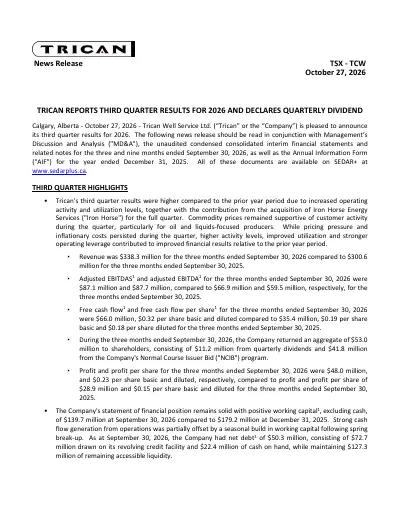
Overall, third quarter reflected strong activity levels after a bit of a slow start, with improved utilization and a solid contribution from the Iron Horse division for the full quarter. Commodity prices remained supportive of activity, particularly for oil and liquids-focused producers, and completion programs continued to increase in scale and complexity across many of the resource plays where Trican operates.
Overall, revenues for the quarter were $338.3 million compared to the $300.6 million we generated in Q3 of 2025. The increase was driven again by stronger operating activity and utilization levels during the quarter, together with the contribution from Iron Horse for the full quarter of this year versus effectively one month of Q3 of 2025 just due to the timing of the acquisition.
Adjusted EBITDA for the quarter, $87.7 million or 26% of revenue, compared to adjusted EBITDA of $59.5 million or 20% of revenue in Q3 2025. Adjusted EBITDAS for the quarter came in at $87.1 million or 26% of revenue, compared to the $66.9 million or 22% of revenue we printed in Q3 of last year.
To arrive at EBITDAS, we add back the effects of our cash-settled stock-based comp recognized in the quarter to more clearly show the results of our operations and remove some of the mark-to-market impact of the movements in our share price between reporting dates. On a consolidated basis, this results in earnings of $48 million during the quarter, which translates to 23 cents per share on both a basic and fully diluted basis, compared to earnings of $28.9 million or 15 cents a share on a basic and fully diluted basis in Q3 of last year.
We generated free cash flow of $66 million during the quarter, and our definition of free cash flow is effectively EBITDA less non-discretionary cash expenditures, such as maintenance capital, interest, and current taxes. You can see more details on this in the non-GAAP measures section of our MD&A.
CapEx for the quarter totaled $26.5 million, split between maintenance capital, $7.7 million, and upgrade capital of $18.8 million. Our upgrade capital was primarily directed towards the construction of our first 100% natural gas-fueled continuous heavy-duty hydraulic frac fleet and the purchase of electric ancillary frac equipment.
These investments form part of our broader fleet modernization strategy and support our focus on technological leadership, operating efficiency, and the ability to execute larger and more complex customer completion programs. Continuing to maintain a strong balance sheet, exiting the quarter with positive non-cash working capital of $139.7 million, net debt of $50.3 million, in line with what we were expecting, and approximately $127 million of accessible liquidity.
During the quarter, strong cash flow generation from operations partially offset by a seasonal build in working capital following a spring break-up session, but again, in line with where we were expecting, and I would expect some of this to unwind as we move through the back half or the back part of the year. With respect to our return of capital strategy, we repurchased and canceled 6.9 million shares under our NCIB program in the third quarter at a weighted average price of $6.09 per share, representing approximately 3.3% of the shares that were outstanding at the beginning of the year.
Subsequent to the quarter, we've repurchased and canceled about 600,000 shares and will continue to be active in our buyback program when market prices are at levels that provide a favorable investment opportunity. As noted in our press release, the Board of Directors approved a dividend of 5.5 cents per share, reflecting approximately $11.1 million in aggregate distributions to shareholders.
That distribution is scheduled to be made December 31st of 2026 to shareholders of record as of the close of business on December 15th, 2026. I would note that the dividends are designated as eligible dividends for Canadian income tax purposes.
With that, I'll turn things back to Brad.
Brad Fedora
Thanks. Overall, Q3 came in as expected.
It was a good quarter, but believe it or not, our results were again significantly impacted by wet weather, much more than normal for a third quarter. Even though it was very busy, we actually still had a lot of down days, particularly in the two frac divisions.
All divisions performed really well. Margins were quite consistent across all four service lines.
We pumped record amounts of sand in September. Unfortunately, nowadays much of it is self-supplied by our customers, which is a significant loss of margin for us, meaning that we have to work a lot harder to make the same amount of cash flows that we used to in prior years.
We are still experiencing significant pricing pressure in the bidding processes that have been unfolding over the last couple of months, and we're still seeing cost inflation across our entire supply chain, due mainly to higher diesel prices that started earlier this year that doesn't look like any of that is going to abate anytime soon. It's still too early to determine the impact of the counter tariffs against U.S.
parts and steel, but we expect that those will be material. As with happened with sand, we got all those tariffs back.
In the meantime, they can be a little bit painful and feel a little bit costly, but I think overall, in the long run, that'll probably work out much like sand did last year. Q4 has started off great.
We're having a record month in October. We do expect, though, that all divisions except cementing will slow down as we approach the end of Q4, and we do expect our results to be lower than Q3.
I know we've seen some analyst comments out there that they're actually showing growth in Q4 over Q3. I think that's a bit of a stretch.
As I think with normal seasonality and budget exhaustion going into year-end, you should see Q4 a little bit lower than Q3, and that would be, I think, the normal cadence going forward. Nothing's changed.
Our customers are still very focused on technology and efficiency. Efficiency is king on location now, just given the size of these fracs and of these frac programs.
Any little time savings or cost savings that you can provide are significant over the course of a year. Particularly the opportunity to burn natural gas instead of diesel.
The cost savings for that are well over $100,000 a day. Obviously, way lower emissions.
The natural gas is available right on location in many cases, and so it's a very important part of our frac strategy going forward. Our natural gas assets combined with our electric backside equipment are leading the industry in Canada.
We get diesel substitution rates well over 90% percent when you combine our 100% natural gas pumps with our electric blenders and sand handling equipment. We still remain very focused Montney/Duvernay.
Probably 70% of our work is still directed toward natural gas plays. They all have, I think, fairly heavy liquids components for the most part, but it's still very much a natural gas basin.
We actually see the oily parts of the basin as a great opportunity to expand our services, particularly in cement and coil. In the deep frac division, it's going very well.
Continue to build out our differentiated service offering with our 100% natural gas GMS pumps. We're definitely the leader in this space when you combine our natural gas equipment with our electric backside equipment combined with our engineering and lab facilities.
We view ourselves as a technical leader, and I think our clients do too. Wells are getting longer, there's more stages, the sand per well continues to grow.
I'm always referencing sand numbers, but I think this basin could approach 10 million tonnes any day now. You compare that to sort of 4 or 5 years ago, it's double the amount of sand that's getting pumped.
To us, that just means more time on location, the need for more robust, efficient equipment, and certainly we are leading that war on innovation and technical ability in the field. Almost 30% of our work now is in the Duvernay.
That's a big increase from even 2 years ago. Very positive for future frac demand.
It's a very pressure pumping-intensive play, and it pumps at very high pressures. The importance of new, robust equipment designed for long pumping rates at very high pressures is just amplified in that play.
We're really happy with our position there. Unfortunately, there is an undisputed trend of customer-supplied sand that's been a big loss for us from a cash flow perspective, and the only way to deal with that is to increase your last-mile logistics and try to find returns in sort of the logistics value chain.
That is not a trend that we see going away. It probably continues to increase.
We've really focused a lot of our work in driving efficiencies from our last-mile logistics. We have the largest fleet of sand trucks in Western Canada, and we'll continue to focus on that division.
We have received our 100% natural gas pumps as I discussed earlier. Those are coming in.
They're a little behind, but we do expect to have all of our pumps in the field by year-end. They're performing very well in the field so far.
Better than expected, actually. Better at burning field gas than the old Tier 4 engines that we were using that we continue to use, and it's just the more gas you can burn, especially at these diesel prices, the more fuel savings are provided for the customer.
Something that the customers are very focused on. It looks like the pumps will be more spread across our deep fleets instead of being combined into an eighth fleet in the near term.
What that does, it just makes each of our fleets sort of more technically and operationally advanced and, as a result, a little bit more profitable. You may want to adjust your models accordingly.
Then as we add more of these pumps, then we will evaluate at that time whether or not we want to add incremental fleets, or we want to just continue to increase the profile of each of our deep fleets. We need more of these.
We simply can't get them fast enough. They're a huge win for our customer, and they're a win for us.
This is certainly a technology that we expect to be deploying over the next few years. We're the only company that is now running in the pressure pumping space anyway that is now running natural gas-fueled semi-trucks.
We've received two of three so far. They're performing well.
They have a great fuel range. There's a significant savings on fuel versus diesel.
Even though these trucks are expensive, we expect that we're going to be getting reasonable returns just on fuel savings alone. We'll be deploying those into our trucking fleet as they arrive.
What I would say is demand for the natural gas pumps far exceeds our ability to supply them, and as well as our electric backsides as well, which is composed of the blenders and the sand handling and the chemical handling equipment. It's frustrating for us that we can't get more of this equipment, but there's basically a global demand for these engines.
We're just trying to make sure that we position ourselves in the queue, and we'll get them as fast as we can. We fully expect that we'll be ordering more of those pumps going forward.
On the Iron Horse side, as anticipated where oil prices went, Q3 was a great quarter for them. Clients were busy in the field.
They especially had a lot of weather delays, but they still had a great quarter. Oil price conditions like we're experiencing today really really highlight why we thought that was a good acquisition.
It's broadened our exposure to parts of the basin that we were not present in before, and we're looking forward to a really busy 2027 in that division. On the cement side, we continue to be really happy with how that division continues to operate.
We've maintained really high market share in both Montney and the Duvernay. We secured a Q1 SAGD project twice the size of our 2026 program.
In-depth discussions with additional customers to provide equipment and provide efficiencies in their programs. We currently have almost no market share in heavy oil and SAGD, so as we expand into that market share, it's pure organic growth and incremental to what we're doing today from a revenue and cash flow perspective.
Those jobs are smaller, but there's lots of them, and the margins on those are almost as good as our deep gas margin. That'll be an area of expansion for this company in the future.
We successfully cemented the longest well in Canada in the summer. It was just over 9,600 meters, great job to the cement division and the crew that executed there.
As wells get longer, more expensive for the customer, they, of course, are more and more reliant on companies like us that have advanced blends, a deep engineering program, a deep lab expertise, and years and years of operating experience. Our competitive positioning should just do nothing but improve as wells get bigger and more complicated going forward.
We are working on electrification in that division as well. We expect delivery of a hybrid mixing unit in Q1 of 2027.
That is delayed from Q4 of this year. With that equipment, we'll see the elimination of hydraulics, which will mean less breakdown, less R&M, and just better reliability for the customer.
Especially in the cold, a much more pleasant operating experience for the operators as well. On the coil side, we had a good summer in coil.
Again, lots of delays due to weather, but August, September were two of the busiest months ever in that division. This has continued into October as well, which will probably be the busiest month for this division.
As with everything, wells get longer, creating challenges for coil. Trican manages all of these challenges with an extensive string inventory, lots of high-rate injectors, and our relationships with tool companies that continue to allow us to take on technical challenges and provide really good service for our customers.
This coil division as well, we look at heavy oil and SAGD as a great opportunity for us to expand. Again, we've done very little in that part of the world just due to equipment and staffing shortages over the past few years, but we see that as a great opportunity to show significant organic growth in that division.
I'll just make a few comments about our outlook for Q4 and 2027. I'd say Q4 is going very well.
October is basically a continuation of Q3. Probably will be a record month for this company overall.
You should expect things to slow down significantly in December. Our financial results will be good, but I do expect them to be a little bit lower than Q3.
We're seeing research notes that are implying Q4 is going to be higher than Q3. I think that's very, very unlikely unless there's significant roll-forward of budgets from 2027 into 2026.
I think the normal cadence will be Q3 is probably the busiest quarter of the year, and then Q4, Q1 are just slightly below it. Again, the loss of sand is a real impact to our operations, and so we have to end up doing a lot more work to show the same sort of EBITDA and cash flows.
At this time, we're not seeing any significant budget being pulled forward from Q1 2027 into Q4. I won't be surprised if we see a little bit of that.
Q1 2027 is very busy. All of our customers are telling us that they're going to be busier next year.
Q1 2027 is almost fully booked, and the conditions for Q1 are improving as the weeks go by. We are expecting a very busy winter and a very busy spring.
Overall, when we look at the basin, we expect activity probably goes up 5% or so a year, and we'd probably see a similar increase in pricing to go along with it. This might be conservative, but I think until we get a much more constructive natural gas market, we're taking, I think, a conservative stance on growth.
Focusing on getting the right people, getting the right equipment, making sure that even though things are getting busier, we continue to operate at an extremely high level of not just quality of operations, but efficiency of operations as well. Still a very competitive space to operate in, and lots of pressure from our suppliers across our entire supply chain.
Even though it's growing, we want to continue to operate on efficiencies, providing very good service for our customers, making sure that we have the right people in place as this market grows. I would echo our comments from the last few years.
We view Western Canada as a great place to be. We expect that this basin's going to continue to expand over the next 4 years, 4 or 5 years, just given everything that we've seen from an egress perspective on both oil and natural gas.
We hope to be a big part of that. We see growth coming from five key areas.
Just overall industry activity and pricing is one. Our market share within that market is two, just given our technology and equipment advantage.
The third is just well-intensity growth. More sand means more time on location for us, which just means higher frac bills, reducing the effective capacity of the fleet in Canada as a whole.
More hours on location, I think, is a win. Cement and coil will have lots of organic expansion just in the heavy oil and SAGD areas.
As our last-mile logistics expand, we'll start seeing that as a separate operating division that is also providing profits to the overall company. I'll just finish off with sort of our view of value for shareholders and return of capital.
It's a grind, but we continue to generate free cash flow and maintain a conservative balance sheet. We're not totally debt-free, but we're effectively debt-free.
We do subscribe to a diversified return of capital strategy, a combination of sustainable dividends and the NCIB. Since 2020, Trican has returned over $540 million to shareholders in the form of buybacks and dividends.
It's a very, very significant number that I think it's almost getting taken for granted for now. We look at buying our own share as probably the best M&A we ever could have done.
We're really happy with how that's worked out. I think we're, I don't know, Scott, what are we, almost 55% of the shares since 2017.
We'll continue to flex our NCIB up and down based on share prices and other market opportunities. We are very active in our M&A department.
We're combing through deals, trying to find the right places to invest, making sure that they're exposed to the markets that we want to be in. It's, as always, very tough to find the right deal, and we'll keep digging.
In the meantime, we'll keep buying our shares as a form of M&A. Don't expect that to change anytime soon.
On a go-forward basis, I think we've said in the past, give or take, you should expect about 50% of our free cash flow to go to shareholders in the form of buybacks or dividends. I think over the long term, that's probably a good metric, and it'll vary from year to year depending on the stock price environment and what's available from an M&A perspective, but over a 10-year period, I think that 50% number's probably about right.
We're not afraid to use our bank lines. We feel a lot better about debt today than we did even a couple of years ago.
I think it's no surprise to people that this management team is very conservative from a debt perspective, but just given the stability that we're seeing in the market and our views of the future for the Canadian market over the next 5 to 10 years, we wouldn't hesitate to use our bank lines to make the right investment. I'll just finish off with saying our priorities have not changed: build a resilient, sustainable, and differentiated company; invest in high-quality growth and upgrading opportunities to ensure that we're adding value for our customers.
It's not enough to just show up and execute. You have to show them why using our services creates incremental value for them.
Then provide a consistent return of capital to our shareholders through the dividend and the NCIB when appropriate. Operator, I think I'll stop there, and we'll go to questions.
As a reminder, if you'd like to ask a question, simply press star followed by the number 1 on your telephone keypad.
Operator
Your first question comes from the line of Aaron MacNeil from TD Cowen. Your line is live.
Aaron MacNeil
Hey, morning, all. Thanks for taking my questions.
Brad, you highlighted that pricing pressure persisted in Q3, and then you had later mentioned the potential 5% inflection in both activity and pricing next year. I'm hoping you can just expand a bit more on how you see the competitive intensity evolving into 2027, and maybe just couch it as both on the sort of supply side as well as the demand side.
I know demand you said maybe 5%. Would you characterize the market today as sort of adequately supplied, oversupplied, and what would it take to change your view?
Brad Fedora
It's a bit of a quirky market in the sense that I don't think activity is necessarily in any particular month that consistent across all the service providers. I think we sort of take turns having very busy months, but there's certainly some white space present if you looked at the industry as a whole.
Even though I think everybody's expecting a much busier next year, I think our customers have played this really well. They're securing longer-term relationships, using today's maybe angst about white space, and so even though I think the market's going to be undersupplied very soon, you're not seeing it in pricing today.
It'll happen quickly. Is it going to be a huge 20% jump in pricing?
No, I don't think so, and that's why I think taking sort of a conservative view of starting with cost recoveries just given how much our margins have been squeezed, starting with cost recoveries and a little bit more activity will allow you maybe to inch pricing up a little bit. Remember, it's a very torquey business.
We have about $1.2 billion top line. You don't need a big price increase to really move earnings around and free cash flow.
A little bit of activity combined with a little bit of pricing and a little bit of cost recovery, it's very, very significant. The exact timing of which nobody knows.
Aaron MacNeil
Gotcha. Just to maybe clarify, anything you're seeing on the supply side?
Brad Fedora
As everybody knows, the supply side's actually improved here. There's chatter about maybe up to 4 spreads leaving Canada going to the U.S.
My sense is, once they get down there, it's going to be really hard to bring them back because it's busy in the States, too. Maybe I would even say the slope of their recovery curve has been higher than Canada's in some of those basins, my guess is some of that equipment's going to go south and not be back anytime soon.
As we all know, a marginal fleet either additions or subtractions can have a big influence on the overall market. Thanks for asking that question.
It's a sweet point. Okay.
Aaron MacNeil
Then you mentioned again, back to the supply side, that you couldn't get some of these natural gas pumps fast enough. Maybe in broad strokes, how many pumps do you think you can get your hands on next year, and do you think you'll sort of maximize your ability to do that?
I know you said no modeling questions, but to the extent you'd like to comment on what the '27 CapEx could look like, I'd be interested in getting your views.
Brad Fedora
I would say you should assume the same CapEx for next year. I'm looking at Scott, he's nodding, so, but if we could double it, we would.
You can't buy what they won't sell you.
Scott Matson
The other comment I'd make, Aaron, is that there's a timeline around these things. We ordered our first set of these natural gas pumps about a year ago, and so we've taken delivery of kind of 3 out of 10.
There's quite a lead time, and then there's just quite a build slot time, even if we could order double them, we wouldn't get them for a full season,
Brad Fedora
so. Anything ordered today is 2028 basically,
Scott Matson
yeah.
Brad Fedora
It's frustrating, but there's demand for those engines in all parts of the economy, especially in power.
Aaron MacNeil
Right. Appreciate the time and turning it over.
Brad Fedora
Thanks.
Operator
Your next question comes from the line of Keith MacKey from RBC. Your line is live.
Keith Mackey
Hey, thanks and good morning. Maybe we could just start out on that sand pumping trend that you mentioned a few times there, Brad.
What portion of sand that you pumped in the quarter did you supply versus third-party supply? How might you expect that to change going forward?
Are we in the eighth or ninth inning of that, or is there a significant amount of sand that might be supplied by third parties going forward?
Scott Matson
In the quarter, that number was, call it, roughly 50% supplied by Trican or customer-supplied. That's been a slow, steady trend upwards as we've moved through the last year or two.
Brad Fedora
We would have been 70/30 a year ago.
Scott Matson
70/30 a year ago. That trend will probably continue, but there will still be an element of Trican-supplied sand specifically for certain customers want us to be able to handle that process for them, and the larger and the bigger demand on sand from a program perspective you have, the larger the operator, the more likely they are to procure their own sand.
We're probably in the 6th, 7th inning of that as we go forward. I think there'll be more, but not dramatically.
Keith Mackey
Okay.
Scott Matson
Sorry.
Keith Mackey
Very helpful. Maybe just talk a little bit about business development.
You mentioned M&A active. Can you just kind of speak to some of the things that you've in general in broad strokes have looked at?
What types of things might meet your return threshold versus what types of things might not? How do you want to bolt those into Trican as an existing business?
Is it about creating more integration or more breadth, or what is the approach in the latest thinking today?
Brad Fedora
We're looking at everything. We're very bullish on not just Canada, but we're bullish on the U.S.
as well. Again, we'd never buy fracturing operations or sole fracturing operations in the U.S.
We don't think we have anything to offer there. We're looking at everything.
We're a logistics-based business today, and we do have seasonal issues that we have to deal with, we're always looking to smooth those out. Quite frankly, it's hard to do in Canada.
We are, I would say, underexposed to the oily parts of the basin. Like I said, we're 70-plus percent focused on natural gas.
Our first foray into the oil world was the Iron Horse acquisition. Frankly, just given everything that's happening from an egress perspective, we're not really participating in the oily side of the market.
Look at the Clearwater, it's not going to slow down anytime soon, and there's really nothing for us to do there other than coil. We're actively looking to expand our coil services in that play, but if there's acquisitions that could speed up our exposure to heavy oil and SAGD and things like that, we would look at it.
I'm giving you a non-answer answer, but so we're not fussed with it having to be in a vertical integration. We're happy to add business lines on that we're not currently in, and where we maybe in sort of indirectly in our own operations.
I think when people talk about M&A and other service lines, I think you have to remember we're all calling on the same people, right? Our coil and fracking divisions call on the completions departments, our cement division calls on the drilling departments, and so it's very easy for us to make step-out acquisitions in other service lines because you have the same customers.
We all know who those customers are, and the people that were calling on, they have a long positive experience with Trican, they're very familiar with our company and the quality of our service offering, and so we're not afraid to add what appear to be unrelated service lines, but we all go to the same well, and we all call on the same customer. They're not actually all that unrelated, and at the end of the day, much of oilfield services is can you move lots of people and lots of equipment around efficiently.
We obviously know what our core competencies are, and we're not afraid to use them in other places.
Keith Mackey
Understood. Thanks very much for the color.
Operator
Your next question comes from the line of Tim Monachello from ATB Marks Cormark Capital. Your line is live.
Tim Monachello
Hey, guys. Most of my questions have been answered, but just curious on the addition of new 100% natural gas pumps that probably comes in the 2027 budget.
Are you seeing inflation in the cost of that equipment given, I guess, the demand that you're seeing or that those OEMs are seeing across different end markets?
Scott Matson
Not a ton, Tim, yeah. The thing that probably keeps me the most up at night would be potential tariff impact of those things moving back and forth.
Any engine is predominantly steel, there's lots of impact there, but to date, we haven't seen a rapid increase in what we've been getting and what we've seen delivered so far, but TBD for 2027.
Brad Fedora
It'll come in some form for sure.
Scott Matson
They never get less expensive.
Brad Fedora
One way or another, the price will go up.
Tim Monachello
Okay. Have you guys made a decision on that formally, or when do you think that you'll pull the trigger on that decision?
Brad Fedora
No, we make a formal board approval on a 2027 budget in early December, but we'll certainly be asking for more of them.
Tim Monachello
Got it. It sounds like the new equipment that you have coming in in late '26 will be largely complementary to the current frac spreads that you have in the market, adding capacity and some margin there.
How do you think about the idle equipment that you have in the fleet, assume it's largely Tier 2 stuff, does that ever go back to work, or is that something that you think about divesting to other markets or something?
Brad Fedora
Just I'll back up a little bit. As we think about the fleet and the quality of the fleet going forward, our goal is to high-grade those fleets and make them as I guess technically advanced as possible to increase their sort of profile for customers, and what that means is we will continue to sort of bring in the new state-of-the-art technology and move out the diesel pumps or the old Tier 2 pumps, and that equipment's old, really old, and it's not just here, it's everywhere.
The good thing about the pressure pumping business is even though we all continue to invest in our fleets, the fleet isn't growing, which sets up a good supply-and-demand dynamics going forward, and we've had sort of 3 to 4 spreads parked on the fence now, just make sure we don't sort of ruin the industry by bringing that equipment back to work, but the reality is we may never bring that equipment back to work, and we continue to dispose of sort of parked equipment that we talk very little of, and if doesn't get sold into the Canadian market, it only gets sold outside of Canada. You'll just see a continuous improvement in the quality of our fleet.
It's a totally different frac fleet than it was 3, 4 years ago.
Tim Monachello
Okay. Then last one for me, just curious if you can give an update on, I guess, the profitability and activity levels that you're seeing within the Iron Horse fleet, outlook for that fleet in '27.
Brad Fedora
We don't talk divisional margins or anything like that, but certainly Q3 would be a good indication of how we expected that business to perform, and they have more seasonal issues than the deep fleet just due to road bans and things like that, but it's fair to say when that equipment is highly utilized, we're really happy with the purchase.
Tim Monachello
Great. I appreciate the details.
Turn it back.
Operator
Your next question comes from the line of Nathan Ritchie from Schachter. Your line is live.
Nathan Ritchie
Hi, Brad. I just wanted to thank you for everything you're doing for shareholders.
I've been following your story since prior to the Canyon merger, and you guys continue to deliver. First off, thanks for that on behalf of shareholders.
Where I wanted to speak about is if you can speak more on your application of AI in the business. Some context to why I ask is I was at a presentation this summer that Liberty Energy did, and they spent so much time talking about technology and AI and data, by the end of the presentation, I had to remind myself it was an oilfield services firm.
I know they're not that big in Canada, you're not probably competing with them as much as far as customers go, but you may be competing with them for investors, I just want to see if there's a focus. I know the focus right now is use technology to deliver results for your customers, which is obviously a priority and is obviously working for you, but is there also a way that you can talk about your technology a little bit more and promote what you're doing in the market so that you're viewed more as a technology company that's in oil and gas services rather than an oil and gas service company that uses technology, and then from that, potentially be able to trade at a little bit higher multiple?
Brad Fedora
I hope none of the board is listening. We hear you.
First and foremost, my job is to provide returns, not glossy brochures. We are an oilfield services company that uses technology, and that's never going to change in the next few years, I'm never going to say I'm a technology company that is in the oilfield services business.
I shouldn't say I'm never going to say that, but in the next 36 months, that's very unlikely. We very much understand what you're saying.
We're all fighting for the marginal dollars from investors, and we probably could do a better job talking about the technology investments that we're making, particularly using data that is in the trillions of data points in this organization. We are going through a great big systems upgrade, and I do not want to be a first mover on AI.
I'm happy to be a number 2 on AI, and let the non-return money get spent by somebody else. Where we're seeing probably the best opportunities in the near future on using AI and data management is on frac automation and preventative maintenance.
As that gets more developed and it gets field tested, we'll start talking more about it, but rest assured, we understand sort of the comments you're making. I don't agree with all of them, but I certainly understand what you're getting at.
Nathan Ritchie
Thanks, Brad. That's the main thing.
Appreciate that.
Brad Fedora
Yeah. As a reminder, if you'd like to ask a question, simply press star followed by the number 1 on your telephone keypad.
Operator
Your next question comes from the line of Colby Sasso from Daniel Energy Partners. Your line is live.
Colby Sasso
Hi, thanks for having me on. Just a quick question from me.
You've discussed the trend towards longer laterals, more stages, and higher sand intensity across the Montney and Duvernay. Are you seeing any indication that operators are beginning to reach diminishing returns on completion intensity, or do you expect these trends to continue driving higher service requirements over the next several years?
Brad Fedora
Remember, we make sort of blanket statements for the basin as a whole, not, there's always exceptions from this area versus that area or this operator's view of how they should do it versus that operator's view. In general, yes, we expect this trend is going to continue.
Colby Sasso
Then one last one. You delivered a strong EBITDA margin of 26% in Q3, which is one of the highest levels we've seen over the past several years.
As you look ahead towards '27, how sustainable are these margins, and should we expect this level going forwards, or does Q3 represent a high watermark of sorts?
Scott Matson
Good question. If you look through the year, this has been our highest margin quarter probably in the last 4 or 5 or 6 quarters.
I think this will kind of moderate as we go through 2027. There was a bit of G&A stuff in this quarter that gave us a bit of a benefit as well, if you're in the mid-20s as we go forward, that's probably a pretty good indicator.
Some of that changes that the relative proportion of sand-in versus sand-out work moves that margin percentage number up a little bit,
Brad Fedora
Not the dollars. but
Scott Matson
not the aggregate dollars, if that makes sense. This is probably a decent run rate to go forward.
If you blend this thing out for the whole year, we're probably mid-20s, and I would expect that's pretty safe.
Colby Sasso
That's all for me. I'll turn it back.
Operator
That concludes our question-and-answer session. I would now like to turn the call back over to Brad Fedora for closing remarks.
Brad Fedora
Thank you, everyone. Thanks for your time and your interest.
I know it's a busy time of year. We are available for any follow-up calls that you may have, particularly with respect to the financial models, etc.
We won't be hard to find for the next couple of days. If we can help you, please reach out.
Thanks again.
Operator
This concludes today's meeting. You may now disconnect.