TFI International Inc.
Q3 FY2026 · Earnings Call TranscriptOctober 30, 2026
Operator
Good day, ladies and gentlemen. Thank you for standing by.
Welcome to the TFI International third quarter conference call. At this time, all participants are in a listen-only mode.
Following the presentation, we will conduct a question-and-answer session. Callers will be limited to one question and a follow-up.
Again, that's one question and a follow-up so that we can get to as many callers as possible. Further instructions for entering the queue will be provided at that time.
Please be advised that this conference call will contain statements that are forward-looking in nature and subject to a number of risks and uncertainties that could cause actual results to differ materially. I would also like to remind everyone that this conference call is being recorded on Friday, October 30th, 2026.
Joining us on today's call are Alain Bédard, Chairman, President and Chief Executive Officer, and David Saperstein, Chief Financial Officer. I would now like to turn the call over to Alain Bédard.
Please go ahead, sir.
Alain Bédard
Thank you very much, operator, and welcome, everyone, to this morning's call. Yesterday, after market close, TFI International reported another quarter of solid results, with a standout performance from our truckload segment.
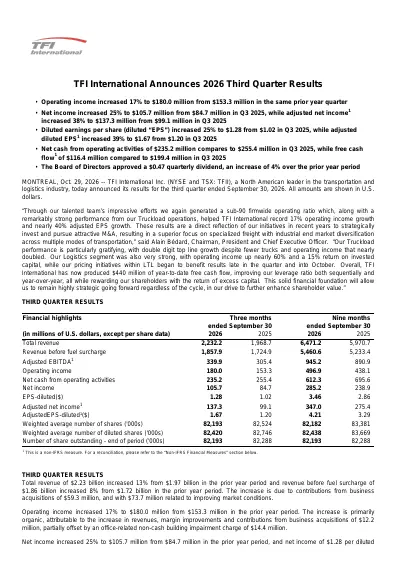
Overall, adjusted diluted EPS was $1.67, up nearly 40% over the prior year's of $1.20. Our overall operating income grew 17% to $180 million despite an office-related real estate impairment charge, and this was driven by truckload operating income that nearly doubled and logistics operating income that was up 60%—almost 60%.
Another important highlight is that this was the second consecutive quarter that TFI International achieved a sub-90 operating ratio on a consolidated basis. Of significant importance to our business strategy, we generated another $116 million of free cash flow, bringing our year-to-date total to more than $440 million, even while investing for growth.
As a result, our leverage ratio further improved this quarter, as I'll discuss in a moment. This very solid financial foundation allows us to thoughtfully invest for the future during up and down cycles alike, and also allows us to return excess capital to shareholders whenever possible, which we did both during and subsequent to the third quarter, as I'll also discuss.
Taking a step back, our current strong performance is the direct result of the investment we made during the downcycle. We invested in our operation, we made strategic acquisitions, and as a result, we now have an enhanced focus on specialized freight, which improves diversification towards industrial end markets and across multiple modes of transportation.
All the while, the talented men and women of TFI International have maintained their focus on efficiency and the related operating principles that drive our profitability. With that, let me quickly review our consolidated third quarter results before taking a closer look by business segment.
Our top-line total revenue before fuel surcharge of $1.9 billion was up 8% over the past year, while operating income reached $180 million, up 17%. Our operating margin of 9.7% was up 80 basis points over the prior-year quarter of 8.9%.
Turning to our segment, we will begin with truckload, which simply had a phenomenal quarter and now represents 40% of segmented revenue before fuel surcharge at $753 million. That was up 10% the past year, and our revenue per truck per week, excluding fuel surcharge, climbed 13%.
Operating income nearly doubled to $100 million, up from $53 million in the year-ago period, and our industry-leading adjusted OR of 86.7% marks a 560 basis point improvement over the past year. Lastly, our return on invested capital for truckload was 8%, up from 6% last year.
In addition to the tightening capacity industry-wide, these results directly reflect our favorable exposure to the right end markets, our emphasis on the specialized side of the business, and our limited capital intensity, with an optimal asset mix and improved fleet productivity. Next up is our LTL.
LTL was 36% of segmented revenue before fuel surcharge at $678 million, which was roughly flat year over year. Our adjusted OR was 91.3%, and operating income was $44 million.
Again, that's including a non-cash impairment and equates to a return on invested capital of 11.1%. Finishing up the segment, logistics also had a strong quarter, with revenue before fuel surcharge of $437 million, up a robust 19% year over year, and logistics now accounts for 23% of our segmented total.
Perhaps more impressive, our operating income jumped 59% to $49 million, and that equates to an 11.3% margin, up nearly three full percentage points from the prior year's of 8.4%. Our logistics return on invested capital was 14.9%.
Turning to our balance sheet, as I mentioned, $440 million of year-to-date free cash flow has further added to our overall strength, and we ended September with an adjusted funded debt-to-EBITDA ratio of 2.1. Please note that this is an updated measure, which excludes the letter of credit and contingent consideration, which affected the previously communicated banking covenant ratio.
I'll wrap up my prepared remarks this morning with our updated outlook, which include fourth-quarter adjusted EPS of $1.30 to $1.40, which, at the high end, would represent a 28% year-over-year increase. In addition, we continue to expect year-over-year adjusted operating ratio improvement of 400 to 500 basis points in the truckload segment, 100 to 200 basis points for our logistics, and a slight decline, maybe of 100 basis points, up to 100 basis points for our LTL.
Lastly, in terms of our outlook, we continue to expect net CAPEX, excluding real estate, to be in the range of $225 to $250 million, demonstrating improved capital efficiency. As always, our outlook range assume no significant change in the operating environment.
With that, operator, David and I are ready to take question if you could please open up the lines.
Operator
Thank you. Ladies and gentlemen, if you'd like to ask a question, please press star one on your telephone keypad.
If you'd like to withdraw your question, press star two. As a reminder, please limit yourself to one question and a follow-up.
One moment, please, for your first question. Your first question comes from Ken Hoexter from Bank of America.
Please go ahead.
Ken Hoexter
Hey, great. Good morning.
Alain, thank you. You ran through truckload and logistics in, I guess, more detail than LTL.
Maybe just take the opportunity to dig into LTL, talk about your thoughts on the US performance, maybe talk about fuel, the benefit, and then throw that into your fourth quarter outlook, how should we think about the improvement potential and going into fourth quarter and next year?
Alain Bédard
Yeah. A very good question, Ken.
If you talk about Canadian LTL, fuel is some kind of a tailwind because of our density, right? Our density in Canada is second to none.
In the US, it's the opposite kind of thing is our density is so bad that when you have inflation like we went through in Q2 and in Q3 with fuel, that turns to be some kind of more of a negative because our density is not that good. We do about 20,000 shipments a day, we cover all the US, and our density is not good.
Now, as we've been going through a very rough, very rough patch in our US LTL for the year '25, '26, '26. We're not very happy at all with the results that we have in '26.
We're in for major improvement, I think, going into '27 with improvement in the team and all that. That being said, we've tried something, Ken.
Trying to grow organically at TForce Freight, and the results, our timing was probably bad because we tried that in Q1 of '26 when the weather was not helping us at all, okay, if you remember January, February, it was difficult, even Dallas was tough to deal with. Then you go into Q2, we end up with something like a 22,000 shipments a day, and our guys are not able to manage that.
We're really sad about that that we have to say that, but those guys were not able to do that, and then we end up with inflation on the linehaul because at the same time that our driver in our linehaul department cannot take this excess volume, we have to go on the spot market. The spot market in Q2 and in Q3 for linehaul is just killing us, right?
We have that negative affecting us, and at the same time, also we've tried to grow in terms of volume, but we had to discount a little bit on the price, it's like a double whammy where you get less revenue per shipment, at the same time you've got more cost per shipment. This does not work, okay?
This is why it's when you look at our Q3 numbers, we did fantastic everywhere except our US LTL, which is a broken story. It's like we all keep repeating the same story time over time, and hopefully with the improved teams that we have on board now, okay, under Carl's leadership, we could finally get this ball up and running.
Now, I'm sure you saw in our MD&A, okay, another little thorn in our shoe for our US LTL is our six years partnership with our friend at UPS is coming to an end, okay, in early '27, right? This is, again, another reason why, if you look at our forecast EPS for Q4, okay, because this partnership is ending early in '27, we anticipate that some customers will have to find a solution somewhere, okay, we're working on a solution of our own, but this is difficult to do to try to replace UPS with someone else, right?
This is why we're very careful about the guidance that we're giving for Q4. We feel really good about our truckload, like I said on the script, okay, we feel really good with our logistics, but another rock in our shoe on our US LTL is what I just said about GFP, okay, the partnership that we have for six years with UPS that will come to an end at the end of January '27.
Now, when you look at that, you say, "Hey, you've been at it for years and years and years," and I agree, and we were never able to turn the corner with this. '21, '22 were way better.
'23 was not so bad, but then '24, '25 with freight recession, increasing inflation on the costs, etc., etc., we believe that we're going to turn the corner in '27. Now, that's an opportunity because if you look at our revenue, okay, and the small margin that we get out of that, once we fix that, TFI is going to be like, "Wow."
That's the big rock that we have in our shoe, Ken, okay, but that's also the big opportunity down the road if we can fix that, and we have to fix it because this is huge revenue for us, and the contribution is minimal, right? The good thing is we've acquired Daseke two years ago, and that Daseke ship has been turned around very, very fast.
If you look at when we bought Daseke, these guys were running a 97, 98 OR. In Q2, okay, we did a good job.
In Q3, now we're coming with a sub-87 OR in our truckload compared to my best peers, okay, in the US. We're doing great.
The Canadian operation is doing even better, okay, but our US operation slowly is catching up, right?
Ken Hoexter
Yeah. Just to follow up, do you need to acquire to get the density there, or is that something you can do on your own?
Alain Bédard
Ken, it's a union shop, right? The only other union shop, those guys, they do a great job.
They're better than us, right? For sure, we've tried to do something and it never worked.
The plan, Ken, has been simple, is that we're building, okay, in parallel to our 20,000 shipments, slowly we're going to start building in a non-union, okay, operation. Today, we do about 1,000 shipments a day non-union through Hercules, our US operation.
Hercules has got partnership with some of our Canadian business as well. This is small, right?
Unless there's something of size that comes to us, the plan is going to be really to slowly build that non-union, okay, like we do in Canada because, Ken, in Canada, we run both. We run union and non-union.
To me, it's okay. We'll run a second network if we can, and the idea is to bring more stability to our TForce Freight because, again, if you look at history, the way we used to do things in the US is, okay, volume goes down, okay, because of December, January, we let go people, then we call them back in March, those guys are not available, you have to rehire.
This is instability. This is one thing that we're working on with Carl and his team, okay, to try to have a volume that is steady, okay, month over month, okay, in that 20,000 shipments a day range, which we are now.
Ken Hoexter
Great. Thanks for the thoughts, Alain.
Appreciate it.
Alain Bédard
Very good, Ken.
Operator
Your next question comes from Scott Group from Wolfe Research. Please go ahead.
Scott Group
Hey, thanks. Good morning.
Just a couple follow-ups on that LTL. Maybe can you share where's the US LTL margin right now?
The UPS relationship that's sort of ending, does this impact just the GFP business? Is that going away, or is there a broader impact than GFP?
Alain Bédard
No, no, Scott. The GFP thing is just that partnership that we have with UPS, okay, that's going to come to an end at the end of January '27.
After six years of partnership with UPS as a reseller of UPS services, this is going to go away, okay? That's a GFP thing.
About the profitability of our US operation LTL, okay, for sure, when we report a 91 OR, okay, you can think that our US operation is more closer to a 97 OR and our Canadian operation is more like a sub-75 OR operation. The size is not the same, right?
We do about 10,000 shipments a day in Canada, we do 20,000 in US.
Scott Group
Right. Then so how big is this GFP business today?
David Saperstein
The operating income in Q3 was a little over $4 million.
Scott Group
Thank you, David. Then maybe just, Alain, bigger picture, in that first question, you said it feels broken, we have no density, but you also said we think we can improve it in '27.
Help us square those two comments. Then when you think about allocating capital to the business, it felt like a few years ago we wanted to allocate more capital to LTL, we were thinking about de-emphasizing truckload, is the message different that we want to allocate more capital to truckload, or how should we think about where you want to invest incremental capital?
Alain Bédard
Okay. What, Scott, that's a very good question.
If you look at opportunities right now, okay, in our US truckload operation or even our Canadian operation, we still have a good year to go to fine-tune everything that we do in our US truckload operation. Let's say something nice comes around, okay, in mid-'27, for sure, we're in a position to look at it.
On the LTL side, on the Canadian side, there's not much that we can do. On the US side, union side of our operation, there's nothing we could do except build some kind of a non-union network in parallel to the network that we have.
In the meantime, okay, for sure, we're adapting the network, okay, to a 20,000 shipment company. As an example, we're going to have a transaction with one of our friend in Chicago where they will take over one of our terminal.
We're in discussion also with one of our terminal in the New York area to reduce our footprint, okay, to that 20, 22,000 shipments a day. Also at the same time, our focus is going to be try to bring more density to that 20,000 shipments, the average miles that we drive today between each and every stop in our P&D is about twice as much as our Canadian operation.
Why is that? Because in Canada, we focus trying to do business with customers that are close by and not run 100 miles to do a delivery, right?
This culture, we've been working at it with our friends there at the US LTL, but it seems to be difficult to do. We're getting some support.
We just hired an executive that hopefully is going to be able to help us drive change. There's more team members that we need to add to drive more change and to bring that density down because fuel is high, okay, in Canada, like I said with Ken, it's a tailwind for us, okay, but in the US, truckload or in our US LTL, it's not a tailwind.
It's more of a headwind, right? We did fantastic in Q3 even with that headwind in our truckload, but we did very poorly, okay, in our US LTL in Q3 with that headwind, that cost inflation on our linehaul because the market has been very hot, okay, on the spot.
All that really turned out to be not a great quarter for us at all. Now, in terms of investment, if you look at our CAPEX, okay, this year in our US LTL, we did a lot of CAPEX to support this company.
We bought 1,500 trailers, okay, this year. We bought a little over 600 trucks.
We continue to do the investment, okay, but the return has been not great at all, okay? This is why it's like, guys, we have to turn this thing around.
There's no other solution. I'm very happy, like I said earlier, with the capital intensity of our truckload in US that has improved tremendously.
Our revenue per truck, okay, is up big time, not just because of the revenue per mile is up, the usage, the number of miles per truck is also up. We've also been able, with Steve and his team, to transform our US truckload operation with more niche carrier.
If you just look at one of our carrier, SPD, on the West Coast, they were like jack of all trades, master of none. They were servicing the aerospace industry, like Boeing and Bombardier and others, but that was with 75 trucks.
They had also another 125, 125 trucks losing money. We said, "No, no, forget about that."
Those 125 trucks have been moved to Wylie, and now SPD is making money with the truck, making money with the brokerage. We've also attacked our friend in Texas, Lone Star.
Again, very great carrier, okay, with the wind, with the data center and all that. They also had an over-the-road operation that was just killing them.
We said, "No, no, no, this is over, my friend." This is just happened in Q3.
Over-the-road is going to Wylie, okay, fine. This is the fine-tuning that Steve and his team still have to do.
We're working on COTC right now, and then it's offshore. That's why I'm saying '27, Q4 '26, '27, for our truckload, we see great improvement there.
Truckload is great. Logistics is great.
US LTL is not. That's, again, I feel like I'm a broken record on that.
We got to correct the situation. We know what to do, it's just we need the soldier, we need the management to jump in and do the right thing.
Scott Group
Thank you, Alain.
Alain Bédard
Okay.
Scott Group
Thank you very much. Appreciate it.
Alain Bédard
Pleasure.
Operator
Your next question comes from Jason Seidl from TD Cowen. Please go ahead.
Hi, morning. This is Uday on for Jason Seidl.
Maybe just to go back to the US LTL, Alain, revenue per shipment I think decelerated a bit here in the third quarter. Last quarter you spoke about 3PL mix being a factor.
I'm just wondering
Alain Bédard
was
that still a factor in the third quarter, and then if that was the case, then thoughts on how you plan to rationalize that?
Alain Bédard
It's still a factor in Q3, but over the course of Q3 it's been improving. Q3 is three months, right?
It was not good in July at all, okay, it got a little bit better in August, and better in September, and we keep improving that for our Q4 situation there. It's been an ongoing thing where our commercial team has been really hard working at it, so, yeah.
All right. Thanks, that's helpful.
You mentioned the linehaul pressures here. Can you maybe give us some detail, maybe remind us how much rail do you utilize presently, and maybe on the trucking side, is there an opportunity to enter more contract-type exposure and reduce spot?
Alain Bédard
Yeah. If you look at our situation today, about 55% of our miles is done through our own people, okay, our own drivers.
About 20-some percent is rail, okay? Then we have about 125 owner-op, okay, that is also exclusive to us.
Over and above that, we have also contract. When the volume went from, let's say, 19,000 shipments to 22 at the peak, we have to go on the spot market because we didn't have enough power with our own team, okay, we moved a little bit more volume on the rail, but there again, then you end up with service issue, it's not the solution, we went on the spot.
The spot was about what, $2.75, $2.90 a dollar, whereas, let's say, eight months ago was $2.20, right? That killed us, okay, in Q2 and in Q3.
Now, at the end of Q3, we're back to normal because now, okay, we don't have to go on the spot market to get power for our linehaul.
All right. Very helpful.
Thank you very much, Alain.
Alain Bédard
My pleasure.
Operator
Your next question comes from Ravi Shanker from Morgan Stanley. Please go ahead.
Ravi Shanker
Great, thanks. Alain, David, kind of thanks so much for the details so far.
Alain, you've been very clear on the idiosyncratic changes you guys need to make in the LTL business. I'd love to hear your characterization of the LTL market overall as well.
Kind of where do you see demand right now relative to where ISM is in the mid-50s? Where do you see the pricing environment?
How do you see competition and capacity shaping up, etc.?
Alain Bédard
The chance we have in our US LTL is our peers are smart. We're not competing with stupid peers.
Our peers are really, really smart, doing a great job, and so this is why to me, okay, volume is soft a bit, yes, it's been soft for the last few years, but at least the pricing is holding. There's no, from what I could see, pricing war because we have smart leadership in the US LTL, okay, with the leader, okay, running a 70 OR, with the second next one running an 80 OR.
You've got smart guys doing a great job on the market. To me, the market is soft a bit, but pricewise, us, it's us.
We are the problem, us. It's not the market that's a problem, it's us, okay?
We have to do a better job, okay, commercially to identify what fits, okay, and the average weight per shipment. You see another of our peers, weight per shipment is up.
This is the way to go because you're paid by the pound, okay? Our weight per shipment is down a bit, so that's the wrong direction, guys.
We have to move this into more heavier industrial. We love us industrial freight.
Why is that? Because this is us.
With our truckload operation, that's what we move, it's everything is industrial. We don't move retail.
We don't have, let's say, Dollar Store as a customer, retail. We don't move that, us.
We move industrial. Again, those industrial customers have LTL.
Us, with the old UPS approach, they were focused on retail freight. Now we're opening more doors with the size that we have now in truckload industrial freight.
We're saying to our US LTL, "Guys, guys, wake up, and let's piggyback our US LTL commercial team working with our truckload commercial team to get more of that industrial, okay, freight in our LTL environment." At first, with the old team there, we got pushback, "Oh, there's lots of claims and bla bla bla," all kinds of story.
Now, this is something that's ongoing to try to improve, okay, the weight per shipment at the same time as the revenue per shipment. Ravi, in my mind, this US LTL market is way better than the Canadian one.
It's way better. The leadership is great.
The market is soft, but at least the pricing is holding, and the leaders are getting more dollars, right, per hundredweight. It's not the market, it's us.
Ravi Shanker
Understood. Maybe quickly as a follow-up on the TL side as well, shifting gears a little bit, can you talk about the potential upside you see for 2027, especially around rates and bid season, especially as '27 takes off?
Alain Bédard
I think that on the truckload side, the market is still soft. The demand is not there, it's not really wow, but it's the supply, okay, because of the administration, okay, what these guys have been doing with CDL, illegals, the guy can't speak the language, and all that story, okay?
This has helped us to a certain degree so far in '26. Going into '27, I think that this is some kind of a permanent change, and if the demand starts to grow, like in the building material, for example, this is dead for us.
Who's buying a house now, right? Who's building?
No one. Okay.
Interest rates at 7%, okay, fine. This is going to come to an end at one point.
Building material is key to us, steel, aluminum, and all that. We feel very good about '27 because at one point the demand will start, the supply will stay constrained, and us, like I said, during the course of '27, we still have some tweaks to do, Mr.
Brookshaw and his team. They still have some improvement of our own to do, and it's going to take us another six months in '27, maybe all year of '27 to have a state-of-the-art US operation like we have in Canada.
David Saperstein
The thing I'd add to that is the nature of our business, the structure of the business has changed, and you see that in the reduction in the capital intensity, right? We have a principle, which is to do more with less, and you really see that here, right?
You see more revenue with less trucks. As a result, the OR goes from 92 to 86.5 because depreciation expense is far lower, the productivity on the trucks is far higher.
Our brokerage revenue in the quarter was up 49% year over year, right? We're basically taking our assets, we're putting them to the most productive use, meaning the end markets that are the most productive, the customers that provide the highest return for us, right, where we have real competitive advantage, niche businesses, and the rest we're brokering or using independent contractors.
That's why our return on invested capital in truckload, it jumped from 6% to 8%. It's enormous.
It's a 33% increase in ROIC year over year, and I would encourage you to benchmark other truckload players for true after-tax ROIC. Nobody's at 8%, nobody's even close to 8%.
The reason for that is that it's like a hybrid business. It's not a pure asset-based business, it's a hybrid business that we've built in this way to get these returns, and you're seeing that transformation take place.
When Mr. Bédard talks about these further adjustments that are still to come, which is in addition to the market, this is what we're talking about.
We're talking about more right-sizing of the capital intensity and more increases in the returns as a result.
Alain Bédard
Yeah. Guys, on the brokerage, if I may add, we're not like some of our peers in the brokerage world, okay?
Us, we have a specific carriers that we use, okay, all the time. We're not using Joe today and Peter tomorrow and then someone else the next day.
No, no, no, no, no. Us, we have a portfolio of carriers that deal with us, okay, on a daily basis that we deal.
The same is true of GHT as an example, okay, when we're moving trucks for our OEMs, we have one of our agent that is going to do probably out of the 250,000 trucks that we move, this guy will probably move for us 40,000 trucks, okay? It's brokerage for us, but we don't deal with 45 different companies, we deal with one guy, right, that we know that he's got coverage and he's got insurance, right, that he's a professional, not an illegal guy that today decided to lease a truck and he becomes a truck driver.
Ravi Shanker
Understood. Thanks for both for color.
Operator
Your next question comes from Walter Spracklin from RBC Capital Markets. Please go ahead.
Walter Spracklin
Thanks very much. Good morning, Alain.
Good morning, David. Morning.
Coming back to your costs, I've had a number of questions with regards to your cost structure perhaps being able in theory to be more insulated against some of the wage inflation aspects that other carriers might have that may be more reliant on owner-operators or may not be unionized and therefore could see more competitive moves. We're not really seeing that in these results.
Can you speak a little bit to is that just kind of great in theory, but not in practice? Love to hear your thoughts on your cost structure there.
Alain Bédard
Yeah. Walter, are you talking about LTL or truckload or both?
Walter Spracklin
Mainly on where you're seeing the most inflation. In the areas where you're seeing the most wage inflation.
Alain Bédard
Okay. On the truckload side, for sure, Walter, US and on the Canadian side, as of Q2, we're starting to see, okay, some inflation on the salary, okay?
That's a given. Why is that?
Because there's the eternal shortage of drivers, right? If you would talk to Steve Brookshaw, he would tell you, "My main thing is I need drivers," right?
What happens when you need drivers is the price or the cost of a driver goes up, right? We are going through some inflation for sure, okay, with the driver wage.
At the same time, we have to be more efficient with our asset, okay, our drivers and our trucks. This is what David was saying, okay, more revenue per truck.
Also, the other thing that Steve and his team has focused is the empty miles, right, between, okay, the unloading of your customer and the reloading of your next customer. Between the two, okay, nobody pays fuel surcharge.
When you're buying fuel at $6 a gallon versus $3 a gallon a year ago, this is inflation to your cost, right? The smarter you are improving your density in your truckload, that's going to be a huge benefit for you.
That's the truckload. Now, on the LTL side, labor, okay, is not an issue so far because, like you said, in the US, most of our labor is unionized, we have a contract, it's 3%, it's no big deal.
It's the third party that we're using, okay, for linehaul or for the last mile. That is where we got a lot of cost increase, okay, and this is why we had to go back to do it ourselves, okay, instead of using a third party that's going to cost $2.90 a mile to haul a trailer from point A to point B, okay, whereas we used to pay on the spot contract rate $2.20.
This is where we had inflation in Q3, and it will continue when you have inflation at 3% to 4%, for sure, we're going to have cost pressure. This is why, like I said to Steve, we got to do more with less.
Forget about those guys that bring revenue of $3,000 a week on a truck. This guy, don't give him a truck.
He's always sick, he's always on vacation, he this, that. No, no, forget about this guy, okay?
Get this guy out, okay? We need $5,000, $6,000 per truck per week, okay, because under that, it's difficult to be profitable.
David Saperstein
As it relates to the LTL and the cost pressures we saw in the quarter, part of that was also related to the transition around the rate of volume growth. If you remember, last quarter we had too much volume growth, the rate of growth was too high, we raised price aggressively on the blanket 3PL rates to slow the rate of growth, and you see that, right?
The year-over-year shipments in LTL is 4% this quarter as opposed to 7.5% last quarter. Those costs came out of the network over the course of the quarter and not necessarily in lockstep with the volumes coming out.
As we look, though, now towards the end of the quarter, the balance is there, into October the balance is there, and so some of those excess cost lags were impacting Q3 and are no longer there today.
Alain Bédard
Yeah. What, Walter, when you think about the theory is, if a guy delivers 15 shipments a day, you give him two more, okay, this is going to be very profitable.
If the guy comes back with those two shipments and you have to give that to a third party, it's a losing proposition, right? I was not very happy with what happened there, right?
This is why I said, "Carl, Carl, we need stability. We need better management.
We need to better manage our costs and manage our people." We have great terminals within the TForce Freight network, highly profitable terminals, but we also have dogs.
We're attacking those dogs where you give a guy more shipment and he just come back with those shipments. He says, "Well, we'll do it tomorrow."
No, because then we miss service, my friend. You have to do it today.
Again, this is part of all this situation that we are aggressively working on. That's also part of that inflation because we had to hire a third party to do the delivery, okay, of that additional freight, if you want to call it that.
Walter Spracklin
That's great color. Alain, I'm going to ask you a question.
I don't know to what extent you're going to be able to answer it, but it is about kind of leadership succession planning. We just had a bunch of retirements in the railroad sector last night.
Our friend, Jean-Jacques Ruest, announced he's putting up the gloves as well. When I look out to your plan and your strategy over the next year or two, you'd always had articulated the idea of acquiring to build scale in LTL and then spinning truckload and kind of going that path.
If that gets delayed and we're not able to get the right acquisition and you're not able to bring in the right scale that you talked about and density that you're looking for, are you looking at any other avenues? Are divestitures in the works?
Are there any other things that you're considering as we go toward a change in leadership eventually? We don't want you to retire, but when you do, we know it's inevitable.
How are you thinking about that over the next couple of years if things don't pan out from an M&A perspective as you hoped in 2027 or 2028?
Alain Bédard
What, Walter, we've got a lot of opportunity on $150 to $200 million EBITDA with low da, okay? We don't like da at all, okay.
There's some that happened in Canada that we passed on and my friend made the deal, okay, great. We had to digest the Daseke acquisition.
If you go back, '25 was not great for our truckload business. Because we had all kinds of problems, okay, because of this acquisition that we were doing the integration.
If you look at '26, forget about Q1 because Q1 was like the tail of '25, but from Q2, we start to see the results of what Steve and his team have done in the US, and it's a confirmation in Q3. We still have some work to do, but if the right investment comes along, okay, sometimes in '27, we're ready, okay, we're ready.
Now, it could be of size, okay, it could be $100 million EBITDA company, it could be a 2 to $300. We've got capital to justify through debt a $1 billion, $1.5 billion, okay, acquisition, cost of an acquisition.
What we look at is always the same thing, is the US LTL, okay, would like to do something there, okay, and the logistics. Us, we're big fan of logistics, and I think that our team is doing it really, really well.
Just look at the results of Q3. Those guys came in with an 11% bottom line.
This is great news. We're not stuck with all this issue of you're brokering to a jack of all trade and you got the risk like some of our peers.
Us, our logistics is not just brokerage. We do brokerage, yes, but we move trucks, we do all kinds of work for Ford in contract logistics, etc., etc.
It's not just one thing that we do, and we are really in control. If the right opportunity comes along with a great logistics company that would be a fantastic fit, but we're not looking at a guy with a 2% bottom line.
This is not for us. We leave that to the other guys.
Walter Spracklin
Appreciate the color as always, Alain. Thank you.
Alain Bédard
You're welcome.
Operator
Your next question comes from Brian Ossenbeck from JPMorgan. Please go ahead.
Brian Ossenbeck
Hey, good morning. Thanks for taking the question, guys.
Just two quick follow-ups. First, on LTL, US LTL, is there any operational impact to the network when GFP doesn't get renewed?
Does that affect density even further or, I guess, complexity of the network? Then just speaking of complexity, how would a non-union, I guess, bolt-on or expansion work functionally with the current footprint?
Is that something you need to acquire more, need to expand or maybe bifurcate how you use some of the terminals? Maybe just a little bit more detail on that because it does sound like that's more part of the future plan here.
Alain Bédard
Okay. On that, Brian, GFP is like a brokerage operation for us, okay?
Everything was done by UPS, our partner, okay, it does not affect our operation at all, okay? That's number one.
Number two, what we're building as a non-union, okay, with just 1,000 shipments, is more of an asset-light carrier, right? If you look at our capital intensity in Canada, it's really, really low.
Why is that? Because we use a lot of third party, okay?
The only thing really that we manage in Canada, except for TST where we have assets, okay, is the dock. This is the direction that we're going in the US in the non-union LTL operation, is that we're going to manage the dock, yes, us, but all the P&D, all the linehaul will be third party, right?
Why are we doing that? It's because we hate capital intensity.
This is why we're going to start building that because we believe that one day, okay, in the US, there will be an LTL company that's going to be an asset-light operation, like in the parcel world, right? You got this big blue machine that's running on third party everywhere, basically, okay?
If those guys decide one day to be in the LTL world, they will probably go asset-light. This is why, us, we cannot be asset-light in our union environment, okay, we could do it to a certain degree, but not like 80%.
Like we did in Canada, okay, we are slowly going to build a non-union, asset-light, okay, operation in the US. That's the goal unless we find a solid operator at a reasonable price, then we'll see.
In the meantime, if we got to go baby step trying to build this network, that is the intention. That's where we're going.
Brian Ossenbeck
Understood. Thank you.
Just for a quick follow-up, I guess it relates to that comment about going more asset-light. It looks like some of the reserves for accidents were up, and that includes a reversal, I guess, from the prior years.
Maybe you can just talk more broadly about the complications of going more asset-light in this sort of backdrop, and I guess how you're experiencing that right now not only from a brokerage liability perspective, but also just from an auto liability claims and how that's also inflationary. Thanks.
David Saperstein
Our accident accrual this quarter was very much in line with normal, right? A lot of it is in corporate costs, especially for the larger accruals, and you can see our corporate costs were around $14, $15 million, very normal for the quarter.
What you saw last year this quarter was that we settled a claim for $5 million less than our accrual. That is a testament to the machine that we've built to handle our accident liability.
We've got a fantastic team that is out there settling claims early, sometimes on the spot. We're very, very close to this in the finance team in terms of really following each of these cases, getting them done fast, making sure the accruals are right.
Really the year-over-year change in the quarter should be viewed as a very positive thing. It's not an increase in accident expense.
Yes, arithmetically it's an increase, but really what it is is it's highlighting the fact that we got something done less than the cost of our accrual in the year prior. More broadly, as it relates to managing this, the approach, of course, is to have kind of adequate risk management as it relates to the insurance program, but the most important thing to reduce accident claims is to reduce accidents.
This is why we invest in technology, this is why we invest in driver safety, this is why we're very careful about all of these things. When there are incidents, we deal with them aggressively and quickly and proactively because time is against you in these things.
Alain Bédard
Yeah. If I may add, in our truckload, guys, we are starting to implement, okay, inward-facing camera.
That's number one. We're also implementing, okay, to teach our driver, simulator, okay, like those airline pilots, okay?
We are introducing simulator, okay, to our GHT team, to our TForce Freight team, okay, so that you can test a driver, okay, in all kinds of different environment, okay? That's ongoing.
Then, on top of that, if I go back to brokerage, pure brokerage that we do, okay, because our loss ratio is so minimal, okay, David, what did we do with the insurance on that?
David Saperstein
On the brokerage, we did go out and buy much higher limits, much higher coverage on the brokerage, and it cost us very little because our loss ratio in brokerage is zero.
Alain Bédard
Yeah.
Brian Ossenbeck
Very helpful. Thanks, guys.
Alain Bédard
You're welcome.
Operator
Your next question comes from Jordan Alliger from Goldman Sachs. Please go ahead.
Jordan Alliger
Hi. Morning.
Just a couple of things. One, on the logistics front, which is doing quite well, is it primarily being driven by brokerage?
I know you have other services in there as well. Can maybe talk a little bit about that?
Then, secondly, just on the LTL, appreciate all the comments on it in terms of things to think about and how to fix, but, Alain, do you have a timeframe for the fix where we could start to see better profitability? Is this six months, 12 months, and is there a point in time where you say, "Okay, we have to start the script over and come up with a new three-year plan"?
Thanks.
Alain Bédard
Yeah. In terms of the time, we bought this company, think about that, five years ago, okay, in May of this year.
It took us two years to get financial information that we can manage, okay, '21, '22 all the way up to the summer of '23. We've been at it for three years, and it's not doing well, right?
We made some changes. We've invested in talent coming from outside the world, okay, the Canadian team, because what we've done since day one is we brought some Canadian guys to help the US team.
Now, okay, what we've been able to accomplish is to bring an executive from one of our peers, okay, that had retired, and we said, "Hey, maybe you're up to another challenge?" This guy joined us October 1st.
I think that now the recipe is to try to improve. I remember one of our major shareholder, always told me, "Alain, you've got to hire a super guy like one of your peers did."
Us, we're saying, "Well, yeah, but we're unionized, okay, and maybe this guy was right, okay, at one of our investor at the time." Now that's what we're doing, is we're beefing up with people from outside this UPS world, UPS Freight world, okay, that we got, because we've tried.
We've tried, but it's like you're trying to change a guy that's been in an environment for some 20-some years, and he's been used to not care too much about service, not care too much about costs because it's just the way it is. You're trying to change this guy, but nah, it doesn't work, right?
New broom sweeps clean. After three years of trying and trying and trying, okay, we said, "We got to change the recipe," okay?
That's what we're doing now, okay, we're changing the recipe. We're going to bring more executives from some of our peers that's got experience in our world to turn this ship around and to change this mentality of we don't really care, right?
It's simple, why we have executives that don't care or employees that don't care in that world, it's because the previous owner did not care about UPS Freight. They did not invest in the fleet, they did not invest in real estate, they did not invest in the technology because for them it was like, "Forget about it.
We don't need that. Our focus is the other company, and we're doing great there."
Fine. All this, we tried to change this old executive team there and improve them by giving them financial tools, better technology, better assets, etc., etc.
It's not working. If you look at the results, it's not working, right?
We said, "Now, okay, guys, this doesn't work. We need now to change course, and that's what we're doing."
Now, your first question was—
David Saperstein
On logistics, what was that, Jordan? Could you repeat it?
Jordan Alliger
Just what's driving the logistics? I have to say brokerage, last mile, you have other things in there,
Alain Bédard
so. Yeah.
On the logistics side, for sure, we're piggyback on the OEM, right? The OEM, like PACCAR and DTNA, those guys are doing good, well, for sure, we're going to do better, right?
This is something that's helping us. The other thing also that's helped us is the acquisition we did December of '25, late last year, of two entrepreneur that build a fabulous company.
Now with these guys, we are now involved into data center, we're involved also with one of our customers on the storage, the battery storage that these guys are building, those guys are really building a fantastic business, so that's helping our logistics. Our US last mile also is doing quite well.
On the Canadian side, we've lost a little bit of business. We had a business with the banks in Canada through Sameday that was doing great.
15 years ago, that business was supposed to disappear, and now it's disappearing, right? We rode the horse until it dies, but that horse is dying on us right now, okay, that's on the Canadian last mile operation.
We have all kinds of puts and takes, but at the same time, we are growing the business organically in our logistics sector, piggyback on, yes, we're big with two major OEM, but we're also growing with the smaller guys, like the Hino and the Isuzu and all these guys. For sure, on the EV side of the truck, that's something new for us, okay, for sure, these guys will not use only one carrier, they will probably use three carriers, we'll be one of them.
Again, this is all nice opportunity that we have in terms of growing this business.
David Saperstein
The logistics, as you can tell, the margins are really top of the peer group, and growing fast, right? We did $49 million of operating income in the quarter, that's up from $31 million last year.
It's really a collection of asset-light businesses. This is not just commoditized brokerage at all.
It's a collection of asset-light businesses where we've got really good market share, good barriers to entry, good connectivity with our customers.
Alain Bédard
It's
David Saperstein
just a collection of great businesses that continues to grow.
Jordan Alliger
Thank you.
Operator
Your next question comes from Cameron Doerksen from National Bank. Please go ahead.
Cameron Doerksen
Thanks. Good morning.
You've touched a little bit on this already, but I'll maybe ask it again or in a little different way, just on I guess the US LTL business. Obviously, this is a source of frustration for you and for investors as well, but if the desire, I guess, for the company as a whole is to become more asset-light, and obviously you've indicated that you're looking at potentially asset-light LTL acquisitions in the US, is there an option or is it make sense at all to maybe divest the TForce Freight business in the US?
It just seems like this may be something that takes a lot longer to get to the type of returns that you really want than maybe you're willing to be patient about.
Alain Bédard
What, Cameron, we sold a few business in my 30 years life with TForce with TFI. We sold the waste to GFL.
What did we sell? The waste and CFI.
The reason we sold the waste is because we couldn't grow it, right? Because we were trading at 6 and the market for waste was 10, we sold it.
CFI was we don't want to be in the truckload sector. If you look at TForce Freight, we want to be in the LTL.
To me, it's been a disappointment, I'm not happy at all with what's going on, but it's a fight, and we've been fighting, but losing. We're going to keep fighting, and I think that Carl's approach is we're going to change the recipe, we've invested tons of dollars with the asset, the fleet, and the real estate, the tools, etc., etc.
It's not working. Then, what's left?
It's the human asset that we're going to have to invest and change and improve. This is the kind of war that we're going to go through in the next year and two.
This question that was asked, "How long is this going to take for you to fix it?" It's going to take time, but we fell, we're on the floor, okay, but we're going to stand up again and we're going to keep fighting on that, Cameron.
We have no intention of selling our US LTL at all, but we want those guys to be efficient, to be productive, and after improving everything except the human side of the business and it's not working, well, you say, "Hey, guys, the problem is the human." There's no more excuse on the fleet, there's no more excuse on the financial tools or whatever.
It's just that we have the wrong guys.
Cameron Doerksen
Okay. No, that's helpful.
I'll leave it at one question. Thanks very much.
Alain Bédard
Okay.
Operator
Your next question comes from Kevin Chiang from CIBC. Please go ahead.
Kevin Chiang
Hey, thanks for taking my question here. Maybe if I just take a step back and I think back to the last cycle and I know different factors were at play, but you achieved over eight bucks of EPS clearly during a more robust volume environment.
I think expectations were that you could reach a higher high as US LTL hit the KPIs you wanted. Let's say excluding a recovery in US LTL, is that level of EPS growth, like $8, $9, still achievable for the rest of the business just given clearly TForce Freight wouldn't have been much of a contributor back four or five years ago?
Alain Bédard
Kevin, I think that today, based on what I know about this market, we're still in a freight recession, right? Let's say that we accomplished the $1.40 in Q4, we end up the year at what, $5.50 or something like that, okay, which is still far from $8.
This is a long way from $8. Now, with all the tweaks that we have to do with the rest of our business, logistics and truckload and all that, can we add a buck, okay, in this freight environment?
Maybe, okay. I've not seen '27 plan yet, okay, I'm going to be in Toronto in two weeks to review all that with the team there, but it's difficult until we have freight coming back to normal, okay?
We need the contribution of TForce Freight to be an $8 guy. If those guys continue to be minimal contribution to us, it's going to be tough for us to be back to $8.
We need those guys to get the job done, right, to get to that $8. Now, don't forget, when we got $8 in '22, we didn't have GHT, we didn't have Daseke, okay, but don't forget also that we pay in terms of interest because our debt is still around $2.2 billion, okay?
We don't do anything of size, okay, in '27, our debt from 2.2 is going to go down to maybe, I don't know, down let's say $500 million, okay, at 5%, okay, of interest cost, it's $25 million, after tax let's say it's $20 million on 80 million shares, okay, well, what is that? 25 cents.
Okay. We're heading in the right direction if this happens, but we're not at $8 at all, right?
We need the freight market to come back to be an $8 guy in my mind, and the contribution also of TForce Freight.
Kevin Chiang
That's helpful. You need the contribution.
Maybe just a quick follow-up. Just given where the stock is now, just changes in maybe near-term capital allocation, do you lean more on the buyback here?
You were active in October. Does that accelerate here just given the move in your share price?
Alain Bédard
For sure, Kevin, we we, like you said, we bought back about 400,000 shares in October, we're we're at a crossroads right now, okay, based on So what do you do? Do you do M&A, okay, or do you just buy back your stock and wait, let's say, six months, 12 months to have more confirmation that this freight environment is is changing, or you just do some small tuck-ins like we always like we always do?
This is for us, it's it's going to be a major decision into '27 is that based on the stock price, based on what's going on with our industry, if you just go back to, let's say, six months ago, and today our stock is down what, 30%, David, or about, right? Were we overvalued then and now we're undervalued?
It's not just us. The industry in general is down big time, okay?
It's going to be a balance, okay, that we're going to have to look at. For sure we'll look at the reaction on the stock, we'll look at the reaction of our investors, okay, and and what they're saying.
To for us, if we don't do anything of size, to buy back a million shares at $100 US, I don't know if the stock is 100, but we'll see, it's just $100 million US, and we're going to generate probably with without any large M&A transaction another $700, $800 million of cash in '27, even if this soft environment continues. Why take the risk of huge M&A when you got a stock that is in the doldrums?
David Saperstein
That's always been the beauty, right? That's why we have a 30-year track record of compounding so tremendously.
It's just that we generate so much free cash, and we reinvest it. We give back a solid amount to the shareholders in the form of a dividend, which has a very long track record of increasing each year, but the rest is reinvested, and it's compounds over time, so that's always been the key to the long-term success.
Alain Bédard
Yeah.
Kevin Chiang
I appreciate you taking my question, and best of luck as you close out 2026 here.
Alain Bédard
Thank you.
Operator
Your next question comes from Bruce Chan from Stifel. Please go ahead.
Bruce Chan
Hey, good morning, gents. Just a couple of cleanups here.
On the truckload side, you've made some nice progress on pricing, and I know you said, Alain, that you see some upside in bid season for next year. Just want to get a sense maybe for what you're seeing in terms of contract renewals.
Then, David, is there anything that we should be thinking about as far as headwinds for driver cost inflation given the tightness in the market?
Alain Bédard
Yeah. We know that contract rates, the guys are working on that.
We have a customer, okay, contract is due November 1st, and we've honored the contract, us, and we're saying, "Mr. Customer, you're going to have to pay 20% more."
The guy says, "Ooh, this is a lot. Can we extend the contract for another year?"
We said, "No. No, because this is reality."
For sure, and also what Steve has done is that now we have a commercial team under one leader, which is Scott Hoppe, right? Scott sees everything that's going on, right?
This customer, our friend Scott is involved, and for sure, this is what we need. Now, it's not easy when the market has to be adjusted 20% to reflect market conditions, but we've honored the contract, now this is reality, Mr.
Customer. What we see in contract renewal is that prices are going up.
Prices are going up. Now, to second leg of the question, like we said, we have pressure on labor costs.
Why is that? Because everybody is looking for drivers, right?
It's the eternal issue when, okay, you got more freight, although we don't have more freight, but we have less drivers availability, well, everybody's looking for drivers right now, so that brings inflation, okay, to the salary, which, between you and me, I think it's needed, okay, when you have a 3%, 4% inflation, you need to adjust the salary of those guys, and at the same time, we have to push customers around that this is the new reality, my friend, and this is the new price. We're not in the business of practicing delivery just to have fun.
No.
David Saperstein
I think in terms of quantifying it, the revenue per truck per week, which we publish, is a really good indication of where pricing is, right? We're up 13%, because that's where the facts really hit, right?
Because it's one thing to get contract rate increases, but the question is how many miles do you get at those contract rates? It doesn't help you if a customer gives you a big rate increase and then he doesn't give you any freight.
Where the rubber meets the road is really what's the revenue per truck? Is that going up, or is it going down?
In our case, it's going up 13%. That gives you a sense for realized pricing, and, of course, there's a little bit of productivity, more miles in there.
Then the beauty of our model is that in the face of driver shortage, difficulty recruiting, etc., we've been able to grow our revenue while decreasing our truck count. Why?
Because we're brokering more. This enables us to sort of work through this driver inflation kind of situation more effectively because we're actually reducing our driver pool while increasing our revenue.
Bruce Chan
Great. That's helpful color.
Then just a last one here. Alain, you talked about LTL service levels.
Any sense for, directionally, where those are right now and where they're going?
Alain Bédard
Hey, you know what, we were heading in the right direction in '25. From start of '25, okay, our service was improving big time.
Then we messed it up. We messed it up in '26, right?
Why is that? First, we started the year with this issue with the weather.
Everybody's got issues with the weather, but it seems for us was more prevalent, okay. Then we had volume, and, whoop, the shit hit the fan, right?
Our service tanked. This is the wrong direction.
Now, we've addressed that. From that disastrous nine months of '26, now we're heading in the right direction because we have stability now.
We're at 19, 19.5, to 20,000 shipments. Now we have stability, and now the focus is, guys, we have to deliver on time, we cannot lose customers' freight, okay, etc., etc.
To improve the service, because that's the key. This is like the chicken and the egg, what comes first?
What comes first is the service, okay? Once you have the service, then you could be a top-class carrier and you can ask for more money.
Until such time that you're a dog in terms of service, it's difficult to get the premium revenue per shipment, right? This is why the trend has to be, "Hey, guys, okay, forget about the first nine months of '26, we shit the bed.
Now let's roll up our sleeves and do the job." This is what the team and the executive team that we're building, okay, gets.
Bruce Chan
Great. Appreciate it.
Alain Bédard
Good.
Operator
Your next question comes from Konark Gupta from Scotiabank. Please go ahead.
Konark Gupta
Thanks, operator. Good morning, Alain and David.
Thanks for squeezing me in. Alain, we probably haven't talked a lot about 2027 yet.
I'm sure you will probably talk about that with Q4, but just to build a framework for where things are heading. 2026 was like a hybrid year, right?
You had parts of recession and parts of some rebounds and capacity exits and rate improvements, etc. When you look at 2027, do you expect, broadly, volumes in your truckload and LTL segments to be up, margins to further improve, and maybe further growth in logistics?
Alain Bédard
Yeah. Konark, we believe that '27, on the truckload sector, the freight environment is going to be still soft, but the supply is going to be constrained, okay?
That's going to help us in '27, like it helped us in Q2, 3, and 4 of '26. Like I said earlier, we still have some tweaks to do of our own to improve our profitability on that.
On the US LTL side, I think that the market will still be soft too, and us, there, we have a big job to do in terms of doing a better job in terms of service, reducing the costs, etc., etc., improving the mix, improving the revenue per shipment, and all that. Like I said, the chance we have in US LTL is our peers are smart.
We're dealing with guys, professionals that are really good, okay? At least the market is stable in terms of pricing, there's no war on rates and all that.
Volumes is down a bit, but everybody is doing a great job except us, okay? This is why we've done everything we could on the fleet, the financial tools, all that, we did everything that is possible to do, and we don't have the results.
Then, like I said earlier, now we're attacking the human side of it, okay? Because if you're sitting on your hands, we don't need you, right?
This is where we're at now. We've got too many of our service managers or that day-to-day team that accept things that are completely unacceptable, right?
That to me, we should see some improvement during the course of '27 in our US LTL. Canadian LTL, we're doing great.
Logistics, we've got some great opportunity in '27, okay? This is why we feel really good about what these guys have done, okay, and the potential for '27.
We have a great team. The only cloud that is the bank business in Canada that we're losing, okay, because of technology, so that's a little bit of an issue in Canada, but the team will replace that business.
It's going to take us some time, maybe a year to two years, because this was great business for us, but really in our logistics world, we have a fantastic team with a lot of organic growth, okay, potential. A little bit like Steve Brookshaw in the US, okay, our revenue is up, it's organic growth, and the way we're set up now with Steve Hoppe, Scott Hoppe in charge of all of our commercial team in the US, we're going to see huge benefit in my mind of that during the course of '27.
Okay. No,
Konark Gupta
that's great color. Appreciate that.
Just if I can squeeze one more in here on the LTL, you laid out some expectations for operating ratio to be up as much as 100 basis points in Q4. Can you frame expectations for tonnage and yield into Q4?
Alain Bédard
I think it's going to be year over year, I don't know that, Konark, but I would say that versus Q3, it's probably in terms of pounds, in terms of volume, going to be probably about flat versus Q3.
David Saperstein
Konark, if you look at the press release, I want to make sure that you see what's in the press release. We say 0 to 100 basis points decline in LTL year over year.
Alain Bédard
That's in the OR.
David Saperstein
That's what's in the press release,
Alain Bédard
yeah.
Konark Gupta
Right. The decline is an improvement.
Alain Bédard
No.
David Saperstein
No, no, no. If you look at how it's written, when you talk about truckload, it's an improvement of 400 to 500 basis points for truckload, 100 to 200 basis points for logistics, and 0 to 100 basis points decline in the LTL.
Improvement is truckload and logistics, deterioration is in the LTL. In the LTL,
Alain Bédard
yeah.
Konark Gupta
In LTL, absolutely. I got it.
Perfect. Thanks.
Tonnage is flattish on
David Saperstein
Q3 to Q4
Konark Gupta
deterioration. Perfect.
Thanks, thank you.
Operator
Your next question comes from Benoit Poirier from Desjardins Capital Markets. Please go ahead.
Benoit Poirier
Yes, thank you very much. Good morning, Alain.
Good morning, David. Just on the TL, if I look at the implied guidance for Q4, it implies that you'll be finishing the year with a 400 bps improvement versus last year, probably around 89%.
I was just wondering what kind of OR improvement we might be thinking of for next year, and I understand that there are some investment to be done with Mr. Brookshaw, I'm just wondering what could be some reasonable expectation.
Doesn't look like that you have the ability to hit 83% or 80% as it was previously discussed before on this call given the current macro backdrop. If you could provide more details around TL, that would be great.
Thank you.
Alain Bédard
I think, Benoit, if you look at '27, we still have some tweaks. Now, Q1 '26 was not good for us, right?
I think that Q1 '27, it's going to show major improvement versus Q1 '26, okay, that's number one. Globally, okay, like you said, if you look at the year, year '27, can we be a sub-85 OR?
We've done that before, but the market, the demand is still soft. What's helping us is the supply, but the market is still soft.
With the same kind of market condition, I think that to be an 85 OR for '27, I think that this is probably the best that we can do with this kind of an environment. Now, don't forget that our Canadian operation has been affected by tariff, right?
Steel, for example. We don't know what's going to happen with steel, but we know one thing, is that us, okay, we're the largest carrier of steel in Canada, right, or Canada to the US, and we don't move a pound right now of steel between the two countries.
That's something that we don't know. Probably steel will still be 50% tariff, if this is the case, whoops, this is not going to help us.
There's a lot of small things that could help us, but we don't anticipate anything major to help us in '27 except, okay, the supply constraint is going to continue. Fuel, we believe, is going to stay high, which is not helping us at all in our truckload, okay, because right now fuel surcharge is 100% of the freight bill.
This is tough to swallow for customers, right? If you add all that, Benoit, I think that if we get 85 and grow, organic growth too, right, on the revenue side, Mr.
Brookshaw and his team will have done a fantastic job in '27.
Benoit Poirier
Okay. That's great.
You've been talking about some external help to join the team at TForce Freight, I was just wondering where the new guy comes from and what will be his role versus Carl and Chris, that would be great.
Alain Bédard
Yeah. Benoit, this will come public, okay, probably within the next few weeks, right?
It's still not public, okay, this is why we'll say that publicly probably before because I'm having a meeting with those guys in Toronto, I think it's the week of November 15, and so this is why after that, okay, it's going to be public.
Benoit Poirier
Perfect. Maybe just a quick one, obviously on the LTL, I would expect more details.
There are still some investment to be done in 2027. If I look at the guidance, it implies you'll be about 91.5% OR for the year, what kind of reasonable expectation we might see for LTL?
Could we see even some deterioration given all those investment to be made, or you would expect some improvement in terms of OR from LTL next year?
Alain Bédard
I don't think so, Benoit. I think that we've done everything that we could, okay, in terms of investment.
Now we're investing in people, okay, and I think that I would be very disappointed for '27 if we don't break the 90 OR globally.
Benoit Poirier
Okay. Great, that's great.
Thank you very much for the time, Alain.
Alain Bédard
Very good, Benoit. Thank you.
Operator
Your last question for today comes from Ari Rosa from Citigroup. Please go ahead.
Ari Rosa
Hey, good morning, Alain, David. I want to stay on kind of the subject that everyone else has been talking about, but I want to ask it from a slightly different angle if I could.
Alain, in the past, you've spoken about viewing the US LTL business as not necessarily structurally broken given the union, and now I hear you talking about wanting to expand in kind of non-union areas within LTL. I'm just curious to hear has your thinking evolved in that regard?
I hear you saying kind of the people are the problem, the mindset, the culture is the problem. I'm just wondering, what do you say to skeptics who would say the business seems to be structurally broken?
If we're looking at a management change and we look forward kind of 12 months, 18 months, and we're still seeing that business under pressure, what's the answer? What then?
Alain Bédard
Yeah. You can't blame the drivers, okay?
If those guys are not efficient, it's got nothing to do with the driver. The driver will do, okay, what he's supposed to do if he's managed properly, okay?
If he doesn't do what he's supposed to do, then the management has to sit down with this employee and make sure that he's going to do what he's supposed to do, or he's going to have to look for another job, okay? When I talk about the issue of people, I'm talking about the management.
I'm not talking about the dock guy or the driver. Those guys will do what they're supposed to do if you manage them properly.
It's a management thing. This is why I've said don't blame the union, don't blame the fact that the guy is a unionized guy to say that the results are poor, okay?
No, because we have the same issue in Canada. We have unionized guys, and the results are great.
It's not the union or the driver. Maybe we have some guys that are cheating, etc., etc., but the start is really the day-to-day management of those guys.
Okay. That's for TForce Freight.
In terms of building a non-union, okay, in parallel, okay, the objective is really to build an asset-light, okay, network, and an asset-light can be done in a non-union environment. It's not like we're trying to build a non-union environment just to be in a non-union world.
Our objective is to build something that is asset-light, and in order to do that, well, you can't have a union, right? That's really the direction that we're going unless we could find, down the road, maybe an LTL operation, okay, that makes sense of size, right?
We'll see. We're having some discussion with some carriers that, "Hey, you want to join the team?"
We'll see how this goes. In the meantime, okay, our TForce Freight business is not performing well at all, but it's not the issue of the driver or the dock guys or the union, it's the issue of the local management, okay, that are not managing properly, okay, or effectively those guys.
Ari Rosa
Understood. Then just quickly as a follow-up, David mentioned the idea that TFI has been a really strong compounder over time, and I think that's what certainly we like about the business and a lot of people have kind of identified TFI as a compounder over time.
Yet, we've kind of stalled out, and obviously I understand, we've had a freight recession and difficult macro conditions, but how do we get back to that trajectory? Again, unless we're kind of hanging our hat on macro turnaround, does it require that turnaround in TFI, or can you get back to that kind of trajectory of compounding without that?
Thanks.
Alain Bédard
No, because we have a huge revenue with basically little contribution, this is the issue we have, guys. If you look at the latest investment of Daseke, this thing has been turned around, okay, we're doing well.
Our logistics is doing well, right? The big rock that I got in my shoe for the last few years is TForce Freight.
We've tried everything with those guys, right? The fleet, the financial tools, the real estate, we've tried everything, and the results is not good.
Now we're saying, "Guys, the problem is the people," right? Not the drivers, not the dockworkers, I'm not saying that.
I'm saying the way we manage those guys, okay, that is problem number one that we got to fix. We got to bring pride to this company that, if you look at all of our business unit, even the Daseke companies that we bought two years ago, we have people that are pride of their company.
I'm not too sure how many people are pride of TForce Freight today with every investment that we've made. It's still like, "Well, you know what, we don't really care about what's going on.
We don't provide good service, we bring back the delivery of this shipment back to the dock. We were too busy at the coffee shop probably, and, well, we'll just bring it back."
Service suffers, right? This is all these things that you say, "Well, did you see that before, right?"
After three years of looking at it, well, there was always, "Well, we need this, we need that, we need this, we need that." Now you got everything.
You got everything that you need, and you're still not performing well, the problem is the guy sitting on that chair.
Ari Rosa
All right. Fair enough.
Thanks for the time, Alain.
Alain Bédard
My pleasure.
Operator
There are no further questions at this time. I will now turn the call back over to Alain Bédard for closing remarks.
Alain Bédard
All right. Thank you, operator, and like to thank everyone for joining our call and for your interest in TFI International.
We look forward to finishing the year strong and seeing many of you at the six investor conferences that will be attending before year-end. As always, please don't hesitate to reach out with further question, and please enjoy the weekend.
Thanks again.
Operator
Ladies and gentlemen, this concludes today's conference call. You may now disconnect.
Thank you.