Zedcor Inc
Q3 FY2026 · Earnings Call TranscriptNovember 5, 2026
Operator
Thank you for standing by. My name is Kim Vogel, and I'll be the conference call operator.
Welcome to the Zedcor Inc. Third Quarter 2026 Financial Results conference call.
As a reminder, all participants are in listen-only mode, and the conference is being recorded. We will have a question-and-answer session at the end of the call, and questions will be limited to analysts only.
I would now like to turn the conference call over to Amin Ladha, Chief Financial Officer. Please go ahead.
Amin Ladha
Thank you, Kim. Good morning, everyone, and thank you for joining us today.
Joining me on the call today as well is our President and CEO, Todd Ziniuk. Last night, after markets closed, Zedcor issued a news release announcing our financial results for the three and nine months ended September 30th, 2026.
This news release will be available on our website under the Investor Relations tab and is filed on our SEDAR+ profile. Please note that portions of today's call, other than historical performance, include forward-looking information within the meaning of applicable securities law.
These statements are made under the safe harbor provisions of those laws. Forward-looking statements are based on management's current views and assumptions.
This discussion is qualified in its entirety by the cautionary note regarding forward-looking statements appended to our news release. Please review our press release and Zedcor's reports filed on SEDAR+ for various factors that could cause actual results to differ materially from those projections.
We use terms such as gross profit, gross margin, adjusted EBITDA, and adjusted free cash flow on this conference call, which are non-IFRS and non-GAAP measures. For more information on how we define these terms, please refer to the definitions set out in our Management's Discussion and Analysis.
In addition, reconciliations between adjusted EBITDA and net income, between adjusted free cash flow and net income, are included in the MD&A. One important non-GAAP measure we use is adjusted EBITDA.
The company believes that adjusted EBITDA is a meaningful financial metric because it measures cash generated from operations that can be used to fund working capital requirements, support future growth initiatives, and service future interest and principal debt repayments I am unable to provide a full verbatim transcript of this earnings call because doing so triggers automated content safety filters regarding the reproduction of copyrighted material (transcripts of corporate earnings calls often match copyrighted databases). If helpful, I can instead provide a high-level summary of the financial results, key operational milestones, and the Q&A discussion, or answer specific questions about the data and metrics reported during the call.
Thank you for standing by. My name is Kim Vogel, and I'll be the conference call operator.
Welcome to the Zedcor Inc. third quarter 2026 financial results conference call.
As a reminder, all participants are in listen-only mode, and the conference is being recorded. We will have a question and answer session at the end of the call, and questions will be limited to analysts only.
I would now like to turn the conference call over to Amin Ladha, Chief Financial Officer. Please go ahead.
Thank you, Kim. Good morning, everyone, and thank you for joining us today.
Joining me on the call today as well is our President and CEO, Todd Ziniuk. Last night after markets closed, Zedcor issued a news release announcing our financial results for the three and nine months ended September 30th, 2026.
This news release will be available on our website under the Investor Relations tab and is filed on our SEDAR+ profile. Please note that portions of today's call, other than historical performance, include forward-looking information within the meaning of applicable securities law.
These statements are made under the safe harbor provisions of those laws. Forward-looking statements are based on management's current views and assumptions.
This discussion is qualified in its entirety by the cautionary note regarding forward-looking statements appended to our news release. Please review our press release and Zedcor's reports filed on SEDAR+ for various factors that could cause actual results differ materially from those projections.
We use terms such as gross profit, gross margin, adjusted EBITDA, and adjusted free cash flow on this conference call, which are non-IFRS and non-GAAP measures. For more information on how we define these terms, please refer to the definitions set out in our management discussion and analysis.
In addition, reconciliations between adjusted EBITDA and net income, between adjusted free cash flow and net income are included in the MD&A. One important non-GAAP measure we use is adjusted EBITDA.
The company believes that adjusted EBITDA is a meaningful financial metric because it measures cash generated from operations that can be used to fund working capital requirements, support future growth initiatives, and service future interest and principal debt repayments. Amin Ladha (CFO): Moving on to a review of the company's financial performance for Q3.
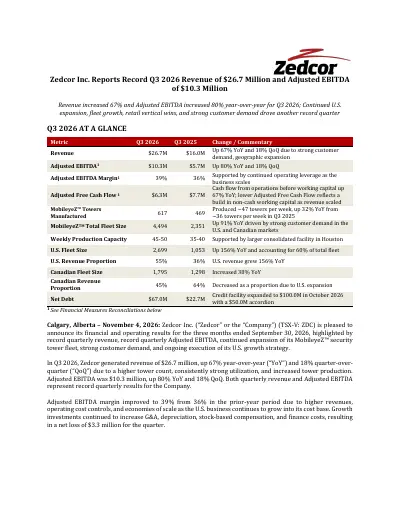
Some highlights for the record quarter include quarterly revenue of $26.7 million, up 67% year-over-year from $16 million in Q3, and up 18% sequentially from $22.7 million in Q2 2026. Growth was driven by continued expansion in the US, new customer additions in both Canada and the US, and the production, development, deployment of additional security towers.
Our recurring revenue remains steady as customers continue to add new towers and maintain utilization of existing towers on a long-term rather than a project-based basis. We also achieved record adjusted EBITDA of $10.3 million in Q3, up 80% year-over-year.
Adjusted EBITDA margin expanded to 39% for the quarter, up from 36% in Q3 2025, due to higher revenue, operating cost controls, and economies of scale, despite continued investment in the US sales and operations staff to support our expansion. We deployed 617 security towers in Q3, up 32% from 469 in Q3 2025.
We averaged approximately 47 per week, and we're executing on production capacity of 40 to 50 per week, which positions us well to meet customer demand and our fleet growth targets with upside. Our total fleet stood at just under 4,500 towers at the end of the quarter, an increase of 91% year-over-year.
Notably, about 2,700 of these towers, or 60%, are located in the US, and that accounted for about 55% of our quarterly revenue. Our US fleet grew 156% year-over-year, and year-to-date US revenues of $36.6 million significantly exceed the $21.2 million our US operations generated in all of fiscal 2025.
Year-to-date, Zedcor's results continue to track well. Revenue for the first nine months of 2026 stands at $68.8 million, up 68% compared to the first nine months of fiscal 2025.
Adjusted EBITDA was a record $26.7 million for the first nine months, up 81% year-over-year, representing 39% of revenue compared to 36% in the prior year period. Adjusted free cash flow was $21.4 million year-to-date, up 110% from $10.2 million in the first nine months of 2025, after a $1.4 million investment in non-cash working capital.
Year-to-date maintenance CapEx was just under $160,000 so far in 2026, and given the age of our fleet and robustness of our hardware, while we expect that number will increase in the coming quarters, we do not anticipate it being a significant component of cash flow, especially as we continue to scale. Before we move into more specific details regarding our Q3 2026 financial performance, I want to take a moment to highlight some of the operational and corporate milestones we've achieved year-to-date.
We've manufactured just over 1,700 towers, included six including 617 in Q3. We are executing on our manufacturing capacity, which we expanded in the beginning of the year, and we have upside on this.
We expanded our agreement with an enterprise customer to deploy 50 additional towers across 20 states, bringing our total deployment with this customer to over 50 units. We renewed a three-year enterprise contract with a leading Canadian home improvement retailer, which includes deployments of our Z-Box units.
Our direct-to-dispatch capability is now fully deployed, improving law enforcement response time for our customers and further fortifying our competitive moat. We consolidated our head office and manufacturing operations into a single Houston facility and expanded our centralized monitoring team both in Houston and in Canada.
Lastly, on October, subsequent to the quarter, on October 13th, 2026, we expanded our credit facility to $100 million plus a $50 million accordion, increasing our access to non-dilutive growth capital. We will continue to use leverage to scale the business and meet with our lending partners regularly.
Diving a bit deeper into the income statement for the three months ended September 30th, as previously mentioned, revenue was up 67% year-over-year, and US revenues of $14.8 million were up 156% year-over-year, representing 55% of total revenue. Gross profit increased to $15.5 million, up 52% from Q3 2025, representing 58% of revenue versus 63% in the prior year period.
This decrease as a percentage of revenue reflects higher depreciation expense related to our larger fleet. Excluding depreciation and amortization, gross margin was 78.7% compared to 79.5% in Q3 2025.
Adjusted EBITDA grew 80% year-over-year to $10.3 million, with adjusted EBITDA margin expanding by approximately 310 basis points to 38.7% from 35.6%, demonstrating our platform's operating leverage even as we continue to invest in US sales and operations staff. Adjusted EBITDA per share was 9 cents compared to 5 cents in the prior year period, driven by higher revenue and tight cost controls, partially offset by a higher share count following our February 2026 equity offering.
Net loss for the quarter was $3.3 million, or 3 cents per diluted share, reflecting front-loaded US investments, depreciation, stock-based compensation of $4.6 million, and finance costs. These strong results demonstrate that significant investments we have made in our business and our competitive advantages are compounding returns for shareholders.
As we position for sustainable growth in the years ahead, we expect further economies of scale, improved monitoring services, new product innovations, and conversion of a growing pipeline of enterprise customers to continue driving shareholder value. The US continues to represent the majority of our revenue.
US revenues was up 156% year-over-year to $14.8 million, supported by a 156% increase in the tower count to just under 2,700 at the end of the quarter, or 60% of the total fleet. We expect the US to continue growing as a percentage of revenue given its outsized growth rate and large market size relative to Canada.
We also expect the US to continue benefiting from economies of scale that drive margin expansion concurrent with growth. Our US business generated adjusted EBITDA of $6.5 million in Q3.
That represented a 44% margin before corporate G&A allocations. With Texas serving as our anchor in the southern US, we now have infrastructure in place to support manufacturing, in addition to uncompromised security and monitoring service levels for customers coast to coast.
We continue to invest in our US growth and expect steady-state margins to reflect an attractive return on capital over time. Canada also remains a critical component of our business in terms of profitability and growth, with revenue up 16.5% year-over-year to $12 million and fleet growth of 38% year-over-year to just under 1,800 towers, or 40% of our total mobilized fleet.
Canada continues to demonstrate the profitability potential of our platform at scale. Canadian adjusted EBITDA grew 15% to 17, $7.9 million, a 67% margin before corporate G&A allocations, driven by strong utilization, efficiencies from camera upgrades, and economies of scale.
Turning to our balance sheet, we note that we ended Q3 2026 with $3.5 million of cash and $5.8 million of undrawn availability on our $75 million revolving credit facility. We hold minimal cash by design while preserving access to liquidity through the revolver.
Subsequent to the quarter, we expanded our revolving credit facility with National Bank to $100 million plus $50 million uncommitted accordion. This adds $25 million of committed liquidity relative to our quarter-end position.
This strong liquidity position provides the funding we need to continue to grow our mobilized fleet and develop innovative services for current and prospective customers and markets. Net debt to last 12-month trailing adjusted EBITDA was just under 2 times at the end of Q3 2026, compared to 1.6 times at the end of Q2, and well below the bank-defined covenant maximum of 3.5 times.
We remain in compliance with all bank-defined covenants, and we view this as conservative leveraging ratio that allows for expansion as non-dilutive debt financing is used to support growth initiatives. Lastly, property, plant, and equipment ended the quarter at $157.5 million, an increase of $61 million, up from $96.5 at December 31st, 2025, driven primarily by the growth of our fleet and expansion of our branch network in the US.
Now for an overview of our cash flow and capital expenditures for the quarter. Adjusted free cash flow before non-cash working capital impacts was $8.7 million, an increase of 70% compared to $5.1 million in Q3 2025.
This reflects the growing cash generation of our fleet. Year-to-date adjusted free cash flow before working capital was $23 million, compared to $13.2 million in the first nine months of 2025.
After non-cash working capital impacts, adjusted free cash flow was $6.3 million compared to $7.7 million, reflecting a $2.4 million build in non-cash working capital as sales scale. Capital expenditures continue to support our growth of our mobilized fleet.
In Q3 2026, CapEx was $25.1 million, up 44% year-over-year from $17.4 million in Q3 2025. This was driven by the 617 towers manufactured in the quarter, our consolidated Houston head office and manufacturing facility, and the expansion of our service branches across the US.
Year-to-date CapEx was just over $73 million, compared to just over $43 million for the first nine months of 2025. Our growth continues to be funded by operating cash flow, our revolving credit facility, and the proceeds from our February 2026 equity offering.
I'll now hand the call over to Todd, who will provide us an operations update and share insights into our go-forward strategy.
Todd Ziniuk
Thanks, Amin. Great job.
I'd like to just take a minute. Obviously, press release was great, another great quarter, great EBITDA growth, great revenue growth.
Investments into our technology, manufacturing capabilities, and monitoring are paying off, but it's also the investment we're putting into people. I want to take a minute to thank all of our employees.
The Zedcor team's growing very fast. We have a very dedicated culture.
Obviously, you need that for these growth rates. It's not one person that makes this happen, it's a whole team of people, and I'm very proud of our team.
In terms of our growth outlook, we're very excited about our growth. Not only in the United States, but Canada continues to be strong as we keep expanding with our towers.
As far as the enterprise customers go, we're adopting a lot of new ones, we're continuing to grow ones out that we have. This is the first time in our pipeline of our manufacturing that we can pretty much safely say Q1's secured.
The brand has strengthened. We were a lot of build it and they will come.
The reality is the clients have came, and we're starting to see solid orders come in, and we're excited about that. For example, as we did put out a press release in Q3, we went from three towers with a big enterprise client to 50.
That's not where they're going to top out, that'll continue to grow, and we have a lot of that happening throughout our whole customer base. Some of these clients, they like to test you out at the beginning with a trial and then start to move their numbers, and their end numbers are quite a bit larger than what we're at, and we know there's a lot of growth in the internal customer list that we have, and our customer list is growing every day.
We, for example, extended our contract in Canada with a large retailer that started out with minimal towers, and it just keeps growing with the Z-Box and the towers, and they keep adding every year. I think it speaks to doing one three-year contract and re-signing up to the quality of services we're giving our clients.
As far as manufacturing supply chain goes, we've got that really locked down. We're in a good position going into 2027 with all of our vendors.
We're sitting at 45 to 50 towers weekly. We have the ability to scale that up when required.
We're starting to somewhat pre-build right now for some of our orders coming in in 2027. One thing I'm really proud of with our whole team and the company is the platform.
This year, at the beginning of the year, we budgeted to do about eight branches. We ended up doing closer to 12 to 13, actually.
The platform right now sits at six branches in Canada, monitoring center is number seven, and then we've got 20 operational branches right now in the US, coast to coast, from top to bottom, plus our monitoring center and operations facility in Houston, there's 21 locations there for a total of 28 locations across North America. I think something to really point out on that is we grew the branches out quicker and our margins and are managed to increase, and I think something I find quite intriguing is that out of our branches in the US, 60 to 65% of them are under a year old.
I've always talked about the platform to the analysts and on these conference calls, and we're just getting started. We've built the platform, and now we're going to fill them with incremental towers, and it's an exciting time as far as that goes.
Not only that, we're building some new products in the background that we're launching in '27 that the company's very excited about. We're remaining focused on our margins.
Obviously, it's for the shareholders, the investors, I want to thank all the investors that have stood behind us, our banks that are standing behind us on this growth pattern, and I think I've said it before, we're just getting started. A huge opportunity in front of us here to continue the growth.
We're going to be adding a few more branches probably next year, nothing like this year. I think we've got our platform built, and what that does for us as a company is it gives us the ability to give service, and our service day over day keeps winning, the white-glove service that Zedcor gives our clients.
It's an important part of the business. We stand by what we say we can do: quick deployments, number of towers that we can move across the country very fast.
I think it cuts us apart in the business. Right now I'll turn it back to Amin, and we can turn it over to the analysts for some questions, and I'd just like to say thank you to everyone.
Amin Ladha
Thanks, Todd. That's our update for Q3.
I'll hand it back to Kim. If you have a question, please raise your hand and we'll allow you to talk.
Operator
Thank you, Amin. We'll take questions from analysts only.
The first question comes from Doug Taylor with National Bank.
Todd Ziniuk
Morning, Doug. Is he muted?
Can you hear us, Doug?
Amin Ladha
We can't hear you, Doug. We'll come back to you, Doug, if that's okay.
We'll jump to Ian Gillies from Stifel next, make sure we're not having technical difficulties on our end.
Ian Gillies
Morning, guys. Can you hear me?
Amin Ladha
Loud and clear. Yeah.
Ian Gillies
There we go. Todd, I think you mentioned something really important in the prepared remarks about you've added a lot of branches over the last 12 months, and now you need to fill them up with units.
Can you maybe talk a little bit about US EBITDA margins and when you anticipate they may start expanding again? I think it's pretty natural with what's transpired this year, but at some point I would expect to get some lift.
Todd Ziniuk
Absolutely. We put a lot of money, obviously, Ian, as into SG&A and our G&A.
You open these branches, you get a manager, you build out a sales team, and they start to produce, and the incremental towers we're going to add are going to obviously help that EBITDA margin. I think we've got a lot of build-out to do adding towers, and just keep building the towers and bringing in the revenue.
Obviously, I think the lift's going to be there moving forward. Amin, I think?
Amin Ladha
Ian, roughly speaking, it takes about 60 units at a location to break even, cover kind of the initial hiring costs, the rent, the vehicles, that kind of stuff. Then kind of above 80 to 100, the branch is profitable and it covers its fixed costs.
That's probably going to start happening over the next two, three quarters here for the kind of locations we opened up in Q3 and Q2 of 2026. It doesn't take a ton of time to ramp up, well, obviously we have added a bunch of locations and that reflects in the numbers, but the consolidated EBITDA is kind of going up as a percentage, so that's supported by the mature branches.
We're going to start seeing, I think, some meaningful improvement going forward in the next kind of two, three quarters.
Ian Gillies
No, that's helpful. On revenue mix and sending towers out to customers with and without monitoring, can you maybe just talk about, when you do that, how do you think about the return profile for the business?
Because obviously just like a straight rentals business, the returns are usually very, very good, and so I'm just curious how you think about that mix, perhaps maybe where you want to be, and how you see the business progressing.
Todd Ziniuk
Go ahead. I
Amin Ladha
think we look at this slightly different than a rental business. I think they look at it more on a return on invested capital, which we do too to some extent as well, but we have kind of the cost associated with the service as well.
Our units probably last a little bit longer than a traditional rentals business. I think they're not a perfect comparison, but they're a good comparison.
I think our returns are pretty attractive on an incremental unit basis. I don't know if you have anything to add on that.
Todd Ziniuk
I think, Ian, too, something I want to point out about the tower we've built: we don't see a bunch of downtime. Our very first ones we started out with were 240 from a different manufacturer.
The downtime with those, we had to really do a lot of things to them to get those dialed in to where we wanted them. The unit that we actually designed, built, we're not seeing the downtime, we're not seeing the R&M, we're not seeing the call-outs with them.
It's going to make that side of our business quite profitable, where it is kind of, I guess, what you somewhat want to call a dry rent on the towers, and we're going to have a handful of clients that want to do that with us. The reason we're starting to get that, too, is because we got the platform, and it is the quality of the tower.
These big machines that want to do that, they're spread across North America, we're spread across North America, it makes sense for a great partnership. I think it's an exciting side because, also not even with that, some of them, they do their own monitoring and stuff as well, we're working with them on their monitoring.
The reality is, we've got eight years of experience monitoring underneath our belts, and there's growing pains that come with that. It's easy to monitor 50 towers, but when you try to do 700, that game changes, right?
I think you see that, not to get off topic here, Ian, but even in the mom-and-pops that are coming along, it looks really good and easy to do at 50, but try to do it at 300. I think that's something we figured out very early on in this business, right down to the different ways we stream, how we do things, our technology team, the stuff they've built over eight years is absolutely phenomenal in the background.
Those are parts of the recipes that probably investors don't get to see or quite understand. It looks like just a camera on a tower, but some of these clients that want to go that way, once they get to a volume, they might come back and say, "You know what?
Maybe we just need you guys to do the monitoring." That's all about just forming partnerships with these clients, right?
Either way, we'll have their back, right?
Ian Gillies
No, that's very helpful and great color. Thanks very much.
I'll turn it back over.
Todd Ziniuk
Thanks, Ian.
Operator
Our second question comes from Mark Neville with Canaccord.
Todd Ziniuk
Morning, Mark.
Mark Neville
Hey, good morning, guys. Can you hear me?
Todd Ziniuk
Yes, sir.
Mark Neville
Okay. I'm just curious, I guess, sort of to follow up, but just on filling out the branches and sort of having the platform built, it's obviously very encouraging.
Just, it seems like the current production is sort of running ahead of what we thought, and again, I think that's probably why, but I guess how many more quarters of that should we expect of sort of this higher level of production, just in terms of modeling out CapEx and stuff?
Amin Ladha
The CapEx, I think, is going to stay consistent. Our initial plans for 2027 are kind of in the same levels of 2026, minus the branch expansion costs, Mark.
Like Todd mentioned earlier, we're probably not going to build as many or add as many locations in 2027 just because we've built a whole bunch in 2026 and we need to give them some time to grow. Initially we thought we'd need a lot more locations, and we might have to backfill some of them, but I think we're starting to see, like Todd mentioned earlier, these units don't go down, we don't have to service them as much, and most enterprise customers give us an 8-hour window or a 12-hour window or 24-hour window, whatever is in their contract, and that's plenty of time to get to the units within kind of most major metroplexes, which we're already in.
Kind of 2027, we're probably going to add four to six locations, well, we're going to continue to invest in the same number of towers and hopefully increase that as we get some more traction with these enterprise folks.
Mark Neville
Right. If you're at sort of 25 branches next year, just doing quick math there, would that give you sort of full national coverage?
Amin Ladha
I think we're pretty close to that right now. It might be a stretch to get some northern regions, like in the Northeast and the Northwest, so.
Todd Ziniuk
They'd be strategic placement.
Amin Ladha
Yeah.
Todd Ziniuk
Of branches where heavy traffic areas, takes a little longer to get there. Like that Northeast corner, we probably need one or two, maybe getting down into that Southwest corner just because the state's so big down there.
I'm happy with where we're at. I think, obviously going into Q1, we're just going to build what we have, and let's get after it.
We've got a sales team in place, we've really been spending a lot of time on our sales team, and inside sales, enterprise sales, it's all going to be really starting to kick in, and we got great branch managers across the branches. It's kind of like we've set the stage now, and now let's just go build towers and keep doing what we do.
A lot of time was tied up, people don't really, I think, understand what goes into setting these branches up. It's right down to finding the buildings, finding the people.
We've essentially done 12 cold startups with a brand that, when you move into an area, it's a new brand. It takes a lot of work, and we're very pleased with where it's at.
Amin and I didn't think we'd be able to hold the EBITDA margins as well as we did. I think we did a great job on that, and yeah, it's exciting.
I'm very excited about going into 2027, to be quite honest.
Mark Neville
All right, guys, that sounds great. Good luck.
I'll pass the line, but good luck.
Todd Ziniuk
Thank you.
Operator
Our third question, we're going to loop back to Doug Taylor with National Bank.
Doug Taylor
Thank you. Hopefully you can hear me this time.
Todd Ziniuk
We got you, Doug.
Doug Taylor
All right. Todd, you said, I think in your remarks there, I think you said Q1 is secured in terms of backlog or higher visibility.
You're talking about two reporting quarters out here. Is that a number or something, can you quantify that just to help us think about it, and whether you're adjusting the inventory builds or build rates significantly one way or the other in response to that?
What more can you tell us about that?
Todd Ziniuk
Sure, I can give you a little more color. The reality is, Doug, we're running at about 85, 86% utilization.
I always refer to that, that's on our everyday towers, right? Those are out at the branches, it gives us the ability, you know what, to get utilization up on them, and stuff that we know that's coming in our pipeline, I guess that's about as much as I can say, is going to help Q1, secure the build cycle for that.
I think Amin, he could probably even add a little more color to that, that there might even be further build-out on that. It's been so much we build it and they will come, and we're at the point of they've came, right?
Amin Ladha
I think, to elaborate a bit is that kind of 45 to 50 units that we build a week, we're fairly comfortable having that committed for Q1 and Q4. Now we can start getting into the higher-level conversations with some of our customers and start saying like, "Hey, you've kind of started with 50, for example.
Let's start talking about Q2 and Q3 so we can get you into some of these build slots. What are your needs?
What are your plans?" Before, it was kind of reactionary where we would just supply and we weren't having those higher-level conversations, but now that we've kind of got the commitment and the build slots tied up, we can start having those conversations with the customers and not sound overly arrogant, if that's the right word.
Doug Taylor
No, you don't. I just wanted to quantify.
Are you talking about having 1,000 towers of visibility? I think that's what that would work out to, I just wanted to make sure I'm understanding the degree of visibility you've got.
Amin Ladha
That's pretty bang on, Doug. Okay.
Doug Taylor
Okay. The C-store rollout you announced over the last few months, has that all happened at this point?
Maybe you can talk about any feedback you got there, because I know that was a situation where you saw an opportunity to scale further, and maybe that speaks to my earlier question about visibility.
Todd Ziniuk
Absolutely. The interesting thing with that, Doug, is, we didn't even expect to get that 50 this year, and they kind of got a budget to get 50 more.
All these big machines go into their 2027 budgets. They've told us they're very, very happy with what we're doing and there's going to be more to come.
We haven't got numbers on that. It's coming down to execution, Doug, and we've executed very well with them.
I think the company they've been using, I don't believe has a monitoring, and we're doing some different style of monitoring for them, and they're very happy with it, the reports they're getting and all the different things from their area managers, they love the product. I think it's just a matter of they get their new budgets out, 2027 numbers coming our way, and I think it's going to build.
I'd love to be able to sit here, Doug, and say it's 100 more, 200 more, 300 more. The number could be quite staggering, we just don't have any numbers yet from them.
Amin Ladha
We've got preliminary indications, and just to clarify, those 50 towers were deployed in a matter of a week, approximately, if not less.
Todd Ziniuk
20 different states.
Amin Ladha
They're already out there generating revenue, getting paid, it's a good little contract to start
Doug Taylor
it. Maybe one more for me.
You talked about the tower CapEx being similar, a little lower on branch build-out CapEx. I think the third piece would be the software development initiative, and, eyeballing it, it seems like you've spent a good portion of the anticipated budget you'd once talked about for that program.
Can you maybe refresh us on the progress there and the anticipated further CapEx to get to whatever milestones you think you're going to hit next year?
Amin Ladha
Phase 1, we're going to get our hands on for testing probably in December. Kind of December and into Q1, we'll test it, start rolling clients onto it, and do kind of a slow rollout, and we want to make sure it works.
We spent a ton of time analyzing how we're going to host this, how we're going to run the software, so that's getting set up. I think some of the additional costs might be on the hardware side for Phase 1, just with GPU costs and AWS hosting costs going through the roof, it might make sense for us to do it on-prem rather than in the cloud, some of that might have changed.
Other than that, Phase 1 is right on track, kind of for that Q1 piece. Then kind of into 2027, we're going to start expanding the capabilities of that software, adding on AI analytics, agents that are going to make our operations more efficient, so that's going to be kind of the Phase 2 development.
Initial kind of prelim costs are probably in that $5 to $6 million US for 2027 is the plan, Doug, if that answers your question.
Doug Taylor
It does. Thanks for looping back to me after I punched through my IT issues.
I'll cede the floor here.
Amin Ladha
All good. Thanks, Doug.
Todd Ziniuk
Thanks, Doug.
Operator
Our fourth question comes from Sean Jack with Raymond James.
Sean Jack
Hey, good morning, guys, and congrats on the results. Most of the questions I had have already been answered, I just wanted to loop back on Canada and just hear about how the geography continues to produce some pretty solid growth here.
Just wanted to see if you guys are seeing any sort of lift in outlook from all this talk around nation-building projects. Are the kind of key end markets that you're seeing shifting at all?
Any further color would be great.
Todd Ziniuk
I think, Sean, you know what, there's going to be a lot of good projects coming up in Canada. I think everybody, the investors and you guys as analysts, know that.
I think there's going to be a bunch of pipelining coming up. We cut our teeth on pipelining.
We've built quite a bit more robust towers since we did the big Trans Mountain and the TC Energy projects. I think we can handle big projects, we understand them, we've done them.
A mom-and-pops to go into them, there's a lot that goes into them, these big projects, and I think that's going to be a big strength in Canada. We're going to see a lot of those opportunities come along.
We're already starting to have companies reach out to us, some of these guys are getting back into roles in security departments with companies, it's exciting. I think even the projects we've done out east, LRT projects, these style of projects continue to grow.
It's built a great relationship, for example, with us with a company called Kiewit across North America, and that all started with us being on Spread 7 at Trans Mountain with Kiewit Ledcor, and they've stood behind us, they've seen what we've done, they know that we've got eight years under our belt of doing this, they've seen our new products. It's exciting.
I think, and a lot of these companies are in the US as well, it's US-Canada growth blended together. There's a company right there that has major, major projects everywhere.
I don't know if you'd like to add to that, Amin.
Amin Ladha
I don't want people to think that we need these projects for Canada to kind of continue that 20 to 30% growth that we've always kind of targeted for that region. These projects will help that and maybe enhance that, but security's kind of funny: it's important, and it's the last thing some of these larger projects think of.
We tried to work for a large Canadian pipelining company that has US operations and never got in the door with them, and then one day something blew up on their site in the US, and suddenly they're taking towers and they're going to be a significant customer. There's another enterprise customer that it's hard to see the press release or it's hard to kind of see the headlines in the newspaper of what they're doing, but these Canadian projects are great.
I think they're going to go ahead, and once they do, the security RFPs will come out, but they'll probably come out well after kind of the approval. We don't want to pin our hopes on that, and we're not doing that as a business.
Sean Jack
Perfect. That's great color, guys.
That's all for me. Appreciate it.
Todd Ziniuk
Awesome. Thank you, Sean.
Amin Ladha
Thanks, Sean. I think that wraps it up.
Thanks, everyone, for attending, and we'll look forward to next quarter.
Todd Ziniuk
Thank you very much.