United Microelectronics Corp.
Q3 FY2026 · Earnings Call TranscriptOctober 28, 2026
Operator
Welcome, everyone, to UMC's 2026 third quarter earnings conference call. All lines have been placed on mute to prevent background noise.
After the presentation, there will be a question-and-answer session. Please follow the instructions given at that time if you would like to ask a question.
For your information, this conference call is now being broadcasted live over the internet. Webcast replay will be available within two hours after the conference has finished.
Please visit our website, www.umc.com, under the Investor Relations, Investors, Events section. Now, I would like to introduce Mr.
Michael Lin, Head of Investor Relations at UMC. Mr.
Lin, please begin.
Michael Lin
Thank you, and welcome to UMC's conference call for the third quarter of 2026. I am joined by Mr.
Jason Wang, CEO of UMC, and Mr. Chitung Liu, the CFO of UMC.
In a moment, we will hear our CFO present the third quarter financial results, followed by our CEO key message to address UMC's focus and fourth quarter 2026 guidance. Once our CEO and CFO complete their remarks, there will be a Q&A section.
UMC's quarterly financial reports are available at our website, www.umc.com, under the Investors, Financials section. During this conference, we may make forward-looking statements based on management's current expectations and beliefs.
These forward-looking statements are subject to a number of risks and uncertainties that could cause actual results to differ materially, including the risks that may be beyond the company's control. For more detailed description of these risks and uncertainties, please refer to our recent and subsequent filings with the SEC and the ROC security authorities.
During this conference, you may view our financial presentation material, which is being broadcast live through the internet. Now, I would like to introduce UMC's CFO, Mr.
Chitung Liu, to discuss UMC's third quarter 2026 financial results.
Chitung Liu
Thank you, Michael. I'd like to go through the third quarter 2026 investor conference presentation material, which can be downloaded or viewed in real time from our website.
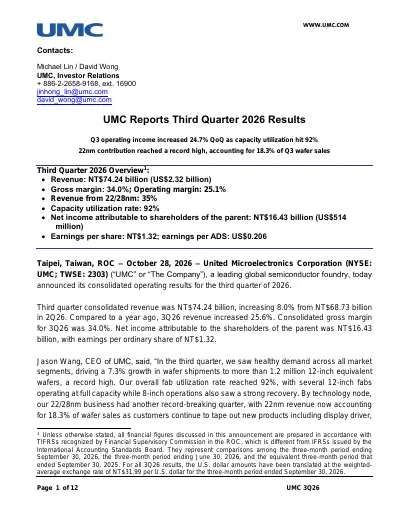
Starting on page 4, the third quarter of 2026 consolidated revenue was NT$74.24 billion, with gross margin rate at 34%. Net income attributable to the shareholder of the parent was NT$16.43 billion, and earnings per ordinary share were NT$1.32.
Capacity utilization rate in the third quarter reached 92%, compared to 85% in the previous quarter. Overall EPS for the quarter was NT$1.32.
On page 5, revenue grew 8% sequentially to reach NT$74.2 billion. As we stated earlier, gross margin rate also improved from 32.5% in the previous quarter to 34% in this quarter, or NT$25.2 billion.
EPS per US ADS is $0.206. For the year-over-year comparison on page 6, revenue grew 16.1% to NT$204 billion, and gross profit also grew 30.8% year-over-year to 65.3 billion, or 32% of the gross margin rate.
With the help of the non-operating income, overall net income attributable to the shareholder of the parent grew 136.5% year-over-year to reach NT$74.86 billion for the first nine months of the year. EPS for the first three quarters reached $6 in NT dollar terms, or $0.945 per ADS in US dollar terms.
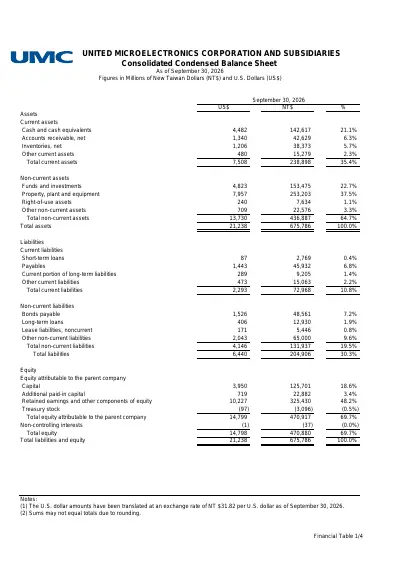
On page 7, our balance sheet at the end of third quarter, total equity is NT$470 billion, with cash account for about 142 billion on the September 30th. For blended ASP in the third quarter was relatively stable, remained firm compared to the previous quarter on page 8.
For revenue breakdown on page 9, there's a very little change for quarter two compared to quarter three of 2026 for revenue breakdown by geography. On page 10, our revenue breakdown by customer type also remained virtually unchanged, for IDM with about 14% of the total revenue, and fabless account for the others.
For revenue breakdown by application, consumer stayed unchanged at around 32%, when communication and computer also stayed quarter-over-quarter unchanged. On page 12, our 22 and 28-nanometer revenue still account for more than one-third, reached about 35% of the total pie chart, and 40-nanometer is around 16%, and 65-nanometer is about 19%.
Our quarterly capacity continued to increase slightly, mainly coming from our 12i facility in Singapore. For quarter four of 2026, we expect the capacity for overall UMC reach about 1.33 12-inch equivalent—1.33 million for 12-inch equivalent capacity by Q4 2026.
CapEx, compared to the last quarter's estimate, still remain unchanged around $2 billion. The above is the summary of UMC result for third quarter 2026.
More details are available in the report, which has been posted on our website. I will now turn the call over to CEO of UMC, Mr.
Jason Wang.
Jason Wang
Thank you, Chitung. Good evening, everyone.
Here, I would like to share UMC's third quarter results. In the third quarter, we saw a healthy demand across all market segments, driving a 7.3% growth in wafer shipments to more than 1.2 million 12-inch equivalent wafers, a record high.
Our overall fab utilization rate reached 92%, with several of our 12-inch fabs operating at full capacity, while 8-inch operations also saw a strong recovery. By technology node, our 22/28-nanometer business had another record-breaking quarter, with 22-nanometer revenue now accounting for 18.3% of wafer sales, as the customer continued to tape out new products, including display drivers, automotive radar, and Wi-Fi ICs.
In new business area, active customer engagement for advanced packaging and silicon photonics remained robust. We expect this engagement to translate into accretive growth over the coming quarters as we ramp existing projects and support new product tape-outs.
Looking ahead to the fourth quarter, we expect the positive demand momentum to sustain, supporting stable shipments and utilization rate. Revenue from our specialty technology portfolio will continue to grow sequentially, driven in part by the ramp-up of our advanced packaging and silicon photonics businesses.
We have seen a significant increase in demand for these new business areas, and we are in the process of converting some existing capacity to address near-term unfulfilled demand. In the longer run, our dual-track expansion plan in Singapore and Tainan will be crucial to ensure UMC's capacity growth and keep pace with our customers' needs.
We are pleased to announce our board of directors today approved an additional capital expenditure budget of approximately US$3.2 billion, which will enable us to accelerate our expansion schedule as we continue to align with customers on their product roadmap and requirements. Now, let's move on to fourth quarter 2026 guidance.
Our wafer shipment will increase by low single-digit. ASP in US dollar will remain firm.
Gross margin will be comparable to the preceding quarter. Capacity utilization rate will be in the low 90% range.
Our 2026 cash-based CapEx budget will be at US$2 billion. That concludes my comments.
Thank you all for your attention. Now, we are ready for questions.
Operator
Yes, thank you. Ladies and gentlemen, we will now begin the question-and-answer session.
If you have a question for any of today's speakers, please press star key and number one on your telephone keypad, and you will enter the queue. After you are announced, please ask your question.
If you find that your question has been answered before it is your turn to speak, please press star key and number two to cancel the question. Thank you.
Our first question will be coming from Sunny Lin, UBS. Go ahead, please.
Sunny Lin
Good afternoon. Thank you very much for taking my questions.
Several questions from my side. Number one, now that UMC will finish 2026 on a high note, any early view for 2027 based on the current visibility?
Jason Wang
Yes. For 2027 early view, we expect the growth momentum established in 2026 will continue into the next year, supported by the healthy demand across our core business and growing opportunity in differentiated technology and high-value applications.
If we look at this, in 2026, our growth has been driven primarily by high wafer shipments, improving utilization, and customer share gain. Looking ahead to 2027, we expect the further growth.
Although with utilization already above 90% and several technologies operating at our near-full capacity, our shipment growth will increasingly be constrained by available manufacturing capacity. AI remains to a key growth driver, creating demand across power management, FPGA, and connectivity application.
Meanwhile, the silicon photonics and advanced packaging are emerging as a new growth engine for UMC, addressing the next-generation optics connectivity, power delivery, and memory bandwidth requirement for AI infrastructure. Beyond AI, we continue to see opportunity from customer market share gain and increasing foundry share across premier smartphone, automotive, industrial, and other specialty applications, despite an uneven recovery in some end markets.
With customer demand in selected technology already exceeding our available capacity, we see opportunity to capture greater value from our existing manufacturing footprint through improved pricing and richer product or technology mix in 2027, alongside continued shipment growth. While 2026 growth were driven primarily by volume and utilization, we expect 2027 to become increasingly value-driven, with higher value per wafer and differentiated technology and contributing more to UMC revenue growth and long-term earning potential.
Sunny Lin
Thank you very much. Very helpful and encouraging.
On the pricing side, how should we think about the ASP environment for UMC, especially going into 2027? How are the negotiations with key clients progressing for the coming few quarters?
Jason Wang
We are engaging with customers right now for our 2027 pricing, and we're seeing a significant shift in pricing environment heading into 2027, supported by a strengthening customer demand and increasing tight capacity in selected technologies. We see clear opportunity for pricing improvement across both our 8-inch and 12-inch business, while maintaining our disciplined and value-based pricing approach.
Importantly, we expect 2027 to mark a turning point in our blended ASP trajectory, moving from an environment of ASP erosion toward a meaningful, positive uplift beginning in the first quarter. While we anticipate at 10% of blended ASP increase year-over-year, this is more than an incremental pricing improvement.
It reflects both a more constructive pricing environment and our increasing ability to capture value through a richer product and technology mix. Our record-high 22-nanometer revenue contribution and continued specialty technology momentum also provide a strong foundation, while silicon photonics and advanced packaging create additional higher-value growth opportunity as they scale.
Sunny Lin
Thank you very much. Also, maybe a quick follow-up.
You mentioned 10% year-over-year improvement. Is that initial view for your blended ASP improvement going to Q1?
Jason Wang
No, that will be on a year-over-year basis.
Sunny Lin
So 10% would be your target through 2027, not just for Q1?
Jason Wang
As a whole, a year-over-year of 2026 year compared to 2027, year-over-year, yes.
Chitung Liu
We will provide Q1 ASP guidance for the next quarter's earnings call.
Sunny Lin
Got it. Then maybe on the CapEx, you just mentioned an additional $3 billion budget on top of the $5 billion budget announced a quarter ago.
Now, could you share a bit more color on how that translates into capacity expansion in the coming few years? Then on silicon photonics and advanced packaging, how are you seeing the market demand overall in coming years?
Jason Wang
We are accelerating selected investments because several of our new growth businesses are moving from technology development into commercial execution, which faster than our original capacity roadmap anticipated. We are seeing three things happen at the same time: the market is expanding as the AI infrastructure drives higher requirement for bandwidth, power delivery, memory, performance, and system integration.
Our customer engagements are also progressing from qualification into production ramps and capacity planning. At the same time, our solution roadmap is moving forward, with a product already in mass production and additional product completing tape-outs, customer validation, and new generation of product already under development.
Our focus now is shifting from whether this opportunity will materialize to how quickly can we extend capacity to meet the customer demands. Under our current expansion roadmap, we are targeting monthly capacity of approximately 18k wafer for silicon photonics, 22k for DTC and silicon capacitor, and 20k for TFLN modulators.
This next phase of the capacity will start its ramp in late 2028 and reach its planned scale by 2030. This is not a broad-based capacity expansion.
We are directing our capital toward customer-backed growth opportunity that will fuel UMC's next phase of growth. That will give you a flavor why we are accelerating and milestone how we plan for those CapEx.
For your question on the silicon photonics and advanced packaging, we believe UMC is well positioned to capture the next wave of AI infrastructure opportunity through our competitive silicon photonics performance and proven manufacturing execution and advanced packaging capability. In silicon photonics, our data indicate that our PIC technology outperform peers in key parameters, such as propagation loss, supported by our manufacturing high production yield now.
Our 12-inch PIC platform already supported 1.6T optical applications, while our 8-inch TFLN platform has completed 1.6T system validation with industry-leading yield. Building on this achievement, our roadmap extend toward 200G—200G per lane and ultimately 400G per lane solution for next-generation 3.2T applications, supported by hybrid bonding, TSV, and chip-to-wafer integrations.
For the advanced packaging, we are making progress in two key solution areas: a DTC for power delivery and customized memory stacking. Our discrete DTC solution for mobile has entered mass production this quarter.
For AI and server application, our substrate-embedded DTC solution has completed tape-out and functional-verified. With our customized memory stacking solution has passed initial customer verification to address the growing bandwidth requirement of AI inference.
All this achievement demonstrate UMC's ability to translate technology innovation into the commercial execution now. By combining the device performance, manufacturing expertise, and close customer collaboration, we are expanding our role in next-generation AI infrastructure, helping the customer to address the three critical requirements, including faster optical connectivity, more efficient power delivery, and high memory bandwidth.
That's why we believe we are in a great position to capture those opportunities.
Sunny Lin
Thank you. It does sound like your capabilities are pretty competitive.
Then for both silicon photonics and also advanced packaging, say, for EDTC or silicon capacitors, some of your peers are also building more supply. Should we be concerned about maybe potential overbuild, say, if AI demand slowed down at one point?
How should we think about the overbuild risk?
Jason Wang
We look at this on twofold, right? One is the demand side.
First, we are seeing a very strong demand driven by the AI-related application for silicon photonics and advanced packaging. In silicon photonics, we have been working with a leading customer.
We recently achieved significant milestones as a multiple hyperscaler qualified our 1.6T optical transceiver platform. Our 12-inch PIC platform supported the 1.6T application, and the 8-inch TFLN completed the 1.6T validation and the already demonstrated manufacturing yield.
With the roadmap going to next generation, and with the end of advanced packaging, our discrete solution, like we said, and our first industry discrete DTC solution and for the AI and server application has completed tape-out with our key customer, and the focus of the customer discussion already moved to that from validation to customer demand planning. Our current expansion plans are tied to those customer commitments in terms of demand.
How about the overbuild? Based on what we see today, we do not believe we are building ahead of the market.
Demand for silicon photonics and related AI infrastructure are growing faster than qualified capacity is being added. We continue to monitor our peers' expansion and timing of the new industry supply closely, too.
Oversupply, overcapacity is an industry question, not just an UMC question. We look at how quickly end demand is growing relative to the capacity being added by overall industry.
Based on the customer demand and industry capacity plan we see today, we believe the market can support the expansion we are planning. Meanwhile, UMC is building the capacity in phases to mitigate risk.
At the same time, we remain cautious and disciplined in how we add capacity. Most importantly, our capacity expansion is backed by customer commitment, like I said earlier, and tied with customer product roadmap, production ramp, and capacity requirement.
Even with all this expansion, we expect customer demand to exceed our planned capacity according to the customer, underscoring the strength of the commercial opportunity ahead and our decision to accelerate the selected investments.
Sunny Lin
Got it. Sounds good.
Sorry, a last question if I may. Also recall a quarter ago, you quantified the AI-related sales to be about $300 million for 2026, and you have a target to triple or more than triple to over a billion by 2029.
Now with the accelerated expansion for both silicon photonics and advanced packaging, how should we think about your AI revenue by 2029?
Jason Wang
Okay. You remember.
Now, our AI-related business span a broad range of specialty semiconductor solutions, support power management, connectivity, FPGA, as with our growing advanced packaging and silicon photonics. All these applications are becoming increasingly important contributors to our growth going forward.
We are extending our capacity, like we reported, and investing in technology, manufacturing infrastructure to address all those growing demands. Our AI-related revenue, it is close to $300 million in 2026.
Looking ahead in three years, we expect our AI exposure will probably exceed quarter of our revenue now.
Sunny Lin
A quarter of UMC sales maybe by 2029?
Jason Wang
Yes.
Sunny Lin
Got it. Thank you very much.
Sorry, let me get back to the queue.
Jason Wang
Thank you.
Operator
Thank you. Next one, Laura Chen, Citi.
Go ahead, please.
Laura Chen
Yes. Hi.
Thank you for taking my questions. Good afternoon, gentlemen.
Just a quick follow-up on the 10% increase on pricing. It's more like a blended ASP increasing, or like-to-like increase into next year?
Jason Wang
It is a blended, yeah.
Laura Chen
It's
Jason Wang
more than incremental pricing improvement. It reflects both the pricing environment improved and our increase of capture the other products, richer product and a different product mix, yes.
Laura Chen
Got it. Very clear.
Also, we think we have a various difference plan for AI-related applications. Can you give us more color about that, how much the capacity we are planning for the silicon photonics, including in Taiwan and also many in Singapore?
Also on the TFLN, we are ahead of our peers. Just wondering, can you also give us update about the capacity build-up plan, and in maybe two years, how big the capacity we are looking for?
Thank you.
Jason Wang
Giving the current milestone and the facility and tool schedules, it's we doing all this expansion in phases, and we'll continue updating you in terms of the progress. Meanwhile, we're still working closely with our suppliers.
Hopefully, we can accelerate and expedite those installations. Meanwhile, as I mentioned earlier, if I look at the overall CapEx plan and which approved by our board, the capacity build-up is approximately 18k for silicon photonics, 22k for DTC, which is silicon capacitor, and 20k for TFLN modulator.
At this current stage, we project the initial install will happen in late 2028, and going into 2029, and reach the scale by 2030. Now, for the location-wise, we are focused on the silicon photonics in Singapore facility, and the silicon capacitor in our Tainan facility, and the TFLN will be in our 8-inch operation.
Laura Chen
Sure. Thank you very much.
I know probably we will talk more next year, but I think given the high utilization rate is already 90%-plus, and also pricing into next year is more favorable, are we seeing that any structural gross margin upside based on current visibility?
Chitung Liu
Certainly, the price increase is likely to happen in the first quarter, we are also seeing some headwinds from the increased raw material costs, which we need to work hard to offset the impact. It's our view that the structural profitability remain intact.
EBITDA margin, certainly we will see in good shape if we compare to the previous cycle. Due to the stronger-than-expected CapEx led by stronger customer demand, depreciation will be higher, and gross margin as a result is unlikely to see near the previous high level.
We will maintain a disciplined spending and try to capture the megatrend of the AI growth opportunity.
Laura Chen
Okay. Thank you.
Very helpful.
Operator
Thank you. Next one, Bruce Lu, Bank of America.
Go ahead, please.
Haas Liu
Yes, thanks management team for taking my question. I think just starting from price hike by 10% year-on-year, you clarified it is going to be on blended basis.
Would you be able to share on the like-for-like basis how much is going to be hiking? How much of the that of the price hike is related to the cost pass-through?
How much of that is because of the tighter supply-demand landscape?
Jason Wang
If we look at the on a very high level, like I said, we expect 2027 will mark a turning point. The the ASP trajectory will moving from, historically the erosion to a uplift.
We are talking to our customers and across the the broad range of the the applications. Now, on the the conversation actually is more complicated, as, the one is there are current contractual relationship, a portion of that, and secondly, and a focus on different node and application and technology.
They are various. The there's a mix of the the the pricing adjustment, you know.
Therefore, it's a lot easier to look at this on a the blended basis and so instead going to every specific area, because they they are quite complex in terms of the the mix, yeah. Okay.
Haas Liu
Because the reason why I'm asking this question is because your utilization has been improving by 16% from fourth quarter last year to fourth quarter this year based on your guidance, but your pricing has been relatively stable. Just wondering why your customers suddenly decided to accept this price hike by 10% in 2027 if in the past couple of quarters you have been striving to improve your utilization by 16%, but blended has been blended pricing has been relatively more stable, but now you are seeing an inflection of that?
Is it because of the product mix, or cost pass-through that your customers decided to share the burden with you?
Jason Wang
Both, right? The the product mix is part of this, and and part of that is really reflecting the inflationary cost increase.
We are seeing, like Chitung mentioned earlier, we are seeing a some of the the rising cost headwinds and and also additional depreciation associated with our our investment. While we anticipating that, while the the overall the customer demand are increasing and increasing tight capacity on selected technology, combination of all those resulting in the conversation with the customer.
I think the customer understand the overall industry tightness in terms of capacity, and also understand the rising cost. In a variable space.
That's why I think we, I think this is a naturally a a conversation that we will have at this current point with the customer. We usually do this on a yearly basis.
Again, we started this conversation in Q3, and with with the alignment going into Q4, we're at a very late stage of those conversations. We we have a fairly confidence with the the guidance that we just provided, yeah.
Got it.
Haas Liu
That is very helpful. Second question is probably just on your current expectation for the consumer and market demand in 2027, because the supply chain seems to be suggesting that the unit demand across smartphones, TVs, and PCs could be down from the unit demand perspective.
If that negatively affects your utilization, keeping at around low 90 percentage levels instead of further hiking to close to full levels, would your customers be able to request for some price discounts or pushback on the price hike through 2027, and how would you deal with it?
Jason Wang
Let me kind of explain about the utilization outlook. We we are expecting the capacity utilization to remain at a very healthy level.
In this year, we improved from 85% in Q2 to above 90% in the second half of 2026 already, with several of our 8-inch and 12-inch fabs operating at a full loading at this current point. We are seeing the AI-driven upside demand, such as power management and FPGA, which we cannot fulfill the demand today, and the backlog PO is piling up.
We we will continue to optimize the production efficiency by debottlenecking the key steps and transferring the technology across different fabs to maximize the output. Operationally, there are minor mismatch between our demand and capacity configuration.
When you see less than 100%, it does not doesn't mean the the fab is not fully loaded. It's really more of the mismatch between the demand and capacity configuration.
We are working diligently to address this capacity configuration mismatch. We are upgrading our manufacturing capability to support our long-term product mix optimization as well.
For instance, we we are converting one of our 8-inch fab to expanding TFLN capacity. While we converting that, and the loading is, will be will be lower, but doesn't mean the the the facility is not being occupied and and work on it.
While we're strengthening our silicon photonics roadmap and pursuing UMC's future growth, all those are critical for our future growth. We we are managing that through this through this activity.
That said, the 90-some percent is doesn't translate to a vacancy in terms of the capacity. It's more of a mismatch situation, yeah.
Haas Liu
Yeah. Just a quick question before jumping back to the queue is it is very encouraging to see that you approved CapEx, additional CapEx to support your new businesses, including silicon photonics, TFLN, and silicon capacitor.
Would you be able to provide the timeframe on your spending through the next few years? Because last time you guided 2027 CapEx could be up to like $3 billion, but now with incremental CapEx, would you be able to just provide an update on that?
Relatively is how do how should we think about the economies of scale of your new businesses, including TFLN, silicon capacitor, as well as silicon photonics, that by 2029 when this capacity starts to ramp to a certain scale, would those business be the gross margins for those business would they be comparable to the corporate average, or still going to be below because of the higher depreciation burden? Thanks.
Jason Wang
We we can provide you the update when when the the the update is more clear to us. Like like we have board approval, and now we are closely working with the supplier to make sure that we can accelerate and expedite the schedule.
Once those information are conclude, and we'd be able to give you more a concrete outlook in terms of the milestones. Meanwhile, we are phasing in the different these different capacity in a different timeframe.
Since we're still still in motion on that negotiation, and probably not the right time to provide you that. On a high level, we we feel very comfortable with all those demand.
We only things, we worry about now is we can really get them fast enough to our facility. Let us work on that, and when going into the the Q1 next year, we should give you a more clear picture with a with the next phase.
Now, in terms of the the each of the economics, I mean scale and the benefits to the to to our business, the the silicon photonics will ramp in 2027, followed the advanced packaging in 2028 because of facility reason. The the and I think the all those will be accretive to our our current models, because the the they, right now they they above our current corporate average, yeah, higher than our corporate average in our compared to existing solutions.
Haas Liu
Okay. By the time this new business starts to ramp in 2028, 2029, those businesses should be carrying higher than corporate average margins even with higher depreciation.
Jason Wang
That's what we have modeled right now at this point, yeah.
Chitung Liu
Under the same same circumstance, or for the same ramp, if you compare to, say, previously 22/28, of course, that curve looks better.
Haas Liu
Got it. That's very helpful.
Thank you so much.
Operator
Thank you. As a reminder, please press star key and number one on your keypad if you would like to ask a question.
Thank you. Next we will have Charlie Chan, Morgan Stanley, for questions.
Go ahead, please.
Charlie Chan
Thank you. Hi, Jason.
Hi, Chitung. Again, congratulations for a very strong execution results.
My first question is probably to Jason, that I know previously has asked about some concerns about the non-AI part of demand offsetting the AI upside, right? Realistically, do you see any kind of cuts recently from non-AI segments?
Do you have a preliminary assumption for next year's PC, smartphone segment demand and your observation on this end-market inventory? Thank you.
Jason Wang
Right now, we we we expect a positive positive demand momentum to sustain from 2026 into 2027, Q4 and 2027. On a high level, is, we've seen the momentum will continue sustain.
Obviously, the AI remains the key growth driver. There's no worry on the AI side.
Beyond AI, we continue to see opportunity from customer market share gain as well and increase the foundry share. That's for UMC, because we primarily serving the premier smartphone and automotive and industrial space, and we see a healthy automotive and industrial recovery at this point.
I think we have less concern for automotive and industrial. However, on the on the smartphone, since we have less exposure in the the mid and low-end smartphone, we think we have less exposure in that space, while we do project the the market outlook in that space is weaker than the others.
Meanwhile, a near-term, we also see some decline in in in computer, because we see a soft demand in in the computer AI, LCD controller, DDI, and Wi-Fi space. While the communication and automotive, industrial, and AI remains non-AI, the communication, the automotive, industrial remains robust, but we do see some weakness show up in in the PC space, yeah.
Charlie Chan
Got it. Those are kind of weakness are all being considered.
Thank you. I'm sorry, but I hope to clarify a little bit about blended ASP up 10%, because I'm sure it's 8-inch, 12-inch blended ASP, and 12-inch mix increase will bring down a lot of blended ASP, right?
I want to make sure, are you are you 8-inch that you have a different product lines that [unclear]—
Jason Wang
I'm sorry, you broke up a little bit. Can you repeat that?
Yeah.
Charlie Chan
Oh, okay. In the blended ASP increased by 10%, is that 12-inch plus 8-inch blended ASP, or a different product mix?
You are referring to the 8-inch to be up 10%?
Chitung Liu
It's a company-wide blended ASP as we reported. Although we didn't disclose the number, but we do have an annual number for 2026.
The 10% we are referring is for the whole company, on the whole year 2027. It's going to be about 10% year-over-year increase, including like-for-like price increase as well as the richer product mix.
Charlie Chan
Got you. Everything blended
Chitung Liu
together, yeah.
Charlie Chan
Okay. You you don't want to further break it down to, like, for example, if you remove the 12-inch mix change, what would be kind of like-for-like ASP increase?
Would you able to comment on that? It's
Chitung Liu
a very complicated process, and some of the technology are totally different, or different product. It's very difficult to give a give you a generalized idea.
A 10% is probably the best indication for now.
Charlie Chan
Got it. Thanks.
Last one is probably kind of a very open question. Because we kind of think AI demand strength is no-brainer, right?
I think Jason talk about we're not worried about AI demand. The recent capital market about AI infrastructure demand, no matter Cloud financing, there's a ROI issue, right?
I'm not sure how visible is kind of UMC on this real kind of AI demand, especially for your product that you have exposure to? How can you be sure it's a so-called undersupply?
Just a kind of open question, because capital market reaction seems don't believe that the AI demand will be so sustainable into next year.
Jason Wang
The AI demand is not in general AI demand. When we talk about what we are serving, really in the selected technology and focus.
For instance, on the the optical space, I think the the ramp are just starting, and so it's more of a could be a replacement mode. To us, I think the silicon photonics is really a new space that we we're entering, and as well as the industry is entering into.
The the PIC platform that we're offering, the TFLN, is all associated with that. While the industry is moving from the 1.6T moving into 1.6T and for the future 3.2T, we we actually think this demand will be continued robust.
The advanced packaging is really a solution that we, we talk about the the DTC, a deep trench capacity solution, a capacitor solution, right? They they are more of a device that can be implemented in multiple different areas.
The power the the power integration, the all this power will continue driving the industry going forward. I think with the with with all those solutions, I think the market will be continued, the demand will continue to be robust, yeah.
Charlie Chan
Got you. Even like AI infrastructure slow down, that's kind of a technology migration, like 1.6T to 3.2T, etc.
Those those will continue. You are not that worried about so-called overall AI demand expansion pace.
Jason Wang
Because if you just look at this, the the truly the what drives that demand is the compute, and also power, and speed, right? Really, the the optical speed requirement, and the the power integration, requirement, is more of forward-looking hybrid applications.
We're not talking about the AI demand in general. We're talking about technology migration to support the future growth and meeting the the the system requirement.
Charlie Chan
Understood. Very clear.
Thank you. I also agree that DTC, the deep trench capacitor, is a very important next-generation.
Thank you, Jason. Thank you, Chitung.
That's super helpful. Thanks.
Jason Wang
Thank you.
Operator
Next one, Gokul Hariharan, J.P. Morgan.
Go ahead, please.
Gokul Hariharan
Hi. Thanks, Jason and Chitung, for taking my questions.
Just want to clarify, Jason, you mentioned long-term AI revenues can be 25%. Was it 25% of current revenue, roughly $9 billion, or you think it will grow to 25% of revenues in 2030, which is probably a much bigger number?
Just wanted to clarify that.
Jason Wang
I'm referring to the revenue in next three years, the three years from today, yeah.
Gokul Hariharan
Okay. In three years, it can be 25% of total revenue.
Jason Wang
Yes, right.
Gokul Hariharan
Okay. Understood.
Thank you very much. Could you talk a little bit about your any any indication on revenue contribution from silicon photonics and the embedded deep trench capacitor for next year, given those seems to be ramping earlier?
Also on silicon photonics, any aspirations you have in terms of where you want your market positioning to be, given you are starting off later than competition, but you also have some unique advantages here? The
Jason Wang
we are currently running at full capacity, we we said, this year will be somewhere at the $300 million range. For the new add, the mass majority of the capacity will start coming in line in late 2028.
So 2027 is still going to be under the constraint. While we we we try to optimize, like I said, we try to reconfiguring some of our facility, hopefully we can optimize on the short term, but we are under the constraint for 2027.
We probably be able to share some light, in the next quarter. Again, it's not going to be a significant because the capacity is not available yet.
That's the the revenue for 2027. What was your second question?
I'm sorry.
Gokul Hariharan
Secondly, what is your aspiration from a silicon photonics market share perspective, given you are starting a little bit later than your competitors, and but you also kind of migrating straight to 12-inch, you already starting to see some like at least test results which are comparable or better than your competition? Just wanted to think about like where we could end up in silicon photonics market share.
Jason Wang
Of course, yes. The aspirations are very high, and we have very high confidence, in terms of our decision moving into a 12-inch directly, without going through the 8-inch.
Right now, I think the the decision actually did pay off. We have demonstrated, with our 12-inch PIC technology, we already demonstrated better performance in the many of the key parameters, and our customer and their end customer.
Right now, the product is being validated and qualified by the end customer as well. With the the production yields get to a the manufacture level, we we think the our 12-inch PIC platform is ready to support the customer for their current 1.6T optical application and going into the the next generation as well.
Now, the the TFLN is a little bit different situation. I think we much much ahead of about anyone else in the TFLN development.
I think the customer also see a benefit between the the integration of the putting TFLN modulator with our 12-inch PIC solution. Because that, our advanced packaging preparation is also, bear fruit now, because the with a hybrid hybrid bonding, the the chip-to-wafer capability, I think those actually will help us to even become even more competitive, because combination of the the silicon photonics solution along with the the packaging capability, and that just putting us in a unique position.
We feel very competitive in those space, yeah.
Gokul Hariharan
Okay. Just a follow-up on the TFLN engagement, Jason.
Is it mainly going to be HyperLight whom you're going to be supporting, or are there a broader set of customers that you already have got beyond HyperLight, which I think you already invested in them and kind of publicly announced as well?
Jason Wang
We announced the HyperLight partnership, and because HyperLight was a very early adopter of the the TFLN. I think we're very pleased with that that program.
Because we already demonstrated with HyperLight, and we we've seen a very strong interest in the TFLN solution now, not just from HyperLight, from many different customers in this space, yeah.
Gokul Hariharan
Okay. Maybe on the 2027, given your capacity constraint, any any read on how much capacity can you still squeeze out on a overall basis, let's say, for 12-inch?
Can we do mid single-digit capacity growth next year, or is still like low single-digit potentially next year? The
Jason Wang
well, I guess my my reaction is just not enough. I I the the I I think we want to improve that number anywhere we can.
Right now, the the the biggest, the best way to explain that is it's called not enough.
Chitung Liu
You're right. Very minimal, yeah.
Yeah.
Gokul Hariharan
Okay. Chitung, just wanted to also lastly examine the gross margin puts and takes.
Obviously, price increase, blended ASP of 10% or thereabouts is quite positive. If you carry the utilization gains from Q4 into all of next year, it also is positive.
Could you give us some indication on how depreciation is going to shape up? I think last quarter, you mentioned depreciation will be moving higher, but it looks like the pace might be a little bit more.
Are we saying that we are largely going to be in the similar gross margin range, or can we still squeeze out some gross margin expansion into next year, even with heavier investments coming through? The
Chitung Liu
depreciation is going to be certainly higher, and maybe a couple years in a row. We are talking about low single-digit depreciation growth at least for 2027, if not more for 2028.
For gross margin, this is going to be a big number to to offset. On top of that, we also have rising raw material costs, etc.
Like I mentioned earlier, we feel more confident to have a healthy EBITDA margin structure. For gross margins for next two years at least, depreciation along with the rising raw material costs is going to put pressures on our overall financial gross margin.
Jason Wang
I I I also like to echo what Chitung just said. We we are expecting ASP improvement, and we are expecting higher utilization, and all those will provide support to our profitability for 2027.
At the same time, we are anticipating a high rising cost headwinds and additional depreciation, which associated with our our investment decision. Our priority now is to maintain a healthy profitability profile, while continue invest in different differentiated technology and support our long-term growth.
That that will give you some some color on, how we view about this gross margin question, yeah.
Gokul Hariharan
Got it. Thank you.
Thank you very much, yeah.
Operator
Thank you. Ladies and gentlemen, we thank you for all your questions.
That concludes today's Q&A session. I'll turn things over to UMC Head of IR for closing remarks.
Thank you.
Michael Lin
Thank you for attending this conference today. We appreciate your questions.
As always, if you have any additional follow-up questions, please feel free to contact [email protected]. Have a good day.
Operator
Thank you. Ladies and gentlemen, that concludes our conference for 3Q '26.
Thank you for your participation in UMC's conference. There will be a webcast replay within two hours.
Please visit www.umc.com under the Investors, Events section. You may now disconnect.
Thank you again. Goodbye.