Tyler Technologies, Inc.
Q3 FY2026 · Earnings Call TranscriptOctober 29, 2026
Operator
Hello, and welcome to Tyler Technologies' third quarter 2026 conference call. Your host for today's call is Lynn Moore, executive chair, president, and CEO of Tyler Technologies.
At this time, all participants are in a listen-only mode. Later, we will conduct a question-and-answer session, and instructions will follow at that time.
In order to address everyone's questions and stay within the allotted time, please limit your question to one question. As a reminder, this conference is being recorded today, October 29th, 2026.
I would like to turn the call over to Hala Elsherbini, Tyler's senior director of investor relations. Please, go ahead.
Hala Elsherbini
Thank you, and welcome to our call. With me today is Lynn Moore, executive chair, president, and CEO, and Brian Miller, our CFO.
Also joining us today on today's call is Chief AI Officer Franklin Williams. Franklin will participate during portions of the discussion to provide additional context on our AI strategy, commercialization efforts, and adoption trends across the business.
While we expect Franklin to periodically join future earnings calls when relevant, he will not be a regular participant each quarter. In an effort to streamline our earnings communications and provide timely context around our quarterly earnings release, we published our prepared remarks yesterday shortly after posting our full quarterly results release to the news section of our investor relations website.
We have also posted on the investor relations section of our website under the financials tab schedules with supplemental information and an earnings summary deck to supplement our prepared remarks. After I give the Safe Harbor statement, Lynn will have some opening remarks, and we'll move directly to our Q&A session.
During this conference call, management may make statements that provide information other than historical information, and may include projections concerning the company's future prospects, revenues, expenses, and profits. Such statements are considered forward-looking statements under the Safe Harbor provision of the Private Securities Litigation Reform Act of 1995, and are subject to certain risks and uncertainties which could cause actual results to differ materially from these projections.
We refer you to our Form 10-K and other SEC filings for more information on those risks. Lynn?
Lynn Moore
Thanks, Hala. Our third quarter results reflect continued strong execution across the business.
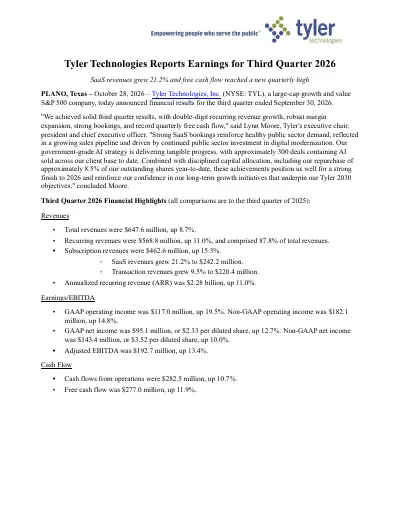
We delivered 11% recurring revenue growth, including SaaS revenue growth of 21.2%, expanded operating margins by 150 basis points, and generated record quarterly free cash flow of $277 million. Public sector demand remains healthy, supported by ongoing modernization priorities, strong client engagement, and an active pipeline.
Budgets remain supportive of continued investment in mission-critical technology, and AI is increasingly being evaluated as an extension of broader modernization initiatives. Total SaaS bookings increased 14%, reflecting continued momentum in cloud adoption and digital transformation efforts across government.
We made meaningful progress on several of our strategic growth initiatives during the quarter. Cloud migration remains one of the most significant drivers of long-term value, and momentum continues to build.
Following our July outreach to on-premises enterprise clients highlighting the value, incentives, and urgency of moving to the cloud, we have seen strong engagement across our client base, and increasing activity among large clients advancing their transition plans. We also reached a key milestone with our first implementation of our multi-tenant solution for an existing enterprise ERP client, representative of our complete Cloud Living commitment.
This is an important step toward a common code stream that enables continuous innovation, automated quarterly release upgrades, and more efficient delivery. With broader Cloud Living rollouts on track for early 2027, we are well positioned for an accelerating pace of migrations beginning in '27.
We also advanced our AI strategy with growing deployments, expanded agentic capabilities, and continued validation of our commercialization approach. Client adoption continues to grow, with approximately 300 deals containing AI across the portfolio.
We also continued to execute our disciplined capital allocation strategy through the acquisition of Cody Systems and significant share repurchases. Year to date, we have repurchased approximately 8.5% of our shares outstanding, with almost $1.4 billion remaining in our authorization.
We enter the fourth quarter well positioned to deliver a strong finish to '26, and confident in the long-term growth initiatives that underpin our Tyler 2030 objectives. With that, let's open the call for questions.
Operator
We will now begin the question-and-answer session. To enter a question into the question queue, please press *1 on your touchtone phone.
If you are using a speakerphone, please pick up your handset, and then press the star key and the number one. To withdraw your request, press the star key, then the number one.
As a reminder, please limit your questions to one question, we may stay within the allotted time. To ask additional questions, you may re-enter the queue.
We will pause momentarily to assemble our roster. Your first question from the line of Matt VanVliet with Cantor.
Your line is now open. Please go ahead.
Matt VanVliet
Good morning. Thanks for taking the questions.
I guess when you look at the pace of SaaS flips that you've had over the last couple quarters, we're seeing a little bit of an uptick, but maybe not an acceleration quite to the levels that some were expecting. Is there anything on a seasonal basis that you're seeing that's maybe limiting the upside in this quarter, or just so far this year?
Then how much of the Cloud Living initiative and sort of push there should actually catalyze maybe a further acceleration to get more customers to make that SaaS flip? Thanks.
Lynn Moore
Sure, Matt. I don't think there's anything really seasonal to the flips.
I think if you look at the way we've approached things over the last several years, our approach has changed. I think if you look back four or five years, we took a little more deliberate approach for a couple of reasons: one, I don't think the market was quite ready; and two, I'm not sure Tyler was quite ready.
What we've done in the last few years around version consolidation and, yes, now with our Cloud Living initiatives, I think we're at the point where now we can be much more proactive, and we're starting to take those steps. We talked about in the July call about the fact that I had sent out a letter to all of our local enterprise clients.
Each of those clients then received a touch point, a direct contact from their reps, and we're putting together now pricing strategies to sort of help people make that move. We're also in a position now where we're starting to do things, I think, more on the what we traditionally called disincentives or sticks, which is our first flagship product this past quarter actually started to announce with its client base end of life for support as well as the last version release with new product upgrades on the on-prem version.
We're going to continue to do those things in the coming quarters, which will, I think, continue to accelerate our flips to the cloud. I will say that the receptiveness from our clients with this new, more proactive approach has been really strong.
They welcome it. We talked about this before, we talked about it at Connect and our Client Advisory Board.
Some of our clients need that little push, they need that help selling the flips inside their own departments, and we're putting together the strategies to help accelerate that. We feel confident about where we are today and our overall 2030 flip plan.
Operator
Your next question from the line of Terry Tillman with Truist Securities. Your line is now open.
Please go ahead.
Terry Tillman
Thanks. Good morning, and thanks for taking my question.
It's good to see the updates on the AI side and the early deal activity. I am getting some questions from folks on the SaaS revenue growth and the guide for the year, I was going to ask about that.
It's kind of a multi-parter. I think you all brought down a little bit the high end of the SaaS revenue guidance range.
There was something in prepared remarks around timing of new sales and just kind of when that plays out in the year. Could you just talk a little bit about, is there a cadence dynamics that's changed a little bit on when you're signing the deals or some of the early revenue that you would see from these SaaS deals?
Then also what would Cody provide in 4Q? I know it's small, but what kind of SaaS revenue contribution there?
Thank you.
Lynn Moore
Terry. If you look at our outlook for SaaS sales for the year, it really hasn't changed meaningfully from where we were a quarter ago or two quarters ago, but the timing has moved a little bit.
We've seen some deals, especially some larger deals, that have signed either later in a quarter or later in the year, it's become just a little bit more back-end loaded. Again, the total sales number pretty consistent.
As a result of that shift in the timing and to a little bit later in the year, the revenue that we're able to recognize under those new deals, and flips included in that, has come down a bit. It's really around timing.
As we look at the fourth quarter, we're already off to a good start in terms of the fourth quarter. We've already signed in October a large ERP deal, probably the largest ERP deal we've signed in several years, as well as the flip of a statewide court system.
Again, really around timing within the year affecting on a really pretty marginal basis the amount of revenues that we'll actually see this year from those new deals.
Operator
Your next question from the line of Tamjid Chowdhury with Guggenheim Securities. Your line is now open.
Please go ahead.
Tamjid Chowdhury
Hi, thanks for taking my question. Excluding the Texas contract churn, it seems like transaction revenue growth is actually pretty strong at 14%.
Can you give us more color on what's driving that? I think in the prepared remarks there was some language around transaction-funded deals, I think in New Jersey State Police.
Can you talk about the pipeline of that sort of deal over the next 12 months? Thank you.
Brian Miller
Transaction growth has been strong. It's exceeded our expectations a little bit this year.
I think there are a couple of different vectors there. One is that we continue to have a lot of success in our strategy of integrating our payments platform with our software solutions, and selling transactions back into our existing customer base that use those systems that have payments embedded in them, as well as with new software sales increasingly including payments.
That continues to drive incremental growth. As you mentioned, we do continue to see a number of new SaaS deals that are funded as transactions.
As a reminder, those deals don't show up in SaaS revenue growth or in SaaS bookings, they show up in transactions, but with SaaS-like margins. These are things like digital motor vehicle titling solutions.
This quarter we had a deal in the regulatory space that was a different kind of solution funded under transactions, these are funded not through SaaS fees, but user fees that are associated with the transactions that are managed by that software. That is a part of the pipeline for next year.
We have a number of opportunities in the digital motor vehicle titling arena, as well as around regulatory. Outdoor recreation is the other area where we've seen deals, and we had a couple of those this quarter, including for Louisiana State Parks.
While it's not the primary way where our software model works, it is a model that's very attractive, especially to state government clients, because they don't have to budget funds. They're not appropriated funds, and they're not affected by budget pressures.
It is a growing part of our SaaS new deals, and you need to keep that in mind as you look at our SaaS bookings growth and our SaaS revenue growth.
Operator
Your next question from the line of Saket Kalia with Barclays. Your line is now open.
Please go ahead.
Saket Kalia
Great. Hey, guys, thanks for taking my question here.
Brian, maybe just to dovetail on that last point, I want to talk about sort of SaaS bookings and ACV sort of broadly. I think ACV from new SaaS deals and conversions was up pretty strong, I think north of 30%.
SaaS bookings growth was, of course, slower. You talked about transaction-funded SaaS deals, but maybe you could also talk about how bookings duration, maybe the combination of those two, how they might be impacting that SaaS bookings number?
Brian Miller
Clearly the the transaction-funded deals are not showing up in that number, and if they were under a traditional SaaS arrangement would actually contribute fairly significantly to to that percentage growth. Duration is a factor here.
Last year for new SaaS deals, last year in Q3 our average duration of contracts was about three years. This quarter, it was just a little over two years.
That, 30% difference in the duration really accounts for that difference between the ACV growth and the TCV growth, that 14% versus the the 30% plus. To some extent, that's intentional.
We have continued to try to shorten the initial terms of our SaaS agreements. A lot of our flips come in as one-year agreements and as well as some of our new deals.
That duration can bounce around a bit, but this quarter it definitely was a factor in that difference between total bookings and ACV.
Operator
Your next question from the line of Ken Wong with Oppenheimer and Co. Your line is now open.
Please go ahead. ):
Ken Wong
Great. Thanks for taking my question.
I wanted to touch on the 300 AI deals that you mentioned, Lynn. When taking a look at how those deals might have played out, under a normal situation versus embedding the AI in it, any comments you can put out there as far as what the uplift in TCV, ACV, basically the ARPU around those deals have looked like?
Franklin Williams
Hey, this is Franklin Williams, I'm happy to address that. I think with a lot of the things we saw in those 300 deals, what you're seeing is that embedded strategy play out.
You're seeing us basically be able to attach these solutions, whether it's AP automation, fraud, risk, and compliance, to broader deals that we're bringing into the market. I think in each of those, the kind of attach, the uplift that we're seeing there is probably still in the single digits with some of those solutions, but it is very real, and it is very much growing as well.
Brian Miller
I'd add to that, Franklin, that generally what we're seeing, I know we've had a lot of questions about this, but what we're seeing in the market, what we're seeing from our clients is they want these embedded solutions. They are not looking for bolt-ons from outside sources.
We're also not seeing RFPs that are specifically calling out AI for AI's sake. What they're wanting is functionality, and that functionality that we're being able to deliver in our systems with AI capabilities to continue to differentiate our products.
Operator
Your next question from the line of Kirk Materne with Evercore ISI. Your line is now open.
Please go ahead.
Kirk Materne
Thanks for taking the question. Actually, Lynn, I just want to follow up on that last point, which is you've obviously gone back to a lot of your customer base about flips over the next 12 months.
Do they want that AI functionality as part of them flipping over, or is it sort of like, look, get me over like-for-like, and then we'll add to that? I'd imagine that might be part of the reason you're maybe looking to shorten contract duration at the outset, you can come back and upsell them new AI functionality sooner rather than later.
I was just kind of curious, where are we on that? Can they take on the AI functionality at the time they're doing the flip, or is it easier for them just to sort of go from on-prem to cloud and then address AI whenever, a year or two down the road?
Thanks.
Lynn Moore
I think the AI piece of that as relates to flips will be sort of part of what we talked about that bucket of incentives, so that as we move forward, AI features will only be in our cloud release and not on our on-prem release. I think you'll continue to see us do that.
To your first comment or one of your earlier comments, and I kind of touched on it in the last question, is the spectrum of clients wanting AI is kind of all over the board. The market still has some slow receptiveness, but there's also some people that are a little more innovative.
They're not really calling out AI for AI's sake. There's still a lot of hesitation, there's still are going to fall back on the things that I think really differentiate us from anybody outside there, which is the data and the trust that we provide.
They're looking to us to help make their jobs better and their citizens' lives better, but, again, they're wanting it to come from inside our systems, not external bolt-ons.
Operator
Your next question from the line of Parker Lane with Stifel. Your line is now open.
Please go ahead.
Parker Lane
Hey, guys, good morning. Brian, you talked about some of the larger deals that you're signing coming in later in a quarter, later in the year.
Is that simply a function of customer-specific factors, or is there something more broadly that's causing that dynamic in the business?
Brian Miller
It's not really a market condition. It's really customer-specific.
It's been a part of our business for a really long time that large deals can be lumpy and the timing can be unpredictable. They tend to move a little bit more slowly through the pipeline, and even when they get down to kind of the signing line, often there are delays that we see, and so it's hard to predict exactly where they fall.
I think one of the keys is really, even though we've had really strong SaaS bookings growth through the first three quarters of the year, it really hasn't been on the back of large deals. It's really been driven by a lot of volume of kind of traditional mid-sized deals and smaller deals.
While we've said that the pipeline does contain a normal volume of larger deals, and I think we'll see some of those in the fourth quarter. It's really kind of customer-specific, no trend or kind of market dynamic that's affecting it.
It's fairly normal.
Operator
Your next question from the line of Alex Zukin with Wolfe Research. Your line is now open.
Please go ahead.
Alex Zukin
Hey, guys, thanks for taking the question. Maybe just a two-parter, Lynn, for you.
Maybe if you can opine, is the current cybersecurity environment having any impact on accelerating flips or moves to both new business for your cloud or AI products? Then, Brian, just to clarify again, really strong SaaS ACV bookings, but the decel in organic SaaS revenue growth to 16%, maybe just detail a little bit more specifically about the timing impacts that are leading to that, and how should we think about this improving when sizing how SaaS growth should move back towards your mid- to long-term growth targets?
Lynn Moore
Thanks, Alex. On your first question, I think the short answer is yes.
Cybersecurity continues to drive momentum to the cloud, and will continue to drive all of our modernization and security features that are available both with the cloud. One of the things that we're principled about with our AI offerings is to make sure that the security is in there, and it goes back to the concept of trust with our clients.
You read about cybersecurity in the news, but I can assure you that there's a lot more issues going on within the client base that won't be out there publicly. Yes, it is a driver.
Brian Miller
In terms of the SaaS growth rate, we remain very confident in that long-term 20% through 2030 that we've set as a target. We're a bit below that right now, and for this year, again, the timing of some of the deals, especially some of the larger deals, coming a little bit later in the year, and therefore delaying the start of revenue recognition a bit.
There also can be some variance around how long that lag is from when we sign a deal, whether it's a flip or a new SaaS deal, to when we start to recognize revenues. That's a factor affecting this year a bit.
Again, as we move into the fourth quarter, we're pretty confident around our sales objectives in the fourth quarter, and that as we move into 2027 that we're on the right trajectory. Certainly, as we think about how flips contribute to that 20% or north of 20% SaaS revenue growth, there should be an increasing contribution from those over the coming quarters and years that push us above that level.
Lynn Moore
If I could dovetail on that, Alex, I'd say a couple of things. Coming into this year, if you looked at our sales quotas across the board, they were elevated, and we are outperforming sales from last year on our internal basis.
More holistically, we've got a lot of strategic initiatives going on. We talk about them all the time.
One of the things that we've been really looking at over the last couple of quarters is a more holistic review of our sales engine generally, and how it complements with our marketing engine, looking at things like coverage, SAM, quotas, number of reps, et cetera, and starting to look at market data-driven insights to help drive sales. I think we're going to see some more investments in our sales and marketing going into '27.
You'll probably see a little bit of that in the revenue line next year, but there's a significant focus to continue to expand our sales and sales coverage, and it's something that's a strategic priority for us.
Operator
Your next question from the line of Allan Verkhovski with BTIG. Your line is now open.
Please go ahead.
Allan Verkhovski
Hey, there. Thanks for taking the question.
On the EPS guide into the full year, you left that unchanged when in past Q3s we've seen you take that up a bit. Can you highlight maybe what we should take away there besides maybe some of the impacts from the revenue timing shift you called out, for why with your buyback activity that we're not seeing the EPS guide come up?
Brian Miller
A little bit of that shift in timing and SaaS revenues has a small EPS impact. As we've continued our buyback, it is accretive.
We see lower interest income as we use those funds, but the lower share count provides an EPS growth. Overall, we've left the range the same.
We haven't narrowed the range, and we still expect to be within that range. There's various puts and takes, but ultimately we're still in that same range for the year.
Operator
Your next question from the line of Rob Oliver with Baird. Your line is now open.
Please go ahead.
Rob Oliver
Great. Thank you.
Good morning. Lynn, in your prepared remarks you talked a little bit about the accelerated pace of SaaS bookings, and conversions for next year that you expect.
Sounds like that's in response to kind of the letter you put out or the clarion call you put out to your customers back in the summer to get everybody on board with a cloud plan. I just would love to get a little bit more color on kind of the receptivity you got to that.
'27 sounds as if it's perhaps even a little bit more quickly than we expected. Were there particular areas of pushback, readiness issues, any color there?
Then as you think about that in the context of the kind of 2030 targets of getting up to 85% conversion, how you are comfortable relative to that? Thank you.
Lynn Moore
Rob, I'd say the receptiveness to the letter, the proactive outreach by each of our reps that had contacts with the clients, the things we're doing around pricing strategies, it's very welcomed in the market. I want to caution, we did say we would expect flips to accelerate.
We expected that anyway. Turning that excitement and receptiveness in and trying to pinpoint exactly how that's going to play out in '27, I can't specifically speak to that today, because there will always be other factors.
However, the receptiveness that we've seen gives me even more confidence in our target for 2030, and I think that that's still on track. I also mentioned we've talked before about disincentives, which are really more things geared around, hey, let's nudge a little bit more, when are we going to stop having new on-premise releases with value, when are we going to start doing end of life for support, things like that.
Those are going to start rolling out. We already did one, I mentioned, with one of our major flagship products.
That messaging will continue into '27, which will continue to nudge the base. What we're hearing from our Client Advisory Board and our other client focus groups is they appreciate the nudge, and they are welcome and receptive to where we're heading.
Operator
Your next question from the line of Joshua Reilly with Needham. Your line is now open.
Please go ahead.
Joshua Reilly
Great. Thanks for taking my question.
As we look at the public safety market, we were just at the IACP conference, and a key theme there was around vendor lock-in and going all-in with one vendor. What are you seeing given some of the PR challenges in that industry in terms of any impact to spending trends?
This vendor diversification concept versus going all-in with just one vendor, how might that help Tyler going forward? Thank you.
Lynn Moore
Josh. I didn't attend the IACP conference, but I certainly got a debrief.
My understanding was it was the largest conference ever, I think over 19,000 attendees. The feedback that I've received is that the funding environment in public safety remains very strong.
We left that conference with, I think, about two times the leads that we have in the past. We really like our position in public safety.
Our competitiveness and our products is still really strong in the market. We don't talk about specific wins against competitors, but I can assure you I take note each quarter of certain wins and certain competitors that we do favorably against.
I really like our position. It's also an area I talked earlier about sales and expanding our coverage, and we've been doing some things in sales there, I think, to continue to take advantage of our position in the market.
In terms of the comment on sort of one vendor versus multi-vendors, I haven't seen anything that's driving a material difference in deals right now, but it's something we'll keep an eye on.
Operator
Your next question from the line of Andrew Sherman with TD Cowen. Your line is now open.
Please go ahead.
Andrew Sherman
Oh, great. Thanks, guys.
Wanted to ask about the state and also the federal business, because you highlighted a bunch of those deals. What drove the strength there?
How did those each track versus your expectation? How are the pipelines for those looking into next year?
Thank you.
Brian Miller
I think the state business is an area where we continue to execute well with the cross-sell strategy and being able to leverage the deep relationships we have through our state enterprise agreements to sell more Tyler software products into those markets. We started to build out a dedicated state sales team about a year ago to really be that bridge between the Tyler software products and the enterprise state relationships.
That group is really starting to generate some meaningful opportunities. We're seeing an excellent level of collaboration and cooperation between our different business units in the state market.
The federal market actually was pretty strong this quarter. We haven't talked a lot about federal, but we had some really nice deals this quarter, the third quarter, coinciding with the federal budget cycle is typically one of the stronger quarters there for new business.
We saw some really nice deals with our platform there, and it was definitely a bright spot in our bookings this quarter.
Operator
Your next question from the line of Alexei Gogolev with J.P. Morgan.
Your line is now open. Please go ahead.
Alexei Gogolev
Hello, everyone. Brian, I wanted to summarize maybe some of the comments that you made and try to get a clearer view of '27.
Because it sounds like you have very strong federal, state, and local demand, and there have been some delays and some timing of those large deals. Did I hear you correctly that you expect next year's SaaS organic growth to accelerate versus this year?
You expect some of those larger deals to close, and then once Texas deal lapse, we should see acceleration of transactional revenue. Putting all this together, as well as from what I remember you suggesting that AI monetization will become more visible next year, does that imply a more visible acceleration of top line?
Brian Miller
We're certainly not ready to give guidance for any kind of revenue growth for 2027. You're correct in that there are a number of positive trends.
The timing around things, whether it's the timing of signing of new deals, when they start to generate revenues, we've already talked about the expectation. It's really at least the second half of next year before we start to see really meaningful contribution from a lot of the new agentic AI capabilities that we're rolling out.
I'd say all those trends are positive. We have a lot of confidence in our long-term views.
Certainly flips we expect to be a bigger contributor next year in terms of signings. Again, the timing will affect when those actually start to generate revenues.
Generally, our trends are positive. We like our market position, we like our pipelines, and the activity does seem to be growing across all of those areas.
Operator
Your next question from the line of Trevor Walsh with Citizens JMP. Your line is now open.
Please go ahead.
Trevor Walsh
Great. Good morning, everyone.
Thanks for taking the question. Brian, maybe for you, but Lynn, feel free to chime in as well.
As the book of business around transaction-funded deals grows, does the risk profile of that kind of portion of revenue change a little bit just given that it's going to be subject more to user fees, usage of the platform in whatever way you have that deal structured? I know there's some seasonality obviously around some of the outdoor things you've talked about in the past, but just how do you think about that, I think, broadly?
Then can you refresh our memory on that front, how are these contracts structured such that you guys will have a minimum kind of takeaway in any given year, regardless of kind of how the actual kind of flow of transactions and/or, again, fees flow through? Thanks.
Brian Miller
In a lot of cases there is a floor. I would say that in most of these cases, there's, at least within a range, a fairly predictable volume of whether it's how many motor vehicle registrations there are in a state in a typical year or how many visitors to a state park that generate those fees that drive the revenues to us.
As you said, they can be seasonal. Some of those things can be affected by external factors, for example, motor vehicle registrations are affected by car sales, and those are affected by the broader economy.
They're not a pro rata revenue recognition, they're not a fixed amount, there is more variability in them or potential for that. Our pricing also reflects to some extent that additional uncertainty or risk that we take on, we are compensated through that, and we generally expect those deals to be at least as profitable as they would have been had they been a SaaS deal.
The real key is that it takes it out of the budget pressure world. They're not subject to appropriated funds, they operate outside of the state or local government's budget, and so it really kind of insulates them from those kinds of pressures.
Operator
Your next question from the line of Camden Levy with Wells Fargo. Your line is now open.
Please go ahead.
Camden Levy
Hi, good morning. This is Camden Levy sitting in for Michael Turrin.
Thank you for taking our question. Wanted to quickly touch on agent adoption.
You have 11 agents generally available with the target of 25 by year-end. Curious what metrics should investors use to distinguish proliferation from commercialization, and where are you guys seeing the highest uptake and interest of those agents across the portfolio of customers today?
Franklin Williams
I'm happy to talk about that. I think the uptake we're seeing, it's pretty broad across the portfolio.
When we think about the key metrics that we're looking at, a lot of it is really centered on the value that we're delivering to our clients, the ROI that we're returning to them, time we're putting back in their day, the money that we're putting back in their budget. Really what we're looking at right now is, how do we drive more adoption across that portfolio?
How do we give our clients what they need, the predictability they need, the proof that they need, and then all of the additional pieces that they need to know that they can trust these agents and that they can ultimately bring them in and deliver the value that we're promising. When we think about the proliferation of this across the portfolio, I think it is important to realize that this market looks different than others, the adoption is going to move at a different pace than others, but we remain very optimistic that once we meet the mark that our clients are demanding, the trust, the proof, the predictability, that they'll be adopting these solutions really kind of across the portfolio.
Operator
Your next question from the line of Sownthar Parameswaran with D.A. Davidson.
Your line is now open. Please go ahead.
Sownthar Periathambi
Hi, thanks for taking the question. This is Sownthar sitting in for Pete Heckmann.
My question revolves around the issue of AI discovering critical vulnerabilities. Could you really talk about how you respond to those, and specifically the issues with running vPatch with PHP over the last week?
Franklin Williams
I think I'd take this maybe in a couple of parts. I think the first part is, as part of the value proposition that we offer to our clients from a SaaS perspective, we have a very robust security program that is continuing to get ahead of this problem.
A robust security program that's making sure that vulnerabilities are discovered ahead of time, are quickly patched, are quickly addressed. That security program is also starting to leverage AI to fight these vulnerabilities as well.
There's work that we're doing with our frontier partners, work that we're doing with Anthropic, work that we're doing with others, to bring in more advanced capabilities, capabilities that Tyler has been approved both by those frontier partners and the US government, to be able to deploy to further secure these solutions. We think that that value proposition that we can offer is one of the additional things that we think will, over time, start to drive more and more SaaS adoption over the course of the coming years.
Operator
Your next question from the line of Mark Schappel with Loop Capital Markets. Your line is now open.
Please go ahead.
Mark Schappel
Thank you for taking my question. Brian, I was wondering if you just comment on the areas of the business that are seeing some of the strongest growth, such as ERP, Courts & Justice, and maybe also talk a little bit about which ones are maybe growing a little bit more modestly.
Brian Miller
I don't think there's a wide dispersion of growth across our portfolio. In terms of sales, ERP is having a strong year.
We're seeing nice improvement in win rates, and more activity, especially at the upper end of the market. Courts & Justice continues to be a strong performer for us.
We've got a lot of flip opportunities there. With the FTR acquisition, we're really excited about the opportunities that brings us to continue to expand around our very large install base there with new solutions.
Public safety also is an area that we are very optimistic about the growth opportunities there as we continue to move those clients to the cloud. We've seen success in recent quarters, especially at the higher end of the market there, with some state police deals and larger opportunities.
There's a lot of flip opportunities in that market as well. With the acquisition of Cody, that gives us a really strong presence at the lower end of the market, where we really didn't have a solution that fit well for that market.
We would expect to continue to see our public safety growth opportunities continue to expand.
Mark Schappel
Thank you.
Operator
The line is now open for additional questions. If you would like to ask a question, please press *1 on your handset to enter the queue.
Our next question comes from Saket Kalia with Barclays. Your line is now open.
Please go ahead.
Saket Kalia
Great. Hey, guys, thanks for taking my follow-up here.
Lynn, maybe for you. In the past we've talked about how things like presidential elections, for example, don't really have an impact on spending at the state or local level.
As we go into kind of midterm election season here that, of course, are at the state level, and for all the years and decades that you've been around the business, I'm curious what you've seen historically just in terms of spending around those times, and whether there's anything that you're seeing here as we look at Q3, Q4? Doesn't seem like it, but I just want to make sure we address it.
Lynn Moore
Saket, you're dating me by talking about all the years and decades I've been in this business. Obviously in the state market, the midterms have a little more meaning.
There's a number of governor elections going on, obviously some of those happen in a presidential election cycle. We haven't seen anything really leading up to this, but it can create a little bit of uncertainty when there's new administrations that come in.
There could be a little bit of disruption as they try to get their agenda set, particularly if it's a little bit of a different agenda. On the flip side, I think it actually drives a lot of opportunity, because a lot of the candidates, they run on things that we actually provide.
They run on agendas based on efficiency and accountability and public safety and oversight. Maybe sort of in the short term, there could be a little bit of uncertainty, but in the long term, particularly based on the things that are top of mind with a lot of people today around government spending and trying to become more efficient, all the things that go right into our playbook, to me it creates opportunities over the long term.
Operator
Your next question from the line of Billy Fitzsimmons with Piper Sandler. Your line is now open.
Please go ahead.
Billy Fitzsimmons
Hey, guys, thanks for taking the question here. We've talked a little bit on this call about AI readiness with the customer base potentially being uneven, with many clients interested in better functionality, but not necessarily seeking AI for AI's sake.
Imagine it varies on a case-by-case basis, but any anecdotes you can share on what differentiates those customers moving ahead versus those taking the wait-and-see approach? Is it that those customers are potentially in a better place from a data readiness standpoint, or these customers potentially having processes where they see a more tangible immediate ROI?
Then for those customers taking the wait-and-see approach, what key hurdles are there that you can kind of help them get over as they potentially adopt these solutions? Thank you.
Franklin Williams
I think you really nailed it when you talked about basically places where they can see a clear ROI. I'll give you an anecdote from our Courts & Justice executive forum that we recently held.
Those products, document automation, for example, really helps compress the amount of time that people spend docketing, filing, and processing documents. What we're seeing there is we're seeing that move from a you should do this to a you must do this.
The reason that we're seeing that is because the ROI for those types of solutions are becoming just super clear. We're compressing time from weeks down to days, sometimes hours.
When we can put that in front of our clients, we can tell that story, people are adopting it, and they're really starting to basically bring that into their to their enterprise. That's where we're basically looking to kind of run that playbook again and again and again through our intentional rollout process for these agentic solutions, moving into a very close, tight private preview with some of our trusted customers, making sure that we can prove ROI, we can put time back in their day, we can put money back in their budget.
Once we can do that, we can basically demonstrate that very tangible, very practical ROI to our other customers. When we do that, we find that those customers are very enthusiastic to move forward, because every one of them, I think, philosophically knows that they should be doing something here, and philosophically knows that AI can transform their work, they just need help discovering the how.
When we can put that tangible ROI in front of them, we can help them understand the how, we're going to see more and more and more these solutions start to look like our document automation does, where it goes from something that you should do to something that you'd be irresponsible not to do.
Lynn Moore
I would add to sort of cover the other side of the coin where there are pockets of hesitation, is AI is still a little bit political, there's a little bit of unknown, there's concerns and fears out there. Public officials are hearing from their citizens, whether it's we don't want data centers here, we don't want our jobs taken away.
There's some of that. When I talk about you don't see in RFPs people seeking AI, what they're seeking it for is better value and the return on investment that we can show them that Franklin just mentioned.
It is a bit of a balancing act, and it's like any other technology, you're going to have people on the forefront who are the innovators who are leading the charge, and you're going to have people are going to be lagging behind, taking a wait-and-see approach. Whether that's in the private sector or the public sector, we know the public sector traditionally lags regardless.
We're providing that value, and we're embedding it in our systems to show our clients. Sometimes we don't need to actually lead with the phrase quote "AI."
Franklin Williams
It's
Lynn Moore
more about, here's what we can do to make you more efficient, here's how you can serve your constituents better.
Operator
Your next question from the line of Terry Tillman with Truist Securities. Your line is now open.
Please go ahead.
Terry Tillman
Thanks for letting us get back in. I promise I won't get back in for a third time, okay?
I did notice earlier the commentary on federal government deals, and if I wasn't mistaken, that was the smallest business over time, and you had some acquisitions that got you into that space as well, but it was 5% or something of the business, and you can correct me if I'm wrong on that. I noticed in your all slides, Department of Veteran Affairs, Department of Justice, Department of Ag, Workforce Case Management.
I'm curious, is there some selling efforts that are paying off? Are you expanding share?
Who would you be competing against in some of these deals, because they are big agencies. I just don't know the scope of the deals.
Just some more color would be great. Thank you.
Brian Miller
These are deals that are typically six-figure ARR. Most of these federal deals are utilizing our application platform that came originally from our acquisition of MicroPact several years ago, which got us really into the federal space.
Federal is still a market that is less than 5% of our total revenues. That product is very competitive.
It's a application platform, a low-code platform that has pre-built modules or accelerators that manage various processes across a wide range of federal agencies. Things like the Workforce Case Management, managing EEOC claims, labor relations, background checks and security clearances across a number of federal agencies, and these are just part of their modernization efforts.
I think as we've now moved a year away from a lot of the uncertainty and pressures we saw around DOGE and the noise around that, that some of the contracting we're seeing at the federal level is returning to sort of a more normal environment. In a lot of those opportunities, we'd be competing with other sort of platform providers.
We do have a really wide network of partners, systems integrators, and partners that we work with at the federal level, and a lot of the business is driven through those partners.
Operator
Your next question from the line of Allan Verkhovski with BTIG. Your line is now open.
Please go ahead.
Allan Verkhovski
Hey, thank you for taking the additional questions here. Lynn, can you talk more about what stood out most to you from on-premise customer reactions to your letters about moving to the cloud, and how that impacted your confidence in reaching your 2030 migration target?
Brian, just quickly for you, what amount of inorganic revenue are you assuming in Q4 SaaS revenue? Thanks, guys.
Lynn Moore
I didn't hear the first part of his question.
Brian Miller
The reaction from clients around your letter.
Lynn Moore
Yeah. Again, it's been extremely well received.
The fact that it wasn't just a letter that went out, but then it was followed up Well, the letter actually contained a QR code where they could be directed to our website talking about them, how they could start their Tyler cloud journey, but then followed up with a direct contact from our sales reps. It's not just anecdotal messages that I'm getting.
We've had contact with, I think, over 1,500 clients directly through our sales reps. I think the letter went out to 2,500.
It's the direct feedback that I'm hearing through our sales channels that gives us that confidence that our base is actually now ready to make the move.
Brian Miller
With regard to inorganic contribution to Q4, we're estimating somewhere in the range of $8 million to $9 million of revenues that are coming from acquisitions that we've closed within the last year, and the biggest share of that is coming from FTR.
Operator
Your next question from the line of Tamjid Chowdhury with Guggenheim Securities. Your line is now open.
Please go ahead.
Tamjid Chowdhury
Hey, thanks for taking my follow-up question. I guess for Frank, can you maybe talk about, as your customers adopt these AI and agentic solutions, can you talk about what you're hearing from them from their cost perspective?
Is there an heightened sense of caution when it comes to keeping a lid on the costs associated with these agentic workflows that we hear about in the news in general? Thank you.
Franklin Williams
I think there is. Let's maybe take this from kind of two perspectives.
Let's take it from what we're hearing in terms of the value that they're getting out of these, and then let's take it from the perspective of the unique concerns that they bring to the table. When we think about the value that they're getting from these, we're hearing people that are basically telling us that it's like basically having extra staff that's part of their team.
We launched a product, our priority-based budgeting team launched a strategist this past quarter, and the feedback in private preview was pretty overwhelming. People were basically saying it's like having a management consultant available to us 24/7 that can help us identify opportunities for savings, and many of those clients are finding significant savings.
We had one large county that had a $13 million budget crunch, and was able to basically find $9 million in savings. The reason they were able to do that was because they were able to use agentic AI, able to use this kind of 24/7 management consultant to identify, surface, and then help them act on that.
Seeing very similar things with other agentic solutions like grant writing, grant researching, where if I'm in a small town, there's a bunch of grants that are available to me, but I don't have the staff to really find those, I don't have the staff to maintain those, I don't have the staff to apply for those, and so those grants go unused. Our agentic solutions are basically helping expand their staff, helping augment their teams, and able to help them in our private preview find several million dollars in grants, help find $20 million that they could be applying for as well.
When we think about the value that's being delivered and how our clients are talking about it, whether it's the ones that we've launched here, whether it's our existing solutions like document automation, they're really viewing it as augmenting staff and having folks that are available to them that they just simply haven't had before. Now, you raised a second question, though, which is a really great question around cost and cost overruns.
This is something that we've heard loud and clear from our clients. We also had our Customer Advisory Board join us this past quarter.
We spent about 3 hours with them talking about AI, talking about the state of the market, our direction. One of the things we heard loud and clear from them was that the current variable metered pricing that many of the frontier providers are doing simply does not work in the public sector.
They need predictability, they need reliability, they can't be going back to council month after month after month asking for increases. One of the things that we at Tyler talked to them about, one of the things that we at Tyler believe that we can offer our clients is that predictability.
That we can build these solutions, we can govern these solutions, and we can deliver these solutions in a way that provides them that peace of mind and that predictability so that they know what they're spending ahead of time, they can budget for it, and they can ultimately capture that value that I talked about originally, while also making sure that they're protected from all these various cost overruns.
Operator
Your next question from the line of Alex Zukin with Wolfe Research. Your line is now open.
Please go ahead.
Alex Zukin
Hey, guys. I just wanted to ask about the cadence for buybacks from here.
Is it rational for us to expect a continued strong buyback cadence into the remainder of the year? Then maybe just any kind of further update on how to think about tuck-in M&A and capital allocation on tuck-in M&A versus buyback, particularly given kind of where shares are trading?
Thanks, guys.
Lynn Moore
Sure, Alex. Let me take the last one first.
We're always going to be looking at tuck-in M&A. I've said many times, there are deals that get presented to us literally every week.
A lot of brokers reach out to us. That process will always continue.
It's been part of our history. You've heard me say M&A is part of our DNA, and that's part of it.
We're going to continue to be smart around that. There's certain areas that we would certainly like to continue to explore, but it's all like everything else, it's all a matter of valuation, which I think segues into the share buybacks.
We've been very active. I think right now, we will continue to be active.
Will we be as active as we were a few months ago? Part of that is looking at our cash flow, part of that is looking at our opportunities with M&A.
It's to me, right now share buybacks remain a higher priority. When you talk about the value of the stock, I look at it more as what do I have confidence in our 2030 vision?
I have a lot of confidence in our 2030 vision. I tell our teams all the time, we have the right strategic initiatives, and we have the right people in place to execute on them.
Then I look out at 2030 and I look at our free cash flow, I discount it back to today, I put in other variables and say, okay, what's a reasonable buy today? To me, it's still very compelling.
That to me, it's our confidence in our vision. I think you will see us continue to buy back stock.
I've used the term "reduce and maintain." I think you will see over the coming years as we continue to chip away at our outstanding shares that we will also probably be a little more proactive with offsetting dilution on stock-based comp, which, as at Tyler's is pretty minimal compared to other software companies.
Operator
There are no further questions at this time. I will now turn the call back to Lynn Moore for closing remarks.
Lynn Moore
Thanks, Rita. Thanks, everybody, for joining our call today.
If you have any other questions, please feel free to contact Brian Miller or myself. Thanks, everybody.
Have a great day.
Operator
This concludes today's call. Thank you for attending.
You may now disconnect.