Uber Technologies, Inc.
Q3 FY2026 · Earnings Call TranscriptNovember 4, 2026
Operator
Hello, and welcome to Uber's Q3 2026 earnings conference call. All lines have been placed on mute to prevent any background noise.
After the speakers' remarks, there will be a question-and-answer session, and if you would like to ask a question during this time, please press *1 on your telephone keypad. I would now like to turn the conference over to Alax Wang, Head of Investor Relations.
You may begin.
Alax Wang
Thank you, Sarah. Thank you for joining us today, and welcome to Uber's third quarter 2026 earnings presentation.
On the call today, we have Uber's CEO, Dara Khosrowshahi, and CFO, Balaji Krishnamurthy. During today's call, we'll present both GAAP and non-GAAP financial measures.
Additional disclosures regarding these non-GAAP measures, including a reconciliation of GAAP to non-GAAP measures, are included in the press release, supplemental slides, and our filings with the SEC, each of which is posted to investor.uber.com. Certain statements in this presentation and on this call are forward-looking statements.
You should not place undue reliance on forward-looking statements. Actual results may differ materially from these forward-looking statements, and we do not undertake any obligation to update any forward-looking statements we make today, except as required by law.
For more information about factors that may cause actual results to differ materially from forward-looking statements, please refer to the press release we issued today, as well as risks and uncertainties described in our most recent Form 10-K and in other filings made with the SEC. We published our quarterly earnings press release, prepared remarks, and supplemental slides to our Investor Relations website earlier today, and we ask you to review those documents if you haven't already.
We will open the call to questions following brief opening remarks from Dara. With that, let me hand it over to Dara.
Dara Khosrowshahi
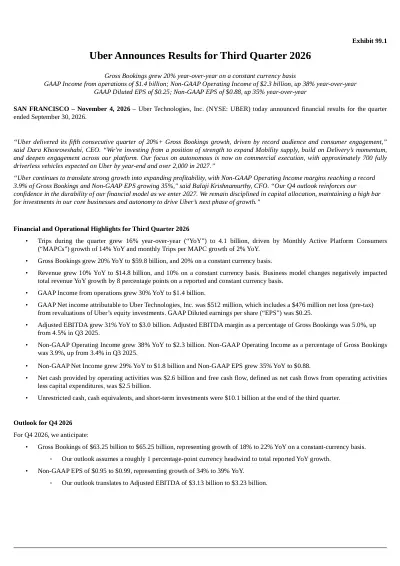
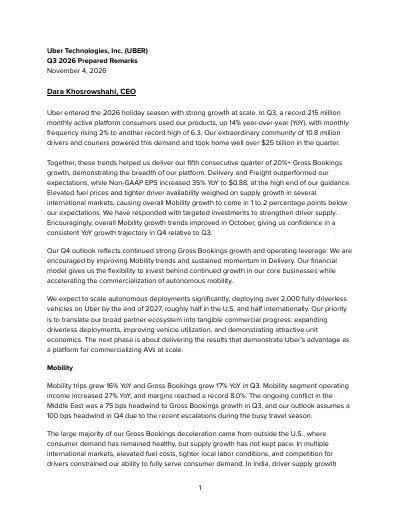
Thanks, Alax. Q3 was another strong quarter of growth and expanding profitability for Uber, with record audience and engagement across our platform.
We reached 215 million monthly active platform consumers, who are using Uber more frequently than ever. That helped us deliver our fifth consecutive quarter of 20+% year-over-year gross bookings growth, alongside 35% growth in non-GAAP EPS, and record trailing 12-month free cash flow of $10.4 billion.
Mobility continued to see healthy growth, but came in below our expectations as a result of driver supply not keeping pace with strong consumer demand in several international markets. We're responding with targeted investments to improve driver availability and marketplace balance, and we saw encouraging improvement in October.
Our focus is on driving consistent growth while maintaining strong profitability of the business. Delivery had another excellent quarter, with gross bookings up 23% year-over-year, and organic growth accelerating.
Our investments in selection, affordability, and reliability are making Uber Eats even more useful for everyday occasions, from restaurant meals to weekly groceries and last-minute essentials. With approximately 55 million Uber One members, we're deepening consumer relationships across both Mobility and Delivery.
Those direct consumer relationships are central to our approach to AI. We're using AI to make everyday transactions simpler and discovery more personalized, while selectively exploring new distribution channels that can bring incremental demand.
In AVs, our focus is shifting from partnerships and testing to driverless commercial service. We're excited for Zoox to launch on Uber in Las Vegas later this month, with Motional moving up to fully driverless operations soon thereafter.
We expect approximately 700 fully driverless vehicles on Uber by year-end, and more than 2,000 by the end of 2027. Just as importantly, we're focused on demonstrating utilization and economics that are needed to scale.
As we enter Q4, our priorities are clear: improve mobility supply, build on delivery's momentum, and deliver against our AV milestones, all while continuing to grow profitably. Before I hand it off to the operator, I did also want to offer a special thanks to Jill Hazelbaker, our President and Chief Corporate Affairs Officer.
After 10 years here at Uber, she's moving on to OpenAI. It's a big win for them, it's a loss for us to lose someone like Jill.
She's been such a big part of our culture, our company, but fortunately, she has built a great team who get to step up to more senior positions, many of them working with me directly. I want to personally thank Jill for her 10 years here.
She's helped me in innumerable ways, both professionally and personally as well. She's been a great advisor.
It's a big win for OpenAI, and I'm really glad that the team that she built is ready to step up to bigger positions, which they fully deserve at the company. Big thank you to Jill, and with that, I will turn it over to the operator for questions.
Operator
Great. Thank you.
Your first question comes from the line of Eric Sheridan with Goldman Sachs. Your line is open.
Eric Sheridan
Thanks so much for taking the question. I want to come back to the parts of the letter and prepared remarks around AV fleet financing.
Can you go a little bit deeper in terms of how we should be thinking about the balance sheet and incremental free cash flows that you want to put behind these efforts, and how should we be thinking about rates of return or aligning the economics with the commercial opportunity? Thanks so much.
Balaji Krishnamurthy
Thanks, Eric. I can take this.
I think we aren't ready to say a lot on the structures that we are working on just yet. What I would point you to is the billion-dollar financing arrangement that we had set up with Santander earlier in the year that was focused on our traditional fleet partners.
That is a template for what we could be doing with our AV fleets as we go through the next few months. We are actively working on these kinds of setups, and specifically, you should expect that we will have announcements to make both on infrastructure financing, but also on vehicle financing as we go forward.
Our long-run expectation is that this should be financed by third-party capital, not by Uber's balance sheet. In the near term, as you've seen with the announcement that we had in the release that we will have about 700 driverless vehicles on our network this year, 2,000 by the end of next year, the capital deployment against those is fairly limited.
As we start scaling out into the 10,000+ territory in 2028 and beyond, we want to bring in third-party capital against that, and we feel good about the ROI that the third parties can get then.
Dara Khosrowshahi
Eric, just a little bit more for me, which is, we do think that fleet financing for these cars is going to be somewhat unusual, in that if you look at fleet financing for rental car fleets, etc., they're all based on residual value of vehicles. I think the residual value of AV vehicles isn't established yet.
As a result, in the early days, we're going to take these vehicles on our balance sheet. We have a very strong balance sheet, are capable of doing so.
I think a lot of the fleet financing is going to be based on revenue, kind of revenue potential of these fleets. What we're able to demonstrate is that cars on our network get very, very high utilization, and actually higher utilization on cars that aren't on our network.
We show a 30% kind of utilization premium on our network, and we're able to do so very flexibly. If there's a fleet that for some reason fails in terms of their operations, we can take that AV vehicle and put it under separate ownership, and it will still earn on the Uber network, to speak.
We think that the financing on the Uber network can have a real advantage in terms of cost of capital versus alternatives. It is kind of business model that we're working with to establish with partners.
The reaction has been, actually, they're quite interested. They want to diversify away from data centers, to speak.
We're quite optimistic on it, but we do have to establish kind of the business model, the utilization advantages, demonstrate that to the banks, and then go from there.
Alax Wang
Next question, please.
Operator
Your next question comes from Nikhil Devnani with Bernstein. Your line is open.
Nikhil Devnani
Hey there, thank you for taking the question. I wanted to follow up on the international supply dynamic you called out.
Just want to make sure, did something sort of change through the quarter? I think last time we had talked about Brazil, but it seems like there's a few more markets that are now reflecting this.
If you could just elaborate on what you saw through the quarter, that would be helpful. Then also, as we look forward, how should we be thinking about the supply-side investments required, because some of the variables called out like immigration feel a little bit more persistent.
It would be helpful to understand just the degree and persistence of these investments as you try and reaccelerate the business. Thank you.
Balaji Krishnamurthy
Thank you, Nikhil. I think what I would say is a lot of this is a continuation of the dynamics that we have seen through the year.
If you zoom out and look at the macro environment, with the escalation in the war in the Middle East, fuel cost impacts have been felt globally. Where it shows up most materially for us is in emerging markets where there is a level of price sensitivity on both the consumer and the driver side.
What we talked about last quarter in Brazil was specifically focused on moto supply from driver delivery competition in the market. Through the last quarter, we have seen the elevated fuel price impact in markets like Brazil and India in particular, quite meaningfully impacting the supply situation.
Similarly, the immigration dynamics have been in place through the year. As we go through the back half of the year, and we see elevated demand from the holiday season that you have coming through right now, which, again, the demand picture is pretty strong, we see an elevated impact on the supply on the marketplace when the supply is short.
That's kind of what we're calling out in Canada as well. Now, this is a good problem where we are at the scale that we're at, operating at, and we still are running into supply constraints rather than demand constraints.
We know exactly how to address those kinds of challenges with the history that we have demonstrated. We're making targeted supply investments.
This is focused on driver acquisition, retention, and engagement. As we go through that kind of investment, we are already encouraged with the early signs of supply improvement we saw in October.
Supply hours growth globally accelerated in October, including notable improvements in Brazil and India. I think, with all of that, you see our outlook, which is steady at the 18 to 22% growth range, which is steady from the last couple of quarters.
We feel good about where we are, and the growth runway in front of us is extremely long. Over the last five years, we have doubled our eligible population penetration in our top 10 markets, but it's still at only 10%, right?
We feel really good about where we can go from here.
Dara Khosrowshahi
I think just the additional factor that we are dealing with is that we obviously have the year-over-year pressure on supply, but then we also have seasonal pressure on supply as well, which is September, October, November, December are kind of peak season for us, both in Mobility and Delivery. In some markets like Brazil, Mobility and Delivery depend on two-wheel supply, which for us is, for example, one of the examples of supply that we need to add.
Those kind of intermingle. It's a seasonal issue, and it's a year-on-year issue that are hitting together.
We've got a good handle on it. We're very optimistic about the trends as we see them in October and going into Q4.
Again, this is not the first time we have dealt with this kind of situation.
Alax Wang
Next question, please.
Operator
Your next question comes from Brian Nowak with Morgan Stanley. Your line is open.
Brian Nowak
Great, thanks for taking my questions. Maybe one on grocery.
Just talk to us a little bit philosophically about the investments you need to make in grocery and retail to sort of further accelerate and compete in that business in the US. How do you think about the need to have a larger 1P presence, so, your own dark stores or your own sort of fulfillment operations?
Dara Khosrowshahi
Absolutely, Brian. We're very excited about the progress of our Grocery and Retail business.
We're at a $15 billion run rate, growing 40% on a year-on-year basis. We think this is like a $10 trillion TAM, it's an enormous market for us.
What we see from consumers is, over and over, they want more stuff faster. They want everything faster.
I think when Amazon brought overnight shipping, it was magic, and now, next-hour shipping is magic, and pretty soon, people are going to expect everything in 15 minutes. We play right into that area.
The areas of investment for us are really about selection, they're about affordability, and they're about kind of consumer experience. On the selection side, we're very excited to expand to Costco nationwide.
We also have added a number of international players: Target, Decathlon, Priceline in Australia, Tesco in the UK, Rewe in Germany as well. We continue to invest in selection, and as we add selection, we have more consumers coming online as well, and also conversion rates improve.
We continue to invest in affordability, whether it's Fresh Off Tuesdays, or, for example, members not having any fees above $15, $50, $60 bucks that our members are loving as well. Then we continue to invest in product innovation as well to make sure that our pick-pack is as accurate as it can be.
We're investing in shopper quality, we are paying high-quality shoppers more. We're also introducing technology, for example, where our shoppers will take a photo of an empty shelf to verify that the items that you're looking for isn't there.
It also helps our consumers too, because when they see the empty shelf, they don't get upset. It's not the shopper's fault, it's just what they wanted wasn't there.
It helps establish trust between both sides of the marketplace. For us, it's just all about execution.
As it relates to dark stores, our number one priority has been to work with our partners and to help them grow their businesses. Now, we're very excited, as it relates to Delivery Hero, they have built a substantial quick commerce and dark store business.
The benefit of dark stores is that you have a much better handle on inventory. Usually, your pick-and-pack success percentages, your found rates are much higher.
Quality goes up as a result of the vertical integration. This is a part of the Delivery Hero potential acquisition that we're very excited about.
That team has been building the quick commerce business for well over seven, eight years. It is hit breakeven, it is growing at very attractive rates, and we're very excited to add that as part of our portfolio once we close on Delivery Hero.
Balaji Krishnamurthy
Just one additional comment on the dark store question. This is for us a fit-for-purpose sort of solution, right?
We don't want to get into this business everywhere, but there are markets where it makes sense. As Dara mentioned, Delivery Hero has done a really good job with their dark store footprint in the Middle East.
We are also in a position where we would be able to look at that business in Turkey, both with our existing presence in the market, but also with the Getir transaction that we have done, and that business, again, is running near profitability, and then we have organically experimented with this in Taiwan as well. Ultimately, it needs to be a business that can be run well, has to meet the market conditions, and has to have a good return on assets when you go into that sort of a field.
We'll be selective in where we engage with this. Otherwise, we would work with our grocery partners who are experts at doing that in their own space.
Alax Wang
Next question, please.
Operator
Your next question comes from Ron Josey of Citi. Your line is open.
Ron Josey
Great, thanks for taking the question. I want to ask a little bit more about the fully driverless roll out from 700 this year to 2,000 next year.
Just help us understand a little bit on the geography pace of rollout. I think you said 50-50 in the US, international, and how you're thinking about that.
Thank you.
Dara Khosrowshahi
Absolutely. We're very excited.
We've got launches. Obviously, we're in market with Waymo already in the US.
We're in market with WeRide and Baidu with no drivers in a number of international markets. We expect to launch Zoox and Motional, as we mentioned, in Vegas this year.
Then next year, we expect to add Nuro in California and then in Houston as well in Texas, at least early on in 2027. These are fully driverless commercial rides.
Avride middle of the year in Texas as well. Internationally, we expect to add Pony and Momenta to our no-vehicle operator kind of inventory.
In late 2027, I do think we are going to be doing kind of testing rides, vehicle operator testing rides with NVIDIA, with Rivian, hopefully with Waabi as well, and also Wayve outside of the US. The partner strategy and the panoply of all these partners are really going to start adding up, and we're quite confident of getting to the 2,000 vehicles in 2027.
The real goal is to get to tens of thousand vehicles, tens of thousands of vehicles in 2028 and beyond, and really scaling the ecosystem. We are in market in these markets.
We have relationships with the cities. We have operations in those markets.
We don't have to build demand; the demand is already there. We think we can launch very quickly at very high utilizations for our partners, which makes us even more optimistic about the opportunity here.
Alax Wang
Next question, please.
Dara Khosrowshahi
Sure.
Operator
Your next question comes from Shweta Khajuria with Wolfe Research. Your line is open.
Shweta, perhaps your line is on mute?
Shweta Khajuria
Can you hear me?
Alax Wang
Yes.
Dara Khosrowshahi
We can.
Shweta Khajuria
Sorry about that. Thank you for taking my questions.
Let me do two, please. The first is on AV unit economics.
In the illustrative example that you gave, 30% increase in paid trips, with a 23% decrease in fixed costs, and even if partners were to pay the transaction fee or take rate to Uber, that would still be additive to them. My question is, how durable is that 30% increase in paid trips that you would add?
How durable is that advantage as you think long-term in AV? Then the second question I have is on just your capital allocation strategy.
You talked about that in your letter. There's no change there in terms of your priorities, and you don't expect further M&A until year-end or after.
I guess what was the rationale for ezCater? How are you thinking about capital allocation in general when you think about Mobility and Delivery, as well as AV going forward?
Thanks a lot.
Balaji Krishnamurthy
Sure. Thanks, Shweta.
I'll take the first one, Dara going to jump in on the second one. On the utilization lift, I would start by saying we believe it's a very durable advantage for Uber.
Maybe just for context, when we're talking about the 30% lift here, we are comparing Uber's deployments on a hybrid basis in the US with mature 1P deployments, right? These mature 1P deployments have the advantage of mix in that they include San Francisco, which is a uniquely favorable market for AV deployments today.
As that deployment scale broadens out, we expect that 1P deployments will likely have utilization that will be worse than what they're seeing in San Francisco. In fact, what you're seeing on the ground today is exactly that.
Both for Waymo and Tesla, their trips per vehicle per day in the new markets that they have launched this year is in the low teens versus high 20s that we are seeing on our network in these hybrid markets. Effectively, you're looking at 100%+ utilization for us in those markets.
I think the other part of this is, we are also going to likely have advantages on additional pieces of the unit economics pile. First, the vehicle costs over time are going to come down, and that will be true for many players.
In general, what we are trying to ensure here is that as we work with OEMs, we want to ensure that we have line of sight to advantaged pricing that we can deliver because we have scale. Second piece that we will have advantage on also is on shared charging, maintenance, and fleet infrastructure, since that can be shared across multiple AV partners.
I would think about this as the hyperscalers getting advantage versus on-prem data centers that were serving one one corporate. I think those two pieces, in addition to the utilization, will support long-term economics.
Our goal is for AV trips to deliver margins comparable to human-driven trips over time. As we get beyond that kind of point, we can share savings with consumers and truly expand TAM beyond what we're already seeing on the ground.
Dara Khosrowshahi
Right. In terms of capital allocation, etc., our priorities haven't changed.
Obviously, our number one priority is to drive organic growth. Investment in the AV ecosystem, we talked about a $10 billion commitment based on certain deliverables, both in investment in partners and/or AV fleets, etc.
That's another priority. Then there's M&A and buybacks as well, and we have plenty of capital for both.
We are going to shift to, I would say, more of the top two, and we're going to pull back on M&A chiefly because we're really focused on integration of the deals that we've already announced. Generally, they're performing great, but we want to make sure we get the right cost of capital as it relates to M&A.
If you look at kind of our M&A philosophy historically and going forward, it's really in a couple categories. One, you'll see deals that expand our geographies, right?
They allow us to offer our services in more countries. Delivery Hero is an example of that.
Trendyol Go is an example of that. Not only do we get into new geographies that are growing very, very fast, but it allows us to offer the platform advantage, the power of the platform, which is Mobility and Delivery, cross-promoting each other, membership programs cross-promoting each other, in more countries.
We're in many, many of the Delivery Hero markets, and it's just the extension of our platform geographically. The second area we look at are, what are capabilities that we can build that are specialized and we think really profitable?
We've talked about our premium business growing, and we've talked, for example, it's grown 35% year-on-year, and our U4B business grew almost 50% year-on-year. Premium is a theme for us, and corporate business is a theme for us, is something that we want to kind of double down on.
Those, for example, are the acquisitions of Blacklane and ezCater that you asked about. Blacklane gives us more specialty, very high-quality inventory, and ezCater has specialized capabilities.
They only work with merchant partners who focus on catering. A lot of times, a delivery partner has to come into the office, set things up.
It's a different level of service, and there's a huge advantage in being able to offer both Blacklane and ezCater to our U4B audience, which I think now we've got half of Fortune 500 companies now as well. Those are established businesses, different capabilities, and we can introduce our U4B audience and really embed with them even more.
Then third is kind of new products that can grow with our audience. SpotHero is an example of that.
We want our product to be more relevant, for example, to commuters. Commute is one of our largest categories.
To be able to offer commuters, an Uber to work, a pass to avoid surge, and parking if they want it, when they want to drive, is a great example for us building out our inventory of services to the commuter, who is a top customer for us. Those are the themes that we're going after.
We're really excited about the acquisitions that we have on our books. We're very excited about ezCater, and generally as standalones, they are operating at higher levels than our deal cases, and now we would just want to make sure that the integration is right, the teams are treated well, and everything goes well, which is why next year, I think the focus is going to be more on organic, autonomous, and then of course, buying back stock opportunistically.
Balaji Krishnamurthy
I'd just add that from a process standpoint—
Dara Khosrowshahi
Sure.
Balaji Krishnamurthy
—from a process standpoint, for any deals that you see us do, we are always evaluating the build versus buy case, and we're looking at the accretion math relative to what it would look like if we just bought back our own stock. In this specific case, since you specifically asked about ezCater, the build versus buy math could not be more obvious.
We are talking about acquiring a business that is profitable right now. We have more synergies coming, and relative to building this business, we expect that you would see a few hundred million dollars of profit swing in the build case versus buy.
I think we feel very good about the deal logic, and we now are focused on executing against it.
Alax Wang
Next question, please. That's helpful.
Operator
Your next question comes from Michael Morton with MoffettNathanson. Your line is open.
Michael Morton
Good morning. Thank you for the question.
I wanted to maybe talk about the potential combination of DoorDash and Instacart. Uber has talked a lot about the cross-platform success you've experienced from Eats to your Mobility business.
I was wondering if you could talk about the potential opportunity and/or risk that you see created by this combination. Thank you.
Dara Khosrowshahi
Absolutely. I don't think, honestly, Michael, it's going to affect us too much.
Our Grocery and Retail business is growing, it's a $15 billion run rate growing 40%. Our focus really is to continue to improve the product, and the product still has a lot of improvement ahead of it in terms of selection, in terms of quality, in terms of on-time rate, in terms of fill rates, etc.
When we talk to our merchant partners, they want choice. They want to develop direct channels.
They want plenty of partners, including us and DoorDash and Instacart, to work with. This potential deal takes one of those partners off the table, and we've already had kind of reach-outs from our partners, both who are very worried about the potential transaction and asking us, "What do you think?"
, and then two, wanting to actually work with us more, wanting to build their business with us so that they are not overly dependent on a single platform if DoorDash and Instacart happens, which will be a very, very large percentage of the online market. From our standpoint, the promise of this market, it's a $10 trillion market.
This would create a competitor that has a big share of certainly the online portion of that market, but we think for us, we're going to continue to invest, and these acquisitions create a lot of distraction. At this point, the reach-outs we've gotten from merchants are merchants who want to embed with us more deeply and want to build their business with us so that they have alternatives.
It's going to be up to the government to decide whether three alternatives or two alternatives is better.
Alax Wang
Next question, please.
Operator
Your next question comes from Ken Gawrelski with Wells Fargo. Your line is open.
Ken Gawrelski
Thank you. Two, if I may, please.
First, could you talk about domestic, or US Mobility trends, maybe what you saw in 3Q and into 4Q? You talked about improving mobility growth, but I want to see if we can touch a little bit upon what you're seeing in the US versus some of the international markets you've talked about.
In particular, I think there's a market focus on California, but maybe even in some markets in Texas where there's been heavier AV penetration. The second question is, you talked about organic delivery acceleration.
Could you talk about the drivers, between kind of restaurants and grocery? Are you seeing core restaurant acceleration as part of that overall organic acceleration?
Thank you very much. Yeah.
Balaji Krishnamurthy
Thanks, Ken. On the US for mobility, we are seeing relatively resilient growth in the US versus the international trends we talked about earlier in the call.
Growth moderated a bit in Q3, but not as much as in the international markets. Elevated gas prices are an issue globally, and there is some level of supply pressure that we're seeing in the US as well, but we are responding with the supply investments that we talked about earlier.
I think beyond the supply question, what we are seeing in the US that continues to be true is the insurance tailwinds continue to build. We talked about the meaningful acceleration in California trip growth, they continue to out perform relative to the rest of the country.
Two, our barbell strategy on the product side continues to be really, really healthy in the US. US barbell products grew at 3x the rate of the overall business in Q3, and it's driven by strong innovation around both that portfolio, including Wait and Save, Comfort, Reserve, Black, but then also expanding to new demographics with teens and women preferences that are targeting just new cohorts of consumers and creating more options for our consumer base.
Then finally, from a sparse market standpoint, we just see so much runway in the US. Less than 10% of eligible consumers in sparse markets have used Uber in the last 12 months.
That number in dense markets is 50% of consumers. We continue to make improvements on supply and reliability in these markets, and that should have long-term impacts that are very favorable.
Dara, you want to take the second one?
Dara Khosrowshahi
We're quite pleased in terms of US Delivery, which accelerated nicely. It's the second quarter in a row that organic growth in US Delivery accelerated.
Really, is for a number of factors. One is mathematically, our Grocery and Retail business and direct business, which are growing faster than our OFD business, are becoming a higher percentage of the portfolio, to speak.
You just have kind of a bigger, faster-growing part of the business getting even larger. Our core restaurant business is also accelerating, and that is because of really merchant selection.
The number of merchants that we added in the US was up nicely, about 12% on a year-on-year basis. As we add more selection, everything helps.
Conversion improves, we get new customers on the platform as well. Membership is definitely a tailwind for us, members are now 70% of delivery gross bookings.
Membership is deepening in engagement with our consumers as well. Then, of course, sparse markets, as Balaji said, sparse markets is a play that we're running globally, but it's absolutely a play that we're running in the US as well for delivery.
That helps. Then last but not least, is really deals.
We are focused on kind of merchant-funded promotions in addition to the membership discounts that we give to our consumers. If you look at our ad business and merchant-funded promotions, they grew to over 10 billion on a year-on-year basis.
These are dollars that we're giving to our consumers, and the return for merchants is new consumers, and kind of higher penetration in the marketplace. All of it is working at this point.
If there's one issue, it rhymes with mobility, in that we continue to invest in delivery, in couriers, to make sure that kind of our courier growth keeps up with the consumer demand that we're seeing on the food side. That is right now the biggest challenge that we've got, but the team, we think, is more than up for it.
Alax Wang
Next question, please.
Operator
Your next question comes from Mark Mahaney with Evercore. Your line is open.
Mark Mahaney
I just want to ask one question on the profitability of the Mobility segment. These 8% margins you had this last quarter, with the supply initiatives that you're introducing in international markets, can you maintain the profitability performance that you've had, or do we have a detour?
Is it structural, or is it a temporary detour, or is there any detour just in those profit margins? Thank you.
Balaji Krishnamurthy
Mark, I think I would just take you back to our philosophy as always, which is that we want to drive margin expansion for the total company on a year-on-year basis, and ideally, we want to do the same for the segments as well. On a quarterly basis, there is some variability in the business, both from just the investments we typically make in supply in holiday season, etc.
I wouldn't call out any kind of meaningful changes in the margin trajectory for the business. We would have some color on just the Q4 supply investments for mobility that would have an impact on take rate, but not necessarily from a margin standpoint anything meaningful.
Look, I think the final point I'd make here is on profitability, if you look at our outlook, we delivered a quarter of mid-30% EPS growth. The Q4 outlook that we just provided at the midpoint is a 37% year-on-year growth on our non-GAAP EPS.
If anything, you're seeing the profit ramp expand, and that puts us in a pretty good spot for 2027.
Dara Khosrowshahi
Mark, just a little bit more so you understand the picture in terms of supply and demand. We have base pricing for both kind of our consumer pricing, and then base pricing for driver, courier pay, etc.
Then we have incentives, and there are kind of, call it rider-side incentives, driver-side incentives, eater-side incentives, and then kind of courier incentives as well. These are more flexible dollars that we target times, like Halloween, make sure drivers show up, etc., or we'll target places.
If we think that there's a ball game going on, we'll put incentives for drivers to show up to the ball game at the right time. The cool thing is that we just rebalance incentives between riders and drivers, for example, in this case.
Whereas last year more of the incentives went to riders to reduce price, now this year, we're taking down rider incentives, and we're using those dollars to fund driver incentives. Now, that does mean sometimes higher prices for riders, which is something that we watch out for.
We will do tradeoffs against profitability, but that's something that we handle. There is a flexible incentive pool that we allocate to supply or demand based on the balance of the marketplace, and that's part of kind of the art that we've got.
Then there's a lot of science, algorithmic science that goes into, hey, if you have a dollar, what is the maximum predicted return for that dollar, and should I invest that dollar in a driver in Brazil, or should I invest that dollar in a rider in India, for example? The algorithms are making these choices, and they structurally can make these choices based on training on billions of trips, and they can allocate these investments in a way that humans just can't.
Mark Mahaney
Thank you, Dara. Thank you, both.
Alax Wang
Dara, we'll take our last question, please.
Operator
Your last question will come from Doug Anmuth with J.P. Morgan.
Your line is open.
Doug Anmuth
Thanks so much for the question. Dara, I was hoping to get your latest thoughts on AI agents.
Can you just talk about some of the goals and differentiation that you can provide by building agentic directly into the Uber platform, and then also how you're thinking about the opportunities on third-party platforms like Muse and others? Thanks.
Dara Khosrowshahi
Definitely. Doug, I think our focus is making sure that we invest for the best possible experience if you come direct.
It's price, your delivery time, reliability, selection. Obviously, we have membership benefits, and members now account for more than 50% of our bookings.
To just build the best experience when you come direct, and we're really focused on making sure that the direct app experience is already frictionless, right? The mean ride time booking is less than a minute.
It's actually 50 seconds. That's how much time people spend on our app, and 75% of our rides are a single tap based on personalizing your destination based on the data that we have on you.
If you look at the mean time for an eater to reorder their favorite food, it's only 90 seconds. We make sure that kind of coming to Uber doesn't require a bunch of toil.
You can get in, you can get out, and because of the data that we have, where you're going, when you're going there, etc., we think we're going to have a ton of people come direct to our site. Listen, I used to work in the travel business where we were dependent on the Googles of the world.
I don't want to go back there. Really, kind of the best-in-class marketplace technologies that we're building, operational execution, I think is going to have more and more people coming direct to us.
We are building our own AI experiences, for example, we have a cart assistant, which we're very excited about. Early signals show that baskets that you build with a cart assistant are roughly twice the average of the average basket as well, and we're working on kind of Eats assistant, driver assistant, etc., to make sure that kind of we have the best AI assistants that can get you in and out of our services very, very quickly.
That said, we will have discussions with kind of third-party AI agents. We think that it's another opportunity to reach our platform.
We think it'll be a net positive in terms of demand into the ecosystem. You can guess based on kind of our services, every single AI assistant company is talking to us, and we're really now negotiating the terms of trade.
The good news is, in most markets, you have two big mobility providers, two big delivery providers. I think I've counted now there are eight different assistants, and I think there'll be more than 10 assistants.
I think the content players in our space, in the physical space, where kind of the fulfillment, the demands on the services that we build are very large. I think the demands on our services are going to be very, very high.
Something we're really excited about now. It's pretty small.
Balaji, I think you were telling me, what were the transaction volumes at this point?
Balaji Krishnamurthy
I think just to put numbers to it, we had one of our largest weeks last week because it was Halloween, we did just around 320 million trips on Uber and Uber Eats. The volumes coming from AI agents for Uber Eats were around 500, 500 orders total, and for our rides business, it was a grand total of four trips that we fulfilled from agents.
It's very, very early and very limited traction that we're seeing so far.
Dara Khosrowshahi
Listen, we hope that there will be more traction. We do think that we want to make services that are available to consumers in a delightful, easy way.
We think our direct services are going to be the most delightful and easy, but we will work with these third parties. This is very, very early, and we want to make sure we're not dependent on any one player, and I think we're very well positioned in this environment going forward.
All right. I think that's it.
Thank you, everyone, for joining. Thank you, Uber team, for everything that you've done to deliver a great quarter.
We're excited to close out the year hopefully with a really, really strong quarter, and a big thank you to our investors and our owners who put their dollars and faith in us as a company. More to come.
Thank you.
Operator
This concludes today's conference call. Thank you for joining.
You may now disconnect.