Urban Edge Properties
Q3 FY2026 · Earnings Call TranscriptOctober 28, 2026
Operator
Welcome to the Urban Edge Properties Third Quarter 2026 Earnings Call. At this time, all participants are in a listen-only mode.
A question-and-answer session will follow the formal presentation. If anyone should require operator assistance during the conference, please press star zero on your telephone keypad.
Please note this conference is being recorded. I will now turn the conference over to Areeba Ahmed, Investor Relations Associate.
Thank you Areeba, you may begin.
Areeba Ahmed
Good morning, and welcome to Urban Edge Properties Third Quarter 2026 Earnings Conference Call. Joining me today are Jeff Olson, Chairman and Chief Executive Officer; Jeff Mooallem, Chief Operating Officer; Mark Langer, Chief Financial Officer; Heather Ohlberg, General Counsel; Scott Auster, EVP and Head of Leasing; and Andrea Drazen, Chief Accounting Officer.
Please note today's discussion may contain forward-looking statements about the company's views of future events and financial performance, which are subject to numerous assumptions, risks, and uncertainties, and which the company does not undertake to update. Our actual results, financial condition, and business may differ.
Please refer to our filings with the SEC, which are also available on our website, for more information about the company. In our discussion today, we will refer to certain non-GAAP financial measures.
Reconciliations of these measures to GAAP results are available in our earnings release and our supplemental disclosure package. At this time, it is my pleasure to introduce our Chairman and Chief Executive Officer, Jeff Olson.
Jeff Olson
Thank you, Areeba, and good morning. We delivered another strong quarter.
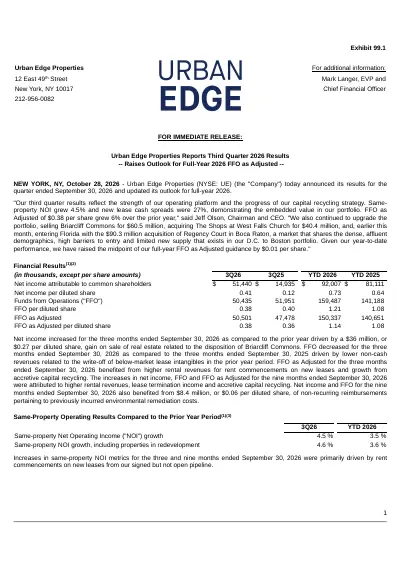
FFO as adjusted was 38 cents per share, up 6% from last year's third quarter and 6% year-to-date. Same-property NOI, including redevelopment, grew 4.6% for the quarter and 3.6% year-to-date.
We raised FFO as adjusted guidance by a penny per share at the midpoint to $1.52 to $1.54, which implies 7% growth over 2025. We continue to improve the quality and long-term growth rates of the portfolio through capital recycling.
In September, we sold Briarcliff Commons, a Kohl's-anchored center in Morris Plains, New Jersey, for $60.5 million. That sale moves Kohl's from our third largest tenant by ABR to our seventh.
We structured it as an accretive reverse 1031 exchange paired with our acquisition of The Village at Bridgewater Commons. Earlier this month, we closed on the $90.3 million acquisition of Regency Court in Boca Raton, marking our entry into Florida.
As we've stated in the past, moving south is a natural extension of our footprint. Several of us on the leadership team spent years owning, living in, and operating shopping centers in South Florida, we know these communities well.
We expect to keep growing in this market, mostly through selling some of our more stabilized, high-credit power centers in New Jersey. Regency Court is a 140,000 square foot center anchored by Publix and Walgreens in an irreplaceable, highly affluent trade area.
Average household income is $194,000 within 3 miles and more than $280,000 within 1 mile. The center sits at the entrance to Woodfield Country Club, surrounded by other high-end club communities, and there is no other grocery-anchored center within 2 miles.
It draws 3.3 million visitors a year, with traffic still increasing. We underwrote this acquisition on growth embedded in the rent roll, not on the going-in yield, which was approximately 4%.
Both anchors pay a fraction of market, and both leases expire, including all options, in six years. Beyond the anchors, we see opportunities to add value through upgrading the tenant mix, improving access and parking, and potentially adding GLA.
We expect to earn an 8% to 9% unlevered IRR. With Regency Court, The Shops at West Falls Church in Virginia, and The Village at Bridgewater Commons in New Jersey, we've acquired $185 million of high-quality centers this year, further diversifying our geographic footprint and increasing our long-term growth rate.
We are encouraged by the strength and depth of the leasing environment. Nationally, retail vacancy is 4.3%, near record lows.
Big-box tenants are competing for well-located space, and scarcity is pushing rents higher. Our same-space new lease cash spreads are 28% year-to-date, and our signed but not open pipeline is $21 million, representing 7% of annualized net operating income, one of the largest pipelines in the sector.
We're very well positioned for continued steady growth. With that, I'll turn it over to our Chief Operating Officer, Jeff Mooallem.
Jeff Mooallem
Thank you, Jeff. In the third quarter, we signed 37 leases totaling 463,000 square feet.
That included 26 renewals totaling 406,000 square feet at a 12% spread, and 11 new leases totaling 58,000 square feet at a 27% same-space spread. The new leases were with a good mix of retailers new to our portfolio as well as names we've worked with before.
Examples include Veterinary Emergency Group, Foot Locker, First Watch, McDonald's, Honeygrow, and 7 Brew Coffee. Same-property leased occupancy is now 96.6%, up 20 basis points from last quarter, and shop occupancy is 91.7%, unchanged.
With every new lease, we try to achieve three things: enhanced quality and credit, higher starting rent and increases, and a lower level of landlord investment. In that regard, the fourth quarter is shaping up to be one of our best.
We are in active negotiations with over 30 tenants, a mix of both anchor and shop leases, with a noticeable uptick in quality over the leases we were negotiating just a couple of years ago. Replacing outdated or lower credit concepts with stronger operators will keep adding value to these centers for years.
Rent spreads are stronger, too. With about two months left in the year, we are targeting rent spreads around 50% for the fourth quarter and over 30% for the year.
Notably, those spreads are coming as much from anchors as shops, as the scarcity of box space in our markets creates additional leverage in our favor. Finally, while we don't discuss it on these calls as much as we discuss rents, the reduction in leasing costs over the last few years is as impactful to our business as the increase in rents.
The average shop deal leasing costs, defined as landlord work, tenant allowance, and commissions paid, has declined about 15% from 2024 compared to the first three quarters of 2026. For anchors, it is even more meaningful, a little over a 30% decline in average leasing costs.
Many of our anchor deals now are as-is, reducing both overall cost and time to rent commencement. Tenants who previously insisted on their exact construction specs have had to adjust to a new reality.
Two projects stabilized in the third quarter at a total investment of $9 million and an average yield of 18%: Nordstrom Rack and Fidelity at Manalapan Commons, and a new Adidas store at Bergen Town Center. In both cases, we brought in better quality tenants than what was previously there at solid returns.
Over the last 12 months, we've completed $40 million of these projects at a blended 23% yield. This quarter, we started another: a $7 million multi-tenant pad development at Ledgewood Commons for Veterinary Emergency Group and two additional tenants.
Our active redevelopment pipeline now stands at $152 million, with $57 million left to fund and an expected yield of about 12%. Most of that work is in assets we've owned for several years, but our three 2026 acquisitions will add to it, since each has some mix of vacancy, dated tenancy, and below-market leases that provide an opportunity to create even more value.
With that, I'll turn it over to our CFO, Mark Langer.
Mark Langer
Thank you, Jeff, and good morning. We delivered another strong quarter.
FFO as adjusted was 38 cents per share, up 6% from the third quarter of last year, and same-property NOI, including redevelopment, grew 4.6%. The growth came from higher rental revenue from rent commencements and contractual rent increases, along with the benefit of our earlier capital recycling.
Results this quarter were slightly ahead of our expectations. NOI growth came in stronger because uncollectible revenue was better than budgeted, at 45 basis points of gross rental income.
That reflects the health of our tenant base. Our bankruptcy watchlist is smaller than at this time in prior years, consistent with a broader market.
In October, we modified and extended our existing $70 million mortgage secured by The Outlets at Montehiedra, adding $17 million of additional proceeds through an interest-only B-note at a fixed rate of 6.95%, reflecting the growth in NOI and favorable outlook for the property. Given income taxes paid in Puerto Rico, the tax-effective interest rate of this B-note debt is 3.9%.
The modification extended the term on the entire mortgage to seven years, which now has a current weighted average interest rate of 5.4%. We ended the quarter with $75 million drawn on our credit facility.
After the quarter, we drew another $63 million for Regency Court. With that activity included, our liquidity remains very strong at over $875 million.
That consists of $86 million in cash, $138 million drawn on the credit facility, and nothing drawn on either our five-year or seven-year delayed draw term loans. Net debt to EBITDA was 5.7 times for the third quarter.
Looking ahead, we are raising our 2026 FFO as adjusted guidance by a penny per share at the midpoint. That implies fourth quarter FFO of 39 cents per share and $1.53 for the full year.
We have also raised our full year same-property NOI growth guidance, including redevelopment, to a midpoint of 4.1%, up from 3.5%. Our $21 million signed but not open pipeline continues to give us good visibility into future growth.
In the third quarter, $2.6 million of annualized gross rent commenced, and we expect another $700,000 to be recognized in the fourth quarter and almost $13 million to be recognized in 2027. In closing, we are pleased with our third quarter results, encouraged by the strength of our leasing pipeline, and excited about our progress on the capital recycling front.
With that, I'll turn the call over to the operator for Q&A.
Operator
Thank you. We will now be conducting a question-and-answer session.
If you would like to ask a question, please press star one on your telephone keypad. A confirmation tone will indicate your line is in the question queue.
You may press star two if you would like to remove your question from the queue. For participants using speaker equipment, it may be necessary to pick up your handset before pressing the star keys.
One moment please while we poll for questions. Our first question is with Michael Goldsmith with UBS.
Please proceed with your question.
Michael Goldsmith
Good morning. Thanks a lot for taking my question.
First question, let's just talk a little bit about Florida. Feels like the name of the game across REITs has been size and scale.
You're entering a new market, it sounds like you want to build additional scale there. Can you just talk a little bit about what that process looks like, how quickly can you gain scale in that market?
Then also, right, this was acquired at a pretty compressed initial yield, would you maybe just a little touch on whether you'd continue to maybe dilutively buy in that market as you capital recycle? Thanks.
Jeff Olson
Good morning, Michael, it's Jeff. I'll take part of it and then I'll turn to Jeff Mooallem to take part of it.
Regency Court was pretty darn special. I think it may be one of the best shopping centers in Florida that's traded in the last decade.
Properties like this don't come to market very often. Actually reminds me of when we bought Westlake Shopping Center in Daly City many years ago at Kimco, and then also Aventura Square at Equity One, which is near Aventura Mall.
When I look at the common denominator behind those two as I compare it to Regency Court, one is the location is just exceptional, beyond exceptional, in a severely supply-constrained market. Number two is that they're older properties with anchor leases that run out of term, which is hard to find.
Three is the land values are super high, there will be opportunities to take that land value and monetize it at some point. Four, which is an important one, is all of these assets had been under the same ownership for decades and decades.
We think bringing a fresh perspective is going to be unique. Our experience, these types of assets are just gifts that keep on giving, almost in perpetuity.
Jeff, why don't I turn it over to you in terms of adding scale? Ironically, I used to live in South Florida, Langer lived in South Florida, Jeff lived in South Florida, this is a market that we know very well.
Jeff Mooallem
Hey, good morning, Michael. I'd echo everything Jeff said about South Florida as a market and the uniqueness and specialty of Regency Court.
In terms of what the growth strategy would be, I think what's the most instructive thing is just look at what we've done in the New England and the Boston market over the last five years. That was a market that we had barely any presence in five years ago and it's now roughly 10% of our company, roughly half a billion dollars of value there.
That's a byproduct of slow and steady targeting the right kind of assets, being visible in the market, being present in the market, and buying selectively and strategically. It's really hard to do that when you don't already have a foot in the door.
Regency Court is a very special foot in the door. It's a foundational asset that immediately is an asset that we're excited to get to work on, and it will open the door for other opportunities for us in South Florida.
Michael Goldsmith
Thanks for that. Just as a follow-up, same-store guide same-store NOI guidance moved higher and it implies a material acceleration in the fourth quarter.
Mark, do you mind just kind of talking about the building blocks there? I think you talked a little bit about, the SNO pipeline and and recognizing some some revenue, coming up, but maybe you can just provide a little bit more detail in the in the building blocks there.
Thanks.
Mark Langer
Hi, Michael. The biggest building blocks are what you said, really the full stabilization of rents that commenced in Q3 that will roll over, as well as what I mentioned for the incremental rent from the SNO pipeline in Q4.
In addition, fourth quarter is, we're expecting that's when we get our largest percentage rent and some ancillary income. Then on the recovery side, it's hard to imagine, but a year ago, we actually had $3.5 million of snow removal expense.
We got hit with some storms late in December last year, that could inure to our benefit. We don't model that level for this year as well, a little bit on recovery.
It's really a blend of all of that, but the biggest propellant is really the new rents coming online.
Michael Goldsmith
Now we know why you like South Florida so much. Thanks so much.
Mark Langer
I don't have $3.5 million of snow in South Florida, I can tell you that.
Michael Goldsmith
Amen.
Mark Langer
Thank you.
Operator
Our next question is from Ronald Kamdem with Morgan Stanley. Please proceed with your question.
Ronald Kamdem
Hey, great. Just staying with South Florida, I guess it sounds like you envision this could be 10% of the company, if I'm understanding correctly, over time obviously.
Just more color around, are you only buying? Would you consider developing in the market?
Are there other markets considered, right? Would you grow beyond South Florida?
Just trying to get a sense of the scope of what checks the box and what we could see on the acquisition and potential capital deployment front. Thanks.
Jeff Olson
We'd love to find more Regency Courts candidly, but again, they don't come up very often. I think we would extend to other portions of the state because we are very familiar with the state overall, but it's going to be opportunistic and it really is dependent upon the individual real estate.
Jeff Mooallem
Ron, I would add, on the question of development, our forte is not necessarily always ground-up development, but we are really, really good at repurposing older product. As South Florida as a community ages, as Tampa as a community ages, other markets like that age, there's lots and lots of shopping centers that will be sort of in need of what we do, and it is a skillset that not a lot of people do anymore because there hasn't been a whole lot of retail redevelopment over the last 15 years.
We are definitely hoping for more opportunities to do meaningful redevelopment, as deals come forward.
Ronald Kamdem
Got it. That's helpful.
Then maybe just staying on the theme of same-store, but on expenses, just looking at the year-over-year growth, maybe can you talk to that? Are they more elevated than they should be?
Are they in line? Just would love to hear some comments on the expense line items this quarter and going forward.
Thanks.
Mark Langer
Are you referring to the expense side of things, Ron?
Ronald Kamdem
Yep.
Mark Langer
Okay. When you look in the supplement, you may have noticed on the real estate taxes year-over-year, you saw the decline, and that's really just a reflection in this quarter, we had a few properties where we settled pending tax appeals, which required a true-up for the year-to-date number, because the recovery ratio on real estate taxes is so high, you had an offsetting impact on recovery revenue, the net impact to NOI was negligible.
In terms of other expense categories, Ron, I think on a go-forward basis, it's fair to assume we've been renegotiating, looking hard at those, but I think a 3% escalation in general for property OpEx is a reasonable assumption.
Ronald Kamdem
Great. That's perfect.
Thank you so much.
Mark Langer
Yep.
Operator
Our next question is from Michael Griffin with Evercore ISI. Please proceed with your question.
Michael Griffin
Great, thanks. Not to belabor the point on Regency Court, but Jeff, I know you gave the going-in cap rate.
Curious if you can give any commentary on what your expectations of stabilized yields are for that project and how quickly you can realize those below-market rents. Then given Walgreens' tenancy there, how do you underwrite a renewal versus a potential vacancy and just any kind of thoughts there on the tenancy at the center?
Thank you.
Jeff Olson
I won't give specific numbers because it's a little bit speculative, but we know that those two leases expire in six years. Rarely do anchor leases, by the way, go to full term, our expectation is that there probably will be some type of deal between now and six years.
You can sort of do the back-of-the-envelope math looking at our 8% to 9% unlevered expected yield, and that sort of gives you I think enough guidance for you to put into your model.
Michael Griffin
Right, that's super helpful. Then Jeff Mooallem, I appreciated your comments around more favorable capital costs and I think having greater leverage just in the supply-constrained environment.
As you look out into the near and medium term, does this capital cost as a percent of NOI, are we just in a different paradigm and you expect a more favorable environment here? Just curious how we think about this relating to the ultimate opportunity set within growing internal cash flow if you have less capital outlays to get the tenants into the properties.
Jeff Mooallem
Hey, good morning, Griff. I do think we see it as a trend that shows no sign of abating, and we are expecting it to continue.
There's sort of two buckets of capital, right? There's the leasing costs and then there's the stuff that we have to do to maintain our shopping centers, whether that's renovation stuff the customer can see or deferred maintenance the customer can't see, and all those categories are going down.
I talked about the leasing capital in my remarks and how we've just been able to negotiate better deals, more as-is deals, a lot of it around sort of you have to take the HVAC we have or you got to put the demising wall up, kind of conversations that our leasing team is doing a really good job of delivering lower capital deals. Even on the other side in terms of what we spend on deferred maintenance and renovation, Mark has messaged consistently over the last few quarters that we've spent a lot of money.
I think we improved probably 70% of the portfolio or something like that, over the last 5 to 10 years, and we don't expect that to be the run rate going forward. If you looked at our 2027 budget numbers, it would bear that out.
No reason to believe that the trend of keeping capital lower on a go-forward basis will stop anytime soon.
Michael Griffin
Great. Thanks so much.
Operator
Our next question is from Floris Van Dijkum with Ladenburg Thalmann. Please proceed with your question.
Floris van Dijkum
Hey guys. Couple of follow-ups on Regency Court, seems to be a topic du jour.
What is the GAAP yield versus the cash? I presume the 4% is a cash cap rate.
Where are you marking it today given the below-market leases and what can you get away with?
Mark Langer
We haven't finalized the purchase price allocation, Floris, but I expect the GAAP yield to be in the 5s. Then,
Floris van Dijkum
apparently Publix was bidding on that property as well. Could you consider doing something where you sell the grocery box to Publix to lower your basis and increase the yield, or would you want to mark the rent for Publix to market partly because the upside potential?
Or is that still an ongoing negotiation, potentially?
Jeff Olson
Ongoing, sort of all depends on price, as you would expect.
Floris van Dijkum
Great. The second question I have is on Bruckner, because that's going to be a major part of your SNO pipeline, presumably.
How is that progressing? When is that going to be stabilized?
Any other developments there or are you seeing more momentum for that center? Because I think that's going to be $15 million of NOI once it's stabilized, if I'm not mistaken.
Jeff Mooallem
That's right, Floris, it's Jeff Mooallem. Good morning.
I'll take the stabilization question. You can see in our supplemental, we're targeting the four or five new tenants that are going to be opening there, which is Chick-fil-A, Chipotle, BJ's, Ross, and DSW, all open in the first half of 2027, some in 1Q and some in 2Q.
Right now, we feel very good about those dates. We're hopeful that we'll beat them on average by 30 to 90 days, but we feel very good about where they are in the first half of the year.
Then as far as more momentum, I got to get more space. We're pretty much fully leased there.
Scott and his team have done a very good job of increasing rents and improving tenancy. We just signed Foot Locker, tenants like that, but we really don't have a lot of vacancy at Bruckner Commons, so as space becomes available, these new tenants will only increase the level of demand.
Floris van Dijkum
Thanks, Jeff.
Operator
Our next question is from Michael Gorman with US Bancorp BTIG. Please proceed with your question.
Michael Gorman
Thanks. Good morning.
I was wondering if you could just talk about the three acquisitions done this year have a significantly higher shop component than kind of the in-place portfolio, and I'm just curious, is that just a function of the deals that you're seeing in the marketplace right now? Is this a specific strategy that you're trying to increase the percentage of shop components in the portfolio?
Any color there would be helpful.
Jeff Olson
Yeah. Look, what we're trying to do is through capital recycling, sell more of our high-credit sort of lower-growth properties that might generate, I don't know, 1% to 2% growth each year that we can get pretty low cap rates for, and redeploy that into assets that are 2.5%, 3.5%, 4.5% growth, and Regency's case much, much higher than that actually.
It's less about format and it's more about long-term NOI growth prospects over the next five to seven years.
Michael Gorman
Great. That's helpful.
Then just maybe one quick one. Any updates that you can provide on the parcel sale at Sunrise?
I think that's still pending. Is that just going through normal channels or anything to keep an eye on there?
Jeff Mooallem
Good morning, Michael, it's Jeff. We have a hearing in two weeks, which is a publicly noticed hearing to move forward with the site plan approval for the parcel sale there.
We've been working diligently behind the scenes to get ready for that hearing. Once that is completed and that goes through the process, and with these things, it's impossible to say if it's going to take one hearing or two or three, but we feel very confident that we're prepared and ready for it.
Once that goes through the process, we can start targeting things like closing timelines and planning out the rest of the project. In terms of new developments, I would tell you in two weeks from, I think tomorrow, is when our hearing is, and that will be the next critical day in the process.
Michael Gorman
Great. Maybe just one last quick one.
The Publix at Regency Court, has that been redeveloped or refreshed as a store at any time in recent years?
Jeff Olson
It has not.
Michael Gorman
Great. Thank you very much.
Operator
Once again, if you would like to ask a question, please press star one on your telephone keypad. Our next question is from Paulina Rojas with Green Street.
Please proceed with your question.
Paulina Rojas
Good morning.
Jeff Olson
Hi, Paulina.
Paulina Rojas
I'm interested in the demographics of acquisitions. How would you define your buy box in general?
Your recent acquisition in Florida has really outstanding demographics, and prior comments also very high barriers to entry, what I imagine it's very hard to replicate. Should we assume you're targeting similar demographics going forward in this market, or are you open to something slightly different?
Jeff Olson
Look, we favor densely populated markets, first-ring suburbs, highly affluent areas where where where supply is severely constrained, and where we can do something with a shopping center that makes it unique. So, I I would I would expect that that that we would continue to deploy capital in areas where those demographic trends, are all in line.
I I would not expect us to, and and remember, we named the company Urban Edge because, we're on the edge of these urban markets in these first-ring suburbs. I would not expect us to to to to go away from that strategy.
Paulina Rojas
Thank you.
Jeff Olson
We love infill, and the tenants are paying the rents that's required in many cases for us to invest significant amounts of capital into these properties to bring them to current standards.
Jeff Mooallem
Paulina, I would just add in the case of Regency Court in Boca, like Jeff mentioned in his comments that there's no other grocery-anchored center within 2 miles, but if you looked at our competition map and zoomed out even further, the other shopping centers that are competitive are owned by names like Regency, EDENS, Simon has the mall, and then most notably Publix is the big owner of these kinds of properties. That does a couple of things.
Number one, it makes it very difficult to ever buy in these kinds of markets, which is why we wanted to pounce on this opportunity. Number two, you're surrounded by owners who, like us, know how to push rents and don't give space away.
That generally kind of lifts all boats. Regency Court is a very unique property for that reason.
Paulina Rojas
Thank you for the color. My second question is, the vast majority of your portfolio is in the DC-Boston corridor, but you own a very few assets outside the two centers in Puerto Rico, I think there is another one in St.
Louis, a couple, actually, in California. What are your updated thoughts on them?
Are they short-term or mid-term holds, or candidates for recycling as you build in your new regions?
Jeff Olson
I think those could likely be candidates for recycling, Paulina, all price dependent, and we'll weigh that against other possible sale candidates that we have, again, referencing to some of the very high credit and lower growth power centers that we have in New Jersey that trade very well. We'll weigh it all.
Paulina Rojas
Can I add one more question?
Jeff Olson
Of course.
Paulina Rojas
What about the topic of scale? Do you need certain scale in South Florida to be efficient, or you can live for a while with one, two, or three centers?
Jeff Mooallem
I think we can live for a while with one, two, or three centers. Don't forget, we have a lot of operating expertise in this market.
I think between the three of us, Mark, Jeff, and I, we probably have over 20 years of living there and working there. We know a lot of the key players.
We have a good management strategy for the asset. While we may use a local broker to help us with some of the more local leasing, the national relationships that want to be in Boca Raton are the same national relationships that want to be in Bridgewater, New Jersey, and Framingham, Massachusetts.
We have lots of different ways that we can reach the right tenants and manage the property effectively. Having said that, scale is always nice, and if we could add two or three or four more centers in the area and spread out our management a little bit, we certainly are going to try to do that.
Paulina Rojas
Thank you.
Operator
We have reached the end of the question-and-answer session. I would like to turn the floor back over to Jeff Olson for closing comments.
Jeff Olson
Great. Thank you for joining us.
We appreciate your interest in UE and we look forward to seeing you guys soon. Thank you.
Operator
This concludes today's teleconference. You may disconnect your lines at this time.
Thank you for your participation.