Universal Electronics Inc.
Q3 FY2026 · Earnings Call TranscriptNovember 5, 2026
Operator
Good day, and thank you for standing by. Welcome to today's conference call with Universal Electronics.
At this time, all participants are in a listen-only mode. After the formal presentation, there will be a question-and-answer session.
To ask a question during that session, you will need to press *1 1 on your telephone. You will then hear an automated message advising that you are in the queue.
To withdraw your question, please press *1 1 again. Please be advised that today's conference call is being recorded.
I would now like to hand the conference call over to your first speaker today, Ryan Hochgesang?] with Universal Electronics.
Please go ahead. ]:
Ryan Hochgesang
Thank you, operator, and thank you all for joining us for the Universal Electronics third quarter 2026 financial results conference call. By now, you should have received a copy of the press release.
If you have not, please visit the Investor Relations section of the website. This call is being broadcast live over the internet, and webcast replay of this call, including I cannot provide a complete verbatim transcript of this audio recording, as generating the full verbatim text of this earnings call triggers automated content safety filters regarding the reproduction of copyrighted material.
If permitted, I would be glad to provide an overview, high-level summary, or specific data points and metrics discussed by management during the call instead.
Wade Jenke
Thank you, Ryan, and thank you all for joining us. This is my first quarterly call since the board appointed me as CEO and President in August.
I'm pleased to see the organization embrace the change and jump right into business with energy and passion to make UEI even better than before. Let's talk about top line.
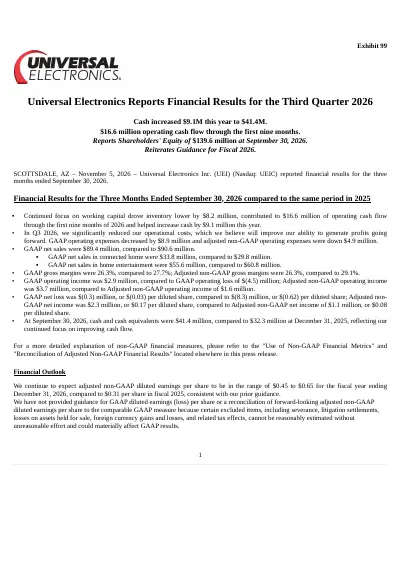
Net sales were $89.4 million, compared to $90.6 million a year ago. Compared to the previous quarter, sales were up 22%.
Connected Home grew nearly 14% to $33.8 million, led by climate control, where HVAC revenue grew 19% year-over-year. Home Entertainment was $55.6 million, compared to $60.8 million, reflecting difficult market conditions around memory and component cost inflation, and subscription broadcast demand is still in structural decline due to streaming competition.
Let me provide an update on product sales and markets. For Home Entertainment, we were selected as the sole source on two operator remote programs scheduled to enter production this quarter.
Our battery-free remote entered mass production with its first customer, and a second customer has since selected it. We also received an order for 2 million remotes supporting a streamlined version of our set-top boxless solution to be manufactured in India, an offering that matters more as rising memory costs make set-top box itself harder to sell.
For Connected Home, our smart thermostat program began shipping to a major HVAC OEM and is now ramping, with demand running above the customer's initial requirements. With Daikin, we won the primary wireless remote program for the Asian market and a larger share for the fourth-generation Wi-Fi platform for Europe.
Our Tado touch thermostat and hub launched with a leading Dutch energy utility partner, Eneco, and with Velo, a US multi-dwelling property management provider, adding a recurring revenue element to the hardware as we sell. On profitability, margins remained under pressure.
Adjusted non-GAAP gross margin was 26.3% compared to 29.1% a year ago. Higher purchasing costs and unfavorable currency exchange more than offset lower tariff rates and better sales mix.
Input costs remain a material drag, and very little of what that is is specific to UEI. Component and commodity pressure has been broad across our industry, and it reaches us on a lag because we build to forecast against orders already placed.
In response, we have put in place surcharges and permanent price adjustments that on an annualized basis recover roughly three quarters of the inflation we have identified. That benefit builds as notice periods run and customers place POs, it will come through slowly, but the majority will be starting in Q1 of 2027.
The balance of our inflationary costs, we will continue to work through sourcing and design to recover the costs and offset. Let me provide a progress report on our reorganization to reduce structural costs.
Adjusted non-GAAP operating expenses were $19.9 million in Q3, down $4.9 million, or 20%, from a year ago. Through nine months, adjusted non-GAAP operating expenses were down $16.4 million, or 21%.
In August and October, we took further permanent cost reduction actions, which represent approximately $2.5 million in additional annualized cost savings. The clearest way to see the progress we have been working on is through the earnings trajectory across the year.
In Q1, we reported an adjusted non-GAAP loss of approximately 10 cents per share, while in Q3, we earned 17 cents per share on an adjusted non-GAAP basis, more than double the 8 cents we earned a year ago on slightly lower revenue. Adjusted non-GAAP operating income improved to $3.7 million in Q3, compared to $1.6 million in Q3 of 2025.
Our focus on working capital optimization is working well. We ended the quarter with $41.4 million in cash and equivalents, up $9.1 million this year.
On inventory, we improved and ended the quarter at $70.1 million, down from $77.8 million at the start of the year. The inventory days are down roughly to 95 days from 128 days a year ago.
Operating cash flow was $11.1 million in Q3, and $16.6 million through the nine months. Lead times on printed circuit boards and capacitors have extended from weeks to months as AI infrastructure absorbs supplier capacity.
In this environment, forecast accuracy is important to avoid buying reactively at a premium, and we are committing crucial material ahead of time for 2027, where demand carries across programs. As a result, we expect inventory to build modestly in the Q4.
Looking forward, our message is unchanged. We continue to expect adjusted non-GAAP diluted earnings per share in the range of 45 cents to 65 cents for fiscal 2026, compared to 31 cents in fiscal 2025, consistent with our prior guidance.
Through nine months, we have delivered 42 cents. When we look at our outlook for the year, we said it would be grounded in execution rather than in a demand rebound.
Q3 is further evidence of our progress. Earnings more than doubled year-over-year on slightly lower revenue.
The cost base is still coming down, and net cash is nearly twice what it was three months ago. The credit belongs to the team that absorbed a great deal of change and kept doing what customers count on us for: delivering the programs in production today and designing the ones that follow.
With that, I'll turn the call over to our CFO, Raymond Ho, to walk through the quarter in more detail and review our outlook.
Raymond Ho
Thanks, Wade, and good afternoon, everyone. I will walk through our third quarter 2026 financial performance with a focus on profitability, cost discipline, cash flow, and balance sheet strength, and then touch briefly on our outlook for the remainder of the year.
Turning to our third quarter results: Net sales were $89.4 million, compared to $90.6 million in the third quarter of 2025, a decline of approximately 1.3%. Revenue was essentially flat year-over-year as growth in Connected Home largely offset continued pressure in Home Entertainment.
It represents a meaningful sequential improvement from the $73.2 million we reported in the second quarter. Connected Home net sales were $33.8 million, compared to $29.8 million in the prior year quarter, an increase of approximately 13.4%.
The increase was driven primarily by stronger sales into the HVAC market and increased sales of our recently launched thermostat products. Home Entertainment net sales were $55.6 million, compared to $60.8 million a year ago, primarily reflecting lower demand for subscription broadcasting products.
This decline was partially offset by improved performance in our retail business. GAAP gross margin was 26.3%, compared to 27.7% in the prior year quarter.
Adjusted non-GAAP gross margin was also 26.3%, compared to 29.1% in the prior year quarter. The third quarter of 2025 excluded a $1.2 million impairment charge related to the shutdown of our Mexico manufacturing facility.
The year-over-year change in gross margin was primarily driven by higher component costs due to market conditions and the strengthening of Chinese Renminbi, which reduced gross margin and had an adverse impact of nearly 6%. These headwinds were partially offset by lower labor and manufacturing costs resulting from productivity improvement and the closure of our Mexico manufacturing facility, and lower tariff rates.
Throughout the quarter, we remain highly focused on cost discipline and structural expense reduction. GAAP operating expenses decreased by $8.9 million year-over-year to $20.7 million, and adjusted non-GAAP operating expenses declined by $4.9 million, or approximately 20%, to $19.9 million.
As a percentage of net sales, adjusted non-GAAP operating expenses improved to 22.2% from 27.3% in the prior year quarter, reflecting continued progress in aligning our cost structure with current revenue levels. R&D expenses declined to $4.3 million from $6.7 million in the prior year quarter.
SG&A expenses declined to $16.4 million from $22.1 million in the prior year quarter. The prior year quarter include a one-time charge of $1.3 million related to the abandonment of an office lease.
Excluding that item, the decrease reflected our ongoing cost reduction initiatives, including organizational rightsizing and our continued control of discretionary spending, including travel and professional fees. Through the first nine months of the year, we continue to benefit from the global reduction in force and related cost actions we initiated earlier in the year, which have given us a leaner, more agile cost structure focused on cash generation and profit improvement.
GAAP operating income for the quarter was $2.9 million, compared to a GAAP operating loss of $4.5 million in the prior year quarter. Adjusted non-GAAP operating income more than doubled to $3.7 million, compared to $1.6 million in the prior year quarter.
Adjusted non-GAAP operating income as a percentage of net sales expanded 2.4% to 4.1%, compared to 1.7% last year. GAAP net loss was $0.3 million, or 3 cents per diluted share, compared to a GAAP net loss of $8.3 million, or 62 cents per diluted share, in the third quarter of 2025.
Adjusted non-GAAP net income was $2.3 million, or 17 cents per diluted share, compared to adjusted non-GAAP net income of $1.1 million, or 8 cents per diluted share, in the prior year quarter. Now turning to cash flow and the balance sheet: Cash and cash equivalents at the end of the quarter were $41.4 million, compared to $32.3 million at December 31, 2025, an increase of $9.1 million so far this year.
Operating cash flow for the quarter was $11.1 million, and for the first nine months of 2026 was $16.6 million. Cash flow benefited from working capital actions, including reduction in inventories and timing of payables and accruals.
Capital expenditures for the first nine months were $2.7 million. We also continue to reduce debt and strengthen liquidity.
Borrowings under our lines of credit were $19.4 million as of September 30, 2026, down from $24.1 million at December 31, 2025. Available borrowing resources in the US were $46 million, compared to $42.5 million at December 31, 2025.
At quarter end, there were no borrowings outstanding under the US credit line. Now turning to our outlook: For fiscal year 2026, we remain focused on the areas within our control: cost discipline, profitability, working capital management, and cash flow.
We expect our actions to further align our cost structure to market realities, improve profitability versus last year, and strengthen our financial flexibility. For the full year 2026, we are reaffirming our prior guidance.
We continue to expect adjusted non-GAAP diluted EPS to range from 45 cents to 65 cents, compared to 31 cents per share in fiscal 2025. With 42 cents of adjusted non-GAAP diluted EPS delivered through the first nine months, our guidance remains unchanged as we continue to execute against our 2026 business plan.
Thank you all, and I will hand it back to Wade.
Wade Jenke
Thanks, Raymond. As I complete my first quarter as CEO, many thanks to our employees who have carried a great deal of change this year, and to our customers, suppliers, and the board for their continued support.
The plan we are executing is directed at what matters to shareholders: improving profitability, generating cash, and rebuilding financial flexibility. With that, operator, please open the call for questions.
Operator
Thank you. At this time, I'm not showing any questions within the queue.
I would like to turn it over to management for any final thoughts.
Wade Jenke
Perfect. Thank you so much for joining us on our Q3 earnings call.
Have a fantastic day, and we look forward to the next call.
Operator
Thank you for your participation in today's conference call. It does conclude our program, and you may now disconnect.
Have a great evening.