Victory Capital Holdings, Inc. Class A Common Stock
Q3 FY2026 · Earnings Call TranscriptNovember 5, 2026
Operator
Good morning, and welcome to the Victory Capital Third Quarter 2026 Earnings Conference Call. All callers are in a listen-only mode.
Following the company's prepared remarks, there will be a question-and-answer session. If you would like to ask a question, please press star one to raise your hand.
To withdraw your question, press star one again. I will now turn the call over to Miss Carly Thomas, Director of Investor Relations and Responsible Business.
Please go ahead, Thomas.
Carly Thomas
Thank you, operator, and good morning, everyone. Before I turn the call over to Chairman and CEO David Brown, I would like to remind you that during today's conference call, we may make several forward-looking statements.
Victory Capital's actual results may differ materially from these statements. Please refer to our SEC filings for a list of some of the risk factors that may cause actual results to differ materially from those expressed on today's call.
Victory Capital assumes no duty and does not undertake any obligation to update any forward-looking statements. Our press release, which was issued after the market closed yesterday, disclosed both GAAP and non-GAAP financial results.
We believe the non-GAAP measures enhance the understanding of our business and our performance. Reconciliations between these non-GAAP measures and the most comparable GAAP measures are included in tables that can be found in our earnings press release and in the slides accompanying this call, both of which are available on the Investor Relations section of our website at ir.vcm.com.
The slides also include further information on the historical investment performance statistics discussed today. In addition, today's presentation includes information regarding the pending acquisition of First Eagle Investments and our upcoming special meeting of stockholders.
Please refer to slide three for these disclosures. It is now my pleasure to turn the call over to David Brown, Chairman and CEO.
David?
David Brown
Thanks, Carly. Good morning, everyone, and welcome to Victory Capital's third quarter 2026 earnings call.
I'm also joined today by Michael Policarpo, our President, Chief Financial and Administrative Officer. I will start with an overview of our third quarter results, which delivered the strongest organic growth in our company's history.
I will also give a brief update on our pending acquisition of First Eagle Investments. After that, I will turn the call over to Mike to review the financial results in greater detail.
Following our prepared remarks, we will be available to answer your questions. On slide six, you'll see the third quarter was a record quarter for flows and for organic growth.
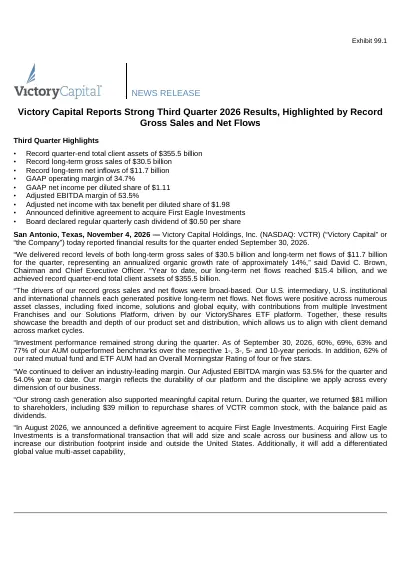
Total client assets reached $355.5 billion, up 3% from Q2 and 13% higher than at the end of the same period last year. Long-term gross flows were a record $30.5 billion, up 38% quarter-over-quarter and 80% versus the same quarter last year.
Annualized, that is more than a third of our long-term AUM, a level we believe is more than sufficient to drive sustainable organic growth over the longer term. Long-term net inflows were also a record at $11.7 billion, an improvement of $7.5 billion from the second quarter and nearly $12 billion from the third quarter of last year.
That represents an annualized long-term AUM organic growth rate of close to 14% and brings our year-to-date long-term net flows to $15.4 billion. From a financial perspective, adjusted EBITDA was $212 million, and our adjusted EBITDA margin was 53.5%, up 80 basis points from the same quarter last year and well above our long-term guidance of 50%.
Adjusted earnings per share was $1.98, up 21% from Q3 of last year. Additionally, in August, we announced a definitive agreement to acquire First Eagle Investments, which I will go into in more detail later in the presentation.
I want to drill down on flows to better explain what is going on in this part of our business and why we are so excited about the future opportunities we have. What you are seeing come to fruition is the hard work and investment that began several years ago.
Over that time, we've invested deliberately in distribution through people, technology, data, marketing, and product development. When we closed the Pioneer acquisition, we brought two sales organizations together, and since then, we have invested heavily in educating our sales professionals across the entire product line.
Today, we operate as one complete sales organization representing all products, with every sales professional able to represent the full vintage Victory Capital and Pioneer lineup. Relationships in our industry take time to season.
Clients rarely invest on the day of the first meeting. They get to know the investment team, the process, and the track record, and then they commit.
We are seeing the results of a great deal of hard work over many client interactions. That is also why I want to be very clear about the breadth of this quarter's results.
Our growth is not coming from one vehicle, one franchise, one client, or one asset class. Our US intermediary, US institutional, and international channels each generated positive long-term net flows.
Multiple investment franchises and our VictoryShares ETF platform were net flow positive. Flows were positive across fixed income, solutions, multi-asset, and global equity.
The breadth is both important and intentional. The diverse nature of our product lineup spanning numerous asset classes and vehicles allows our teams to lead with effective solutions built around client objectives.
Underpinning all of this is strong investment performance, which brings me to slide seven. Investment performance remains the foundation of everything we do.
It is the reason clients hire us, and the reason they stay with us. As of September 30, 2026, 56 of our mutual funds and ETFs, or about half of our rated funds, earned four or five-star overall ratings from Morningstar, compared with only about a third of rated funds industry-wide.
Those funds represent 62% of our rated AUM, up from 60% last quarter. Against benchmarks, 60% of our AUM outperformed over the one-year period, 69% over three years, 63% over five years, and 77% over the 10-year period.
On a strategy count basis, 64%, 63%, 66%, and 69% of our strategies outperformed their benchmarks over those same time periods. Our clients invest with a long-term horizon, and we manage their assets the same way.
Our focus remains on disciplined, repeatable investment processes, reflecting the trust our clients place in us every day. Slide eight shows the diversification of our platform today.
Solutions now represents 33% of our $355.5 billion in total client assets, US equity 29%, fixed income 25%, and global and non-US equity 11%, with alternatives and money market making up the balance. Last quarter, I walked through how far we have come since our management buyout in 2013, when approximately 80% of our AUM was in US equity.
This quarter, that diversification showed up directly in our flows. The areas where clients across the industry are allocating today, including fixed income, multi-asset solutions, and ETFs, are areas where we have deliberately built depth.
Having a complete product set means that when client demand shifts, we are already positioned to meet it. Turning to slide nine, our VictoryShares ETF platform had its strongest quarter to date.
ETF AUM ended the quarter at $27.7 billion, up 48% year-to-date and 61% year-over-year. Positive net flows of $3.9 billion in the third quarter represent an annualized organic growth rate of 67% and bring our year-to-date total to $6.4 billion.
ETF net inflows exceeded $1 billion in every month of the quarter. Last quarter, I described how we built this business from just a few hundred million dollars of ETF assets in 2015.
This quarter shows what that consistency produces. Our free cash flow ETF series continued to lead, with our flagship VFLO, which launched just three years ago, now over $12 billion in AUM with a Morningstar five-star overall rating.
Our fixed income ETFs were also meaningful contributors, contributing close to $1 billion of net inflows in the quarter, led by our Pioneer Investments and Victory Income Investors offerings. We also continued to innovate.
During the quarter, we launched two new municipal ETFs, the VictoryShares Municipal High Yield ETF and the VictoryShares Short Duration Municipal ETF, bringing our platform to 25 ETFs across seven investment themes, with more to come as we continue to build out the platform and bring new products to market. Our average ETF fee rate is 33 basis points, 73% of our rated ETF AUM carries a four or five-star overall rating from Morningstar, and the margins of our ETF business continue to meet our firm-wide standards.
In other words, the average fee rate might be lower than our firm's overall average fee rate, but the margins on these products are not lower than our firm-wide margin. Slide 10 covers our international business, which continues to build significant momentum.
At quarter-end, we had $65.8 billion in AUM from international clients, with clients in 62 countries outside the US, and 35 of those countries with more than $100 million in Victory Capital AUM. We sub-advise 23 UCITS at quarter-end, and we have since launched a fixed income UCITS with Victory Income Investors, bringing the current total to 24.
International AUM has grown 46% in the 18 months since the Pioneer transaction closed, and our international business was net flow positive in the quarter, year-to-date, and cumulatively since closing. When we announced our partnership with Amundi, we said it would take time for their distribution teams to get to know our investment teams and our capabilities.
18 months in, that familiarity is growing every quarter. As our product set in this channel expands, and as relationships season, the opportunity continues to grow.
Turning to slide 11, I would like to provide a brief update on our pending acquisition of First Eagle Investments. As we said when we announced the transaction in August, this is a transformational acquisition for Victory Capital.
When we close, we will have greater size and scale across every part of our business, giving us even more capacity to invest in our investment teams, our distribution, technology, data, and our people. The investment capabilities are complementary to what we have today.
First Eagle adds a differentiated global value multi-asset capability, complementary equity and fixed income capabilities, and a scaled CLO and alternative credit platform. First Eagle manages approximately $222 billion in AUM.
92% of its rated mutual fund and ETF AUM carries a four or five-star overall Morningstar rating, and has generated positive net flows in each of the last three years and year-to-date in 2026. The transaction meaningfully expands our US distribution.
First Eagle products are used by approximately 103,000 US financial advisors and roughly 3 million end investors, along with over 700 institutional clients. Internationally, both firms work with Amundi today, this deepens a strategic partnership that is already working incredibly well for us.
This is also an area where our organic and inorganic growth strategies come together. We are acquiring a business that is already growing, which adds to the organic momentum I described earlier.
Our business becomes more diversified, more durable, and more resilient across all market environments and cycles. Our teams are deeply engaged in integration planning together with the First Eagle team.
We continue to work towards closing by the end of the first quarter of 2027, subject to customary closing conditions. Our special meeting of stockholders to approve the share issuance is scheduled for November 17th.
As I said in August, integration is a core competency of our firm. It is work we know how to do, done by people who have done it many times before.
We are on track with our net expense energy target of $280 million, 35% accretion target to annualized 2027 adjusted earnings per share, and timing targets in reference to close and net expense synergies we communicated at the announcement of the transaction. Slide 12 places First Eagle in the context of our longer-term journey.
Since our management buyout in 2013, every step of our growth has been intentional. On a pro forma basis, including First Eagle, our AUM will have grown by more than 3,000% since 2013.
Each acquisition has made our platform stronger, more durable, and ultimately more competitive, and each one has positioned us to do the next. The opportunity set remains deep, with more than 110 investment firms managing between $50 and $200 billion, and more than 35 firms between $200 and $500 billion.
Our immediate focus is on closing and integrating First Eagle, and we remain committed to our goal of $1 trillion in assets under management over time. Slide 13 outlines our capital allocation framework, which has not changed.
Strategic acquisitions remain our primary and best use of capital. We have closed eight strategic acquisitions since 2013, and that disciplined approach has driven our adjusted earnings per share with tax benefit to grow at a compound annual rate of approximately 21% since our IPO, with quarterly adjusted EPS up nearly 400% over that period.
That is what step-change growth looks like in practice, and First Eagle will continue and enhance that pattern. At the same time, our commitment to returning capital to shareholders continues.
Since our IPO, we have returned $1.6 billion to shareholders, including $1 billion in share repurchases. In the third quarter, we returned $81 million to shareholders, including $39 million in share repurchases, and we have now returned more than $400 million year-to-date.
That reflects the strength of our free cash flow and our asset-light business model. Stepping back, this quarter showed what happens when years of investment in distribution, product, and people come together on top of strong investment performance and a highly efficient platform, all supported by an ownership culture.
We have the people, the platform, and the strategy, and I'm as excited about the future of this company as I ever been. I will now turn the call over to Mike to walk through the financial results in more detail.
Mike?
Michael Policarpo
Thanks, Dave, and good morning, everyone. The financial results review begins on slide 15.
Revenue for the quarter was $396.6 million, up 10% from the same quarter last year, and the second highest in the history of our firm. On a GAAP basis, operating income was $137.7 million, and net income was $1.11 per diluted share.
GAAP results this quarter include higher acquisition-related costs associated with the First Eagle transaction. Adjusted EBITDA was $212.1 million, and our adjusted EBITDA margin was 53.5%.
Adjusted net income with tax benefit was $163.2 million, or $1.98 per diluted share, up 21% versus Q3 2025, and the second highest in the history of our firm. Our adjusted EBITDA margin of 53.5% reflects the continued efficiency of our platform and was up 80 basis points from the same quarter last year.
We ended the quarter with $208 million of cash and a net leverage ratio of 0.9 times. We returned $81 million to shareholders in the quarter, including $39.3 million in share repurchases.
On slide 16, total client assets at quarter-end were a record $355.5 billion, well diversified across our US intermediary, US institutional, US direct, and international channels, with clients in 63 countries, including the United States. Slide 17 shows our long-term AUM flows, and this is the slide that best captures the momentum in our business.
Record long-term gross flows of $30.5 billion were up 38% from Q2 and 78% from the fourth quarter of 2025. On an annualized basis, gross flows are running at approximately 36% of current long-term AUM.
That is a level of long-term gross flows that we believe is more than sufficient to drive sustainable organic growth over the longer term. Record net long-term flows of $11.7 billion represents 13.8% annualized organic growth, and every month of the quarter was net flow positive.
In Q2, I described what we were seeing as a convergence point, where the investments we have made in technology, data, distribution, marketing, product, and people were starting to work together. The third quarter is what that convergence looks like when it continues to build.
The breadth is what stands out. Positive long-term net flows came from multiple investment franchises, including Pioneer Investments, RS Global, Victory Income Investors, and WestEnd Advisors, as well as our VictoryShares ETFs.
They came from multiple channels, with our US intermediary, US institutional, and international channels all contributing. Our won but not yet funded pipeline also remains significant across multiple franchises and channels, both in the US and internationally.
Moving to slide 18, revenue was $396.6 million on record average AUM of $350.6 billion. Our average fee rate for the quarter was 44.8 basis points.
As a reminder, a single-digit percentage of our annual revenue comes from certain annual fees that are recognized at specific points in the year, rather than evenly each quarter. The amount recognized in Q3 was significantly lower than in Q2, which accounts for the majority of the change in both revenue and fee rate quarter-over-quarter.
Additionally, our sales are in line with where client demand is across the industry: fixed income, multi-asset, and ETFs, along with continued growth from our international clients. Those areas carry fee rates modestly below our total firm average.
This is about asset and channel mix. It has nothing to do with reducing fees on our products.
We are selling very strongly in exactly the areas where clients are allocating, and they are choosing the products we have built. Looking through the quarterly timing, the full year picture is unchanged.
Year-to-date, including annual fees, our average fee rate is 46.3 basis points, squarely in line with our full year guidance of 46 to 47 basis points, which I am reiterating as we look forward. Most importantly, we manage this business for margin and earnings growth, not for fee rate in isolation.
Because of the efficiency of our platform and our highly variable expense base, the growth we are generating in these areas comes with strong margins, and that is evident in our 53.5% margin this quarter. Turning to expenses on slide 19, total operating expenses were $258.9 million in Q3.
Cash compensation as a percentage of revenue was 21.7%, within our expected range, and we continue to expect cash compensation to run in the low to mid-20s as a percentage of revenue on a normalized basis. Our variable cost structure remains a key feature of our business.
More than two-thirds of our total operating expenses are variable, which provides meaningful flexibility through different market environments. Two items increased this quarter, and both are non-recurring in nature.
Acquisition-related expenses rose to $17.1 million on transaction costs primarily associated with First Eagle. Non-cash equity compensation increased on the accelerated performance share vesting as two vesting hurdles were achieved in the quarter.
On slide 20, adjusted EBITDA of $212.1 million was up 11% year-over-year, and our adjusted EBITDA margin was 53.5%. Adjusted net income with tax benefit of $163.2 million was up 16% year-over-year, and $1.98 per diluted share was up 21%.
We are maintaining our long-term adjusted EBITDA margin guidance of 50%, a level we have now met or exceeded for 14 consecutive quarters. That consistency is the result of a purposely designed, highly efficient, scalable platform, and the exceptional people who run it every day.
Finally, slide 21 covers our balance sheet and capital management. We ended the quarter with $208 million in cash and $975 million of debt, with a net leverage ratio of 0.9 times adjusted EBITDA, and our $100 million revolver remains undrawn.
We returned $81 million to shareholders in Q3. We enter the First Eagle transaction from a position of strength.
Our leverage is below one times, we have fully committed financing in place, and the free cash flow characteristics of our business give us the ability to fund the transaction, delever at a quick pace, and continue returning capital to shareholders along the way. The board declared our regular quarterly cash dividend of 50 cents per share, which will be paid on December 23rd to shareholders of record at the close of business on December 10th.
With that, I will turn the call back to the operator for questions.
Operator
We will now begin the question-and-answer session. If you would like to ask a question, please press star one to raise your hand.
To withdraw your question, press star one again. Please limit yourself to one question and one follow-up.
If you have further questions, please rejoin the queue. We ask that you pick up your handset when asking a question to allow for optimum sound quality.
If you are muted locally, please remember to unmute your device. Please stand by while we compile the Q&A roster.
Your first question comes from the line of Craig Siegenthaler with Bank of America. Your line is open, please go ahead.
Craig Siegenthaler
Hey, good morning, Dave, Mike. Hope you're both doing well.
When I see flows that good, I got to congratulate you on that.
David Brown
Thank you, Craig.
Craig Siegenthaler
Our first one is on the net flow dis-synergy potential relating to the First Eagle merger. We've heard your commentary around the strategic distribution opportunities from putting their funds on the Victory platform.
In the past, large asset manager combinations can also create near-term flow dis-synergies. How are you underwriting potential client attrition, consultant re-underwriting, product overlap, or distribution issues around the integration?
Just remind us what's embedded in your accretion assumptions.
David Brown
I'll—I'll take the flow part, and then Mike can talk about the accretion. I would first say that, we've drawn—we've gone back on, looked at our previous acquisitions, and I think Pioneer is the best example.
You, we just did not see any flow dis-synergies, based on, the tactics we use. If you look at how we do the integration, how we work with, putting the sales teams together, in the way specifically the First Eagle products are distributed, we don't think there will really be any flow dis-synergies, to speak of, or really anything that concerns us.
That platform has grown for the last three years, calendar years. It's positive year-to-date.
The performance on most of the products are excellent. And, we really think it's actually when we close, we think, we'll hit the ground running and really be able to expand the distribution.
Our assumptions are really around a positive synergy as opposed to a a dis-synergy. I think we have done eight acquisitions in the last 13 years and have learned a lot along the way and some things to avoid.
We'll put those things in practice as we, as we as we close at the end of the first quarter.
Michael Policarpo
I can jump in on the assumptions that we have in the accretion that we've put out there. We have what I would call a conservative, normalized level of organic growth with respect to the combined organization.
Dave mentioned that we anticipate the opportunity for revenue synergies and expansion based on putting the businesses together. We have not included that expansion in the accretion numbers.
It's a modest, very conservative view, single digits with respect to organic growth.
Craig Siegenthaler
Thanks. I think your stock is the top-performing asset manager stock on a three, five-year basis.
These deals have really worked well in your favor. My second one is a similar one, but a different angle.
It's on retaining and motivating investment talent. First Eagle's value is really tied to the investment talent behind that franchise.
Can you discuss the retention arrangements for key investment teams, how much of their employee economics are rolling into Victory, and also what the long-term incentive structure looks like once any transaction-related retention awards run off?
David Brown
Three, five-year, and actually since our IPO, we're the best-performing asset manager, Craig, as you know. We'll use the same tactics we've used with all of our acquisitions on First Eagle.
The teams will be on a revenue share, and then all of what they do will be exactly as we have with our other investment franchises, which has worked out really well from a retention perspective. The First Eagle Investments investment professionals are excited to join our platform.
They're excited to be part of something larger. I think they're excited to come from a really great environment and continue that on our environment.
We will use really nothing different than what we've used in the past, which has worked pretty successfully, and I think it's a proven group of incentives that we use. Ultimately, it comes down to, for these investment franchises, and it will for First Eagle, is if they perform well, they have a great opportunity to grow their client list, to grow their assets under management.
They have a great opportunity to kind of practice their craft of investing in a really positive environment. I think they enjoy coming in, and then being incentivized if they're successful.
Craig Siegenthaler
Thank you, Dave.
Operator
Your next question comes from the line of Michael Cho with JP Morgan. Your line is open, please go ahead.
Michael Cho
Hi, good morning. Thanks for taking my questions.
I just wanted to touch on flows. You gave some detailed commentary around the third quarter.
You talk about broad-based strength. I just wanted to drill down a little bit on fixed income and solutions.
It seems like there's a real gross sales emerging while redemptions are staying relatively consistent. Was wondering if you could further unpack some of the inflection points or incremental demand, and any thoughts on near-term sustainability as we think about these two segments of your business that seem to be inflecting on the gross sales side?
Thank you.
David Brown
Good morning. Let me start with the tail end of the question.
The momentum we have seen in the third quarter has continued in the fourth quarter, and I think you'll see that from our AUM release when we do that for the October time frame. That has continued.
Specifically to fixed income, Victory Income Investors, and then Pioneer Investments is where you have the fixed income franchises. ETFs, institutional separate accounts outside the US, UCITS, and accounts are growing.
We really have a wide variety and collection of products that really address all of the challenges that are happening in the fixed income markets today, really supported with really good investment performance and longer-term track records. There isn't one specific product or one specific vehicle on the fixed income side that we're seeing the majority of the flows.
It's widespread, and we have a really, really deep lineup of fixed income products. On the solutions side, a portion of the growth that we're seeing on the solutions side is from the VictoryShares ETF platform.
A number of the ETFs have been created by the solutions team and are under the solutions umbrella. We're seeing a lot of momentum there.
Again, both of those areas, fixed income and the solutions and VictoryShares, has continued in the fourth quarter, and really the same kind of momentum what we've had in the third quarter we have in the fourth quarter. I would also add that our multi-asset products have done well, and the global equity, we've seen momentum as well inside the US and outside the US.
Michael Cho
Great. Thanks, Dave.
Appreciate all that color. If I could just quickly follow up on fee rate, Mike, you gave the annual guide.
We're almost halfway through the fourth quarter. It seems like the fourth quarter should see a modest uplift at least quarter-over-quarter just based on the annual guide.
Then if I just look into '27, if there's anything you want to call out in terms of the cadence of some of these annual payments that touch in terms of a quarterly cadence, and anything else you want to call out in terms of the addition of the First Eagle assets. We can all try to back into some of the impact, but wanted to give you a chance to call anything out.
Thank you.
Michael Policarpo
Good morning. Thanks, Michael.
With respect to Q3 and then Q4 with respect to the fee rate, the decline from Q2 to Q3 really was with respect to some of the annual fees that were recorded in Q2. We had an excess of $50 million recorded in Q2.
That number was significantly lower, about $500,000 in Q3. As we look forward for Q4, we'll see a modest uptick in fee rate, just based on what we anticipate for the fourth quarter.
Hard to give specific timing. I think we have said that the first half of the year usually has the lion's share of some of those annual fees that we record, but I think that's how to think about it.
I do think you're right. The guidance we've given is 46 to 47 basis points over the full cycle, and year-to-date we're 46.3, and we kind of reiterated that guidance as we enter the fourth quarter here as well.
With respect to First Eagle, the fee rate that exists at First Eagle is higher than the fee rate at Victory. Post the transaction closing, we would anticipate our fee rate guidance to go up really just as a math exercise of taking their higher fee rate and combining our fee rate together with the assets.
We'll give a little bit more guidance as we get closer to it, but it should increase into the low to mid-50s is kind of the expectation. That's post the close of the deal, which is anticipated the end of Q1 next year.
Michael Cho
Great. Thank you.
Michael Policarpo
Sure.
Operator
Your next question comes from the line of Benjamin Budish with Barclays. Your line is open, please go ahead.
Benjamin Budish
Hi, good morning, and thanks for taking my question. Maybe just following up on that last bit, Mike, it sounds like the expectations are pretty well understood for the sort of annual fees in the back half of the year.
Could you maybe just remind us, what is the typical seasonality? I know first half should be a little bit stronger than second half.
Was there anything unusual in Q2, is that a decent guide for what Q2 of next year looks like? How much of those are tied to true sort of annual true-ups versus performance-based benchmarks?
It would be helpful to get a little more color given the magnitude of those fees in the last couple of quarters.
Michael Policarpo
I think, as we've said, if you look at it over the full course of a year, it's going to be single-digit percentage of our total revenue. They're really, as you highlighted, they're kind of true-ups from an annual perspective with respect to mechanics that are both performance-related, AUM-related.
They do tend to happen in the first half of the year predominantly, although we do have some institutional clients that crystallize, if you will, in other quarters as well. It really is kind of a mixed bag.
I would say what you saw for trend-wise in 2026 by quarter is a fair representation. Obviously, the levels could change, based on our investment performance, as well as some of the other mechanics that drive some of those fees.
I think as we sit here today, if you look at kind of the cadence for 2026, I think that's a fair representation going forward. Obviously, that will be subject to the completion of the First Eagle transaction, which may have some different dynamics as well, which we can give guidance on as we get closer.
Benjamin Budish
Great. Very helpful.
Then maybe just to follow up on the fixed income side. Another quite strong quarter for flows.
I know in the last quarter, you talked a bit about a strong won but not funded pipeline, although I don't think it was expected to be particularly chunky. Just curious if you can give us an update there, how much of sort of what you had line of sight to ended up flowing in in Q3?
Is there anything that you can share about Q4, or is it truly just kind of broad-based and a lot of things firing all at once? Thank you.
David Brown
I think first on the Q4 kind of won but not yet funded, it's fairly broad-based. It's very strong, and I think if you looked at timing of it, it's fourth quarter, and maybe the first quarter of 2027, and it's significant.
Then if you look at the different asset classes, it's definitely fixed income, multi-asset, our solutions platform. We have some global and US equity as well.
It's fairly broad-based. It's across multiple franchises and multiple channels.
It's truly reflective of where we were in the third quarter and how assets came in across multiple franchises and multiple channels. The won but not yet funded mirrors that if you looked at channel, franchise, and kind of momentum.
Benjamin Budish
All right, thank you both. Mhm.
Operator
Your next question comes from the line of Michael Cyprys with Morgan Stanley. Your line is open, please go ahead.
Michael Cyprys
Hey, good morning. Thanks for taking the question.
Just wanted to ask on the international business, with the AUM there approaching now 60 $6 billion or so. I was hoping you could unpack some of the drivers of the strength and growth that you're seeing across the international side of the business.
How much of the growth that you're speaking to from the acquisition of Pioneer would you say was from legacy Victory-related strategies that you have been distributing into the international side versus the growth from the Pioneer side? Just more broadly, I was hoping you can maybe just give us an update on how the Amundi partnership is progressing and your sort of goals, aspirations into '27 there.
Thank you.
David Brown
Good morning, Michael. A couple questions in there, and and let me take them piece by piece.
The first is, from a geography perspective, Asia, broadly speaking, continues to be very, very positive for us. Europe as well, and I think emerging in the Middle East.
Those three areas are the primary areas of growth for us. It's fixed income and global equity for the most part from an asset class perspective, although we are seeing some demand now for US equities.
Those areas are the areas that are selling. From a a legacy Victory or Pioneer, the majority of the assets today are coming in off of the Pioneer franchise.
What we're starting to see emerge, and this is exactly as we thought it would happen, is we are now getting the legacy Victory products into the system, getting vehicles launched, we're presenting them to clients, and we're starting to see some of those gain momentum. That's what really has us excited is that you have an ecosystem of the Pioneer franchise and lots of different asset classes there and strategies selling, and you're starting to see the the legacy Victory franchises products start to sell, but we have not seen the full impact of that yet.
I would also say, as successful as we've been over the last 18 months, I still think that we have not even close to realizing the full potential of outside the US through the Amundi partnership on growth. This is an area where we're super excited.
We've invested pretty significantly here with people, and focusing our team's time on getting out into the field and talking to clients. Amundi has done very well with growing their business, and we're a beneficiary as well.
We're super excited about that, and as we look to 2027, I think this area will continue to grow at a faster pace than what our overall business will. And, as we said when we did the transaction, this was white space for for Victory.
We didn't have a sizable business outside the US. Today, we have clients in 62 countries.
That's expanding. We now have our US some of our US-listed ETFs available outside the US, in Asia and in Latin America, which is just starting.
We're we're pretty excited about the opportunity outside the US.
Michael Cyprys
Great. Thanks.
Then just to follow up on the robust and impressive gross sales in the quarter, over $30 billion, I was hoping maybe you could elaborate a bit on the composition by channel, and how that's evolving. As you were speaking to the very strong pipeline ahead, how does that also compare from a channel mix standpoint?
Thank you.
David Brown
We don't give numbers from a gross sales perspective per channel, but I would say that it was nicely distributed amongst the international, institutional, and what we call the intermediary channel, which is US retail. All of those channels were positive net flows and had very strong gross flows.
I believe all of those channels grew quarter-over-quarter from a gross flow perspective. On the won but not yet funded, again, and looking into the fourth quarter, we see strong momentum in all of those channels.
I don't think there's one channel that is dominating the flow profile. All of them have a lot of momentum, and each of them have different kinds of buyers.
I think the breadth and depth of our products really allows us to be successful in all of those channels. For example, outside the US, the demands by clients, and even within different geographies, demands by clients are different than what might be inside the US, and then inside the US, on the institutional and on the intermediary side, clients are demanding different things, and we have a really wide product set to address them.
The third quarter's gross flow number, as you can see from the presentation, grew pretty significantly, and I think both Mike and I said in our opening remarks that we think the levels we have today are more than enough to keep the organic growth, and I think the levels today are very sustainable from a gross flow perspective.
Michael Cyprys
Great. Thanks so much.
Operator
As a reminder, if you would like to ask a question, please press star one to raise your hand. To withdraw your question, press star one again.
There are no further questions at this time. I will now turn the call back to David Brown for closing remarks.
David Brown
Thank you. Before we close, a few items to note.
We will be publishing our October monthly AUM data on November 11th. As a reminder, our special meeting of stockholders to vote on the share issuance in connection with the First Eagle Investments transaction will be held on November 17th.
We also have a very busy conference and roadshow schedule over the coming months, and we look forward to seeing many of you along the way. In the meantime, we welcome all of your questions and are very happy to connect.
Thank you for your continued support of Victory Capital, and we look forward to speaking with all of you again soon.
Operator
This concludes today's call. Thank you for attending.
You may now disconnect.