Viavi Solutions Inc.
Q1 FY2027 · Earnings Call TranscriptNovember 4, 2026
Operator
Good afternoon. My name is Jonathan, and I will be your conference operator today.
At this time, I would like to welcome everyone to the Viavi Solutions fiscal first quarter 2027 earnings call. Today's conference is being recorded.
All lines have been placed on mute to prevent any background noise. After the speakers' remarks, there will be a question-and-answer session.
If you would like to ask a question, please press star one on your telephone keypad to raise your hand. If you wish to remove your question, press star one again.
At this time, I would like to turn the call over to Vibhuti Nayar, Head of Investor Relations. Please go ahead.
Vibhuti Nayar
Thank you, Jonathan. Good afternoon, everyone.
Welcome to Viavi Solutions fiscal first quarter 2027 earnings call. My name is Vibhuti Nayar, Head of Investor Relations for Viavi Solutions.
With me on today's call are Oleg Khaykin, our President and CEO, and Ilan Daskal, our CFO. Please note, this call will include forward-looking statements about the company's financial performance, outlook, and longer-term growth strategy.
These rest on a number of assumptions, such as sustained capital spending, particularly by data center ecosystem, service providers, and aerospace and defense customers; our ability to maintain or gain market share and develop and deliver new products on time; adequate component availability; and stable macroeconomic conditions. These assumptions are not exhaustive, and additional assumptions, risks, and uncertainties are discussed in our filings with the SEC.
These statements are subject to risks and uncertainties that could cause actual results to differ materially from our current estimations and expectations. Please review our most recent annual report on Form 10-K filed with the SEC on August 13, 2026, and our quarterly SEC filings, particularly the risk factors described in those filings, for additional information regarding the assumptions, risks, and uncertainties underlying these forward-looking statements.
These forward-looking statements, including the guidance that we provide during this call and our expectations regarding the end markets, revenue growth, and market expansion, are valid only as of today. Viavi undertakes no obligation to update these statements.
Please also note that unless we state otherwise, all results discussed on this call, except revenue, are non-GAAP. We reconcile these non-GAAP results to our preliminary GAAP financials and discuss their usefulness and limitations in today's earnings release.
The release, as well as our supplemental earnings slides, which include historical financial tables, are available on Viavi's website at www.investor.viavisolutions.com. Finally, we are recording today's call and will make the recording available on our website by 4:30 PM Pacific Time this evening.
With that, I would like to turn the call over to Ilan. Ilan?
Ilan Daskal
Thank you, Vibhuti. Good afternoon, everyone.
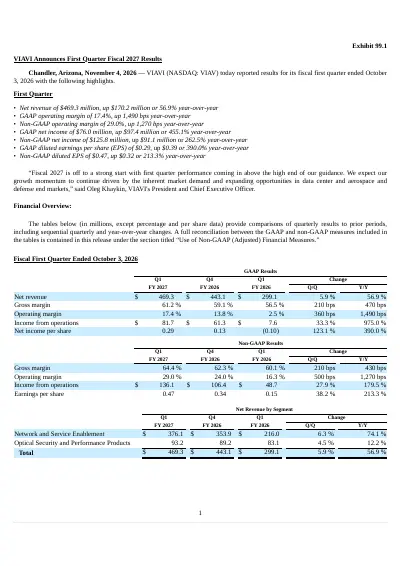
Now I would like to review the results of the first quarter of fiscal year 2027. Net revenue for the quarter was $469.3 million, which is above the high end of our guidance range of $450 to $460 million.
Revenue was up 5.9% sequentially and on a year-over-year basis was up 56.9%. Operating margin for the first fiscal quarter was 29%, above the high end of our guidance range of 26.7% to 27.5%.
Operating margin expanded 5 percentage points from the prior quarter and on a year-over-year basis was 12.7 percentage points higher. Operating margin included a net benefit of about 110 basis points from tariffs refund of approximately $11 million, which was offset by the additional one week of some variable costs.
EPS at 47 cents was well above our guidance range of 40 to 42 cents and was up 13 cents sequentially. On a year-over-year basis, EPS was up 32 cents.
EPS includes a net benefit of about 2 cents from tariff refunds and from the additional one week of variable expenses. Moving on to our Q1 results by business segment.
NSE revenue for the first fiscal quarter came in at $376.1 million, which is above the high end of our guidance range of $360 to $368 million. Revenue from Spirent product lines was $52.7 million.
On a year-over-year basis, NSE revenue was up 74.1% as a result of continued strong demand for our lab and production and field products driven by the data center ecosystem, as well as the acquisition of Spirent product lines. We also saw strong demand for our aerospace and defense products.
NSE gross margin for the quarter was 66.2%, which is 310 basis points higher on a year-over-year basis and was mainly driven by the tariff refunds and product mix. NSE's operating margin for the quarter was 25.5% versus 8.2% during the same quarter last year.
NSE operating margin was well above our guidance range of 22.6% to 23.6%, mainly as a result of higher fall-through. OSP revenue for the first fiscal quarter came in at $93.2 million, which is also above the high end of our guidance range of $90 to $92 million.
On a year-over-year basis, OSP revenue was up 12.2% driven by strength in 3D sensing and anti-counterfeiting and other products. OSP gross margin was 57.1%, up 460 basis points on a year-over-year basis, primarily driven by higher volume and favorable product mix.
OSP's operating margin was 43.2%, which is in line with our guidance range of 43% to 43.4%. OSP operating margin increased 600 basis points on a year-over-year basis.
Moving on to the balance sheet and cash flow. Total cash and short-term investments at the end of Q1 were $535.3 million compared to $656.7 million in the fourth fiscal quarter of 2026.
Cash flow from operating activities for the quarter was $104.7 million versus $31 million in the same period last year and was driven by higher net income and timing of working capital. CapEx for the quarter was $12 million versus $8.5 million in the same period last year.
During the first quarter, we purchased about 3,949,000 shares of our stock for about $150 million at an average share price of $37.98. We have about $18 million remaining under the current authorized share repurchase program, and our Board of Directors has authorized a new buyback plan of $500 million.
Our capital allocation strategy will continue to focus on organic growth, potential M&A targets, as well as opportunistic share buybacks. The fully diluted share count for the quarter was 266.2 million shares, up from 227.9 million shares in the prior year and versus 268 million shares in our guidance for the first fiscal quarter.
Moving on to our guidance for the second quarter of fiscal year 2027. We expect the second fiscal quarter revenue for Viavi to be up sequentially driven by continued strength in our key end markets.
We expect quarter-over-quarter growth to continue throughout the rest of the fiscal year driven by tailwinds in our end markets. For NSE, we expect second fiscal quarter revenue to be up as a result of continued strong demand for lab and production and field products driven by the data center ecosystem, as well as aerospace and defense customers.
For OSP, we expect quarter-over-quarter revenue to be lower in line with seasonality of lower demand for 3D sensing and anti-counterfeiting and other products. For the second fiscal quarter of 2027, we expect Viavi revenue in the range of $505 and $515 million.
We expect NSE revenue in the second fiscal quarter of 2027 between $426 and $434 million. OSP revenue is expected to be in the range of $79 and $81 million.
Operating margin for Viavi is expected to be 29.3% plus or minus 30 basis points. NSE operating margin is expected to be 28.1% plus or minus 30 basis points.
OSP operating margin is expected to be 35.7% plus or minus 20 basis points. EPS is expected to be between 50 cents and 52 cents.
Our tax expenses for the second quarter are expected to be around $12 million plus or minus $500,000 as a result of jurisdictional mix. We expect other income and expenses to reflect a net expense of approximately $3.5 million, and the share count is expected to be around 264 million shares.
With that, I will turn the call over to Oleg. Oleg?
Oleg Khaykin
Thank you, Ilan. The first quarter coming in above the high end of our guidance, our fiscal 2027 is off to a good start.
The year-to-year-on-year performance was driven by strong growth in many of our end markets. NSE revenue in fiscal Q1 grew approximately 74% year-over-year primarily driven by continued strong demand from the data center and aerospace and defense customers.
More specifically, the data center segment, which includes high-performance semis, optical modules, NEMs, and hyperscalers, drove strong demand for lab and production and field instruments in support of the scale-up, scale-out, and scale-across applications. In addition to the traditional lab and production end markets, we also expanded our TAM to include the semiconductor packaging and test.
With the adoption of NPO and CPO technologies, we expect the semiconductor packaging and test segment to become a major new growth area for Viavi. The September quarter marked a major milestone as we commenced the initial shipments into that segment.
Data center demand for our products remains very strong, and we expect continued robust growth in this segment in calendar 2027. Our aerospace and defense business also saw another quarter of strong year-on-year and quarter-on-quarter growth driven by demand for our positioning, navigation, and timing products.
Our communication and avionics products are also seeing robust demand. Our T-Rex system was recently selected by the US Army's Threat Systems Management Office to create complex, realistic electromagnetic environments across newly opened Army test ranges to support drones, counter-drones, and interceptor development.
This is potentially a sizable growth opportunity for Viavi over the next several years. We expect strong momentum in our A&D business unit to continue into calendar 2027.
The service provider business, which includes field instruments, wireless, and service enablement products, was up driven by stronger-than-expected seasonal demand. The highlights included increased demand for our fiber monitoring systems in support of fiber build-outs and for our cable instruments in support of DOCSIS 4.0 and DAA cable architecture.
In addition, we are seeing early signs of a multi-year refresh cycle from service providers as they begin to upgrade and replace the equipment purchased in 2020 through 2022. Wireless products remains the only lowlight in the service provider segment due to the anemic spend environment.
That said, we remain optimistic about the medium-term prospects for our wireless business as AI-RAN and 6G development start to ramp up. Lastly, our OSP business unit also saw strong year-on-year revenue growth driven by 3D sensing and anti-counterfeiting and other products.
Looking ahead to Q2, we expect a very strong quarter for NSE. We expect NSE revenue to be up quarter-on-quarter driven by strong and growing demand from the data center and aerospace and defense customers.
We also expect seasonal tailwinds from service providers. Conversely, we expect OSP business unit to be down quarter-on-quarter in line with the seasonally lower demand for both anti-counterfeiting and 3D sensing products.
Net-net, we expect the quarter quarter-on-quarter growth to be meaningfully up with strong NSE demand more than offsetting seasonally weaker OSP quarter. To summarize, our fiscal '27 is off to a very good start, and we expect the strong momentum to continue into the second half of the fiscal year.
During this quarter, we expect to reach $2 billion revenue run rate, which is ahead of our prior expectations. As we look ahead at our diverse end markets, customer dynamics, and the expanding Viavi end market footprint, we expect the current growth momentum to continue over the next several years.
We see four major drivers supporting our growth strategy. The first one is the continued growth of the data center segment driven by continued investment in scale-up, scale-out, and scale-across applications; expanded Viavi TAM, including semiconductor assembly and test and fiber manufacturing; increased fiber penetration and densification in the data center; and faster product replacement cycles.
The second driver is continued aerospace and defense growth driven by strong demand for our positioning, navigation, and timing products. The third driver is multi-year service provider refresh cycle.
The fourth driver longer term is a recovery of the wireless business driven by 6G and AI ramp. Okay.
In summary, I would like to thank the Viavi team for their continued strong innovation and execution, and thank our customers and shareholders for their continued support. With that, I will now turn it back over to the operator for Q&A.
Operator
We will now begin the question-and-answer session. Please limit yourself to one question and one follow-up.
If you would like to ask a question, please press star one to raise your hand. To withdraw your question, press star one again.
We ask that you pick up your handset when asking a question to allow for optimal sound quality. If you are muted locally, please remember to unmute your device.
Please stand by while we compile the Q&A roster. Your first question comes from the line of Ruben Roy from Stifel.
Your line is now open. Please go ahead.
Ruben Roy
Yes, hi. Thank you for taking my questions.
Congrats, Ilan and Oleg, on the outlook to $2 billion run rate. Oleg, you talked about the strength going into the December quarter and some of the drivers there.
Wondering, as you think about this 14% or so quarter-on-quarter guide for NSE into the fourth quarter, can you maybe walk us through how much of the step-up is coming from the traditional data center ecosystem versus Spirent seasonality, which I think is strong typically in the December quarter, and then A&D?
Oleg Khaykin
Yeah. I think actually every one of our product lines is growing into the December quarter.
Clearly, I would say field instruments and service enablement is benefiting from seasonally stronger service provider spend. I would say, if I look at the projected NSE growth, I'd say probably about a third is coming from the data center growth, about probably a third coming Actually, about maybe 40% coming from data center growth, about a third is coming from aerospace and defense, and the rest is the service provider.
It's actually in the NSE business, we're seeing nice growth across the board anywhere between 20 10% to 30% depending on the product line.
Ruben Roy
Okay. Okay.
Helpful. Then as a follow-up, Ilan talked about expectations for sequential growth to continue through the fiscal year, particularly March is a seasonally weaker quarter.
I assume some of these data center tailwinds are continuing as you think about calendar '27. Oleg, you also talked about entering the optical plane of semiconductor test, and we've been talking about things like NPO and CPO.
Can you talk high level about the revenue opportunity for that new area of your business, who the early customers are, and if some of those revenues are considered in the guidance for continued sequential growth through fiscal '27? Thank you.
Oleg Khaykin
Sure, yes. Traditionally our lab and production, you sell into contract manufacturing, mostly making I'll say the fiber optic modules, pluggables.
As we see the NPO and CPO penetrating, we're now actually opening a whole new market segment, which traditionally would be known also as OSAT, outsourced assembly and test. That's selling our optical test products into the kind of probe stations at the foundry and, of course, then the multiple insertions at the final assembly and test.
That's a completely new market segment for Viavi. We made our first shipments this quarter, and we think this could be a sizable segment in a couple of years, north of $100 million for Viavi just by itself.
It's a nice growth market, and it's clearly an attractive, more predictable segment than many of our service provider segments. The other area is we talked about also densification of fiber and making these massive parallel connectors.
That's, just like we are now seeing demand for our products in the semiconductor supply chain, we are also seeing a market opening up with the fiber optic and connector manufacturers. That's two new market segments that we are entering above and beyond our traditional kind of pluggable testing.
That's a very attractive, and it's clearly driven by market size and the volume. To the extent we see more densification, more multi-core fibers, more integrated silicon photonics closer to the ASIC, that is going to be the principal driver of demand in those markets.
In terms of customers, those are all the usual suspects. I think you pretty much know all the major AI processor and optical switch, as well as the Ethernet switch vendors, who are the early adopters of the CPO and NPO technologies.
Ruben Roy
Great. Thanks for the detail, Oleg.
Oleg Khaykin
Sure.
Operator
Your next question comes from the line of Ryan Koontz from Needham & Company. Your line is now open.
Please go ahead.
Ryan Koontz
Great, thanks for the question. Great outlook, guys.
Want to ask about a couple of product cycles within the data center and try to gain an understanding of where we are from your perspective. Maybe starting with the 1.6T optical modules.
Obviously, we're at an inflection point here, and from your perspective of selling test gear, has a lot of that production capacity been built out now for you, or is there still a lot ahead for Viavi here in terms of selling into the production capacity side?
Oleg Khaykin
I would actually say it's still very early innings. If you use baseball analogy, probably more like a second, third inning.
I think the 1.6 peak will be probably sometime in the second half of next year. In terms of approaching the high volume.
Today, we're still the highest volume shipments is 800-gig. 1.6 just kind of starting to ramp up.
I can see 800 and 1.6 running concurrently for quite a while. It'll be probably till the end of next calendar year where the 1.6 will surpass 800 at the earliest.
Ryan Koontz
Got it. Helpful, thank you.
Then maybe on some of these new OCS products that are coming to market for optical switching. I assume your fiber testers have some potential here to sell into this new product cycle.
How would you assess that opportunity for this?
Oleg Khaykin
I think OCS is probably, from point of view of test content, one of the biggest sweet spots in the market in terms of the dollar content per port. It's clearly, as these volumes grow, a very attractive segment for us.
Ryan Koontz
Got it. Great.
Then with regards maybe to shifting gears over to your defense and aerospace side, any color there in terms of kind of product mix? I assume this is mostly still dominated by your PNT into the drone ecosystem, or are there other products that are contributing much there?
Oleg Khaykin
I'd say it's the drone ecosystem, both aerial, ground, sea, and undersea drones, followed by the alternative GPS to GNSS. It's all the products for anti-spoofing, anti-jamming equipment where you need to provide resilient timing and navigation systems.
It's kind of including retrofitting in-the-field systems, as well as the new products being launched.
Ryan Koontz
Got it. Maybe one last if I can squeeze it in around wireless.
You talked about that, hopefully bringing some recovery there. Are you thinking that this opportunity where SpaceX is talking about building a new terrestrial carrier, is that a real opportunity for you to sell your field gear in that, and probably lab?
Oleg Khaykin
Clearly, if anybody is going to be doing it, you have to develop the equipment, so that'll stimulate some of our sales. I think I view it also as a positive because it's by introducing kind of the new player into the market.
Clearly, I know as much about as you are in terms of all the initial pronouncements. I think it's all going to be feeding into the 6G and AI-RAN deployment with the non-terrestrial network component.
I think the sooner somebody gets moving, it will be more of a change in equilibrium where things are kind of being currently in a limbo mode. There's R&D going on and we're selling into that, but until things kick into high gear with the planned deployment, that's when you'll actually see volume picking up.
We welcome more innovation. Cool.
Great.
Ryan Koontz
Thanks for the comments. Yeah.
Thanks, Oleg.
Oleg Khaykin
Sure.
Operator
Your next question is from the line of Michael Genovese from Rosenblatt. Your line is now open.
Please go ahead.
Michael Genovese
Thanks very much. There's a lot of interest out there, Oleg, in NPO, CPO, just any more color you can give us on whether there were revenues there in September or whether they really start in December and if they're more on the NPO or CPO from your perspective and just any other color you can help give us on that as a growth driver in '27 and beyond, I think people would appreciate.
Oleg Khaykin
As I said, our first milestone shipments were in the September quarter. Think of it as a single million-dollar shipment.
Just early beginning. It's accelerating in the December quarter.
There's a little echo. It will continue to accelerate into the March quarter and so on and so forth.
We initially shipped in September and it's ramping in every quarter since then going forward. It's predominantly supporting CPO.
I think there may be some designs are NPO, but I think the overwhelming mix is supporting CPO.
Michael Genovese
Thanks for that. Then on the operating margin, the operating income rose more than the revenue did in the quarter.
Even if we back out the full $11 million tariff refund, I'm getting an incremental operating margin of about 70%. Does that seem right to you?
Since in the past, you've mentioned numbers that are more in the 40s, maybe in the 50s, was that too low, and are we actually looking at a higher incremental operating margin, just based on the evidence here?
Oleg Khaykin
I think probably, all things being equal, there's always leading component versus lagging component. Eventually you bring up some OpEx cost and some bonuses and things like that.
Early on, when you get this incremental cost, disproportionate amount falls to the bottom line. I think also I wouldn't say it's 70%.
I think it's probably more in the high 50s, low 60s for this particular quarter. I think the conservative, good way to think about it is in low to mid-50s as an incremental fall-through to the bottom line.
Ilan Daskal
Mike, also, some of the operating expenses this quarter, it's about timing, similar for the December quarter. Usually when you get to the March quarter, there is a little bit uptick, the operating expenses,
Oleg Khaykin
statutory expenses,
Ilan Daskal
and others, etc. Similarly, when we kind of hire in kind of R&D, etc., it's all about timing, nothing else.
Oleg Khaykin
I think you bring up good point as we've been saying it for several quarters. We have a significant operating leverage in our business model as revenue goes up because effectively it's just higher volume, not necessarily more work content or more headcount and things like that.
The other thing is, of course, as you've noticed, our tax expense is now in a single digits, which is the second operating leverage driven by our heritage from JDS Uniphase where we inherited massive NOLs. That's finally all falling into place, and we're seeing very strong both operating as well as the appearing leverage at the gross margin, as well operating margin, as well as the net profit.
Ilan Daskal
Mike, the effective tax rate this quarter was down to 8%, so that's kind of, I think, historically low for us.
Oleg Khaykin
Yeah.
Michael Genovese
Great. Perfect.
Then I'll just get one more in here. This is a fantastic guide.
Especially considering how much OSP is down sequentially. It's a really, really strong guide.
Given where the stock is and the reaction is not as strong as I would expect, I think it's pretty clear that there's still credit concerns rattling people, and now there's the politics and sort of just general worries about data centers. Just you've got good perspective on a lot of things.
Do you have anything to add to help us kind of think through those issues?
Oleg Khaykin
I I take a, I I think I agree with you. I think the somehow we are being treated as an AI play, which is we have a significant portion of our business exposed to data center.
Remember, data centers, I think the data center is not going away. The new technology is going to continue to go into data centers.
The refresh cycle of technology in data centers is about 3 to 4 years. Okay?
The same technologies that go into AI data centers will go into even regular cloud data center, okay? Only a portion of the data center business is driven by volume of investment.
Then let's not forget, we also have expanded TAM. We're getting into semiconductor test and into the fiber optic and connector manufacturing test.
It doesn't matter if it's AI data center or the cloud data center replacement. It's still going to be a new market.
Then the whole thing is the shortening of product cycle, densification is all that. I think only a portion of a data center spend for us is the big portion is driven obviously by the CapEx, but we are still very much lagging what was being spent or being committed.
We are still way behind that curve in terms of what the actual demand going to be. That's only the data center.
Then there is aerospace and defense. If you look at it, you could think about maybe there'll be less defense spending, but I'll tell you one thing, there'll be a hell of a lot more money spent on anything autonomous, such as drones, and the, these lower cost weapon systems, which require its own in- internal PNT.
We are very well-positioned for that market. Last but not the least, we had a lot of sales in 2020 to 2022.
All of these products are very long in the tooth, and there'll be a probably a multi-year we're approaching multi-year replacement, refresh cycle from service providers. That's kind of like the tide that raises all the boats.
I think if somebody just takes it purely Viavi is an AI play, I think they are grossly undervaluing the diversification of our end markets and where we're playing. Eventually wireless is also going to recover.
Today, it's been for the last 3 years, it's been very much of a of a headwind. Eventually, it'll become a tailwind, and that's obviously will kick in in other in other stage of the growth.
I feel pretty good about our business. We are not a one-trick pony.
We're actually fairly well-diversified, and there's multiple technology cycles that are favoring us, and not only AI. AI is clearly a big one.
Ilan Daskal
Mike, I may add that in the prepared remarks, we specifically highlighted that we see a continued growth in the next few quarters. That's updated.
It does not change due to the political kind of aspect that you mentioned earlier. AI is not going anywhere, and data centers will continue to...
Oleg Khaykin
Anybody thinks that AI is dead is delusional, because there's still the rest of the world and there's a fundamental competition. I think it may not grow as rapidly, but it's still going to grow and it's still a pretty sizable investment already being committed.
That's just kind of my view on it.
Michael Genovese
Yep. Perfect.
Appreciate the comments. Thank you so much.
Oleg Khaykin
I'll just add one more thing. We have never overhyped it.
There's been a lot of companies kind of got ahead of themselves. We always took a more measured and conservative view of how it's going to grow.
In fact, we probably were a little too conservative. We thought we'll hit $500 million run rate the end of next calendar year, then we updated it to the middle of the calendar year, and now it's pulled in to the end of this calendar year.
If anything, we probably should be accused of being overly conservative in that respect. In a way, it's kind of plays out.
Operator
Your next question comes from the line of Andrew Spinola from UBS. Your line is now open.
Please go ahead.
Andrew Spinola
Thank you. Oleg, along those lines on AI, I'm wondering from a high level, have you seen any changes in the buying by your customers, whether anyone has adjusted spend here or there, or cut back in places, or is it pretty much the same as it's been?
Oleg Khaykin
Actually, I would say in many ways we have seen our expectations, we were lagging the actual demand. If anything, we've been getting more surprised by the increase in the spend.
I think we're playing catch-up to a large extent. As I was saying just before you came on, we thought we'll hit $500 million the end of next calendar year.
We have had to pull it in almost pretty much the entire year. I don't see any slowdown.
Then again, I would say we probably were thinking much more conservatively in our outlook. To the extent there will be some pull-back, it still represents an upside for us.
Ilan Daskal
That goes again to our prior remark also that we see continued growth in the next few quarters, again it doesn't change anything for us. Exactly.
Andrew Spinola
Got it. Ilan, I have a question on the NSE margin.
As they mentioned earlier, quite strong in Q1 and the guide for Q2. Just wondering, are there any residual Spirent synergies that are flowing through here in H1, or is this all related to scale in the business?
Ilan Daskal
This is all scaling the business. Spirent integration was already completed at least 2, 3 quarters ago.
It was pretty fast and successful. Everything that you see right now is the leverage that we have from the growth that we are experiencing.
Oleg Khaykin
I think this quarter, even last quarter, we're seeing initial products which were kind of co-design, I would say, maybe integrated. Probably next calendar year, we're going to launch products that are fully integrated between Spirent and the Viavi portfolio.
I think in that respect, organizationally we are fully integrated. The product lines wise, I think we are already, I'd say, 25% there.
Probably exiting next year, we should be at over 75%.
Andrew Spinola
Got it. One last one, Oleg, for you.
A couple of years ago, when I started covering you guys, the market was much tighter, margins were a lot lower, you were a smaller business. You've obviously scaled up with Spirent, and obviously AI's data center is giving you a lot of scale, much better margins.
I'm wondering, as you approach this business, does anything change for you in terms of your longer-term thinking, in terms of where you're investing, what markets you're going after? One of the things I'm particularly curious about is you've talked about the semiconductor test and some of your success in some of these other markets.
I'm wondering if you're capturing more share on the R&D side, if you're seeing that, and if that's part of your strategy potentially going forward?
Oleg Khaykin
I think, look, when you started covering us, we were still heavily exposed to the service provider field instruments, which actually gross margin-wise, maybe low 60s, it's not that much lower. There, because the company was of smaller size, the burden of R&D and sales was much higher.
As a result, you had a much lower operating margins in NSE. The single biggest driver of expansion of operating margins is the top-line growth, right?
On top of it, bringing in Spirent, it's clearly comes at the higher margin, so that kind of helps the overall picture. Even you look at it, Spirent had the nice growth, but it's, low teens.
Our organic business grew about 50% year-on-year for the September quarter. Just purely pure Viavi with no acquisitions, right?
In that respect, the products we're getting into, clearly just volume of sales, a lot of it just falls right to the bottom line. As we talk about the growth, clearly one of the big areas we focused was the R&D test, and that is kind of the leading the market.
The single biggest volume that scale-up when we talk about semiconductor test is the production, right? Clearly we are in every lab of for every high-performance semi company when they are testing their PCI Express, or their 1.6-terabit, Ethernet, and so on and so forth.
It's the volumetrically what drives the revenue and volume is when it goes into the production test. By production test, I'm talking about not only the traditional testing in and out of the pluggables, but it's now up to five insertions in the, from the wafer probe to the known-good-die testing to the optical engine test to the assembled substrate and the optical engine, all the way to the final test.
That's the piece where we are seeing our growth happening, and we started shipping in the first quarter into that market. The other one is also came out, as the complexity, densification is going on, you're going to multi-core fiber and you're going to massive parallel fiber optic connectors, we're now seeing our equipment also being pulled into the fiber optic and connector manufacturing supply chain.
It's going well beyond the traditional kind of, optical module test. The last but not the least, I think is the OCS.
We've been in this market for many years. Now the volumes there were fairly low, but now they're starting to scale and we're seeing a lot of demand for our products also driven by the OCS growth.
Hope that helps. That's great color.
Andrew Spinola
Thanks a lot, Oleg. Thank you.
Oleg Khaykin
Thanks, Andrew.
Operator
Your last question comes from the line of Tim Savageaux from Northland Capital Markets. Your line is now open.
Please go ahead.
Tim Savageaux
Good afternoon. Congrats on the great results.
I want to go back to the commentary on the CPO, NPO opportunity. I think you've mentioned expectations that could be $100 million-plus business.
I want to try to relate that to what your customers are seeing, right? Lumentum just talked about a $5 billion order there, I'm sure over multiple years.
Can you relate revenue at that level to opportunity for Viavi? Should we be thinking something, I don't know, low to mid-single digits in terms of if this is a $2 billion annual business for your customers, it's $100 million for you?
On the one hand. On the other, would you say the same thing about OCS in terms of that potential to get to $100 million-plus, as you did about NPO?
Oleg Khaykin
When I talk about $100 million-plus, it's purely semiconductor. That does not include OCS, right?
This is more like your Ethernet switching or AI processor and things like that. OCS is a different animal.
There, the amount of content per port is quite significant because also the testing is quite sizable. I would say, generally, when people say they're going to do $2 billion, my question becomes is it an annual run rate, or is it over 3 years or what have you, right?
Clearly, from there, we can
Tim Savageaux
average out the increased capacity. Let's just say it's annual.
Oleg Khaykin
Annual. To support that much, that probably would be in the tens of millions of dollars, maybe approaching between 50 and $100 million.
Tim Savageaux
Great. What I was only trying to say as you look at the OCS...
That's about roughly
Oleg Khaykin
Think of it as a Yeah, up to 5%, 5% of your revenue. That's fair.
Tim Savageaux
Beautiful. Now what I was trying to say is to the extent we're talking about the CPO opportunity, would OCS be of a similar magnitude over time or greater, understanding they're not related to each other?
Oleg Khaykin
I think the CPO with switches and ASICs is a higher volume opportunity because volumetrically, it's a much bigger volume business, right? Because think about it, when you go to OCS, you're really getting into the core, Now, you have a lot of test time for each one of them because you could have 300 by 300 switch, but it's sitting at kind of at the center.
When you talk about the CPO with ASICs and CPUs, there's many more of them on the edge and you need multiple insertions. It's kind of hard to tell because I think there's not enough data points to really see how things will shake out.
There, you have a much bigger volume of ASICs, right? Unit volumes are much higher, and you need multiple insertions.
I'd say my bet on that, maybe I'll say OCS is a lower volume, but higher value per shipment. The CPO with ASICs, it's a much higher volume and lower value per shipment.
Tim Savageaux
Great. Thank you.
If I can fit one more in there, you mentioned organic growth at 50%. I'm going to assume that data center growth was greater than that on a year-on-year basis, and also now is more than 50% of NSE revenue.
Are both of those fair statements at this point?
Oleg Khaykin
If I look at September quarter last year versus this year, NSE was $216 million in September '26. Sorry, '25.
Then today, it's 376. There's a $160 million growth, okay?
$52 million of it is Spirent, you back it out, it's about $100 million growth. I would say the data center, yeah, it's clearly more than 50%, right?
I would say aerospace and defense is the second highest, and aerospace and defense and field instruments are I would say a little bit north of 50%, and data center is almost 2x.
Tim Savageaux
Great, we're talking growth rates there, I assume, but thanks, and congrats.
Oleg Khaykin
Growth rates, yeah.
Operator
Thank you. We have now reached the end of the question-and-answer session.
I will now turn the call back over to Vibhuti Nayar for closing remarks.
Vibhuti Nayar
Thank you, Jonathan. This concludes our earnings call for today.
Thank you for joining, everyone. Have a good afternoon.
Operator
This concludes today's call. Thank you for attending.
You may now disconnect.