A2A S.p.A.
Q3 FY2026 · Earnings Call TranscriptNovember 10, 2026
Operator
Good afternoon, ladies and gentlemen. Welcome to A2A's 9-months 2026 results presentation.
At this time, all participants are in a listen-only mode. However, if you wish to ask a question, please dial pound key five on your telephone keypad to enter the queue.
Please be advised that today's conference is being recorded. Now, I would like to hand the conference over to our host, Marco Porro, Head of Investor Relations.
Please go ahead, sir.
Marco Porro
Good afternoon, everyone, and welcome to A2A 9-months 2026 results presentation. Today, our CEO, Renato Mazzoncini, and our CFO, Luca Moroni, will review our financial and operating performance, highlighting how our diversified business model has helped us navigate a challenging environment and preserve earnings visibility.
Let me leave the floor to Renato to start the conference call.
Renato Mazzoncini
Okay. Thank you, Marco.
Good afternoon, everyone. Okay.
We start with this presentation from the slides number two. The first message is that in the first 9-month of the year, unfolded against a challenging backdrop shaped, in particular, by lower hydro availability.
Consider that this year is the second worst after '22 in the last 10 years, complicated, guys. Extreme weather conditions and volatility in energy price, and higher hydroelectric concession fees.
These are some elements absolutely challenging to face. Yet, despite these headwinds, A2A continue to deliver a resilient performance, exactly supported by the strength and our diversified portfolio and by the operational levers embedded in our integrated model.
In particular, higher solar and wind linked to new plants that we delivered with our continuous CapEx, in particular, in generation. CCGT generation, consider that every time in which there is few water, the CCGT perform well.
Are complementary, of course, because the total energy that we needs is always the same. In this year is growing the demand.
Opportunities captured through energy management, exactly because when there is a situation different from the forecast, there are more energy management opportunities to rebalance the system. Solid performance on electricity networks, in particular, [duereti?]
are performing really very well and also in linked to the plan of acquisition that we did with Enel. Resilient mass-market margins, and these four factors significantly mitigated external pressures.
In addition, we also saw treatment plant performance stabilized during the third quarter because we talk about the problem of performance during the half presentation. In this third quarter, the situation came back good in terms of performance.
This brings me to the central message today. Despite an increasingly volatile environment, our integrated model continues to ensure balance, flexibility, and earnings visibility.
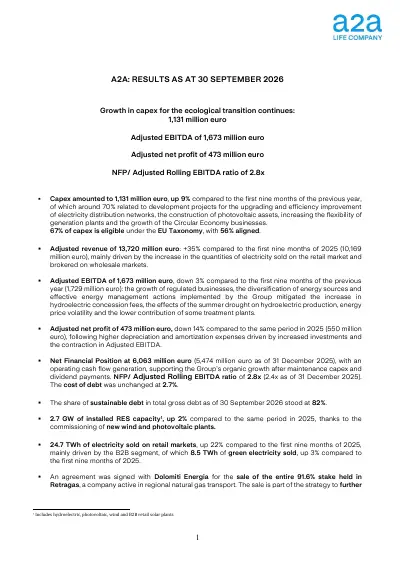
Looking at slide number three in which there are our numbers, we have an adjusted EBITDA that reached €1,673 million compared with €1,729 in the first 9-month '25, a reduction around 3% of EBITDA. The year-on-year change reflect the operating dynamics I have just outlined.
This is a message very very very clear, very strong because consider that only considering the concession fee in hydro and the reduction of water, we face a '26 with around 1 million of EBITDA less than '25, and the reduction is limited to half of this value. The year-on-year change reflected operating dynamics.
In particular, the diversification of our portfolio helping to mitigate the impact of the group. For example, in October, super interesting the performance of our CCGT, but once again are mitigating the effect of the hydro production with a super performance that probably will arrive also in the next 2-month till December.
Adjusted group net profit stood at €473 million, excluding the impact of additional IRAP charge. We can discuss about IRAP later in the financial balance of our state.
That there is a new increasing of IRAP for the next years. Net financial position was €6 billion at the end of September with a leverage of 2.8 times compared with 2.4 at year-end '25.
The increase in debt reflects investment deployment, working capital absorption, and dividend distribution. In a minute, Luca will work with you through the earnings and cash flow bridges in more detail.
First, let me underline slide number four about CapEx, our investment plan. As you can see, we continued to execute our investment program with a total CapEx exceeding €1 billion in the first 9-month of the year.
Investments, in particular, electricity distribution networks increased by 5% year-on-year. This is really interesting because is the proof that the space to continue to invest and to improve the efficiency in the grid network is super super key for us.
While scaling back investment in gas networks. Around 70% of our CapEx is dedicated to development, only 30% are maintenance, with an increase of 20% year-on-year, reflecting the progress of projects already underway across our businesses.
Alongside our network investment, we are enhancing the flexibility of our generation fleet, progressing towards a key milestone on the new Monfalcone CCGT plants and developing new solar assets. In particular, we have a large solar plant in Friuli-Venezia Giulia, 100 megawatt of new capacity, super large, the biggest in the north of Italy, exactly near our actual plant of 60 megawatt.
That means that we have in Friuli a plant with 160 megawatt. Monfalcone will arrive into operation in mid '27 around.
I remember that the EBITDA coming from Monfalcone will be more or less €10 million every month. We are also expanding our circular economy businesses with, in particular, the new waste-to-energy plant in Corteolona that is under construction also, in this case, till the end of '28.
Our focus in increasing our execution and on bringing these investments into operation, so that the capital deployed progressively translated into additional operating contribution. We remain disciplined in capital allocation, prioritizing project that strengthen our asset base and support sustainable returns over time.
Luca, if you want to explain the detail slides from the next.
Luca Moroni
Thank you very much, Renato. Good afternoon, everyone.
I would like to start from the statement Renato did. Our 9-month results show the balancing effect of A2A's diversified and integrated business model.
This is very important because our portfolio give us the opportunity to balance some bad situation with positive ones. Different trend across the businesses partially offset each other, limiting the reduction in the group adjusted EBITDA to 56 million.
Adjusted EBITDA was €1,673 million, down around 3% year-on-year. Three contribution had to mitigate external pressure: higher wind, solar, and CCGT production, the ability to capture trading opportunities and strong energy management performance, and the growth in electricity distribution due to the deployment of our CapEx plan.
This partially offset the impact from higher hydroelectric concession fees and lower hydro production, price volatility, and lower contribution from the treatment sector. Let me now walk through each business.
Generation and trading: Generation and trading adjusted EBITDA stood at €569 million, down around 9% year-on-year. The key point here is the balancing effect of our generation portfolio diversification.
Within renewables, higher wind and solar production partially offset the lower hydroelectric contribution, €40 million in term of EBITDA, which in its turn was somehow mitigated by the hydro production in the Southern Italy. Maybe you remember the very positive production in term of volumes in Calabria, which compensated the less production in Valtellina.
Higher hydroelectric concession fees also weighted on the results for €47 million. Higher CCGT production, €20 million, together with opportunities captured by energy management, provided further supports.
This performance highlights the value of our diversified generation mix and our ability to capture opportunities through portfolio flexibility. Market: Moving to the market business, performance remained resilient in a highly competitive environment.
Adjusted EBITDA stood at €321 million, down €10 million compared the first 9-month 2025. Higher electricity volume supported the results, helping offset lower unit margin.
In the third quarter, imbalance charges linked to energy price volatility and fees and a less favorable year-on-year comparison for retention cost weighed on performance. On the contrary, churn rate began to reduce during Q3, now almost aligned to the last year level, while stronger customer acquisition is supporting an improvement in the customer base trend.
These developments are encouraging for entering the final quarter, alongside the continued support for higher electricity volumes. Let me now turn to circular economy business.
Adjusted EBITDA was €403 million, compared €423 in the first 9-month 2025, a decline of around 5%. The reduction mainly reflects negative H1 industrial effects due to lower plant availability, a performance stabilization of treatment plants in Q3, lower margin on the new Acerra service contract.
These negative elements were partially offset by higher treatment pricings. Collection recorded a slight increase, while integrated water cycle benefited from higher allowed revenues.
District heating recorded lower heat volumes and reduced contribution from white certificates. All in all, the gradual return to normal operation in treatment plants, together with a positive contribution from district heating, supported the outlook of the remainder of the year.
Let me now turn to smart infrastructure. In smart infrastructure, our allowed revenues in electricity distribution more than offset the lower contribution from gas network due to perimeter and one-off effects.
Adjusted EBITDA reached €413 million, up €28 million, around 7%, compared with €385 million in the first 9-month of 2025. Electricity network benefited from growth in the regulated asset base and higher allowed revenues, reflecting the continued deployment of investment.
In gas network, the lower contribution reflect asset disposal and the absence of non-recurring OPEX recognition recorded in H1 2025. Overall, the result confirmed the visibility and quality of earnings provided by our regulated infrastructure platform.
Let's conclude our overview of the result of each business unit. Let me now move to adjusted EBITDA to group net profit before turning to cash flow.
Starting from adjusted EBITDA of €1,673 million, D&A amounted to €768 million, up €53 million year-on-year, mainly reflecting CapEx deployment over the period October 2025 to September 2026. Provisions were €53 million, down €16 million year-on-year, reflecting higher risk provision reversal in 2026 and lower bad debt provision related to the loss of safeguard tender.
Adjusted EBIT, therefore, amounted to €852 million, compared with €945 million last year. Adjusted net financial expenses were €145 million, compared with €128 million last year, due to higher net financial debt.
The average cost of debt remained stable at 2.7%, despite rising market interest rates, reflecting our proactive management of refinancing needs. Including €5 million from equity accounting investment, adjusted profit before tax was €712 million.
Adjusted taxes amounted to €210 million, €30 million lower year-on-year, with a tax rate of 29.5%, excluding the impact of IRAP increase introduced by energy decree, which has been accounted for as a special item. Adjusted group net profit was €473 million, compared with €550 million in the first 9-month of the 2025.
Reported group net profit was €476, including a net positive of €3 million contribution from special items, mainly for the Netcity fair value revaluation and the energy decree tax effect. At the end of September, ROI was 8.7%, ROE 10.2%.
Let me conclude by reviewing our cash flow performance. For the first 9-month 2026, net financial position increased by €589 million, resulting in closing net debt of €6,063 million as of September 30.
Despite persistent market volatility, our credit profile remained resilient, which leverage anchored at 2.8 times, aligned with our strategic capital structure threshold. During the period, the group generated €937 million in operating cash flow, providing robust support for our organic growth initiatives.
The primary driver of our cash performance are: net working capital. Net working capital expanded by €534 million, acting as a temporary cash absorber.
This dynamic was driven by price-induced inflation in retail receivables, seasonal gas storage replenishment, and non-recurring regulatory events, specially the reduction of payment terms to CSEA under the 2026 energy decree and hydroelectric concession fee payments. Taxes and financing costs: Combined cash flows for taxes and net financial expenses totaled €202 million, comprising €76 million in corporate taxes and €126 million in net financial expenses.
Capital expenditure requirements represent cash outflows of €1,131 million, of which €744 for development projects. Operating cash flows before dividend, reflecting the intensive CapEx cycle, this metric stood at -€194 million.
Net free cash flow, which result following the distribution of dividends and coupon payments on perpetual subordinated hybrid bonds, was negative for €558 million. Change in consolidation perimeter had a net negative impact of €16 million.
This reflect €42 million in transaction-related outflows, partially offset by €25 million price adjustment from the partial disposal of gas assets to Ascopiave completed in '25. Finally, share buyback: The execution of share buyback program accounted for a further cash allocation of €15 million.
Looking forward, we reiterate our confidence in the group cash flows outlook. This stability is underpinned by our integrated and diversified business model, which provide the optionality and operational flexibility required to mitigate market volatility, navigate energy sector uncertainties, and preserve balance sheet strength.
Now, I will hand back to Renato for the final part of the presentation.
Renato Mazzoncini
Thank you, Luca. Looking the guidance, we confirm our '26 guidance range, probably with results expected at the lower end.
Frankly speaking, it depends a lot of the quantity of water that will arrive in the next weeks till December. The operating trends across our business support this outlook as we enter in the final quarter.
In particular, in generation and trading, we expect the higher CCGT generation. In October, we have seen this effect.
Opportunities captured through energy management to support performance. We also expect to commission, as I said before, 100 megawatt of new solar capacity in Friuli-Venezia Giulia starting from next week.
In market, the churn rate that is a problem since a couple of year has been improving since the third quarter. The reduction is visible, with positive indication for the fourth quarter.
At the same time, the customer base trend is turning positive, means that is growing again in the last month of October, supported by stronger customer acquisition. In circular economy, the normalization of treatment plant performance, together with a positive contribution from district heating, should support fourth-quarter results.
Taken together, these fourth-quarter opportunities provide a clear path to achieve our full-year guidance and demonstrate, once again, the resilience of our diversified business model. Let me conclude by reiterating the central message of our presentation today that we live in a time of constant change, with a lot of problem.
Our integrated model built a robust foundation, continues to ensure balance, flexibility, and earnings visibility, and our capacity to face the future with a strong CapEx plan built the path really for our future. Thank you very much, and we are now ready to take in your question.
I imagine about the new DDL Bollette or something else. Please.
Operator
Thank you very much. If you wish to ask a question, please dial pound key five on your telephone keypad to enter the queue.
If you wish to withdraw your question, please dial pound key, then six, on your telephone keypad. The first question comes from the line of Francesco Sala of Banca Akros.
Please go ahead.
Francesco Sala
Good afternoon. Thank you for the opportunity of the questions.
The first one is on the new regulations put forward by the Italian government. Can you help us quantify the impact of the higher IRAP tax and also the price cap on gas price?
The second one is I wonder how clean spark spreads have evolved during the first weeks of the fourth quarter compared to the third quarter, of course, and whether this is above or in line with your original assumptions. Third one, if you can give us an update on your hedging policy and how much of the expected generation for 2027, 2028 maybe was sold forward.
Finally, as regards the Operator: Good afternoon, ladies and gentlemen. Welcome to A2A's 9-months 2026 results presentation.
At this time, all participants are in a listen-only mode. However, if you wish to ask a question, please dial pound key 5 on your telephone keypad to enter the queue.
Please be advised that today's conference is being recorded. Now, I would like to hand the conference over to our host, Marco Porro, Head of Investor Relations.
Please go ahead, sir.
Marco Porro
Good afternoon, everyone, and welcome to A2A 9-months 2026 results presentation. Today, our CEO, Renato Mazzoncini, and our CFO, Luca Moroni, will review our financial and operating performance, highlighting how our diversified business model has helped us navigate a challenging environment and preserve earnings visibility.
Let me leave the floor to Renato to start the conference call.
Renato Mazzoncini
Okay. Thank you, Marco.
Good afternoon, everyone. Okay.
We start with this presentation from this slides number two. The first message is that in the first 9-month of the year, unfolded against a challenging backdrop, shaped in particular by lower hydro availability.
Consider that this year is the second worst after '22 in the last 10 years, complicated, guys. Extreme weather conditions, and volatility in energy price, and higher hydroelectric concession fees.
These are some elements absolutely challenging to face. Yet, despite this headwinds, A2A continued to deliver resilient performance, exactly supported by the strength and our diversified portfolio, and by the operational levers embedded in our integrated model.
In particular, higher solar and wind linked to new plants that we delivered with our continuous CapEx, in particular, in generation. CCGT generation, consider that every times in which there is few water, the CCGT perform well.
Are complementary, of course, because the total energy that we needs is always the same, and in this year is growing, the demand. Opportunities captured through energy management, exactly because when there is a situation different from the forecast, there are more energy management opportunities to rebalance the system.
Solid performance on electricity networks, in particular Duereti are performing really very well and also linked to the plan of acquisition that we did with Enel. Resilient mass-market margins, and these four factors significantly mitigated external pressures.
In addition, we also saw treatment plant performance stabilized during the third quarter, because as we talk about the problem of performance during the half presentation, but in this third quarter, the situation came back good in terms of performance. This brings me to the central message today.
Despite an increasingly volatile environment, our integrated model continues to ensure balance, flexibility, and earnings visibility. Looking slide number three, in which there are our numbers, we have an adjusted EBITDA that reached €1,673 million compared with €1,729 in the first 9-month '25, a reduction around 3% of EBITDA.
The year-on-year change reflect the operating dynamics I have just outlined, and this is a message very very very clear, very strong, because consider that only considering the concession fee in hydro and the reduction of water, we face a '26 with around €100 million of EBITDA less than '25, and the reduction is limited to half of this value. The year-on-year change reflected operating dynamics.
In particular, the diversification of our portfolio helping to mitigate the impact of the group. For example, in October, super interesting the performance of our CCGT, but once again are mitigating the effect of the hydro production with a super performance that probably will arrive also in the next 2-month till December.
Adjusted group net profit stood at €473 million, excluding the impact of additional IRAP charge. We can discuss about IRAP later in the financial balance of our state.
That there is a new increasing of IRAP for the next years. Net financial position was €6 billion at the end of September with a leverage of 2.8 times compared with 2.4 at year-end '25.
The increase in debt reflects investment deployment, working capital absorption, and dividend distribution. In a minute, Luca will work with you through the earnings and cash flow bridges in more detail.
First, let me underline slide number four about CapEx, our investment plan. As you can see, we continued to execute our investment program with a total CapEx exceeding €1 billion in the first 9-month of the year.
Investments, in particular, electricity distribution networks increased by 5% year-on-year. This is really interesting because is the proof that the space to continue to invest and to improve the efficiency in the grid network is super super key for us.
While scaling back investment in gas networks. Around 70% of our CapEx is dedicated to development, only 30% are maintenance, with an increase of 20% year-on-year, reflecting the progress of projects already underway across our businesses.
Alongside our network investment, we are enhancing the flexibility of our generation fleet, progressing towards a key milestone on the new Monfalcone CCGT plants and developing new solar assets. In particular, we have a large solar plant in Friuli-Venezia Giulia, 100 megawatt of new capacity, super large, the biggest in the north of Italy, exactly near our actual plant of 60 megawatt.
That means that we have in Friuli a plant with 160 megawatt. Monfalcone will arrive into operation in mid '27 around.
I remember that the EBITDA coming from Monfalcone will be more or less €10 million every month. We are also expanding our circular economy businesses with, in particular, the new waste-to-energy plant in Corteolona that is under construction also, in this case, till the end of '28.
Our focus in increasing our execution and on bringing these investments into operation, so that the capital deployed progressively translated into additional operating contribution. We remain disciplined in capital allocation, prioritizing project that strengthen our asset base and support sustainable returns over time.
Luca, if you want to explain the detail slides from the next.
Luca Moroni
Thank you very much, Renato. Good afternoon, everyone.
I would like to start from the statement Renato did. Our 9-month results show the balancing effect of A2A's diversified and integrated business model.
This is very important because our portfolio give us the opportunity to balance some bad situation with positive ones. Different trend across the businesses partially offset each other, limiting the reduction in the group adjusted EBITDA to 56 million.
Adjusted EBITDA was €1,673 million, down around 3% year-on-year. Three contribution had to mitigate external pressure: higher wind, solar, and CCGT production, the ability to capture trading opportunities and strong energy management performance, and the growth in electricity distribution due to the deployment of our CapEx plan.
This partially offset the impact from higher hydroelectric concession fees and lower hydro production, price volatility, and lower contribution from the treatment sector. Let me now walk through each business.
Generation and trading: Generation and trading adjusted EBITDA stood at €569 million, down around 9% year-on-year. The key point here is the balancing effect of our generation portfolio diversification.
Within renewables, higher wind and solar production partially offset the lower hydroelectric contribution, €40 million in term of EBITDA, which in its turn was somehow mitigated by the hydro production in the Southern Italy. Maybe you remember the very positive production in term of volumes in Calabria, which compensated the less production in Valtellina.
Higher hydroelectric concession fees also weighted on the results for €47 million. Higher CCGT production, €20 million, together with opportunities captured by energy management, provided further supports.
This performance highlights the value of our diversified generation mix and our ability to capture opportunities through portfolio flexibility. Market: Moving to the market business, performance remained resilient in a highly competitive environment.
Adjusted EBITDA stood at €321 million, down €10 million compared the first 9-month 2025. Higher electricity volume supported the results, helping offset lower unit margin.
In the third quarter, imbalance charges linked to energy price volatility and fees and a less favorable year-on-year comparison for retention cost weighed on performance. On the contrary, churn rate began to reduce during Q3, now almost aligned to the last year level, while stronger customer acquisition is supporting an improvement in the customer base trend.
These developments are encouraging for entering the final quarter, alongside the continued support for higher electricity volumes. Let me now turn to circular economy business.
Adjusted EBITDA was €403 million, compared €423 in the first 9-month 2025, a decline of around 5%. The reduction mainly reflects negative H1 industrial effects due to lower plant availability, a performance stabilization of treatment plants in Q3, lower margin on the new Acerra service contract.
These negative elements were partially offset by higher treatment pricings. Collection recorded a slight increase, while integrated water cycle benefited from higher allowed revenues.
District heating recorded lower heat volumes and reduced contribution from white certificates. All in all, the gradual return to normal operation in treatment plants, together with a positive contribution from district heating, supported the outlook of the remainder of the year.
Let me now turn to smart infrastructure. In smart infrastructure, our allowed revenues in electricity distribution more than offset the lower contribution from gas network due to perimeter and one-off effects.
Adjusted EBITDA reached €413 million, up €28 million, around 7%, compared with €385 million in the first 9-month of 2025. Electricity network benefited from growth in the regulated asset base and higher allowed revenues, reflecting the continued deployment of investment.
In gas network, the lower contribution reflect asset disposal and the absence of non-recurring OPEX recognition recorded in H1 2025. Overall, the result confirmed the visibility and quality of earnings provided by our regulated infrastructure platform.
Let's conclude our overview of the result of each business unit. Let me now move to adjusted EBITDA to group net profit before turning to cash flow.
Starting from adjusted EBITDA of €1,673 million, D&A amounted to €768 million, up €53 million year-on-year, mainly reflecting CapEx deployment over the period October 2025 to September 2026. Provisions were €53 million, down €16 million year-on-year, reflecting higher risk provision reversal in 2026 and lower bad debt provision related to the loss of safeguard tender.
Adjusted EBIT, therefore, amounted to €852 million, compared with €945 million last year. Adjusted net financial expenses were €145 million, compared with €128 million last year, due to higher net financial debt.
The average cost of debt remained stable at 2.7%, despite rising market interest rates, reflecting our proactive management of refinancing needs. Including €5 million from equity accounting investment, adjusted profit before tax was €712 million.
Adjusted taxes amounted to €210 million, €30 million lower year-on-year, with a tax rate of 29.5%, excluding the impact of IRAP increase introduced by energy decree, which has been accounted for as a special item. Adjusted group net profit was €473 million, compared with €550 million in the first 9-month of the 2025.
Reported group net profit was €476, including a net positive of €3 million contribution from special items, mainly for the Netcity fair value revaluation and the energy decree tax effect. At the end of September, ROI was 8.7%, ROE 10.2%.
Let me conclude by reviewing our cash flow performance. For the first 9-month 2026, net financial position increased by €589 million, resulting in closing net debt of €6,063 million as of September 30.
Despite persistent market volatility, our credit profile remained resilient, which leverage anchored at 2.8 times, aligned with our strategic capital structure threshold. During the period, the group generated €937 million in operating cash flow, providing robust support for our organic growth initiatives.
The primary driver of our cash performance are: net working capital. Net working capital expanded by €534 million, acting as a temporary cash absorber.
This dynamic was driven by price-induced inflation in retail receivables, seasonal gas storage replenishment, and non-recurring regulatory events, specially the reduction of payment terms to CSEA under the 2026 energy decree and hydroelectric concession fee payments. Taxes and financing costs: Combined cash flows for taxes and net financial expenses totaled €202 million, comprising €76 million in corporate taxes and €126 million in net financial expenses.
Capital expenditure requirements represent cash outflows of €1,131 million, of which €744 for development projects. Operating cash flows before dividend, reflecting the intensive CapEx cycle, this metric stood at -€194 million.
Net free cash flow, which result following the distribution of dividends and coupon payments on perpetual subordinated hybrid bonds, was negative for €558 million. Change in consolidation perimeter had a net negative impact of €16 million.
This reflect €42 million in transaction-related outflows, partially offset by €25 million price adjustment from the partial disposal of gas assets to Ascopiave completed in '25. Finally, share buyback: The execution of share buyback program accounted for a further cash allocation of €15 million.
Looking forward, we reiterate our confidence in the group cash flows outlook. This stability is underpinned by our integrated and diversified business model, which provide the optionality and operational flexibility required to mitigate market volatility, navigate energy sector uncertainties, and preserve balance sheet strength.
Now, I will hand back to Renato for the final part of the presentation.
Renato Mazzoncini
Thank you, Luca. Looking the guidance, we confirm our '26 guidance range, probably with results expected at the lower end.
Frankly speaking, it depends a lot of the quantity of water that will arrive in the next weeks till December. The operating trends across our business support this outlook as we enter in the final quarter.
In particular, in generation and trading, we expect the higher CCGT generation. In October, we have seen this effect.
Opportunities captured through energy management to support performance. We also expect to commission, as I said before, 100 megawatt of new solar capacity in Friuli-Venezia Giulia starting from next week.
In market, the churn rate that is a problem since a couple of year has been improving since the third quarter. The reduction is visible, with positive indication for the fourth quarter.
At the same time, the customer base trend is turning positive, means that is growing again in the last month of October, supported by stronger customer acquisition. In circular economy, the normalization of treatment plant performance, together with a positive contribution from district heating, should support fourth-quarter results.
Taken together, these fourth-quarter opportunities provide a clear path to achieve our full-year guidance and demonstrate, once again, the resilience of our diversified business model. Let me conclude by reiterating the central message of our presentation today that we live in a time of constant change, with a lot of problem.
Our integrated model built a robust foundation, continues to ensure balance, flexibility, and earnings visibility, and our capacity to face the future with a strong CapEx plan built the path really for our future. Thank you very much, and we are now ready to take in your question.
I imagine about the new DDL Bollette or something else. Please.
Operator
Thank you very much. If you wish to ask a question, please dial pound key 5 on your telephone keypad to enter the queue.
If you wish to withdraw your question, please dial pound key, then 6, on your telephone keypad. The first question comes from the line of Francesco Sala of Banca Akros.
Please go ahead.
Francesco Sala
Good afternoon. Thank you for the opportunity of the questions.
The first one is on the new regulations put forward by the Italian government. Can you help us quantify the impact of the higher IRAP tax and also the price cap on gas price?
The second one is I wonder how clean spark spreads have evolved during the first weeks of the fourth quarter compared to the third quarter, of course, and whether this is above or in line with your original assumptions. Third one, if you can give us an update on your hedging policy and how much of the expected generation for 2027, 2028 maybe was sold forward.
Finally, as regards the performance of the electricity distribution business, I wonder whether you can help us quantify the impact of the ROSS methodology and how big the fast money component is, and whether there is also a component related to still efficiencies after the purchase of the Milan network from Enel a couple of years ago. Thank you.
Renato Mazzoncini
Okay. About the first question, about the so-said DDL Bollette.
The reason why if you open the newspaper today, the mainstream information is the impact for families is approx to zero, is the reason why the [tope?] didn't work in Spain, in Portugal, because the cross-border energy market is not able to work if you try to reduce virtually the price of gas only in one country.
To be clear, consider that the level negotiated with Europe of €58.9 per megawatt-hour gas price in which if the price of gas is higher, this decree start working, can work only if the differences between Germany, Slovenia, Austria, France, and so on is not more than 8 7, €8 per megawatt-hour. There is a technical relation linked to the decree that explain exactly why the effect is so limited and is linked to the fact that Europe said, "Okay, guys, you can try to apply the [tope?]
, but you can't produce flow cross-border." In this situation, the effect of the decree is really really limited.
What is the problem, and in this moment is very difficult to be more clear, because the decree, consider this, that is a super high level, and then is ARERA, the authority, that must apply the decree. To understand well the effect, we must know exactly how ARERA will decide to apply the decree.
Because all the contract with variable price will pay completely the cost of the compensation, the thermo compensation, let's say. The problem are the contract with a fixed price, because, once again, Europe said, "Okay, guys, you can try to use this formula, but you can't put a cost on contract fixed that has not any advantage from this decree."
In Spain, or in Portugal, was the general taxation to cover this part. Here, in this decree, the government asked to our company that generated with fixed price, hydro, aeolic, solar, every kind of generation with fixed price, to cover the compensation to the thermo.
Only for the contract with fixed price. Consider that overall in Italy, considering mass-market and B2B, the total number of terawatt-hours in fixed price is more or less 30%.
That means that 70% of the measure is covered by the customers, 30% covered by our generation company. It's not clear, once again, how large is the number of companies that must pay for the compensation with gas.
Very complicated, once again, to define the effect, also because every times, for example, in Spain, in which someone try to introduce a decree like this, the effect is to increase the thermo production. As A2A is the first player in thermo production in Italy.
From one time, we have this, let's say, this kind of tax. From the other side, probably it's possible to have a positive effect on the thermogeneration.
We have to see. To close, I'm sorry, but it's very difficult in this moment, also because the text of the decree arrived some hours ago, during our board.
We study and we tries to simulate the effect in the next hours, and then my colleagues, Marco Porro and the team, will take contact with you to give more detail. I don't think to see an effect really material.
Also because it's one-shot, that is 12-month more six, an emergency. The other elements surely positive is that in the last 10 days, the gas price decreased of 20%.
In this moment, Q4 '27 is already to 60, €61 per megawatt-hour. More or less to the level in which the decree stop is effect.
This is the other elements very important, because after the election in US, the tension in Hormuz seems to reduce a little bit, and the effect on the gas price arrived immediately. Okay.
On the hedging policies, '27, all right, Luca, if you want to.
Luca Moroni
There is also the IRAP question related to the impact from the Decreto Bollette. You have seen and read that it is a 5 percentage point in '27, and 3 '28 and '29.
We see if considering then as a special item, as we did or we are doing for the 2 percentage in 2026. This is also because it is not a structural reform, but it is temporary to face the current situation.
The impact, you can count €10 million each percentage point. So 5 is €50 million, as 20 is the 2 percentage point of percentage for this year.
Clean spark spread: We achieved a low double-digit number for the 9-month, and we are assisting to an increase peaking three times in the last two weeks. That means that we can see for the end of the year an average increasing from low double-digit to high double-digit.
Hedging policy: I recall to everybody, which is for 2026 the remainder part of the end of the year 85% hedging ratio with €113 million average sorry, euro per megawatt average. For 2027, 75% already hedged at 103, and we start looking at '28, considering the liquidity of the market.
Electricity distribution, coming to the efficiencies and synergies made on the perimeter acquired by Enel, we can count roughly €10 million a year. As we said and we promised, the synergies are there, and the performance of the company is very good.
The ROSS methodology gave us an opportunity in this year for a couple of year previous couple of year by €30 million average, which is we can consider 15 and 15. This is a nice flexibility we can exploit also in the future, considering the CapEx plan.
I think that it's all.
Operator
Thank you very much. Our next question comes from the line of Emanuele Oggioni of Kepler Cheuvreux.
Please go ahead.
Emanuele Oggioni
Good afternoon. Thank you for the presentation.
My first question is on the networking capital. We know that the drivers of the increase of the trade receivables are related to the energy commodity effect, and also the usual seasonality, of gas storage, etc., and partially also one-off related still to the energy bill draft law.
What are the guidance for the full year and so the net debt, and for '27 in case of you already said the decline by 20% point of the gas price, probably we can see normalization in '27 or already in early '27 of the gas price and so the power price, or at least decline. These effect could be at least partially reabsorbed, in your opinion.
The second question is on the overall outlook on '27 as regards the moving parts for different business units. We will see a slight increase in the achieved power or hedged power price year-on-year, for example, or the increase in contribution from waste treatment after the maintenance and also after the extra cost and the CapEx deployment occurred in '26, the same the natural organic growth in networks, etc.
Then another question is about the hydro concession update. There was in the last few weeks some confusion about the interpretation of the proposal by the government, in this case were related only to grants, but in general, what is your opinion about the fourth way, if the fourth solution will be a net positive for you, even including the energy release, probably at around 15% of the volume at 70, €75 per megawatt-hour, etc., what will be, etc.
In any case, you consider a net positive this solution, based on the latest discussion with the authority. Thank you.
Renato Mazzoncini
Emanuele, I start from your last question about the hydro concession. Starting from the article 78 of our financial law.
Consider that the idea is to use a part of the €14 billion of the flexibility that Europe said to Italy for defense, let's say, linked to the energy investment to have more autonomy in Italy. The idea is to use a part of this money for hydro.
Someone that probably don't know exactly what we need decided to use to try to put on the table €800 million, more or less €1 billion, for extraordinary maintenance of the basin, in particular to reduce the sand in the lake, let's say. The problem, in this moment, is that for us is not a topic of money, because if you're able to increase the capacity of the basin, we have every kind of money to manage the extraordinary maintenance.
The problem is simply that if we bring the sand coming from the mountain and coming in the lake and we extract from the water, this sand become immediately a waste. Theoretically, we need a landfill, and imagine to take an helicopter to bring the sand from 2,000 meter in the mountain in a landfill in near Milano.
It's foolish, you can understand. We need simply a law that is under working in the Minister of Environment to change the taxonomy of this kind of product to be able to move outside the lake, remaining in the mountain.
Then, chapter two of this article, if someone ask to use this €800 million to compensate the cost that the government put on the table, must give between 50% and 80% of the energy in hydro release to the GSE. You can understand, of course, that no one will ask this money in the future.
Exactly in the same days, last Friday, in which went out this article, immediately there was a note on the ANSA of the Minister of Environment that give the correct interpretation, saying that is voluntary a possibility to use this amount of €800 million and linked to the use of the hydro release. The effect of this article in this situation is absolutely zero.
Talking about the hydro concession is interesting, because once again, the fact that we reopen the discussion about hydro with this article produce another new discussion about the fourth way. In particular, because the idea of a hydro release, as is embedded in the fourth way idea.
I have a dimension of 15% of the energy, in particular to a price of €70 per megawatt-hour. Is interesting, in particular, for Confindustria, and for, in particular, our clients, energivore and so on, steel producer and so on.
I think that is not impossible that exactly in this financial law, maybe that till December we'll have a opportunity to reopen the discussion about the fourth way inside. Also because in the last month, you have seen that in France, they found a way to reassign the concession.
In this case, using the instrument of authorization that is a little different from concession. In France and in Italy, the legislation is a little bit different, but the strategically idea is exactly the same.
To reassign the concession to the actual player with a CapEx plan and with a part of hydro release. This is the situation.
We are working. The PNRR finished in August, and so also the vincola linked to the PNRR are less strong.
I hope really that in the next month, we can find a solution for the future. Also because '29 is coming, and in '29, as expired all the concessions, not only ours that expired some years ago.
The timeline now is the same for all, and this is, of course, you can understand, a big advantage.
Luca Moroni
Regarding net working capital, you already capture all the most important events impacting on September the 30th. For sure, some of those are one-off.
Other will continue to have an effect also in the first quarter 2027. Coming to your question, first of all, the expectation we have for the end of the year is to a seasonal increase of the net working capital, more or less by €100 million compared to the situation as of today.
Remaining with a very strong 2.8 times ratio, which is very satisfactory for us. If the prices will decrease in the first part of '27, for sure we will have some release of cash, positive effect, because of the decreasing of the prices.
In any case, we continue to manage the situation in order to have a strong ratio in term of net debt to EBITDA. Of course, there are other potential impact on the net working capital.
One for the increase of IRAP will affect also '27. As I said, we continue to manage the situation in a proper way, as we did in the previous year.
Outlook '27: As you have seen, we are able to manage a tough year like '26 with some drawbacks we suffer from, also coming from external effects and decisions. We are working on '27 budget and the new plan.
We are in the position to communicate in our CMD events considering the current situation we have with the Decreto Bollette, the energy decree. The other situation, considering the volatility of the prices, we decided to postpone a little bit the presentation of the plan in order to have more visibility on '27.
In any case, we are working to stay in line with the current business plan.
Renato Mazzoncini
Consider that looking not only '27, but our industrial plan, what is super clear in this moment in Europe is that we need more electrification, more power grid, more renewable generation, exactly in line with our plan. What is interesting is that looking this year '26, the demand is growing.
Is growing not only for the weather condition, incredible weather condition that we suffer in July and in August, conditioner and so on, but also because are growing the electrical vehicle. In terms of vehicles sold, the increasing is huge.
The arrival of data center and so on. We imagine that the curve of growth the electrical demand is really a visible effect, and we are on the good way to face this opportunity.
Looking our industrial plan, we trust absolutely in our numbers.
Operator
Thank you very much. Our next question comes from the line of Javier Suarez of Mediobanca.
Please go ahead.
Javier Suarez
Thank you. Thank you for the presentation.
Several questions. The first one is on the guidance.
During the presentation, you have been guiding, confirming, or affirming the guidance, but probably at the lower end of the guidance. I just wanted to understand which are the reasons that are leading you to guide towards the lower end of the guidance.
Is that, obviously, a combination of lower hydro conditions? If you can share with us your latest expectations on hydro production for 2026.
Probably there is an element of some deterioration versus previous expectation in the supply business. Is that a fair statement?
The third element probably is this thing of more working capital absorption that is denting your net income. You can help us to understand why the company is now guiding towards the lower end of the range, and the assumptions embedded into this new guidance.
Then the second question is on the supply business. We have seen a certain contraction in the profitability of the supply business during the third quarter.
If you can help us to understand the key dynamics, is this linked to fixed pricing offers in a context of higher commodity prices? The question is which is the combination of effects that are affecting the profitability of your supply business, and why are you saying in the presentation that you are expecting some of these trends turning positive during the fourth quarter of the year?
The third question is on the balance sheet and the net debt to EBITDA. I think that the company has been guiding to 2.8 times net debt EBITDA, that should be consistent with the debt by the year-end along the lines of €6.2 billion.
If you think that that is a fair statement for the debt by the year-end, and in a context on which the net debt to EBITDA is moving towards a level closer to 3 times versus 2.5 times, the company is screening any M&A opportunity through different lenses? Thank you.
Renato Mazzoncini
Okay. Guidance, Luca, do you want to say something about?
Luca Moroni
For sure, Javier. As we said, the first quarter has been affected, in particular, but not only, by hydro volumes.
Our projection for the end of the year is to have a production of 3.5, 3.6 terawatt. Last year, we end the year at 3.7.
The target, as was to reach 4 terawatt. The difference is affecting the P&L of generation and trading division.
For certain stance, we have been able to partially compensate it. We continue to manage.
We have some opportunities, as we have seen in the month of October and in these first 10 days of November in term of good prices on the market. All in all, we are considering the lower boundaries of the guidance being a situation achievable for us.
Going down on the profit and loss, yeah, we have some volume effects on the financial expenses due to the higher rates and also due to the situation related to net working capital absorption, but also to the margin calls, which affected us, in particular, in the last month. We need to manage, as we are used to do, in a proper way.
All in all, this give us to have also in term of net profit a guidance in the lower part of the boundaries.
Renato Mazzoncini
Consider, Javier, that a fork of €40 million in EBITDA on 2.2 billion is absolute small. When we said in the low part is also because is a fork very, very limited.
Only the different quantity of water in a month like December can move €10 million more or less in our balance. In this moment, prudently, we think that we can confirm the guidance.
Last year, I said, "Okay, we are in the high part." This year, I said with all what happened, we stay in the low part, but more or less the fork is limited.
Now talking about supply. Talking about supply, what happened in October, in particular, is that in October we restart growing like customer base.
For two effects. The first is a reduction of churn, that is typical when the price grow.
Because, when the price grow, all people that has a fixed price remain with his contract. Is a typical effect the reduction of churn.
I can say to joke that the war between US and Iran has a lateral effect to reduce the churn in our Europe, exactly because the price jump to an higher level and people remain fixed in their contract. Typical in this situation, for the same reason, is difficult to grow in acquisition.
This is the positive effect, that despite a churn in reduction, not only in A2A, but in all the market, we had a super large acquisition in the month. This is linked probably to the fact that the diversification in the products that A2A has for the customer base is unique on the market.
For example, we arrived to 150,000 contract PPA mass-market, Noi2, that in this moment has a price that is 1/3 compared with the gross price of the market. Of course, this is the reason why in this moment is easy, if you have renewable energy, or you are able to work like platform, no, buying renewable energy also from other products to sell this kind of contract.
In March '26, we started also with PPA for small business. In February '27, we start for the last part, professional, partita IVA, and so on.
Coming to be the only companies with a PPAs for every kind of customer. This, linked with our capacity to stay on the market, our phygital position, because we opened a lot of new shops all around Italy, and so on, our presence in communication, our visibility, our awareness, that in this moment is 67%, and so on, produce a capacity of acquisition.
In October, we turn on in a positive growing of the customer base. I think that this is an effect that will remain for the next month, also because in some products, for example, the PPA mass-market, there is no our other competitors that has this kind of product.
Consider that in this moment on the market, a fixed price for a couple of years stay at 180 to €200 per megawatt-hour compared with 105 of our 10 years.
Luca Moroni
Last question was on the ratio net debt to EBITDA 2.8 times, which are considering feasible, and this is something which give us an FFO to net debt in line with the old credit metrics, considering that the new ones giving us the opportunity to decrease the threshold from 24% to 20%, having a availability for a financial flexibility of roughly €1 billion. We have enough room to do a lot of things.
The current situation is a temporary situation, considering the commodity prices. As it happened at the end of 2022, in 2023, a release of cash could be there, considering the time when the prices will start to decrease and normalize in a situation we consider around 30, €35 per megawatt the gas price.
I don't know if I have got the point of your question, but I am here to answer if not.
Operator
Thank you very much. The next question comes from the line of Roberto Letizia of Equita.
Please go ahead, sir.
Roberto Letizia
Yes. Good evening.
Thanks for taking my questions. I would like to go briefly to the energy decree.
I know that we don't have the details, and of course, the devil is also always in the detail, but one things that we have understood, and you mentioned also in your initial comment, is that part of the burden of the cost for reimbursing gas producer is on the player of the balancing system, which cannot transfer to the final customers the burden in case they serve the fixed-price contract. Then the decree also specifically say that the potential extra cost of up to €15 per megawatt-hour applies also to the renewable energies before 2017, which basically refers to the hydro, that serves fixed-price contract.
Of course, we need the clarification and potential eventual change, but as far as I read it in this way, your price contracts that are served with that kind of energy, namely the hydro, and usually we know that operator tends to enter in fixed-price contract only if this is served by renewable energy, because this is the natural way of managing those type of contract. I would like to ask you, sorry, I've been a little bit long, first a calm brief comment on that, if you can clarify how much terawatt-hours are actually locked in into fixed-price contract on your customer base, and if you believe that, as far as it is written today, that could be the maximum impact.
Then it can be only €1 per megawatt-hour or up to €15 per megawatt-hour. If that is the risk that potentially may affect you in '27.
A second question, still remaining on the hydro concession, a more qualitative question for you, but the government is acting in a way that let us understand that they want to push lower prices for hydro, as the article 78 said, as explained, ask for a lock-in in very long-term contracts in case you use the money. Then we have the discussion on the fourth way which regards the energy release.
The discussion today is that it seems the government is not ready to leave you those advantages also in the negotiation of the hydro. You several times said that eventual energy release then have to be paid at the expense of the concession fee.
Actually, the way the government is acting in the last month make understand that maybe the cost of extending is on the burden of the hydro producer. Is that the case?
Can you please clarify this a little bit better? I have a final question on the refinancing.
Looking into 2027, you now have 40% of variable debt, and you have around under €700 million of maturity next year that has to be refinanced, and we had higher cost of debt. Just wondering if you can give us the idea of how much higher cost of debt versus strategic expectations do you expect now in to 2027.
Thanks a lot.
Renato Mazzoncini
Okay. Coming back to the Bollette decree.
I confirm that in this moment it's very difficult to to forecast the impact, in particular, because we need to see how ARERA will apply the decree. Also because there are some elements of the decree that in our personal opinion can't work.
For example, for the new fixed price, you must maintain a same condition between producer integrated like us and subject that only sell, like Poste, Octopus, and so on. For example, this point is not clear.
Coming back to the reimburse, starting from the fact that is impossible to have more than 7, €8 per megawatt-hour gas price differences between one country and another, the maximum cost for us is, as you said, as is written in the decree, €15 per megawatt-hour electrical megawatt-hours. Of course, the topics is which is the maximum effect for A2A and is a P for Q, terawatt-hours for price.
In this moment it's difficult both to say terawatt-hours than to say the price. Terawatt-hours, why?
Because for sure are excluded all the terawatt-hours used for PPAs, every kind of PPAs, mass-market, small business, large business, and so on. What is not clear is how to manage the energy already sold in in, for example, '27.
This is to clarify. In this moment, consider that A2A has more or less, depending on the year, on the water, 6 6, 7 terawatt-hours, 15% covered with PPAs, another 60% sold in advance, and only 20, 25% open to.
The impact depends on how to consider the energy already already sold on the market. Surely, in this moment, surely only energy sold for PPAs is out of taxation, for sure.
The other elements is €15 per megawatt-hours, because €15 is a maximum that depends, once again, from the number of contract with fixed price that in A2A is overall 30%, because is a 50% of mass-market and less than 30% on B2B. That is much more the energy for us sold in B2B than in mass-market.
Overall, we have a 30 35% fixed price and 65% floating. On the part of floating, there is no cost, no impact.
The 15% is correct to calculate the proportion between 15 and the contract, the percentage of contract with fixed price? Probably yes.
If you use this formula, the impact is €5 for 6 terawatt-hours, €30 million. It's difficult really to to say a number in this moment.
This is probably an estimation that with elements that we have in this moment on the table we can consider. Talking about the hydro concession, is is clear that the common government push to find a solution, because there is a law, and the region must apply the law.
All the concession are coming to '29, and a solution is fundamental to find. France found a solution, because we can't remain with a law that says tender without apply the law.
In this moment, for the government is much more interesting, you can see, for example, in this article 78, to find a solution with the actual player to share to do a profit-sharing, let's say, that is the same criteria of the fourth way. The fourth way is there is a concession fee that is is now is super high, because consider that in '26 and '27 and for the future, we'll pay more or less €35 per megawatt-hour of concession fee.
That is, I imagine, the maximum cost for the concession fee that is logical to appoint on the hydro production. Then the cost of production depending on the year, because is super linked to the quantity of water, because you have a lot of fixed cost that increase the cost of production depending on the on the water.
But €15 per megawatt-hour of cost is is normal to have like like OPEX, let's say. Consider that we are selling the the hydro production for '27, as Luca said, at €103 per megawatt-hour.
If you consider 103 less 35 of concession fee, we are around 65, more or less. We are around our cost of production.
Is is very difficult to imagine to have a situation in which the the the economics of hydro will change significantly for us. Because it's absolutely not true when when Carlo Calenda says that we sell water at €350 per megawatt-hour.
This is absolutely false. In this moment, we sell our water like Enel and the other at 105 to €110, more or less, that is exactly online on every logical regulation for the future.
When we discuss about project finance, fourth way, and so on, with remuneration of CapEx, correct remuneration of the plants, more or less we stay around this this economics, that are the logical effect of a gas price €30 per megawatt-hour, a thermo price at €100 per megawatt-hour. A normal world in which, in Italy, the cost of energy is around 100, and also the the hydro energy is around 100.
Luca Moroni
Last point is refinancing for 2027. We manage this part of the year taking into consideration the rate effect increase.
We work on the curve, managing in a proper way the situation, also through some activity on the interest rate. We did swapping some fixed to floating when the interest rate were very high and peaked very high in the last week and month.
We manage proactively the situation. For sure, we will see the first part of the year the chance to go out for new issuance.
Taking into consideration the level of the rate at that point in time, we will manage the duration properly in order to stay with the average duration, but not with a tenor very long if it is not the case, not deteriorating the average cost of debt.
Operator
Thank you very much. Our last question comes from the line of Davide Candela of Intesa Sanpaolo.
Please go ahead, sir.
Davide Candela
Hi. Good afternoon, gentlemen.
Thank you for taking my question and for the presentation. I have a couple of high-level questions.
The first one is on the dynamics of current power prices we have seen. Say that gas prices lowered in the last couple of weeks by 20%, but power ones remained broadly flat at €170 per megawatt-hour.
That implies, more or less, clean spark spreads with regards to gas generation that are in the region of 50. I was wondering if you can share your view on this fundamentals with the fact that it seems like power prices are decoupling to the gas ones.
I wonder the reason why are the reason behind this kind of decoupling. Say that the expectation of hydro are low not only on Q4, but also going through the beginning of 2027, just a view on that.
Related to that, on your hedging policy for 2027, it seems to me that the share of the hedging is broadly similar to what you shared with us at the first-half results. Wondering if you are on purpose staying quite open on that, or the liquidity is not there for the market in 2027, or this connected again with the hydro that you may bear some further low production in 2027 as well, and so you don't want to overhedge that production?
Final one, on the balance sheet side, we spoke about your flexibility provided by the credit metrics and so on. With regards to maybe asset rotation, we have seen a deal with Dolomiti Energia on Retragas.
I wonder if you can share if you have some pipeline maybe to dispose some non-core assets and to collect money to push further on investments, notably as maybe data centers are getting more capital-intensive going into 2027 and 2028. Thank you.
Luca Moroni
Yeah. First question, dynamics on gas prices and power prices: I think that the decoupling is related to temporary situation, specifically in North of Europe in Germany, because we were assisting to a particular situation.
It already happened, by the way, related to the fact that lack of wind hit the plants, and the situation there, the prices peaked. The power prices peaked, and this generated a peak also in a way.
Also considering that the prices in Europe are linked, and we discuss a lot about energy decree, but this is at the end reality of the market. Considering the peaking of the prices in Germany, the effect are also in Italy with the current situation of the opening between the prices, between gas and power, creating some opportunity for the spreads.
Hedging: The hedging for '27 is around 70%, 70, 72%. It is the normal share we are used to have every year, notwithstanding any specific situation, considering a standard production of hydro around 4 terawatt, which could be variable from 3.9 to 4.2, depending on the average we consider every year, and which time frame the average get into account.
It is not because we want to keep a share open in particular or not. This is the normal hedging we are used to do without any specific situation considered.
It come from the fact that at certain point in time during this year, we increase a little bit the share also in defending the prices, which decreased a lot because of the first Decreto Bollette, energy decree. Then after the war, the prices started to increase, and we did the second part of the hedging, balancing and averaging the level of the coverage.
Regarding the balance sheet flexibility and the asset rotation, as usual, if there are opportunities, as it has been for Retragas, we can consider it, considering assets that are not strategic for us. We don't have a specific plan of asset rotation.
Every time every month, we sit down to consider if we have opportunities or not in order to see also according to market condition what will come again in opportunistic approach.
Operator
All right. Thank you very much.
This brings us to the end of the Q&A session. I will therefore hand the conference back to the speakers for any closing remarks.
Marco Porro
Thank you, everyone, for joining us. If you need any additional information, please refer to the IR department.
Have a very good evening to everyone. Thank you.
Bye-bye.