Credit Agricole SA
Q3 FY2026 · Earnings Call TranscriptOctober 30, 2026
Operator
Good morning. This is the conference operator.
Welcome, and thank you for joining the Crédit Agricole third quarter 2026 results conference call. As a reminder, all participants are in listen-only mode.
After the presentation, there will be an opportunity to ask questions by pressing star and one on your telephone. At this time, I would like to turn the conference over to Ms.
Clotilde L'Angevin, Deputy General Manager of Crédit Agricole. Please go ahead, madam.
Clotilde L'Angevin
Thank you very much. Hello, everyone.
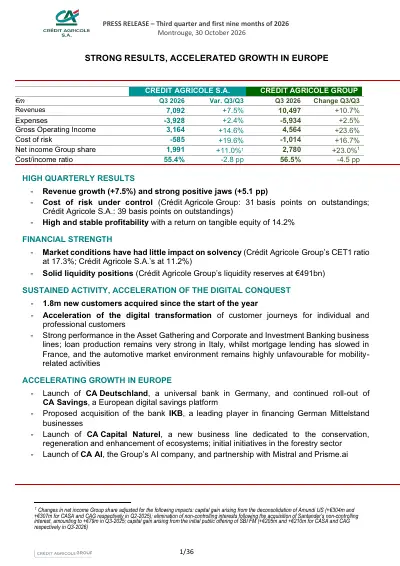
I'm going to start with a few messages on these results that are very strong. CASA is posting high results close to €2 billion this quarter.
As a reminder, all of the variations here are presented here are based on the 2025 pro forma figures, that is where Banco BPM is equity accounted at 20.1% in 2025. We consider a few other retreatments, i.e., one, the Q3 '25 results from the cancellation of minority interest of CACEIS one year ago with the completion of the acquisition of Santander's 30.5% stake in CACEIS; and a second exceptional item, which is this quarter's results from the capital gain realized by Amundi with the IPO of the JV that they have with State Bank of India.
If you exclude these two exceptional elements, net income grew by still a strong 11% over the year. As was already the case last quarter, this strong performance is in particular due to a very strong growth in revenues, 7.5% this time, with significant positive jaws, 5.1 percentage points.
All of this resulting in a very high and stable profitability with an ROTE at 14.2%. Regarding solvency, despite some deterioration of market condition, the CET1 ratios are at the end of September roughly stable compared to the end of June at 11.2% for CASA, a decrease of 10 basis points, and at roughly 17.3% for the group, an increase of 10 basis points.
I'll come back to that afterwards, our liquidity positions are very strong, and we have had an increase in liquidity reserves close to half a trillion euros. This is globally a very good and strong quarter looking at financials.
Again, it's a very rich quarter in terms of the deliveries linked to the strategic initiatives we announced a year ago with the presentation of our strategic plan, Act 2028. In Q3, we announced a couple of elements linked to the development in Europe.
I'm talking about the expansion in Germany with the launch of Crédit Agricole Deutschland, our universal bank in Germany, and the agreement to acquire IKB, which is one of the most established financing partners for the German Mittelstand. We're also accelerating our transitions with the launch of Crédit Agricole Capital Naturel, which is a new division dedicated to the preservation, regeneration, and enhancement of natural capital with a first focus on forests.
Of course, we confirmed the acceleration of the AI transformation. This quarter is the effective launch of the group's AI company and of associated partnerships with Mistral and Prism AI.
Moving to the description of these strategic initiatives. First, one of our ambitions in the medium-term plan was to be a leader in Europe and, in particular, thanks to CA Savings, for which we're accelerating in terms of savings.
It's a European platform that was first launched in Germany. As you can see here on the slide, we have seven on-balance-sheet products that are offered offered.
This differentiates us vis-à-vis other digital players that have a lower array of savings products. Since launched in Germany in April, this platform continues its development with a sustained acquisition dynamic, which is balanced with the preservation of margins.
As you can see, we're targeting a rate of 650 new customers per day at the end of the year. We're already at more than 200 new customers per day, and we're preparing for the scale-up.
We announced just last week a rollout of this savings platform in Belgium and in the Netherlands, and we should go in six other European countries shortly from 2027 and onward. Of course, we're going to gradually expand our offer proposition towards financial off-balance-sheet savings.
There's going to be also cross-selling with Crédit Agricole Deutschland. As you can see on the next page, this is launched has been launched much more recently, in October, and the idea is really to enter the customer relationship through savings, but to go beyond that and to offer everyday banking services, i.e., a current account, a debit card, access to consumer credit.
The idea is to have an app-first digital bank, including AI, but also we have 20 Creditplus branches which allow us to have this reassurance in terms of physical human points. Again, the idea is to gradually enrich the offer with financial savings and retirement savings that will be added in 2027 with an upmarket shift through three tiers: Free, Intermediate, and Premium, with increasing benefits and service.
On the next page, that was for individual customers, but we also want to develop in Germany in the mid-caps. We announced this quarter a partnership, a project to partner to acquire, sorry, to acquire IKB, which is a recognized and long-standing player in German SMEs.
IKB has an expertise in public loans and a team based in the largest German cities, three, six, sorry, large German cities. IKB is going to give us immediate access to a very large portfolio of close to 500 active SME clients in the German market.
The acquisition of IKB, as you can see the figures here, we're giving you the figures of the price, around €660 million, and it's going to generate value. We have a target of 15% ROI within three years.
This value integrates what? The deepening of relationship with the existing clients of IKB, the expansion of the client base, the reactivation of historic clients.
All this will be done through the mobilization of the balance sheet of Crédit Agricole to expand upon the current roughly €8 billion corporate loans. We're also going to develop cross-selling with our CIB activities, with our leasing and factoring activities in Germany.
We're also going to leverage on our existing corporate client base in France, in Italy, and in Poland to support these customers with the financing needs they may have for their activities in Germany. Regarding the price, around €660 million, you can safely assume that the transaction should generate a little bit of a badwill.
For this ROI, we're very confident in our ability to generate significant value, both through cost synergies and revenue synergies. For the CET1 impact, we disclose a 20 basis points impact at the time of the closing, which is planned at the end of the first half of 2027.
This should be considered relatively prudent because we have estimated RWAs in a conservative manner, including our potential more conservative views on the underlying ratings attributed to the loan portfolio. We have, of course, safety buffers in our capital impact.
The idea is really to avoid any negative surprise in the first half of 2027. Our first target is to be a leader in Europe.
The second is to be a leader in transition. On the next page, you see a little bit of detail on the launching of Crédit Agricole Capital Naturel, for which the idea is really to reinforce the one-stop-shop offering of the group on natural capital regeneration.
We want to combine advisory services, investment, operational management of natural assets solutions. The first area we're going to invest is really forestry with two major initiatives at the European level.
We're acquiring a majority stake in EcoTree, which is a leading French player that offers a comprehensive range of expertise of engineering and services in the forestry sector. We're launching the Amundi Arbor Nova fund, which is going to invest in the restoration and reforestation projects in France and across Europe.
The idea is to ultimately mobilize €200 million. Those are the strategic initiatives we announced this quarter.
If I move to the key figures slide, just to take a step back from the listed entity to look at Group Crédit Agricole, which posted a very strong performance this quarter with a strong increase of net income of 23%, excluding the same exceptional items I mentioned earlier. This performance is driven by revenues, which grew by 10.7% with a strong increase that results both from CASA's activities and revenues, but also for the regional banks' activity, for which we have a very strong growth in revenues, 15.5%, benefiting again this quarter from a very strong upturn in net interest income, plus 41% quarter-over-quarter.
The gross operating income grew by 23.6%. The cost-to-income ratio over the last nine months is well below 60% at 57.7%.
This quarter, we had very favorable jaws of 8.2 percentage points. The cost of risk is slightly increasing, but remains very well-managed at 31 basis points on outstandings.
Of course, we have a very strong position in terms of solvency and liquidity. As you see, the reserves are up to €491 billion, up €16 billion compared to last quarter.
Moving to CASA, we have a strong growth in revenues, positive jaws, a gross operating income that increased by 14.6% this quarter. Very strong performance that allows us to post 14.2% in terms of ROTE.
On the next slide, this strong performance is, as often, due to a sustained activity in our business lines. What we can note this quarter: customer capture very strong, close to 1.8 million new customers year-to-date, and again benefited from an increased digital acquisition both in France and in Italy.
You see the detail here here on the slide. Since the beginning of the year, we launched a series of fully digital offers for LCL and the regional banks for professionals and individuals.
BforBank is pivoting towards a savings platform in France. In Italy, digital customer acquisition represents 38% of customer capture.
Now if we dig a little bit by business, in retail banking, we have a mixed loan production in France where we have home loans that are decreasing a little bit, whereas corporate loan production is increasing. In Italy, the credit production is dynamic, driven by all of the segments, corporates and home loans, despite the competitive market.
We have also dynamic production in Poland. If we look on at the assets, we have on-balance-sheet assets that continue to grow, and we have a strong growth in off-balance-sheet assets both in France and in Italy.
This explains the performance of asset gathering division in particular. In particular, with insurance, we have yet another record level for Q3 of €12.4 billion in terms of premium income.
This increased by 6%, driven by all of the activities. What's interesting is we have a 20% market share in France on the savings and retirement gross inflows compared to the of around 15% on the outstandings.
The net inflows were very strong, balanced between euro and unit-linked. We've reached 18.3 million contracts in P&C this quarter.
We have strong net inflows for Amundi, €46 billion, excluding the outflows from a low-margin Indian mandate. We have AUMs that are stable compared to June of 2026, despite a negative market effect, thanks to these net inflows.
Finally, in wealth management, the AUMs are increasing with positive net inflows and favorable market effects. In CACF, the activity was impacted again this quarter by the unfavorable automobile market.
This weighs on the resale of used cars, which has an impact in terms of Leasys and Crédit Agricole Auto Bank Drivalia. Also this time, we had an impact on the short-term rental activity of Drivalia that has an impact on our revenues.
Our business mix is very diversified, and so again, we have our CIB that posted a record Q3 thanks to the FICC activities, plus 8.3% this quarter, benefiting from increasing interest rates, and very strong performance also in terms of financing activities, and in particular trade finance and cash management. Finally, CACEIS posted a strong activity with a high level of settlement and delivery volumes, boosted by market volatility in 2027, and we have very high levels of assets under administration and conservation.
We're going to benefit soon from a new partnership that we announced with Edmond de Rothschild in Luxembourg. If I move to the next slide on revenues, revenue growth was very high this quarter, as you can see, 7.5%, driven by a strong momentum in asset gathering, mainly thanks to higher management and technology fees at Amundi and to strong commissions in wealth management.
The insurance revenues grew by more than 4% thanks to the savings and retirement business lines, thanks to this strong activity, which offset the impact of the weather-related events this quarter: droughts, crops, for storms, and fires. I was talking just before about the record revenues for large customers.
For SFS, despite the good performance in personal finance, which was supported by positive price effect, the mobility continued to be impacted by weak automobile market. This resulted again this quarter in lower margins on used cars at Crédit Agricole Auto Bank Drivalia.
I talked just before about the significant drop in activity in the short-term rental. For retail banking, now this quarter, we again had a very strong upturn in net interest income in LCL in France, 18%, excluding Milési, thanks to positive price effects with, on the asset side, a front-book rate that is well above the back-book rate, and on the liability side, we still have a stable deposits mix.
Italy confirms the upward trend which started in Q2 with an increase of net interest income of more than 5% thanks to improved margins and a positive volume effect. Our fees increased in all geographies, in LCL and in Italy, thanks strong savings activity, account management, and payment means.
This revenue dynamic illustrates, once again, the strength of our universal banking model underpinned in particular by these diversified revenues. If I move to costs, we have a significant positive jaws this quarter of 5.1 percentage points.
As you can see here, the increase in expenses is limited in all of the businesses. It's even decreasing for the asset gathering division because of the significant positive base effect linked to last year, the €80 million exceptional restructuring costs that we booked at Amundi with the objective of generating €40 million cost of savings in a full year to fuel strategic investments.
If you retreat this, as you see on the right, and for other nonrecurring items that are recorded at Crédit Agricole Italia and a couple of scope effects and integration costs, you'll see that the increase in expenses remains very controlled at 3.4%. In particular, it's variable compensation increase linked to the strong performance of the CIB that explains most of this increase in the large customers division.
We also have strong investment, in particular in SFS, because, as it's in SFS that we're booking the investments of CA Savings and Crédit Agricole Deutschland with costs that represent around €17 million over the first nine months of the year. We should remain below €50 million in 2026.
Of course, naturally, we're investing in the transformation of LCL with €67 million over the first nine months out of the €95 million expected in 2000 2026. Recall that we talked in our workshop of a total of €350 million investments, which should allow us to capture 1.2 million new customers by 2028.
Cost of risk on the next page. We have the cost of risk increase between the Q3 and Q3 of last year mainly, as you can see here, driven by an increase in Stage 1 and 2 provisions.
This increase in Stage 1 and 2 provisions is a prudent provisioning. As you can see, we have very high loan loss reserves at Crédit Agricole S.A.
level and at the group level. Most of this increase in Stage 1 and Stage 2 provisions is located at CACIB due to the cautious management of ratings on some files.
There's also some less significant additions in other entities, for example, in FGA, which is an entity in CASA that guarantees risks for the regional banks. All of this is a very cautious management of the loan book in the current context.
On the other hand, incurred risk, i.e., Stage 3 cost of risk, is under control this quarter, decreasing since the second quarter. We see more or less the same trend as in previous quarters.
We see for SFS the Stage 3 provisionings that are relatively stable at a high level, nevertheless, linked to continuous tensions on consumer finance in France, and increasing a little bit in some international entities. In retail banking, the incurred risk is relatively stable since the beginning of the year.
As we continue to monitor a certain number of sectors that are retail distribution, transport, construction. Let me remind you, sorry, a small parenthesis on a technical issue.
In the CIB last quarter, there was a technical transfer from Stage 1 and 2 to Stage 3 due to exposures that were being disposed of. The total exposure on these files was between €500 and €60 million.
This quarter, we finalized the disposal of some of those files for just under €200 million. We still have a couple of other files, but we're expecting to dispose of most of these exposures by the end of the fourth quarter of 2026.
This explains the footnotes that you have on the coverage ratio in particular. In the end, we have no surge in loan loss provisions.
The credit quality indicators are very high with NPL ratios that remain stable and low, loan loss reserves and coverage ratios that are high. All of this would allow us to absorb any surge in incurred risk.
Our provisioning is, as always, prudent. We have among among the best coverage ratios in Europe.
Of course, with that said, we're very cautious and we continue to monitor corporate customers in retail banking, consumer finance. All of that is under surveillance.
As you can see on the next page, we look in terms of cost of risk at each of the business lines. We're cautious regarding incurred risk for CACF and the international entities.
Nevertheless, you see that we have a relatively stable cost of risk for CACF. I just wanted to point out on the financing activities for the CIB where the cost of risk reached 16 basis points this this quarter, which is very low in absolute terms.
Again, as I was saying, this increase is almost entirely driven by Stage 1 and 2 additions, which is cautious rating management on some files. Of course, recall the very good quality of CACIB's customer grade base with investment-grade customers mainly and diversified and balanced geopolitical risk.
The increase in cost of risk for CA LF is not material, mostly Stage 1 and 2 additions. The cost of risk is very much under control in French retail banking.
Note in particular for the regional banks cautious Stage 1 and 2 provisionings this quarter also, in line with the Q2. For Crédit Agricole Italia, there's a slight increase in the total, but credit metrics, quality metrics, are still improving since last year.
On the next page, all in all, as you can see, net income is high and increasing by 11%, excluding these two elements that I was talking about: base effect linked to the cancellation of CACEIS minority interest, and this quarter's capital gain related to Amundi SBI JV, which is SBI SN IPO. I also mentioned the very strong increase in revenues and positive jaws, which result in a strong increase in gross operating income of 14.6% over the year.
As you can see, the cost of risk increased slightly, but really mainly driven by an increase in Stage 1 and 2 provisions, reflecting the cautious management of the loan book. Net income, however, was impacted this quarter by a slight decrease in equity-accounted entities.
We have roughly two opposite effects. First, the decrease in the contribution from Leasys by €48 million this year, again, due to a very deteriorated automobile market with lower margins on used cars.
This was positive partially offset by two positive elements. The equity-accounted lines benefiting for Amundi from the new contribution of ICG, Amundi brought its participation in ICG to 9.9%.
Of course, an increase in the contribution of Banco BPM, which represents €106 million in the Q3, thanks to our increase in our stake to 29.3%. Today, we are at 29.6% in the Q4.
Also, this and despite the inclusion of an amortization that we talked about in the pre-close note on PPA with a Q1 and Q2 catch-up effect. What you can expect going forward, we're going to have a contribution of Banco BPM based upon what the consensus sees going forward and including this PPA amortization for €20 million per quarter.
We should expect around €140 million contribution per quarter onward. All in all, we have net income that's increasing thanks to a very strong increase in gross operating income, activity buoyant, cost of risk controlled.
All of this bears witness, of course, to the strength of our diversified universal banking model, which helps us, for example, with strong activity in asset gathering, large customers, retail banking, and personal finance. This helps us weather more challenging conditions in the mobility business where we remain very cautious about the outlook for the next several quarters.
Moving to capital. Capital is very robust this quarter with a CET1 CET1 ratio of 11.2%, despite volatile rates environment.
As we have a capacity, continued capacity, to generate organic capital generation thanks to our ROTE, by the way, of 14.2%. You see here, organic capital generation 34 bps, distribution of 22 bps, which allows for a provision of a dividend of €0.85 per share.
Roughly 10 basis points like every quarter of organic capital generation net of distribution. This quarter, we were impacted by a few elements.
One, you remember every year we have an employee right issue that we compensate with a share buyback. The net impact is 4 basis points.
We have another effect, which is quite reversible, which is an impact in terms of the OCIs, the fair value of our assets capital, an impact of 13 basis points. Most of this impact comes for our from our insurance business, about 11 basis points, and the remaining 2 basis points comes from the banking activities.
How is this sensitive to market conditions? The main impact, 9 basis points, and of which about 8 from insurance, is related to the evolution of rates.
The rates moved by 76 basis points in the Q3. Then we have another impact, which is much lower, which is linked to the widening of spreads on French sovereign bonds bonds by 42 basis points this quarter, 2 basis points.
The remaining 2 basis points impact comes from the widening of corporate spreads and the decrease in equity. What you have to really bear in mind is the fact that CASA's CET1 ratio sensitivity to an 100 basis points increase in rates is close to 10 bps.
Its sensitivity to a move of the same magnitude on the French sovereign spread is close to 6 bps. A very limited impact of this market fluctuations on our CET1, and and and very reversible also impacts.
As you can see, RWAs are very well managed. They even decreased this quarter thanks to, in particular, a continued activity in terms of of securitization.
Looking ahead, we have a couple of methodological impacts, plus 5 bps in the Q4, minus 15 bps probably in 2027, but something that's very stable. Again, I want to insist upon the fact that we have organic capital generation going forward net of distribution, as always, thanks to our model that generates capital with a strong ROTE.
On the next page, our objective, nevertheless, is not to accumulate capital at the capital at the CASA level. When we assess capital strength, the relevant figure is the group CET1 ratio, which has increased this quarter to 17.3%, despite the market elements environments, with more or less the same factors that apply as for CASA, with organic growth in particular of the retail banks, a slightly lower impact on the on the OCIs.
I wanted to stress also the strong TLAC ratio, which is close to 28% percent, thanks in particular to the fact that we accelerated our medium- to long-term funding plan, which has been realized at 129% this year. Moving to liquidity, we have a very comfortable liquidity position with a high level, as you can see, and increasing of liquidity reserves at €491 billion.
The LCR and NSFR ratios are excellent. We're above our target range for LCR, which is 110% to 130%.
We exceeded our funding plan. The deposit has increased slightly, are still diversified and granular.
I just wanted to stress, I think on page 55, you have our exposure to the French sovereign, which is quite natural for a group like our are like our like us, and we have a €26 billion exposure on the banking book, excluding trading, to the French OAT. Natural for a group like ours.
Then I'm going to conclude on these on this page of income statement by saying that, to recall a little bit the main messages, we're posting strong and growing results thanks to a sustained activity in all of the business lines, and in particular to record performance in asset gathering, large customers, retail banking. This allows us to reach a record level of €7.1 billion in revenues, up 7.5%, which bears witness to our diversified business mix, which allows us to have a positive momentum in most of the business lines, which allows us to weather more challenging conditions in the mobility business where we were very cautious about the outlook for the next quarters.
Operational efficiency is controlled. We have a steady cost of risk.
We continue to invest, but cost-to-income ratio is decreasing. We're investing in the development in Europe, as I was talking about, in AI, in the transformation of our businesses and in transitions.
All in all, we have a very high and stable profitability with a return on tangible equity of 14.2%. This allows us to maintain strong capital levels that are that have a low sensitivity to market turbulence, strong capital, liquidity, and loan loss reserves, which allows to approach the uncertain macroeconomic environment with a lot of confidence.
I'm going to stop here. Thank you very much for your questions for your attention, and we can now open the floor to questions.
Operator
This is the conference operator. We will now begin the question-and-answer session.
Anyone who wishes to ask a question may press star and one on their touch-tone telephone. To remove yourself from the question queue, please press star and two.
Please pick up the receiver when asking questions. Anyone who has a question may press star and one at this time.
The first question comes from Jacques-Henri Gaulard with Kepler Cheuvreux. Please go ahead.
Jacques-Henri Gaulard
Yes. Good morning, everyone.
Nice to talk to you. Two questions, I think.
The first one on Italy. I think, Clotilde, the BPM-Crédit Agricole Italia combination is still the one you favor officially, and I think that's very clear.
What in your mind prevents this from being done, really, considering that the situation seems to have calmed down at many different levels? It was really a curiosity.
What in your mind is still preventing this from being announced? The second one I had was that you spent a lot of time on asset quality, and thank you very much for that.
In a way, it's a bit surprising because there was no material, if not at all, effective deterioration. You had a bit of ratings migration, and you remain within your target, right?
I think of around 40 basis points or below. The questions was more: are you trying to prepare us for something, or are you considering increasing that cost of risk for the 2027-2028 part of the plan?
Thank you very much.
Clotilde L'Angevin
Thank you. Thank you, Jacques-Henri, for your question.
Regarding Italy, in fact, we're always permanently reassessing our options. We're always looking very closely at the M&A discussions and all of the movement that takes place around us.
Our strategy in Italy has not changed. Let me recall you're talking about the combination.
Indeed, it would be a very interesting combination for us to do a combination between Crédit Agricole Italy and Banco BPM. Why?
Because, as Italy is our second domestic market. We want to continue to roll out our strategy, which is to continue to develop in retail banking, which is to continue to develop in the business lines, to develop synergies between retail and business lines, to continue our long-standing partnership with Banco BPM, as you know.
This is also why we increased our share in Banco BPM in the beginning to protect our partnerships in consumer finance and in insurance. We have a very solid relationship with Banco BPM.
Yes, a combination would make a lot of sense. There's, of course, other options on the table, but a combination would make a lot of sense.
Why? Because it would generate strong synergies, because it would have a low execution risk, and as we have a very common DNA with Banco BPM, consisting in particular in the supporting of the local customers.
In any decisions that we can take, we're always considering the importance of stakeholders and shareholders. We want to be really in a logic of value creation for Banco BPM shareholders, for CASA shareholders.
Indeed, as the Banco BPM CEO in fact first evoked this scenario last year, indeed, a combination between Banco BPM and Crédit Agricole Italy would make a lot of sense for us. That's your first question.
In terms of asset quality, you're absolutely right. There's no material deterioration.
The cost of risk remains in the hypothesis we made for our medium-term plan. There's absolutely no intention to change in any way this hypothesis because we're still very comfortable with this hypothesis.
Nevertheless, in terms of outlook, it's important that we take into account the uncertainty that exists today in terms of the macroeconomy, France and internationally. As you saw, our activity is sustained, but there is a slowdown in home loans in France.
We're monitoring closely the impact of the environment, even though our businesses are very diversified and very international, so that's a strength. For France, we still have a strong momentum for corporates, in particular for high-potential sectors like defense, advanced manufacturing, and biotech, complemented by structured financing.
We still have a support of precautionary savings for asset gathering, but of course, it's kind of the long-standing prudence of Group Crédit Agricole, we're always monitoring the evolution of the environment, the political context ahead of the upcoming elections in France to if appropriate, assess any impact on our outlook. This is for France.
In Italy, we have an economic situation that is improving and we have good business momentum in Italy. In CIB, the activity is going to depend on the global context, but we have a very balanced business mix.
What I can tell you, Jacques-Henri, is that, of course, we're very prudent all the time. We're looking at what happens in terms of incurred cost of risk for French retail banking, for consumer finance, but our loan loss reserves allow us to be quite confident.
Also, the diversity of our business mix geographically and in terms of business allows us to still remain confident.
Jacques-Henri Gaulard
Thank you, Clotilde.
Operator
The next question comes from Giulia Aurora Miotto with Morgan Stanley. Please go ahead.
Giulia Aurora Miotto
Hi, good morning. Thank you for taking my questions.
I have two. The first one, thank you for this slide on the international growth progression.
Sorry if I missed, I don't see the balances. How much deposits have you been able to raise so far, and what is your ambition across not just Germany, but also Belgium, the Netherlands, and the six additional European countries?
Then secondly, a question on capital. The 13 basis points OCI, I was wondering if you can split that between spreads widening and higher rates impact, and if you can give us the sensitivity going forward.
Thank you.
Clotilde L'Angevin
Yeah. Thank you, Giulia, for your questions.
Regarding CA Savings, in fact, we have announced in the medium-term plan a target to increase our outstanding on-balance-sheet savings from €15 billion that we have today in Germany to €40 billion across Europe. We want to also double the number of customers.
We're starting in this target. We have the about 30,000 to 40,000 new customers that are expected in Germany at the end of the year.
We should have roughly about €1 billion in an additional outstandings in terms of on-balance sheet. What's important is that we're looking at the space of customer acquisition and inflows of savings not only in terms of absolute targets in terms of number of customers, but also managing that in terms of the price.
We're making sure that we're really steering, in fact, the increase in this resource to make sure that it corresponds to the group standards in terms of the price of liquidity and make sure that this resource is not too expensive. It's going to be, by the way, interesting for IKB because as we're acquiring IKB and we're going to want to expand our balance sheet, expand on the support that we could provide in particular in terms of financing, but not only, for our customers, this liquidity that is going to be able to be brought by the CA Savings platform in Germany is going to be very interesting.
Really, we're steering it, in fact, we're fine-tuning the steering of the pace of growth also based upon the prices that we see compared to our different standards. Of course, the expansion in Belgium, Netherlands, we're going to have the same type of strategy in this respect.
Regarding your question in terms of capital, yes, we have this 13 basis points impact, which is mostly related to the evolution of rates: 9 basis points for the evolution of rates, 2 basis points from the widening of spreads on French sovereign bonds, and 2 basis points from the widening of corporate spreads and the decrease in equity. We have a stronger impact of the evolution of rates.
Why? We have two kind of types of different exposures to the French sovereign debts.
We have, first, a banking portfolio, I talked about €26 billion just before. This banking portfolio is very much mostly, 90%, hold to collect, has very limited sensitivity to the spread of French sovereign debt.
Then we have close to €40 billion in terms of exposure to the OATs in terms of the investments that we provide for life insurance customers. In this respect, the sensitivity is relatively limited, much more than what we saw in 2022, if you recall, where we had an impact of 88 basis points on the OCIs in 2022.
The sensitivity is much lower. Why?
Because since IFRS 17, we have, in fact, the matching between assets and liabilities of the savings of our customers in terms of savings and retirement. Nevertheless, there is still a sensitivity for insurance, mostly a sensitivity linked to rates.
That's why the impact of the 9 basis points I was talking about related to the evolution of rates is 8 basis points simply on insurance. To sum up all of that, we have two types of sensitivities: to a 100 basis points increase in rates, that's 10 basis points sensitivity of CASA; and 100 basis points increase of the French sovereign spread entails in decrease in CET1 ratio of 6 basis points.
So 10 basis points and 6 basis points sensitivity, they're both very low and, again, it's reversible.
Giulia Aurora Miotto
Clear. Thank you very much, Clotilde.
Operator
The next question comes from Tariq El Mejjad with Bank of America. Please go ahead.
Tarik El Mejjad
Hi, good morning, Clotilde.
Clotilde L'Angevin
A
Tarik El Mejjad
couple of questions, please. First, I'll start with capital.
This is a topic we've kind of moved on for you and not arguing much since you've been hovering around 12% with the diversified and de-risked business you hold. Now, flirting with 11%, environment where you have volatility in your capital given the sovereign, the debates about the macro, and also your M&A ambitions sounds a bit light.
How you feel really comfortable about not trying to rebuild a bit the capital through even more staying balance sheet optimization or whatever. How comfortable you are with this close to 11%.
The reversal you're mentioning of CET1 from OCI that's conditional to tightening of the spreads, which doesn't sound like it for now. The second question is on the EU ambitions, more towards the way you get there.
When you presented the plan last year, I liked what I saw, what I heard about the vision, but clearly sounded organically would be laborious and take a lot of time. I think the IKB deal demonstrated that you will accelerate that when possible.
Is that a strategy of a dual, kind of organic and then accelerate if you have this, and how you will fund that in the future, given your capital position? Thank you.
Clotilde L'Angevin
All right. Thank you, Tarik.
For capital, we're very comfortable with our target of 11%. You remember in the medium-term plan that we had talked to you about the flexibility, the strategic flexibility of 150 basis points that we were building up over the medium-term plan.
Why is this? It's because of our capacity to generate organic capital over every quarter.
Over the past roughly, if you exclude distribution, we're in capacity to generate about 10 basis points of organic capital net of distribution every quarter. We have this regular accumulation of capital at the level of CASA.
This allows us to plan for M&A operations, etc., on which, often times, we're very prudent. We have, for example, a prudent estimation of the impact of the acquisition of IKB, which should close at the end of the first half year 2027, of 20 basis points.
This very positive capital position is something that allows us to be very comfortable. You were talking also about how we can optimize.
Yes, we are optimizing, because every quarter, we roll out different levels of securitization. For example, this quarter, there was €1 billion thanks to a new SRT in consumer finance, in particular.
We have SRT and credit insurances that are save around, let's say, €25 billion of RWA at the level of CASA at the end of the third quarter of 2026. We can go further, we can intensify this, building upon the capacity of CACIB to securitize its loans, building upon the capacity of Agos, Crédit Agricole Auto Bank, Credibom.
We want to expand that and provide this expertise to other entities in the group, which should allow us to increase the capacity to securitize. This is something that we're very much focused upon.
Again, if you take off all of these elements, in any case, with our more than 14% ROTE, we have this capacity to continue to generate capital net of distribution very regularly over every single quarter. Regarding the EU ambitions, yes, indeed.
I think we're very much rolling out and putting in place the different building blocks that are really going to allow us to reach our European ambitions in terms of individuals, for which savings are very important. We decided to start in Germany because that's where there's a lot of acceleration possible of savings.
We're expanding into other countries, and this Crédit Agricole Deutschland solution is also something that is going to allow us to expand on the needs of the individuals. If you look in terms that's first dimension, savings individuals.
If you look at our expansion that we want to do in mid-caps, which is the target that we have in Europe. You remember in the medium-term plan we talked about these kind of two triangles, which were France, Italy, and Germany on the one hand, and Germany, Poland, and Ukraine on the other hand.
We could, of course, have reached our target organically because, as always, in our medium-term plan, we prefer to set targets that can be reached organically. Undoubtedly, the IKB acquisition is a solution that is going to allow us to accelerate.
We will accelerate. The 15% ROI target for us seems quite reasonable.
Why? Because we really think that we can mobilize our balance sheet to expand the solutions that IKB is already providing to its existing customers.
In fact, IKB is a leader, in particular, more than half of its loans is in this activity, which is public-private loans with a refinancing by KfW. This refinancing is currently limited by the size of the balance sheet of IKB.
We can provide increased mobilization of the balance sheet, but not only that, the cross-selling that we can do with CIB, with leasing, and also the cross-selling that we can do across Europe. We're quite enthusiastic about the way we can create value thanks to IKB.
Again, when you're talking about a mix between M&A and organic, the elements I'm talking about in terms of cross-selling and synergies are, in fact, a mix of M&A and organic because it's going to create synergies for other businesses present in Europe.
Tarik El Mejjad
Thank you.
Operator
The next question comes from Delphine Lee with J.P. Morgan.
Please go ahead.
Delphine Lee
Yes. Thank you for taking my questions, Clotilde.
Just wanted to ask two. One is going back to Italy and about Banco BPM.
Just wondering a little bit, sort of what form this combination, whenever it happens, could take. Are you thinking more about a reverse merger and selling Crédit Agricole Italia to Banco BPM in exchange of a bigger stake, or would you prefer to own 100%?
Just thinking, what options are here on the table for you. Then my second question is, going back to asset quality and France.
You've been strengthening a little bit the sort of S1, S2 provisions for France. It doesn't seem like you're seeing much changes so far.
Is that something you would expect because of the macro situation? Do you think there is early signs with the slowdown on mortgages, or are you seeing anything on the SME side that points to potential deterioration which can justify a little bit that strengthening of provisions?
Thank you.
Clotilde L'Angevin
All right. Thank you very much, Delphine, for your questions.
On Italy, how can you think of things? The way we think of things is that our strategy in Italy is a long-term strategy.
If you're thinking in terms of long-term strategy, our long-term strategy in Italy is, one, retail banking, we want to develop retail banking; and two, developing our business lines, which are all present in Italy. As you remember, in our medium-term plan, the target is to move from about 6 million customers to 6.5 million customers.
If you look at this long-term strategy, you realize that if we consider the different scenarios that are on the table, and we're going to make a decision when time comes, of course, the idea is really to think that how do we create value, maintain the value creation, and enhance value creation for our customers, for our shareholders, for us over the long-term. We're going to take into account financial dimensions, of course.
We want to create value in particular for our shareholders of CASA. We also want to look at the strategic dimensions because we're present in this second domestic market and we want to continue to roll out the synergies between retail and between business lines.
This is the way we're thinking of things in terms of value creation. This is the way we can access any different type of options really in this perspective of value creation over the long term for us, for our customers, and for the stakeholders.
Now in France, in terms of the macroeconomic situation, yes, we do see early signs of slowdown on home loan mortgages because, as you can see, we have a slowdown in the loan production of home loan mortgages. What is this linked to?
This is probably linked to the increase in rates, of course. That's also why, as we had a guidance for the net interest income of LCL.
In fact, we have a net interest income that was expected around high single digit for the end of the year. We're probably going to have a continuing, in fact, of this momentum that we have seen until now.
We're expecting in 2026 a net interest income for LCL which would be, let's say, in the mid-teens. However, we're maintaining the guidance that we gave you, remember in the workshop, of 6% growth in net interest income over the years 2026 and 2028, which, as you recall, was built upon the assumption of lower rates on term deposits renewals, higher rates on new loans, and stable liability mix.
We have a rise in the rates. We should continue to have a positive view in terms of the assets because, as we still have a difference between the front book and the back book.
In fact, the increase by 30 basis points of the rate of the back book is what explains the strong increase in net interest income for LCL. Then on the other hand, we would have a decrease in the cost of refinancing.
Of course, we hedge a lot of that, so that should be limited. Of course, the hypothesis we made were made upon no shift in the liabilities mix.
This is something that we have to remain prudent about regarding the price evolution of the client resources in the current environment. That's really something that's important to look at how we see things going forward in terms of net interest income for home loans.
Now if you look at the other dimensions of the macro outlook in France, you have corporate activity. As of today, we do not see a decrease significantly or in the SMEs or corporate activity.
We have strong corporate loan growth still in France. Again, we're very cautious because we know that we have an environment that is difficult, even though there's a lot of resilience of our corporates, a lot of which are investing, are diversifying, etc.
We have to remain prudent, and we do, of course, have to remain prudent in terms of consumer finance. We're monitoring very closely the cost of risk in terms of consumer finance in France.
It's more, if I can answer in a nutshell, it's what we see is a slowdown in mortgages, not so much on the rest. It's really prudent approach to the uncertain macroeconomic environment that we have today.
Delphine Lee
Thank you, Clotilde. Thanks.
Operator
The next question comes from Stefan Stalmann with Autonomous Research. Please go ahead.
Stefan Stalmann
Morning, Clotilde. I have two questions, please.
The first one is on your Crédit Agricole Auto Bank where you show that you have €28 billion of loans. Can you maybe give us a sense of how many of these loans actually are leasing structures where you bear the residual value risk of what you finance?
Related to the same topic, your joint ventures, Leasys in particular, are now losing meaningful amounts of money. Do you see any risk that you and Stellantis may actually decide to continue these joint ventures?
Where do you think is the pain threshold for that? The second question just very briefly.
With OAT yields now at around 5% for 10-year maturities and with only 7% of your liquidity reserve invested in OATs, is there scope for you to buy more?
Clotilde L'Angevin
All right. Thank you, Stefan.
Maybe on the second question first. It's true that OATs are very attractive.
We like to have a prudent management of our liquidity portfolio in our banking portfolio over time. As you can see over the past years, we're very We have public figures all the time about our exposure to OATs.
It increased slightly this quarter compared to the Q2. As you can see, the movements are very limited.
We like to have a very stable approach to this type of investments. Now for Crédit Agricole Auto Bank, in terms of Drivalia, in Drivalia, we do have a situation where we have, in fact, an impact of the automobile market in two dimensions: the resale of used cars and the residual value, of course, of the vehicles that are on the road.
There's a difference between Crédit Agricole Auto Bank and Leasys because for Leasys, we have this JV that you were talking about with Stellantis. We have a partner, which I'll come back to just afterwards.
Talking about Drivalia, for Drivalia, we have a more diversified mix of partners. Nevertheless, even if we have this diversified mix of partners, we do have a negative impact in terms of the used car value and the residual value of our cars.
On a fleet that we have, answering maybe in terms of the number of fleet rather than the outstandings, we have a little bit more than 230,000 vehicles in the fleet for Drivalia, of which we have short-term rental, which represents a little bit below 50,000 vehicles. This is something that has been impacted also this quarter, so that's maybe a short-term, limited overtime impact.
What we have to continue to monitor and on which we're not that optimistic, to say the truth, for the next quarters, is the residual value and the remarketing of the total of the Drivalia fleet. This is an impact that should also continue for Leasys.
You were talking about the JV. What we have is that with the JV with Stellantis, we have been impacted by the automobile market.
In particular, Stellantis has been a little bit more impacted by other than other car constructors. Why?
Because maybe we're not enough skewed towards electric cars. We're working on that, on how we can skew our exposure to electric cars a lot more.
Of course, we also had a situation where the increase in the stock of our fleet took place at a time where the used car prices was high. The used car prices has already decreased by 12% compared to the high, and it should continue to decrease a little bit this year.
In this context, we have a situation where the automobile market has an impact in particular for Leasys, which is relatively strong. What we're working on right now: first, I want to be very prudent in terms of the impact of this situation in terms of the income of CACF and the contribution of Leasys to this income in the Q3 in the Q4, sorry, which should not be good.
This situation, deteriorated situation for the mobility activity should continue for a certain number of quarters. I think you really have to wait for 2028 for things to pick up again.
What we're focusing right now on in terms of Leasys and Drivalia, in fact, in terms of how we can pick up, of course, we're working on value-driven pricing, we're working on the diversification of our top line, we're working through the higher penetration of services and insurances, we're working on the improvement of our remarketing process. In the short term, our priority is really to manage the stock of our old cars because we had a share of old cars of used cars, sorry, that were in our stock for more than 120 days that was too high, and we're bringing that back down.
We're working on managing all of these elements. We have these two situations with Leasys and Drivalia, but in any case, we want to be very prudent as to the coming coming quarters.
Stefan Stalmann
Thank you very much for this.
Operator
The next question comes from Pierre Chédeville with CIC. Please go ahead.
Pierre Chédeville
Yes. Good morning, Clotilde.
Clotilde, one main question for me left regarding insurance. When we look at your combined ratio undiscounted, it's close to 100%, which is quite concerning.
I was wondering if you feel that it's a combined ratio for the all year or just because you have a peak in Q3. If not, do you have any intent to change your pricing policy or maybe your reinsurance policy in order to mitigate the secondary perils impact on your combined ratio?
Also, sorry, do you have any idea, or is it too early to have an idea of the impact of recent riots in France on your combined ratio for Q4? Maybe a subsidiary question on Poland and Ukraine, where we see that in Poland, you had a nonrecurring item.
If you could tell us a little bit more about the situation there. Also in Ukraine, where we know, of course, that the situation is difficult, but we had the impression that it was stabilizing for you.
We can see that suddenly, you have a significant rise in cost of risk. Thank you.
Clotilde L'Angevin
Thank you very much, Pierre, for your questions. Regarding the claims, yes, we had an increase in claims over this year, mainly due to climate events.
In particular, we had an increase. The combined ratio is something that you can see over the nine first months.
The combined ratio is the consequence of the claims that we saw in the third quarter, but also in the first quarter. Remember, we had, in particular, strong claims for the storms.
Now the impact of of this of these claims was compensated by the very dynamic activity in terms of savings and and and retirement activity for insurance. It's true that we're always reassessing the impact on on the climate climate events on our claims, which should there's there it should not decrease significantly in the fourth quarter.
We should continue to see kind of the same trend at the end of this of this year. In terms of pricing policy, reinsurance, in fact, what we saw this year was more a set Often times, the reinsurance policy is based upon large events.
Here, we had a set of not that large events, in any case, not large enough to entail reinsurance treaties in the in in as we as we could expect. We're constantly reassessing the pricing, our reinsurance contracts that we have.
This is something that we do very frequently in order to really steer, to fine-tune the way we manage these claims related to climate events, which should not decrease over the long term. For the recent riots, it's it should be low.
It's it's very early. It's too early to assess these elements, but it should be low.
It should not be at all the same order of magnitude as the storms and and and the hail and and and the drought events that we had this year. For Poland, we had, in fact, yes, we had a nonrecurring items item which is linked to the decision of the European Court of Justice of April 2026 because the the Court of Justice was referred to by a Polish court.
The Court of Justice ruled that banks could not charge interest on credit-related costs such as insurance premiums or commissions that are financed by the lender. This is a product a practice that was common in Poland.
We complied, of course, immediately. The new contracts were adjusted.
What you see here is a provision that has an impact in revenues, let's say, about €30 million, on the coming interest on existing loans and the interest accrued or to be accrued. We complied, we're provisioning, we're looking at what could take place at the other countries in Europe or other entities, and we're quite comfortable with the fact that this should remain very limited.
In terms of Ukraine, what I can tell you regarding Ukraine is that we do have a couple of downgrades of ratings. We have a growth in in customer loans, we do have a certain number of downgrade.
What's important for you to to to bear in mind in Ukraine is the fact that we're expanding with this Lviv Bank Lviv integration proposal, which is progressing. This is something that we should be able to announce quite shortly.
We're hoping to have a closing in the fourth quarter of 2026, which should allow us to continue to develop and to and to benefit well, benefit, to support the reconstruction of Ukraine. Talking about what I was saying before in terms of the mid-caps, really developing the synergies also with the other different countries.
Pierre Chédeville
Okay. Thank you very much.
Clotilde L'Angevin
Thanks, Pierre.
Operator
The next question comes from Matthew Clark with Mediobanca. Please go ahead.
Matthew Clark
Good morning. A few nerdy ones, I'm afraid.
Firstly, a question on your U.S. branch, which has, I think, $16 billion of loans to non-bank financial institutions.
You've told us that you only have a couple of billion of private credit exposures. I'm just wondering what the balance of that is in your U.S.
branch: who are the other non-bank financial institutions that you're lending to, and what's the nature of those loans? That's the first nerdy question.
Second nerdy question is on the PPA increase related to Banco BPM. I'm just wondering what the balance sheet impact was of that reallocation that led to the higher PPA run rate going forward.
Any color you can give there would be appreciated. Then last question, could you give us an update on the Solvency II ratio for Crédit Agricole Assurances, please?
Thank you.
Clotilde L'Angevin
All right. I'm going to start in different orders.
For the PPA, in fact, what we did is remember we were in a situation of badwill. The PPA, what we did was we did the PPA for the past acquisitions between 2022 and 2025.
We have revalued retroactively our assets on the balance sheet. This has a positive impact.
Since it's posterior to the moment when we had done the operation, it has an impact on our balance sheet that does not have an impact on our badwill. Then there's a second dimension for which we catch up since the date where we bought the different in 2022 and 2025, we catch up the amortization in P&L due to this exercise of the allocation of PPA.
We have a certain number of assets and liabilities that amortize. We have a plus, we have a minus.
The net impact of that is very limited. It is something that we have put into our reserves, that has on the other hand, a positive impact onto the equity accounting situation in terms of the equity-accounted value of Banco BPM, but it's very limited.
What we have, however, going forward is we continue to have this amortization in terms of PPA, which should be about €20 million per quarter. That's why we had an impact this quarter of €60 million just about because we took into account the past impact in the past three quarters.
Matthew Clark
Can you give us a bit more detail on how long you expect that PPA amortization to last?
Clotilde L'Angevin
It's not short. It's relatively long, nevertheless.
Matthew Clark
I struggle a bit there as to why the impact on valuation is small, because if you have multiple years of an €80 million per annum amortization, it implies the balance of the asset that's created
Clotilde L'Angevin
You have a net impact. You have a gross impact with the retroactive revaluation on the assets on your balance sheet, but you have a net impact which is lower because you have a catch-up since the date where we bought these shares in terms of the amortization.
It's going to be just beyond our medium-term plan, this continued amortization, and the impact in terms of our balance sheet is very limited. It's a gross and it's a net impact.
In terms of Solvency II ratio, we don't, as publish Solvency II ratios in the third quarter. Nevertheless, what you can expect is that there is an impact of the rate environment on solvency for our insurance solvency.
Why? Because when you have an increase in rates, besides our activity, which is very strong because we have an increase in terms of the profitability of our life insurance and people do precautionary savings and invest in life insurance, but you can also have, going forward, savers that decide to buy back their life insurance.
That is what is modeled in the impact in terms of solvency. However, over the past years, when we saw high increases in rates, in particular in the 2022 large increase in rates, over the past years, the buybacks of these life insurance were very limited, less than 10% annualized.
We have a very stable behavior of our customers. This stable behavior, and also everything that we can do to support solvency, we issued a Tier 2 in insurance in September of this year, of course, we're working in terms of the insurance in terms of what could be reinsured in case of buybacks.
All of these elements allow us to be quite confident as to our solvency, which should decrease when we publish it in the Q4 of this year, but it remains extremely solid. We have a relatively, in fact, managed effect on the increase in rates.
In terms of private credit, indeed, we have low exposures to private credit, which is €3.2 billion. We'll come back to you onto the detail of the €16 billion of NBFIs, which is a sum of mixed elements.
You have a lot of institutionals, insurance, etc. Really, the private credit dimension is very limited at €3.2 billion.
Matthew Clark
Thanks very much.
Operator
The next question comes from Chris Hallam with Goldman Sachs. Please go ahead.
Chris Hallam
Yeah. Good morning, everybody.
Thanks for taking the questions. Could you give a quick overview on your base-case assumptions for Livret A funding costs in the coming quarters, how much you expect that to move by?
Also, if you can see any to the visual-related pricing headwinds emerging on the asset side, I think those limits are now inside French sovereign rates for something like a mortgage, for example. Then second, given that 20 basis points CET1 impact from IKB, I guess it comes back to a few of the earlier questions, but just would you be comfortable temporarily operating below that 11% CET1 if you needed to in order to pursue additional strategic actions?
You mentioned earlier that the relevant metric is a group metric, not the CASA metric. Just wanted to hear your thoughts on that question.
Thank you.
Clotilde L'Angevin
All right. In terms of Livret A, as we have often said, you have in the annexes of our slides the exposure that we have to Livret A for LCL and for the regional banks.
What's really important is that, in fact, we have hedged a lot of this exposure because we have a hedging in terms of rates and inflation that is very strong. In fact, the net impact of any moves in Livret A, which we can expect in February of 2027, should be very limited for us thanks to this hedging, a hedging that allows us oftentimes to have a better situation in terms of a downward turn, but on the other hand, it kind of smooths out the evolution when things are increasing.
There's a lot of talk, I don't know if your question was also about that, but there's a lot of talk about the cap on the Livret A. We had said that for us, we consider that even though, of course, it was important to continue to support, in particular, the high schools in France, we've said that it was something that was not necessarily the good solution because if you increase the maximum level of deposit you can put on the Livret A, it's going to be something that is going to benefit more for the more wealthy customers, of course, naturally, and it could have an impact on liquidity.
What we really think it's important is to be able to continue to develop savings that are more oriented towards higher yield in order to contribute to productive investment in Europe. Besides saying that, we're going to see what happens.
Of course, we continue to hedge for the Livret A. Is that what you were saying in terms of pricing headwind on asset side?
I'm not sure I understood exactly your question regarding
Chris Hallam
On the asset side, it was just the usury rates. From memory, from when rates moved a lot back in '22, '23, that became an issue on asset pricing on mortgages relative to French sovereign,
Clotilde L'Angevin
and
Chris Hallam
I think if I look at French 10-year today, it's wide
Clotilde L'Angevin
of You had the usury rate that was really something that limited our increase. In fact, that's why today, we have high net interest income, for example, in LCL and in regional banks, because we still have this difference between the front book and the back book because, in fact, the back book was limited by the usury rate.
Today, we're in a situation that should be different. Why?
Because a couple of years ago, in 2022 and '23, the rate increase was very steep and starting from a very low level. Today, the rate interest is more progressive and we started at a higher level.
When you look at the usury rate, the usury rate is calculated by looking at the average rate over the past quarter. If you look at the situation that we have today, the usury rate, it's much less of a cap than what we had before.
For CET1, would we be comfortable below? In fact, 11% is our target.
We never said that it was going to be a cap. However, we're aware of the fact that it's important for you, for us, to be comfortable as to if we were to dip below 11%, we're aware of the fact that we would have to make sure we reassure you in terms of our capacity to continue to generate capital and to increase.
As I was saying just before, we have this regular capacity every single quarter to continue to generate capital, and so this is something that we would be very comfortable with. Not a cap in an individual quarter.
It is always possible for us to dip just below 11% on one specific quarter, but we are aware of the fact that we have to improve things going on if this were to happen.
Chris Hallam
Thank you very much.
Operator
The next question comes from Anke Reingen with RBC. Please go ahead.
Anke Reingen
Thank you for taking my questions. Just two small ones.
Coming back on the PPA, I just wanted to confirm you say the €20 million is your stake going up to the 19%, and there will be more for the further increase in the stake. When you guided to the €140 million contribution per quarter, that would consider any additional PPA impact for your stake going above the 19.8%?
Then, secondly, on the dividend. You accrued the 50% at the nine-month stage.
We turn up at year-end. I just wanted to understand how important the 50% is relative to the absolute dividend.
In the past, you always sort of topped up above the 50% payout ratio to deliver a dividend growth. Is that the way we should be thinking about it this year as well?
Thank you very much.
Clotilde L'Angevin
Thank you, Anke, for your questions. On the PPA, in fact, the acquisitions we made in 2022 and 2025 before we had gone beyond this 20% limit were acquisitions that entailed a badwill.
When you have a badwill, when you do the PPA, it's going to have a P&L impact. However, the acquisitions we made beyond that point were acquisitions that entailed a goodwill.
In this goodwill, when you do a PPA, the PPA has an impact in terms of the adjustment of the goodwill, it should not have any significant P&L impact, contrary to what we had here for the PPA on these past stake increases. That's the first point.
In terms of dividend, the target that we give is to say that we want to distribute 50% in cash. We're always having a shareholder-friendly attitude, and it's a decision that we take, taking into account a certain number of elements.
We're always free to adjust a little bit this target of 50%, always bearing in mind that we want to remain shareholder-friendly.
Anke Reingen
Thank you.
Operator
The next question comes from Sharath Kumar with Deutsche Bank. Please go ahead.
Sharath Kumar
Good morning. Thank you for taking my questions.
I have two, please. Firstly, on other international retail, would the current high rates in Poland and Ukraine expected to continue going forward?
Are you open to selling some of your other international retail activities, say, for example, Egypt, to have some flexibility on your CET1? Then a clarification on the nonrecurring item.
Should we consider the 2Q number as the recurring run rate for other international revenues? Those are my questions on other international retail.
Secondly, quick one on IKB Germany. They are expected to generate a net income of around €60 million for the current year.
Your 15% ROI assumption implies a net income of around €300 million within three years. Is my understanding correct, and how should we expect this to be phased in the coming years?
Thank you.
Clotilde L'Angevin
Okay. Thanks, Sharath.
In terms of international retail, we're very comfortable with our setup today. We're very comfortable with Poland and Ukraine, which are in these triangles that I talked to you about, the mid-caps and Egypt in Europe.
We're very comfortable with our Egyptian setup also, that is a great driver in terms of profitability. We have no intention today to change anything significantly in the setup and in the array of diversified businesses that we have today in Crédit Agricole and in Group Crédit Agricole.
In terms of nonrecurring items, indeed, we're always have to be cautious about legal issues. Yes, indeed, it's quite probable that this nonrecurring items is not going to be something that is going to continue significantly in this respect.
It's difficult to say that you can go back to the Q2 because there's always issues in terms of the impact of rates on activity that we have. There's always a question that we have to look at in terms of activity, cost of risk, in terms of taxes, of course, that increased, in particular, in a couple of these countries.
What I can tell you is that this nonrecurring impact, we're not at all planning on it having to be repeated in the next different quarters. Then IKB in terms of ROI, yes, indeed.
The idea is really to think based upon the investment that we made, the €660 million that we talked about in the slide, what is the net income that we can generate additionally to our current setup thanks to this investment. That's the order of magnitude that you have, it's 15%.
We're always looking at this element. We're always looking at the return on invested capital.
The figure that we're giving you here is the return on investment. You really have on the numerator additional net income, and on the denominator, what we have invested in buying this new activity.
Sharath Kumar
Thank you.
Operator
The next question comes from Alberto Artoni with Intesa Sanpaolo. Please go ahead.
Alberto Artoni
Thank you. Good morning.
I have two questions. The first one is on insurance.
Of course, we have seen that the climate events are becoming more frequent, unfortunately. Just wanted to understand if that is going to reflect in a more interesting pricing on a newly written business.
The second question is a more strategic one, considering that in the first 9 months of 2000 and 26, you're already delivering a return on tangible equity north of 14%, which is in line with your target for 2028. How do you see that?
Of course, it's a strong delivery, but can we expect, perhaps, it's an indication that we could expect something more going forward as you continue to deliver on the strategy? Thank you very much.
Clotilde L'Angevin
Okay. Thanks, Alberto, for your questions.
On insurance, as I was saying, the climate events, yes, are coming more frequently and it should not decrease. We're always monitoring quite closely the issue of pricing and the issue of reinsurance.
This is something that we take into account and we take quite seriously. This is something that is the job, the business as usual, in fact, of the teams in insurance, for which, as we have a lot of our revenue generation which comes from savings activity.
Again, this quarter, we have the savings activity that compensated, more than compensated, the impact of claims. In terms of ROTE, yes, indeed, the ROTE is very strong.
We always have to remain prudent. We've always been prudent when we talked about our medium-term plan, in particular in the context of macroeconomic uncertainty.
Nevertheless, what we said in the medium-term plan was that the ROTE of 14% was to be seen more as a minimum over the medium-term plan because it's a minimum that was made under the hypothesis which we make in the medium-term plan all the time that we're going to reach our targets through organic growth. When you do M&A, the financial criteria that we have for M&A, is to have accretive M&A with strong ROIs.
M&A should naturally contribute to enhance the ROTE in the medium term. Indeed, in the medium term, the ROTE of above 14% should be considered a minimum.
Alberto Artoni
Thank you.
Operator
The next question comes from Joseph Dickerson with Jefferies. Please go ahead.
Joseph Dickerson
Hi. Thank you for taking my question.
A lot of ground's been covered, but I just wanted to go back to the topic that Jacques-Henri raised on credit. This topic is received, I think, quite a bit of airtime, including Mr.
Gavalda talking earlier to the press on slowdown risks in France. I guess what I'd like to know is, is there anything that you've seen in the month of October that is different from what you observed over the course of the third quarter?
Thank you.
Clotilde L'Angevin
No. In fact, as of today, activity in October is really continuing the trends that we saw in the second quarter.
We have to look always in terms of forward-looking, what we can see in terms of kind of second level signals that we have where we do have discussions with our corporate customers that are saying that they're relatively prudent about the outlook, even though they want to continue to invest, they want to continue to diversify. There is prudence, there can be a form of wait-and-see attitude that we can see in particular for the corporates in our CIB.
Our corporate customers, for example, in CIB, are very well diversified. The businesses that we monitor quite closely in terms of French retail, as we talked about distribution, retail, farmers, transportation, textiles, all of these sectors are sectors that I've been talking about for many quarters.
There's no surge in provisions linked to any other specific sector that could pop up beside these different sectors that we're monitoring. We do not see in October any significant change in the activity that could cause us to really change significantly what we're saying.
When Olivier is talking about prudence, it's because there is a set of uncertainties everywhere, uncertainties in terms of macro environment, uncertainties in terms of the impact of the increasing rates in terms of loan demand, on geopolitical uncertainty. For all these reasons, we prefer to be prudent.
That's why, in fact, the loan loss reserves that we have at the level of the group represent, as 2.5 years of cost of risk. Very strong prudence to weather any possibilities.
Joseph Dickerson
Excellent. Thank you.
Operator
The next question comes from Benoît Valleaux with ODDO BHF. Please go ahead.
Benoît Valleaux
Yes, good morning. Thank you for taking my question, and good morning, Clotilde.
Maybe two follow-up questions on my side regarding insurance. The first one, sorry to come back on this, but on nat cat event in P&C, can you please compare the cost of nat cat event versus your budget for the first 9 months of the year?
Did you mitigate that impact by some reserve releases, or not at all? Maybe on another way to ask my question, could we assume that the 2.5 percentage point deterioration on your undiscounted combined ratio is only related to nat cat event?
Maybe the second question is on the life savings business, it's a bit more philosophical, if I can say that. Just to understand how you will manage your Q4 earnings in current environment with a sharp increase in interest rate, we might imagine that you will have to boost a little bit your crediting rate to be paid to policyholders.
If this is the case, will you use your PPE reserve in order to have, I would say, a broadly neutral impact on your expected revenue on Q4? Thank you.
Clotilde L'Angevin
Good questions. Thank you for the philosophical question.
The climate events were higher than what we had expected in terms of the budget. However, we're always doing stress tests all the times, we're completely capable of managing climate events that are higher than what we have in our budget.
Again, this year, we did not benefit as much as we could in a normal year from the reinsurance treaties because we have an accumulation of not that big enough events. Of course, bearing in mind that these events are big for each of the individuals that have to live them.
In terms of reinsurance, it's not an event that causes us to entail the reinsurance treaties as we could expect. Nevertheless, we're always repricing, we're always thinking in terms of asset allocation, we're always working in terms of reinsurance.
This diversity of the business mix that I was talking about as a whole for CASA is also something that you see within Crédit Agricole Assurances itself. Because compared to the budget, the climate events were stronger, but compared to the budget, the precautionary saving was higher, and so the impact on savings and retirement activity was higher also.
Now the question that you asked for the Q4, it's how are we going to manage the rates we provide to our customers in terms of this savings activity, which is always something that it's a strategic decision that takes into account what individuals can compare these yields to in terms of other types of savings, on-balance-sheet savings, other types of off-balance-sheet savings. It's a decision that we always have to take.
As we have a strong value of the PPE, which is more than €5 billion. This strong PPE allows us to have a lot of flexibility in the decisions that we would take in the fourth quarter based upon our customer interest and upon the capacity over time to continue to provide strong yields, because this PPE allows us over time to smooth out the impact on yields.
All of these are elements we're going to take into account when we take this decision.
Benoît Valleaux
Thanks very much.
Operator
The next question is a follow-up from Sharath Kumar with Deutsche Bank. Please go ahead.
Sharath Kumar
Thank you again. Sorry, I just had one follow-up on the used car sales results.
Avis, in the call yesterday, indicated that September was better than the Q3 average, while my read of your comments is that it could get worse from here. Wanted to understand where are we on the inflection point.
Appreciate there are a lot of uncertainties related to oil price, tariffs, etc., but any views would be appreciated. Thank you.
Clotilde L'Angevin
Okay. Thanks, Sharath.
I'm not going to comment on what our competitors are doing. What I can tell you is that we have our stock of vehicles that increased later than other competitors at a time where the used car prices was high.
What we're working on right now is we're working upon the management of the stock of these used cars. We want to decrease quite significantly the stock of the used cars that are older than 120 days.
As we decrease this, we have to take into account the impact that this decrease in used cars rate will have on our residual values and on our used car remarketing activities. That's why I really want to be prudent in terms of what's going to happen in the Q4.
It is not going to be a good quarter for the mobility activity, that's for sure. And 2027 should also be a year where things are not going to be that great.
You really have to wait until 2028 for things to pick up. I'm not commenting upon our competitors, but for us, we have this impact of the automobile market that is significant.
Again, as I was saying, diversity, geographical and business, of our activities allows us to continue to have an increase in revenues, as always. Again, just want to recall the 7.5% increase in revenues this quarter.
Sharath Kumar
Thank you.
Operator
Ms. L'Angevin, this was the last question.
Back to you for any closing remarks you may have.
Clotilde L'Angevin
Thank you very much. Thank you, everyone, for these questions that were very rich and allowed us to cover a lot of ground, as you were saying.
Just wanted to tell you that our next meeting is going to be a workshop on insurance, which is planned for the 25th of November. We had a couple of questions on insurance on this call, we're going to be very happy to be able to dig a little bit deeper in order to explain the drivers of the activity and results of this very important business for us.
We'll see you on the 25th of November. Thank you, everyone.
Bye-bye.
Operator
Ladies and gentlemen, thank you for joining. The conference is now over.
You may disconnect your telephones. Thank you.