SBO AG
Q3 FY2026 · Earnings Call TranscriptNovember 26, 2026
Judit Helenyi
Ladies and gentlemen, good morning and good afternoon, depending where you are, and welcome to the SBO's conference call on the results of the first three quarters of the year 2026. My name is Judit Helenyi.
I'm responsible for IR, and I would like to thank you for joining us today. We appreciate your interest in SBO.
Before we begin, let me briefly cover a few organizational points. As usual, this conference will be recorded and made available for the public.
The presentation will be held in listen-only mode, followed by the Q&A session. Please note our disclaimer, which you can find, as usual, at the beginning of the presentation.
This presentation will be given by SBO's Executive Board, Klaus Mader, CEO, and Campbell MacPherson, COO. With that, we are ready to start.
Please go ahead, the floor is yours.
Klaus Mader
Judit, thank you very much for your kind introduction. Ladies and gentlemen, a warm welcome also in the name of the Executive Board.
As usual, I'm doing this call together with Campbell MacPherson, Chief Operating Officer. Today, we will talk about the business highlights in the third quarter and the financial performance on a group and segment level for the year-to-date figures, but also, very important, for Q3 only, followed by a market outlook, including the implications on our business.
As usually, this is followed by a Q&A session. Today, I will start with the promising Q3 highlights.
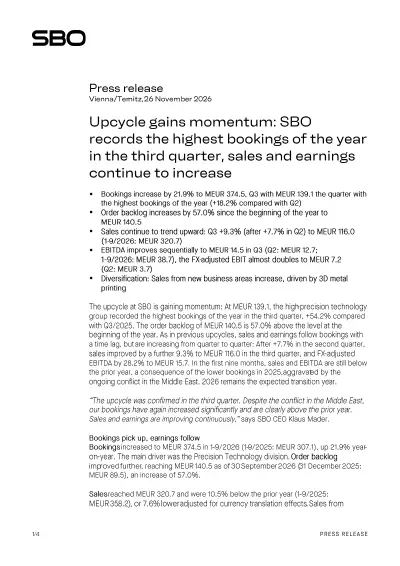
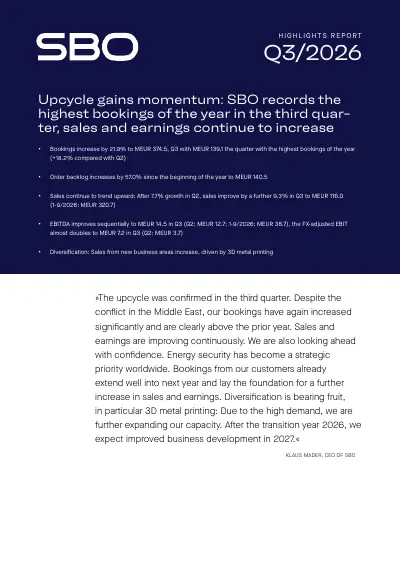
You may recall our half-year earnings call when we talked about the start of an upcycle, and it has been confirmed with the Q3 figures. First, bookings in Q3 increased by more than 18% compared to the second quarter, the upward trend in bookings continued for the fourth consecutive quarter.
With this, the backlog is now at €140.5 million, which is a 57% increase compared to the beginning of the year. After a sales increase already in the second quarter with close to 8%, sales further increased by another more than 9% compared to the second quarter to €116 million, and also the earnings increased.
Although we suffered foreign exchange losses in Q3 amounting to 1.2 million, we do report an EBITDA of 14.5 million, which is 14% up, and even 28% up foreign exchange adjusted. In other words, the upcycle is confirmed.
We also see progress in diversification, sales from new business areas rise, led predominantly by 3D metal printing. Capacity is being expanded to meet the demand.
You will remember the press release from summer. Also, Campbell explained it in a lot of details during the half-year call.
Already at the beginning of the presentation, a teaser to the outlook: bookings already extend well into 2027. After the transition year, the expected transition year with sales and earnings below the previous year, SBO expects improved business development going forward into 2027.
Let's start with the business highlights also in the third quarter. You see many of them: strategy execution continued, strategy delivers progress across all four strategic pillars.
I'm not going to get into the details for each and every bullet point, but what you can see is there is an ongoing growth in diversification driven by 3D metal printing, but also diversification into subsea and geothermal. Also on the other pillars, activities were set with new contracts and partnerships, record drillings in US land, or technology steps with wireless real-time of our rotary steerable tool.
For more information, please look into our quarterly highlights where you see a couple of pages giving more details and color on the various strategic execution activities. Let's move to the financial highlights, and let's start with the year-to-date comparison.
The promising news is that the bookings on a year-to-date performance are up by almost 22%, 374.5 million compared to roughly 307 in the previous year. Important and already flagged by me, with Q3 being the strongest quarter with another 18% increase compared to the second quarter, this takes the book-to-bill ratio to 1.2.
On the sales, it is the similar explanations that we had earlier this year. Year-to-date sales are down 10.5% with some impact from the foreign exchange, foreign exchange adjusted, the decrease is 7.6%.
This is driven, as we already said, from lower customer demand that we have seen last year, sales deferrals in energy equipment, and also the weaker US dollar. The promising news and important to note is that last year we had a decreasing trend in sales and profitability, and this year it's an increasing trend with sales and earnings increase from quarter to quarter, and therefore narrowing the gap on the year-to-date figures.
EBITDA and EBIT follows the sales reduction, with EBITDA from 58.6 million in the previous year to 38.7 this year, and the same development on the EBIT level. Also on the earnings level, an increasing trend with reported EBITDA plus 14 and EBIT plus 46% compared to the second quarter.
Bookings, I already flagged the year-to-date performance, the plus 22% compared to the previous year, and also the increase of the order backlog. That order backlog is predominantly a Precision Technology figure, where in Energy Equipment, bookings and sales are in similar periods.
The 57% is a promising figure. Also the Q3 bookings in 2026 compared to the Q3 bookings in 2025 are more than 50% up.
You see that on the right-hand side, the trend line in terms of bookings that we see now for the fourth consecutive quarter increase bookings. Let's move to sales on a group and divisional level.
Sales on the group level we already discussed, minus 10% and foreign exchange adjusted minus 7.6%. On a segment level, Precision Technologies sales are 8.6 below the previous year, and this is the result of the lower bookings in 2025.
In Energy Equipment, the main driver being below the previous year are the deferred sales from the Middle East conflict. We had lower North American activity in the first half of the year, but already increasing activity in the third quarter.
Therefore, more interesting is the development also on a quarterly, on a sequential development. When you look here, you see only pluses: sales plus 9% compared to the second quarter.
We also see, after a clear improvement in PT from Q1 to Q2, another 9.4% sales increase. In Energy Equipment, who has a higher exposure to the Middle East, but also a promising plus 9% in the third quarter compared to the second quarter.
Moving now to earnings and profitability. First on a year-to-date perspective, and here the drivers of the lower profitability on a group and divisional level have been the low bookings in '25, which is predominantly relevant for Precision Technology.
The lower bookings resulted in reduced sales and lower capacity utilization, but however, profitability is improving over the course of the year. In Energy Equipment, it's a mix of factors driven by product mix, the ramp-up of the US reline and distribution center, the logistics constraints that we have seen due to the Middle East conflict, and expenses related to product innovations.
More important and also more promising is the quarterly development, and here you see that not only the sales, but also the profitability shows a clear upward trend. The reported group EBITDA with 14.5 million is 14% higher than in the second quarter.
Foreign exchange adjusted, 1.2 million which is coming from the Precision Technology division, the EBITDA is 15.7 and therefore a 28% increase. The reported group EBIT with 6.1 million is more than 46% above the 4.2 million in Q2, and foreign exchange adjusted it almost doubled in terms of EBIT.
When we come to the Precision Technology, you see a slight decrease from the second to the third quarter, but nothing to be concerned about because we had 1.2 million foreign exchange losses in Q3 in PT compared to a foreign exchange gain of half a million in the second quarter. Also the adjusted EBITDA figures show an increase in profitability.
In Energy Equipment, with more or less no foreign exchange impact because all those entities—Wellbore, DSI, BICO, and D-Tech—are nominated in US dollars, the driver of the increased profitability is purely driven by higher sales. Coming to the final slide on the financial information, the balance sheet.
The balance sheet remains to be very solid with high liquid funds and a solid equity ratio. Operating cash flow stays at 14.2 million, which is below the previous year, and this is predominantly driven by lower profits and increase in working capital.
This also takes the free cash flow into the negative territory, but let me elaborate that a little bit. I already said during the half-year's figures, the negative free cash flow is nothing to be concerned about because the two main drivers are increase in working capital and strategic capex.
Increase in working capital, let's start with accounts receivable: 116 million sales in the third quarter of this year, and more or less DSO are around 90 days, quarterly sales at the end of the period are in accounts receivable. Compare it with the fourth quarter of last year, which gives you the accounts receivable at the beginning of this year, a 20% increase in sales from Q4 '25 to the third quarter of this year is resulting also in higher accounts receivable because we are in an upcycle.
When we are in an upcycle, higher bookings result in higher inventory for a period of time. This is a temporary event, and therefore working capital is up.
For me, an increased working capital being part of an upcycle is nothing to be concerned about. The second one is the strategic capex.
We talked about heavily during August, almost 50% of our capex this year is connected to additive manufacturing, the purchasing of printers, the connected infrastructure layout and facility changes. This is something we have to do in order to invest in our growth strategy and also execute on our strategy.
With an equity of more than 430 million, with liquid funds of 268 million, and a gearing at solid 25%, it's a strong financial foundation to invest and also to finance this growth strategy, and therefore we might have to see a negative free cash flow for a period of time. This will come back as soon as EBITDA increases and more cash flow is coming from the profits.
With that financial information, I'm going to hand over to Campbell for the outlook on a market and also on our business side. Campbell, the floor is yours.
Campbell MacPherson
Thank you very much, Klaus. Good morning and afternoon to everybody from my side.
Let's turn to the outlook for the business. As Klaus has already mentioned, we recorded our strongest bookings quarter of the year at €139 million, and we ended September with our backlog 57% above the year-end '25.
What I'm very pleased to add is that this positive bookings momentum we've seen through the first nine months has continued into quarter four so far. As in previous cycles, of course, sales and earnings follow bookings with a time lag, and this is consistent with the transition year we expected in 2026.
When we spoke last quarter, the Middle East disruption was drawing down inventories and increasing the focus on energy security. Those effects, of course, continue to shape the global outlook.
For '26, the IEA expects global supply to decline by approximately 4.8 million barrels per day compared with a decline in demand of 2.7 million. Inventories have helped cushion that disruption.
For '27, the IEA expects supply to recover by 6.6 million barrels per day and demand by around 2 million, provided that flows through Hormuz recover sustainably. That would, of course, ease supply pressure and create room to rebuild depleted stocks.
Even as supply recovers, though, countries remain focused on reducing their exposure to future disruption. The three energy security priorities we discussed last quarter therefore remain extremely relevant.
They continue to shape national policy and the investment plans of energy producers. First, refill inventories, replenishing commercial stocks and strategic reserves as supply becomes available.
Second, diversify supply, reducing dependence on individual producing regions and vulnerable transport routes. Third, developing local resources, bringing more energy supply closer to home and under greater local control.
Alongside these priorities is a point I've made on previous calls, and that's the continuing need to replace production lost as fields mature. In its latest World Energy Outlook published only last week, the IEA notes that nearly 90% of upstream oil and gas investment over the past five years went towards offsetting production declines.
Even when demand growth is modest, continued investment in drilling and production remains essential. For SBO, these investment needs support the demand for our customer services and equipment.
Our opportunity is increasingly driven by footage drilled, well complexity, and reliability requirements and technology content per well. Major projects are moving forward across several regions.
Rystad forecasts $223 billion in investment commitments for new oil and gas projects this year, including $150 billion offshore. This is substantially above 2025, with development programs extending over several years.
Even in the Middle East, it remains a very important part of that picture. This month, ADNOC Gas reaffirmed plans to invest around $20 billion between '26 and 2030 across four major growth projects.
These include its Ruwais Gas development, for which $8.2 billion of contracts were awarded in August. In September, Saudi Aramco awarded drilling contracts covering more than 450 wells over an initial three-year period, with mobilization beginning in Q4 this year.
Of course, beyond the Middle East, our customers' public updates point to stronger well construction activity in Latin America, US land, alongside continued offshore activity in Asia. The pace will, of course, vary across markets, but our major customers confirm the upcycle and expect further improvement in the market environment in '27.
This is absolutely consistent with what we're seeing at SBO. Customer commitments, stronger bookings, and our growing backlog give us the greater confidence in the continuation of the upcycle into 2027.
What does this mean for our divisions, Precision Technology and Energy Equipment? Let's start with Precision Technology.
Demand for high-precision components and non-mag steel continues to improve. Our bookings already extend well into 2027.
This, of course, gives us better visibility, allowing us to plan production and capacity, but of course what you see is this supports a further increase in sales and earnings. Alongside our core energy business, and for me this is very exciting, while we're in an upcycle in our core business, we're also seeing demand from our diversified businesses grow.
Demand from space, aerospace, defense, and semiconductors is supporting the expansion of our 3D metal printing activities in particular. Capital expenditure on additive manufacturing totaled just over €14.1 million during the first nine months.
This included printers, infrastructure, and post-processing equipment. Three additional printers came into operation during Q3, with two more ordered to support customer programs.
This brings us up to a total of 36 printers across the group, with two more to be added later on in the beginning of next year. As our advantage is in combining 3D printing with our complex precision machining capabilities and other post-processing, allowing us to deliver finished components for very demanding applications.
We're also expanding our position in subsea, moving from precision machining into complete turnkey component supply. We also received our first order for a 3D-printed subsea manifold.
This demonstrates how we can combine our manufacturing capabilities to capture new opportunities in newer adjacent markets to where we operate. Turning to Energy Equipment, we saw clear improvement in the third quarter.
Sales and earnings both increased compared with Q2, and the division delivered its strongest sales quarter of the year. The direction is extremely positive, although the recovery has been slower and less even than we would have anticipated.
A less favorable product mix, costs during the Houston reline center's ramp-up, and Middle East logistics restrictions have held back the pace of improvement. There's always a timing element to the recovery as well.
New products and commercial initiatives need qualification and customer adoption before they contribute fully to sales and margins. In North America, activity has improved and we expect it to remain supportive.
Customers remain disciplined in their spending, with demand focused on better drilling performance, reliable tool availability, and more efficient well completion solutions. Internationally, we're extending our presence across Latin America, Asia-Pacific, and Africa.
Recent awards in Colombia and China, together with our offshore activity and local service support in Namibia, demonstrate how our technology is reaching more customers and markets. In the Middle East, which represented around 13% of group sales in the first nine months, activity remains uneven.
Logistics continue to affect deliveries, tool deployment, and product qualifications. Just to give you a practical example, our freight forwarders recently reported around 160 vessels waiting to berth across Fujairah and Khor Fakkan, delaying deliveries and adding costs.
Across both divisions, however, we see this primarily as revenue timing and execution issue. Bookings and backlog remain intact as customers continue to demand our products and services.
For SBO, the opportunity comes with the de-escalation and normalization. This would help us execute delayed business and convert that backlog into revenue.
Looking into '27, we also have several specific growth opportunities in EE. Geothermal, of course, is one.
Our drilling, completion, and circulation technologies are already being used in projects across North America, Europe, Latin America, and Asia, extending the market for these capabilities. Of course, our US motor reline and distribution center has been ramping up through '26.
As the utilization increases there, we expect better efficiency, greater control over our quality and cost, and of course our turnaround times, our ability to be able to reline more motors more quickly to support growth in the sales and our rental business. Certainly new products come to the market.
One of the exciting ones that Klaus just mentioned was the introduction of our wireless real-time communication coupled with our rotary steerable system. We truly believe this is going to provide further opportunities as we build on the successful field testing we've had and move towards wider customer adoption.
Together with our order visibility, international expansion, and technology developments, this supports our expectation of a continued growth in '27, with additional upside, of course, if the Middle East conflict eases. Back to Klaus for the closing remarks.
Klaus Mader
Campbell, thank you so much for your comprehensive explanations. Let me conclude the presentation with the final slide.
You recall the theme that we had during the course of this year, navigating challenges, shaping the future. At the end of the year, we can clearly say and confirm what we said at the beginning of the year: 2026 is going to be a transition year.
With the subdued bookings coming from '25, we expected that sales and earnings will be below the previous year. The more promising is that sales and earnings follow bookings with a time lag, and we have seen already during the course of the year increased sales and earnings from quarter to quarter.
The downturn that we have seen for many quarters has been overcome. We are very happy with the strongest bookings in Q3 of almost €140 million, although the normalization in the Middle East still did not happen, which is a significant increase also to the first half of the year.
The upcycle is confirmed. It's confirmed also by our customers.
When you read their earnings calls a couple of weeks ago, they confirmed the upcycle. We see it also already in our order book with a backlog increase by 57% since the beginning of the year.
The core business is coming back. The downturn is overcome.
The upcycle is confirmed. On our growth strategy, Campbell mentioned the diversification efforts and also successes.
I flagged that the strategy execution is progressing, so that we can say, based on the increased bookings that we are seeing from the core business, as well as from the rising demand in diversification, we expect to have a better year in terms of sales and profits going into 2027. We are looking positively into the next year.
Before we go to the Q&A session, allow me some remarks at the end of the presentation. You may have seen it yesterday that we announced yesterday organizational changes in the Executive Board.
Campbell has decided for personal reasons, and he will comment on it, not to extend his contract beyond 2026. Yesterday, the Supervisory Board designated Mathias Klein as the next Executive Board member starting in January 2027.
Mathias was the Chief Sales Officer of a company the size of SBO, a production systems and machine tool manufacturer, and was playing in various different industries. With his experience in industrial technology, sales, and marketing, and strong connections into industries that SBO is targeting to, we see us in executing and accelerating on the diversification on SBO.
With the early extension also of my contract, and we are just two Executive Board members, continuity and stability should be proven. It's also a commitment to executing on our Strategy 2030.
I want to take this moment also to thank Campbell in the name of the entire SBO Group, because it's his last earnings call. I want to thank him for his commitment, for his dedication and contributions.
Many of you know him personally, got a chance to interact with him over the past couple of years. Campbell shaped SBO and was contributing to the success of SBO for almost two decades.
He was running SBO companies. He was setting up the very important facility in Vietnam, who is a big contributor to the success of SBO.
He was running Precision Technology division for many years. It was an honor for me to have him as a colleague on the Executive Board over the past three years.
Campbell, many, many thanks. All the best for your private future, and we will miss you within the SBO organization.
Campbell MacPherson
Good. Thank you very much, Klaus, for those very kind words.
It's much appreciated. Just to make everybody aware, I decided not to extend my contract.
When I took up the role to join Klaus on the Executive Board, it was always a personal decision to retire after those three years, and I can't believe that those three years are already over. SBO's been a very significant part of my life now for 20 years, and it's really been very grateful for all of the experiences that I've had, all of the people and fantastic colleagues that I've had.
Like to pass my thanks to Klaus and all of my colleagues across the group, because that's what I'm going to miss most is the fantastic people and the teams that we have all around the business. I've also valued the good and constructive discussions with you, our investors and analysts.
This has definitely been a new part of business life for me over these last three years, I've learned a lot from that, and I thank you for your engagement, of course, over these three years and the very interesting and sometimes challenging questions. I'd also like to wish Mathias every success as he joins the Executive Board.
He couldn't be joining a better company at a better time with such a fantastic future ahead of it. I'm very happy to see that we're really getting on a very positive trajectory going into '27, it's excellent that Mathias is joining the business.
A little bit of a bittersweet moment for me, so, yeah. Thank you very much, and yeah, appreciate it.
Thank you.
Klaus Mader
Thank you, Campbell. Judit, the floor is yours.
Judit Helenyi
Thank you very much. Thank you, Klaus and Campbell, for your presentation.
We will now begin with the Q&A session. As a reminder, you have two options.
First, you can please raise your hand if you are in the Webex call. Once I call your name, you may unmute your microphone and ask your question.
The second option is alternatively, you can post your questions in the online Q&A tool and I will read them out loud. With this, I open the Q&A and our first question is coming from Baptiste Lebacq, ODDO.
Baptiste, please go ahead. Yes,
Baptiste Lebacq
hi, good afternoon, everybody. Hi Klaus and Campbell, and all the best for the future, Campbell.
I will keep the opportunity to continue to ask you some questions before. First one is regarding the energy equipment.
Can you give us an idea of the impact of Middle East in terms of maybe deliveries and costs, if possible? A second question is more on the subsea equipment that you mentioned as a new opportunities.
Is there a testing period in order to certify these equipments, or is it already possible to deliver them and enter into, let's say, a commercial mode? Thank you.
Campbell MacPherson
Thank you, Baptiste, for the question. Let's start off with the situation in the Middle East and the effect of that in relation to energy equipment.
I think in terms of actually an effect to the financials of the business in the Middle East, it's quite difficult to quantify, but I think we keep it very much at the situation that we reported in the half year, that the effect on sales is roughly at low double-digit numbers. These are mostly to do with deferrals for backlog that we continue to have.
What's been a bit more difficult to quantify is lost opportunity, because for rental business, for instance, you can't rent again. It's more difficult to be able to catch that revenue up.
Also the other aspect that's affected us, particularly in the Middle East in our completion-related business, is new product development. We have quite a large new product development program, and many of these products go through their first testing and qualification phases in the Middle East.
Of course, with the situation in the Middle East, many of these testing and qualifications have been delayed. That's where the majority of the impact has come from the EE-related business in the Middle East.
In terms of the subsea business that we do, the subsea business that we're getting involved with now is the manufacture of components and parts for what's called intelligent completion systems that operate in subsea. I can't tell you too much more about the overall function, but it's a very kind of groundbreaking technology developed by one of our customers, and it's really got people very excited about the potential and opportunities of it because it allows subsea completion work to be done interventionless, which means it can be done remotely rather than using a platform or a large offshore supply vessel to do this intervention work.
I truly and firmly believe, once it goes through all of the product qualification and testing and gets acceptance—it's right now going through acceptance testing in the Gulf of Mexico and offshore Brazil—this is a part of the business that has a great potential for growing. Hopefully, that's answered your questions, Baptiste.
Baptiste Lebacq
Of course. Thanks a lot.
Judit Helenyi
Thank you very much. Our next question is coming from Kevin Roger: Good afternoon.
How should I think about the group's EBITDA margin next year? This is the first question.
The second question: free cash flow will probably be negative for the full year. How should we think about the dividend for next year?
Klaus Mader
Kevin, good afternoon. Us for many years.
In terms of guidance, that we are very hesitant in giving a guidance on a specific figure, because the world continues to be in disarray. We saw some adaption in the Middle East, but we are far away from a normalization.
What I can tell you is that based on the current bookings, we do see a significant increase in sales and also in EBITDA for the next year. Dividends, I know it's one of your favorite questions.
Here, I need to ask you for some patience. We are going to announce the dividend with the preliminary results.
The year is not fully over, 11 months are already done, but we will not wait till March with the dividend proposal, we will wait to January. I ask you for two more months patience.
Thank you.
Judit Helenyi
Thank you very much. The next question is coming from Velizar Vutov, Lansdowne: Your Q3 bookings of €139 million were largely placed before Brent fell into the low 90s and before the IEA moved to forecasting a Q4 surplus.
Customers set 2027 budgets in January and February. What have you seen in bookings since the quarter closed, and how much of the €140.5 million backlog converts to revenue in H1 2027 versus later?
Campbell MacPherson
Thank you for that question. I mentioned it already in the presentation, that the good thing is that we have seen the high level of bookings that we experienced in quarter three continue into quarter four so far.
For us, it's more about the investments and commitments of our customers and what they're carrying forward than it is against what the price of oil or what the rig count directly is doing at the moment. We can see a backlog that's extending, particularly in our Precision Technology business, into the second half of next year at this moment in time, and seen that continue to build over the course of this quarter and the beginning of next year.
If you talk to our customers and you see what they're actually publishing, one area that we focus a lot on is the manufacture of directional drilling equipment, and some of our key customers are talking about shortages of those types of equipment for the projects that they're needing to do globally, and they're actually having to turn down jobs. The direct impact of that is good for our business, because they need to order more capital tools for their fleets to be able to achieve that level of growth that their customers want.
Judit Helenyi
Thank you very much. The next two questions are coming from Richard Dawson: We have seen margins in PT weighed down by excess capacity from the lower bookings last year.
Where are you now in terms of capacity utilization? The second question is: How are you seeing bookings developing in Q4 as we are nearly two-thirds through?
Is the momentum still continuing?
Campbell MacPherson
Thanks, Richard. Hopefully, your second question I answered previously in terms of where we're going.
In terms of capacity utilization in PT, it's definitely increasing quite substantially. To put it in perspective actually, now we're seeing lead times for some of our products increasing right into the middle of next year.
The beauty is margins are increasing in PT, you will see them continue to increase, because as we get that absorption of our fixed overheads filling up with the volume in our business, obviously that comes down to the bottom line. The positive signs are of course those bookings, and we're hiring people at our manufacturing facilities to be able to fulfill these orders.
Judit Helenyi
Thank you. I'm not sure, Baptiste, if you have a follow-up question, I would first move on with a new question from Mr.
Alexander Zienkowicz. Please go ahead and unmute your mic.
Alexander Zienkowicz
Hello, good afternoon. I got one on energy equipment: how much of the margin improvement in Q3 is sustainable, and when should we think that the Houston ramp-up and logistics costs normalize?
My second question would be if you could elaborate on the scale of your aerospace business, and how should we think how significant additive manufacturing could become for group revenues and profitability over the next two or three years? Thank you.
Campbell MacPherson
Let me answer the one in relation to the reline center in energy equipment. That business basically has been a startup project where we've actually built up basically a whole new manufacturing process that was something new to us.
Over the course of this year, we have been slowly building up that business and getting to a point where we've now reached, in September, October, the output that we planned to, and we've crossed all of the teething problems and issues with that business and starting to get it running much more efficiently and effectively. For the motor reline-related business, you will see definitely an improvement in margins going forward into 2027 as a result of that, but also as a result of other activities that are happening within the Energy Equipment business.
Klaus Mader
Should I take the aerospace question?
Campbell MacPherson
Yes, Campbell. Yes.
Klaus Mader
We mentioned throughout the presentation that predominantly with the additive manufacturing, we are stepping into other industries. Diversification plays a very dominant role into our Strategy 2030, and the goal is to generate in 2030 20% beyond oil and gas.
What I can confirm, we are on a good path to it. The business that we're doing in additive manufacturing is predominantly coming from space, aerospace, the defense industry, and also the semiconductor business.
You may have seen also in the quarterly highlights that we are manufacturing also turbine engine parts that we got it from a European manufacturer of aero engines. This is going to continue.
It is a longer-term story. We are in the high single percentage this year, hopefully breaking 10% in terms of sales already next year for diversified business.
We will, with the annual report, also provide more color on our diversified efforts and numbers so far. We are on track, and also with the hiring of Mathias, who is representing also that industries, we are confident in generating and also achieving the targets that we were setting ourselves.
Alexander Zienkowicz
Thank you very much. Also all the best to Campbell.
Campbell MacPherson
Thank you. Much appreciated.
Judit Helenyi
Thank you. The next question is a follow-up question coming from Richard Dawson, Berenberg: Are you seeing any constraints in your operations or supply chain as you ramp up activity given the momentum in bookings and expectation for higher sales in 2027?
2027, sorry.
Campbell MacPherson
Thank you, Richard, for that question. I think we do not see any alarming constraints within our supply chain.
We see the normal constraints that we see every upcycle on supply chain: lead times get longer, material becomes tighter, it becomes more difficult to source things. What?
We're very used to managing the cycles both up and down, and at the moment, this is all within our overall controller. Except, of course, in the Middle East, we're not facing any logistics supply chain issues that aren't abnormal to us and that we can't handle.
Judit Helenyi
Thank you. The next question is coming from Nikolas Knaep, Wiener Privatbank: Have you experienced margin pressure from rising inflation costs?
If yes, have you been able to pass on these higher costs to your customers? Going forward, do you expect rising pressure from higher steel and energy prices?
Campbell MacPherson
Thank you for the question. Yes, of course we've seen a lot of inflation across our overall cost of sales in our business.
Material costs have increased, tooling costs have increased over the past year more. Of course, what we always do is we pass that on to our customers.
We want to make sure that that is not being absorbed by us and it's passed on to the market and our customers in every case that is very important for us to do that. That's something we're very careful about, we're good at managing that, and justifying those cost increases on to our customers.
Judit Helenyi
Are there any further questions? Let us give some seconds to process any further questions, if there are any, or we were completely comprehensive.
As there seem to be no further questions at the moment, please feel free to contact me should you have any questions later. Now let me hand back to Klaus for his closing remarks.
Klaus Mader
Ladies and gentlemen, thank you very much for your participation. We appreciated the discussions with you.
We gave a lot of comprehensive information, and I want to reiterate the positive outlook going into 2027. We will see each other, hear each other in between, but in two months' time, we are announcing the preliminary figures.
In between, I wish you all the best, a nice Christmas period, stay safe, stay healthy, and looking forward to seeing you soon. Thank you very much.
Goodbye.
Campbell MacPherson
Thank you and goodbye.
Judit Helenyi
Bye.