Veralto Corp
Q3 FY2026 · Earnings Call TranscriptOctober 30, 2026
Operator
My name is Erica, and I will be your conference operator this morning. At this time, I would like to welcome everyone to Veralto Corporation's Third Quarter 2026 Conference Call.
All lines have been placed on mute to prevent any background noise. After the speakers' remarks, there will be a question-and-answer session.
If you would like to ask a question during that time, simply press the star then the number 1 on your telephone keypad. If you would like to withdraw your question, please press star then the number 2 on your telephone keypad.
I will now turn the call over to Ryan Taylor, Vice President of Investor Relations. Please go ahead, Mr.
Taylor, you may now begin.
Ryan Taylor
Morning, everyone. Thanks for joining us on the call.
With me today are Jennifer Honeycutt, our President and Chief Executive Officer, and Sameer Ralhan, our Senior Vice President and Chief Financial Officer. Today's call is simultaneously being webcast.
A replay of the webcast will be available on the Investor section of our website later today under the heading Events & Presentations. A replay of this call will be available until November 9th.
Yesterday, we issued our third quarter 2026 earnings news release, earnings presentation, prepared remarks, and supplemental materials, including information required by the SEC relating to adjusted or non-GAAP financial measures. These materials are available in the Investor section of our website, veralto.com, under the heading Quarterly Earnings.
Reconciliations of all non-GAAP measures are also provided in the appendix of the webcast slides. Unless otherwise noted, all references to variances are on a year-over-year basis.
During the call, we will make forward-looking statements within the meaning of the federal securities laws, including statements regarding events or developments that we believe or anticipate will or may occur in the future. These forward-looking statements are subject to a number of risks and uncertainties, including those set forth in our SEC filings.
Actual results may differ materially from our forward-looking statements. These forward-looking statements speak only as of the date that they are made, and we do not assume any obligation to update any forward-looking statements, except as required by law.
With that, I'll turn the call over to Jennifer.
Jennifer Honeycutt
Thanks, Ryan. I want to start by thanking our 17,000 associates for delivering an outstanding third quarter.
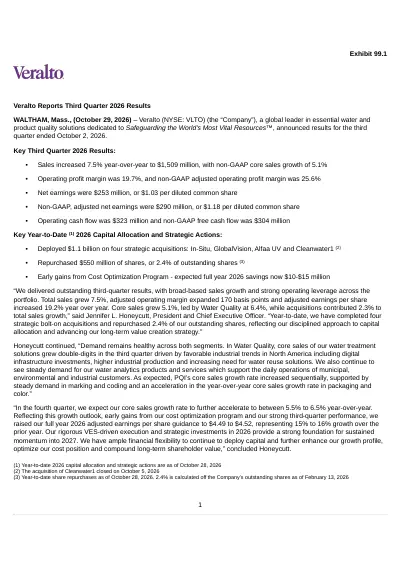
We continue to build on our track record of meeting or exceeding our financial commitments through rigorous execution in support of our customers. In Q3, total sales grew 7.5% year-over-year, adjusted EPS increased 19.2%, and we generated robust free cash flow of $304 million.
We delivered 5.1% core sales growth, led by Water Quality at 6.4%, with PQI at 3.2%. Both segments accelerated core sales growth sequentially from Q2 to Q3.
Broadly speaking, demand for our products and services remains healthy across both segments. Relative to the fourth quarter, we expect core sales growth of 5.5% to 6.5% and approximately 5% growth from acquisitions, resulting in total sales growth of approximately 10%
Ryan Taylor
to 11%.
Jennifer Honeycutt
Based on our third quarter performance, fourth quarter outlook, and early gains from our cost optimization program, we raised our full-year adjusted EPS guidance to $4.49 to $4.52 per share, representing 15% to 16% growth over the prior year. Our 2026 guidance includes benefits from our disciplined capital deployment.
Year-to-date, we've deployed more than $1.65 billion across four strategic bolt-on acquisitions and the repurchase of 2.4% of our outstanding shares. Our most recent acquisition of Clean Water 1 expands our capabilities in water treatment solutions, and I'm excited to welcome the Clean Water 1 associates to Veralto.
With our strong balance sheet and robust cash generation, we have ample flexibility to act decisively on attractive new opportunities. This year's performance and disciplined capital deployment reflect the stronger Veralto that we have been architecting since our spin-off in 2023.
As we mark our third anniversary as an independent public company, I'm proud of how much we've accomplished and even more excited about our future. Over the course of the first three years, we have simplified VES and bolstered our execution, accelerated innovation, and strengthened our portfolio through disciplined M&A.
These actions have accelerated our core sales growth, driven consistent margin expansion, and double-digit adjusted EPS growth. I'm incredibly proud of what our team has accomplished.
With a stronger foundation, talented team, and proven track record, we are excited about the opportunities ahead and confident in our ability to deliver sustainable long-term value for shareholders. That concludes my prepared remarks, and at this time, we will now take your questions.
Operator
Thank you. As a reminder, if you would like to ask a question, it is the star and 1 on your touchtone telephone.
If at any point you would like to remove yourself from the queue, please press star then the number 2. We do ask that you limit yourself to one question and one follow-up question.
We'll pause momentarily for all questions to queue. We'll take our first question from the line of Jeff Sprague with Vertical Research.
Please go ahead.
Jeff Sprague
Hey, thank you. Good morning, everyone.
Hey, Jennifer, hey, good morning, hope you're doing well. You're not inherently a project-related business, but when I look at these kind of improving trends in industrial water, some of the digital workflow stuff, maybe some things going on in the muni side, just wondering if you could kind of comment on maybe the level of visibility or sort of confidence level in 2027.
Maybe cheating here a little bit and trying to get an early 2027 preview from you.
Jennifer Honeycutt
Thanks for the question, Jeff. I think the way to think about our exposure here is, we have a balanced portfolio in our water business between muni sales and industrial sales.
In fact, 50% of our sales in Water Quality are into industrial applications. Insofar as your question around municipal spending, as a reminder, 60% of our revenue sits in recurring revenue, given the razor blade business, we're essential to the customers' operations.
When we do have equipment that gets sold as CapEx, it's part of the normal operational CapEx cycle, and that is to say that these tend to be facility upgrades or optimizations as opposed to infrastructure investments, which are more prone to federal funding fluctuations. We see strong demand really for our solutions here relative to both the operating side of the business, whether that's our recurring revenue-based model or project-based business, simply on the back of the secular drivers that we see, right, recycle, reclaim, severe weather events, water scarcity, and so on.
We feel pretty good about ongoing demand here, and we'll keep you posted once we get to 2027.
Jeff Sprague
Maybe just one on PQI. On that side of the equation, is there some visibility on the CapEx side that's come into view or not at this point?
Jennifer Honeycutt
By and large, the PQI side of the house is not a CapEx business. These equipment purchases in terms of marking and coding or packaging and color tend to be, again, operational improvements to existing lines.
Again, for our marking and coding business, we've got 60% of that business is recurring revenue-based, and we've got a huge installed base there for continuing to upgrade as there are technology changes relative to substrates, packaging sizes, and so on. We see good pull-through in our digital workflow solutions in packaging and color, which, as we've continued to invest there by virtue of M&A.
We see steady demand, and we feel confident about the future there.
Sameer Ralhan
Maybe, Jeff, I'll add one more thing is, as you look at the packaging and color business on the digital workflow solution business that's growing nicely, there we have pretty good visibility, given those are SaaS contracts. As we sign up the contracts, and we're recognizing revenue over time.
We have pretty good visibility on that side, and then the marking and coding, as Jennifer said, for us, the demand patterns have been pretty steady.
Jeff Sprague
Great, thank you. I'll leave it there.
Sameer Ralhan
Thanks, Jeff.
Operator
Thank you. We'll take our next question from William Grippin with Barclays.
Please go ahead.
William Grippin
Great, thank you. Appreciate the opportunity here.
My first question, you're flagging some early progress on cost savings here in the third quarter. I guess, on top of that, some small benefit here from tariffs.
I was wondering if you could help us think about the margin cadence next year within that context. I guess just maybe more specifically, just given the progress thus far on the cost saves, are you maybe seeing potentially more cost-out opportunity than you had initially laid out?
Sameer Ralhan
Hey, thanks, Will. As you kind of look at the cost optimization program, at the beginning of the year, we had said that roughly half the savings by 2027 and then full run rate in 2028.
That plan is still one to follow. Look, we've had some early successes, a good start out of the gate.
We're going to see $10 to $15 million worth of savings in 2026. For 2027 at this point, just model it the way we kind of guided earlier, roughly half the savings.
We'll give more specifics as part of the 2027 guide on where we stand. Just keep in mind, right, that the savings are net of investments as well.
There's always a little bit of a variation on the timing which we want to make sure that we properly dial in into the '27 guide. That's how you should think about the cost optimization program at this point, on track with a nice early start in 2026 for us.
William Grippin
Great, thanks. My follow-up here, in the release last night, you noted strong demand from municipalities in Hach.
Was wondering if you could provide a bit more color on drivers there, whether it be replacement cycle, new product introductions within that business, or new customer wins, and maybe, how are you thinking about demand trends exiting the year?
Jennifer Honeycutt
I would say here on the muni side of Water Quality, we're really kind of firing on all cylinders here, and this is on the back of a three-year build relative to commercial architecture, VES discipline, new product development, and, as a reminder here, we're really on the OpEx side of our customers' operations as opposed to CapEx. It's non-discretionary spend, right.
This is regulated testing, customers use our equipment to make sure that they stay within compliance. I would say here throughout the last year or so, our new product development flywheel has particularly taken hold, and we see that across our analytics business, as well as our water treatment businesses.
For municipalities, Hach's got a brand-new flagship spectrometer, got new ammonia and phosphate analyzers. We continue to see sort of great execution that's been bolstered by this increase in cadence of new product development launches.
We feel good about our position here, and we would expect that to continue.
William Grippin
Great. All right, Jennifer, Sameer, thank you.
Appreciate the time.
Jennifer Honeycutt
Thank you.
Operator
Thank you. We'll take our next question from Mike Halloran with Baird.
Please go ahead.
Mike Halloran
Hey, morning, everyone.
Jennifer Honeycutt
Morning, Mike.
Mike Halloran
Hey, thanks. Maybe just some thoughts on underlying trajectory in the short term here.
Certainly heard the answer to Jeff's question. Just curious, sounds like most of the pieces of your portfolio are tracking sequentially the right way.
Anything that you're seeing that deviated from seasonalities as you worked through the quarter? I guess the question is, are there any areas of your portfolio that you're not seeing that positive trajectory, or maybe put differently, are there any very obvious flex points where you're thinking about in the portfolio as we position for 4Q in next year?
Jennifer Honeycutt
Thanks for the question, Mike. Broadly speaking, all of our businesses are trending well in terms of growth and sequential acceleration.
I would say we've seen some timing differences relative to kind of project timing, and that's affected pieces of our packaging and color hardware business, to a lesser extent on the water side. I would say, projects tend to move around a little bit, but they generally come through.
We haven't seen any indefinite delays or project cancellations, but timing sometimes is variable there. In the main, I would say, by virtue of our large sort of recurring revenue business, things are pretty steady.
Demand continues for the products and services that we have. We've got great secular drivers relative to data centers and feeder industries in power, semiconductor, and mining.
Recycle, reclaim is big on the muni side as water scarcity becomes a bigger issue. I would say, in the Food Safety Modernization Act, it's driving a lot of need for product reformulation, packaging changes, and so on.
We see good demand there as well. I think we feel pretty good about the outlook here in the fourth quarter and the fact that we believe that momentum will continue here into 2027.
Mike Halloran
Appreciate that. Then just on the capital deployment side, it's been an aggressive year and balanced with buybacks and M&A.
Maybe a twofold question. One, how are you thinking about the buyback intent in the short term?
Obviously, saw some of the ongoing repurchases in October. Then how do you think about the pipeline after having completed a fair number of acquisitions over the last 18 months or so?
Sameer Ralhan
Hey, Mike, thanks for the question. As far as the buyback is concerned, look, if you add what we have done in October that we've disclosed, we've effectively done with $550 million of share repurchases out of the 750 program.
Look, if we, as we always said, we going to be opportunistic, and if there's an opportunity in the marketplace where we think there's a disconnect between the intrinsic value and the market value, you should fully expect us to be using the authorization, we'll continue on that path. As far as overall the pipelines are concerned, look, the pipelines are pretty active on the M&A side both.
As we're going to move forward, we expect to stay pretty balanced. There's no change in the overall capital allocation strategy.
Mike Halloran
Appreciate it. Thank you.
Sameer Ralhan
Thanks, Mike.
Jennifer Honeycutt
Thanks, Mike.
Operator
Thank you. We'll take our next question from Nathan Jones with Stifel.
Please go ahead.
Adam Farley
Good morning, this is Adam Farley on for Nathan.
Jennifer Honeycutt
Morning, Adam.
Adam Farley
Good morning. Maybe on chemical treatment within Water Quality on the data center piece, what is Veralto's overall exposure to data centers within Water Quality?
Maybe where do you think that exposure can grow to over time? Where in the data center construction timeline does chemical treatment benefit?
Jennifer Honeycutt
Overall, as we've said previously, our total sales into data centers today remains small. We will say that our data center growth continued to be very strong and, in fact, doubled in Q3, but that's obviously off of a small base.
The draw here is from both our treatment and our analytics businesses. We are, by virtue of our ChemTreat business, engaged early in those project builds and get requested to participate in helping to consult on water train and water treatment design so that customers can optimize both water utilization, power consumption.
Those often are counterbalanced to one another, and so finding the balance between power-efficient and water-efficient design is something that every data center is working to solve for. We are involved early in the process.
We have good installed base relative to utility water and increasingly have offerings and are really in the liquid side of direct-to-chip cooling as well. Good exposure here, small base of business, growing double digits, strong double digits, and we would expect that to continue for the foreseeable future.
Sameer Ralhan
Adam, as you kind of think about the data center business for us, especially on the treatment side, it's an annuity business for us. Yes, the build cycle, I get that question, but think of our business predominantly as more an annuity business.
As these data centers come on and operate.
Adam Farley
That's really helpful color. Then just staying on Water Quality, can you provide an update on your expectations for growth regionally?
Do you expect North America to continue to lead growth maybe through next year? Then maybe what are you seeing out of China?
Thank you.
Jennifer Honeycutt
Just to clarify, the last point was what do we expect out of China?
Adam Farley
In Water Quality.
Jennifer Honeycutt
Yeah. Water Quality, yeah.
China continues to be lower in its muni spend, kind of still bumping along the bottom there. We're not accounting for or expecting any significant change there.
As a reminder, China represents about 6% of our sales. In Latin America, water was down modestly year-over-year, but higher sequentially throughout the quarters here.
Underlying demand is strong, but timing of some of these projects has been delayed, and that's largely on the back of waiting for election results and so on. I would say given the completion of the election here in Brazil, that uncertainty should clear here, and we should start to see that demand start to increase.
We continue to watch our high-growth markets here. They have been relatively lower than their name would suggest with good growth in the Western markets of Europe and North America.
We continue to have good opportunities in Latin America, I would say, as well in India, parts of Southeast Asia. China is definitely still not investing.
Adam Farley
Thank you for taking my questions.
Operator
Thank you. We'll take our next question from Andy Kaplowitz with Citigroup.
Please go ahead.
Andy Kaplowitz
Hello, can you hear me?
Operator
Yes, go ahead.
Jennifer Honeycutt
Yes.
Sameer Ralhan
Andy, we can hear you.
Andy Kaplowitz
Hey, good morning, guys. Maybe we could just double-click into the reacceleration organic growth you're seeing in PQI.
Jennifer, you mentioned some project delays, but obviously your growth has been picking up and you've continued to talk about acceleration in digital workflow solutions. What are your core customers telling you and, given the economic environment is sort of mixed out there?
Jennifer Honeycutt
I think what we see here is strong demand and bookings of our digital workflow solutions. This is on the back of the TraceLink, Global Vision acquisitions being integrated into the Esko digital backbone.
As we book revenue over the life of the contracts, which gives us good visibility and confidence in the sequential core growth acceleration. We continue to see steady demand in marking and coding, right.
There are some category changes within consumer product goods, but effectively, we see strong, continued performance and uptake from our mid-market customers. That's going to continue to result in sequential core sales growth.
Then I would say the other element here is Q4's got a relatively easy comp in our marking and coding side of the business, so that's an element as well. Then finally, say that our sales recovery of our color measurement equipment in packaging and color, we would expect that to come back.
We see good commercial execution, good funnels. We exited Q3 with stronger service growth, and that gives us confidence here as we head into Q4.
Andy Kaplowitz
Very helpful, Jennifer. Then, Sameer, can you give more color into what you're seeing maybe in price versus cost?
I think you're modeling adjusted operating margin to be down a bit in Q4 versus Q3, even excluding the tariff benefit in Q3. Just maybe the puts and takes on sort of how you're thinking about margin in Q4.
Sameer Ralhan
Andy, maybe I'll discuss the margin first. If you look at the margin for Q4, yes, sequentially, most of the impact that you see is really driven by the Clean Water 1 acquisition.
Overall, for Q4 margins, you should fully expect the fall-through to be 30% to 35%, so that's roughly 30 bps of a margin expansion on year-over-year basis. Cost optimization program, if you look at the guide that we've given for 20 for the full year, that adds another roughly 40 basis points to the OMX for Q4.
That adds 70, and that 70 is mostly offset by Clean Water 1 acquisition. That's how we kind of modeled in.
As in Q4, we do tend to make some investments to help support '27 strategic initiatives. We've built in a fairly healthy amount of investment in Q4 tied to that.
To the extent that those things come in light, of course, there'll be upside to the guidance.
Andy Kaplowitz
Appreciate all the color.
Sameer Ralhan
Thanks, Andy.
Operator
Thank you. We'll take our next question from Jacob Levinson with Melius Research.
Please go ahead.
Jacob Levinson
Good morning, everyone.
Jennifer Honeycutt
Morning, Jake.
Jacob Levinson
Just to go back to Mike's question for a second on the M&A side of things. I know you folks have been pretty active here with a number of bolt-on deals.
Can you just give us a sense of what that funnel looks like from here? Is a lot of these smaller assets that are out there, or are there also some larger deals that you might be interested in as well?
Jennifer Honeycutt
I would say, Jake, that it's a mix. Funnels on both sides of the house are healthy and full, lots of cultivation work underway.
I think what you've seen us do here in the first three years is build out our position in treatment in the environmental business and digital workflow solutions, all of which are expansions of our current positions, but squarely within our wheelhouse. We feel good about the funnels.
There are all kinds of assets in those funnels. There are large deals, there's small deals, there's technology deals, there's geographic expansion deals.
We have a track record here of going after these strategic bolt-ons. I think we're well served by that.
Again, we've got a variety of different types of assets in our funnel that will continue to work and bring those in under the very disciplined approach that we've taken thus far to increase long-term shareholder value.
Jacob Levinson
That's helpful. You made a comment in your slide deck on slide 4 that I'm not sure I've seen before around modernized technology and upgraded facilities.
I know you've done some work on the footprint given everything with tariffs, but maybe you can just elaborate on what that really means.
Jennifer Honeycutt
I don't think it's unreasonable to think that some of our technologies might have atrophied in prior times, being a smaller portion of Danaher. This is just part and parcel to continuing to mind the shop here at Veralto and make sure that we have modernized tech stack for all of our data systems to ensure that we are continuing to invest in technology.
One example would be robotic automation of our ChemKey lines at Hach, right. We will continue to modernize and upgrade manufacturing facilities, our ability to utilize data in ways that are AI-friendly.
This is just part and parcel to making sure that we are staying fit operationally, as we would say, and to make sure that we've got access to the latest and greatest tools to continue to be able to run the business well.
Sameer Ralhan
Jake, for those of you who have been to our Hach manufacturing facility in the last 12 to 18 months, and I knew the tours, right, you've seen all the automation that we have done over there on the board manufacturing side. Those are the kind of examples where we are really upgrading our manufacturing footprint to be able to serve the customers more regionally and more effectively here in US.
Jacob Levinson
Great, appreciate the color. I'll pass it on.
Thank you.
Jennifer Honeycutt
Thanks, Jake.
Operator
Thank you. We'll take our next question from John McNulty with BMO Capital Markets.
John McNulty
Please go ahead. Good morning, thanks for taking my question and congrats on some really solid results.
Wanted to dig into the water side and, in particular, water treatment and the UV treatment, just where you saw the double-digit growth. I guess, can you help us to think about, at least high level, how much price there was there?
I think some of the players in the industry put out some blanketed-type pricing, and it looks like it was around mid-single-digit. I know you're a little more surgical, maybe a little more detail or color around the pricing environment would be helpful.
Sameer Ralhan
John, thanks for the question. Look, the pricing over there is pretty much in line with what you are seeing overall, John.
We want to make sure that we're covering the inflation and the chemicals that's coming in the chemical treatment side. Those are very selective discussions with the customers to make sure that we are serving them well and making sure we're getting paid for the service that we are delivering.
There is nothing out of the normal. Overall, from our perspective, pricing is an important lever, and at the same time, installed base and having those contracts in place for the longer term is really key.
As as we kind of think about the water treatment, both on the ChemTreat side and the UV treatment side, having installed base really drives recurring revenue over the longer term. We always very mindful of that, how we kind of think of the price in the instruments versus the services versus consumables.
John McNulty
Got it. No, that's helpful.
Then also in the water side, you've made a couple of transactions, some very recent, some you've had a little duration on. I guess, can you speak to the growth that you're seeing in those businesses?
Are they seeing any incremental synergy benefits on the revenue side yet or not, and how you're thinking about that going forward?
Sameer Ralhan
John, I'll start with that. If you look at the acquisitions that we have done on the water side, the first one was In-Situ at the beginning of the year.
Really solid start. You've seen us the expansion in the water side.
If you look at the M&A contribution line in the Water Quality, fairly solidly contributing. That's where you see the impact of In-Situ.
Overall, I would say on the synergy side and the commercial, we are well ahead of the plan, actually, that we used to underwrite the acquisition. Feeling really solid about the In-Situ, and you're going to start seeing that in the organic growth as we're going to move into next year.
I would say the Aquafides acquisition that we did in Europe on the UV treatment side, again, really solid execution and contribution that we're seeing over there. Alfa UV and Clean Water, just early days, right.
Alfa UV, they've been there only less than a month. Clean Water has been there for less than a month with us.
More to come on Alfa UV and Clean Water as we're going to move into the year and we talk about the guide. Overall, really pleased with the execution and the synergies, especially the synergy part, on both In-Situ as well as Aquafides.
Jennifer Honeycutt
The way to think about this is all of those assets that Sameer just mentioned are high-single-digit, low-double-digit growers, right. It's by virtue of where they sit in the water treatment process.
In-Situ certainly in the groundwater, hydrology side of things, as municipalities look for intelligence around what water is coming into their plant as influent. Alfa UV, our UV business at Trojan's been a high-single-digit, low-double-digit grower.
Alfa gets us really good position in India with good sales into sort of industrial applications. Clean Water 1 has a leading set of technologies that really help in sort of the disinfection, odor control, and solids management side.
Again, these are all sort of technologies and product lines that fit in high-value areas that are structurally faster-growing than some other portions of the portfolio.
John McNulty
Got it. Thanks very much for the color.
Operator
Thank you. We'll take our next question from Robert Davies with Wolfe Research.
Robert Davies
Morning, thanks for taking my question. I had two.
One was just on the cost optimization program. You'd obviously flashed out some early gains there, $10 to $15 million, but could you provide us a little bit more color exactly what you're doing, where the kind of main areas of focuses for that program?
Thank you. Then the second question was just around the sort of non-recurring part of your business, the 40%, I guess, of Water Quality.
What's going on there? Do you see any sort of slow down, any kind of impact from higher interest rates, any more caution or down-trading?
That'd be great. Thank you.
Sameer Ralhan
Thanks, Robert. I'll start with the cost optimization first.
The cost optimization program is really focused around three activities. The first is the simplification of the business processes.
Second is the functional transformations to optimize the cost. Then really looking at the investments that we can do to improve the competitive positioning from the technology perspective or the process improvement perspective.
That's how really the activities in the cost optimization program are focused around. We've had a pretty nice start to the program early on, and as we're going to look at making the investments, overall we're still on plan to deliver roughly half of the savings by the end of '27 and the full run rate in 2028.
That's how you should think about the cost optimization program.
Jennifer Honeycutt
Relative to your question around the 40% of Water Quality that is a hardware or instrument base, bear in mind that we've got hundreds of thousands of instruments from Water Quality sitting out in our installed base, and those will have a seven-year life on average. Ongoing sort of reoccurring revenue to upgrade hardware, move to modern technologies as there are changes in the knowledge base of folks that sit in water treatment plants.
There is a trend towards deskilling of the labor, and we've made a concerted effort here to collapse workflows, simplify the technologies that are deployed. We feel good about the ongoing demand for new technology purchases and upgrading the existing installed base that's out there.
Robert Davies
Great, thank you very much.
Operator
Thank you. Our next question comes from Andrew Buscaglia with BNP Paribas.
Please go ahead.
Andrew Buscaglia
Hey, good morning, everyone.
Sameer Ralhan
Hey, Andrew.
Jennifer Honeycutt
Morning, Andrew.
Andrew Buscaglia
I'm just wondering if you could kind of set us up into '27 on margins here. I know you don't want to probably give guidance for next year, but I think your margins are really starting to accelerate.
It's a stark contrast to kind of what else we're seeing this earnings season where costs and inflationary pressures are starting to sting some companies. You guys have navigated that quite well.
Just looking out to '27, are you cautious on costs creeping in any sort of business? Are you seeing any challenges on the horizon or that have crept up in the last 3 months in terms of inflationary pressures?
Kind of what's your view on just price/cost and the ability to continue this margin acceleration into '27?
Sameer Ralhan
Andrew, thanks for the question. Let's start with the raw material costs and the price side first.
As you kind of look at this year, look, we are seeing inflation, right. We are seeing the inflation in some of the materials that are tied to or which are oil derivatives.
You can start looking at some of the transportation costs, memory prices. Of course, as we are instrumentation company, we do have some exposure over there.
We're seeing those price increases, but really really solid VES-driven execution and the partnership between our procurement teams and the business teams to help offset that. At this point, as the results demonstrate both in Q3 and also as you look at the guide for Q4, we believe we have well positioned at least in 2026 to make sure we offset that and drive the margins.
Now as we kind of move into 2027, look, we will, Andrew, talk in more detail in February. Overall, I think it's fair to expect that, look, we will have 30% to 35% kind of a fall-through, and that's close to 30-ish bps on the margin side.
Cost optimization, of course, if you do that run rate, roughly $35 million cost saves. Now we'll get 15 already this year, right, so that's going to be a little bit of an upside on the cost optimization side, on the margin side.
We are going to have a couple of headwinds as well on the margin side as we move into 2027. We got a little bit of benefit from tariffs, so that's not going to be there next year, and then some of the dilution from the Clean Water 1 acquisition.
There are lots of puts and takes. More details to come in February.
Andrew Buscaglia
Okay. Thanks for that.
I wanted to ask on Clean Water 1. I think this deal looked interesting to me.
It's a kind of a perfect fit with Trojan, and there seems to be some real synergies, like real near-term synergies where you might even get some accretion in '27, it sounds like, on bottom line. Was that the impetus to do this deal, or where it's a kind of a cost savings margin ramp type deal, or is it a missing link here kind of technology portfolio that you think you had to have?
Jennifer Honeycutt
I think we're most attracted to the leading technologies that are brought with the acquisition. This bolsters our technology portfolio relative to treatment, and it expands our penetration into higher-growth water treatment applications.
They've got a terrific 25,000 equipment installed base, with deep applications expertise. We do see commercial synergies with Trojan and their UV treatment solutions.
I think the first order of business obviously is don't break what we bought. We will bring them in in the customary way relative to other acquisitions and focus on making sure that they're firing on all cylinders as we look for those opportunities to bring synergies together with Trojan.
Sameer Ralhan
Andrew, to your point regarding the accretion, right, the point that I've made earlier is on the margin, it might be a little dilutive, but from the EPS perspective, we expect it to be flat to slightly accretive, as you said.
Andrew Buscaglia
Nice. Yeah.
All right, thank you, guys.
Sameer Ralhan
Thanks, Andrew.
Operator
Thank you. We'll take our next question from Jeff Reive with RBC Capital Markets.
Please go ahead.
Jeff Reive
Thank you. Good morning, everyone.
My first question is on PQI. The high-growth markets there grew 4.7% with strength in China and Latin America.
I think that's a notable reversal from the declines earlier this year. Maybe what changed, and is this recovery broad-based or concentrated in specific products?
Jennifer Honeycutt
I think one of the things that we see here with our high-growth market exposure in PQI is we see good growth in China as manufacturing has come online and industrial output increases there, particularly relative to our coding and marking business. Anywhere in the world, we see growing middle class that leads to more sort of consumption.
We see that in India, see it in parts of Southeast Asia, and we've seen relatively good uptake as well in Latin America for our products and services. I think the secular drivers that are around sort of industrial manufacturing, growing middle class in terms of consumption for products that you'd see in our packaging and color side, in terms of brand development, as well as coding and marking, is something that we continue to see as well.
Good position here in high-growth markets, and we would expect that to just continue.
Jeff Reive
Got it. Okay.
Then maybe just to double-click on PQI in the fourth quarter. I think you said you expect a meaningful acceleration in the digital workflow solutions.
Can you just help us calibrate what meaningful means? Is this driven by bookings and ACV already in hand, or is there an element of pipeline conversion that needs to occur, or is this an easy comp?
Sameer Ralhan
Jeff, thanks. When we say it's meaningful, really, when you kind of look at the guidance, right, we said 5.5% to 6.5%, PQI will be closer to the high end of the range, right, for Q4 guide.
Now what's driving it, it's really as Jennifer said earlier on the call, right, it's the digital workflow solution is going to be the biggest piece. There we have the bookings, and we're recognizing revenue over time.
When you kind of look at a three-month period, we have pretty solid visibility on that. On the marking and coding side, it's going to be a steady demand, there a little bit of comp helps for us.
Last, the element that's giving us a confidence on the guide in Q4 is really the recovery in the color and measurement instruments. As that business has been down for almost four quarters.
We saw some recovery in Q3, and as we exited the Q3, the order books look good, good commercial execution that is giving us a confidence. Really, it's not dependent on one factor or the other.
It's really a combination of those three factors which is giving us a confidence as we kind of think about the core growth for PQI in Q4. Great,
Jeff Reive
appreciate it.
Sameer Ralhan
Thanks, Jeff.
Operator
Thank you. We'll take our next question from Steve Volkmann with Jefferies.
Please go ahead.
James Grzinic
Good morning. This is James on for Steve.
Thanks for taking the questions here. I guess I wanted to touch on Water Quality here a bit.
Data center obviously is still small, but that has kind of doubled, and you kind of talked about chemical processing, food and bev, power and mining all growing kind of double digit here. Are these kind of new site wins driven that kind of are going to build an annuity going forward or are those more so kind of recurring OpEx work?
How should we think about sizing of this fast-growing market exposure? I know data centers is small, but if we had to combine everything, how big are those?
Jennifer Honeycutt
We don't disclose our sales by vertical market segment. Rest assured when these are of size that require us to declare, you'll see it in print.
The way to think about our play in data centers is very much driven by the recurring revenue side of things. For our ChemTreat business, obviously there is a consultative opportunity early on when the plant is being designed, but the reality is where we really gain traction and start to accelerate is when those data centers come online.
There's greenfields, there's brownfields, there's expansion of existing data centers. The technology within a data center will be upgraded every five to six years.
Over a life of a 30-year data center, you've got five to six opportunities really to play a role in how they upgrade and optimize. The reality is we've got to play in utility water, and then certainly when those data centers come online, they're operating 24/7, and that's an opportunity for us to continue to have good penetration of our chemical solutions and services that go into everything from utility water to direct-to-chip cooling as well.
I think the drivers here are pretty durable in terms of how we think about this going forward, with every data center that comes online, an increasing opportunity for us to gain market share.
James Grzinic
Awesome, thanks for the color. I guess following up on that, you kind of talked about increasingly offering into kind of the liquid side of direct-to-chip cooling here, and that kind of sounds like it's from utility water chemistry.
What are you actually selling there? Is it like fluid chemistry, monitoring, filtration?
Is the content per site kind of richer than the traditional kind of cooling water side?
Sameer Ralhan
Look, it's going to be fluid and the services kind of tied to it. You've seen us announce a partnership with Dow as well, right, on the glycol side.
It's a combination of things around that and the services that go along with it.
James Grzinic
All right, thanks for taking the questions here.
Operator
Thank you. We'll take our next question from Josh Specter with UBS.
Please go ahead.
James Cannon
Yeah. Hey, guys, this is James Cannon on for Josh.
I just wanted to dig into the regional trends in PQI again. To me, the Europe numbers seem to lag a bit versus to us it seemed like the end consumer trends seem a bit more stable region to region.
Can you just unpack what you're seeing there and how you expect that to trend going forward?
Jennifer Honeycutt
The low-single-digit growth in packaging and color in Western Europe, what we see there is marking and coding flat. We do see solid growth in consumables, but modestly lower sales in equipment, and that's largely on the back of some timing around customer spend.
We do see solid growth in Western Europe for marking and coding during the first half of the year, and we do expect certainly to see some growth here in the fourth quarter.
James Cannon
Great, thank you very much.
Operator
Thank you. We'll take our final question from Joe Giordano from TD Cowen.
Please go ahead.
Joe Giordano
Hey, guys, thanks for taking my question. The acceleration at PQI here into the 4Q, I just want to kind of understand how representative is that of the true underlying conditions as we go into next year?
Is that a good exit rate to be building on? I know you don't want to give guidance here, but is there anything in that kind of 6.5% that's a little bit one-timing, a little bit comps, or should we kind of think about that's truly the pace of growth across that portfolio now?
Sameer Ralhan
Thanks, Joe, for the question. Look, I wouldn't draw a straight line from that.
Needless to say, in 2027 at this point, we'll talk about that in February. If you're going to look at the build-up to the core growth in Q4 for PQI, right, marking and coding is kind of steady, so that should kind of flow into 2027 at this point based on everything that we know.
On the digital workflow solution side, that is driven by the underlying demand in the TraceLink, Global Vision, and core Esko product lines. That should expect that to grow.
On the color measurement side, comp is helping, right? If you recall, we started seeing the weakness in the second half of last year, Q3, Q4 were pretty weak in the color measurement side.
That will normalize over time. We'll talk about more in detail in February, Joe, but there are some elements which are kind of helping from a comp perspective here, too.
Joe Giordano
Okay. Then just on the Water Quality broadly, I'd say as we've gone through earnings season, most of the commentary across water has been utilities kind of a little bit constrained on spend and project delays, and I fully appreciate the nature of your business is not into these projects and not doing water meters and stuff like that.
Ultimately, if these utilities are facing kind of budgetary constraints to some extent, does that ultimately roll over to you guys on some sort of lag to a lesser extent? How should we think about the issues as they're seeing in one part of their spend ultimately impacting the totality of the spend?
Jennifer Honeycutt
Obviously, the vast majority of our sales in water are OpEx instead of CapEx. Where they are CapEx, they tend to be on the operating side of technology upgrades or facility improvements as opposed to infrastructure, where government funding and federal funding is more material.
Look, we represent a low relative cost of the entire operating environment where critical workflows are essential. The cost of failure to the customer is high, and they're not going to take a chance on choosing not to fund water treatment operations.
Our sales here are really durable. 60% recurring revenue, the other 40% is really around sort of upgrades and reoccurring revenue relative to equipment that needs to be replaced over time.
Again, we see this as being pretty durable on an ongoing basis, and we are very minimally exposed to sort of federal funding fluctuations. We like where we sit, and we continue to have good momentum here.
Joe Giordano
Thank you, guys.
Ryan Taylor
Thanks, Joe. This is Ryan Taylor with Veralto.
We just want to thank everybody for joining the call. That ends the question-and-answer portion of the call.
We really appreciate the engagement, and we wish everyone well, and we will talk to you next quarter.
Operator
We'd like to thank everybody for their participation. Please feel free to disconnect at any time.