Vulcan Materials Company (Holding Company)
Q3 FY2026 · Earnings Call TranscriptOctober 29, 2026
Operator
Good morning, everyone. Welcome to the Vulcan Materials Company third quarter 2026 earnings call.
My name is Beau, and I will be your conference call coordinator today. Just a reminder, today's call is being recorded for replay at the company's website.
All lines have been placed in a listen-only mode. After the company's prepared remarks, there will be a question and answer session.
I would now like to hand the call over to Mr. Mark Warren, Vice President, Investor Relations.
Please go ahead, sir.
Mark Warren
Thank you, operator. Joining me today are Ronnie Pruitt, Chief Executive Officer, and Mary Andrews Carlisle, Senior Vice President and Chief Financial Officer.
Before we begin, please note that a press release and a supplemental presentation related to this call are available at vulcanmaterials.com. Today's discussion includes forward-looking statements, which are subject to risks and uncertainties.
Reconciliations of any non-GAAP financial measures and other disclosures are included in our earnings release, supplemental presentation, and other SEC filings. During Q&A, we kindly ask that you limit your participation to one question.
This will help us to address as many questions as possible. Now I'll turn the call over to Ronnie.
Ronnie Pruitt
Thanks, Mark. Thank you all for joining our Vulcan Materials third quarter earnings call this morning.
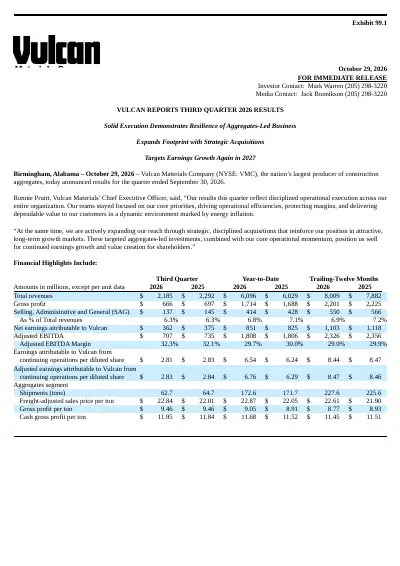
Here in the quarter, we continue to successfully execute on our two-pronged growth strategy by improving the profitability of our organic business and expanding our aggregates franchise through disciplined bolt-on acquisitions. Absent energy cost headwinds of approximately $40 million and adjusting for the prior-year divestitures of some more cyclical downstream businesses, adjusted EBITDA for our underlying business grew 5% in the quarter, demonstrating the resilience of our aggregates-led strategy.
Our operating and sales teams are aligned with our Vulcan Way of Operating and Vulcan Way of Selling disciplines. I am pleased with the execution we are seeing across our footprint and am confident that there is significant value to create by staying focused on the fundamentals.
Aggregates cash gross profit per ton continued to compound higher, even with the inflationary pressures from higher energy costs. During the quarter, we closed on two attractive bolt-on aggregate acquisitions and have since completed another acquisition earlier this month.
This year, we have added strategic aggregate assets in two key Vulcan states, Texas and Tennessee, in addition to expanding our reach into the southeastern Colorado and southern Ohio markets. These acquisitions add long-term, quality aggregate reserves to our portfolio, carry minimal risk, are easy to integrate, and are synergistic with our existing assets.
The pipeline for future growth opportunities is healthy, and I expect we will complete several more transactions before the end of the year. Thoughtful portfolio actions and solid execution delivered adjusted EBITDA of $707 million and 20 basis points of year-over-year margin expansion in the quarter.
On a seasonally adjusted basis, aggregates shipments momentum in the third quarter was similar to the second quarter and consistent with the current demand environment. On a year-over-year basis, shipments decreased 3%.
The prior year benefited from favorable weather and outsized seasonally adjusted shipments in the third quarter following a slow start to the construction season due to severe winter weather and rainfall throughout the first half of last year. Aggregates cash gross profit per ton expanded modestly over the prior year, with higher freight-adjusted selling prices more than offsetting sharply higher diesel input costs.
Our teams are executing well on the fundamentals they control. On a mix-adjusted basis, average selling prices in the quarter improved 5% compared to the prior year, with improvement widespread across geographies.
Excluding diesel, aggregates freight-adjusted unit cash cost of sales increased 3% compared to the prior year. Now let's shift to the demand backdrop against which our teams are delivering these solid results.
The demand environment remains mixed across end uses, with growth opportunities in some categories and challenges in others. Our Vulcan Way of Selling disciplines allow us to navigate complex market dynamics and maximize value in any environment.
On the public side, activity remains healthy at healthy levels. There is still a long tail from IIJA, with approximately 35% of funds yet to be spent.
There is a current extension of the Federal Highway Authorization Bill that maintains funding at current levels and is expected to be extended again until a bill is passed. These dynamics provide an environment in which states are continuing to let work and execute projects.
Importantly, the opportunities in Vulcan markets continue to outpace the US overall. For example, trailing 12-month contract awards are up 2% in Vulcan markets versus 1% at a US level.
The need for continued investment in infrastructure is significant, and something our elected officials are working to address. On the private side, large project opportunities continue to drive non-residential activity.
Our footprint is well aligned with the ongoing data center development and increase in energy and other manufacturing opportunities. We are currently shipping on a variety of solar, wind, LNG, power plant, and refinery projects, in addition to large-scale manufacturing projects like SpaceX and Toyota in South Texas, and Scout Motors in South Carolina.
Our scale, quality, and customer service make us a supplier of choice on large, complex projects. The continued lack of housing affordability and a challenging rate environment are limiting residential construction activity.
In Vulcan markets, demographics are favorable to the rest of the US and create a fundamental need for additional housing, but timing of a recovery is still unclear given affordability dynamics. With a solid year-to-date execution from our operating teams, we expect to deliver another year of earnings growth and approximately $2.4 billion of adjusted EBITDA, even with a muted demand environment and over $100 million of energy headwinds now expected for the year.
With that, I'll turn the call over to Mary Andrews to provide some additional commentary on our third quarter performance, after which I will share some initial thoughts on 2027 before we take your questions.
Mary Andrews Carlisle
Thanks, Ronnie, and good morning. Ronnie highlighted the consistent execution of our two-pronged growth strategy.
The same is true for capital allocation. We continue to prioritize reinvesting in our franchise, identifying disciplined opportunities for growth that align with our aggregates-led strategy, supporting our steadily growing dividend, and returning excess capital to shareholders through share repurchases.
Through the first nine months of this year, we have generated nearly $1 billion of operating cash flow and received cash proceeds of $572 million for downstream and non-core divestitures. We have reinvested approximately $550 million into maintenance and growth capital expenditures, thoughtfully redeployed approximately $300 million of proceeds, primarily from the California concrete sale, into strategic aggregates acquisitions, and returned approximately $950 million to shareholders through a combination of dividends and $750 million of share repurchases.
Importantly, we have moved our trailing 12-month return on invested capital 20 basis points higher since year-end. At September 30, net debt to adjusted EBITDA leverage stood at 1.9 times, providing plenty of capacity to continue to support an active acquisition pipeline.
Up and down the P&L, we are focused on controlling what we can control. SAG expenses year-to-date are 3% lower than the prior year, even as we make incremental investments in technology and talent to support our strategic disciplines.
Closely managing our human capital, aligning compensation costs with results, and driving efficiencies across the enterprise are all contributing to lower SAG year-over-year on both a percentage of revenue and absolute basis. Now before we take your questions, I'll pass back to Ronnie to share some initial thoughts on what lies ahead in 2027.
Ronnie Pruitt
Thanks, Mary Andrews. As I look to 2027, I am confident we have the right strategy, the right team, and the right focus to continue delivering earnings growth and value creation for shareholders.
I expect the demand backdrop will largely be a continuation of the current environment, with opportunities for growth varying across and even within end markets. Our backlogs and quote activity also support this outlook.
With a stable federal highway funding in place through the continuing resolution and steady growth in awards over the past several years, the public pipeline remains healthy at healthy levels as we move into 2027. We are hearing that there is a real focus in DC on getting a bill passed, which we expect to be a priority after the midterm elections.
This bodes well for future public demand. On the private side, we expect that large project opportunities will continue to drive non-residential activity, and that residential will remain challenged until affordability is addressed.
Against this similar demand backdrop to 2026, we anticipate 2027 aggregates pricing to benefit from pricing actions taken this year as the inflationary environment set in, and from announced increases for January 1st. As a result, we expect aggregates prices to grow mid to high single digits in 2027, creating a strong opportunity for attractive unit profitability expansion as we continue to control cost and leverage our Vulcan Way of Operating disciplines.
We are in the midst of our annual planning cycle now and will provide more detail in February on any shifts in the demand environment, our shipments outlook inclusive of 2026 acquisitions, and our profitability expectations. Now Mary Andrews and I will be happy to take your questions.
Operator
Thank you very much, Mr. Pruitt.
Ladies and gentlemen, at this time, if you do have any questions, please press *1. If you would like to remove yourself from the queue, you may do so by pressing *2.
Additionally, to get to as many questions as possible, we do ask that you please limit yourself to one question. We'll go first this morning to Trey Grooms with Stephens.
Trey Grooms
Hey, good morning, everyone. Thanks for taking the question.
If it weren't for the oil-related headwinds, it looks like you guys could be at the midpoint of the guidance range. If you could maybe talk about some of the things you're doing to dampen the impact of inflation and grow EBITDA in what, as you guys said, is a fairly muted demand environment.
Then from a high level, how are you thinking about the inflationary environment and how you plan to navigate that as you look into 2027? Thank you.
Ronnie Pruitt
Good morning, Trey. Thank you.
You are correct. Our adjusted EBITDA performance, it would be directly in line with the expectations we set coming into the year if not for that cumulative oil-related headwind that we currently expect to be over $100 million by the end of the year.
Our results really underscore the fundamental durability and the resilience of our pure-play aggregate business model. I would remind you, our focus is really combine two things: our strategic commercial discipline, Vulcan Way of Selling, and our operational agility through Vulcan Way of Operating.
Both of those things have really paid off. We've expanded our year-to-date gross profit margin by 30 basis points, and we've grown our cash gross profit per ton by 2%.
Price still remains our most effective lever to mitigate oil-related cost headwinds. That's about timing.
The oil-related stuff hit us coming into the year. If you recall back, hit us in the first quarter.
Into the second quarter, we thought there was some talks around things may start to be muted with some end of the war, and then they really set in and we saw that in the third quarter. What have we continued to do?
Our pricing is up in the third quarter on a mix-adjusted basis 5% year-over-year. Our commercial teams are executing.
I'll remind you that about half of our products are sold through our daily bidding process and half of them are through the fixed-plant stuff. We've talked about what we're doing and what we expect for next year.
On the operational side, again, excluding that direct impact, our unit cash cost of sales is only up 3%. I would tell you that's just discipline and really demonstrating those strong operational things we can control across our footprint.
Our advanced analytics, which we call process intelligence, it continues to drive and really enable us to optimize our critical product throughput. It eliminates unnecessary downtime and maximizes our efficiencies throughout our network.
I'm really pleased with our operators and the efforts they've continued to give. As Mary Andrews said in her prepared remarks, our focus is on execution up and down the P&L.
I'll turn it over to Mary Andrews to talk about some of the other puts and takes on what we've done to battle some of these headwinds.
Mary Andrews Carlisle
Thanks, Ronnie. I would just reiterate that our cost discipline does extend well beyond our operating facilities.
Our SAG expenses were $137 million in the third quarter, down from $145 million in the prior-year period. That cost discipline, alongside the consistent execution in each of our lines of business, and also just the benefits of an aggregates-led portfolio, allowed us to expand our adjusted EBITDA margin by 20 basis points in the quarter to 32.3%, which was a really solid performance.
Trey Grooms
Thank you for all the color, Ronnie and Mary Andrews, and I'll pass it on. Take care.
Ronnie Pruitt
Thanks, Trey.
Mary Andrews Carlisle
Thanks.
Operator
Thank you. We'll go next now to Phil Ng with Jefferies.
Phil Ng
Hey, guys. Team's executing in a tough environment, Ronnie.
When we kind of think about mid-year's being a little more flattish, and I think what you're outlooking for 2027 is more of a flattish backdrop, what gives you confidence that getting mid to high single-digit aggregates pricing in 2027 is achievable? Any early feedback you've heard from your customers, just given it's a noticeable step-up?
Just follow-up question on the mid to high single-digit framework you've calling for pricing next year, is that on a reported basis just because mix has been a drag this year? Thank you.
Ronnie Pruitt
Let me let's let's talk about the first expectation, then I'll talk about the the mix impact on that. Yes, we fully expect 2027 to be another year of of healthy price growth and, as we've said, mid to high single digits, and and in a flattish environment like you said.
I would tell you, really three things that give us that confidence is, first, our commercial execution, and those conversations that you talked about. Remember, half fixed plant, half of our work is on a bid basis, but but on the fixed-plant side, one of the things we did this year, we pulled those announcements earlier, we sent out our announcements early to give our customers an opportunity to prepare for that.
Those conversations are going as expected in in this kind of environment, and so I'm pleased with where those conversations are. I'll remind you that, diesel cost, no one's immune to that.
It's not something that is unexpected from anyone that that they understand the impact of the diesel. It's impacting them as well, and our customers are looking for opportunities to to continue to get better value for their products as well.
We're going to be one of the good excuses for them to go talk to their customers about. That's that's going as expected.
Two, I I still think we have a a stable demand environment. We've said flat, but it is stable.
I really look at, let's talk about public. If you recall back, 4 to 5 years ago when IIJA really kicked in, everyone was waiting on, well, we start to saw we we started to see contract award levels go up, but where were the tons?
We kept getting asked, when are the tons going to come? We said there's always that delay of the contracts getting awarded, and typically that's 6 to 8 month months after those contracts get awarded, the shipments start.
That same thing's going to happen now that the bill is expiring, and so, there's some concern out there, will the bill expire, you're in this form of a continuing resolution, but that's where we've said 35% of the dollars have yet to be spent, and there'll be a tail to that. We'll benefit the same way it took us time to get started on the front end, we'll continue shipping on the back end.
I believe public continues to remain steady. On the private side, we've got really healthy bookings, backlog, quoting activity, and it is around, large non-res projects.
It's not just data centers. Data centers has been a really, really good benefit to us, but we also see heavy infrastructure and and some of the other projects that I called out in my prepared remarks on SpaceX and the Toyota factory in South Texas.
Those are other kind of manufacturing that we're seeing kick in. I think the energy side will continue to see solar opportunities as well.
There's a lot of other things that are happening to to support that stable demand environment. Then structurally off our advantaged footprint, and I would tell you that most of these large, heavy non-residential projects are located with that within our advantaged zone of a of a Vulcan facility, which again, when you think about the proximity that that gives us to these projects, it reinforces our position as the supplier of choice with those logistical moats that we have.
I continue to have a lot of confidence in our pricing ability, and I think that's the the story of aggregates over over time and and historical side of it, is that's what aggregates does. It's just timing, we'll catch it this year, and we'll continue to move forward.
As far as the mix side, I would tell you that's inclusive. When we give that kind of guidance, we're we're we're saying that we believe that's all in, and then we'll talk about within each quarter as we talk about, okay, where's the geographic impact of that, where's the product mix impact of that.
As we sit today, that mid to high single-digit range is inclusive of of mix impact.
Phil Ng
Really appreciate the color, Ronnie. Thank you.
Ronnie Pruitt
Thank you.
Operator
Thank you. We'll go next now to Garik Shmois with DA Davidson.
Garik Shmois
Morning, thanks for having me on. Just want to follow up on some of the demand observations you were just making in response to the last question.
I was hoping you could unpack your demand outlook for '27 a little bit more. Could it be up, just given the visibility that you have both on large projects and on infrastructure, and just maybe a little bit more color on what you're seeing on the light private side as well?
Ronnie Pruitt
No, thank you. I said similar to 2026, but I would tell you there's opportunities for growth varying across markets and even within some of our individual end markets.
Again, with the change we've seen on these large projects, location matters, and that's why we love our footprint, that's why we say we have an advantaged footprint. We believe our footprint will continue to outperform the rest of the country when it comes to those growth opportunities.
That applies to single-family as well as these large non-res projects. It also applies to public.
On the public side, like I said, I think we're seeing the back end of IIJA, and we'll continue to see those dollars flow. I also believe the states are in a really good position.
As we think about our states and the state funding levels, we're getting really good insight into what their letting schedules are going to be. Those numbers are out there, and we don't see any pull back on that.
Then we're also seeing increasingly more innovation around P3 projects, toll authorities. There's some really large projects.
Atlanta has two of them, really large P3 projects that are in addition to IIJA, in addition to the typical state lettings. We're seeing different ways of funding.
Again, as I step back and look at that side of it today, I'm not real concerned on the public side. I think we have midterms coming up.
Obviously, we believe shortly after that that the House and the Senate are both aligned on we need an infrastructure bill, and we believe they'll be hard at work at getting that done. I just don't anticipate much disruption today on the public side.
Now on the private side, again, I think it's really the primary engine for where some of that other growth could come from. If it was going to look different than what we see today, it would probably be on that private side, and it's really the timing of some of these large projects.
We're seeing on the data center side these projects are really fast. From the time we quote to the time we book to the time we start shipping, those things accelerate really quick.
The other things, when it comes to manufacturing, the energy-related projects and other manufacturing, are still in that typical 6 to 9 month, you quote it, you book it, and then the shipments become later. We're starting to see those things that we were talking about at the beginning of '26, we talked about manufacturing was going to start kicking back in.
We're starting to see a lot of those things finally start to come out of the ground, and I think those are opportunities ahead of us. Then I think the energy side is another one.
We got transmission lines being built. The energy one's a little more difficult because some of it is tied to a data center project.
Some of those are hard to split out. When you see the capital dollars of the data centers, that's why they're so great is because some of those include the energy with them.
I just see a lot of different dynamics here under the backdrop of what we're seeing today. Could be similar to '26, but to your point, there could be some opportunities for growth.
Garik Shmois
Appreciate all the detail. Best of luck.
Ronnie Pruitt
Thank you.
Operator
Thank you. We'll go next now to Anthony Pettinari with Citi.
Anthony Pettinari
Good morning. Ronnie, in the '27 outlook slide, you talk about portfolio management, and I'm just wondering if you can talk a little bit about the M&A landscape, what that looks like.
Then, with the cost inflation that's kind of rolling through the industry, does that maybe change the calculus for maybe some of the smaller players in terms of maybe opening up some opportunities on the acquisition side? Or I just kind of curious what it looks like.
Ronnie Pruitt
I would say it it's been a very active year thus far, and as I said in my prepared remarks, I think we've got the opportunity to to close on several more before the end of the year. For us, for for for Vulcan strategy, it's going to continue to be aggregates-led.
It is a it is a very simple story. We like to keep it simple.
I talked about the ease of integration. I talked about the ease of execution.
I talk about the ease of capturing those synergies. These are in the form of bolt-ons.
Where we're focused today is going to continue to be on on those type of bolt-on acquisitions. They're very easy for our employees, and and and bringing in those new employees to the Vulcan tent, it's it's it just is a lot easier to predict and a lot easier to execute.
For our shareholders, it's a lot easier to predict. We're not going to We're not going to surprise our shareholders with with any of these deals that that might not make sense for us.
I would tell you that pipeline is very healthy. To your point, diesel has affected everyone.
I would tell you that we're we're having a lot of conversations with potential sellers, and they're feeling the impact of it. Now that timing is still, it's their call.
We're always actively looking, but the things we're looking at are going to be in the form of the things you've already seen us do. Those range in between, 0.5 million to 1 million tons each.
Some of those can can be smaller or bigger, but but nothing transformational for us. This is our discipline.
We we really, really love executing the way we do, and they're very, very much within our control.
Anthony Pettinari
That's very helpful. I'll turn it over.
Thank you.
Ronnie Pruitt
Thank you.
Operator
We'll go next now to Kathryn Thompson with Thompson Research Group.
Kathryn Thompson
Hi, thank you for taking my question today. It's on the policy side, and it can tie a little bit into the private, but it's a bigger picture.
Ronnie, when you and I first met each other in the industry, states could account for maybe 50% and the Fed the other half, or, give or take, for funding. For many of your states, 75% of funding is coming from the states and not the Fed.
Texas is a really good example. Then you have triple P's that you talked about earlier in the Q&A.
In our backyard of Middle Tennessee, one of the biggest triple P projects is potentially on the slate to start up in the next year or two, which would clearly benefit you guys. As you think about the pie of funding for public that also has trickled down to private, how do you think that pie looks 3 to 5 years from now?
In other words, how important will the Fed really be as you see going forward, and what's the balance of state and private funding for overall infrastructure funding in the US as we think of the broad trend of reshoring? Thank you.
Ronnie Pruitt
Thanks. That was a lot.
Appreciate you taking me back to the days we first met.
Kathryn Thompson
I know. Way too long.
Ronnie Pruitt
You're absolutely right, Kathryn. What we see today is that the Fed piece of it is still very important from an underlying, reliable planning aspect.
Again, I think as we get a bill, it gives the states at least that assurance of where the dollars are going to come from. Part of the BA 250 was going back to the matching program, which is way more predictable for the states than the grant program was.
I like the characteristics of what BA 250 did. You're absolutely right, we see a lot of different forms of funding, both at the state and the local and the public, toll roads and public-private partnerships and those things.
I think where you're going with this is, you've seen the inflationary environment and we've talked about it. Inflation has eaten up some of the tons out there, and so where are those dollars?
You and I both know that road out there doesn't care. That road in any market you go to, in Atlanta, LA, Dallas-Fort Worth, Nashville, what do you do?
You go sit in traffic. I haven't been anywhere to date where fuel prices have stopped traffic.
Everywhere I go, we still sit in traffic. The roads are still deteriorating, the bridges are still need built, the infrastructure of the country still has to be taken care of, and things are more expensive.
What are we going to have to do? We're going to have to get creative on funding.
I think that's what the states, the local municipalities, as well as the federal, are really addressing. I think it's to your point, things are going to look different in the future because it's going to have to be more creative.
Then you have the phenomenon of electric cars and hybrids and the fuel tax, is that going to cover it? I think there's a lot of things that both the federal and the state are working on.
Looking forward, to your point, to the future of how are these going to get paid for. I'm excited about the opportunities that it's still in demand.
The roads are still going to be in demand, the bridges are going to still be needed, and everyone loves driving their own cars. I think public's in a really good spot, and to your point, I think we're going to get creative in the future on different ways of funding it as well.
Kathryn Thompson
Thanks so much.
Ronnie Pruitt
Thank you.
Operator
We'll go next now to Michael Dudas with Vertical Research.
Michael Dudas
Good morning, Ronnie, Mary Andrews.
Ronnie Pruitt
Hey, Michael.
Mary Andrews Carlisle
Good morning.
Michael Dudas
Mary Andrews, for both of you guys. Encouraged to see the aggressiveness you've shown in share repurchases, certainly with the share price being down and valuation much more attractive than had been.
Maybe as going forward, I'm sure there's a balance to it, but given where you're targeting your acquisition opportunities on bolt-ons and ease of assimilation, etc., and given where some of your CapEx might be on a growth side, maybe could balance on where is there going to be more opportunity for funding to support growth CapEx and maybe continued reasonable share repurchases as you look for the plan over the next couple of years?
Ronnie Pruitt
I'll let Mary Andrews talk about our capital allocation and then I'll follow up with some comments. Go ahead, Mary Andrews.
Mary Andrews Carlisle
Mike, as we've consistently communicated, including at the Investor Day back in March, our cash generation really has reset higher over the last several years. That positions us really well to be able to continue to both fund M&A and other internal growth opportunities and to more consistently return capital to shareholders.
That's what you've seen the last 12 months, and I think that's what you can expect to see going forward.
Ronnie Pruitt
I'll add to Mary Andrews' point is we have reset at that level, which is a great place to be. Balance sheet's in a really good spot.
Even when it comes to those buckets of our typical maintenance CapEx, when we look at maintenance CapEx today with the tools that we've invested in with Vulcan Way of Operating, we're really looking at how do we drive more efficiencies. We don't want to just replace like-for-like.
We want to drive more efficiencies with every dollar we spend, and so those dollars are getting put to work. That's where you see truly our ability to outperform the market when it comes to how do we control our costs.
These are really good investments we've made even in the form of maintenance CapEx. Every dollar we spend, we want to get a return on it.
This is a tough business. We break a lot of stuff.
Crushing rock is hard. It also gives us an opportunity that when we're going to replace it, how do we do that in a better way.
To Mary Andrews' other point of we've got lots of opportunities out there to grow this company. We're just going to be very disciplined.
It makes sense for us and our shareholders that we're really good at what we do in the aggregates business, and we're going to stay focused on that.
Michael Dudas
You guys are crushing it, for sure. Thanks, guys.
Ronnie Pruitt
Thank you.
Operator
Thank you. We'll go next now to Rohit Seth with B.
Riley Securities. Hi,
Rohit Seth
thanks for taking my question. Just back on the guidance on pricing, the mid to high single digit, pretty wide range there.
Can you just talk through what gets us to the low end, what's at the high end, and are you going to have room there to go back out at the mid-year? Just guide the pricing, what you expect coming out of January 1st.
Maybe if you can touch on your cost expectations ex diesel for 2027.
Ronnie Pruitt
Rohit, you always like to pin us down, don't you? I would tell you that we're in the middle of putting those plans together.
We're going to give you a lot more insight into that as we get in the beginning of next year. I would say that at the end, that range right now as it sits is really a function of the two sides of our business.
The stuff we're bidding every day and where we see a lot of momentum on that, our quoting and booking activities looks really good. We're continuing to really push and using our Vulcan Way of Selling and our proprietary pricing tool to make great decisions as it looks at the value of our products and the commercial expertise of that.
Our advantaged footprint plays into that, the geographical position that we're in and where those projects are matters. There's still large value swings between some of our markets, and we have those disciplines to move price throughout our markets, but there's still some big swings between one market to the other.
Then on the fixed-plant side, remember, our fixed-plant business, people think about fixed plant and they jump right to concrete, but fixed plant also represents asphalt. The asphalt business is really good.
The asphalt business really plays into the public side and they have good demand structure. As I sit here today, I think the range we've given is a very achievable range, and I think as that plays out, we continue to develop those plans.
We'll get a really good sense of what happens in January, and then in February we'll come back and give you a lot more detail around that. I'm excited about the opportunities we have, and just as we did coming out of the inflationary environment when COVID hit, we delivered, and my expectation is we're going to deliver again.
Rohit Seth
Fair enough. Maybe can you compare and contrast how this cycle is compared to 2022?
Ronnie Pruitt
From an inflationary standpoint, it's more tied to just oil-related and the diesel side. We haven't seen a lot of trickle out into other things.
The inflationary environment in 2022 was more broadly. There is that piece of it that we understand exactly what it is, but no one in our industry is immune to it.
It is affecting everyone. It's affecting our customers, it's affecting our competitors.
Everyone has to buy diesel, that's just part of it. The other piece of it is the mix between coming out of that last inflationary period, resi was doing good, but non-res wasn't as strong.
Now we've got non-res stronger, you got the phenomenon of large projects versus smaller resi projects. There's a lot of differences, but I think the underlying piece of it is we're seeing inflationary pressures, and again, historically, what do we do?
We're going to price through that, and so that's the similarity of it, and that's what we're expecting to do.
Rohit Seth
Thanks for all the great detail.
Ronnie Pruitt
Thank you.
Operator
Thank you. We'll go next now to Angel Castillo with Morgan Stanley.
Angel Castillo
Hi, good morning. Thanks for taking my question.
Ronnie, a lot of great detail and really helpful. Just wanted to continue, I guess, on the line of the price-cost discussion.
I think the way that this was described or the way I understood it is thinking back to the 2022, 2023 timeframe, in the subsequent year, you get a little bit of kind of catch-up and incremental gross profit per ton growth. Just can you help me understand, I guess, or reconcile rather, the 7% type of inflation that it seems like we're kind of experiencing right now with a mid to high single digits type of price increase target for next year, and just how should we think about, effectively, are we going to get more catch-up and incremental gross profit per ton growth next year?
Or is it more of just a returning to kind of the algorithm, just help us understand kind of the puts and takes there?
Ronnie Pruitt
Now what I would tell you is as we sit here today and we think about the range we've given on pricing and where we think the cost side is going to be, right now we're sitting here and our expectation is diesel's going to stay up. If it comes down, it's probably going to be mid to late half of '27, and that's a guess.
We're going into the year planning on diesel to be high. That's where, and you look at our pricing, we talk about those percentages, obviously, you're talking about 5 to our 5% to 10% on an average selling price of $24 plus, and then you're talking about cost side of $11 $10 to $11.
Yes, when we talk about those percentages, we will be back to growth. We will grow our cash gross profit per ton.
The percentages sound similar, but you're talking about two relatively different numbers when it comes to our already very good price-cost spread, and so we're going to continue to grow that. I would tell you that the initial outlook that we've given you puts us back in an opportunity to grow our cash gross profit per ton and continue to really keep the momentum towards the goal that we set of $20 a ton.
Also,
Mary Andrews Carlisle
Angel, I'd just on the cost side, remind you inflation is one side of it. The other side is the way that we execute, and we fully believe that there are still opportunities ahead of us from investments we've been making in Vulcan Way of Operating, and that's why it's really important for us to finish our planning here in the latter part of the year to be able to give you a good indication in February of the level of unit cost performance we think we can deliver in 2027.
Angel Castillo
That's very helpful, thank you. Then maybe just one last one on price.
Can you talk about it a little bit in terms of what the expectation or the timing of it is, how much of this have you already gone and gotten at in terms of your bid work versus how much incrementally you need to get kind of early next year? Then especially if you could kind of split up the fixed business, just how much of that is kind of January pricing versus I believe ready-mix had already kind of moved back to one price increase in April.
Trying to understand as we think about the mid to high single digits, how should we think about the January, April, versus July, kind of achieving or realizing that price? Apologies if you've already discussed that.
Ronnie Pruitt
No. You go back to the nature of our business, it's about half and half.
Half of our business is the things we're bidding every day, and so those prices continue to move, and we've got good insight into what they're doing, which is baked into that. Our confidence in what we will see in '27.
The other half is the fixed plant. Our letters went out early, and we've seen support in the markets for January 1.
Our expectations is it will be January 1. We also will always have the discipline of our mid-year increases, and so we have two shots at that.
We will continue to always have the ability to do that, and we're going to be very disciplined around that. I look at it, I think it's all within that mid to high single-digit guidance that we put out.
It's a combination of the two, and I believe that the Vulcan Way of Selling, the tools we have, and the insight that we have, the market intel that our people get, and our disciplines around that, are fully baked into that, and I've got all the confidence that we'll be able to achieve it.
Angel Castillo
Very helpful. Thank you.
Ronnie Pruitt
Thank you.
Operator
We'll go next now to Keith Hughes with Truist.
Keith Hughes
Thank you. Ronnie, sounds like, as you said several times, you already talked to your customers.
Is there at least a good chance that you're going to get faster realization that what we've seen in other price increases, more in the first quarter as opposed to this elongated push into the spring that happens in so many years?
Ronnie Pruitt
That's what history would tell us, Keith. In these inflationary environments, it's not like these letters came to a surprise to anyone, and they're feeling it as well.
Like I said earlier, I think they're looking for the opportunity to also go to their customers and get increases for their products that they're making with our products. They're going to use us in an excuse, which I love to be used as an excuse, and so I do think in these types of environments, you see more discipline around that, and I do think that realization comes quicker.
That's something that I believe we will see in 2027.
Keith Hughes
Thank you.
Ronnie Pruitt
Thank you.
Operator
We'll go next now to Ivan Yi with Wolfe Research.
Ivan Yi
Hey, guys. Good morning.
More broadly speaking, as you look to next year, do you see more of an opportunity to improve gross margins through aggregate price increases or more through cost-cutting initiatives, a good mix of both? I guess, which is the bigger lever in terms of driving the margin improvement next year?
Thank you.
Ronnie Pruitt
No, it's a good question. As I said in one of my first comments, price continues to be our biggest lever, and it's our quickest lever to overcome.
I would tell you the things we do operationally are critically important, and so when you look at Vulcan's performance, and why we are the leaders in our markets, is because it is two-pronged, is because we do Vulcan Way of Selling and Vulcan Way of Operating. Both are critically important, but I would tell you the price side is where we're going to see these jumps around, how do you get to this mid to high single digit is going to be around price, because of the inflationary environment we see.
I would tell you our operators are out there every day trying to control costs, and they're doing an excellent job of that. Both are important, but price continues to be our biggest lever.
Ivan Yi
Thank you so much.
Ronnie Pruitt
Thank you.
Operator
We'll go next now to Steven Fisher with UBS.
Steven Fisher
Thanks. Good morning and congrats on the cost management.
Wondering if you could just break down for us maybe that $100 million in terms of how that's falling over the course of the year, kind of what was Q2, Q3, and what will you be thinking Q4, I think you said it might be $100 million plus. Then just related to this, the change in guidance, was it only for the $100 million of energy, or were there other offsetting puts and takes?
Just cuz it looks like on the volume side, you were I think originally at 1% to 3% and now it looks like 1%. Just wanted to clarify those couple of things, please.
Thank you.
Ronnie Pruitt
I'll let Mary Andrews talk about the cost side of it, and then I'll circle back on the demand side. Go ahead.
Mary Andrews Carlisle
As it relates to energy, Steve, we've had about $80 million year-to-date, that was about $40 million in the third quarter. We would expect something similar in the fourth quarter.
When it's all said and done, probably $120 million. That is a combination of diesel headwinds and also the increases in liquid asphalt in the asphalt business.
As it relates to the guidance, I think Ronnie put it well earlier that very simply, our full-year outlook, we would be near the midpoint but for those energy headwinds. Now there are some puts and takes up and down the P&L.
I think for the full year, you'll now see volumes to grow very modestly. This would assume continuation of current shipping momentum and a fourth quarter pretty consistent with year-to-date results on a year-over-year basis.
Very importantly, in this environment, we expect aggregates unit margin expansion even with those diesel price headwinds to yield probably 4% for the full year, which would mean low double digits in the fourth quarter on a year-over-year basis given last year's comps. If you think about price and cost, mix-adjusted price has been at 5%, which is the expectation coming into the year of what underlying pricing momentum was, expect that to be similar as we move through fourth quarter.
I think Ronnie just talked a lot about our cost execution, which we do think has been really good, and our operators have really delivered on those low single-digit cost increases we expected coming into the year, but for the fuel. Now with the diesel impact, we will be closer to mid single digit for the full year.
Just a reminder, that it does imply, and we do expect that cost will look very different on a year-over-year basis in the fourth quarter, flattish to even potentially down given what last year's fourth quarter looked like. Two other things maybe on guidance, outside of aggregates, the SAG, as I talked about earlier, has been a good story this year.
We think that it'll be about $30 million lower than the range that we initially provided. That's an important contributing factor to offsetting lower downstream earnings from the energy that we started with.
Also, we do expect that our CapEx expenditures for the year will likely be at the lower end of that $750 to $800 million that we provided. There's a few details on kind of the puts and takes of guidance, and Ronnie may want to add in.
Ronnie Pruitt
No, I think that was great. Steve, the other thing I would say is, to Mary Andrews' point, when we look, and we try to give you some color year-over-year, kind of the difference between the third quarter of this year versus last year, if you recall, we started off the year this year much stronger, and then we look at this in really a demand environment that we say has been flat to muted for three years in a row, nothing about these shipments are surprising to us at all.
Because if you think about where our customers are today, they're looking at the same headwinds with fuel, they're looking at the same headwinds with demand environments in their local markets. We just don't see a lot of people getting in a hurry, going adding another crew, trying to run really fast, and I think everyone is just being patient with that.
Our shipments momentum is basically what we expected, and I think it carries through the fourth quarter, and then we'll give you more insight into what we believe '27 looks like more granularly as we continue to put our budgets together. I think we've given you a pretty good insight into what we see the underlying demand environment is, and our shipments reflect that.
Mary Andrews Carlisle
I think the ultimate important part is that even with that $120 million, call it, of energy headwinds for the year, we expect to deliver adjusted EBITDA growth of approximately 3%, or closer to 5% on a same-store basis. Our business is one that meant for times like these and that can perform well even with the macro challenges.
Steven Fisher
That's all really helpful. Thank you so much.
Ronnie Pruitt
Thanks, Steve.
Operator
We'll go next now to David MacGregor with Longbow Research.
David MacGregor
Morning, everyone. Ronnie, late in the call here, you've provided a lot of detail in our call today, thanks for all of that.
I guess I'd just be interested in, maybe at a high level, what you learned from the mid-years this year in terms of the current state of the markets and how maybe they were received versus your experience with mid-years a year ago, and just any kind of observations that would extrapolate to how that shapes how you go to market in '27 with your price ask.
Ronnie Pruitt
I think what we learned in mid-years is what we already knew was, where are things going to be challenging at? They're going to be challenging in those smaller fixed-plant guys that are really heavily tied to resi.
Everything else went through as expected. The other part of our business, when we talk about our bid work and our bookings, we've continued to see really good momentum there.
We've talked in the past, what mid-years does is it sets up success for the next year. We're seeing that.
We're seeing that in the conversations we're having today about our January increases. Look, our pricing is going to always be a campaign.
It's not like we sit around and go, okay, mid-years hits, now call that, and now January hits, now call that, then mid-years hit again. We're always focused on how do we continue to move price through this campaign.
Our customers understand that. We're very, very transparent when it comes to our pricing strategy and what we're going to be looking at, giving them lots of opportunities to do that.
The mid-years didn't surprise me. I think what we see in this environment is a lot of support out there in the market for pricing to be very disciplined when it comes to January 1 increases.
I think we're in a great position, and I think our mid-years helped us set up to where we're at today to get our January increases, and that's what we've said in the past. That's what they're there for.
They give us an opportunity to catch up with something we didn't expect, and they give us a chance to set up the following year. That's what we'll continue to use them for.
David MacGregor
Now, that's very helpful. I may have missed it, but did you quantify the carryover on ASP for '27?
Ronnie Pruitt
I did not. No, I just said I give you a broad range on '27 of mid to high, and then we'll give you more clarity on that as we get into next year.
David MacGregor
Great. Thanks very much.
Ronnie Pruitt
Thanks, David.
Operator
Thank you. Mr.
Pruitt, it appears we have no further questions this morning. I'd like to turn the conference back to you, sir, for any closing comments.
Ronnie Pruitt
Thank you. I'm really proud of what Vulcan Materials has accomplished year-to-date.
We're focused on finishing the year strong, both from a safety and business results standpoint. To my fellow Vulcan employees, keep each other safe, and keep up the good work.
To our customers, thank you for your partnership and the trust in Vulcan to provide value for your business. To our shareholders, thank you for your investment.
We are committed to continuing to deliver results and create shareholder value. Have a great day.
Operator
Thank you very much, Mr. Pruitt, and thank you, Miss Carlisle.
Again, ladies and gentlemen, this brings us to the end of today's meeting. We do appreciate your time and participation.
You may now disconnect.