Viper Energy, Inc.
Q3 FY2026 · Earnings Call TranscriptNovember 3, 2026
Operator
Good day, and thank you for standing by. Welcome to the Viper Energy Third Quarter 2026 Earnings Conference Call.
At this time, all participants are in a listen-only mode. After the presentation, there will be a question-and-answer session.
To ask a question during that time, you need to press star one one on your telephone, and you'll hear an automated message advising your hand is raised. To withdraw your question, please press star one one again.
Be advised that today's conference is being recorded. I will now hand the conference over to your first speaker today, Chip Seale, Investor Relations Director.
Please go ahead.
Chip Seale
Thank you, Sarah. Good morning and welcome to Viper Energy's third quarter 2026 conference call.
During our call today, we may reference an updated investor presentation, which can be found on Viper's website. Representing Viper today are Kaes Van't Hof, CEO, and Austen Gilfillian, President.
During this conference call, the participants may make certain forward-looking statements relating to the company's financial condition, results of operations, plans, objectives, future performance, and businesses. We caution you that actual results could differ materially from those that are indicated in these forward-looking statements due to a variety of factors.
Information concerning these factors can be found in the company's filings with the SEC. In addition, we will make reference to certain non-GAAP measures.
The reconciliations with the appropriate GAAP measures can be found in our earnings release issued yesterday afternoon. I will now turn the call over to Kaes.
Kaes Van't Hof
Thank you, Chip. Welcome, everyone, and thank you for listening to Viper Energy's third quarter 2026 conference call.
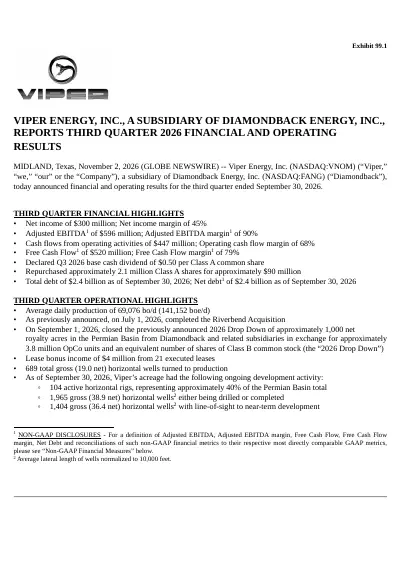
Q3 was another strong quarter for Viper. Oil production averaged just above the high end of our guidance range at over 69,000 barrels per day, up more than 6% quarter-over-quarter, driven by recent acquisitions and continued development from both Diamondback and our third-party operators.
During the quarter, operators turned 689 gross horizontal wells to production on our acreage, including 123 Diamondback-operated wells at an average NRI of over 9%. On the acquisition front, we closed two previously announced transactions: the Riverbend acquisition on July 1st, and the drop-down from Diamondback on September 1st.
Diamondback took its consideration entirely in equity for the drop-down, further increasing its stake in Viper and reinforcing our alignment with our parent company. In September, we also closed the McElroy Ranch acquisition for an aggregate purchase price of $529 million.
This adds about 7,400 net royalty acres in Upton and Crane Counties. This ranch gives us a concentrated ownership of roughly 12% NRI across 60,000 gross acres in what we expect to be the core fairway of emerging Barnett development in the western Midland Basin.
It is more than 95% undeveloped with over 40 net inventory locations, and we expect its development to support our production profile and continued growth outlook over the next decade. Additionally, today we also announced an agreement to acquire nearly 1,600 net royalty acres in the Midland Basin from Buckhorn Minerals for $280 million in cash and 1.8 million Class A shares.
Approximately 80% of the Buckhorn acreage overlaps with Viper's existing footprint, and the asset is roughly 60% undeveloped, including exposure to the highly undeveloped Driver unit. We think this is one of the highest-quality, sizable mineral assets left in the Midland Basin.
By our estimates, nearly half of its inventory, half of its net inventory, ranks in the top quartile of remaining inventory in the Midland Basin, and 70% of the inventory ranks in the top half. Together, the McElroy Ranch and Buckhorn acquisitions add nearly 60 net locations across two largely undeveloped assets.
Notably, we're funding these deals primarily with cash, delivering on the commitment we made when we revised our return of capital framework last quarter to pursue accretive M&A with less reliance on equity. Reflecting the strength of our base business and these acquisitions, we are again raising our full year 2026 oil production guidance with a new midpoint of 67,500 barrels of oil per day.
We're also initiating fourth quarter oil production guidance of 70,000 to 71,000 barrels of oil per day, up nearly 1,500 barrels per day from our third quarter actuals and inclusive of a partial quarter contribution from Buckhorn. Turning to our financial results for the quarter, we generated $520 million of free cash flow, which represents a free cash flow margin of almost 80%.
With the cash generated during the quarter, we declared a base dividend of 50 cents a share, in addition to $90 million of repurchases during the quarter. As part of our revised capital allocation framework announced last quarter, we will also retain a significant amount of incremental cash to pay down debt from our previously discussed acquisitions very quickly.
In conclusion, every part of the Viper model showed up this quarter: organic growth, high-quality acquisitions funded primarily with cash, and a durable, growing base dividend paired with opportunistic share repurchases. With a capital-light royalty model and an unmatched acreage position in the Permian Basin, we continue to believe Viper is uniquely positioned to deliver durable per-share growth and attractive long-term stockholder returns.
With that, operator, now please open the line for questions.
Operator
Thank you. At this time, we will conduct the question-and-answer session.
As a reminder, to ask a question, you will need to press star one one on your telephone and wait for your name to be announced. To withdraw your question, please press star one one again.
Please stand by while we compile the Q&A roster. Our first question is with Betty Jiang from Barclays.
Betty, your line is now open.
Betty Jiang
Hi. Good morning.
Thank you for taking my question. I first just want to ask about the M&A.
It's really good to see the momentum you're seeing there and while being able to fund that with cash on hand and the borrowing base. Maybe just the overall M&A landscape.
Why do you see these deals coming together now? Where do you see more opportunities going forward, and do you think you have the balance sheet capacity to do more of these things going forward?
Kaes Van't Hof
Betty. I'll give the high level, and Austen can tell you what he's seeing in the market.
I think high level, two of these deals, Buckhorn and Riverbend, kind of packages that have been put together over the last few years that were kind of ripe for a sale. We obviously were able to get Riverbend done about six months ago, and then Buckhorn through the process of the summer ended up getting it done.
I think both are very high-quality assets, a lot of undeveloped inventory, and we think about these things as multi-decade assets that we're going to own for forever. Obviously, we still have to be focused on the accretion near term, which both of these are.
I think that's kind of the sweet spot for Viper in our acquisition strategy. I'd say on the McElroy Ranch, that's kind of one of those, we call them the unicorns in this basin, right?
This is a ranch that was owned by a family for, I think, 80 years or 80-plus years, one of the first ranches bought as the Permian started developing vertical wells way back in the day. That's a hard ranch for a lot of people to buy because they needed all cash.
We were able to move quickly and be a good counterparty. I think the notoriety and the size and the scale of this business is what started to allow these deals to naturally accrue to us.
I kind of mentioned in past quarters' calls that the opportunity set ahead of Viper looks a lot like what it did in front of Diamondback six or seven years ago, with just a lot less well-funded large competitive peers in the peer group. I think that should be a win for Viper shareholders, but I think the lesson learned is that it's not all going to be equity funded.
I think we have the balance sheet, the cash flow, the free cash conversion to be able to use cash, do accretive deals for the shareholders, and be prepared to do more by paying down debt very quickly. Austen, what are you seeing in the forward outlook here?
Austen Gilfillian
I think there's still a lot to do, but I think the good thing about how we're positioned today is that we get to be opportunistic and, frankly, we get to be picky about the assets that we choose and the assets that we like. If you look at everything we've done this year, Riverbend, Buckhorn, McElroy Ranch, and also the drop-down, you can include that in there as well, they're all kind of distinct in that they have a weighting to undeveloped acreage.
We generally can, I think, deliver differential returns by having a unique view on asset quality and operator development. That's all to say, while I think there's still plenty to do, we'll look for not only the near-term accretion, but for a unique perspective to gain on the inventory and how that might create differential value for our shareholders.
Betty Jiang
That's great color. For my follow-up, it just seems there's a lot of tailwind to the Viper business right now.
You have higher oil prices, higher activity, and you have these new assets coming in where you have this visibility on development cadence going forward. Maybe can you just speak to your current view of organic growth that you could generate from the asset base today, into '27 or however much visibility that you can provide for the market would be great.
Kaes Van't Hof
We don't have a ton of visibility on the third party yet, right? I think as we get closer to the next year, we start to look at permit conversion and kind of work the third-party plan.
I think the Diamondback plan continues to chug along. These are big numbers, right?
123 wells with an average 9% interest, that's a huge amount of production coming from the Diamondback drill bit that we expect to continue. I think, in general, right?
I think you're right. There's tailwinds.
We've generally bought assets that have outperformed the basin growth, and I think, maybe that's been misunderstood, right? The amount of growth relative to the basin is a testament to Austen and the team picking assets that should outperform the basin, and I expect that trend to continue.
Obviously, a lot of exciting things going on with new zones: the Barnett, Woodford development, McElroy Ranch development, some of the mega themes we talked about in the Diamondback call. All those things generally accrue to the benefit of Viper shareholders and should build value over time.
Austen, you want to say anything about activity levels?
Austen Gilfillian
No, that's right. We had quite a bit of organic growth embedded in the Q3 results, and even once you strip out the contribution from the acquisitions, you're still getting some of that momentum carrying into the fourth quarter.
I think we start to have a much bigger base, the percentages may come down, but Diamondback is still driving a lot of growth through their concentrated activity on our position, and we see that happening for the foreseeable future.
Betty Jiang
Appreciate the color. Thank you.
Operator
Thank you, Betty. Our next call and question is from Neal Dingmann with William Blair.
Neal, your line is open.
Neal Dingmann
Hey, morning, Kaes. My first question, just on asset drop-downs.
Could you talk about further drop-downs for minerals and surface?
Kaes Van't Hof
Yeah. We have dropped down all of the minerals that we know about today that sit at the Diamondback level.
There's always kind of little cleanups here and there from trades that we do if NRIs are above 75%. I think generally we're aware of where surface cash flows trading in the market.
I think we have a unique surface position at Diamondback. We're evaluating the value of that within Diamondback and where it could or should sit.
I think generally our progress on power deals and infrastructure development in the basin is allowing us to think about different options for the various assets we have across the portfolio. Nothing to announce today, but we're very conscious of the market and where multiples are, and I think generally, as I mentioned in the Diamondback call, we feel like we can dominate in this basin in kind of all facets of infrastructure, surface, minerals, midstream, upstream.
More to come there, Neal, but I think we're at the center of this next wave of Permian growth, and Viper and Diamondback will play an important part of it.
Neal Dingmann
Perfect. Thanks, Kaes.
Then just my second question. Really just something you talked about last time on the increased flexibility that you talked about in that, I guess, you called it your previous revised return on capital framework.
Specifically, how do you believe this ultimately will continue to improve investor returns and overall value? Thank you.
Kaes Van't Hof
Yeah. Here's how I would frame it.
We're in a kind of a grow-or-die business, right? If you have all of your free cash flow going out the door every quarter, that limits your opportunities to grow.
I think we recognize that there were a lot of opportunities ahead of us. Obviously, we knew we had McElroy Ranch in the works.
We knew we had Buckhorn in the works. We just said, 'Let's pay a very high base dividend that is competitive with the top dividend payers across our space, the majors combined with even a utility, but let's beat that with growth on top.'
That's allowed us to do over $1 billion of deals with cash this year, and we'll still exit the year at sub-1-times leverage. That should accrue value to the equity holders long term.
It should allow us to grow our base dividend long term and not be a flash in the pan, because we want to be the dominant mineral position in this basin for a long time.
Neal Dingmann
Said. Thanks, Kaes.
Kaes Van't Hof
Thanks, Neal.
Operator
Thank you, Neal. Our next question is from the line of Derrick Whitfield with Texas Capital.
Derrick, please go ahead.
Derrick Whitfield
Good morning again, guys.
Kaes Van't Hof
Hey, Derrick.
Derrick Whitfield
Kaes, I wanted to focus on the acquisition, the McElroy Ranch, with my first question. Regarding that acquisition, how would you guys characterize your visibility into the development of the Barnett?
Clearly, Diamondback can drive activity, but how do you project it across the other operators?
Austen Gilfillian
Derrick, good question. We disclosed that in the Barnett specifically, Chevron's the largest operator, and we have the map on slide 11 of the investor presentation, so that's kind of the big chunk of the contiguous acreage on the southwest corner.
While we don't have specific visibility into what Chevron's going to do, we do know them. We do know kind of operator trends within the basin.
Really where we see value in acquisitions generally, and also to this deal specifically, is ranking the undeveloped inventory in what we think is an operator's overall inventory position. When you look at what Chevron's doing in the Permian, and what we think is their remaining runway, we think this is going to be some of the highest-return inventory that they have, both from an NPV certainty and then also from an ROR perspective.
We didn't underwrite it to happen today or tomorrow, but over the next decade as these inventory locations start to get developed, I think that's going to create a lot of value for our shareholders.
Derrick Whitfield
Great. For my follow-up, I wanted to pivot back to your long-term outlook for the business and what's collectively owned across the Diamondback family of companies today.
I realize Viper is oil and gas royalties-focused, how do you view the longer-term opportunity for surface in Midland, particularly as you think about the mega themes that you outlined in the Diamondback shareholder letter?
Kaes Van't Hof
I would say generally, Derrick, I have grown or we have grown more bullish on surface and kind of understand the long-term option value of it. Now, just like not all acreage is created equal on the upstream side and not all mineral acreage is created equal on the mineral side, not all surface is created equal either, right?
It's about targeted acquisitions of surface that could have real use cases for oil field development or data center development, or power gen development. There's some very specific things we're looking for when trying to pursue that.
I would say just generally our kind of attitude on pursuing the right surface acquisitions has probably grown with knowledge gained through what we hope to be one of the first real projects completed in the basin on the power side.
Derrick Whitfield
Kaes, if I could go one further, maybe just as a follow-up to that, if you guys are looking at that as an opportunity, would that also necessitate standing up a separate team that could really focus on non-oil and gas applications, or do you think that could all be done within the current management in place?
Kaes Van't Hof
Maybe not management, but we have a lot of talented people throughout this organization, and I think those talents can be leveraged to many different things. I think it goes back to the institutional knowledge about the basin and how to get things done here that should drive that talent to succeed.
I know you're baiting me a little bit, Derrick, but I think there's some things in the works over here, and I think we have some catalysts as a group to think about, and who's going to sit where is kind of a secondary discussion.
Derrick Whitfield
Appreciate the color, Kaes.
Kaes Van't Hof
Thanks, Derrick.
Operator
Our next question is from the line of Jack Cavanagh with Goldman Sachs. Jack, your line is open.
Jack Cavanagh
Thanks, Kaes and team. You mentioned earlier that it's a grow-or-die business, I'm just kind of curious how that informs how you're thinking about the buyback for Venom at current levels relative to incremental equity issuance to help fund some of the inorganic growth opportunities you're seeing in the market.
Kaes Van't Hof
Jack. I kind of think about them a little differently.
I see the buyback as something that can grow per-share metrics, and look at how many reserves per share we've grown, how much oil production per share we've grown. We've got to do that at the right time.
I think about the buyback as selective on price. Then on deals, I wish we could control timing of deals, right?
I'd love to buy every deal at $40 oil, but in the minerals business at $40 oil, your check goes down, but you're not being forced to sell, whereas upstream sometimes the CapEx requirements force people into less economic decisions. I think being able to pounce on the upstream is more of a positioning that we focus on, whereas on the mineral side, I think balance sheet capacity to being able to divide between cash and stock, and even some of the unique aspects of Viper where we can offer tax-deferred units to large enough deals positions Viper to be ready to do deals when the counterparty's ready versus be more front-foot and aggressive, I would say.
Austen, you want to add anything to that?
Austen Gilfillian
I think the beauty of the business model is that we can do all of the above. When you think about a business with 80% free cash flow margins for us, it's not a decision of dividend or buyback or acquisitions or debt reduction.
It's a little bit of everything, and it might change quarter to quarter on the margin, but I think we can grow the business from an absolute standpoint with good deals, with continued organic growth. Then if we can reduce the share count opportunistically where we see value, that just means incremental value creation on a per-share basis.
Jack Cavanagh
Great. That makes a ton of sense.
Then for my follow-up, Kaes, when you think about value capture across the FANG-Venom complex, has the stock performance this year for Venom influenced how you're thinking about the relationship between the two companies, and looking forward, is there any change to how you see FANG supporting Venom's growth and value creation given the number of levers you can pull with the FANG enterprise?
Kaes Van't Hof
That's a good question. Obviously very reflective this year on stock price performance relative to peers, and I guess we could debate who we should define as Venom peers.
I think there's probably a couple things I reflect on through the year. I think, wearing my Diamondback hat, we sold some shares in Venom in March when oil prices kind of spiked, and I think, in retrospect, that probably sent the wrong message to the Street, and I'm not afraid to admit some mistakes.
I think selling Venom didn't make sense then. I think we've tried to reframe our commitment to Venom ownership by increasing ownership through the drop-down.
I think over the long term, the FANG-Venom relationship remains very strong. I think, as an overall capital allocator, keeping all of our options open at both companies is going to be a good thing for both shareholder bases.
At Diamondback, that means grow my dividend, pay down debt, do deals, or repurchase shares, but also at Diamondback, it means you can repurchase Venom shares if you think they're a great deal and you're not blacked out from the market to do so. The same goes for Venom, right?
Venom, we can do deals, we can buy back shares, we can hoard cash, or like we did last quarter, we used cash in deals to be able to do that quickly and get our balance sheet back in shape. Long-winded answer of I think the relationship is strong and probably getting stronger, particularly as the three mega themes that we talked about in the last call start to come to fruition and grow within our combined complex.
Jack Cavanagh
Great. Thanks, guys.
Operator
Thank you, Jack. Our last question will be from the line of Leo Mariani with Roth.
Please go ahead.
Leo Mariani
Thanks. Just wanted to follow up on an earlier comment that you made.
Sounds like you're very kind of committed to paying down some of the incremental debt that you guys took on, with the acquisitions. Do you see perhaps, the share back share buyback, getting a little bit less capital to execute, in the next handful of quarters to try to get that debt down, just trying to get a better understanding of that?
Kaes Van't Hof
I'd go back to it depends, Leo. If the stock goes back to where it was the beginning of the third quarter, we're going to lean in and buy back.
That's the beauty of how much free cash this business is generating, and I know people like to focus on debt-to-EBITDA, but at the end of the day, the debt-to-free-cash-flow of Viper is second to none. If we see weakness in the stock price, we're going to lean in and buy back shares.
Leo Mariani
Appreciate that. I guess just, obviously, FANG has had success in the Barnett.
There's been a little bit more shift and activity towards that zone. Sounds like you guys are signaling you plan to kind of continue to do more in the coming years as kind of percentage of activity.
Does that sort of benefit Venom a bit more on the margin? Do they have higher kind of NRIs in the Barnett, perhaps versus some of the other more traditional zones?
Austen Gilfillian
Leo, in the near term or really the medium term, I don't think it has a huge impact to Viper. Really, the way that you need to think about it is total Diamondback completions, and then what percentage of those wells Viper will own an interest in, and then what NRI we have within those.
We'll get the benefit of having some really high NRI in some really good areas, thinking about Spanish Trail specifically, but I think for the next couple years, even with the Barnett being added in a more significant way to the Diamondback development plan, those key metrics look similar, so that's good. I think really what gets exciting is the acquisition opportunity set that we can tailor around the Barnett.
Diamondback can be selective on where they're developing it, and as they start to HBP leases, that creates a lot of synergy opportunities or even leverage for us to be smart in targeted acquisitions. I think that's going to be a big part of the story over the next couple years as the Barnett becomes more relevant to both complexes' development.
Leo Mariani
Okay. It sounds like the McElroy Ranch deal is really kind of a prime example of that, and it sounds like that's really kind of a medium to longer-term bet that's on a lot more industry development in the Barnett.
Kaes Van't Hof
Yeah. I think we highlighted the Barnett there because we think it's probably the best zone, but there actually was good amount of development from FireBird that is now Continental.
Diamondback's got a little of it. It's not A-zone territory, but there are some zones that have been tested further east that have been productive and added to production there.
Leo Mariani
Thank you.
Operator
Thank you, Leo. This concludes the question-and-answer session.
I would now like to turn it back to Kaes Van't Hof for closing remarks.
Kaes Van't Hof
Thanks, everyone, for participating in today's call. If you have any questions, please reach out.
We're available at your convenience.
Operator
Thank you for your participation today. This concludes the program.
You may now disconnect.