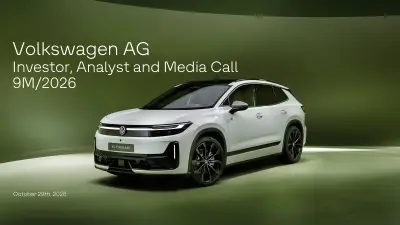
Volkswagen AG
Q3 FY2026 · Earnings Call TranscriptOctober 29, 2026
Operator
Transcribing the earnings call audio... Operator: Good morning and thank you for standing by.
Welcome to the Volkswagen Group 9 months 2026 results conference call. At this time all participants are in listen-only mode.
After the speakers' presentation there will be the question and answer session. We will first take questions from the investors and analysts, after a short break followed by a separate Q&A session for members of the media.
To ask a question during the session, you need to press *11 on your telephone. You will then hear an automated message advising your hand is raised.
To withdraw a question please press *1 and 1 again. Please be advised that this conference is being recorded.
I would now like to hand the conference over to your speaker today, Pietro Zollino, Head of Corporate Communications. Please go ahead.
Pietro Zollino
Good morning everyone and a warm welcome to our call about the 9 months results of the Volkswagen Group. As usual this is a joint call for both the media as well as investors and analysts, moderated by Rolf Woller, our Head of Group Treasury and Investor Relations, and myself, Pietro Zollino.
I'm the Deputy Head of Group Global Communications. With us today is also as usual Arno Antlitz, our CFO and COO.
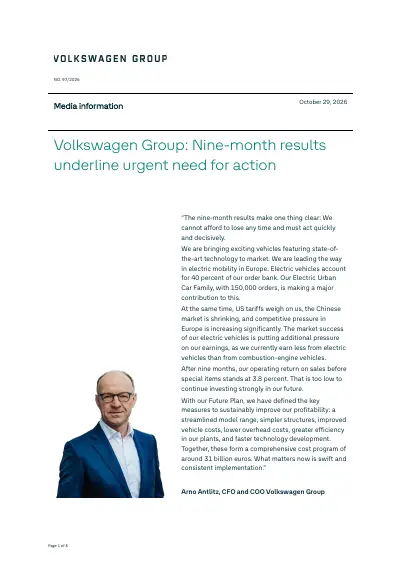
A few remarks before we start. You should have received the press release, the interim financial report, and all other related materials which were published this morning.
If you do not have them yet you can find all documents on our website, or if you have any issues give us a call or drop us an email and we will send them straight to you. Now let me hand over to Rolf who will give you a brief run-through of the next about 1 and 1/2 hours.
Rolf Woller
Thank you Pietro and good morning to everyone on the call. Let us have a look at our agenda.
Arno will take you through the 9 months results and the full year outlook for 2026. Following his presentation we will first conduct a Q&A session for the investor and analyst community, which is moderated by myself, and after the session and a short break of between 5 and 10 minutes where you will hear no music, we will continue with the media Q&A moderated by Pietro.
Since our call will include forward-looking statements, the safe harbor language and other cautionary statements on the slide will govern today's presentation. As usual I encourage you to read the disclaimer carefully as all forward-looking statements are qualified by this language.
With that, I hand it over to Arno. Arno, please go ahead.
Arno Antlitz
Thank you Rolf and a warm welcome to everyone on this call. Ladies and gentlemen, the third quarter has once again shown how demanding our environment remains.
China's market is contracting sharply, driving further export growth into other regions. Tariffs, geopolitical tensions, and unprecedented competition add to the pressure.
Europe's shift from combustion engines to electric vehicles has accelerated. All these factors weighed on our volumes, mix, and margins.
We are managing this environment with discipline. At the same time, we are moving ahead with our strategic initiatives.
We are ramping up our attractive new electric and combustion engine vehicles. We continue to reduce investment spending and overhead cost.
We are making progress on workforce reduction as planned, and we deliver on automotive net cash flow. €4.4 billion year to date is a strong achievement.
However, even before special effects our operating margin stood at 3.8% after the 9 months, which shows the clear need for action. We must accelerate and broaden our efforts to structurally lower our cost base.
This is essential to earn adequate returns and deliver on our financial ambitions. For this we need lasting structural improvements across the group.
Means lowering vehicle costs without compromising product substance, lowering overhead costs, and substantially improving efficiency in our plants. Also means faster technology development and decision making.
These are all areas addressed by the group target picture 2030. What matters now is swift, disciplined, and consistent execution.
The developments in our industry show we have no time to lose. With that, let's dive straight into the presentation.
Our product momentum remains strong. The launch of our electric urban car family was an important milestone.
All four models including their entry-level versions are now available to order. Customer interest is strong with around 150,000 orders received so far.
At the Paris Motor Show we also unveiled the new ID. Tiguan, electrifying one of the group's most successful models.
In the United States we started production of the next-generation Atlas. Audi is strengthening its premium SUV offering with the all-new Q9, developed specifically for US customers.
It will reach showrooms in the coming weeks. Alongside this strong product momentum we continue to advance the strategic transformation of the group.
In early September the supervisory board approved the group's target picture 2030. The objective is clear: a stronger, more competitive, and more effective group and brands.
We also advanced our active portfolio management in the third quarter. Following the announcement of sale of a majority stake in Everlance, we sold a further stake in Sinotruk, divested MHP, and sold our remaining stake in Bugatti Rimac.
Together the completed and announced disposals are expected to generate cash proceeds of around €10 billion. Active portfolio management also means selectively opening our business to strategic partners where this creates additional value for Volkswagen.
PowerCo and Gotion have agreed to accelerate the development of a regional battery supply chain for Europe. Gotion will contribute up to $1 billion.
Building on their longstanding cooperation, PowerCo and Gotion plan three joint ventures at Valencia, Salzgitter, and Kenitra in Morocco. These will cover industrial production of LFP battery cells and cathode active material.
The partnership is strategically important for Volkswagen Group. It will give us access to competitive LFP cell technology and diversify our supply of critical battery materials in Europe.
The partnership combines PowerCo's capabilities and European footprint with Gotion's LFP technology and industrialization expertise. The partners will share investment requirements and industrial responsibilities.
Before we turn to the numbers, let me briefly comment on Audi's announcement from last weekend. Audi plans to establish its first US production site in Peach County in Georgia.
The brand intends to invest around €4 billion in a plant that is designed for annual capacity of up to 200,000 vehicles. Construction is scheduled to begin in 2027 with production planned to start in the early 2030s.
The focus will be on premium SUVs tailored to the North American customers and built locally. The final decision still requires approval by the relevant committees.
We therefore ask for your understanding that we are not yet able to comment on financial implications. This step would be fully consistent with our regional strategy in US for US as part of our global strategy to broaden our regional footprint, especially in one of the financially most attractive markets in the world, the US.
In North America we are closing portfolio gaps in the most attractive segments, specifically large SUVs and pickups. Together with the Volkswagen plant in Chattanooga and the Scout plant under construction in Blythewood, Audi's new site would be an important element to create a targeted and resilient local-for-local footprint in the US.
This would reduce our exposure to trade barriers and currency movements. With that, let's now turn to our deliveries in the first 9 months of the year.
Global deliveries declined by 9% year-on-year in the first 9 months to 6 million vehicles. The decline was driven by China where volumes fell 30% amid a sharply contracting market and a weak consumer sentiment.
Our combustion engine volumes in particular remained under significant pressure as a result of the increased gasoline prices. Outside China deliveries to customers were broadly flat.
In Europe deliveries rose by 1.7% in the first 9 months. BEV demand grew strongly while demand for combustion engine vehicles weakened.
South America achieved 4% growth year-to-date. In contrast deliveries in North America declined by 4% year-on-year in the first 9 months due to lower BEV deliveries and model changeovers, particularly the new Atlas.
Turning to electrified vehicles, the regional picture remains mixed. Strong growth in electric vehicles in Europe in the last months only partially offset the market pressure in China and US.
Globally we delivered 679,000 fully electric vehicles in the first 9 months, down 5.4% year-on-year. Nevertheless the global BEV share rose by 40 basis points to 11.3%.
In Europe electric vehicles accounted for 20% of our deliveries, up from 18% a year earlier. The immense success of our electric urban car family has contributed only modestly so far as deliveries have just begun.
Our order situation in Europe remains robust. In the first 9 months order intake increased by 4%, about 3 million vehicles.
At the end of September the total order book in Europe stood at 1.1 million vehicles, around 11% higher than at year-end 2025. The increase was driven above all by BEVs with particularly strong demand for the electric urban car family.
Based on this development we are increasingly confident that we will meet EU CO2 fleet targets for 2025 to 2027 compliance period, since our BEVs now account for roughly 40% of the order book. At the same time, the shift in mix towards BEVs is still dilutive to our margins in the short term, despite the clear progress we make on the BEV cost side.
We have already seen some of this negative mix effect in Q3, and we expect the BEV ramp-up to put greater pressure on margins in Q4 and the first half of 2027. Let's now turn to the Group financial and operating performance in the first 9 months of 2026.
Lower vehicle sales reduced group sales revenue by 2% to €233 billion. The operating result was close to breakeven at €0.1 billion.
This was mainly driven due to significant special effects and the soft China business. Our 9 months result was burdened by special effects totaling €8.7 billion, €7.8 billion of which were recorded in the third quarter.
The main items within the €7.8 billion are a Porsche goodwill impairment of €6.4 billion, an impairment of assets of fully consolidated companies in China of about €1 billion, and before special effects operating result came in at €8.8 billion with a margin of 3.8%. This is slightly below our recently revised full-year expectation of around 4%.
Just as a reminder, this operating result before special effects contain a burden from tariffs paid to €1.2 billion in the first 9 months of 2026. For the full year we expect the US tariff to impact our results with about €2.8 billion.
It contains roughly €500 million burden related to early retirement schemes in the Volkswagen AG. Profit before tax declined to €0.5 billion in the first 9 months.
This was mainly due to the lower operating result. Financial result turned out positive for the 9 months period.
This was largely due to the further sale of Sinotruk shares. The share sales reduced our stake to below 20%, triggering a reclassification of our remaining holding.
Total book gain from the sale and reclassification contributed to around €2 billion to the financial result. After tax we recorded a loss of €2.7 billion.
This is due to the unusually high taxes, mainly because some of the special items booked in Q3 are not tax-deductible, particularly the goodwill impairment. In addition, no deferred tax assets were recognized on tax losses incurred in Germany in the current year, as these losses are not expected to be utilized within our planning period.
Nevertheless, the resulting tax loss carryforwards have not been permanently forfeited. Our cash flow performance shows that the processes we made and established to strengthen cash generation at Volkswagen Group are delivering lasting results.
Automotive net cash flow improved to €4.4 billion in the first 9 months. The improvement was supported by lower investment spending as well as net inflows from M&A.
Net inflows from M&A amounted to €0.6 billion. The €0.9 billion investment in Rivian was more than offset by the cash in from other portfolio measures.
Proceeds mainly included €0.7 billion from Traton's Sinotruk stake sales and €0.9 billion from the remaining Bugatti Rimac stake. Porsche AG used some of the proceeds from the Bugatti Rimac disposal to fund pensions totaling €500 million in the first 9 months.
Cash flow performance supported a solid net liquidity position. Automotive net liquidity remained at €33 billion at the end of September, some €1.5 billion below the level at year-end 2025.
We fully offset dividend payments and Porsche additional pension funding. Let me now turn to the performance of our divisions in the first 9 months.
Passenger Cars recorded an operating loss of €2.6 billion, largely as a result of special effects and our performance in China. Commercial Vehicles delivered a solid operating result of €1.7 billion and a margin of 5.2%, roughly on par with prior year period.
Financial Services remained robust with an operating profit of €3.0 billion despite higher residual value risks. In the Passenger Cars profit bridge, volume and other effects reduced the result by €1.1 billion year-on-year.
Mix impacted the result by -€1.8 billion. This reflects an unfavorable regional and product mix, particularly driven by higher mix of electric vehicles and a negative segment mix.
Higher incentives more than offset the positive pricing effects, resulting in a net burden from price of €0.6 billion. Product costs reduced the result by €0.4 billion, mainly due to the higher raw material costs.
Favorable hedging positions provided a partial offset here. Fixed and other costs made a positive contribution of €0.4 billion with a sizable contribution from lower overhead costs.
Special effects were a year-on-year headwind of €3.1 billion. This mainly reflects the Porsche goodwill impairment, partly offset by lower restructuring costs and the absence of last year's burden related to the realignment of Porsche's product strategy.
Our overhead costs benefited significantly from consistent implementation of the 2024 and 2025 agreements Future Volkswagen. These include the agreed headcount reduction of around 50,000 across Volkswagen, Audi, Porsche, and Cariad in Germany.
Since at the end of 2023 about 19,000 employees have left Volkswagen AG and around 25,000 have left Volkswagen Group in Germany. Over the same period our global headcount has declined by around 40,000 or 6%.
Automotive overhead costs fell by €0.7 billion in the first 9 months from €33.8 to €33.1 billion. Our savings more than offset the ramp-up of new businesses such as PowerCo and Scout, as well as inflation in the current year.
Turning to the brand groups, the platforms, and Financial Services. Brand Group Core delivered vehicle sales and sales revenue broadly in line with the prior year.
Operating profit declined by 8% to €4.3 billion, corresponding to a margin of 4.1%. Brand Group Progressive operating profit declined to €1.2 billion and a margin of 2.7%.
This was driven by a market decline in volumes in China and the US. Cost discipline and lower overhead provided a partial offset.
Brand Group Sport Luxury vehicles sales fell 11% and sales revenue declined 7%. Operating profit nevertheless rose significantly to €1.5 billion with a margin of 6.7%.
Lower special effects compared to prior year, a better mix, and cost improvements more than offset the weaker top line here. Let's take a closer look at the brands in the Brand Group Core.
Volkswagen brand reported an operating profit of €0.8 billion and a margin of 1.3%, 1 percentage point below the prior year. Even before special effects, the margin stands at 2.6%, which is clearly not where we wanted to be.
Skoda continued its strong performance in a challenging environment. Vehicle sales rose by 3% and sales revenue by 4%.
Building on a highly competitive cost base, the operating margin increased by 30 basis points to a strong 8.3%. Skoda again shows what can be achieved with first-class products based on Volkswagen platforms when operating on a right cost base even in a challenging market environment.
Cariad sales revenue increased by 31% to €1.3 billion on the back of higher volumes on the 1.1 and the 1.2 software stacks. The operating loss improved by €0.2 billion to €1.3 billion, supported by higher sales and continued execution of the transformation program.
PowerCo is keeping operating loss broadly stable at around €1 billion despite the production ramp-up in Salzgitter. Construction in Valencia and St.
Thomas increased investment and net cash outflows. Traton industrial operations maintained their improved momentum in the third quarter.
Sales revenue in the first 9 months increased by 2% to €31.9 billion backed on higher volumes. Operating profit was €1.1 billion with a margin of 5.2%.
Operational improvements offset higher tariffs, input costs, and restructuring charges. Volkswagen Financial Services delivered a solid operating performance.
Contract volumes rose by 1.5% to almost 28 million, and residual value risk also increased, particularly as the European market shifts towards battery electric vehicles. The credit loss ratio remained solid at 0.41%.
Operating profit at €3.0 billion was 3% below the prior year period. We are taking early actions to address growing residual value pressure, and we have therefore adjusted the Financial Services division's full-year operating result outlook to now more than €3.5 billion.
Our investment discipline continues. Automotive investment in R&D and capex fell by almost €2 billion to €22.4 billion in the first 9 months.
This is equivalent to an investment ratio of 10.9%, some 50 basis points below the prior year level. For the full year 2026 we continue to expect an investment ratio of 11% to 12%.
As part of the Group target picture, we target 9% of sales in 2030, which equals €135 billion over the next 5 years, 2027 to 2031. The planned Audi plant is not included in this figure.
However, our aim is to compensate as much as possible of the additional investment within the upcoming planning round through strict prioritization and further efficiencies across our investment portfolio. For us, investment discipline and targeted growth in attractive markets are not a contradiction.
They go hand in hand. In China the automotive market remains under severe pressure.
Market volumes are down 21% year-to-date. Changes in subsidies and tax policies, higher fuel prices, and weaker customer sentiment are driving the decline.
Competition remains intense. In this environment our unit sales declined by 35% to 1.2 million units, with combustion engine models particularly affected.
Significantly lower volumes and costs for new NEV models ramp-up weighed on the proportionate operating result. The step-up cost measures could only partly offset this pressure.
In addition, Volkswagen Group China recognized impairments on legacy MEB-related assets in the third quarter, which reduced the proportionate operating result by about €0.2 billion. Before impairments the proportionate operating result for the first 9 months amounted to €110 million.
For the full year we now expect proportionate operating result from our Chinese joint ventures before impairments to be around breakeven. However, there's a significant risk that Q4 will push the full year result, even before impairments, into the negative territory.
Nevertheless, we continue to implement our in-China-for-China strategy with full force. We are continuing our NEV model offensive rigorously, and our cost reductions and capacity adjustments.
This brings me to our financial outlook for the full year 2026. We expect sales revenue of around €315 billion and a reported operating margin of up to 1%.
Before expected special effects of about €10 billion, our full-year margin outlook is around 4%. Our current run rate is 3.8%, and we expect a higher BEV share in Europe in Q4.
Please keep in mind that around 4% means that we are more in line with the run rate of the first 9 months. Building on the performance in the first 9 months, we expect an automotive investment ratio of 11% to 12%, and we continue to expect reported net cash flow of €3 billion to €6 billion.
We are confident that net cash flow in Q4 will be positive, adding to the €4.4 billion we achieved in the first 9 months. We expect net liquidity of €32 billion to €34 billion, but also here we see a good chance to end the year at or even above the upper end of the range.
Importantly, these KPIs exclude any effects from the sale of a majority stake in Everlance or from Group target picture 2030. Ladies and gentlemen, we are delivering on our strategy and agreements reached in 2024 and 2025.
Yet the world has changed fundamentally since we launched our group-wide efficiency programs. We face tariffs, a sharply contracting Chinese market, and intense competition in Europe from new Chinese entrants.
The market success of our electric cars also weighed on our margins in the short term. Against this backdrop, incremental cost measures are not enough.
We must fundamentally reshape our business model and deliver a decisive improvement in cost competitiveness. This requires a substantial reduction in complexity across the company.
The Group target picture 2030 provides a framework for these changes. Now, it's our task to implement it swiftly and with discipline.
Our financial performance leaves no room for delay. Thank you very much, and with that, I hand over back to Rolf.
Received transcript part 2. Waiting for remaining parts...
Received transcript part 3. Waiting for part 4...
Operator: Good morning and thank you for standing by. Welcome to the Volkswagen Group 9 months 2026 results conference call.
At this time all participants are in listen-only mode. After the speakers' presentation there will be the question and answer session.
We will first take questions from the investors and analysts, after a short break followed by a separate Q&A session for members of the media. To ask a question during the session, you need to press *11 on your telephone.
You will then hear an automated message advising your hand is raised. To withdraw a question please press *1 and 1 again.
Please be advised that this conference is being recorded. I would now like to hand the conference over to your speaker today, Pietro Zollino, Head of Corporate Communications.
Please go ahead. Good morning everyone and a warm welcome to our call about the 9 months results of the Volkswagen Group.
As usual this is a joint call for both the media as well as investors and analysts, moderated by Rolf Woller, our Head of Group Treasury and Investor Relations, and myself, Pietro Zollino. I'm the Deputy Head of Group Global Communications.
With us today is also as usual Arno Antlitz, our CFO and COO. A few remarks before we start.
You should have received the press release, the interim financial report, and all other related materials which were published this morning. If you do not have them yet you can find all documents on our website, or if you have any issues give us a call or drop us an email and we will send them straight to you.
Now let me hand over to Rolf who will give you a brief run-through of the next about 1 and 1/2 hours. Thank you Pietro and good morning to everyone on the call.
Let us have a look at our agenda. Arno will take you through the 9 months results and the full year outlook for 2026.
Following his presentation we will first conduct a Q&A session for the investor and analyst community, which is moderated by myself, and after the session and a short break of between 5 and 10 minutes where you will hear no music, we will continue with the media Q&A moderated by Pietro. Since our call will include forward-looking statements, the safe harbor language and other cautionary statements on the slide will govern today's presentation.
As usual I encourage you to read the disclaimer carefully as all forward-looking statements are qualified by this language. With that, I hand it over to Arno.
Arno, please go ahead. Thank you Rolf and a warm welcome to everyone on this call.
Ladies and gentlemen, the third quarter has once again shown how demanding our environment remains. China's market is contracting sharply, driving further export growth into other regions.
Tariffs, geopolitical tensions, and unprecedented competition add to the pressure. Europe's shift from combustion engines to electric vehicles has accelerated.
All these factors weighed on our volumes, mix, and margins. We are managing this environment with discipline.
At the same time, we are moving ahead with our strategic initiatives. We are ramping up our attractive new electric and combustion engine vehicles.
We continue to reduce investment spending and overhead cost. We are making progress on workforce reduction as planned, and we deliver on automotive net cash flow.
€4.4 billion year to date is a strong achievement. However, even before special effects our operating margin stood at 3.8% after the 9 months, which shows the clear need for action.
We must accelerate and broaden our efforts to structurally lower our cost base. This is essential to earn adequate returns and deliver on our financial ambitions.
For this we need lasting structural improvements across the group. Means lowering vehicle costs without compromising product substance, lowering overhead costs, and substantially improving efficiency in our plants.
Also means faster technology development and decision making. These are all areas addressed by the group target picture 2030.
What matters now is swift, disciplined, and consistent execution. The developments in our industry show we have no time to lose.
With that, let's dive straight into the presentation. Our product momentum remains strong.
The launch of our electric urban car family was an important milestone. All four models including their entry-level versions are now available to order.
Customer interest is strong with around 150,000 orders received so far. At the Paris Motor Show we also unveiled the new ID.
Tiguan, electrifying one of the group's most successful models. In the United States we started production of the next-generation Atlas.
Audi is strengthening its premium SUV offering with the all-new Q9, developed specifically for US customers. It will reach showrooms in the coming weeks.
Alongside this strong product momentum we continue to advance the strategic transformation of the group. In early September the supervisory board approved the group's target picture 2030.
The objective is clear: a stronger, more competitive, and more effective group and brands. We also advanced our active portfolio management in the third quarter.
Following the announcement of sale of a majority stake in Everlance, we sold a further stake in Sinotruk, divested MHP, and sold our remaining stake in Bugatti Rimac. Together the completed and announced disposals are expected to generate cash proceeds of around €10 billion.
Active portfolio management also means selectively opening our business to strategic partners where this creates additional value for Volkswagen. PowerCo and Gotion have agreed to accelerate the development of a regional battery supply chain for Europe.
Gotion will contribute up to $1 billion. Building on their longstanding cooperation, PowerCo and Gotion plan three joint ventures at Valencia, Salzgitter, and Kenitra in Morocco.
These will cover industrial production of LFP battery cells and cathode active material. The partnership is strategically important for Volkswagen Group.
It will give us access to competitive LFP cell technology and diversify our supply of critical battery materials in Europe. The partnership combines PowerCo's capabilities and European footprint with Gotion's LFP technology and industrialization expertise.
The partners will share investment requirements and industrial responsibilities. Before we turn to the numbers, let me briefly comment on Audi's announcement from last weekend.
Audi plans to establish its first US production site in Peach County in Georgia. The brand intends to invest around €4 billion in a plant that is designed for annual capacity of up to 200,000 vehicles.
Construction is scheduled to begin in 2027 with production planned to start in the early 2030s. The focus will be on premium SUVs tailored to the North American customers and built locally.
The final decision still requires approval by the relevant committees. We therefore ask for your understanding that we are not yet able to comment on financial implications.
This step would be fully consistent with our regional strategy in US for US as part of our global strategy to broaden our regional footprint, especially in one of the financially most attractive markets in the world, the US. In North America we are closing portfolio gaps in the most attractive segments, specifically large SUVs and pickups.
Together with the Volkswagen plant in Chattanooga and the Scout plant under construction in Blythewood, Audi's new site would be an important element to create a targeted and resilient local-for-local footprint in the US. This would reduce our exposure to trade barriers and currency movements.
With that, let's now turn to our deliveries in the first 9 months of the year. Global deliveries declined by 9% year-on-year in the first 9 months to 6 million vehicles.
The decline was driven by China where volumes fell 30% amid a sharply contracting market and a weak consumer sentiment. Our combustion engine volumes in particular remained under significant pressure as a result of the increased gasoline prices.
Outside China deliveries to customers were broadly flat. In Europe deliveries rose by 1.7% in the first 9 months.
BEV demand grew strongly while demand for combustion engine vehicles weakened. South America achieved 4% growth year-to-date.
In contrast deliveries in North America declined by 4% year-on-year in the first 9 months due to lower BEV deliveries and model changeovers, particularly the new Atlas. Turning to electrified vehicles, the regional picture remains mixed.
Strong growth in electric vehicles in Europe in the last months only partially offset the market pressure in China and US. Globally we delivered 679,000 fully electric vehicles in the first 9 months, down 5.4% year-on-year.
Nevertheless the global BEV share rose by 40 basis points to 11.3%. In Europe electric vehicles accounted for 20% of our deliveries, up from 18% a year earlier.
The immense success of our electric urban car family has contributed only modestly so far as deliveries have just begun. Our order situation in Europe remains robust.
In the first 9 months order intake increased by 4%, about 3 million vehicles. At the end of September the total order book in Europe stood at 1.1 million vehicles, around 11% higher than at year-end 2025.
The increase was driven above all by BEVs with particularly strong demand for the electric urban car family. Based on this development we are increasingly confident that we will meet EU CO2 fleet targets for 2025 to 2027 compliance period, since our BEVs now account for roughly 40% of the order book.
At the same time, the shift in mix towards BEVs is still dilutive to our margins in the short term, despite the clear progress we make on the BEV cost side. We have already seen some of this negative mix effect in Q3, and we expect the BEV ramp-up to put greater pressure on margins in Q4 and the first half of 2027.
Let's now turn to the Group financial and operating performance in the first 9 months of 2026. Lower vehicle sales reduced group sales revenue by 2% to €233 billion.
The operating result was close to breakeven at €0.1 billion. This was mainly driven due to significant special effects and the soft China business.
Our 9 months result was burdened by special effects totaling €8.7 billion, €7.8 billion of which were recorded in the third quarter. The main items within the €7.8 billion are a Porsche goodwill impairment of €6.4 billion, an impairment of assets of fully consolidated companies in China of about €1 billion, and before special effects operating result came in at €8.8 billion with a margin of 3.8%.
This is slightly below our recently revised full-year expectation of around 4%. Just as a reminder, this operating result before special effects contain a burden from tariffs paid to €1.2 billion in the first 9 months of 2026.
For the full year we expect the US tariff to impact our results with about €2.8 billion. It contains roughly €500 million burden related to early retirement schemes in the Volkswagen AG.
Profit before tax declined to €0.5 billion in the first 9 months. This was mainly due to the lower operating result.
Financial result turned out positive for the 9 months period. This was largely due to the further sale of Sinotruk shares.
The share sales reduced our stake to below 20%, triggering a reclassification of our remaining holding. Total book gain from the sale and reclassification contributed to around €2 billion to the financial result.
After tax we recorded a loss of €2.7 billion. This is due to the unusually high taxes, mainly because some of the special items booked in Q3 are not tax-deductible, particularly the goodwill impairment.
In addition, no deferred tax assets were recognized on tax losses incurred in Germany in the current year, as these losses are not expected to be utilized within our planning period. Nevertheless, the resulting tax loss carryforwards have not been permanently forfeited.
Our cash flow performance shows that the processes we made and established to strengthen cash generation at Volkswagen Group are delivering lasting results. Automotive net cash flow improved to €4.4 billion in the first 9 months.
The improvement was supported by lower investment spending as well as net inflows from M&A. Net inflows from M&A amounted to €0.6 billion.
The €0.9 billion investment in Rivian was more than offset by the cash in from other portfolio measures. Proceeds mainly included €0.7 billion from Traton's Sinotruk stake sales and €0.9 billion from the remaining Bugatti Rimac stake.
Porsche AG used some of the proceeds from the Bugatti Rimac disposal to fund pensions totaling €500 million in the first 9 months. Cash flow performance supported a solid net liquidity position.
Automotive net liquidity remained at €33 billion at the end of September, some €1.5 billion below the level at year-end 2025. We fully offset dividend payments and Porsche additional pension funding.
Let me now turn to the performance of our divisions in the first 9 months. Passenger Cars recorded an operating loss of €2.6 billion, largely as a result of special effects and our performance in China.
Commercial Vehicles delivered a solid operating result of €1.7 billion and a margin of 5.2%, roughly on par with prior year period. Financial Services remained robust with an operating profit of €3.0 billion despite higher residual value risks.
In the Passenger Cars profit bridge, volume and other effects reduced the result by €1.1 billion year-on-year. Mix impacted the result by -€1.8 billion.
This reflects an unfavorable regional and product mix, particularly driven by higher mix of electric vehicles and a negative segment mix. Higher incentives more than offset the positive pricing effects, resulting in a net burden from price of €0.6 billion.
Product costs reduced the result by €0.4 billion, mainly due to the higher raw material costs. Favorable hedging positions provided a partial offset here.
Fixed and other costs made a positive contribution of €0.4 billion with a sizable contribution from lower overhead costs. Special effects were a year-on-year headwind of €3.1 billion.
This mainly reflects the Porsche goodwill impairment, partly offset by lower restructuring costs and the absence of last year's burden related to the realignment of Porsche's product strategy. Our overhead costs benefited significantly from consistent implementation of the 2024 and 2025 agreements Future Volkswagen.
These include the agreed headcount reduction of around 50,000 across Volkswagen, Audi, Porsche, and Cariad in Germany. Since at the end of 2023 about 19,000 employees have left Volkswagen AG and around 25,000 have left Volkswagen Group in Germany.
Over the same period our global headcount has declined by around 40,000 or 6%. Automotive overhead costs fell by €0.7 billion in the first 9 months from €33.8 to €33.1 billion.
Our savings more than offset the ramp-up of new businesses such as PowerCo and Scout, as well as inflation in the current year. Turning to the brand groups, the platforms, and Financial Services.
Brand Group Core delivered vehicle sales and sales revenue broadly in line with the prior year. Operating profit declined by 8% to €4.3 billion, corresponding to a margin of 4.1%.
Brand Group Progressive operating profit declined to €1.2 billion and a margin of 2.7%. This was driven by a market decline in volumes in China and the US.
Cost discipline and lower overhead provided a partial offset. Brand Group Sport Luxury vehicles sales fell 11% and sales revenue declined 7%.
Operating profit nevertheless rose significantly to €1.5 billion with a margin of 6.7%. Lower special effects compared to prior year, a better mix, and cost improvements more than offset the weaker top line here.
Let's take a closer look at the brands in the Brand Group Core. Volkswagen brand reported an operating profit of €0.8 billion and a margin of 1.3%, 1 percentage point below the prior year.
Even before special effects, the margin stands at 2.6%, which is clearly not where we wanted to be. Skoda continued its strong performance in a challenging environment.
Vehicle sales rose by 3% and sales revenue by 4%. Building on a highly competitive cost base, the operating margin increased by 30 basis points to a strong 8.3%.
Skoda again shows what can be achieved with first-class products based on Volkswagen platforms when operating on a right cost base even in a challenging market environment. Cariad sales revenue increased by 31% to €1.3 billion on the back of higher volumes on the 1.1 and the 1.2 software stacks.
The operating loss improved by €0.2 billion to €1.3 billion, supported by higher sales and continued execution of the transformation program. PowerCo is keeping operating loss broadly stable at around €1 billion despite the production ramp-up in Salzgitter.
Construction in Valencia and St. Thomas increased investment and net cash outflows.
Traton industrial operations maintained their improved momentum in the third quarter. Sales revenue in the first 9 months increased by 2% to €31.9 billion backed on higher volumes.
Operating profit was €1.1 billion with a margin of 5.2%. Operational improvements offset higher tariffs, input costs, and restructuring charges.
Volkswagen Financial Services delivered a solid operating performance. Contract volumes rose by 1.5% to almost 28 million, and residual value risk also increased, particularly as the European market shifts towards battery electric vehicles.
The credit loss ratio remained solid at 0.41%. Operating profit at €3.0 billion was 3% below the prior year period.
We are taking early actions to address growing residual value pressure, and we have therefore adjusted the Financial Services division's full-year operating result outlook to now more than €3.5 billion. Our investment discipline continues.
Automotive investment in R&D and capex fell by almost €2 billion to €22.4 billion in the first 9 months. This is equivalent to an investment ratio of 10.9%, some 50 basis points below the prior year level.
For the full year 2026 we continue to expect an investment ratio of 11% to 12%. As part of the Group target picture, we target 9% of sales in 2030, which equals €135 billion over the next 5 years, 2027 to 2031.
The planned Audi plant is not included in this figure. However, our aim is to compensate as much as possible of the additional investment within the upcoming planning round through strict prioritization and further efficiencies across our investment portfolio.
For us, investment discipline and targeted growth in attractive markets are not a contradiction. They go hand in hand.
In China the automotive market remains under severe pressure. Market volumes are down 21% year-to-date.
Changes in subsidies and tax policies, higher fuel prices, and weaker customer sentiment are driving the decline. Competition remains intense.
In this environment our unit sales declined by 35% to 1.2 million units, with combustion engine models particularly affected. Significantly lower volumes and costs for new NEV models ramp-up weighed on the proportionate operating result.
The step-up cost measures could only partly offset this pressure. In addition, Volkswagen Group China recognized impairments on legacy MEB-related assets in the third quarter, which reduced the proportionate operating result by about €0.2 billion.
Before impairments the proportionate operating result for the first 9 months amounted to €110 million. For the full year we now expect proportionate operating result from our Chinese joint ventures before impairments to be around breakeven.
However, there's a significant risk that Q4 will push the full year result, even before impairments, into the negative territory. Nevertheless, we continue to implement our in-China-for-China strategy with full force.
We are continuing our NEV model offensive rigorously, and our cost reductions and capacity adjustments. This brings me to our financial outlook for the full year 2026.
We expect sales revenue of around €315 billion and a reported operating margin of up to 1%. Before expected special effects of about €10 billion, our full-year margin outlook is around 4%.
Our current run rate is 3.8%, and we expect a higher BEV share in Europe in Q4. Please keep in mind that around 4% means that we are more in line with the run rate of the first 9 months.
Building on the performance in the first 9 months, we expect an automotive investment ratio of 11% to 12%, and we continue to expect reported net cash flow of €3 billion to €6 billion. We are confident that net cash flow in Q4 will be positive, adding to the €4.4 billion we achieved in the first 9 months.
We expect net liquidity of €32 billion to €34 billion, but also here we see a good chance to end the year at or even above the upper end of the range. Importantly, these KPIs exclude any effects from the sale of a majority stake in Everlance or from Group target picture 2030.
Ladies and gentlemen, we are delivering on our strategy and agreements reached in 2024 and 2025. Yet the world has changed fundamentally since we launched our group-wide efficiency programs.
We face tariffs, a sharply contracting Chinese market, and intense competition in Europe from new Chinese entrants. The market success of our electric cars also weighed on our margins in the short term.
Against this backdrop, incremental cost measures are not enough. We must fundamentally reshape our business model and deliver a decisive improvement in cost competitiveness.
This requires a substantial reduction in complexity across the company. The Group target picture 2030 provides a framework for these changes.
Now, it's our task to implement it swiftly and with discipline. Our financial performance leaves no room for delay.
Thank you very much, and with that, I hand over back to Rolf.
Rolf Woller
Thank you Arno, and with that we conclude the prepared remarks, and let us now enter into the Q&A session. As a reminder, if you want to ask a question, please press * followed by 1 and 1, and if you would like to withdraw your question then you press again *11.
With that, we are expecting the first question, and the first question comes from Patrick Hummel from UBS. Patrick, please go ahead.
Patrick Hummel
Hi, good morning. Can you hear me?
Rolf Woller
Very good and loud.
Patrick Hummel
Great. Thanks, Rolf.
Good morning, Arno. Two questions, please, for me.
The first one, I'd like to double-click on your comment about the BEV mix dilution. You said it's going to be larger in the fourth quarter and even more so in H1 2027.
Now, it has already taken a toll in the third quarter and looking at the whole complex of EV mix shift and with that also lower CO2 compliance costs on the other hand, how much of a headwind is this going to be in 2027 if the current trend continues, or to take it even on a higher level if we look at the big picture, all the puts and takes that you see from today's perspective, I guess significant raw mats inflation, but on the other hand, substantial cost saves that you're also working on? Can you just elaborate a little bit on the largest building blocks for the EBIT bridge going into next year, starting off that, say, 3.8% clean run rate basis that you're basically endorsing for 2026?
My second question, how important is China still from an earnings standpoint? JV proportionate result now guided at breakeven or slightly below.
We've got a pretty decent idea about what Porsche still makes in China. Can you give us an idea about the consolidated result within Volkswagen Group ex-Porsche, meaning predominantly, I guess, Audi, that's still contributed by China, including all royalties and spare parts, etc., just to get a sense of the remaining downside risk related to group numbers coming from China?
Thank you.
Arno Antlitz
Patrick. Good morning and thank you for your two questions.
As always, and hopefully you're not disappointed, I have to start with it's too early to give you an outlook for 2027. This is what we typically do, as in March next year.
Still some of the building blocks, and you mentioned them basically already. Look, the BEVs are still margin dilutive, but over time they improve.
This is the positive news. For example, from the new electric urban car family, the ID.
Cross has already, I would say, an 80% margin, 70% to 80% versus combustion engine cars. The smaller cars like ID.
Polo are still weaker. What happens over time is, of course, we bring all the cost-down measures into the BEVs and improve our costs there with LFP batteries, with more integrated drivetrains, but they come only over time.
What happened now is due to the fuel prices, specifically in Europe, and I would say also the great performance of our new electric urban car family, the ramp-up of our BEV share is much faster than the ramp-down of the costs. Ultimately, we expect a margin parity and also cost parity towards 2030 with the SSP, but now we are faced with a mix in the order book of 40%.
Just to give you an indication, 40% was the BEV share we were planning for 2029 in Europe. This is what we are facing.
This is one of the headwinds. In terms of raw materials, yes, there might be a headwind, but here we have a lot of hedging and a lot of long-term agreements on energy, and also Rolf and his team does a lot of hedging on aluminum and other raw materials.
Yes, there's steel price and there's also certain risk for semiconductors. In terms of momentum, we bring fantastic new models to the market, specifically Audi with the Q7 and the Q9 and later then also Q8, there should be also continued product momentum.
The biggest building block in that equation is obviously our restructuring program. The group target picture is an immense cost program of more than €30 billion, and from that the overhead cost reduction we want to achieve is €11 billion.
Here we want and we need to get really a step-down in 2027. It's not our plan that we linearly reduce overhead costs and reduce them linearly by €11 billion towards 2030, but rather a step-down with certain measures we're just discussing and working out with tariff partners and with our internal partners.
This is really the major step we are planning for 2027, and this is really too early to give you an indication on that. This might be the building blocks.
In terms of regional development, China stays very competitive as a market. In Europe we expect the competitive pressure to stay, although there might be first effects from the agreement the European Union reached with China that might give a small relief.
We expect a product momentum in US despite the tariffs by the new cars from Audi and also the new Atlas and the new Tiguan.
Patrick Hummel
Let me, if you don't mind, Arno, just follow up on China. Basically, the idea is really to understand what's the remaining downside risk to group earnings related to China if China remains on a constant decline path.
Another way to ask the question is, do you think the volume share that China still has in a group context for you, for Volkswagen Group, is representative of the profit share you have in China, or would you say by now the volume share is actually higher than the profit share because the JVs are profitless?
Arno Antlitz
Patrick, you know we are reluctant to disclose these combined effects from China due to competitive reasons. What I can say, you see the proportionate operating result, which is already basically at breakeven and there's a certain risk that it turns negative this year.
We don't expect any further contributions from dividends in the cash flow next year, this is basically factored in in our guidance. Also from the volume, it's a much smaller part than in the past, and also the profitability, specifically in the premium market, is lower.
That all is factored in. Also Porsche gave some indication of what they expect in China.
Overall, the dependence on the China's market in terms of profit has significantly decreased over the time. I think, Rolf, you want to add a comment?
Or put it positively, we have successfully diversified our group profits from China. In history, I think the contribution on group level was close to 50%, and I think it's very fair to say that we should be well below 25% in the meantime, Patrick, if that helps.
Patrick Hummel
It does. Thanks very much to both of you.
Rolf Woller
Very good. Then we continue in the Q&A row with Tim Rokossa from Deutsche Bank.
Tim, please go ahead.
Tim Rokossa
Thank you very much, Rolf, and good morning, Arno, as well. I'd have two questions as well.
The first one is, there's always a lot of moving parts with you guys, Arno, but when I think about two of the absolute key elements outside of China that determine your immediate and midterm future, it's: a) the union negotiations about the plan, obviously, and then the future of Audi. Can you update us on what your thinking is about the two of them?
Will the negotiations likely be done before year-end? Is this something that could very well drag into next year?
Secondly, should you not get this Audi deal, which by the way, does it include tariff reliefs potentially, or is this just a capex deal? What's really the plan to turn around Audi here?
I hear you on the Q7 and Q9, but arguably someone like Mercedes has an even better product momentum currently, and they really struggle, as we all learned yesterday. Then secondly, perhaps also when we think about modeling the next few years, those elements that are still pretty loss-making like PowerCo, Cariad, now Scout also, how should we think about the loss-making contributors going forward?
Will you cut these losses most likely, or should we continue to model that as a drag? Thank you.
Arno Antlitz
Tim. Thanks for your questions.
First and foremost, obviously we want to close the deal with the unions or the negotiation with the union as fast as possible. If you look at our results, yeah, we need urgent contributions on that.
We don't have it in our own hands alone, I cannot now predict whether we get an agreement at the end of this year or early next year. What I can say, I really ask everybody to remind him of the responsibility we have for this company and for a broader picture, for our also suppliers and partners.
We need the contributions of the €11 billion, and part of the €11 billion obviously is a headcount reduction by 50,000 of indirect worldwide. We have started in some areas there already, but we need the contributions, definitely.
In terms of Audi, yeah, Audi first and foremost has a certain product momentum. The RS models are doing very well, RS 5, and now with the Q7 and Q9 we will see some very mixed, strong cars.
Let's not forget also Audi has a huge job to do on the cost side and on the productivity side in their plants. It's not only brand Volkswagen or Volkswagen AG that has to discuss with the unions and has to reduce headcount, it's also Audi that has to do the job there.
In terms of US, what I can say, as I said, it would be a huge step in terms of localization. US is one of the most profitable markets and the most promising markets in the long term.
Our share is basically limited so far, our market share, and it's really a long-term strategy. If you remember, Tim, back then in Hockenheim 2023, remember my presentation, we said, look, we want to defend Europe, we want to turn around China, and we want to grow in US.
This is a long-term plan we're pursuing with Scout, with more local-for-local tailored to local segments products for Volkswagen, and also for more localization for Audi. Now with the tariff scheme and the regulatory uncertainty, the local-for-local strategy is even more important, which we pursue for Europe, for US, and China.
In terms of the loss-making, look, we have basically three to four loss-making areas. One is PowerCo, which we are very transparent, also Cariad, obviously Scout, and there's a fourth loss-making element: it's our fully consolidated unit in China, it's Anhui.
They also make losses, upfront losses today. What I gave you already is an indication that the losses are 1.5 to 2 percentage points currently, and we want to turn them at least to breakeven by 2030.
Here, more or less, the combined effect would be linear over the next years. As we discussed in Paris, the turnaround of these four loss-making units is planned to contribute also by 1.5 percentage points, almost 2 percentage points to the turnaround plan towards 2030.
Tim Rokossa
Thank you very much, Arno.
Rolf Woller
Thank you, Tim. We continue with Stuart Pearson from Oxcap.
Stuart, please go ahead.
Stuart Pearson
Just China and the joint ventures and just the path forward from here. I just wonder if you're considering, obviously you have quite a patchwork of joint ventures and alliances there, and just noticing the consolidation with Toyota and GAC and FAW JVs, is that something that is possible for Volkswagen Group in China, or are there just too many moving parts and different interests that make that impossible?
I just wondered whether the China positioning could be streamlined. Then the second question, just quickly on the urban BEV orders, get that it's margin dilutive.
I just wonder, and you're kind of answering it in terms of the percentage of your order book, but how much is it cannibalizing orders for Polo and the ICE cars in that segment? Or is it incremental volume that's coming into the group, or is it really cannibalizing the ICE almost one-for-one?
Thank you.
Arno Antlitz
Stuart, look, it all starts with the volume projection. Ralf Brandstätter was very clear about that in an interview he just gave some days ago, and we had Capital Markets Day in China, we were expecting some two, three years ago 30 million vehicles in China total market, and we reduced that to 27, 25.
Now we have an expectation of more than 19 to 21 million. Let's count with 20 million total market.
If we keep our market share projection of 11%, that definitely would reduce our volumes to more like 2.2 million units. There's one missing element in that.
As other Chinese manufacturers, we have the chance to increase that volume in a local production by export. We are already planning significant amount of export, 200,000, 300,000 cars to we call it Global South.
We will start first deliveries to certain regions, Mexico, also South America, which might then add to the 2.2 million units I just derived from the math of the total market. We need to do the math then, and definitely then we have to do more restructuring.
That more restructuring starts with looking at the manufacturing footprint, we have to further reduce our manufacturing footprint. It also is the classical cost work of our units in China, more synergies.
We have a huge holding there, they have to do the cost works as well, and then we look into the chance of export. At the end of the day, we need to also look at the question you just raised: how many partners and how many entities we have there.
This is much too early to give you an answer there. For obvious reasons, I cannot comment on that topic.
At the end of the day, it has to start with a realistic volume assumption and then work back from then. This is what the team is doing.
New electric urban car family, segment by segment it comes on top. Polo orders is running on previous year.
It really adds significantly to the volume, and our order intake and order bank speaks for itself. This is very, very, very good news.
As always, I must say, yes, the cars are margin dilutive, but there's also a very positive signal in that whole topic. Look, Volkswagen was always strong when we delivered on three virtues: first, great products, with second, great quality, and affordable prices.
The good news is once we deliver on these three dimensions, we are very successful. Unfortunately, it's more like an upfront investment in terms of margin because currently we give affordable prices to the customers, but our cost basis not there so far.
This is what we have quickly aligned now. The good news is our winning formula still works, and in order to make that on a long-term success, we have to lower the cost base because you can only provide affordable prices if you have a competitive cost base.
Everybody in the company is aware of that fact, and so this is what we set up now in the group target picture: align the cost base in order to have enough margins to invest significantly into future products and technologies, but also living up to the promise of Volkswagen, which also stands for affordable prices.
Stuart Pearson
Thank you. Just quickly to follow up on that, does that mean if there's a headwind coming from these cars when they're not cannibalizing, that it's fair to assume that at least for now in this start-up phase, they're loss-making at the EBIT level?
Arno Antlitz
Far, they are still loss-making at EBIT level, yeah.
Stuart Pearson
Thank you.
Arno Antlitz
It's clear, but I want to say, of course, with a clear positive contribution margin. That's clear.
Stuart Pearson
Understood.
Rolf Woller
Thank you, Stuart. I like winning formula.
We continue with Daniel Schwarz from Metzler. Daniel, please go ahead.
Daniel Schwarz
Thank you for taking my questions. Three quick questions.
Firstly, who needs to approve the Audi plant? Does it need the two-third majority in the Volkswagen supervisory board, or is it the Audi supervisory board that could approve this factory?
A follow-up on China, if the JV would start to burn cash, would you potentially transfer cash to China, i.e., could the JV contribute negatively to cash flow, or is zero dividend from China really the downside risk? Lastly, Financial Services, the equity that keeps going up every quarter, it's now €48 billion, and the return on equity is quite low if you apply the full €48 billion.
It seems overcapitalized. What is the target here?
Thank you.
Arno Antlitz
Daniel. First and foremost, for obvious reasons, and hopefully you have understanding for that, I cannot give certain details on our internal processes on the approval of that plant.
I think there was some information already given on that process. To turn to China, the downside risk is really zero dividend.
To be very honest, if our proportionate operating result this year is negative, with a certain risk that I mentioned, then we are on that situation in 2027, and we have to factor in in our cash flow guidance for 2027 that there might be no or very limited China dividends. The return on equity on our FinCo, we are heavily regulated in the FinCo business.
There are certain capital market rules on core capital and other elements of the capital. Them very well; they are disclosed very well.
We are aware that we are slightly above this capital scheme, but on the other hand, there's still some room for growth. What we expect over the planning round that we need not to increase the capital, but rather with the growth of our FinCo, they will more and better utilize this equity scheme they have currently so far.
This is our planning going forward. It's well disclosed where we stand and what our capital right now is, and we expect at the end of the planning round that we are exactly in terms of capital need on what we need from a regulatory point of view.
This is what we factored in now in the planning.
Daniel Schwarz
Sorry, could you remind us what the dividend inflow is in 2026 from China?
Arno Antlitz
Roughly, Daniel, the proportionate operating profit we did in 2025. That's the logic.
Daniel Schwarz
Thank you.
Arno Antlitz
Very prudent approach on the equity within the FinCo, meeting the requirements we expect from the growing business by 2030, and the Volkswagen Bank obviously heavily regulated. With that, we continue with Henning Cosman from Barclays.
Henning, please go ahead.
Henning Cosman
Good morning, everybody. Thanks for taking the question.
Arno, I just have one question really, which is on the free cash flow for next year. I appreciate you don't want to go into the guidance for next year too much, but just conceptually.
I understand the China dividend could be down, but you seem to be tracking very well against your free cash flow guidance for this year, and you have this very big step-down in capex next year. There should also be less M&A outflow to Rivian, seems like there could be, everything else equal, could be €8 billion to €9 billion free cash flow next year.
I'm just wondering if I'm missing anything there conceptually, right, not to hold you to a certain number. Where I'm coming from is consensus isn't remotely at that level, I'm just wondering if I'm missing anything.
In related to that, if you could just remind us what sort of capital requirements—you've previously said you have this sort of threefold approach to cash allocation—if you could just remind us on the balance sheet what you're aiming for before more of that super strong cash flow that should be coming very soon before you can allocate more of that to shareholder returns, if you can just remind us of how much you want before you can look into that? In fact, actually, one quick clarification, I'm not sure if I didn't hear, but I believe Tim asked earlier about the potential tariff implications related to the Audi plant.
I think Oliver always made it very clear that he wanted some sort of tariff offset in exchange for committing to incremental investment in the US. I think there was something in the media, but could you just confirm that that's still the case, that it's a precondition to actually go ahead with that investment, that you get a tariff offset that's equivalent to the investment?
Thank you very much.
Arno Antlitz
Henning, a lot of questions. First and foremost, free cash flow, it's even more important that we wait until March next year for the guidance.
There are some obviously moving parts. It starts with the operating result and the cash conversion rate.
Yes, we want to be more, even more disciplined on R&D and capex combined, and we are a very good trajectory there. On the other hand, as said operatively, we see headwind from the margin dilution effect of the BEVs, specifically in the first quarter, in the first half of the year.
Order book is 40%. It depends very much also on M&A, but don't be afraid, we are not planning to spend significantly amount on M&A.
I just see that this year, clearly, we had some positive effects from disposals as promised, Sinotruk, Bugatti Rimac, MHP, and others, and, yeah, we want to continue on that path. We haven't discussed about Everlance, but it's not very clear that next year we will do the next significant steps.
We have to look at the entities that we want to sell, and is it the right time, and are they in the right shape, and we do it when it's best for the company and our shareholders and us, and in terms of value creation. We are not desperate.
Very much depends, as said, also on M&A and asset disposal next year, which we will give you an indication. In terms of our net liquidity, first and foremost, you know how important the rating for our company is and how we strongly look on our rating.
We need that for the refinancing capacity and the competitiveness of our FinCo. There's this one element obviously next to margin, net cash flow, it's net liquidity.
Our policy is more than 10%, but we also aware that some of our competitors are much stronger in terms of balance sheet and they have much better rating. Look at some peers that it's more like act in 20%.
We haven't changed our policy of more than 10%, but obviously in difficult times a strong balance sheet is an asset and we want to increase that. It's too early to give you the combination of the three elements we said: a strong balance sheet, a second obviously a dividend policy with more than 30% payout, and the third element of that is we look at our hybrid bonds, how to cautiously reduce the exposure there, and this is where we stand.
It very much also depends on Everlance, whether we close the deal this year or next year, just to give you a reminder, this would be another cash inflow of 7. 7.2 billion euro, which is also a strong signal.
Again, it's too early to give you a concrete number, but we carefully balance these three dimensions in the best interest of all the stakeholders, including our shareholders. As said before, we cannot comment on any potential agreements on the Audi deal.
Henning Cosman
Fair enough. Thank you, Arno.
Rolf Woller
Thank you, Henning. We continue with Philippe Houchois from Jefferies.
Philippe, please go ahead.
Philippe Houchois
Taking the question. My question is on the we have again a very, very strong performance on Financial Services, and we've seen positive surprises yesterday, Ford and Mercedes.
I'm just trying to understand what is driving such upside and how we should think about it next year in terms of we know residual values might be headwind, rates are headwind. Do we still have kind of a momentum of old residual values that will carry us into 2027?
That's my first question. The second one, possibly if you can maybe give us a bit of visibility on what will drive, I think you covered that Q4 cash flow will be good again.
We know capital spending is going down, but is it going to be more about a working capital benefit as you end the year with low inventory or what is driving the positive cash flow in the fourth quarter? Thank you.
Arno Antlitz
Thanks for your questions. The FinCo is, it's basically a lot of elements.
First and foremost, it's a very stringent process of managing the risk, including residual value risk. I mentioned that before, we see some risk on the combustion engine cars, but it's still from our perspective well managed.
In the FinCo, we also started a significant cost and improvement and efficiency program because at the end of the day, our FinCo provides lease rates and they are partly subsidized by the groups, and so we have a huge performance program in the whole, which includes the FinCo. Third, we look at optimizing refinancing in certain areas, for example, in US.
We have a cooperation with Wells Fargo to optimize refinancing, and we look in other areas where we could potentially optimize refinancing, which then also would improve performance. It's really managing the risks, manage down the overhead costs, and we have really a stringent overhead cost ratios given our FinCo, and optimize refinancing.
I would say these are the elements of the performance of our FinCo so far. To be very transparent, as I said, we see also risks there, and this is why we adjusted our outlook with this caution.
Cash flow Q4, yes, obviously there are some elements why we think we should expect on top of the cash flow we achieved so far a positive one in Q4. First and foremost, some kind of seasonality on working capital, on inventory.
It's even that despite a lot of processes in the working capital management work really very well, and they are continued since months and years. There's a slight burden currently on the working capital due to the ramp-up of our electric urban car family, and this is even a more chance to once these cars flow into the market.
Working capital, then obviously a positive operative business, everything starts with operative business, we expect a positive margin and operative business in Q4. Then, yeah, very stringent in investment discipline.
Currently so far, we are €2 billion below last year in absolute terms, and also percentage points wise, we have some basis points below last year, and there's no reason why we shouldn't continue in that performance throughout the year because we have to reduce R&D, capex anyway target-wise for the next year and for the €135 billion. I would say this should be the major contributions to a positive net cash flow in Q4.
Rolf, do you want to add?
Rolf Woller
No, I think everything well explained.
Philippe Houchois
If I can squeeze another one—
Arno Antlitz
Are you happy as well, Philippe?
Philippe Houchois
I'm happy that your cash flow remains positive.
Arno Antlitz
Very good.
Philippe Houchois
The one if I can squeeze another one is your hedging on raw materials seems to be delivering impressive results, but usually it's a timing difference. We get bad news from GM, we get bad news from Ford overnight on commodity, on Iran, etc.
How are you managing that, or is there a step that should worry about in 2027 where your hedging kind of runs out?
Arno Antlitz
I would propose that I hand over to Rolf because he's responsible for that whole process, I would ask Rolf to answer.
Rolf Woller
Philippe, as always said, yeah, we started into the year well hedged, yeah, on those raw materials actually we can hedge. We always have to say that there is obviously certain raw materials like plastics or oil-based components where it's obviously difficult to hedge, or also steel is something actually which we don't hedge.
In particular on the battery raw materials, yeah, we have also some reasonable good hedge positions left actually for the remainder of the year, yeah, which make us confident that the impact in fourth quarter is limited. We recently saw in particular lithium hydroxide as well as lithium carbonate coming down quite significantly, and we obviously used the opportunity to increase our hedge ratio particularly for 2027.
Cobalt also recently came down in our favor, and we still have a very reasonable position hedged of our 2027 exposure on the aluminum side. That is similar to what Arno has said to the building block, where we are refraining from giving already an outlook for 2027 on the profit bridge, but we are using the optionalities which are offered by fluctuation in raw materials to mitigate the issue as much as we can and do this reasonably successful for those raw materials which we can manage.
Philippe Houchois
Thank you very much.
Rolf Woller
Very good. Then we continue with Frank Biller from LBBW.
Frank, please go ahead.
Frank Biller
Thanks for taking my question. It's just one remaining on the dividend strategy here.
You are targeting more than 30% payout ratio. On what basis are you calculating this more than 30%?
Is this including or excluding the one-offs, or only the non-cash one-offs, or what is your thinking behind that?
Arno Antlitz
Frank, yeah, absolutely have understanding for that question, but currently it's really we have, as said earlier, we have a lot of building blocks. We have our reported operative result in all transparency.
Last year, we said we won't take into account the write-down of Porsche goodwill impairment. We haven't said that so far because we have too many building blocks, we have the Porsche write-down impairment which is not basically cash relevant.
On the other hand, we don't know whether we achieve the closing of the Everlance deal this year or next year. We are absolutely confident that we will close it, but it's not in our hand.
We depend on a lot of authorities worldwide for the agreement. They have to agree on the deal, and that the agreement we get potentially this year or next year.
We don't know whether we so far achieve a major breakthrough in the negotiation with the unions and in their headcount reduction, which might incur also burdens on the results this year or next year. We have a lot of building blocks, and I really must ask for your understanding that currently we cannot reliably communicate and forecast what the basis of that 30% is, and, yeah, this is where we stand today.
You're
Frank Biller
not including the share price here or the dividend yield?
Arno Antlitz
If we include the share price for the dividend yield? You mean that we want to take into consideration the share price?
Frank Biller
Yes, if it's attractive or not, if a share price is very low, it's a very high dividend yield, and maybe you incorporate this?
Arno Antlitz
Frank, this is only one element of one's, yeah, reasoning of that. You need to be patient.
Once we have all the building blocks together in this year, as said, perhaps we get an agreement with the unions which might also burden our result, and then from there we decide what is the right dividend for next year and also takes into account what our dividend policy is. We really also look at all the stakeholders, including our shareholders, look at the, for example, dividend yield as well.
Frank Biller
Yes, okay, you feel comfortable with this more than €4 on a consensus basis for this year?
Arno Antlitz
I think we see less than €4 currently on the consensus basis, but as said, if we would now comment if we feel okay or not, then obviously we would give guidance, so—
Frank Biller
Okay. Thanks a lot, yeah.
Thank you.
Rolf Woller
Thank you very much, Frank. Very good.
Best for last, Jose. José Asumendi from JPMorgan with the last question.
Thank you, Jose, for coming on the stage.
José Asumendi
Thank you very much. Couple of questions, please.
Thank you very much. Arno, back to the building blocks.
Can you comment a bit on cost savings for 2027? If you cannot, obviously, give us a number, at least directionally in the building blocks, where do you see the cost savings, efficiencies coming through?
Which buckets do you think will be bigger, is it purchasing, is it labor, is it any other category that we should have in mind in terms of supporting earnings next year? Then second, I was wondering if you could give us any comments when you are having discussions on the finance front and you're comparing your manufacturing footprint in China, the work you have done there with the suppliers, the Anhui center, and you look at, let's say, manufacturing costs of an e-motor or transmission, how does this compare China versus what you have in Europe, and which opportunities do you think you have there to make the cost footprint in Europe more efficient?
Any numbers you could provide or any examples? Thank you.
Jose.
Arno Antlitz
If you jump back to the building blocks of the cost program in the Zukunftsplan 2030, just as a reminder, I know you have all the facts and figures in your head, it's around €30 billion, €31 billion, about €20 billion of that is operational and €11 billion should come from overhead costs. From the operational side, we talked about material costs, we talked about incentives, material costs over the 5 years in the magnitude of 10%, incentives, and then productivity in the plants.
Obviously, to optimize material costs, it takes some time, including in that is LFP and NMC switch in the battery front. We said we want to use the material cost reduction to offset potential mix effects in the margin side of the BEVs, and that's we have to compensate as much as possible, but they will basically come over time.
We expect another step-down in terms of productivity in the plants. The process we just launched and the discussion we just had with the four plants in Germany which don't have an allocation so far, and the transparency we give on factory costs and the competition we put on the plants was very healthy in terms of motivation for the teams, there should continue improvement there.
As said, the biggest cost improvement should really come from overhead costs. It should not be linear.
We need a step-down in 2027 both in terms of headcount and ideally also in terms of labor cost. This is too early to say, but this is what I would expect and what we need in order to stay competitive, and this is what we are negotiating for so far.
These are some of the building blocks. In terms of, yeah, what we utilize our knowledge in China, what I make you one example: we have achieved significant cost-down in China on the whole electric platform, on engines, on electric engines of course, on battery, but also on conventional components like steering, like seats, structures, and so on.
In setting up our new SSP toolkit for 2030, we take basically benchmarks from our Anhui factory, which is a 100% Volkswagen-owned entity, and compare them where we stand in China, what potential costs are in Europe, and we do some of a, I would say, a walk. If you localize in, either we take the components from China as well, like the ID.1, ID.
Every 1 will get an electric engine from our 100% electric engine plant in China, which is significantly cheaper, or if you localize, we do kind of a cost walk, say, look, these are the costs in China, these are potential higher localization in Europe, and this and then have very stringent targets for each component. The teams in Europe work against these targets, and we are not closing and we are not giving the approval of the component if it's not close or on par on that target.
We really utilize the knowledge and the experience we have in China by designing our new components first, and second, also use our China manufacturing base for potential exports of component into the next-generation platforms. Of course, that might conflict with the European EIA regulation, and so we carefully balance that.
In most of the times, we have basically two sources. We have a potential component we have in China, and a potential component we will localize in Europe, and then we are very flexible.
This is very specific on the process how we manage that.
José Asumendi
Thank you very much.
Rolf Woller
I think that's it. Thank you for all your questions, and we are now at the end of the investor and analyst call.
If anything was left unanswered, yeah, or if there is a question which is popping up as consequence of the discussion, please contact the team here in Wolfsburg around Lars, Christian, Christopher, and obviously Andy. We look very much forward actually seeing you on one of the upcoming conferences and roadshows, and you see them here on the slide where there is the next opportunity to meet with us either in person or virtually.
Now after a short break of, let's say, 5 to 10 minutes, yeah, we will host then the media session, which is moderated by Pietro. Thank you very much for your numerous participation.
Have a great rest of the week, take care, all the best, and speak soon. Thank you.
Arno Antlitz
Thank you very much also from my side.
Pietro Zollino
Operator?
Operator
Hello?
Pietro Zollino
Yes, from our perspective, we could start in about a minute.
Operator
Yes, of course. Thank you.
Pietro Zollino
Hello, operator, are we ready?
Operator
Please, carry on.
Pietro Zollino
Operator, can we continue or do we have to wait for any?
Operator
I just advised, please, can we start at any time? Thank you.
Pietro Zollino
We can start at any time. Good.
Operator
Perfect.
Pietro Zollino
Hello, everyone, and back to the media Q&A now, and I just want to remind you, if you want to ask a question, then to press *11. If you want to withdraw your question, please *11 again.
First on the line would be Hans Evert from Automobilwoche. Hans, please go ahead.
I can't hear you, Hans. Are you in the line?
Hans Evert
Can you hear me now?
Pietro Zollino
Now, perfect. Loud and clear.
Thanks. Yes.
Hans Evert
Sorry. Thank you for taking the question.
Arno, I would like to ask a question regarding your opening statement. I think you mentioned the planned Audi investment in Georgia, and you said if it comes through the supervisory board, then the Audi investment of $4 billion might be compensated through the planning round.
Could you explain a little bit what that would mean? Thank you.
Arno Antlitz
Hans, this was referring to the upfront investment of €135 billion. As we engaged in a plan to reduce our R&D capex combined.
Look, some years ago, we were planning over 5 years period €180 billion, then we approved it to €170 billion, €160 billion, and in the long term, basically aligned also with our strategy we communicated in Hockenheim 2023, we want to reduce the R&D capex combined ratio to 10% and then 2030 to 9%. How is that calculated?
Look, if you take a sales of roughly in an automotive business €300 billion and multiply that with 9%, then this is a yearly run rate of €27 billion, and then times 5 over 5 years is €135 billion. This is our investment budget we agreed on in the Zukunftsplan, €135 billion for research and development and capex.
This was very detailed planned out in terms of projects, in terms of brands, and in terms of investment into certain regions. Now Audi is potentially planning or is planning to invest a factory for €4 billion in US.
What I said, in the €135 billion this plant was not part of the investment budget. It basically theoretically comes on top, but now we try to compensate as much of the investment on top with other saving measures, even more stringent use of synergies, to compensate for that as much as possible within the €135 billion.
Find other measures and compensate on other projects, R&D or capex, or find even more synergies. We cannot promise that we can compensate for the whole amount, but we try to compensate as much as possible in the next 5 years.
Pietro Zollino
Thank you very much. Next in line would be Christina Amann from Reuters.
Christina, can you hear us?
Christina Amann
Good morning, Mr. Antlitz.
I have a few questions. For one, the Audi plant, can you say something what the returns or what the promises from the US side were?
There was reports on $1.4 billion by the state of Georgia, but I assume there's also some subsidies from the federal level, we haven't heard of. Second question, SSP is considered as margin parity essential for Volkswagen.
Do you have any news on the timeline? When's that going to come?
There was reports recently about Volkswagen wanting to use the Chinese architecture, CEA, in Europe. When do we expect a decision on that?
Will that come? What does that mean for the Rivian joint venture?
Also you have said that you're expecting significant step-downs in expenses next year and savings. How much of that has already been agreed?
What does that actually mean? What cuts do you expect for the potential headcount reduction that comes with further savings?
Thanks.
Arno Antlitz
Thanks for for the questions. Quite quite a some few.
Look, first and foremost, as I said before, I hope for your understanding, but at the time now, we cannot comment on any potential agreement we we we are negotiating in the US, and I hope for you really for your understanding that is not possible for us to to comment publicly on on on that. In terms of margin parity, this is a very important topic for us.
It and it's even more important to to look a little bit more deeper. Margin parity is one topic, but that obviously depends on prices.
We think you're only robust if you achieve also cost parity, not only margin parity. Our target is to achieve the cost parity in our with our new platform, SSP, towards 2030, with a lot of measures I just described.
One of the most important measures is also we use intensive benchmarking from our components in the US in in China, in our Anhui operations, where where the teams reduced the platform costs by almost 50%, and we we use some of these measures to to optimize our our components here. A second element is that we will also use some of the components which we import from China, for example, for the ID.
Every 1, which is a very cost-competitive car, just as a reminder, it's it's even below the ID. Polo, it's a €20,000 electric car which which we bring next year, and there, for example, the electric engine is from our fully consolidated engine electric engine factory in China, we we bring that component to Europe.
We look selectively, what can we use from China, what do we want to use from China, and where we localize the the components in Europe, obviously develop our ourselves then, use at least benchmarks from what we learned from from China. In terms of margin parity, as I said, 2030, but we we don't stand still.
For example, the ID. Polo have still a rather weak margin, the ID.
Cross, which is also one of the cars on the electric urban car family, you can compare that car to the T-Cross, and that has about 80%, 70% to 80% of the contribution margin of the of the T-Cross already. We are moving, but but it it just takes time to implement all the all the measures here because we invested in NMC batteries, now we bring LFP batteries, which which is the next cost down, but that that comes only over time.
The the topic of you just mentioned potentially also some some speculation externally on on the architecture. Look, we decided on on basically a split of our electric architecture.
We have a electric architecture for the Western world, basically Europe and US, and the Western world, that we develop together with Rivian, and we agreed on we work on on the China electric architecture, which we developed together with XPeng, but our own teams now took some a lot of responsibility and we develop that now further by ourselves. We have basically two two toolkits, one for the Western Hemisphere and one for China and we call that Global South.
Some of the the cars we develop and sell in China, we also look into export chances like Australia or Southeast Asia, Brazil, or even Mexico, like the other Chinese competitors are doing, and we also look whether we we evaluate whether we can use certain elements of our China architecture and of on our China platform in in certain, yeah, areas in Europe, but the the basic decision that we have a Western Hemisphere platform and and have basically Eastern China platform with the Global South is is where we stand today, and that this hasn't changed. In terms of step-down in in overhead cost, the the biggest chance we have and the biggest necessity we have, which we could really achieve in the third term in terms of cost-down, is overhead cost.
In terms of personal costs, obviously, and in terms of of other costs in in overhead area, marketing, and these kind of things. We, as I said before, we need a step-down there.
It's not linear. We the €11 billion we want to achieve, we need a step-down in 2027, and that obviously goes then hand in hand with the question of what are the instruments.
Currently we we mainly use early retirement programs, and these early retirement programs that you you do the accrual contract by contract. Once once one employee signs, you do the accrual, just to give you an indication, it it costs us currently or we invest currently around €500 million per year every year in the Volkswagen AG for the early retirement program.
In the Zukunftsplan 2030, the early retirement scheme would be not enough to to step down. We want and need to reduce headcount by another 50,000, half of that in Europe and in Germany and half of that outside Germany, and there we need other instruments.
We discuss currently the instruments with the unions, and depending on the instruments, we we then look on how expensive they are and how much accruals we have. This is where we stand.
I ask for your understanding that I can be not more specific on on the numbers, but this depend the numbers obviously depend on the agreements we have with the with the unions. One thing is clear: the early retirement as an instrument would be not enough.
We need other instruments.
Pietro Zollino
Thank you very much. The next one on the list that I'm currently seeing is Kana Inagaki from Financial Times.
Kana, can you hear us?
Kana Inagaki
Hello, can you hear me?
Pietro Zollino
Yes, perfect. Go ahead.
Oh,
Kana Inagaki
great. Thank you so much for taking my question.
I have two questions. One on the China.
I realize that the rising fuel prices is obviously leading to the collapse in combustion engine models in China, and there's also obviously the change in subsidies that are affecting EV sales there as well. It really does seem that every single carmaker is not keeping up with the pace of the correction that's happening in the market.
Arno, I wanted to get your sense of, is this a deeper correction in the Chinese market that is going to last for years? Because I think around the same time last year, some executives in the industry were talking that things might start to stabilize.
I just wanted to hear your take on the nature of the correction that's happening at China. Then my second question is on the Audi plant again.
I realize you can't comment on what this deal entails in terms of what the broader impact is for the group in terms of lower tariffs, but is the fact that you can't comment, is that also a signal that you are still in ongoing negotiations with the Trump administration for some kind of a broader deal? Thank you.
Arno Antlitz
Kana, yeah, China, you're quite right, no? Our teams are confronted with that situation and they know that very well.
Look, when we started the new production of the very competitive new set of cars, ID. Era and Aura and others, we gave them the task to reduce platform costs by 40%, and in the course of the optimization, we realized that that was not enough because prices fell further, and we gave them a task of an additional 10%, and they achieved that task almost, 47%, 48%.
Yes, it's a constant challenge in terms of pricing and in terms of volume. In terms of volume, we currently predict that this year the volumes might be around, yeah, 19 million, reduced from 20 million, about 19 million, and now we predict for 2030 also to the market to stay at between 19 and 21 million.
No further decrease in the market, stabilization, but a significant reduction versus our expectations of growth of the China market just a year or half a year ago, and not only us, but also the external things. It very much depends on what happens with the China local market and export, and currently I think 30% of the production in China goes to export, roughly 20 20 million sold locally and 10 million export, but we cannot rule out that the competition stays as fierce as it is.
In terms of market contraction, we expect it being the level which might be feasible over time in terms of volume for the overall market. In terms of how we are affected, we are much more affected because in that 20 million, the ramp-up of BEVs will continue and the ramp-down of combustion engine cars will continue, we are affected more than the overall market.
We're affected by 30% because we are market leader in the combustion engine segment, and this is shrinking faster than the BEV segment. I must really refer to what I said earlier, we cannot currently really comment on any negotiations on that take place around the Audi plant, and I really ask for your understanding on this position so far.
Pietro Zollino
Look, guys, no offense, but if you keep asking Audi questions, you will always receive the same answers or no answers. I would kindly advise and really being humble to focus maybe on the topics that need clarification.
The next one on the line would be Christoph Kapalschinski from Welt. Christoph, are you on the line?
Morning.
Christoph Kapalschinski
Thanks for having me. You have these Porsche write-downs in your P&L.
Can you elaborate a bit on this, why it was necessary to have those write-downs again, because we felt that Porsche is now having a new plan and maybe get some traction? Could you say a bit forward-looking if there's more to come on these kinds of surprises?
Thank you.
Arno Antlitz
Christoph, the Porsche write-down, look, we have a structure as follows: on our balance sheet, we have certain elements that we allocate to the Porsche subsidiary. This one is R&D and capex, which is basically in a balance sheet, and then we have the brand name and the so-called goodwill, and that whole sum we have to test versus the cash flows we achieve in the future and compare that the future of Porsche, what we expect for Porsche.
It's driven by their volumes, by their margins, and obviously then also by the interest rates, we have to discount that. All of these factors have an element of when you compare the sum you have in our balance sheet, and the discounted cash flows from the future, they are still higher than this amount.
This is technically called basically it's an impairment test, we have to do every year. Now what happened, in their planning, Porsche basically stick to their own guidance between 20% and 15%, but due to various elements in their planning, for example, the overall market in China and their volume in China, they changed the volume assumption, and what's even more important factor is we had to work with higher capital costs.
The higher the capital costs are, the lower the discounted cash flows are, then these are the technical factors we have to look at. Once it's a so-called triggering event, and the triggering event was basically the agreement of Porsche supervisory board, and so we had to adjust based on that our goodwill we have in our balance sheet, and that's the impairment occurred was €6.4 billion.
This is not cash-relevant, obviously, it's basically it only refers to a non-cash item in our balance sheet. Christoph, was that clear enough?
Christoph Kapalschinski
That's clear. Do you think there are more surprises like this in the next months or years?
Arno Antlitz
Obviously we can never rule out that further goodwill adjustment has to take place, specifically when I talk about parameters we don't have in our own hands, no, like interest rates and specifically the interest rates we have to calculate or use the so-called WACC, the weighted cost of capital, and this is also peer group WACC. The management of the business plan is fully in the hands of Porsche, and they're making significant progress in implementing their measures.
They have also a positive product trajectory, combustion engine, Macan type of products, what they expect, and so this is where we stand. We can never rule out that further steps need to follow, but from today's perspective, there we don't see any need.
Pietro Zollino
Now we would like to move to Berlin. Bill Boston, are you on the line, Bill?
Bill, can you hear us?
Bill Boston
I can hear you, and
Pietro Zollino
we can hear you.
Bill Boston
Great. You can hear me now?
Pietro Zollino
Yes, perfect. Loud and clear.
Bill Boston
Great. Perfect.
Some of my questions have been answered, I just want to follow up. I'm wondering about if you could give just more detail on China as an export base for Volkswagen production.
If you look at the vehicles and components that you're building there, what countries are you serving now in terms of exporting from China to other countries with vehicles and components? What share is that of production of vehicles and components in China?
What's your target, say, over the next 3 to 5 years of ramping that up?
Arno Antlitz
Bill, as I said, we talk about the so-called Global South. I think this is a term that we didn't invent, but it's basically countries like Brazil, South Africa, interestingly enough, even Mexico, I think, is part of the Global South.
These are potential countries, Australia. The first exports already started, and we have to obviously look country by country, what are the circumstances, no?
In some countries you have right-hand drive versus left-hand drive, and unfortunately, in China, it's difficult to serve some countries like Australia. The potential we see currently is conservatively about 300,000 vehicles.
This is what we currently estimate. Of course, we work on additional opportunities, no?
As I said before, if we take then the 19 to 21 million cars that our teams in China estimate for the total market in 2030, and we apply the 11% market share we want to achieve, that only would lead to 2.1 to 2.3 million vehicles, and we just months ago or a year ago, we were planning 2.7, 2.8. We try to fill the gap now, as our competitors, with export opportunities, and the first export opportunities we see are estimated around roughly 300,000 vehicles by 2030.
Bill Boston
Great, thank you.
Pietro Zollino
Go ahead.
Bill Boston
How does China fit into the global restructuring that you're doing now? Are you cutting back capacity in China the way you've been talking about in Europe?
Bill,
Arno Antlitz
we have to do the same, no? As said before, I would say a year ago, in the China Capital Markets Day, we were planning with a much higher total market in China, no?
As said before, like 2 to 3 years ago, we were planning 30 million cars, we took that then back to 27 million cars, and now we talk more than 19 to 21 million cars, and even adding a chance of 300,000 would end up with 3.2 2.3, 2.4 million cars. A year ago or 2 years ago, we were planning more like 2.7 or 3 million.
We have to, in China, we have basically do similar steps we did in Europe. They reduced already the capacity significantly versus the past.
We had much more volume in the past, but there's still steps to go. I would say another 500,000 capacity should we take out of the system, and the same steps in our overheads, no?
We have to work on our overhead on our China holding, and in the current setup, it has to be leaner, more consolidated, less complex. It be exactly the same measures we do in Europe.
The team around Ralf Brandstätter started already and have and will to continue. Workforce development, for example, no, we reduced workforce by about 20,000 since 2019 already, and, yeah, there more steps, unfortunately, need to come in order to improve the operative results.
I talked about that operative results is now basically we expect it close to breakeven, and we cannot rule out that, even before one-offs, there's a significant risk that we end up in the negatives on the China operative proportionate results this year.
Pietro Zollino
Thank you very much. I would pick back on that one with a question that I received via email because Matthias Schmidt had technical issues.
He's asking if we are considering of a kind of licensing our plans to other Chinese competitors here in Europe, or at least bring China models into Europe, our own ones.
Arno Antlitz
I assume you refer to the fact that from today's perspective, we cannot secure the efficient allocation of four plants in Germany due to the reduction of the overall market in Europe, no? The basically three elements: the overall market in Europe is not there where it was pre-COVID, no?
Pre-COVID, we had 16 million cars, now we have 14 million cars, we have 25% market share, we are missing 500,000 just for the overall market; then Chinese competitors coming to Europe; and also a third element, we export less and less cars out of Europe into other regions. This has also something to do with competitiveness here, which we have to improve.
These factors lead that we have, from today's perspective, capacity of more than 500,000 cars idle, and we cannot secure the occupation of these four German plants. We discussed that in detail to the six-month earnings call.
Now you ask, what can we do? One element might be look in the cars we don't have in Europe, for example, huge SUVs for Volkswagen, as a successor for the Touareg, that might be a chance for a factory in Europe, but only if it's a Volkswagen nameplate on it.
Also, we have to take into account, if we invest a car from China in a German plant, and it's equivalent, for example, it's a small SUV and it's equivalent to the Tiguan, then we would have filled one plant with a China-based Tiguan, but then that will subsidize and take volume away from our current Tiguan and put pressure on Wolfsburg. We have to look, and is that really a chance, is it a new segment, and is it new customers or is it substitution?
The second, and we look at that, we look at potential chances, specifically investing in Europe cars in segments for Volkswagen, brand Volkswagen, we don't have. Let's put it that way, I would not advise building competitors in your own plants.
They will attack you, and they will take volume from yourself, and then you make them stronger. This is my position on potential investment of competitors in our plants.
I would not advise this.
Pietro Zollino
Yes, thank you very much. We have two more colleagues lined up.
I would continue with Thibaut Madelin from Les Echos, and I think with two calls, we should meet also our timeline regarding 11:00. Thibaut, please go ahead.
Thibaut Madelin
Yes, Thibaut Madelin. Thank you for taking my question.
Can you give us an overview—I would have three, if I may. Can you give us an overview of the special effects or exceptional items you've booked over the last 2 years since 2024?
It must be perhaps tens of billions, that would be interesting. On the BEV shares, the 40% you plan to achieve in 2029, now you're ahead of that target.
What do you think should be an updated target for 2029 in Europe for the share of electric vehicles? Lastly, could you give us a figure of the workforce in China today?
Thank you.
Arno Antlitz
Special effects we booked so far this year, it's restructuring at Brand Group Core, Brand Group Progressive, also Traton, about €400 million, and the the biggest portion obviously is Porsche goodwill impairment of the €6.4 billion. We we booked a an write-down of assets of Volkswagen Anhui, and we booked some smaller elements from our restructuring programs, for example, like the sale of Osnabrück plant was also part of part of part of that, and that led to after 9 months to restructuring of €8.7 billion, and including what we expect, for example, for early retirement scheme in in the remainder of the year 2026, this will roughly add up to €10 billion.
This is what we what we communicated so so far, yeah. In terms of 2025, it's actually the total number is was roughly €8.8 billion on special effects, also restructuring.
We had also the Porsche goodwill impairment back then of €2.7 billion. We had the Porsche product realignment, which we communicated of about €2 billion.
That was that ended basically, yeah, the the total sum in full year 2025 was the exact number was €8.8 billion. A BEV share 2029, look, this is a very good question.
I want to share you share with you some of the discussions we had at the beginning of the year. We were rather worried that our BEV share would not high enough, and we would would have to sell much more BEVs and in in even to support them in order to meet our CO2 targets.
Then all of a sudden, there was a huge incentive program from the German government which we appreciate, then all of a sudden, the conflict of the Strait of Hormuz escalated, and and share and and prices went through the roof, and third, and very very important, our new electric urban car family were very well received. Taking this together, now we achieved a BEV share of now 40%.
What we currently exactly do is look in the planning round, look for 2027 and towards 2030, which of that elements which pushed BEV share in Europe are lasting, and and which will mitigate over time. Obviously a very important factor is the the cost of of diesel and and petrol.
If it stays very high, that will that, from our perspective, will push BEV share higher, but hopefully, at some stage, the Strait of Hormuz will be completely open again, fuel prices would normalize, and that would, from our perspective, relieve some of the pressure and then also give some tailwind also to the combustion engine engine cars. This is exactly the discussion we we have so far, and we will give you an update also at the beginning of March when we communicated our our new plan.
The number of workforce in China, currently it's about 70,000 in our 100% JVs and in our JVs that we operate together with SAIC and and FAW. Last but not least,
Pietro Zollino
Rachel, you would be the one closing the call today. Can you hear us?
Rachel More
Hi, good morning. Yes, I can hear you.
Can you hear me?
Pietro Zollino
Hello. Yes, perfect.
Go ahead.
Rachel More
Hi, thanks for the question. I just wanted to ask again for some detail on the SSP, given how critical it's going to be for profitability in Europe.
I understand the timeline is towards 2030. It's already been delayed.
Can you give more concrete timeline and details on any challenges that you expect to face in achieving this?
Arno Antlitz
Rachel, the SSP is a very important toolkit for us for next-generation BEVs, and it will start that in 2029, but that market availability with a certain volume would be then at 2030. It's a toolkit which we set up throughout the whole group, from Volkswagen to Audi to Porsche, and with that, we really, from today's perspective, we want to achieve not only margin parity, but also cost parity with our combustion engine cars.
This is also how we derived the targets. They are derived from really what we know from China today, but obviously we want to invest and implement that SSP in the major volume, we want to invest that in Europe to be ready for the European EIA, but it's also highly flexible.
Some of the components might also come from China, and this is where we stand. It will be a highly competitive new toolkit for BEVs with the software from Rivian, and with product features, and also in terms of battery.
Battery will come from our PowerCo with 50% of the volume, also localized then in Spain, some will come also from Canada, from Ontario, and this is where we stand. In terms of margin parity, we are on the way already.
As I said, there are some cost-down measures and improvement measures already coming into the current platforms, both in terms of cost, LFP battery, charging time, and others, but the major step-down will be SSP.
Pietro Zollino
I would say this concludes the call. Thank you for joining.
I hope we could answer all your questions. As always, if you have any follow-ups, please reach out to us.
That leaves me just to say have a great day, stay safe, and talk to you soon. Bye.
Arno Antlitz
Thanks very much for your time.
Operator
This concludes our conference call. Thank you for participating.
You may now all disconnect. Have a nice day.