Worksport, Ltd.
NNASDAQ:WKSPQ1 FY2026 · Earnings Call TranscriptMay 13, 2026
Steven Rossi
Good afternoon, everyone, and thank you for joining Worksport's first quarter 2026 earnings call. I'm Steven Rossi, Chief Executive Officer of Worksport Limited.
With me today is our Chief Financial Officer, Jennifer Kartychak, who many of you will be meeting on earnings calls for the first time. Jennifer officially joined Worksport in January 2026 as our VP of Finance and has recently been promoted to CFO.
Jennifer first began providing advisory services for Worksport in August 2023. Her short-term focus is to help strengthen our financial discipline, reporting processes, and our internal control environments as we scale towards profitable operations.
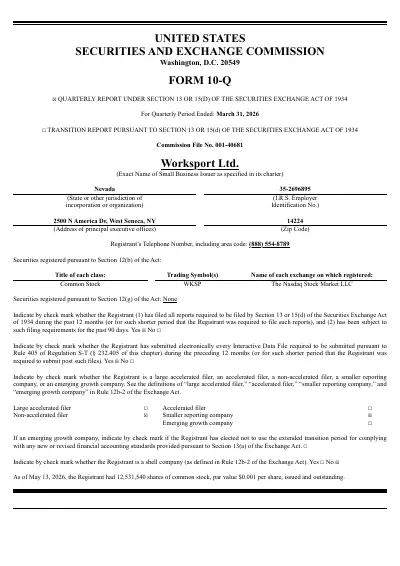
We will be reviewing the financial results for the quarterly period ending March 31st, 2026. These results were just filed today at 4:00 PM Eastern Time in our Form 10-Q and can be downloaded from the link provided in the chat.
At the end of today's call, our prepared remarks and presentation deck will be available for download at www.investors.worksport.com/#reports. Again, www.investors.worksport.com/#reports.
Our remarks will follow on a slide presentation. After our prepared remarks, we will open the line for questions.
On that, let's begin. First, safe harbor statements.
During this call, we will make forward-looking statements including statements regarding our financial outlook for the full year 2026, our expectations regarding financial and business trends, impacts from the macroeconomic environment, and our market position, opportunities, go-to-market initiatives, growth strategy, and business aspirations, and product initiatives, and the expected benefits of such initiatives. These statements are only predictions that are based on our current beliefs, expectations, and assumptions.
Because forward-looking statements relate to the future, they are subject to inherent uncertainties, risks, and changes in circumstances that are difficult to predict and many of which are outside of our control. Actual results or events may differ materially.
Therefore, you should not rely on any of these forward-looking statements. These forward-looking statements are subject to risks and other factors that could affect our performance and financial results, which we discuss in detail on our filings with the SEC, including our annual report on Form 10-K and quarterly reports on Form 10-Qs and other SEC filings.
The forward-looking statements made in this earnings call are only made as of today's date. Worksport assumes no obligation to update any forward-looking statements we may make on today's webinar.
With that, we have our agenda. On today's call, we'll be covering the following.
First, key highlights from our Q1 2026 that we just filed. Number two, liquidity position and capital strategy.
Number three, financial review. Number four, update on Worksport operations.
Number five, an update on Terravis Energy and the AL3X, the exciting product. Number six, the 2026 outlook in general.
With that, let's jump to key highlights. Let's dive into it.
Q1 2026 was the investment and launch readiness quarter, and we executed it with that objective in mind. In January, the SOLIS and COR started commercial shipping.
In March, we unveiled NEXUS to industry buyers at the Keystone Big Show and initiated pre-order activity on this product offering. In April 2026, NEXUS launched commercially, COR received the applicable UL and CSA certification package needed to support broader North American retail and commercial distribution, and we secured distribution with Tri-State Enterprises, including their placement of an initial purchase order.
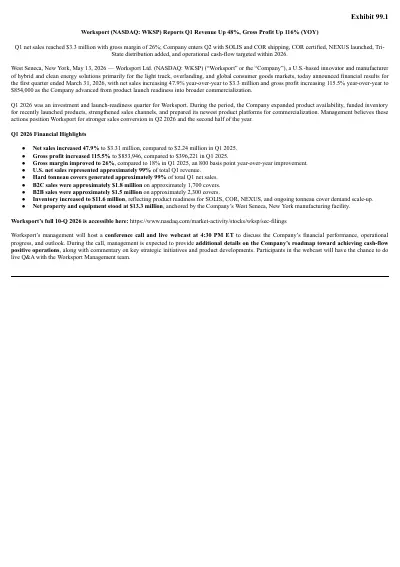
Revenue grew approximately 48% year-over-year to $3.3 million, and gross profit more than doubled, increasing approximately 116% to $854,000. Gross margin was approximately 26% in Q1 compared with approximately 18% in Q1 of last year.
These are meaningful year-over-year improvements. Since Q1 2026 was a launch readiness quarter, our current product portfolio has yet to meaningfully contribute to our results, including gross margin contribution.
We are entering our broadest product revenue opportunity to date for our tonneau cover business. During Q1 of 2026, we funded inventory, conducted multiple product launches, refined our marketing strategy, and allocated resources to bolster our distribution network.
We can now focus on converting our working capital investments for the balance of the year. We enter Q2 with a stronger product portfolio, continued growth with our distribution relationships, and deeper sales channel opportunity than any prior period in Worksport's history.
Our cash position reflects the cost of operational and strategic growth efforts, and we will address that directly. The key investor highlight for Q1 of 2026 is this: we built product availability, funded launch activity, and expanded our commercial platform.
Q2 2026 and the second half are about conversion: shipments, sales channels, and activation; margin efficiency improvement; and lower operational cash burn. We're projecting strong growth in both B2B and B2C sales channels as well as a focus on meaningful efforts towards profitability from the operations in the second half of 2026 and beyond.
More on that soon. First, and before we move deeper into the financial review, let's step back for a second and review what Worksport actually is.
At its core, Worksport, as a business, consists of two key elements. First, we're an innovation-focused US manufacturer.
Second, we are building a clean energy solution, or multiple solutions. These two areas are not separate; they move together.
Our manufacturing platform gives us the ability to design, build, and scale physical products. Our clean energy focus gives our products a larger strategic purpose.
These are the two core capabilities we believe that can drive the company towards profitability within the near term. We are a US-based manufacturer with approximately $11.6 million in inventory, $13.3 million in net property and equipment, including approximately $8.3 million of building and land net value and $6.6 million of manufacturing equipment net value.
We have more than 500 dealer locations and target more than 1,500 dealer locations by the end of this year. Our global intellectual property portfolio alone includes approximately 26 issued and 56 57 patent pending utility patents, 51 issued and 25 pending design patents and registrations, and 44 registered and 15 pending trademarks.
We're also in the process of preparing and filing several other key utility and design patent applications across various countries and jurisdictions. We started production of our tonneau covers just in late 2023, and based on internal sales data, we have sold approximately 26,000 tonneau covers through worksport.com and related direct online channels from 2024 through Q1 of 2026, including approximately 8,000 covers in 2024, 16,000 covers in 2025, and 2,000 covers alone just in Q1 of 2026.
In 2025 alone, across both B2B and B2C channels, Worksport sold approximately 25,000 tonneau covers and generated $16.1 million in net sales. We're quite proud of these statistics.
Worksport started on the foundation of roughly 61 million pick-up trucks in the USA on US roads alone, and pickup trucks remain among the top selling vehicles in the US every single year. People buy pick-up trucks regardless of broader economic conditions.
We started by making high-quality tonneau covers at prices that compete and in many cases can beat competitors that primarily source raw material and components from foreign markets. We believe we can continue to capture market share in the estimated $4 billion-plus tonneau cover market in 2026 and build the tonneau cover core business into a nine-figure profitable middle market company over time.
Said plainly, we believe Worksport has the potential to become a $100 million-plus middle market revenue company profitably from tonneau cover sales alone. That's just our foundation; that's our core of this business.
Our vision does not stop at tonneau covers. We imagine a future where pickup trucks evolve from power-consuming utility vehicles into mobile power platforms, nanogrids that support owners at the campsite, worksite, emergency site, and on fleet levels.
That is where our newly launched SOLIS and COR product offerings enter the picture. The tonneau cover is the physical platform.
SOLIS adds solar generation and COR adds portable energy storage and usable power wherever you go. Together, SOLIS and COR allow Worksport to move from an aftermarket automotive accessory business into an anticipated $13 billion-plus portable power market.
Importantly, COR is not limited to truck owners. COR is a modular portable power system that can function as a stand-alone product for job site, off-grid, emergency, recreational, and general portable power use cases for anybody anywhere globally.
We are actively targeting OEM, fleet, dealer-direct, distributor, and other direct-to-consumer relationships while continuing to build brand and consumer awareness around this new line of product offerings. Our next steps could be to look at integrating COR battery backup technology for residential and commercial power, a possible first-of-its-kind modular battery system for emergency power or peak energy savings and off-peak cost savings for businesses with strong apparent opportunities in industrial applications.
Now, our subsidiary Terravis Energy is at the forefront of developing energy-saving HVAC technology. The AL3X zero frost heat pump has all the elements to become a significant breakthrough in energy saving as a product solution alone.
It is expected to be the only heat pump platform capable of operating without traditional defrost cycles, and it has been tested to operate smoothly in extreme temperatures rarely seen by conventional systems. In fact, I'll say not seen by conventional systems.
AL3X can provide heating and cooling highly efficiently, and we have a keen focus on home heating. We're also currently evaluating efficiencies within data center cooling technologies.
The breakthrough AL3X heat pump is expected to advance towards certification in 2026 and address a $150 billion-plus HVACR market. We have received a strong level of interest through initial inbound inquiries, achieved support through the US Department of Energy including their National Renewable Energy Laboratory, and are engaged in active government-related and strategic conversations.
AL3X sits on top of the core Worksport product platform as an important additional opportunity. In short, Worksport has three related but distinct layers.
First, the core tonneau cover business, what I call our foundational business; second, the SOLIS and COR power ecosystem; and third, the longer-term highly efficient AL3X HVAC opportunity through Terravis Energy. We will provide more information and more details on Terravis later in this call.
Let's talk about liquidity. I will now address our liquidity position directly.
Our fiscal 2025 Form 10-K included a going concern explanatory disclosure. That disclosure is important, and we are addressing it through a clear operating plan: convert inventory into revenue, grow gross margins in each of our sales channels, and reduce operating cash consumption as our product launch spending normalizes, and maintain a disciplined approach to working capital and capital market funding resources as needed.
Our ability to continue as a going concern remains dependent on generating future cash flows from operations while maintaining access to debt and equity capital markets. The largest use of cash in Q1 was the capital-intensive launch-related investments.
The primary use of cash was working capital to support production of our existing product offerings and the expected growth of additional product offerings launched in 2026, including SOLIS, COR, and the new NEXUS. We received approximately $5.1 million of inventory to support the expanded product lineup, with approximately $1 million of these raw material purchases remaining in accounts payable as of March 31st, 2026.
We also used cash to settle prior period working capital obligations. The objective from here is clear: turn that inventory into revenue, continue to improve our gross margin for each sales channel, and reduce operating cash used quarter-over-quarter.
Our West Seneca facility also remains a substantial, meaningful asset on the balance sheet, reflected in our $13.3 million of net property and equipment. We are a manufacturing company with real assets, real inventory, and an expanding order and distribution base.
The question is execution velocity, and Q2 2026 begins answering that question. Our priority is to reduce our reliance on equity capital and potential added dilution, or additional dilution, to existing shareholders as revenue scales and working capital normalizes.
Capital strategy: we remain transparent with our use of capital tools. During Q1 of 2026, we raised approximately $2.2 million, including net proceeds, through our amended at-the-market offering with H.C.
Wainwright. As a result, we issued 1.46 million shares of common stock.
We recognize the impact of dilution, and we are mindful of our shareholder responsibilities. Our strategy remains to use the ATM as a tactical tool subject to applicable Form S-3 public float limitations and market conditions, and not as our primary capital vehicle.
Where capital tools are used, we will continue to evaluate them through one lens: whether the operational return justifies the dilution and improves the long-term shareholder value equation. With that, I'll hand the call over to Jennifer to walk through our financial results.
Jennifer Kartychak
Thank you, Steven. Good afternoon, everyone.
It's a pleasure to be speaking with you, and I look forward to continuing these conversations as we progress through fiscal 2026. Net sales for Q1 2026 were $3.3 million, an increase of approximately $1.1 million, or 47.9%, compared to $2.2 million in Q1 2025.
Geographically, the US continues to represent an overwhelming majority of our net sales at 99%, up 48.5% year-over-year. Within our segment, hard tonneau covers generated approximately $3.3 million in net sales, accounting for approximately 99% of total Q1 net sales.
Our soft tonneau cover segment contributed approximately $0.04 million. The concentration in net sales in the hard tonneau covers segment reflects our ongoing strategic focus on higher-margin, American-made product offerings.
From a channel perspective, Q1 also reflects a deliberate transition in how we are building the business. In Q1 2026, B2C, or the direct-to-consumer online channel, contributed approximately $1.8 million in net sales on approximately 1,700 covers, while B2B generated approximately $1.5 million on approximately 2,300 covers.
Direct-to-consumer activity remains an important sales channel to develop, but our growth strategy includes an enhanced concentration in the B2B sales channel, including dealers, distributors, fleets, and potential OEM partnerships. Moving on to gross margin: gross margin for Q1 2026 was approximately $0.9 million, more than doubling from approximately $0.4 million in Q1 2025, a 115.5% year-over-year improvement.
Our Q1 2026 gross margin was approximately 26% compared to approximately 18% in Q1 2025 and approximately 30% in Q4 2025. The sequential movement from Q 2025 Q4 2025 to Q1 2026 was primarily driven by our sales channel mix.
In Q4 2025, our sales mix was weighted more heavily towards the direct-to-consumer sales channel, while in Q1 2026, our mix shifted closer to an even split between B2C and B2B. Importantly, our B2C margin improved sequentially from approximately 30% to approximately 34%, but the higher relative concentration from B2B sales channel, which has a lower margin, impacted that blended gross margin.
On to operating expenses: total operating expenses for Q1 2026 was approximately $6.6 million compared to $4.7 million in Q1 2025, an increase of approximately $1.9 million, or 41%. Let me walk you through some of the key line items.
Research and development expenses decreased by approximately $0.2 million, or 44%, between Q1 2025 and Q1 2026. This decrease reflects the natural progression of our product development projects.
The AL4 and HD3 moved out of active development and into full production during 2025. Our R&D spend is increasingly directed towards next-generation innovation rather than ongoing refinement of production-ready products.
General and administrative expenses increased by approximately $0.9 $0.8 million, or 24%, from $3.4 million in Q1 2025 to $4.3 million in Q1 2026. This increase is primarily attributable to the timing of costs incurred to support capital market positioning and promotion of our enterprise value amidst a perceived valuation gap in our market value.
We continue to manage this expense caption with strategic discipline. Sales and marketing expenses increased by approximately $1.3 million, or 148%, from $0.9 million in Q1 2025 to $2.1 million in 2020 2026.
The increase resulted from the combination of intentional brand awareness and product launch campaigns directly linked to the launch of multiple product offerings in early 2026. We launched three products and initiated large-scale digital marketing campaigns to drive awareness for both the COR and SOLIS as well as to support the overall brand validation.
We are closely monitoring the ROI on each marketing channel and plan to optimize accordingly. On to cash flows and the balance sheet: cash and cash equivalents were $566,000, down from $5.9 million approximately at December 31st, 2025 2025.
As Steven noted, this decline reflects working capital deployed to fund multiple product launches and reduce prior period obligations. Net cash used in operating activities in Q1 2026 was approximately $8.2 million.
Let's further discuss the cash used from operations. Our net loss of approximately $5.8 million included approximately $1.1 million of non-cash items, primarily stock-based compensation, depreciation, and amortization.
That implies a cash-based operating loss of approximately $4.7 million. Working capital used an additional approximately $3.5 million, driven primarily by inventory build and the settlement of prior period payable obligations.
I would like to reinforce that we do not expect the level of working capital used in Q1 2026 to repeat at the same magnitude as inventory begins converting into revenue and prior period obligations normalize. That normalization, combined with a growing revenue base across multiple sales channels, is how we close the gap and achieve cash flow positivity.
Inventory increased by $2.1 million to $11.6 million as of March 31st, 2026. Of that total, raw goods grew from $3.4 million to $5.3 million, a direct reflection of our investments in COR and SOLIS as well as the NEXUS product readiness.
Raw materials of $5.4 million reflects our near-term production pipeline. We are not anticipating a significant use of cash for further material purchases until Q3 2026.
Working capital as of March 31st, 2026, was approximately $6.6 million compared to $10.1 million at December 31st, 2025. This reflects our strategic decision to proactively convert working capital into operational assets to support the launch of multiple product lines in early 2026.
Our asset base, anchored by approximately $13.3 million of net property and equipment, represents our investment in our West Seneca manufacturing facility and continues to provide a strong foundation to support our future production growth. I will now turn the mic back to Steven to review our operational milestones.
Steven?
Steven Rossi
Thanks, Jen. On January 13th, 2026, we announced the commercial launch of our flagship energy product duo, the SOLIS solar tonneau cover and the COR portable energy system.
This was a defining moment for Worksport. Years of R&D, engineering, certification work, and manufacturing preparation culminating in real products shipping to real customers from our facilities.
SOLIS is the world's only commercially available solar-integrated hard folding tonneau cover. COR is a mor- modular portable energy system that integrates with SOLIS or functions as a stand-alone unit for the job site, off-grid, or emergency power needs.
Together, they represent Worksport's entry into the multibillion-dollar clean energy and portable power market. Excited about it.
With the initial product launches behind us, our 2026 focus is scaling SOLIS and COR revenue. In April 2026, COR received the safety and regulatory certifications needed for North American retail and commercial distribution, including all applicable UL and CSA approvals.
The certification package is important because it expands the universe of retailers, distributors, fleets, and commercial customers that we can evaluate to carry the product. We also strengthened our commercial sales channels around these products.
In February 2026, we announced a strategic partnership with PROLOMAC International Partners to help position the SOLIS and COR ecosystem for federal, fleet, and commercial adoption channels. We do not consider these channels as immediate revenue sources, but it is an important awareness channel for products that can serve worksite, emergency, mobile power, and off-grid applications.
SOLIS also carries credibility through our active conversations with OEMs. The point is not that OEM revenues assumed in our 2026 sales pipeline, the point is that the product platform has strategic relevance beyond direct-to-consumer sales, and we are building the channel architecture to pursue that opportunity responsibly.
The question we are focused on answering is how quickly these products scale through which channels. COR and SOLIS did not represent a meaningful amount of sales in Q1.
As emerging products, we are developing marketing assets, product awareness, and sales pipelines to target strong sales towards the rest of the year. We're just getting started.
With a focus on certification, channel onboarding, repeatable fami- fulfillment, and measured customer acquisition economics, the path for market adoption is becoming accessible. We note it took approximately 1 year for our initial Made in the USA tonneau cover lines to build traction.
I will repeat that: we note it took approximately 1 year for our initial Made in the USA tonneau covers, the AL3, to build traction, and we believe that it can achieve that we can achieve the similar speed or better with the SOLIS and the COR. The third major commercial milestone of the quarter was the unveiling of our NEXUS tonneau cover.
Boy, is it exciting. On March 19th, 2026, we pro- pres- presented NEXUS to industry buyers at the Keystone Big Show.
Keystone's one of the biggest aftermarket distributors in North America, one of the premier aftermarket distributors in North America, and this is one of the most premier events in North America. At the Keystone Big Show, our NEXUS product generated immediate buyer interest and pre-order activity.
Following production and commercial launch in April of 2026, early distributor interest is and remains significant. This supports management's expectation that NEXUS can contribute meaningfully in next sales in net sales for this year.
NEXUS is a premium tonneau cover featuring a newly engineered operating system designed to improve the ease of use, safety, and speed for truck owners. Unlike conventional folding tonneau covers that often require users to walk around both sides of the truck to secure latches or prop rods, NEXUS is designed to allow full operation from a single side of the truck while maintaining full bed access.
This is a practi- practical innovation that's focused on a clear customer pain point, and early distributor demand supports our view that the product can accelerate adoption across both existing and new sales channels. I encourage everyone to check the product out at www.worksport.com.
It's astonishing. In late 2026, we announced that we secured Tri-State Enterprises as a new cross-regional distribution partner and our biggest at the time for full for a full tonneau cover lineup inclusive of NEXUS.
Tri-State expands our distribution reach across Arkansas, Missouri, Oklahoma, and Texas. Tri-State operates approximately 1 million square feet of warehouse space and has already placed initial purchase orders and reorders.
Management believes Tri-State can become a seven-figure near-term account with recurring multimillion-dollar potential. Our distribution strategy remains a central pillar of our 2026 growth plan.
We entered in the year with a dealer network that exceeded 500 locations, a nearly sixfold increase from the start of last year. Our target is to reach 1,500-plus locations by the end of this year through a combination of direct dealer onboarding and new distributor partnerships.
Remember, there's 17,000 dealers in America, we're just getting started. The Tri-State Enterprise partnership announced in April of this year is our first major distributor relationship and gives us the broader penetration into new geographic markets.
Importantly, this is not just a logo announcement. Tri-State has already placed initial purchase orders, and truck bed covers are among its top-selling categories.
That alignment matters because it increases the likelihood that distribution reach can translate into real sell-through. We're also in closing discussions with nationwide dealer network capable of bringing our products to all US continental states.
We will update investors as these as these discussions move from pipeline to signed commercial relationships. Each of these relationships represent a potential step change in distribution reach, but our standard for reporting progress will remain execution: orders, channel activation, repeat purchase behavior.
We're strictly focused on execution this year. Our US manufacturing and quality credentials also matter to this strategy.
The West Seneca facility that we built is an ISO 9001:2015 certified facility, which supports our ability to pursue larger dealer, distributor, fleet, and potential OEM relationships. Quality certification does not create revenue by itself, but it removes the friction in conversations with larger counterparties that require require this for quality systems.
Our B2B go-to-market strategy continues to complement our direct-to-consumer e-commerce sales channel. We believe that the combination of strong online presence, an expanding dealer network, and new distributor partnerships is the right model to capture demand across the $4 billion-plus tonneau cover market.
The investors' takeaway is straightforward: the channel base is becoming larger, more diversified, and increasingly capable of absorbing a broader product lineup. Let's talk AL3X.
Terravis Energy, our our clean energy subsidiary, continued to make progress in the first quarter of this year. In February 2026, we confirmed that a large government entity is actively monitoring upcoming laboratory performance results of for the AL3X heat pump as a part of an internal evaluation process.
We also announced that the certification work is progressing, with AHRI, Energy Star, and other North America certification milestones targeted within 2026. To be clear, no procurement decision has been made, and we are not currently projecting initial AL3X revenue within this year.
However, we anticipate commercial opportunities within 12 months. What we are saying is that a credible government-related evaluation process is underway and that the technology is advancing towards third-party validation, certification, and potential early commercialization in the $150 billion-plus HVACR market.
We believe that AL3X is the only heat pump technology in the world tested to operate at temperatures as low as -57°F without the need for energy-intensive defrost cycles. Our proprietary Zero-Frost technology eliminates defrosting cycles entirely, opening the doors to markets and applications that have historically been difficult for conventional heat pump technologies to to serve.
AL3X can also be viewed as a as a strategic upside driver beyond the revenue drivers embedded in our 2026 pipeline. The core 2026 revenue is expected to be driven by the tonneau cover business and early SOLIS and COR contribution.
AL3X is a separate platform advancing through testing, certification, and commercialization work. We intend to update investors as lab results and certification milestones are achieved.
2026 outlook: so let's talk about this for a second. This is the strongest commercial work position Worksport has occupied at to start any of the fiscal years in our history.
We've provided revenue 2026 guidance of $35 to $42 million in our 2025 Form 10 10-K. We believe our revenue will increase substantially from 2025 and we'll actively target operational cash flow positivity this fiscal year.
As part of our recent key leadership transition, we re-evaluated our strategic priorities. We believe it is in the best interest of all shareholders to conduct a high-growth and construct, sorry, a high-growth, enduring business that can compound shareholder value over the long term.
Although it's not going to be a straight line, we are going to get there, and we are relatively young, and we are a dynamic business with consistent growth in design, production, and distribution of quality and innovative products, which offers us a promising future and opportunities. We believe our approach to support the this achievement of our strategic priorities includes a more holistic evaluation of our guidance policies.
Accordingly, we planned we plan to provide annual financial guide guidance every calendar year. The primary driver for moving away from quarterly guidance updates is to increase our emphasis on allocation of resources on long-term strategy, including a focus on shareholder value.
We believe a change in the frequency of providing guidance updates from a quarterly basis to an annual basis allows us to prioritize long-term vision over short-term metrics, which will allow us to focus and align our near-term priorities to meaningfully contribute to the successful execution of our strategic objectives. With countless potential operational variables alongside emerging sales and product channel mixtures, we'll hold off on specific guidance updates but reaffirm our previous broader guidance.
Fiscal 2026 is about achieving cash flow positivity from operations and continued upward revenue trajectory. As I said earlier, we are executing, we're going to continue to grow, and we're going to hit cash flow positivity, but it is never a straight line.
In closing, to our investors and our analysts, I want to close with this: 3 years ago, Worksport was generating under $2 million in annual revenue. Last year, we crossed $16 million.
This year, we're on the path for achieving operational capital cash flow positivity just with our foundational product and significant revenue uptake. This is the company we have all built together.
We have done this by manufacturing in America, building products that dealers and consumers want, and expanding our distribution with discipline. I also want to note that I've recently purchased shares on the open market, reflecting my personal conviction in the company's long-term direction.
Our responsibility now is to turn that conviction into measurable execution, and I will purchase shares again if I have to. In Q1 of 2026, it's not a perfect quarter from a cash flow perspective.
It will be a quarter it was a quarter where we did what we said we were going to do: launch SOLIS, launch COR, unveil NEXUS, added major distribution, and completed COR certifications, expanded gross margin year-over-year, and improved loss per share, all while it was the slowest quarter of the year. Q1 tends to be the slowest quarter seasonally of the year for tonneau cover sales.
Q1 was the investment and launch readiness quarter. Q2 of 2026 and the second half are about proving proving conversions: turning inventory into revenue, dealer growth into orders, NEXUS demand into shipments, and margin expansion into lower cash burn.
We're also building strategic vectors around federal channels, OEM targeting for SOLIS and COR, and AL3X certification process progress, none of which are required for making the overall business operationally cash flow positive. We expect the tonneau cover business, our foundational business, to be capable of that on its own, and everything else is accretive to that.
We are not managing this business for a single quarter. We are building a durable, American-made manufacturing platform with growing channel reach, expanding product breadth, and clean energy optionality.
We intend to earn investor confidence quarter by quarter through results, not promises. Thank you for your continued support and interest in Worksport.
Thank you, Steve. We have Tate Sullivan here from Maxim who has his hand up for some questions.
Tate Sullivan
Thank you, Steven. Thank you for the comments on inventory.
That was one of the first things I saw, and then with finished goods balance of $5.3 million of the $11.6, is most of that NEXUS, I assume, and other tonneau covers or a relatively large amount in SOLIS and COR as well?
Steven Rossi
COR takes a chunk of it. It's in the millions for COR because we have to manufacture in batches of 1,000 at a time.
Then the rest is a blend: AL3, HD3, AL4, and NEXUS only just started being made at the tail end of the quarter. Jen may have a bit more back-of-the-napkin insight on that, but it's an even blend in my perspective.
Am I right, Jen?
Jennifer Kartychak
Yes, it's an even blend, but there isn't a concentration in our NEXUS. The NEXUS concentration's really in our raw materials at this point.
Tate Sullivan
Understood. Does that imply first sales of SOLIS and COR in 2Q or not necessarily given the timing of the marketing on those products?
Steven Rossi
Sorry, ask that again, Tate. Does sales represent SOLIS and COR?
Oh,
Tate Sullivan
do you think you'll have first sales, first revenue from SOLIS and COR in the second quarter, or did you already have some in the first quarter?
Steven Rossi
We had some. We were building the plane while we were flying it with the SOLIS and COR, and unfortunately the final production units of both were also at the same time concurrent with initial productions like launch.
When we got the first batches of CORs, it was those very CORs that we used to give to influencers, generate media content, and it takes probably a quarter in itself to produce the media content. If you look on our web page, Facebook, all social medias, you're just starting to see that content get out there, and then we have to do ad spend on it and invigorate the markets, as well as the process to get it into distribution and dealers is difficult because there's pricing, there's agreements, there's negotiations.
Like I said numerous times during the earnings call in the transcript is it's not a straight line, but at the end of the day, the dots connect one higher than the next, and we've delivered that. To answer your question, we did clip sales COR and SOLIS, but they just weren't that meaningful, although you look at the AL3, our first product, it took a year to get that to market, and that product is an existing market.
When we're forging a new market the likes of which has never existed, it's to be expected it's going to take at least this year to get that product off the ground into meaningful revenue territory.
Tate Sullivan
Last for me, plea- one more, please, is you had a slide on the B2C B2C and B2B tonneau covers and then the combined price per cover, back of the envelope, a little above $800, that's well above from the level of per tonneau cover last year from the Q information. Is that because of the hard cover mix from soft cover primarily?
Then also the margins with B2B those are lower than B2C, but by a meaningful amount, is that what you said? Sorry, two questions there.
Steven Rossi
The average order value has gone up by about 35% if I'm not wrong, maybe even more. We're just selling more expensive items, and then also with domestic inflation we're 90% we're over 90% domestically sourced materials, very little foreign content, but domestic inflation is real.
The price of aluminum has doubled in the past year, our cost is also increased, and that's eroding margin, but as fast as it's eroding margin, which was a real thing last year as well, we're picking up efficiencies as well in how we make the product. We're improving as fast as domestic inflation might be nibbling away, but the good thing, the light at the end of the tunnel is aluminum is not going to stay at an all-time high, and when it increases, will our margin exponentially while we maintain discipline and manufacturing.
I think that might answer your question if it's not a giant run-on sentence. What was the second one, Tate?
Then
Tate Sullivan
you had a 35% gross margin target, not understanding doing the guidance on an annual basis, and I think you answered that, how you get there even if you have more B2B sales, lower aluminum prices, that'll help you get to that 35, is that fair?
Steven Rossi
With any luck, there's a few different things that we're doing. Number one is B2B is, back of the napkin, lower margin, but there's also a general lower cost to service the account, both in warranty, freight, marketing, CAC costs, CAC is a customer acquisition cost of Google, Meta, these types of ads.
What we discount them is actually at times less than what we have to spend to sell it directly on our website. Net-net is very similar, and then we have the economies of scale from them reaching, like Tri-State Enterprises, let's block and tackle this question.
Tri-State services Texas same-day. There's absolutely no way that Worksport has the infrastructure this year to be able to service that state same-day.
Now we have massive economies of scale by relying on their infrastructure to just sell more covers to more people quicker and better, and then in essence their discount on the product is the equivalent of our CAC cost, our customer acquisition cost on direct-to-consumer, it almost nets out the same. Then, again, the upside is economies of scale, we have our overhead absorption over more units, but then the other thing is as soon as we have, with any luck, a trade deal specifically on aluminum, and some of this craziness that's happening in the broader geopolitical environments, where aluminum starts coming back down, that's when we're really going to reap the benefits.
We're weathering a storm right now that everybody's weathering. Last thing I'll say is the most popular vehicle in North America is the F-150, and I believe the price tag of the F-150 for the average American's gone up $20,000 in a year for the base model, maybe if not 20,000, very close, and that's because it's an all-aluminum truck, Ford feels it, we're going to feel it, and you can't paint Worksport with a different brush than what Ford Motor Company has painted with.
Tate Sullivan
Thank you, Steven.
Steven Rossi
Welcome, Tate. Thank you.
Tate, also, now that we're starting to grow as a business, we're starting to see it's insane to think that Q1, that's measurably the slowest quarter of the year for tonneau cover sales, now that we're growing, we're seeing this, just a lot of snow in most of the US, cold weathers, truck sales are down, as we're maturing, we're learning this, but it's also to note that it's going to almost be impossible to ever have a Q1 be higher revenue than the previous Q4, with Q4 being Christmas, all the holidays, as well as Black Friday, which is by measure our biggest month in November. There's almost no way.
While we're doing guidance and looking at following Worksport and to any investor and shareholder listening, it's important to note that Q4 will always be higher. Even if it's a billion-dollar Q4, we're never going to have a $1.1 billion Q1, at least with the foundational products of tonneau covers, unless there's a massive liquidity event and a new product like the AL3X that might be a more winter seasonal product.
Does that make sense?
Tate Sullivan
Yep, understood. Thank you.
Steven Rossi
Yeah.
All right, Steve, thanks for those replies. We did want to open the floor and and give some commentary to the shareholders attending the call today that going forward, Worksport will be hosting monthly town halls that will be speaking to commentary on business, recent press releases, and updates to the day-to-day developments of the business as it's happening.
This is to boost transparency, but also to show the investors and share- shareholders all the wonderful things that are currently developing. As part of the town hall sessions, we do open up a Q&A portion to people attending the call, as well as people that have submitted questions before the call.
In this case, we do have a host of questions that are available to us that people have submitted within the last 10 days, and, Steve, I will now open the floor with some of those questions. Here, we have question number one, which is around our cash position.
The question is stating that how we plan to fund the company with the current cash balance we have, as well as commentary on any expected dilution.
Steven Rossi
It's a good question. I think that investors have to understand that I'm the biggest shareholder in Worksport, recently having bought shares, and, of course, I don't want dilution.
Nobody does. What all shareholders and investors want is exactly the same.
We all want Worksport to be a $1,000 a share, we all want Worksport to pay dividends, we all want Worksport to be highly successful, and we also don't want any more shares ever to be issued. You can see that over the past 6 months, we've been very modest in at-the-market.
At-the-market, the offering we do at the at-the-market is just selling from time to time stock in at-the-market. It saves us warrants, it saves us discounts to hedge funds.
Hedge funds often want discounts. It saves manipulation in shorting, it saves banker fees, it saves investor relations fees, which were significant last year during our Reg A.
To speak to dilution, we don't want it, and we've tried to sip, not gulp, for almost half a year since December of last year was our last offering. We're doing our absolute best there.
We fund our operations through an operating line. We have a significant book value.
The book value of the business is close to $30 million, if I'm not being too forthright in saying that. That's a financeable assets that we have that we're able to borrow against.
When borrowing money is cheaper than issuing securities at a $10 million market cap, we do that. We are going to maybe raise some money this year.
Last year, we were very active in the markets. We raised, I think, $25 million.
This year would be a fraction of that, if 10% of that, through the markets or through debt instruments. The minute we're cash flow positive, we'll qualify for senior lines of credits at regional banks, at KeyBank in Buffalo, and that's what I'm really hoping, that we could qualify for that $10, $20, $30 million line of credit.
I've said numerous times, and I hope that investors are listening, when I say that it's not a straight line, but I think that the ramp this year in revenues is going to be as close to straight as you could get in real business. It's ugly, but we're getting there.
Thanks, Steve. Appreciate that.
Now we have a question for the CFO regarding a breakdown of G&A. We thought we could get some more insights there for shareholders.
Jennifer Kartychak
Sure. In terms of our breakdown of G&A, I'll talk about G&A in its totality, and then what gets absorbed up into our margin, if you will.
In our G&A pool, about 66% of our G&A costs is with salaries, wages, and benefits, inclusive of equity compensation. About 11% of that is depreciation and amortization, about 10% relates to facility support, and then the remainder relates primarily to professional fees.
Professional fees does include non-cash expense related to equity compensation. Of that 66%, it should be noted that about 20% of that actually gets absorbed into our margin.
Fantastic. Thanks for that insight, Jen.
We had a question for Steve regarding the company's view on how AL3X should be valued or at least looked at at this current time.
Steven Rossi
I I I think that if I think that if AL3X if Terravis Energy was private, I feel that it would have significant valuation. I I'm going to disclaim that disclaimer that I'm not making any representations or warranties by saying this, but I believe that Terravis Energy and the and just the technology with the AL3X is should be a nine-figure valuation.
The the the significance of of interest that we've had from businesses that are cloak global has the likes of which we've never seen before. At its current stage, I feel that it's a nine-figure valuation because I I feel that it's it presents nine- and 10-figure revenue opportunities very, very quickly.
We're going to get there. The we we've shown that we know how to get a product to market and selling, this is just the same.
I think that the valuation, although is is basically nothing right now, we're trading at a third of our book value. I think that Terravis Energy's is a significant value, $50 to $100 million at minimum if it was private.
Thank you, Steve. We have a question here regarding sales and marketing spend.
Could you comment on the jump of Q1's sales and marketing expense and what we think is going to be more likely for the rest of the year?
Steven Rossi
Absolutely. Because of the increase in costs that we've had as a result of inflation, domestic aluminum prices doubling, we've had to reduce the ability to discount.
Before we were, if you guys saw, we were doing, AL3s for $799, and now AL3s are almost $1,000, we can't discount our product as much. To that extent, we've had to spend more on marketing to be able to get higher average order value.
We think that the marketing we got it under control now. It took a little it took all of this quarter, sorry, Q1, to get it under control with the reduction of discounts, and we think that the spend is going to be probably about 20% to 30% of the of the sales.
It's going to keep going up, we're going to spend more because we want to sell more, but the idea is it's all profitable.
Right. We had a question here about Tri-State.
There is a recent distribution partnership with Tri-State. Could you comment on how big that really is, quote-unquote, and if it is likely to lead to other partnerships with other distributors?
Steven Rossi
Tri-State's massive. Tri-State services Texas same-day.
We can't do that. There's no way we can compete with their service level.
They're a big business. They have a million square feet of warehouse space, and they sell tens of millions of dollars of tonneau covers a year, and the NEXUS is the best tonneau cover in the market.
I could guarantee that. Tri-State could be a seven-figure, maybe even eight-figure account for Worksport, and we've heard of distributors buying tens of millions of dollars a month from our competitors, I don't think that Worksport would not be able to at least aspire towards that as time goes.
There's three distributors in America. Tri-State is more regional, they're not national, they don't service all of the US, then there's Meyer and Keystone that's owned by LKQ Corporation.
Typically, they compete with each other, whatever Tri-State does, Meyer's does, and then Keystone does. The fact that we've landed one means that we are very confident that we're going to land the other two, and the other two are larger in revenue and in size, and they service all of North America, inclusive of Canada, maybe even Latin America.
The answer is whatever Tri-State does, typically Keystone and Meyer's does as well, and Keystone and Meyer's are bigger in terms of top-line revenue, the opportunity becomes exponentially larger while Tri-State in itself is still very meaningful for top-line revenue opportunities.
Thank you. We have another question regarding the certification of the COR that has recently passed through in Q1 of 2026.
Does that mean that we can expect revenues to start coming in from that product line, or what does that mean in terms of commercialization?
Steven Rossi
We don't need to have certification. There's Chinese units on Amazon right now that aren't certified.
We don't sell on Amazon. Amazon is, I think, where products go to die, but as we talk to OEMs, governments, and fleets, it's a good qualifier.
ISO certification opens the door to commercial B2B, meanwhile on direct-to-consumer B2C, we've got the marketing assets live now. We're just rolling them out now, and we're going to start the marketing engine.
The AL3 took a year to get off the ground, and we think that within the same year time frame, let's say Q1 of this year to the end of Q1 of next year, we think that the COR is going to be significant. One thing I'll say is EcoFlow, which is Chinese-owned, Chinese-operated, Faron, you got the statistic, I think it was about a billion dollars in sales a few years ago?
Reported to sell over a billion dollars in 2023.
Steven Rossi
In 2023, EcoFlow, which is a Chinese-owned and operated business with an inferior product, not modular at least like ours, sold a billion dollars 3 years ago. We know that even if we got 10% of that over time, that's still $100 million in top-line revenue, and the product's done.
We've turned off the R&D engine for that product, there's no more spend, it's just a matter of getting it out there and getting it selling. The rest of this year is extremely bright looking for the COR.
Thanks, Steve. We have an interesting question here regarding the revenue guidance for 2025, where we initially stated a guidance of $20 million on the north side, and that the year ended up closing closer to $16 million, which was still an improvement by almost 100% year-over-year.
The shareholder has a question regarding missing that guidance and why that kind of happened and what that means for the future revenue guidances that we might speak to or issue.
Steven Rossi
Good question. Revenue guidance, we're we're a $10 million market cap company.
I was saying internally today that we should we have no business issuing guidance, we're just doing it to be as transparent as possible. We don't have to issue guidance, we're doing it to be able to at least let shareholders participate in the business and see what our aspirations and dreams are.
We don't have We're just a a brand new business. It's not like after 10 or 20 years of operations, you could really kind of go based on real metrics.
Last year was the first year for us to be in business with two product lines, this year is the first year for us to be in business with seven product lines, we're really just doing educated guesses. We could spend more and sell more, but then the the gross margin goes down.
To be able to maintain profitability, it's always a a balancing act. We want to be able to sell more, but, yeah, we we we don't we have to spend more on Google, we have to spend more on sales reps and agents and commissions, and and then the profits very low and then that looks even worse.
We we had to call it at the end of the year to say towards the second half of the year saying, "Let's focus on profit" to to be able to finance the the operations versus the growth. The growth is going to be there, it's just a matter of getting there profitably, and that's that's a very difficult balancing act.
We're going to get to a middle-market business, but we want to get there profitably, which may take us a little longer, but it's better than than getting there fast, but not profitably.
Thanks, Steve. We have another question regarding evidence that NEXUS could be a meaningful revenue driver.
Could you speak about the NEXUS product and where you think it falls in terms of the revenue mix for 2026?
Steven Rossi
A good friend of mine, Julian Maiman, was the founder of BAK Industries, he's a friend that I do keep in touch with, he exited the business. He had BAK Industries at $80 million in revenues over a decade ago with the BAKFlip G2, which is measurably inferior to the NEXUS.
BAK Industries is rumored to be over $200 million in revenues today, and their product, I believe, are measurably inferior. If you see some of the videos I did a year ago online, they have paper-thin aluminum panels, they have rubber seals, you have to drill holes in the bed, you have to walk around and do prop rods up, and they're just not as good of a product.
I'm not trying to talk poorly about the company, I look up to their parent company, but I do know that of BAK Industries' product, the rumor was about $200 million of sales. Whether that was a high a few years ago or it's something that they're still doing today, I don't really know because they're private still, but that was the rumors from credible sources.
The answer is if BAK Industries is selling an inferior product, albeit longer-standing product, and about over $100 million, I think that Worksport can be able to get to $50 or $100 million in top-line revenues with an improved, a significantly better product that you don't have to walk around the truck, doesn't dent as easily, and doesn't require drilling, and doesn't fall apart after a year.
Fantastic. Thanks for that insight, Steve.
We do have one more question here regarding the sales and marketing percentage, and I'm going to direct this to Jen. The percentage of sales and marketing that is variable on B2C, could you comment on how that was in Q4, Q1, and now heading into Q2 2026?
Jennifer Kartychak
Sure, I'd be happy to do so. In terms of sales and marketing, the variability really rests with a lot of our IR efforts that we've done to promote our brand, combined with a concentration not only in performance marketing, but also overall brand awareness.
We did complete a multi-month campaign with a vendor to evaluate our overall brand awareness and found that the performance marketing that we have actually been doing so intensely over the past year or so has really contributed towards broader brand awareness and our primary server in the B2C space being those good old truck owners. We really took that information towards the end of Q1 2026 and said, "Let's just keep honing in on the awareness that we are doing in terms of our product awareness and refining our strategies there so that we can get closer to a more normal rate, if you will, to achieve growth certainly within the B2C space, but not having to do as much in the way of promotions as we have in the past 12 months."
Excellent. Speaking specifically to the product margins in B2C, could you comment on how we saw a spend of marketing cost as described inside the transcript for the shareholder who asked for a little bit more insight on how that played out and what we expect to happen?
Jennifer Kartychak
Could you repeat the question? I apologize, you were a little bit muffled.
Steven Rossi
You're mumbled, Faron.
Sorry about that. Is this a little bit more clear?
Steven Rossi
Somewhat, yeah.
Okay. The question is related to the product cost of marketing, if you could give some more insight on how the product marketing costs have changed in the last few months and where it's expected to go.
Steven Rossi
Product marketing costs have changed in the last few months and where it's expected to go.
Jennifer Kartychak
We've done a lot of work in terms of making sure that we understand the level of effort that's necessary in order to contribute towards a successful campaign, and to that end, we've employed some outside consultants to help us assess our existing campaigns, augment those campaigns, and produce more credible reporting for which we are able to use that information in order to build better algorithms, if you will, and achieve our objectives. We very much have been able to use a lot of what we've learned in the AL3, AL4 initiatives to essentially zoom in on our effort in AL4 space, which is a really great revenue driver for us, and then also use that information as a springboard for the COR and SOLIS, because the COR and SOLIS, honestly, from a marketing standpoint, direct-to-consumer marketing standpoint, is a different approach because it achieves the ability to capture market on a broader scale as opposed to just a niche market.
Hopefully, that addresses your question.
Steven Rossi
It does also, I'll just chime in real quick, Faron, that marketing is very volatile. For example, one of our competitors has 2 million site visitors a month, and that's not very organic, that's paid visitors.
Let's say it's a dollar per visitor, they're spending $2 million a month in ads, and we're competing directly with them and other competitors as well. The space is just highly competitive.
I think that the US economy is challenged, the marketing costs are more significant this year because businesses need to continue to find growth and get sales, it's just more competitive in the marketing world right now, and it's expensive. To that extent, marketing costs are very volatile, and it takes a level of basically geniuses to navigate this on active almost 24/7 basis.
Thanks, Steve. The last question here is if you had any final remarks for shareholders that are currently listening to this call and have read the Q, what would you want them to know as the key takeaway from this call?
Steven Rossi
Key takeaway is that growth is ugly and it's not in a straight line, that in the uplisting era of 2021, when we listed to NASDAQ from OTC, we uplisted with companies, my comrades, that none of which exist, which is a testament to how difficult it is to grow a business. That as easy as it is to judge us for our losses, our victories are significant and meaningful in this space.
While we had COVID, hyperinflation, multiple wars, and a lot of economic challenges, but the point is that we remain steadfast in execution, and we remain steadfast in the delivering on our business. From a million to six, from a million to eight to 16, and this year with the 30-plus in line, our insight, I think the key takeaways are that we're executing, but it's not a straight line, and it's not easy, and if it was easy, those that judge easily would be doing it themselves.
To that extent, we're focused on this exclusively and working our rear ends off, and we're going to get there. This year's the first year we have seven products, with AL3X coming down the pipeline as well.
The key takeaways are as much as we didn't sell as much this quarter than Q4, which is unrealistic and crazy to think that a business would sell more in the middle of winter than Christmas and Black Friday, we also spent less and we came out basically even. If we had sold $5 million, we would have made basically the same amount of profit from having to spend so much in marketing.
To that extent, we're being prudent, and we're showing stable, disciplined growth, and we have the best in front of us. Meanwhile, we're focused on delivering shareholder value, which is selfish because I'm a big shareholder in Worksport, I want what everybody on this call wants, which is continued success.
That's in short what it is. It's not a straight line and it's not pretty, but we're grinding.
Thank you very much, Steve. Thank you, Jen, and thank you for everyone attending the call.
This does mark the end of the conversation. We do encourage you to send any additional questions or remaining questions to us at [email protected], and we look forward to hosting monthly town halls going forward.
Steven Rossi
I'll close, Faron, just to say, yeah, In order to increase our following and our appreciation of our hard work and be able to listen to shareholders, we're going to do monthly town halls. What we're going to do now is every month major press releases that have to go out will go out.
We'll do press releases at the end of the month for smaller town hall related matters of updates, larger press release that outlines smaller important elements that are not as material. Anything material comes out right away, of course, by requirement.
Then immediately adjacent to that press release, we're going to schedule, I think, about a week later a town hall where we're going to be live on video just answering questions live. Shareholders will be able to go live, they'll ask questions, not typed, we'll welcome them to voice their questions, they can share video, and we're going to have an open and frank conversation, win, lose, or draw, on a monthly basis where we'll give updates on sales, revenues, answer questions.
You want to know about G&A, I see a question here about salaries and payroll. Jen, actually, you should answer that.
The salaries and payroll, if you're still here, on G&A, Is there a round number you could throw out there on what that looks like?
Jennifer Kartychak
Yes, I can address that from two different perspectives. From the perspective of what makes up our payroll, meaning the components of payroll, our base wages and overtime is a little bit north of 95%, and then our benefits is I gave you the wrong number, I apologize.
I'll shift over just briefly in terms of giving you information as to who's in that payroll number. As of Q1 2026, about 51% of our salaries and wages was actually from our production wing, and most of that gets absorbed back into our inventory, and about 28% of that is coming from our admin function, and the balance is a smattering between our sales function as well as our warehousing function and facilities function.
Hopefully that addresses your thoughts there. Then in terms of our wages and salaries, as I said, about 70% of our salaries and wages is base wages and overtime, about 30% of that is relating to or 17% of that is related to benefits, and then the balance is related to that compensation expense, which is non-cash in nature.
Steven Rossi
Great, thanks, Jen.
Jennifer Kartychak
Then
Steven Rossi
I see Nachi, you're asking me questions about Terravis, and with Terravis, you can ask me I think we talk on LinkedIn, you can message me, but obviously we will always explore divestitures, sales, mergers, acquisitions, these types of things. I think that we want to continue to bring value there so that it's accretive to the Worksport shareholder base.
Worksport owns about 70% of Terravis and the other 30% is held by the key executives. Another thing I'll note with respect to Terravis is it's headed by my father, Lorenzo Rossi, who's the primary shareholder of Terravis Energy and options.
Also Lorenzo, to continue to support the business, has reduced his salary. He still works full-time at Terravis Energy, and he has no salary as a CEO of that business.
He just has base compensation as a director that serves on the board since 2014, which is $5,000. To that extent, he's working for Terravis and leading this charge and bringing the brilliance and genius for $60,000 a year, and I think that that shows that we're all very committed.
Me with my base salary and compensation, I invested a good chunk of that into buying Worksport stock. About a third of it.
To that extent, we're all doing everything we can and working our rear ends off to get there. Like I said, it's not a straight line, we see an $0.85 stock or $10 million market cap, but every quarter we continue to deliver better book value, now that's closer to $30 million in asset value for Worksport with all of these great upside opportunities.
It's going to go eventually, it's going now, but eventually the valuation is going to be better and we're very, very positive for this year ahead specifically.