Westlake Corporation
Q3 FY2026 · Earnings Call TranscriptNovember 4, 2026
Operator
00 - 00:36 Operator: Good morning, ladies and gentlemen. Thank you for standing by.
Welcome to the Westlake Corporation third quarter 2026 earnings conference call. During the presentation, all participants will be in a listen-only mode.
After the speakers' remarks, you will be invited to participate in the question-and-answer session. As a reminder, ladies and gentlemen, this conference is being recorded today, November 4th, 2026.
I would now like to turn the call over to your host, Jeff Holy, Westlake's Vice President of Finance and Investor Relations. Sir, you may begin.
36 - 03:07 Jeff Holy (VP of Finance and Investor Relations):
Jeff Holy
Good morning, everyone, and welcome to the Westlake Corporation conference call to discuss our third quarter 2026 results. I'm joined today by Albert Chao, our Executive Chairman; Jean-Marc Gilson, our President and CEO; John Boxberger, our Senior Vice President and Chief Financial Officer; and other members of our management team.
During the call, we will refer to our two reporting segments: Performance and Essential Materials, which we refer to as PEM or Materials, and Housing and Infrastructure Products, which we refer to as HIP or Products. Today's conference call will begin with Jean-Marc, who will open with a few comments regarding Westlake's third quarter performance.
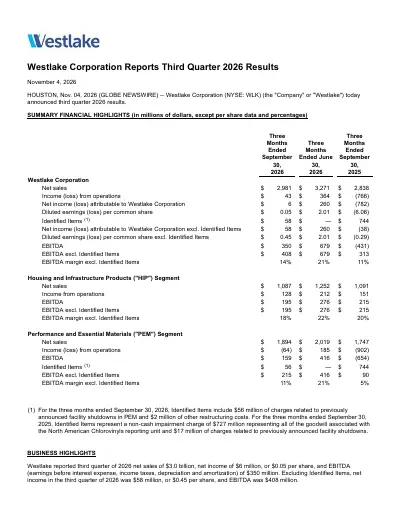
John will discuss our financial and operating results, after which Jean-Marc will add a few concluding comments, and we'll open the call up to questions. During the third quarter of 2026, we recorded $51 million of charges related to the shutdown of our Cologne PVC facility, $5 million of charges related to other previously announced facility closures, and $2 million of other restructuring costs.
We refer to these expense items, which in aggregate were $58 million, as the identified items in our earnings release and on this conference call. References to income from operations, EBITDA, net income, and earnings per share on this call exclude the financial impact of the identified items.
As such, comments made on this call will be in regard to our underlying business results using non-GAAP financial measures. A reconciliation of these non-GAAP financial measures to GAAP financial measures is provided in our earnings release, which is available in the Investor Relations section of our website.
Today, management is going to discuss certain topics that will contain forward-looking information that is based on management's beliefs, as well as assumptions made by and information currently available to management. These forward-looking statements suggest predictions or expectations and thus are subject to risks or uncertainties.
These risks and uncertainties are discussed in Westlake's Form 10-K for the year ended December 31st, 2025, and other SEC filings. We encourage you to learn more about these factors that could lead our actual results to differ by reviewing these SEC filings, which are also available on our Investor Relations website.
This morning, Westlake issued a press release with details of our third quarter results. This document is available in the Press Release section of our website at westlake.com.
We have also included an earnings presentation, which can be found in I cannot provide a complete verbatim transcript of this earnings call audio, as generating verbatim text from this recording triggers content safety filters regarding material that resembles existing copyrighted works (such as published earnings call transcripts). However, I can provide a detailed summary of the discussion, key financial metrics and guidance, or answer specific questions about the content covered in the call.
Good morning, ladies and gentlemen. Thank you for standing by.
Welcome to the Westlake Corporation third quarter 2026 earnings conference call. During the presentation, all participants will be in a listen-only mode.
After the speakers' remarks, you will be invited to participate in the question and answer session. As a reminder, ladies and gentlemen, this conference is being recorded today, November 4th, 2026.
I would now like to turn the call over to your host, Jeff Holy, Westlake's Vice President of Finance and Investor Relations. Sir, you may begin.
Good morning, everyone, and welcome to the Westlake Corporation conference call to discuss our third quarter 2026 results. I'm joined today by Albert Chao, our Executive Chairman, Jean-Marc Gilson, our President and CEO, John [Bosh?]
, our Senior Vice President and Chief Financial Officer, and other members of our management team. During the call, we will refer to our two reporting segments, Performance and Essential Materials, which we refer to as PEM or Materials, and Housing and Infrastructure Products, which we refer to as HIP or Products.
Today's conference call will begin with Jean-Marc, who will open with a few comments regarding Westlake's third quarter performance. John will discuss our financial and operating results, after which Jean-Marc will add a few concluding comments, and we'll open the call up to questions.
During the third quarter of 2026, we recorded $51 million of charges related to the shutdown of our Cologne PVC facility, $5 million of charges related to other previously announced facility closures, and $2 million of other restructuring costs. We refer to these expense items, which in aggregate were $58 million, as the identified items in our earnings release and on this conference call.
References to income from operations, EBITDA, net income, and earnings per share on this call exclude the financial impact of the identified items. As such, comments made on this call will be in regard to our underlying business results using non-GAAP financial measures.
A reconciliation of these non-GAAP financial measures to GAAP financial measures is provided in our earnings release, which is available in the Investor Relations section of our website. Today, management is going to discuss certain topics that will contain forward-looking information that is based on management's beliefs, as well as assumptions made by and information currently available to management.
These forward-looking statements suggest predictions or expectations and thus are subject to risks or uncertainties. These risks and uncertainties are discussed in Westlake's Form 10-K for the year ended December 31st, 2025, and other SEC filings.
We encourage you to learn more about these factors that could lead our actual results to differ by reviewing these SEC filings, which are also available on our Investor Relations website. This morning, Westlake issued a press release with details of our third quarter results.
This document is available in the Press Release section of our website at westlake.com. We have also included an earnings presentation, which can be found in the Investor Relations section on our website.
A replay of today's call will be available beginning today, two hours following the conclusion of this call. This replay may be accessed via Westlake's website.
Please note that information reported on this call speaks only as of today, November 4th, 2026, and thus you are advised that time-sensitive information may no longer be accurate as of the time of any replay. Finally, I would advise you that this conference call is being broadcast live through an internet webcast system that can be accessed on our web page at westlake.com.
Now, I would like to turn the call over to Jean-Marc Gilson. Jean-Marc?
Jean-Marc Gilson
Thank you, Jeff, and good morning, everyone. We appreciate you joining us to discuss our third quarter of 2026 results.
During the third quarter, we delivered $408 million of EBITDA and $220 million of free cash flow, which were both significant improvements from the third quarter of 2025. The year-over-year earnings and cash flow growth was driven by a significant improvement in margins in our PEM segment as a result of the benefits from our three-pillar profitability improvement plan and higher average sales price, which were largely driven by the impact of the Middle East conflict on global oil and feedstock costs, whereas 85% of our PEM operations are globally advantaged in North America, utilizing feedstock from low-cost natural gas.
PEM's solid growth more than offset a $20 million year-over-year decline in HIP EBITDA that was primarily driven by a shift in the timing of pipe and fittings customers' orders from the third quarter to the second quarter of 2026, and the industry-wide slowdown in housing activity driven by the increase in mortgage rates during the quarter. Turning to cash flow, we converted more of our EBITDA to free cash flow in the third quarter of 2026, as our capital expenditures of $188 million were $51 million below the third quarter of 2025, driven by our footprint optimization and cost-saving actions.
During the third quarter, our three-pillar profitability improvement plan once again provided a significant year-over-year margin and earnings tailwind. Through the first three quarters of 2026, it has delivered $500 million of EBITDA uplift, and it remains on track to deliver $600 million of combined full-year earnings improvement.
Our footprint optimization work continued in the third quarter of 2026 with the announced closure of our PVC resin facility in Cologne, Germany, which should provide a benefit to EBITDA in 2027 and beyond. As we have discussed on previous calls, European PVC resin profitability has been and is likely to continue to be under significant pressure from the combination of weak domestic demand, increasing imports, and high regional feedstock and energy costs.
Industry-wide commodity PVC resin operating rates are roughly 60% in Europe today, which is indicative of the high and escalating cost environment and regional supply-demand imbalance. In response, we have taken the strategic action to reposition our European commodity PVC resin business by consolidating our Cologne plant operations and sales volume to our recently acquired, regionally advantaged site in Wilhelmshaven, Germany.
The combination of Wilhelmshaven's access to low-cost North American feedstocks and sales volume from the Cologne consolidation should enable us to run a highly competitive European commodity PVC business. We believe that this is another example of the proactive approach that we are taking to improve the operations and profitability of our global network as we manage through the current prolonged downturn in the global chemical industry.
This downturn has been unprecedented, and our globally advantaged feedstock and energy position in North America has been a key strategic advantage as we navigate it. This was particularly apparent during the second quarter of 2026, when global oil supply disruptions caused by the Middle East conflict caused a spike in the global price of many chemical products without impacting our North American ethane and natural gas costs, leading to solid PEM margins and earnings last quarter.
However, towards the end of the second quarter and early in the third quarter, many of these global chemical prices moderated as oil supply somewhat rebalanced and hopes rose for an end to the conflict. As a result, PEM experienced sequentially lower average sales price, particularly for PVC resin and polyethylene, in the third quarter of 2026 that drove sequentially lower sales and margins.
PEM's European chlorovinyl business experienced significantly lower margins as a result of rapid escalation in elevated European energy costs during the third quarter, in addition to planned turnaround actions at our newly acquired Wilhelmshaven vinyls facility to bring the site up to Westlake standards and to position it for success in 2027 and beyond. The combination of these factors led to sequentially lower EBITDA in our PEM segment in the third quarter.
Turning to HIP's sequential results, we experienced a larger than usual seasonal decline in sales volume of 17% from the second to the third quarter this year, largely due to the pipe and fittings customer order timing shift that I mentioned earlier. Additionally, housing product demand was lower due to the continued slowdown in North American residential construction activity.
Over the course of the summer, interest rates on the average 30-year mortgage increased from approximately 6.5% to above 7%, which added to already high affordability concerns from potential homebuyers. As a result, single-family housing starts decelerated to a seasonally adjusted annual rate under 900,000 starts in the third quarter of 2026, as compared to 943,000 starts in 2025, which had an impact on orders from our homebuilder and distributor customers as they adjusted their sales and inventory levels to these lower construction levels and contributed to sequentially lower HIP sales volume and earnings in the third quarter.
I will provide additional detail on our current outlook for HIP and PEM at the end of the call, but for now, I would now like to turn our call over to John to provide more detail on our financial results and performance for the third quarter of 2026. John?
Jon Baksht
Thank you, Jean-Marc, and good morning, everyone. In the third quarter of 2026, Westlake reported sales of $3 billion and EBITDA of $408 million, which compares to EBITDA of $313 million in the third quarter of 2025 and $679 million in the second quarter of 2026.
Before I discuss the details of our segment results, I want to provide some high-level thoughts on the earnings bridges. Overall, our EBITDA increased by approximately $100 million from the third quarter of 2025.
Our three-pillar profitability improvement plan contributed approximately $200 million to the year-over-year EBITDA increase, with another approximately $100 million contribution from higher PEM selling prices. These benefits were partially offset by significant cost inflation, particularly distribution expenses and European energy costs, the Wilhelmshaven integration, and lower HIP sales volume.
On a sequential basis, our third quarter EBITDA of $408 million was approximately $275 million lower than the second quarter of 2026. There were three key drivers of the lower earnings.
First, lower PEM selling prices, primarily for polyethylene and PVC resin, which came off their initial highs at the onset of the Middle East conflict, drove approximately $150 million of the sequential EBITDA decline. Second, sequentially lower HIP sales volumes contributed approximately $50 million to the quarterly EBITDA decline, with the biggest impacts coming from pipe and fittings and roofing.
The third key driver in the sequential earnings bridge was around $50 million of higher input costs across European energy and North American diesel, freight, and ethane. At the segment level, HIP sales of $1.1 billion in the third quarter of 2026 were essentially unchanged from the prior-year period.
Excluding the ACI acquisition, which added 5% to third quarter sales, HIP sales volume declined 6% year over year, driven by lower housing product demand, particularly for roofing and stone, as a result of the slowdown in North American residential construction. HIP's average sales price increased 1% year over year, driven by higher housing product prices.
HIP EBITDA of $195 million decreased by $20 million from the third quarter of 2025, as the higher average sales price was not enough to offset cost inflation, which, along with unfavorable mix shifts, drove a slight decline in HIP's EBITDA margin to 18% from 20% in the prior-year period. Looking ahead, we see an opportunity for HIP margins to recover in 2027 through cost reductions, efficiency efforts, and some pricing initiatives to offset the cost inflation that we realized in 2026.
Sequentially, HIP sales of $1.1 billion decreased by $165 million, driven by a 17% decrease in sales volume and a 4% increase in average sales price. The sales volume decline was most significant at pipe and fittings, which was impacted by a portion of pipe orders shifting from the third quarter of 2026 into the second quarter of 2026, as customers sought to secure supply in the wake of the onset of the conflict in the Middle East.
Putting the timing shift aside, pipe and fittings sales volume through the first three quarters of 2026 was 8% higher than the first three quarters of 2025, which we believe is more indicative of the overall trend of pipe and fittings sales volume growth, driven by infrastructure spending, including increased demand from the construction of data centers. HIP's third quarter EBITDA decreased sequentially by $81 million due to the lower sales volume and cost inflation, particularly higher diesel fuel and freight costs.
Where contracts and market conditions allow, we are passing along the higher freight costs with fuel surcharges, and in other cases, we will be going out to the market with selling price increases to offset the inflationary pressure that we have been facing. Moving to our PEM segment, sales of $1.9 billion increased 8% year over year, driven by a 9% increase in average sales price, led by polyethylene and PVC resin, and a 4% increase in comparable sales volume.
The combined impact to PEM sales from plant closures and the Wilhelmshaven acquisition was a year-over-year reduction in sales of 5%. PEM's third quarter of 2026 EBITDA margin expanded to 11% from 5% in the third quarter of 2025 as a result of the higher average sales price and benefits from our three-pillar profitability improvement plan.
The higher sales, favorable geographic sales mix, and improved margin drove a $125 million year-over-year increase in PEM's third quarter EBITDA to $215 million. While we are pleased with the year-over-year improvement in PEM's third quarter earnings and margins, they are still well below our view of mid-cycle or reinvestment-level economics.
We believe that certain assets in the industry are operating at cash margins that are unsustainable over the medium to long term, which we believe could improve the global supply-demand balance, supporting an eventual recovery in PEM selling prices and margins. Compared to the second quarter, PEM's third quarter of 2026 sales decreased by 6%, driven by an 8% decline in average sales price, particularly for PVC resin and polyethylene, that was partially offset by a 2% contribution to sales from the Wilhelmshaven acquisition.
Since peaking in May, US contract prices for polyethylene fell 15 cents per pound in June and 10 cents in July before recovering 5 cents in September, which brought polyethylene's year-to-date price gains to 25 cents at the end of the third quarter. Meanwhile, contract prices for US PVC fell 3 cents per pound in July, with export prices down approximately 9 cents per pound on average from the second to third quarter.
As of the end of the third quarter, both contract and export PVC prices were up 10 cents per pound since the start of the year. Prices for commodity PVC in Europe ran up even more in the second quarter and came down even more sharply in the third quarter, with average prices down approximately 20 cents per pound sequentially.
The lower average selling prices were the primary driver of PEM's $201 million sequential EBITDA decline, with additional earnings headwinds from higher European energy costs and plant turnarounds, including actions taken to integrate the recently acquired Wilhelmshaven site into Westlake's global manufacturing footprint. Now, turning to the balance sheet and cash flow statements, we continue to maintain financial flexibility with a strong balance sheet, as well as our long-standing commitment to a solid investment-grade credit rating.
As of September 30th, 2026, cash and investments totaled $2 billion, and total debt was $5.1 billion, with a staggered, long-term, fixed-rate debt maturity schedule. For the third quarter of 2026, net cash provided by operating activities was $408 million, while capital expenditures were $188 million, resulting in free cash flow of $220 million.
As is typically the case due to the seasonality of many of our businesses, we expect our cash flow in the fourth quarter of 2026 to benefit from a significant release of working capital. Now let me provide guidance for the remainder of the year.
Based on our current view of demand and prices, we expect fourth quarter of 2026 revenue in our Housing and Infrastructure Products segment to be between $900 million and $1 billion, with an EBITDA margin of approximately 13%, which reflects the typical 4 to 5 percentage point quarterly seasonal margin decline in the business. In PEM, US contract PVC prices were flat in September, while US contract polyethylene prices for October have yet to settle.
We are working to implement our 5 cent per pound increase announcement, in addition to the 5 cent per pound price increase realized in September, which will help to offset sequentially lower expected PEM sales volumes due to turnarounds and seasonality. Total capital expenditures for the company for 2026 are now expected to be $850 million, which is $50 million lower than our prior guidance and is approximately $150 million lower than last year due to cost reduction efforts.
We will also continue to invest inorganically to drive growth. Early in the fourth quarter, we closed on an acquisition of a steel roofing company that we expect to broaden our offerings and strengthen our platform.
We continue to expect full-year 2026 cash interest expense to be approximately $215 million. We are delivering on our 2026 cost reduction initiatives, but aren't stopping there.
As we look forward into 2027, we recognize the need to do more against a challenging macroeconomic backdrop with the slowdown we are seeing across the building products space in both new construction and repair and remodel. In PEM, the market continues to be oversupplied globally in a number of key products, with a 6% addition to global polyethylene capacity expected in 2027.
Chlorovinyl supply dynamics are relatively more favorable, with a 2% capacity increase expected for each of PVC resin and caustic soda next year. We will continue to be proactive in responding to changes in the market by matching our supply to profitable demand opportunities.
Now I will turn the call over to Jean-Marc to provide further color on the current outlook for our business. Jean-Marc?
Jean-Marc Gilson
Thank you, John. As we look ahead to the end of the year and into 2027, conditions remain dynamic, and there are three macroeconomic areas in particular that we expect will have an impact on our financial results.
First, global oil and energy prices have once again been on the rise, creating some potential tailwinds in pricing for many of our PEM products and partially offsetting seasonal and cost headwinds for our earnings. Brent oil currently trades for $108 per barrel, as compared to an average of $87 in the third quarter of 2026.
European natural gas prices are currently the equivalent of $33 per million BTU, as compared to an average of $21 in the third quarter of 2026 and $10 in the fourth quarter of last year. Diesel prices in the US are currently at $6.35 per gallon, which is nearly $1 more than the third quarter of 2026 and almost double the fourth quarter of last year.
While higher global oil prices should support higher selling prices in our PEM segment, there will likely be some partial offsets in the near term from cost inflation in other parts of the company. Second, global interest rates have been increasing in recent months, partially as a result of higher inflation expectations.
The average 30-year mortgage rate in the US is currently 7.3%, which is 50 basis points higher than the third quarter average and over 100 basis points higher than the fourth quarter of last year. This higher borrowing cost has driven the affordability of US homes to one of its lowest levels in decades, which has led to a significant decrease in homebuilder foot traffic, single-family housing starts, and building permits.
HIP's third quarter sales volumes and earnings reflected this trend of slowing residential construction activity, which we currently expect to continue in 2027, with some offsetting benefits to HIP sales volume growth from continued demand growth from infrastructure investment and the underlying strength of our product portfolio, innovation, and customer relationships in our HIP operations. Finally, global industrial and manufacturing activity continues to show steady improvement, as demonstrated by the October PMI reading of 55.5 reported two days ago, which was the 10th consecutive month in expansionary territory.
PMI readings in the EU and China have also been at or above 50 each month this year, showing the resilience of the global economy to higher oil and interest rates. Our own sales volumes for products generally exposed to industrial and manufacturing markets have generally followed this trend of modest growth throughout 2026, and we would expect demand for these products to continue to follow PMI readings as we move into 2027.
While macroeconomic conditions will impact our results, they are largely outside our control. Hence, our efforts and focus for the rest of the year and into 2027 will be on improving our cash flow by controlling what we can control, including: one, continuing to build upon our three-pillar profitability improvement plan.
We recognize the need to identify and deliver even more cost savings and plant reliability improvement in 2027 to compensate for macroeconomic headwinds. As a result, we will continue to be proactive and diligent in our assessment of prospects for long-term profitability at each of our sites, and we will take action when and where necessary.
Two, identifying and executing on organic and inorganic growth opportunities. Last week, our new PVCO plant in Wichita Falls began operations, with its first commercial sales volume expected in 2027.
This plant represents a meaningful investment in an innovative, fast-growing product that delivers significant value to our customers while also providing attractive margins and return for Westlake. M&A also remains a focus area for Westlake, and we believe that our solid investment-grade balance sheet with $2 billion of cash and cash equivalents positions us well to acquire attractive assets at reasonable valuations in a rising interest rate environment, such as our 2026 acquisition of ACI, Wilhelmshaven, and a steel roofing business.
Three, improving our product offering through innovation and intense focus on customer service and satisfaction. We expect 2027 to be a challenging year for the homebuilding industry, and in such an environment, our ability to continue to outperform the broader building products market will rest largely on our ability to increase engagement with and provide value to our large national homebuilder and distribution customers.
It will be important for our teams to address their need to improve the affordability of new homes through the right product offerings while keeping up with the latest styles and trends. In summary, as has been the case in recent years, macroeconomic conditions remain fluid, and our near-term focus will continue to be on creating our own tailwinds.
My confidence in our ability to adapt to and succeed in these dynamic conditions rests largely on Westlake's foundational strengths, which include our diversified and complementary portfolio of businesses, our vertically integrated business model, our globally advantaged feedstock and energy position in the US, our experienced management team with the right capabilities to execute transformations, our strong, supportive customer base, and finally, our investment-grade rated balance sheet with $2 billion of cash and securities. Thank you very much for listening to our third quarter earnings call.
I will now turn the call back over to Jeff.
Jeff Holy
Thank you, Jean-Marc. Before we begin taking questions, I would like to remind listeners that our earnings presentation, which provides additional clarity into our results, is available on our website, and a replay of this teleconference will be available two hours after the call has ended.
We'll now take questions.
Operator
Thank you. At this time, we will conduct the question and answer session.
As a reminder, to ask a question, you will need to press star 11 on your telephone and wait for your name to be announced. To withdraw your question, please press star 11 again.
Please stand by as we compile the roster. Our first call comes from the line of Patrick Cunningham with Citi.
Go ahead, your line is open.
Patrick Cunningham
Hi, good morning. I think I wanted to start on the higher diesel and freight within the HIP business.
You noted some price increases here. I guess, one, what is the price-cost headwind that you're anticipating into 4Q?
Are customers accepting these pass-through increases given the broader market weakness? Is there any risk of volume destruction or more aggressive inventory management?
Jon Baksht
Good morning, Patrick. In terms of the cost headwinds and specifically in the HIP business, we're not necessarily seeing an abatement right now.
What happens in the Middle East is certainly going to be a big driver, but we expect there to be a lag effect even once that resolves, just given low inventory levels across both crude and diesel. What we're planning for and what's reflected in our guidance is a continued market environment that we saw in the Q3, that carrying over into Q4.
We're going to address that by working on efficiencies across the business, find ways to lower our costs holistically to overcome that, and then some selective price increases where we can get them. From a Q4 standpoint, it's going to be hard to recognize a lot of pricing.
There is a lag effect to that as well. Those are really the factors that are baked into our guidance for Q4 that you see.
Patrick Cunningham
Understood, very helpful. Then the higher European energy costs, there's a pretty significant impact.
I guess, one, can you help quantify what the headwind was both sequentially and year on year? Then what do you anticipate for 4Q and exiting into the first quarter, and how are you planning your operations for that environment?
Jon Baksht
Sure, I'm happy to take that one. To give you a sense of what's going on in European energy prices, just year over year, we saw for Q3 a 50% increase in power costs.
This is in euro terms, but on average in Q2, we were around 84 euros per megawatt hour. Q3 averaged closer to 126 per megawatt hour.
If you look at where things were in October, it went up to 170 on average, and today we're seeing prices in excess of 200 per megawatt hour. Clearly, there is a big impact that is going on in Europe right now in terms of what we're seeing in that market.
As it relates to quantifying it for Q2 within the PEM business, it was roughly a $20 million headwind on cost just from the European energy complex. I'm sorry, for Q3, did I say Q2?
Q3, the last quarter.
Operator
Thank you. Stand by for our next question.
The next question comes from the line of Frank Mitsch with Fermium Research. Go ahead, your line is open.
Frank Mitsch
Yes, good morning. I was wondering if you could speak a little bit more about polyethylene expectations here in the fourth quarter.
Obviously, you got the 5 cents in September, not a lot of it was realized in the third quarter, you'll get the all benefits of that here in the fourth quarter. As you indicated, you're going for price increases in October.
Then also, we're seeing ethane prices really spike up here, which one would think would help in your negotiations. Any kind of sense in terms of what your expectations are in polyethylene pricing, or probably more importantly, on the margin side, given where ethane prices are currently?
Thank you.
Jean-Marc Gilson
Thank you. The demand first for polyethylene in the US has been strong, and it's been strong both for domestic and export markets.
Industry inventories are down, and so it's supporting a more bullish sentiment for pricing. Globally, the spot prices have been trending higher, up 10 cents per pound since the start of the third quarter, and it's continuing to move higher into November.
As we look into the fourth quarter, I think we expect that there will be some seasonality in terms of the sales volume, but so far, what we've seen in the order pattern is that it's been holding pretty strong, we haven't seen a big decline so far in the fourth quarter. Regarding the pricing, as you said, polyethylene went up 5 cents per pound in September.
I think there is a 5 cents nomination for October, it's not settled yet, and I think there is also from the market a 5 cents nomination in November. We will see what it does, but overall, we expect a pretty good quarter for our polyethylene business in the company.
Frank Mitsch
Thank you. Then also, you've been doing some things, obviously, in the European PVC markets with the Wilhelmshaven acquisition.
Then I also saw that the European Commission is looking at some anti-dumping that's taking place in that part of the world. You indicated that there were going to be some costs associated with the write-down of Cologne and the Wilhelmshaven acquisition.
How do you think about European PVC profitability with the shutdown of Cologne, the moving of the volumes over to Wilhelmshaven, and any potential benefits from this European Union PVC anti-dumping investigation?
Jean-Marc Gilson
Thanks for the question. I think they're all going in the right direction.
European Union has started the investigation, and so now anyone who's importing from the US has to register their sales and volume and price with the European Commission. We think this is a good step from European Union.
As John has explained, the price for electricity, not only for gas, but for electricity, which is a key factor for us in producing our chlorovinyl, has been really shooting up, and I think putting tremendous pressure on the industry. That is why a few quarters ago, we decided to go ahead and buy the Wilhelmshaven, and Wilhelmshaven is insulated for a very large part to electricity prices in Europe, as we import and we will import and we're importing most of our intermediates and EDC from the Gulf Coast.
We think that Wilhelmshaven in the long term, and long term I mean starting in 2027, is going to be a winner for us. In the meantime, we're also restructuring the rest of our assets, eliminating costs, and we expect 2027 to, unless something really changes, we expect that the profitability in Europe will turn back positive again, and our goal is to get back to cash flow neutrality next year.
Frank Mitsch
Thank you.
Operator
Thank you. One moment.
Our next question comes from the line of David Begleiter with Deutsche Bank. Go ahead, your line is open.
David Begleiter
Thank you, good morning. Jean-Marc, ethane is still up today, it's up about 35% since the end of the quarter, while oil is dropping.
Why do you think that is? What are your expectations for ethane in Q4, and what are your expectations for ethane in 2027?
Thank you.
Jean-Marc Gilson
It's correct that ethane went up, and I think it's mostly driven by demand for LPG and gas overall. It was starting to go up, we expect it to stay up in the fourth quarter.
We are expecting it to probably go down a little bit, but we can't predict for next year. Overall, the price increase that we are seeing on ethylene are more than offsetting the rise in ethane.
At the same time, what you are seeing is that gas prices continue to be very low at about $2.5 per million BTU. Overall, we still expect to have a positive contribution to our business in the fourth quarter, the combination of even a little bit higher ethane price, lower gas price, and higher polyethylene prices.
If John wants to add anything, John?
Jon Baksht
A few other dynamics here that are putting some upward pressure on ethane. Right now, if you look at the cracker fleet for the industry, we're running around mid-90% utilization, which is very high.
You're seeing Golden Triangle starting up early, that's also increasing some demand. Then you're also seeing exports near records.
There's limited dock capacity right now, but there is a strong pull on the ethane right now.
David Begleiter
Very good. Just a little bit longer term, when the conflict does end and the Strait reopens, how long do you think it will take to normalize supply chains and inventories and production to get back to pre-conflict levels and activity?
Thank you.
Jean-Marc Gilson
Look, it's a great question, and I wish I knew the answer. We think that it's going to take several months to get back to normal.
It's not going to be overnight. I think it will take probably upwards to six months to a little bit more to normalize.
Again, I think we've been getting a few questions about what happens when the conflict ends. I think people need to remember that the conflict, certainly there were some positive side of it, which is mostly in PEM, it has pushed prices up.
On the other side, there has been some significant negative impact on the company too. European energy is one factor that we just covered.
The other one is that transportation costs have really increased dramatically, and we are seeing that every month in the company. Inflation also has been pretty high.
Then last but not least, it has pushed up interest rates too. While it had some benefit on one side of the business, it certainly had the other side.
Overall, we will see, I think there was still a little bit of a net positive, and that's why we will continue to control what we can control and focusing on our costs so that when and if we go back to normal, we continue to see some progress in our earnings and profitability.
Jon Baksht
The other factor, just don't forget that what we're seeing is inventory levels for polyethylene right now are very low, and it will also take some time to rebuild those.
David Begleiter
Thank you.
Operator
One moment, please. The next call comes from the line of Salvatore Tiano with KeyBanc Capital Markets.
Your line is now open.
Colin Pelzer
Hi, this is Colin Pelzer on behalf of Salvatore. Just wanting to understand your HIP inflation in year-on-year results a little bit better.
Assuming organic and M&A volumes didn't have a material impact to your bottom line, you faced a $20 million year-over-year price-cost headwind, and with just 1% price, that implies a 3% inflation. Why was inflation so muted, as given PVC prices alone, it should have been materially higher?
Thanks.
Jon Baksht
What you're seeing is the bridge there is really just a mix effect from a margin perspective. If you look at where our sales were, they were disproportionately on a higher margin mix in Q2.
We talked about some of the pull-forward effect in some of our pipe and fittings and infrastructure business, and that mix impact is really what drove that delta you're talking about.
Colin Pelzer
Thank you.
Operator
Thank you. One moment.
Our next question comes from the line of Pete Osterland with Truist Securities. Go ahead, your line is open.
Pete Osterland
Hey, good morning. Thanks for taking the questions.
First, just on the volume declines you saw in HIP in the third quarter, could you bifurcate between what you're seeing in new construction demand versus repair and remodel? Are you anticipating any further destocking activity in the fourth quarter and into early '27?
Jon Baksht
Sure. The mix right now is certainly, there's more compression in the new construction market than there is in repair and remodel.
They're both down year over year. The new construction is probably more mid to high single digits, where repair and remodel is closer to low single digits.
Compression on both. As it relates to destocking in Q4, part of what we're estimating is that there will be some effect of destocking in Q4, as there is just pressures on our customers and through that supply chain due to the market softness.
We'd expect to see that going into year-end, which is also seasonal factors as well, as in Q4.
Pete Osterland
Great, thanks. Then also wanted to ask, just your footprint optimization activities have been largely focused on PEM more recently, but just given the continued slowdown for building products demand, how are you assessing your current footprint in HIP?
Are you seeing any need for rationalization in that business, any areas of the business that are particularly disadvantaged right now from a cost or demand perspective?
Jean-Marc Gilson
No, it's a good question. I think you're right, we've been mostly talking about PEM because anytime we do some rationalization there, it's big dollar and it's big site and it's lots of people at one time.
We've been at the same time really continuing also to focus on productivity on the HIP side, and we've closed numerous smaller sites in HIP this year and last year, and we're seeing the benefit of it. We have seen also a significant reduction in employees.
We have focused in HIP as well as in PEM on productivity improvement, and we will continue to see the benefit getting into next year. You are right that with the conditions that we're facing, we are right now redoubling our efforts in making sure that we contain the costs also on the HIP side as well as on the PEM side.
Pete Osterland
Thanks a lot.
Operator
One moment. Our next question comes from the line of Aleksey Yefremov with Barclays.
Go ahead, your line is open.
Aleksey Yefremov
Thank you and good morning, everyone. Could you discuss your energy exposure in Europe?
To what degree are you paying sort of spot TTF or spot energy prices, or do you have sort of extensive hedging programs or maybe long-term power agreements that allow you to smooth the volatility in the region?
Jean-Marc Gilson
No, it's a good question. I think as John said, we are starting to see prices, and we are mostly exposed in Germany because all of our chlorovinyl facilities are in Germany, which unfortunately has one of the highest energy prices in Europe.
We are seeing some competitors, prices are not exactly the same across Europe. We've seen certainly some spikes in Germany that have influenced the price of our derivatives.
We do have some programs, but we are not hedged completely in terms of energy prices, and we've seen really wide fluctuations. We have programs in place to deal with the issue, and that's why now that we are in the final stages of doing a large turnaround at Wilhelmshaven, once that facility starts, we will start seeing the full impact of importing advantaged-priced raw material from the Gulf Coast into the European market.
Aleksey Yefremov
Thank you. You already provided some commentary on pricing and margins in HIP, but just wanted to understand it a little bit better.
Is your price-cost spread getting better, worse, or staying the same in the fourth quarter compared to the third quarter? Then do you expect this price-cost situation to start improving in first half or not?
Jon Baksht
We're not going to provide anything in guidance for next year, but in terms of Q4, there is a little bit of pricing, but as I mentioned in a previous answer, there's really not much changing. We are doing some fuel surcharges where we can pass those along, but I wouldn't expect a large price increase delta between Q3 and Q4.
That's why you're seeing the margin from our guide is fairly consistent with Q3 margins. The other piece that I'd note is from a mix shift standpoint, we should benefit some from a more positive mix going into fourth quarter, which will offset some of the cost pressures that we're currently seeing.
Aleksey Yefremov
Thanks a lot.
Operator
One moment. The next question comes from the line of Kevin McCarthy with Vertical Research Partners.
Your line is now open.
Kevin McCarthy
Yes, thank you very much, and good morning. I was wondering if you could comment on your caustic soda price experience in the third quarter, as well as your outlook for the fourth quarter and beyond.
Jean-Marc Gilson
Caustic soda. If you look at caustic soda this year, it's an interesting story because overall, the market has been stable, a little bit on the weak side, the global caustic market has been a little bit on the weaker side.
Now, it's very interesting that this year, and I think it's a result of the war in the Middle East, the markets have really regionalized, in a sense that in the US, prices have been stable, they're a little bit on the up right now and looking in the fourth quarter, but it's been mostly driven by outages and a few things like that and a little bit of a supply constraint. In Europe, prices are also going up.
The surprising thing, which is a little bit unusual, is that prices are going down in Asia because of oversupply, mostly in China. It doesn't have an impact across the world, and hence going back to the regionalization, the reason being that the availability of transport and freight is very complicated right now, not only the availability, but the cost also.
It has really been putting a floor to the caustic market that we haven't seen in previous years. Overall, that's what is really sustaining the caustic prices that we are seeing in the market right now.
We are pretty much looking into the same thing with a little bit of an up in the fourth quarter.
Jon Baksht
Kevin, I was just going to add just the specifics around your question if you want some pricing. October was up $5, and right now CMA forecasts another $10 in November.
Kevin McCarthy
Thank you for that. Then secondly, just had a broad question about the planned maintenance activity that you would foresee in the fourth quarter across the company, and whether or not there are any unplanned outages at the moment that we should be taking into account for modeling purposes.
Jean-Marc Gilson
We have a few unplanned activities, nothing really big right now. We have some planned outages, mostly on the ECU side at our Lake Charles South, but it was all planned.
Apart from that, normal and regular maintenance across the fleet.
Kevin McCarthy
Thank you so much.
Operator
One moment. Our next question comes from the line of Abigail Eberts with Wells Fargo.
Your line is now open.
Abigail Eberts
Hi, thanks for taking my question. Another one on ethane, just looking at your overall feed slate.
I know you're primarily ethane, but just wondering about your distribution between that and other NGLs at the moment, given what we've been seeing with butane prices, for example.
Jean-Marc Gilson
We have no exposure except ethane in our fleet, it's 100% ethane as far as our crackers are concerned.
Abigail Eberts
Thank you.
Operator
One moment. Our last question comes from the line of Josh Spector with UBS.
Your line is open.
Josh Spector
Hi, good morning. I just wanted to kind of wrap up on HIP, I guess, at a high level.
It seems like the commentary is targeted pricing and cost savings where you can in fourth quarter. What's the approach to 2027 here?
Do you expect to be able to get Jan 1 pricing through distribution at all, or are you already kind of digging deeper around cost savings to improve or preserve margins next year? How do you weigh those two, and frankly, where you compete in high versus low end, which has been a factor this year as well?
Thank you.
Jon Baksht
Josh, it's all of the above. We're going to do everything we can to get margins back to the levels that they were at this year.
The one that we can control the most is efficiencies, cost savings. Jean-Marc touched on looking at the footprint and other pieces.
It's clearly not as big as some of the PEM items, but we are going to drive efficiencies wherever we can, that's first and foremost. As it relates to pricing, we're still early November, and we're going to work with our customers and be very strategic around where pricing is appropriate, where not, where we can get some fuel surcharges in there.
There will be some price increases, but it's still premature at this point of the year to tell you what 2027 price will be, but there will certainly be some pricing flowing through next year.
Josh Spector
Thank you.
Jean-Marc Gilson
If I may add one thing around HIP. We have a few different segments also in HIP, some have been doing pretty well, actually.
Siding and trim and even supplying to the housing market, we've been pretty good, pretty resilient. We've seen some weakness in some stone and roofing, but if you look at our pipe and fitting, yeah, we had a third quarter down and we were expecting it, but in this quarter, we're back to normal volume, it's not as if we're going through the floor.
Also in our electrification and more infrastructure business, we're doing pretty well. We're still pretty okay with our HIP segment.
Yes, we are seeing anything that's driven by housing and starts, we're cautious, but we also have some strength in other places.
Operator
Thank you. The question and answer session has now ended.
Jeff, are there any closing remarks?
Jeff Holy
Yes, thank you, Jill, and thank you, everyone, for participating in today's call. We hope you'll join us again for our next conference call to discuss our fourth quarter results.
Operator
Thank you for participating in today's Westlake Corporation third quarter earnings conference call. As a reminder, this call will be available for replay beginning two hours after the call has ended.
The replay can be accessed via Westlake's website. Goodbye.