Watsco, Inc.
Q3 FY2026 · Earnings Call TranscriptOctober 27, 2026
Operator
Good day, and welcome to the Watsco third quarter of 2026 earnings call. All participants will be in a listen-only mode for the duration of the call.
Should you need assistance today, please signal a conference specialist by pressing the star key followed by zero. After today's presentation, there will be an opportunity to ask questions.
To ask a question, you may press star then one on your telephone keypad. To withdraw your question, you may press star then two.
Also, please be aware that today's call is being recorded. I would now like to turn the call over to Albert Nahmad.
Please go ahead. Good
Albert Nahmad
morning, everyone. Welcome to our third quarter earnings call.
This is Al Nahmad, Chairman and CEO. With me is A.J.
Nahmad, President; Paul Johnston; Barry Logan; and Rick Gomez. Before we start, a cautionary statement, this conference call has forward-looking statements as defined by SEC laws and regulations that are made pursuant to the safe harbor provisions of these various laws.
Ultimate results may differ materially from the forward-looking statements on the report. I'm happy to report that Watsco's third quarter results reflect improving demand and simpler operating conditions in our industry and in our business.
The last six years bought a pandemic, supply chain disruption, regulatory transitions, and tariff volatility. Through it all, we stayed the course and invested in our business.
Demand trends are now normalizing, organic growth is improving, and our digital ecosystem is producing measurable results in driving growth. Our largest and most impactful product group, which is residential HVAC equipment, grew 7% during the quarter, with gains on both unit volume and pricing.
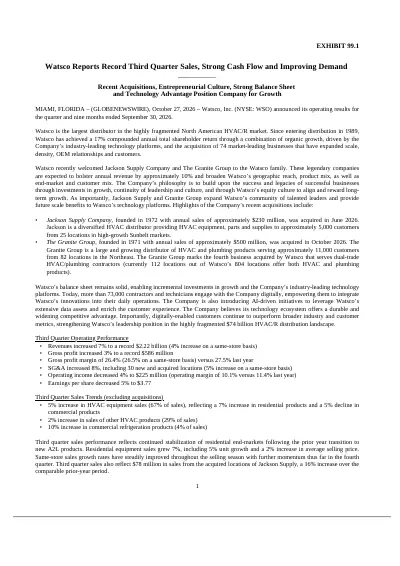
We expect the impact from the A2L transition will be largely over by the end of this year. Third quarter reflects Jackson Supply, which was acquired on June 1 of this year.
Jackson has $230 million in annual sales and operates from 25 Sunbelt locations. Jackson is performing well and grew 16% during the quarter.
We're also pleased to have completed the acquisition of the Granite Group. Granite has annual sales of approximately $500 million and serves over 11,000 customers from 82 locations in the Northeast.
Granite marks the fourth business acquired by Watsco that it serves both HVAC and plumbing contractors. Today, Watsco has 112 locations that offer both HVAC and plumbing products.
Our M&A pipeline has always included companies that have historically distributed both HVAC and plumbing products. We hope to have other similar businesses to join us.
As is our culture, Granite will continue to independently operate and grow their business with our full support. They have big ambitions, and we will support their leadership in any way we can.
Watsco is a more efficient company this year. We have made investments in technology, SupplySync, VCR, Hydros, and other initiatives that will benefit growth in the years ahead.
Excluding these investments, fixed costs have increased 1% so far in 2026. In terms of our balance sheet, we ended the quarter with $649 million cash and no debt.
Even after using a portion of our cash to fund the Granite transaction in October, we remain a positive net cash flow position and are committed to maintaining a pristine balance sheet enabling investments in growth opportunities as they arise. Turning to the third quarter results, sales increased 7% to a record $2.22 billion and 4% on a same-store basis.
Gross profit was a record $586 million. Gross margins were 26.4%.
SG&A increased 5%, excluding Jackson, primarily due to variable expenses. Operating income was $225 million with an operating margin of 10.1%, and earnings per share came in at $3.77.
Gross margins over the last 12 months has been in a narrow range and more in line with historical seasonality and current business conditions. Having said that, we remain focused on reaching our long-term goal of 30% and believe we have the right tools in place to get us there.
Year to date, operating cash flow has improved 79% to $304 million, reflecting our continued vigilance towards managing our assets. Finally, I'm going to hand this call over to A.J.
Nahmad, who is our President, to provide an update on Watsco's technology initiatives, and he will be joined by other leaders of Watsco. A.J.?
A.J. Nahmad
Thank you, and good morning to everyone. With the complexity of the last few years largely behind us, we believe our technology investments have made us a stronger company with higher growth prospects and a widening competitive moat.
Our goals are ambitious and straightforward. First, leverage our industry-leading repository of data: products, market, customer, competitor, pricing, you name it.
This underpins and empowers the industry's most advanced technology platforms. Second, revolutionize our customer experience so that contractors, installers, and technicians love doing business and only want to do business with the Watsco companies.
Next, transform our supply chain and distribution operations to better serve customers and gain operating efficiencies along the way. Finally, develop and launch technologies that help our customers grow their businesses.
Importantly, we see contractor behavior evolving in ways that benefit the technology-enabled distributor long-term. Our core technology platforms continue to scale and add value.
E-commerce sales have grown 12% year to date, well outpacing overall growth and broader industry metrics. E-commerce reached 37% of sales over the last 12 months, with certain markets at 60% to 70% penetration.
Digital engagement with our mobile apps is strong at more than 73,000 active monthly users. OnCall Air continues its growth trajectory.
Over the last year, approximately 351,000 proposals were presented to homeowners, generating $2 billion of gross merchandise value, a 14% increase over the comparable period. Simply put, the contractors we serve digitally are growing faster, have greater loyalty, and we believe we can lower our cost to serve at scale over time.
Just as exciting, the new initiatives announced late last year are making progress. SupplySync.com, our newest platform to serve the growing segment of large institutional customers, launched earlier this year to great fanfare.
We have launched the pilot program and are transacting with customers, with a plan to scale it to more and more customers in the coming months. This is a growing channel with unique customer needs that provide incremental growth opportunity for Watsco, while leveraging our existing scale and infrastructure.
VCR, which stands for vendor consolidation and rationalization, continues to expand across many of our non-equipment product categories. Relationships with our strategic vendor partners have strengthened and in many cases are at all-time highs.
Hydros, which is our investment in shared logistics and distribution, has further matured and will continue to scale in 2027 to more locations and more vendors. The transformational use of AI continues to evolve throughout Watsco.
I could spend the next few hours just on that subject. These investments, along with our scale, entrepreneurial culture, and capacity to invest, are unmatched in our industry.
We view these technology investments as critical to growing our leadership position in the HVAC industry, and attractive to the entrepreneurs of companies like Jackson and Granite, and many others before them, to aid our M&A strategy of acquiring great businesses in our space. We invite you to visit us and learn more about what we consider to be our long-term competitive advantage.
In closing, a reminder of our fundamentals: Watsco is the market leader and the technology leader in what remains a highly fragmented HVAC distribution market. The products we sell are a necessity, and the installed base continues to expand.
We have deep and collaborative relationships with industry-leading manufacturers and industry partners. We offer the broadest variety of products and operate a large and growing network to serve more and more customers.
Our unique ownership culture, shared by more than 8,200 employees, rewards and incentivizes long-term performance. With that, let's turn to Q&A.
Operator
We will now begin the question-and-answer session. Again, to ask a question, you may press star then one on your telephone keypad.
If you're using a speakerphone, please pick up the handset before pressing your keys. To withdraw a question, you may press star then two.
At this time, we will take our first question, which will come from Tommy Moll with Stephens. Please go ahead.
Tommy Moll
Good morning, and thanks for taking my question. Good
Albert Nahmad
morning, Tommy.
Tommy Moll
Morning, Al. Thank you for taking my questions.
Albert Nahmad
Of course.
Tommy Moll
I want to start on gross margin, which I suspect will dominate this call. I'm going to go out on a limb here and try to summarize what we're seeing, and then I would invite anyone to correct me where I'm wrong.
You threw out a lot of factors that drove the results this quarter: customer mix and market, equipment versus non-equipment, but is it an oversimplification to say that you've taken some share in the new home construction market, and that inherently, you're dealing with larger customers on lower-margin equipment product primarily? Is it kind of all one and the same factor here?
Albert Nahmad
I'm going to let Barry Logan and Rick Gomez deal with that because they're on top of the data better than I am.
Barry Logan
Thank you, Tommy, for the question. I would have worried if there was the second question, by the way.
Why
Albert Nahmad
it's the first question.
Barry Logan
There's a measure of still kind of comparison reality going on that just should be accounted for. It's not as simple, I want it to be as simple as what you said, but not quite.
It is becoming more simple. A year ago new construction related equipment sales were down double digits.
This year, they're up double digits. That's a mix reality to margin, as well.
It's also a comparison discussion to last year. It's also our participation in this year, through some of the inference in your question is gaining some share, but there's still a bit of a comparison discussion in that.
When we talk about larger customers, that doesn't necessarily mean new construction, not at all. In fact, even in new construction, the builders themselves hire contractors to do the work.
They're not necessarily all large contractors. In the case of where we comment about large customers, it's really that more seasoned, call it, multi-truck, multi-market customers that I think have done well, that are using our technology.
Our penetration of technology in that group is in excess of 50% e-commerce in to that channel. You can see our e-commerce revenues are up double digits this year.
That tells you something about traction and the affinity of technology in those customers. As you might suspect, the larger the customer, there is a more moderate margin, but there's also a more moderate cost with our manufacturers who support that activity.
It's not up to us to set the price. We jointly work with our manufacturers and our customers on total margin in that segment.
The cost to serve is not as great in that community as it is in let's say the small contractor community. That's a component of it.
Rick, anything else in there that's important to discuss?
Rick Gomez
I would just add a couple of things, Tommy. First, and good morning.
First is that this is part of the comparison reality that Barry described is this time last year there was a shortage of refrigerant in the market. That helped last year's margin.
This year, we have Jackson Supply in our Q2 Q3 revenue mix. They're not quite yet at Watsco's 27% range.
Therefore, that weighed a little bit. That will abate obviously, and that's part of the comparison that Barry's describing.
I think the other thing that's worth pointing out though is that, if we look at margin sequentially, Q2 to Q3, this is the type of sequential margin change that we've seen the last several years as a result of tariff pricing and product transition and other realities of the marketplace. You could go back and look at '25, '24, '23, '22, and you'll see I think similar types of changes from Q2 to Q3 margin.
Not wholly unexpected.
A.J. Nahmad
This is A.J. I'll add.
Albert Nahmad
I was just going to call you.
A.J. Nahmad
Yeah. Yeah.
If you zoom out to the big picture, which is, I guess, where I like to live most of the time is that there's a lot of noise. You have to look for the signal, especially since we're such a long-term focused company, right?
Watsco, in our arc of maturity, we used to operate at 24%, 25% gross margins. That ran up to 29% gross margins with all the noise and Barry and Rick just described some of that.
We're at 27% plus now year to date, and our goal is 30%. We see a path there.
It will not be a straight line. There will be choppiness, certainly quarter to quarter.
Our job, what our focus is, is the long-term, the arc of maturity, and getting from where we were, 24%, 25%, to where we are, 27%-ish, to 30%-ish is where we're heading.
Tommy Moll
Thank you, all. As a follow-up, I wanted to ask about SG&A.
If we just look at the same-store, it ran a little hot versus the sales growth this quarter, maybe about a point more growth in SG&A than sales, although, Al, you pointed out a lot of the increased expense was around some of these big initiatives that you highlighted as early as your Investor Day last year.
Barry Logan
Yeah.
Tommy Moll
Just help us parse the trends here. How do we measure success on operating leverage and with these investments?
When is it reasonable to expect to see it on an all-in or a same-store basis? Thank you.
Albert Nahmad
A.J., Barry, you can jump in.
Barry Logan
I'll take a shot at that. It's a good It's a good I like the phrase, Tommy, where you said, "How do you measure success?"
As a distributor, the the most simple way to measure success is our fixed costs remaining efficient while the while growth is going on, because then every then an incremental margin, every dollar that you sell drops to the bottom line. We wanted to make a lot of progress this year on fixed costs, because we couldn't make a lot of progress in the prior years.
Year to date, if I isolate fixed costs, they're up 1% this year. If I year to date I'll I'll address the quarter in a second.
Year-to-date, variable costs are up 6%, which is some measure of of business units that are doing well, that are growing, that are growing earnings. They're paying commissions, they're accruing bonuses, and a little bit of freight and fuel and delivery costs inflation in that number, which is to be expected.
Overall, it's on a same-store basis, SG&A is up up 2%. Technology spending, by the way, year to date, is up about 13% or $6 million.
Those are some of the new initiatives that are in in in those numbers.
A.J. Nahmad
You used the word "investments." That's the right word for those dollars.
Barry Logan
That's correct. That's the big picture for the year to date is to become more efficient, fixed costs, make them as neutral as possible.
Battle inflation through other initiatives to save, and again, year to date, fixed expenses are up 1%. For the quarter, it's 3%.
Again, there is some inflation in that for rent and facilities and things like that, but in relative terms, it's, kind of in line with inflation. During the quarter, variable expenses were up around 10%.
Again, as we see some acceleration in certainly in some business units that are outgrowing what we report. There are accruals and variable comp and variable type expenses that go with that and some outsized inflation in delivery costs for the quarter, I consider that a short-term thing.
It's a good question about how you measure success. I would say this year's progress not optimized, but good progress.
Tommy Moll
Thank you. I'll turn it back.
Operator
Our next question will come from David Manthey with Baird. Please go ahead.
Good
Albert Nahmad
morning, David.
A.J. Nahmad
Hi.
David Manthey
Yeah. Good morning, Al.
Good morning, everyone. I'll go back to gross margin, of course, here.
If we're looking at normal seasonality into the fourth quarter, I guess the implication is probably something in the 27 range, which I think would put you somewhere in the low-27s for the full year. I believe that you've said in the past that excluding the abnormal second quarter in 2025, you would have been somewhere in the 27.5 range.
So 27.5 to 27, low-27s. I'm not asking for any guidance here, but I'm just trying to think through As you think about from where we are in '26 looking ahead to '27, what are the key levers we should be thinking about moving here in terms of whether that's customer mix or equipment, non-equipment, pricing, price optimization that you're doing internally?
What are the factors we should be thinking about to move the needle one way or the other?
Albert Nahmad
Anyone want to pick it up from there?
A.J. Nahmad
Yes. That's a pretty good list, Dave.
It is a lot of those things. We are certainly still early days in our pricing optimization efforts.
I think there's a huge runway there. There is certainly the influence and the impact of the mix of equipment versus non-equipment, of what equipment is sold, when it is sold, of the customers that are showing up and buying every day.
It's all those things, and we can't predict or control all of those things. Back to where we're investing, we feel very good about what's in flight, right?
We feel good about the technology. We know that the more that customers use more of our technology, the better customers they are.
Not only in gross margin, but also in sales, in stickiness or lack of attrition. We love the VCR initiative where we're finding ways to buy smarter and help our vendor partners at the same time, it's a win-win for them.
We love Hydros, which is helping our business units carry more products on the parts and supply side and expand their offering. We love SupplySync.
SupplySync has got so much opportunity underneath it, and we keep learning about, or thinking about new ideas with new partners. What that should ultimately mean is a lot more sales, and a lot more sales of parts and supplies as it matures.
Your list is good. We like what's in flight.
When does it all show up in every quarter's financials? I can't tell you.
Barry Logan
Yeah. Just to be helpful, Dave, I think just doing the math, just being objective and just using data and simple math, you're right.
The fourth quarter generally has a better margin than the seasonality that preceded it. If I look at the math over a 10-year average, it's about 20, 30 basis points of improvement.
That's just something to consider. Again, as you said, I'm not giving guidance, but that's the math over at least a 10-year period.
I think it's important to remind everyone, for the sake of looking forward, that the OEM pricing actions that are taken, either the amount of those actions or the timing of those actions, certainly plays a role in the equation over, let's say, the next 12 months. The expectation is that they will come early and more conventional and kind of more ordinary, if you will, than what we've seen the last four or five years, which is different amounts, different by vendor, different timing with and without tariffs, with and without mega inflation.
That volatility is part of what we've had to explain the last four or five years. I can't predict the future, but expectation is that going into the next 12 months, that will be a more ordinary and conventional feeling than some of the volatility we've seen.
Mhm. Barry,
Albert Nahmad
anything Okay. Oh, it's Rick.
Sorry.
David Manthey
Sorry.
Rick Gomez
I was just going to add one item to that, which is I think somewhat underappreciated in all of this right now is the fact that we are seeing a rebound and a stabilization of industry volumes. That's important to any distributor, at the end of the day, if you're going to have incrementals, and this goes back to Tommy question a little bit, if you're going to have incrementals that are good and healthy.
If I step back in time, if we go to this call a year ago, same-store sales were down, now they're up. Add-on replacement was down, now it's up.
RNC was down more than 10%, now it's up more than 10%. Equipment sales were down seven last Q3, now they're up five.
Oh, by the way, we're a 10% bigger company, having made two great acquisitions in the last 120 days. I do think that My point in saying that is that there has to be some base level of industry health and stability in volumes, and we're starting to see that now, that hasn't been the case over the last three or four quarters.
David Manthey
Okay.
Albert Nahmad
Said, Rick.
David Manthey
Okay. That's helpful.
Thank you. Then, all of the things we just went through, those all sound like positive needle-movers, with the one exception being the large customer mix that you cited this quarter.
Is that a cyclical or a secular thing in terms of larger customers? Certainly with all of the things we talked about, it's not enough, customer mix paying to toward larger customers, that would not be enough to overwhelm all of the other goodness that you're working on.
Is that correct?
Barry Logan
All right. I wouldn't say this just wait.
This is Go ahead. Oh, go ahead.
A.J. Nahmad
No,
Barry Logan
just take a shot at it. I I think, the word "affordability" is in the lexicon now a great deal of of, the fact that products are, $10,000, $15,000 or whatever to install.
I've always said for my career, we've said for our careers, people can't live without these things. You have immense product change, you have a higher price tag, you have a trickier economy, you have a a more, tricky consumer, therefore, and yet, e-commerce sales grew 10%, 12% this year, and I would say higher-efficiency systems grew 10%, 15% this year year to date.
Does that make sense? I think, again, the larger customer, the one that is using technology, that's affable and going to the home and selling, that wants to move on from from the 410A product, that wants to get their business, marketing and financing and so on, directed toward the opportunity and then and helping us helping empower them to do that is where we see the the benefit from it, Dave.
Again, the cost to serve in those customers is lower than let's say, 50 smaller customers that may do as much volume as as five that are considered large customers. I I think it's really part of the transition, part of the maturation into the A2L products, is those customers have done a good job of it.
Then our job is how do we help all customers plug along and move along the transition and and maturity, as well? That would be some observations, I think.
A.J. Nahmad
Yeah.
Barry Logan
Without without data, but some some good observations, I think.
A.J. Nahmad
I'll double down on that, Barry, which is, just to be clear, large customers is not a bad thing, right? We have tools and technology and systems and processes and programs, and we welcome that customer base.
Our mission and our goal is to make sure that we're the supply house of choice for all those customers, and that we can do so at a profitable level, and sell them the full suite of products that we have in with all the services that we provide. We don't exclusively cater to that segment of customers either.
The small guys with one truck or three trucks, we've got wonderful pricing and programs and technology and systems and processes for those guys, as well, including helping them go from small to big, because when they do, when they drag us along in their growth, and they're very loyal. Like Barry said, our job is to cater to all the customers.
These investments that we keep talking about certainly focus not just on one group, but all groups.
Paul Johnston
If you look at the market that we've got out there right now, the market is up, but it hasn't recovered yet back to what it was. I think at that point, you're going to see the smaller customer become a better customer than what he was this year.
This year, the small customer probably suffered more than the large customers. They don't advertise.
They don't promote. They have an issue where everything has to go by word-of-mouth.
I think as the market recovers, I think you're going to see the smaller customer recover with them.
David Manthey
That's great detail. Thanks a lot, guys.
Operator
Our next question will come from Ryan Merkel with William Blair. Please go ahead.
Albert Nahmad
Morning, Ryan.
Ryan Merkel
Hey everyone. Hey, morning.
Thanks for the question. Can you comment on October trends quarter to date?
I think you mentioned further momentum. Then I'm curious on the complexion.
Are you seeing the new construction recover further? Comment on commercial, if that's getting better, and then aftermarket replace, if you've seen a pickup there.
Albert Nahmad
That's good news. A.J., you want to share that?
A.J. Nahmad
Yeah. No, I don't have the data in front of me though, if Rick or Barry, you want to be more explicit.
Albert Nahmad
We're talking
Ryan Merkel
about October. You're talking about October sales, yeah.
A.J. Nahmad
Yeah. October is looking healthy to date and continuing the momentum that we've been alluding to.
We hope and expect it to carry through the end of the year, but hard to say. Now on the RNC details, I don't know, Barry or Rick, if you have that or if you want to share it.
Albert Nahmad
In revenues, we're up double digits so far in this quarter in revenue.
Ryan Merkel
Got it. Is that total company revenues, or is that organic?
Albert Nahmad
Yes.
Ryan Merkel
Total
Albert Nahmad
company, yeah. It includes the acquisitions that we've made.
Ryan Merkel
Got it. Yeah.
Okay. Would you say it's broad-based recovery?
Barry Logan
Just to say it this way, Ryan. I think just to say it this way, it's careful.
We said in the press release that since May, we've seen improvement every month, month-over-month, in terms of progression and momentum. October is no different.
October is better than September. If you add acquisitions on top of that, that's where you get into the 10% plus on acquired revenue on top of what we're seeing organically.
Ryan Merkel
Got it. That's helpful.
Then, I wanted to ask on the side discharge, which is becoming a big topic. I'm curious for you.
Are you seeing progress on that product? How big is it?
If can you comment on the ASPs versus the traditional condensers?
Paul Johnston
The side discharge has been a good growth market for us over the last two years. What we're seeing is it's probably in the 8% to 10% range of the total market today.
It's going to continue to grow. It's got a lot of benefits that you don't have with the top discharge.
It's variable speed, it's got a lot of efficiency. The cost of the product is relative to the top discharge.
We feel like we're outperforming. We want to continue to outperform in the side discharge.
Side discharge is we think is going to be the future of our market, it's important to us.
A.J. Nahmad
We are leaning into side discharge. We are excited about innovation in the product.
Barry Logan
Obviously, the manufacturing community that supports us, it's as diverse as our typical ducted units. They're branded products.
There are more affordable products. There are private label products.
In our case, as Watsco, our job is to have the broadest diversity and spectrum of good, better, best across all the products we sell and side discharge would be the same. It's really, to me, not a discounted, cheaper product strategy.
A.J. Nahmad
No.
Barry Logan
It's not. It's a ultra-high efficiency play with a new product that has a lot of diversity in brands and price across the spectrum.
All of our partners that are supporting that, we're growing with. It's kind of fun to sell a new product.
As Paul said, it's not necessarily new, but I would say contractor acceptance is where we're seeing traction. As their supplier, we're supporting it.
A.J. Nahmad
Right. I think you said it all, Barry, but just, I would say that that segment of the market is maturing where now it is evolved into a good, better, best offering, whereas it's not just the best anymore and it's not just the value line anymore.
There is room and the market size for that stratification.
Barry Logan
It's a proven product. Basically, what you've done is you've taken the ductless product and you've put ducts on it, as opposed to just having a high wall or a cassette on the inside.
It's a proven product and it's going to be a great product for us in the future.
Ryan Merkel
All right. Great color.
Thanks. I'll pass it on.
Operator
Our next question will come from Steve Volkmann with Jefferies. Please go ahead.
Albert Nahmad
Morning, Steve.
Steve Volkmann
Hey, morning, guys. It's funny timing.
I have two side-discharge units, and they're awesome.
Albert Nahmad
So, [laughter]
Barry Logan
Good job, Steve.
A.J. Nahmad
See if we can sell you a third by the end of this call. [laughter]
Steve Volkmann
Yeah, I'll take it.
A.J. Nahmad
Special price. [laughter] Right.
Steve Volkmann
Can we talk a little bit about pricing? I think pricing was up about 2%, I think you said in the quarter.
Sorry, I have a lot of calls going on today. I'm just curious if you've heard any sort of directionally what we should be thinking going forward, how the OEs are thinking about price for '27.
Paul Johnston
We're seeing a lot of metal prices are going up. A lot of steel prices are going up right now, and so we're seeing price increases on those.
We really don't have a lot of indication yet from the OEMs what direction they're going to be going, but obviously with the cost of freight, with the cost of metal, which is what these products are made of, we expect to have some price increases this fall going into next year.
Steve Volkmann
Okay. All right.
Fair enough. Then, maybe just switching, I'm curious how you're thinking about inventory.
I think last quarter you said you thought it had sort of peaked, but I see it's up a little bit. I assume that includes the acquisitions.
Just how are inventory levels, how should we be thinking about that going into '27, as well?
Rick Gomez
Barry, we were just talking about it, why don't you go ahead.
Barry Logan
Yeah. First you're right.
Our balance sheet in September this year includes Jackson, $67 million in inventory that was not in the prior-year comparison. Last year at this time, we were as Ross Perot once said, a giant sucking sound was going on in terms of unit declines, and this year, we're seeing unit increases.
A year later, I think inventory is up
Rick Gomez
Unit declines in sales, yeah.
Barry Logan
I'm sorry, in sales. Yes.
As we closed this quarter, inventory is reflective of an increasing demand environment. As we close the year, this is usually and historically our season of reaping cash flow and reducing inventory.
There's an opportunity, I'm not saying it'll happen, but an opportunity to get inventory more or less equal to last year at the year-end, excluding the two acquisitions we've made. Historically, I think, sequentially, we have very little reduction in inventory sequentially second to third quarter.
Much of it comes in the fourth quarter. I would say, that's how it looks this year.
Steve Volkmann
Thank you very much.
Operator
Our next question will come from Mitch Moore with KeyBanc. Please go ahead.
Albert Nahmad
Morning. Hey
Mitch Moore
everyone, good morning. Thanks for taking my questions.
Maybe just to build on some of the questions around customer mix. I guess my question is how much, if any of the customer mix headwinds reflects existing contractors kind of consolidating into larger accounts or is it just because larger customers are outgrowing their smaller peers?
Paul Johnston
I think the answer is yes. We're seeing a lot of consolidation.
It's just natural. There's a consolidation going on in the industry.
Rick Gomez
It's
Paul Johnston
probably 7% to 8% of the market right now.
Rick Gomez
That's
Paul Johnston
going to continue. It's not the big guys who are already there.
It's the growth of the medium-sized guys as they start rolling in with private equity.
Rick Gomez
Could I just maybe attempt to I think reframe the narrative around this a little bit, as others have tried. Does it have an implication in margin?
Yes. Is it a headwind to the business?
No, not necessarily. When this happens, Mitch, when you have Customer A buying Customer C, usually there's a market share pickup opportunity also, right?
It's not just axiomatic risk. It's both risk and opportunity when this happens.
I also think we should ground ourselves in the fact that this is a $75 billion industry, 2,000 distributors comprise the landscape. We are, by far, the best positioned to capitalize on this trend relative to that fragmented distribution network that exists.
Is it an irritation in margin? Yes.
Can we count it in basis points? Yes.
Not even nowhere near full percentage points, basis points. By the way, we're doing this as SupplySync is launching, right?
We're not even yet to market with the product and the platform that we think is going to be game-changing in this space. We're not in any way thinking about this defensively or, oh, gee, what's it going to do to margin next quarter?
We're thinking about this more as an opportunity for growing with customers, growing volumes, and growing share at the end of the day.
A.J. Nahmad
The industry is dynamic, and we're dynamic. Mr.
Operator, our Chairman fell off the call. Could you please get him back on the line?
Operator
Absolutely. One moment.
Barry Logan
I just want to add a data point to the question because I don't want it to be abstract. We've said this in our Investor Day when we were developing the technology for SupplySync, the consolidator community today is about a $400 million, $500 million business for us.
If there's out-growth, let's say 10% in that community, either because they're giving us more business or there's more of them, that's a growth opportunity, obviously, that comes at a lower margin. I don't think that's particularly material to the big-picture analysis of Watsco's gross margin.
It's a headwind, okay, but it's also a growth opportunity, to Rick's point. Overall, I think where we kind of segment out margin impacts in our press release and in this conversation today, we're talking 10, 20 basis points in each one of the discussion items.
This is not like a revolution or an evolution that I think has a lot of volatility to it. It's really explaining some of the nuance that we're managing.
As I said very carefully, cost to serve is different, meaning SG&A is different in those customer segments, also, which means EBIT margin is not necessarily proportionately affected by it. I just think we're giving a lot of color today on these nuances, but I don't think anyone should run with it too far when it's 10, 15, 20 basis point discussion items.
Mitch Moore
Great. That was a lot of color.
Thank you for that. I guess just my next question, I think residential units were up 5%.
Could you just help us parse out how much of that growth was replacement versus new construction?
Barry Logan
No, we don't disclose that.
Rick Gomez
We've seen the AOR trends get better as the year has progressed, Mitch, and it was around flat in the second quarter. It was up low-single digits in the third quarter, what we consider to be the add-on replacement universe.
Where your volatility, good or bad, can come is in that residential new construction, multifamily side of the market. That was up low-double digits for us in the third quarter.
That's how you get to a 5% step.
Mitch Moore
Great. Thank you.
Operator
Our next question will come from Jeffrey Sprague with Vertical Research Partners. Please go ahead.
Good
Albert Nahmad
morning, Jeffrey.
Jeffrey Sprague
Hey, good morning, Al. Good morning, everyone.
We covered a lot of ground. I did want to just touch on replacement a little bit more.
Thanks for the comment a moment ago. Obviously, with replacement, comps are a little bit easier.
When you just kind of stand back here and look at things at an absolute level, have we gotten to what you would call some semblance of just normality between repair and replacement?
Albert Nahmad
Good question. [laughter]
Paul Johnston
I think there's still a lot of room to grow in replacement. You had a pull-forward that occurred during the pandemic, and I think as those units mature, I think you're going to see the replacement market return to what we call normal.
Regionally, it's unique. You have a different replacement market in the north than you do in the south and in the west.
We've seen the replacement market change, based upon, where in the marketplace the change is occurring.
Rick Gomez
I agree with that, Paul. Two quick data points there, Jeff, to maybe help you.
One is, if I look at just units, I would characterize it as we're closer to a trend line, but we're not quite at the trend line. Units are still, call it, 10% to 15% below where they were 2 years ago.
AHRI, which you should never anchor on in any given month, but you can look at longer-picture trends with AHRI, those volumes today are where they were around mid-2018. That was a while ago.
I think more importantly, we're still dealing with a consumer that's uncertain and unsure about the state of things. All of that points to we're closer to trend line, but not fully, to Paul's point, at some level of normality yet with replacement.
Jeffrey Sprague
Thank you. Then just want to make sure I'm dialed correctly on this inventory for year-end.
I think Barry gave us the Jackson inventory. How much comes in for Granite?
Barry Logan
It came in in October. Yeah.
All right. Rick, maybe handle that.
There was about,
Rick Gomez
Jeff, I'll say about $140 million, $150 million of inventory.
Jeffrey Sprague
There's
Rick Gomez
going to be some seasonality to that for Granite, but that's what it was let's say to end September, which was not on our balance sheet. Right.
Jeffrey Sprague
Okay. Then maybe just one other quick one.
Just plumbing's becoming a little bit more of a strategic focus, imperative. Does that fundamentally have a different margin profile than your kind of core legacy HVAC business?
Barry Logan
Yeah. Go ahead, Rick.
Rick Gomez
I was going to say not necessarily. I think, what's true in the plumbing space is, if you sell a lot of equipment there, you're going to have one margin profile.
If you sell a lot of non-equipment, you're going to have a different margin profile. The same is true there in HVAC, by the way.
We see that within our portfolio of businesses, too. I wouldn't call it structurally different or radically different.
What is, I think, different is that their customer curve, if you will, is probably at a different state of maturity than the HVAC contractor, which is to say there's likely less consolidation going on there. Those customers are slightly less technology-enabled today than as compared to the HVAC contractor.
We think that there's the same kind of maturity and sophistication curve that we've seen with our HVAC contractor base over the last 5 or 10 years and how they've adopted technology in their business, we think that it's in the very early innings as it relates to the plumbing contractor.
A.J. Nahmad
Which is all opportunity in the long term.
Rick Gomez
Right.
Barry Logan
I wanted to say this to Jeff, I think, we get a lot of questions about entering plumbing. What we've actually entered is acquiring businesses that have done both HVAC and plumbing well for decades.
Granite's been around for over 50 years doing both HVAC and plumbing well for that period of time. Gateway a few years ago, same thing.
In fact, if you look at the top 50 plumbing distributors in the country, 20 of them 20 of the 50 also sell HVAC and are on the top 50 list of HVAC companies in the industry. It's not a new thing or a novel thing.
It's a ordinary thing. We've known these families for a long time.
It's taken us this long to do four of them. That's the approach.
To answer your question again, we don't see a big profile difference in terms of margins because again, they do both well. The better companies have the higher margin and have figured out how to coexist in those markets with those products.
A.J. Nahmad
I also just want to say, I've got to say publicly, Bill and Chris and Amir and the whole Granite team are just world class and as good as it gets. We can't be more excited to have them finally part of this family.
Like Barry said, we've known this family for a long time, but it took us this long, as we talk about it with them, to get to the starting line. Now they're part of the family and it's all upside from here and let the fun begin.
Paul Johnston
Great. Thanks for that.
Albert Nahmad
I would add to that on a big picture that Watsco is now taking
Paul Johnston
Who's that, Al?
Albert Nahmad
Can you hear me?
A.J. Nahmad
Yeah.
Paul Johnston
Yes.
Albert Nahmad
I'd say that a big picture for Watsco that we should explain is that we're now committed to growing in the plumbing market, which means that we have enormous opportunities in that distribution business of plumbing, as well as the HVAC market. We've got two industries that we can play and play hard and get size.
The plumbing one, we're just beginning and it's pretty healthy stuff. We have two other business units before this one that showed us plumbing can add profitability to the business, as they already have over the last several years.
That's a huge ability now for us to take share in the plumbing market, where we just have a few hundred million dollars worth of sales in a much larger market. Big opportunity is what I'm trying to say, and
Operator
All right. Our next question will come from Pratap Singh with UBS.
Please go ahead.
Albert Nahmad
Morning.
Pratap Singh
Thank you, and good morning, everyone. Yeah.
We continue to hear about customers trading down more towards lower-efficiency levels, but it feels like the scope for further mix down could be limited. Can you give your views on what you are seeing and some sense of portfolio impact for you?
Paul Johnston
When you say low-efficiency today, it means that the efficiency is high-efficiency, compared to what it was, 5 or 10 years ago. As they trade down to the baseline efficiency that we have in the marketplace, that is occurring.
That's why we get very excited about the opportunity to be able to sell the side discharge. I think the side discharge will be a breakthrough where customers will start going back to high-efficiency once they see the opportunity.
Rick Gomez
Right, and one perspective, this is as entry level as the industry has been in quite a long time, Paul. You've got some great data around that, but if it's 80% to 85% entry level today, I think the thrust of your question is right, which is there's more likely a mix up opportunity over time, particularly now that you have a side-discharge product that competes very well from a price perspective and gets you all the efficiency on the high end.
It does allow a contractor to deliver more value to that homeowner versus just entry level and traditional top-discharge high-efficiency. There's now something that can help broaden the industry beyond where it is today.
Paul Johnston
Every time there's been an efficiency change, we've seen a compression to the low end, and then it spreads back up. It's not something new that we haven't experienced before.
Pratap Singh
That's very helpful. Thank you.
Just on the margin side, you are integrating a couple of big recent acquisitions. Now, should we expect that to be a headwind to margin in the near term, but with a potential for improvement in the medium term as you scale margins within those businesses?
Can you also help size those impact?
Barry Logan
Again, I just be careful with this. When we acquire a company like Granite or Jackson, we're keeping the people, we're keeping the culture, we're keeping the infrastructure, we're keeping what's made them successful for 50 years.
The question is, how do we help them build on that success and build on their networks and is adding capital or products or technology, whatever it might be. The word "synergy" does not exist in our mindset.
How do we take costs out? How do we tweak margins?
That's not a concept for Watsco. We build a very successful company supporting great companies that became part of our family and that the intent is identical to that theory for Jackson and Granite.
In terms of your question, I don't think there's any risk or short-term kind of trigger or anything that needs to be kind of worried about. The question is, will they be successful as part of the Watsco family?
The only scorecard I can show you is Jackson's up 16% in its first quarter as part of Watsco. I want to impute that, into the future, of course.
Albert Nahmad
Right.
Barry Logan
Just know that there's no sudden move or sudden synergy or sudden anything relative to these kind of opportunities. It's really, how do we build on the great success of these good companies that have been around forever?
Albert Nahmad
That's very well said, Barry.
Paul Johnston
How do we provide them the technology, the financial resources so they can grow faster? That's the opportunity, and that's the only synergy we have.
Albert Nahmad
Another important aspect is that we create an equity culture. We provide equity throughout the organizations that we acquire, which means that they have a stake in the whole company.
Win or lose. I think that's very important in terms of our culture, providing equity to people that sell us their business, their leaders, so that they act as owners and be very conscious of that.
Pratap Singh
Great. Thank you so much.
Yeah.
Operator
This concludes our question-and-answer session.
Albert Nahmad
Hey A.J., did you have something?
A.J. Nahmad
No, I'm all set. Thank you.
Albert Nahmad
Okay. Thanks very much for your interest in Watsco, and we'll talk again in three months or sooner.
Bye-bye.